Other than this exhausting research task, of course I’ll be posting about Chiru films throughout August, and sharing a song a day over on the Facebook page.
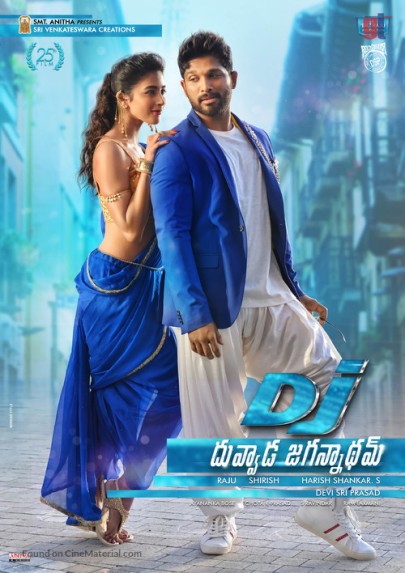
In his latest release Harish Shankar sticks closely to the standard formula for Telugu hero-centric films, which makes Duvvada Jagannadham rather less exciting than it could have been. There is hardly any suspense and few surprises as the hero flexes his muscles, obliterates the bad guys and romances the heroine while recouping lost money for the victims of a property scam. What makes it watchable are the excellent performances from Allu Arjun, Rao Ramesh and Subbaraju who add life and energy to an otherwise pedestrian plot. The story might be plodding along, but the cast give it their all, and with many other veteran performers including Murali Sharma and Posani Krishna Murali, and some good songs, DJ ends up as a reasonable timepass.
The story opens with a young Duvvada Jagannadham Sastry picking up a gun and executing a gang of thugs who attack policeman Purushottham (Murali Sharma) in his local market. Not content with his body count so far, he then turns the gun on a suspected rapist in the police station and shoots him too. Bizarrely the police officer in question rapidly recovers from his previously incapacitating wound and then doesn’t bat an eyelid at the young multiple murderer, instead enlisting him as a vigilante in his never-ending war against crime. Because of course there is nothing abnormal about a young boy killing in cold blood (and also being a fantastic shot) – not in this film at any rate.
Moving quickly among to the present day and Duvvada Jagannadham (Allu Arjun), aka Sastry is a Brahmin priest who runs an all-vegetarian catering business in Vijayawada along with various members of his family. Sastry is devout, speaks in very precise Telugu and is passionate about his cooking, although he doesn’t take life too seriously as demonstrated by a recurring joke about using asafoetida in tamarind rice. Bunny is good here, particularly with the comedy scenes and dialogue, while the trio of Sastry, his father (Tanikella Bharani) and uncle (Chandramohan) make a good team as they feed the hungry hordes of wedding guests around Vijayawada.
However, when Sastry answers his phone he becomes a totally different person – his posture is different, his voice deeper and the language less classical. Going by the name of DJ, Sastry’s alter ego is still a vigilante killer working for Purushottham eliminating criminals permanently from the streets of Hyderabad. DJ is super stylish and ultra cool, which ensures that Bunny remains ‘the stylish star’ despite spending much of the film in more traditional attire. Naturally DJ is also an accomplished killer, although quite where he learnt his skills is as much of a mystery as his motivation to cleanse Hyderabad of all criminals. The action scenes here are all beautifully choreographed by Ram Lakshman and Bunny carries out the various impalings, defenestrations and executions as smoothly and effortlessly as he performs his dance routines, and with just as much style. Sadly, there isn’t much else to the character of DJ beyond the dapper surface and efficient bloodshed. There is no rationale behind why his character is driven to such violence, particularly since he has been raised as a priest and generally seems to be a kind-hearted and benevolent priest at that. There is a brief comment by his father at the start, questioning why his son has so much rage, but this is not explored at all, and of course Sastry never shows any sign of the explosive ferocity that is characteristic of DJ.
Naturally there is also a heroine, and as might be expected from the formulaic plot, Pooja Hegde’s presence is completely superfluous to the story with her only purpose seemingly to be to appear in as many skimpy costumes as possible and dance in a few songs. The brazen character of Pooja seems unlikely to appeal to the traditionally minded Sastry, and although her designer credentials might interest DJ, her nasty, childish behaviour when they first meet is unlikely to impress. The camera spends more time focused on Pooja’s navel than on her face and it’s a shame that the only real emotion she gets a chance to display is when she’s shopping in Abu Dhabi – her excitement here is the only genuine moment her character has throughout the entire film. Still, she does look stunning, and has good chemistry with Bunny in the songs, but it’s a shame that she has no opportunity to do anything more.
DJ becomes personally involved in the case of a property scam where the real criminal Royyala Naidu (Rao Ramesh) hides behind a proxy (played by Prabhakar). Royyala’s son Chintu (Subbaraju) also becomes involved when Royyala conspires with Pooja’s father Minister Kusuman (Posani Krishna Murali) to marry their respective children. Subbaraju is excellent as a crook with an unusual idiosyncrasy, particularly in the final showdown with DJ and Royyala.
Throughout the film Bunny excels with his comedic dialogue as Sastry and does a good job of keeping the two sides of his character quite separate and different. As always his dancing is superb on every level and I did appreciate his collection of sparkly sneakers in various colours too. Devi Sri Prasad’s songs are good, although the song sequences aren’t connected to the plot of the film and seem to be simply added in as part of the standard formula – “fight scene/ family scene/ romantic moment/ song”, and repeat. However, the dance sequences add in energy and give Pooja and Sastry/DJ a chance to develop their romance that otherwise appears rather lacklustre.
Duvvada Jagannadham is disappointing, but the action sequences are impressive, the songs are excellent and Bunny is always watchable. There are some good dialogues that were well appreciated by the audience here in Melbourne, and the comedy with Bunny, Vennela Kishore as his cousin Vighneswara Sastry and the rest of the family is generally pretty funny. The major issue here is the formulaic plot and uninspiring screenplay that feels dull despite the good performances from the cast. However it’s not all bad and there are some scenes that work very well, it’s just that it doesn’t all gel together as it should. Worth watching for Bunny, the songs and the action, just don’t expect too much from the plot.
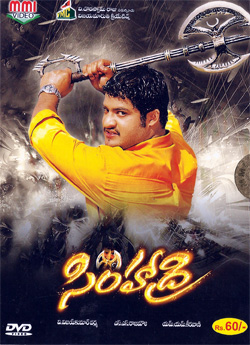
A story told in two parts, Simhadri is uneven. The things I love, I love. And the things I don’t, I really don’t. Rajamouli is always worth watching however, and it is kind of fun to look back at his earlier efforts even when the execution is a little laboured. Tarak is likeable enough, although his acting has improved greatly since 2003.
Simhadri (Tarak) is an orphan living in the household of Ram Bhupal Varma (Nasser) and his wife (Sangeetha). Simhadri is intensely loyal and has anger management issues, and his violence in service of the family is seen as endearing and almost a joke. Anyway, as they keep saying, it’s OK to kill or be killed if it is for the good of people. Tarak and Nasser have some nice badinage and their relationship does seem rock solid and a reasonable motivation for much of what follows. Simhadri is irresistible to women, especially Kasthuri (Ankitha), the daughter of the house. But he spends a lot of time and money with childlike Indu (Bhumika Chawla), and that becomes an issue when Kasthuri finds out. Apparently Simhadri’s style of beating people is medically identifiable and frequently lethal…Or at least that is what a visiting doctor from Kerala says happens when Singamalai beats someone up. But is Singamalai the same person as Simhadri? Why do truckloads of people with many and varied motivations turn up looking for him? Is he leading a double life?
Tarak gets one of the best hero entrance scenes ever, and a quite impractical yet very impressive weapon of choice. The action scenes are crunching and generally humourless, with varying degrees of gore. And he really is delightful in the songs where he is the bumblebee of dance – it seems he shouldn’t be able to move like that but look at him go!
M.M Keeravani’s soundtrack has a dreary orphan song, some cheesy duets, and offers Tarak a range of opportunities to bust a move. It even includes that romantic Indian classic – Cotton Eye Joe!
But Simhadri has to participate in comedy disease shenanigans, and wear some very unpleasant headbands not suited to the hamster-cheeked gent. The obligatory scenes paying homage to the senior NTR are a little overdone, as well as suffering from early 2000s technical limitations. Seeing the younger actors try to leverage their family name while appeasing the inherited fan base and also create their own image is quite interesting to me.
The relationship between Simhadri and Indu is troubling given her childlike mentality. The portrayal is a little flirtatious or at least uses filmi romance visuals which is creepy. Even Simhadri’s family immediately assume she is a prostitute, despite her little girl braids and outfits. And I was appalled by her horrible neighbours. Orphanism isn’t contagious! But despite all this rich material, that renowned wet dishrag of an actress Bhumika uses at most two three facial expressions. The relationship between Simhadri and Kasturi is equally perplexing, although for different reasons. Apparently the way to spark romance is to either scare a man or be scared in front of him. So dropping an ant down your bra and all the following shrieking and jiggling makes perfect sense then. I was kind of glad Ankitha is terrible in this as it would have been sad seeing a good actress enduring the stupidity of the script.
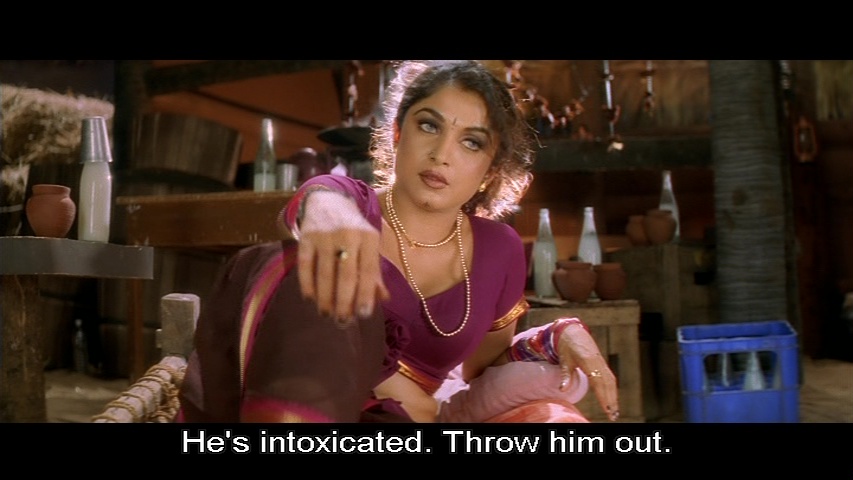
Despite his dubious interpretation of the female psyche, Rajamouli did win a few “you go girl!” points for casting Ramya Krishnan as an item girl.
I found it highly amusing that the song is pretty much along the theme of “do you want fries with that”. But seriously, I am so impressed she has managed such a long and varied career and has made some super films along the way.
The support cast is rich with talent and recognisable faces. Nasser is all reasonable and understanding until someone disagrees with him, then it is “my way or the highway”. He is a great foil for Tarak. Mukesh Rishi is vile and compelling as Bhai Sahib, the big bad gangster. Rahul Dev is slimy Nair, who sparks about an hour of graphic violence including rape and torturing children. Sharat Saxena is the ultimate useless policeman who abdicates all responsibility to the vigilantism of Simhadri. Bhanu Chander has a small but pivotal role that relies on him never making a sensible decision. All of these actors are good, but all their characters need at least one tight slap or maybe a whack with the fancy significant weapon. You know I am close to despair when I can say truthfully that Brahmi and his character is one of the highlights. I also liked Rallapalli and Ragini as Indu’s carers, and Hema as the cheeky maid and confidante to Kasturi.
While the pace is a bit draggy, Rajamouli shines in the action sequences where he uses creative visuals to heighten the drama. Simhadri leaps over the threshold and is then seen landing on the road on a motorcycle. When Simhadri takes on Nair’s gang the fight is intercut with a religious festival, reinforcing that he is doing godly work and getting the adrenaline flowing. The final fight scene has Tarak moving at normal speed but the rowdies in slomo, which was an effective treatment compared with just speeding it all up.
There are some issues with the story, but this is not one to overthink the plot. I mean I can think of several other and better ways to solve the old “bomb in the suitcase” problem…but who wants the sensible masala version?
See this for all the mass tricks, a hero on his way to becoming a genuine star, and a director who backs himself to be playful with the big ticket elements. 3 ½ stars!







 Cinema Chaat