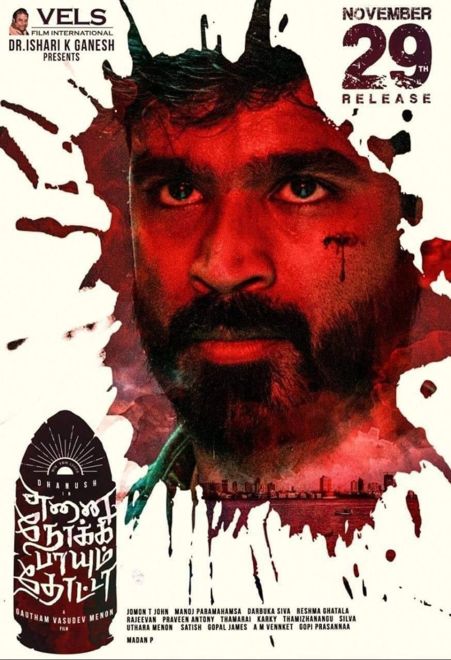
Enai Noki Paayum Thota (2019)

Gautham Menon’s latest film Enai Noki Paayum Thota has a number of similarities with his 2016 release, Achcham Yenbadhu Madamaiyada (Sahasam Swasaga Sagipo), but the formula doesn’t work as well this time around.  Dhanush manages to hold the erratic story together, but there is too much that has been seen before for this film to really make an impact. However, the songs are good, the action sequences work well and Dhanush is charming in the romance sequences, making Enai Noki Paayum Thota worth at least a one-time watch.

Raghu (Dhanush) appears to be a fairly typical student from a rather well-to-do family until the day he meets and falls in love with aspiring actress Lekha (Megha Akash). He is immediately smitten (we know because there is a voice-over that tells us so), but the relationship is initially slow to develop, partly because Raghu is rather awed by Lekha, but also because he isn’t totally sure of his own feelings and appears to prefer a more restrained approach. However, once Raghu makes his move, the romance progresses swiftly and Lekha seems equally head over heels in love with Raghu. That does strike a discordant note since there doesn’t seem to be any reason for Lekha to pick Raghu out of all the scrawny students watching the film shoot in their college, particularly since Raghu doesn’t go out of his way to make her notice him. There is no effort to explain her actions either, but then Lekha generally has very little will of her own in this film and ultimately, she isn’t important except as a reason for Raghu to search out his brother and beat up lots of ‘bad guys’. This film is all about Raghu, and Lekha is just the means by which he gets to show off his survival skills.

The romance itself, although beautifully filmed, is also rather less than satisfying. There is some chemistry between Dhanush and Megha in the songs, but that seems to be muted everywhere else, and the love story just isn’t completely convincing. I can buy that Raghu is besotted by Lekha, but Megha Akash doesn’t seem to be able to generate the same amount of emotion or attraction that Dhanush brings to his role. Since we learn early on that Lekha is being abused by her manager Kuberan (Senthil Veerasamy), this does lead to the conclusion that perhaps the relationship is developed by Lekha to get away from a bad situation rather than being a true love match. There are mixed messages from the dialogue too. Raghu says he’s a good man and doesn’t want to take advantage, but that doesn’t stop him from kissing Lekha when the opportunity presents. Then Lekha says she cannot live without him, but leaves when pressured by her manager, and doesn’t contact Raghu at all for years. It all makes it difficult to empathise with either character or even care if they will manage to meet up again.

Adding to the plot is Raghu’s missing brother Thiru (Sasikumar), who left the family many years ago after a tragic accident. Thiru has been AWOL ever since, but when Lekha finally gets back in touch with Raghu, she reveals that she is staying with Thiru and that he is in trouble. Further muddying of the plot happens with Kuberan’s links to various shady underworld deals, and just in case he wasn’t despicable enough, the years have turned him into a wife-beater and potential rapist who wants to exploit Lekha by pimping her out. It’s all just a bit too much, and the emotional blackmail used to coerce Lekha into staying with Kuberan is equally heavy handed and overly filmy.

There are also a large number of coincidences in the film that further dilute the story. Lekha just happens to meet up with Thiru in Mumbai, a crowded city where it can be difficult to meet up with someone even when you’ve arranged a meeting! It seems too good to be true that Lekha stumbles across someone who is actually an undercover cop, and the rationale seems contrived and simply unlikely. Also conveniently, Raghu follows his brothers trail easily despite minimal information and is able to find the evidence he needs right under his nose, although no-one else has been able to figure it out. And then there are a lot of close shaves with bullets (the title is taken quite literally here) that are rather too miraculous to be true as well.  The different ‘modes’ also generated some laughter in the cinema, particularly ‘beast mode’ which seemed to be an excuse to add some action sequences, although these are well choreographed and work well within the overall story. A word too about the subtitles, which were in yellow and easy to read font, but which appeared to be literal translations in parts, which simply didn’t make sense in English. So, some of the issues I had with the story may just have been due to not understanding exactly what was going on.

The film released late in Melbourne, and I’d read a couple of comments on social media about the voice-overs by Raghu throughout the film. On watching, these do make a sort of sense since the film is Raghu’s life story and his internal monologue helps clarify his thoughts and motivations. To his credit, Dhanush puts enough emotion into his performance to compensate for the lack of actual dialogue between characters, however the voiceovers also isolate the story to just Raghu’s view of the situation, reducing the rest of the cast to bit players in Raghu’s story. Ultimately this affects the all relationships; between Raghu and his family, his brother Thiru and even his relationship with Lekha, since the main view the audience sees of each is through Raghu’s own thoughts.

The focus of the story is firmly on Raghu, and Dhanush puts in an excellent performance, once again transforming himself into a fresh-faced young student and then appearing as an older and wiser version later in the film. He has the energy and acting talent to make his role believable, despite all the odd coincidences, but his character still doesn’t connect well with the rest of the cast. I don’t think this is just because of the monologues, but seems to be a more fundamental problem with the writing. All the other characters appear only through their connections with Raghu and only rarely interact with anyone else. Sasikumar, who should have been a powerful influence in the film ends up with very little dialogue and the lack of a convincing relationship between Thiru and Raghu makes his parts of the story clunky and awkward. Events mean that their relationship never gets any better either, while Raghu’s parents and sister have less screentime and therefore proportionately even less connection with Raghu.

Megha Akash looks beautiful but seems very constrained and lacklustre, especially when compared to Dhanush. Gautham Menon seems determined to make her a victim here, and perhaps I’ve just had enough of this tired trope, but it was frustrating to watch Lekha continually wait for someone to rescue her. Raghu’s Mumbai-based friend Meera (Sunaina) has more gumption, at least initially, but frustratingly she’s also quickly reduced to a victim with little further part to play in the story.

The entire film revolves around Raghu, but this narrow focus makes it difficult to invest in the story or the characters, and it’s really only Dhanush’s performance that makes any kind of impact. While he is front and centre, the film works reasonably well, but there are too many irritating issues with the other characters to make this a truly engaging film. Worth watching for Darbuka Siva’s songs and Dhanush’s skilled performance, but unfortunately there is little else here to be excited about.


Pariyerum Perumal


In this beautifully made and wonderfully expressive film, writer/director Mari Selvaraj paints a very clear picture of the issue of caste in India and the difficulties encountered by those of a socially prescribed lower status. For someone from the West, caste seems such a complex and confusing area, although prejudice is something that is sadly all too common everywhere in the world. Perhaps the most shocking thing about Pariyerum Perumal is that no-one faces any consequences for tormenting others simply due to their social class, even when they are involved in inciting hatred and even plotting murder. The amount of violence and hatred against those who are somehow considered as ‘other’ is almost unbelievable and I watched much of this film with my heart in my mouth waiting for the next sickening attack or outbreak of abuse against the protagonist Pariyan (Kathir). And yet Pariyerum Perumal is compelling viewing, partly due to the well-crafted story, but also thanks to Kathir’s outstanding performance and my favourite character in the story, a dog called Karuppi.

The issue of caste is raised from the opening scene as Pariyerum Perumal (aka Pariyan) and his friends are relaxing in a waterhole after hunting. The approach of a group of higher caste men prompts the group to leave the waterhole, although most leave only after grumbling about the situation. To my eyes at least, there was no discernible difference between the two groups, or any offence committed by Pariyan’s friends against these other men, which makes the animosity displayed difficult to understand. One of the men urinates into the water hole which seems incredibly juvenile and petty, but their next action is infinitely more evil and cruel as they kill Pariyan’s beloved dog Karuppi in a graphically violent attack. Just as shocking though, is the fact that Pariyan and his friends simply mourn their loss and move on. There appears to be nothing they can do and they seem resigned to the lack of justice and inequity of their situation. Throughout the film it’s this sense of being unable to fight back and of having no recourse to justice whatsoever that is the most appalling aspect of the story. It’s also this acceptance that makes Pariyan such a fascinating character as he fights to keep his place in college and remain friends with Jothi Mahalakshmi, aka Jo (Anandhi), a girl from a higher caste.

Pariyan has a seat at college in Tirunelveli where he plans to study law, but almost immediately he runs into problems.  His lack of English opens him up to ridicule from the other students, while his lower status also singles him out for abuse and mistreatment.  Although the college principle (Poo Ram) seems to be supportive, the other lecturers are less accepting, particularly when he questions their use of English as the main teaching language.  Luckily, he quickly makes friends with Anand (Yogi Babu), who is friendly and approachable, despite being from a different social group. Anand is of higher caste, so he doesn’t come in for the same rough treatment as Pariyan, and for the most part he also seems relatively unaware of exactly how badly his peers behave towards his friend. Yogi Babu is perfect here as the bumbling friend who tries his best to keep Pariyan out of trouble and Anand injects some comedy into the story that helps to lighten the darker tones.

Trouble however seems to be Pariyan’s middle name as he upsets Jo’s family and the other students with their friendship. Strangely Jo seems totally oblivious of her family’s animosity towards Pariyan which even extends to her cousin hiring a contract killer to dispose of him after initial attempts to warn Pariyan off seem to fail. In reality, while Pariyan is in love with Jo, he’s not prepared to risk everything to remain friends with her, and it’s Jo who keeps pestering Pariyan rather than the other way around. After he is humiliated at a family wedding, Pariyan tries to avoid Jo, even though he desperately needs her help with his English. Jo cannot understand why Pariyan keeps trying to avoid her, while Pariyan seems unwilling and even unable to explain to her exactly why he cannot continue as her friend. Jo’s innocence is more problematic for me, as the abuse and attacks on Pariyan are quite blatant and leave visible marks. I can’t understand why she immediately assumes that Pariyan didn’t turn up for the wedding, given that it was out of character for him not to obey her instructions. I can more easily understand Pariyan’s reluctant to let Jo know exactly what was going on, since there has to be a certain amount of pride involved, while I can see that trying to get Jo to understand the issue would likely take a huge amount of effort! Pariyan later explains that he doesn’t want to diminish Jo’s father in her eyes. It’s a lovely and mature explanation and highlights Pariyan’s strength of character to be able to rise above his tormentors and take the higher ground.

As Pariyan is alternately beaten up and verbally tormented by his abusers, he sees his dog in visions where she appears painted blue. I had to do some investigation, but discovered that the colour blue has been adopted as a symbol of Dalit resistance in India and represents non-discrimination. The visions of Karuppi seem to give Pariyan the strength to go on, and even save him from death at a crucial point in the story, so it seems apt that Karuppi has her own inspirational song (add link here) and also appears in the powerful Naan Yaar.

A secondary track follows an old man, Thatha (Karate Venkatesan) who surreptitiously murders members of the lower caste and who is ultimately contracted to kill Pariyan. Horrifyingly, these murders are made to look like accidents or suicides with no-one aware that the deaths were deliberate. Thatha’s very ordinariness and his apparent belief that the people he kills are no better than vermin to be destroyed is a shocking comment on the society that allows such intolerance to occur. However, although the film is talking about Indian (and specifically Tamil Nadu) society, the themes explored here are universal and hold a mirror up to the world to-day in a way that doesn’t allow for any avoidance of the topic or absolution by ignorance. The message from Mari Selvaraj seems to be – look, see just what is happening right under our noses and we all do nothing to stop it! Most poignant is Pariyan’s simple acceptance of everything he endures, right up until his father (Vannarpettai Thangaraj) is also attacked. It’s another simple but effective statement that Pariyan is caring and protective of his father, and that in part the violence directed against someone else makes him take a stance, if not actually fight back. Pariyan’s father is also an unusual character, adding further layers to the story and more insight into Pariyan’s capacity to tolerate mistreatment.

Kathir is excellent throughout and turns in a powerful and believable performance. His demeanour appears perfect for the character, including keeping his eyes down and trying to make himself appear as small as possible when confronted by Sankaralingam (Lijeesh) and the other students, but standing tall and becoming livelier when talking to Jo and his own friends. He adds many different layers to Pariyan and clearly shows his struggles while also allowing Pariyan’s joy in finding his ‘guardian angel’ in Jo and his obvious love for his dog Karuppi to shine through. He really is terrific here and fantastic in a role that needed care not to become too preachy or self-righteous, or simply end up as a kind of moral avenger with no shade of grey. Anandhi isn’t as lucky, and her Jo is a bit dim and rather too naïve. She does a good enough job with the role, but her character is underwritten in comparison to Pariyan, and she’s really only in the film to be the reason for most of Pariyan’s struggles. One other standout is Marimuthu as Jo’s father, who perfectly conveys his disgust at the idea that someone of a lower caste might be involved with his daughter but also manages to show his fear that any comeback may also fall on Jo. The conflicted emotions are well balanced and provide yet another viewpoint on the issue.

Mari Selvaraj has taken a sensitive subject and delivered a terrific commentary on the role of caste for both young and old members of society. Despite the brutality of many of the scenes, the film doesn’t ever seem to be glorifying violence or adding in cruelties just for shock-value. Rather this is a clever intertwining of a societal issue with a coming of age story that delivers on both the personal level and on the larger stage. There is enough laughter and joy to balance out the brutality, although be warned that the death of Karuppi is incredibly distressing and realistic. Overall, not one for the faint-hearted, but the final message of hope and the underlying call to fight back against suppression make this a more uplifting film than the storyline would suggest. 4 ½ stars.

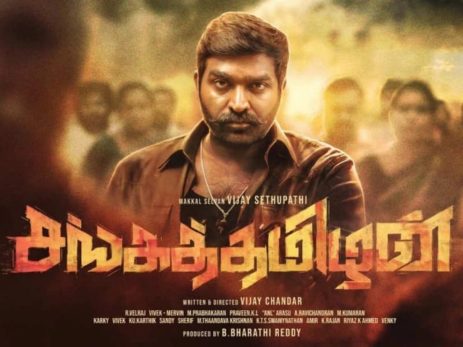
Sangathamizhan

Vijay Chandar’s latest film starts out as a spoof comedy, but ends up as a fairly run-of-the-mill mass entertainer by way of a tired romance and routine ‘villain versus the villagers’ plot. Vijay Sethupathi is always watchable, even in this clichéd action adventure, but the rest of the cast get short-changed by the screenplay, having little to do except either adore or loathe the lead character. There is plenty of action, comedy and even Vijay Sethupathi dancing, but by the end there really is little that makes Sangathamizhan stand out from the rather large pool of similar films.

The opening scene of the film typifies much of the first half. It’s a jumble of mass action and hero-centric plot with a mixed bag of comedy that generally works better than the dramatic dialogue. As aspiring actor Murugan, Vijay Sethupathi has a classic hero entrance before single-handedly reducing a gang of villains to groaning bodies on the floor, while his friend Soori (Soori) cracks a few jokes and performs the usual slapstick side-kick role. It works to some extent as neither Vijay nor Soori seem to be taking any of the dialogue seriously and there are a lot of sideways glances and self-referential jokes in the opening sequences. But the inclusion of a college girl who needs to be rescued from rape, some tasteless jokes about a group of prostitutes and rather humdrum action make this rather more cringeworthy than it needed to be, particularly for the start of the film.

The first half also includes a woeful romance with a truly terrible introduction scene for Kamalini (Raashi Khanna). Murugan crashes Kamalini’s birthday party and then proceeds to scold her for being so generous as to provide him with a free drink at the bar. Somehow this is supposed to make her intrigued by Murugan rather than acting as most women would in this situation and just calling for the bouncer to kick him out of the nightclub. At no point does the love affair between the rich industrialist’s daughter and out-of-work actor seem plausible despite the clichéd and formulaic development of the relationship. The only good thing about their romance is the inclusion of the upbeat and jaunty Kamala (which features men in colourful tutus as backing dancers), even though it doesn’t fit into the narrative at all. In fact, generally the music from Viviek-Mervin is excellent throughout, while the lyrics are beautifully translated by rekhs, who doesn’t just translate the words but makes the lyrics rhyme and scan perfectly. Why doesn’t everyone do this instead of providing literal translations that make absolutely no sense at all?

The plot begins with a courtroom scene where a group of villagers are trying to prevent a copper processing plant from opening in their area. The land appears to have been acquired illegally and for a change the judge seems to be on the villagers’ side, giving the developer just a few weeks to come up with evidence to prove that the factory won’t be a health risk to the villagers. This all becomes much clearer in the second half, which moves into flashback mode to explain the fight between the owner of the copper factory, Kamalini’s father (Ravi Kishan) and the village headman Devarajan (Nassar). Also drawn into the fight is the local politician (Ashutosh Rana) and the rest of Devraj’s family, including his son Sangathamizhan (Vijay Sethupathi).

The tone of the second half is much darker than the first, and from a frivolous romance comedy, it changes into a more dramatic action film. This disconnect between the two halves of the film is jarring as the shift happens suddenly (there is no interval given in Australia) and the mood change is relatively extreme.  Despite this, the second half is actually significantly better since it also includes Nivetha Pethuraj as Thenmozhi, Thamizhan’s romantic interest. Thenmozhi is a better realised character than Kamalini, despite her short time on-screen, with sharper dialogues and actions that actually make sense. Nivetha also has a good on-screen chemistry with Vijay in the romantic scenes between the two characters, which is a significant improvement on the lacklustre interactions he has with Raashi Khanna in the first half. The love story here is also more plausible, making me wonder why so much time was wasted earlier in the film, when the second half has a more convincing story, sharper action and generally improved performances from the entire cast. The main downside is Ravi Kishan’s rather anaemic villain who just doesn’t seem evil or ruthless enough, and Kamalini’s rather bizarre justification for accepting her father’s final fate.

The glue that manages to hold the entire film together (just) is Vijay Sethupathi and his frequent knowing nods to the camera seem to signify that he finds the entire story just as ridiculous as the audience. At times the film dips closely towards satire and throughout the first half I kept thinking that Vijay Chandar was trying to poke fun at the mass genre. But then the second half moves quickly towards more serious topics and the jokes dry up, along with Soori’s virtual disappearance from the screen as the film moves into more straight-up action territory. It doesn’t quite gel there either however as there is too much baggage hanging around from the first half that acts as a distraction. The two characters, Murugan and Thamizhan are also very similar which further undermines the dramatic ‘reveal’ of the finale. The positives are the music, Vijay Sethupathi and rekhs excellent subtitles, but otherwise this is a rather pedestrian and predictable outing that is really one only for fans.