Yutham Sei

After watching the excellent Anjathey I was inspired to seek out more films by director Mysskin, and Yutham Sei was the next in the pile.  Although it leans in somewhat the same direction as Anjathey it’s a slightly different take on the thriller genre and for the first half of the film at least, it’s very successful.  Mysskin excels in building suspense as the plot gradually unfolds and starts to take shape as a detailed and intriguing police procedural drama.  But after such a great beginning the second half is overly dramatic with a little too much focus on the torture and gore and not enough attention to the basic story. So what started out as a promisingly different film ends up with some major plot holes that are conveniently swept aside along with all the blood by the end credits.  However it’s still a gripping story with mainly good performances from the cast and overall Mysskin succeeds in keeping the turns and twists in the plot unexpected and surprising.

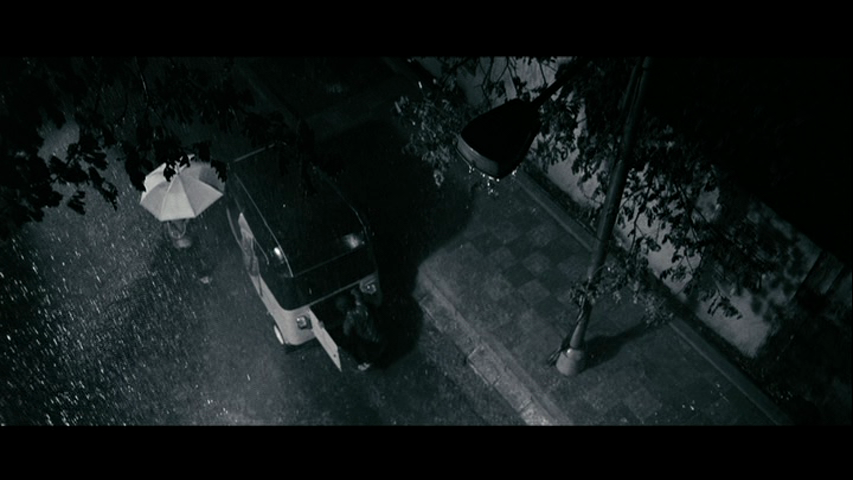
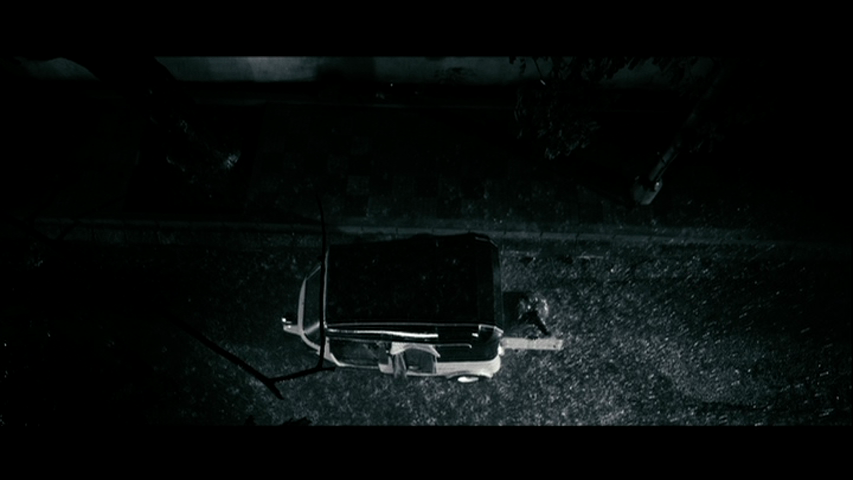
The film starts in black and white with a flashback to events which we eventually learn are critical to the plot.  There are numerous clues in these first few moments but it’s not until much later in the film that the important details and how they all fit together into the main story become clear.  This gradual reveal is the main strength of the film and the suspense is maintained by making sure that we don’t know the full story either and only learn about events at the same time as the main protagonists.
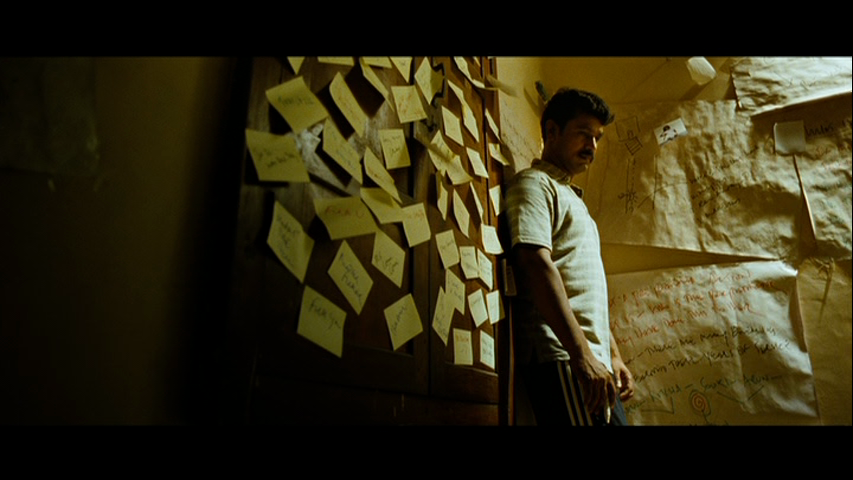
Cheran plays Inspector J. Krishnan, commonly known as JK, who is given the task of investigating a series of gruesome discoveries around the city.  Severed arms have turned up in cardboard boxes conspicuously placed in public areas but no associated bodies have been found.  JK takes on the case rather reluctantly as he wants to spend his time investigating the disappearance of his sister some three months previously.  However his boss promises to reopen his sister’s case, so JK starts the painstaking process of trying to identify the limbs and discover who and what is behind the dismemberments.
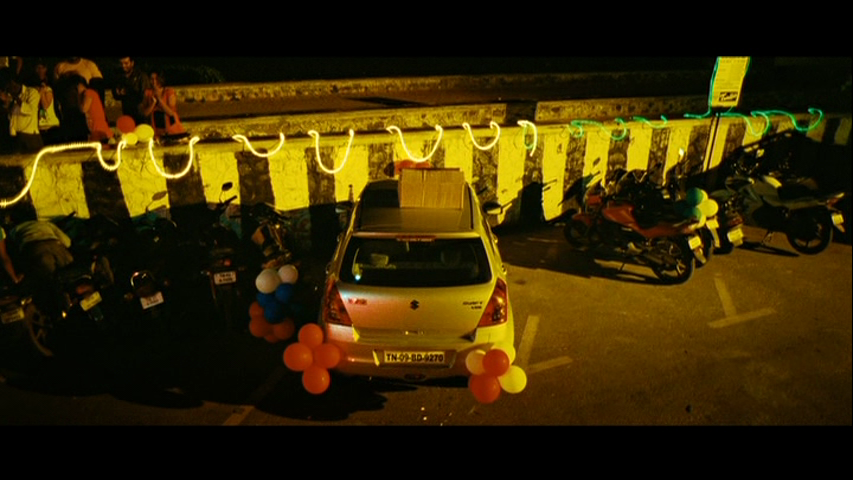
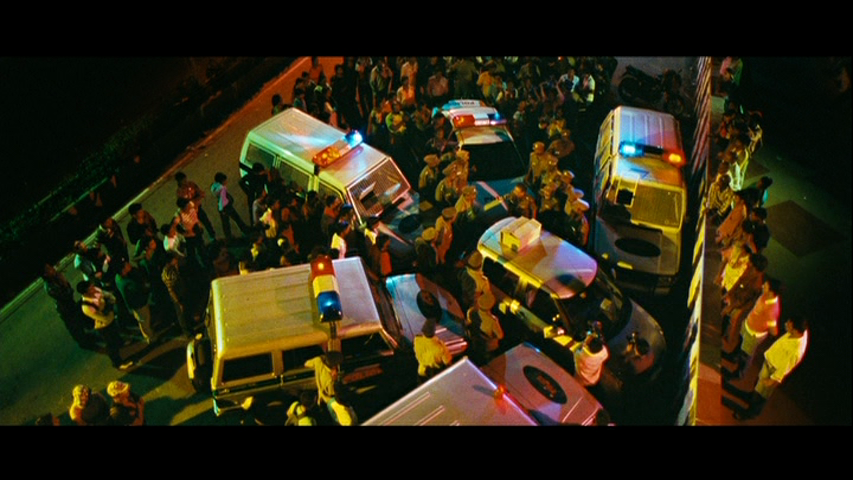
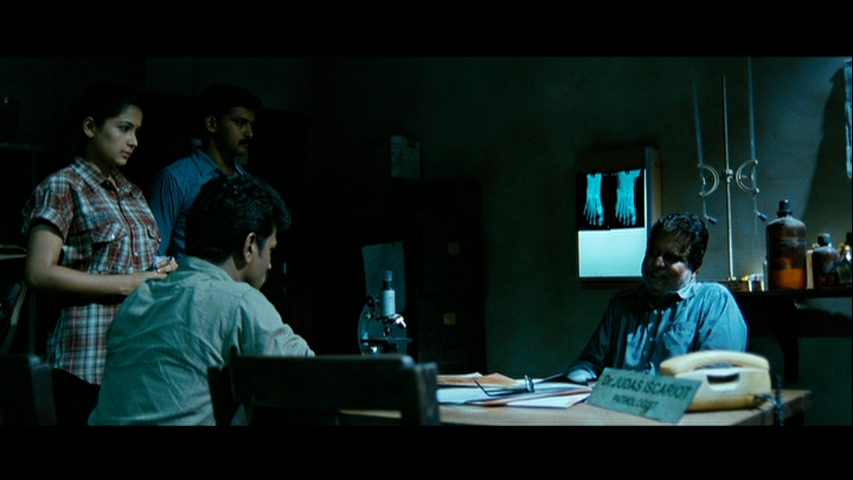
The police procedures are thorough and painstaking as, along with Sub-Inspectors Prakash and Thamizhselvi (Dipa Shah) and Head Constable Kittappa, JK questions suspects, interviews witnesses and slowly identifies the remains.  Scenes shot in the morgue are particularly effective and are a real shock to anyone more familiar with the gleaming white benches and sanitised bodies from US TV crime shows. These scenes also introduce V. Jayaprakash as Chief Pathologist Dr Judas, the chief pathologist and a crucial link in the story, although perhaps his choice of name was a little too revealing.

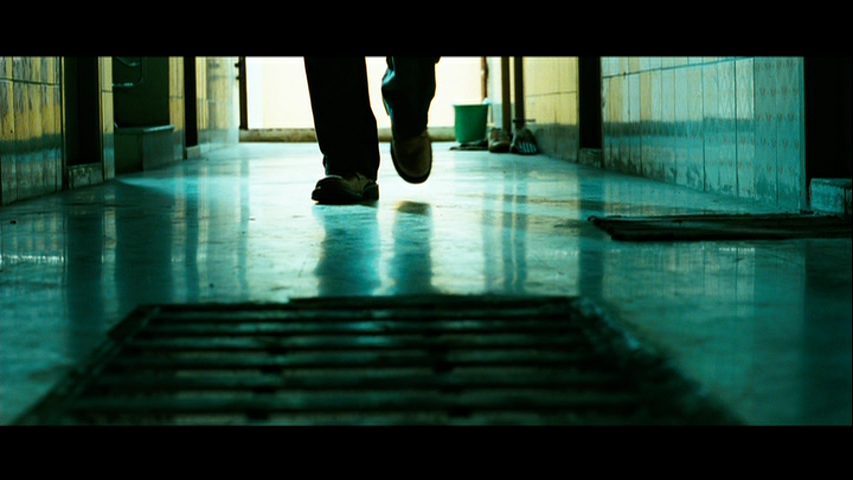
Slowly JK discovers that the severed limbs belong to criminals who are linked to a case involving the suicide of a renowned doctor (Y. G. Mahendran) and his family.  Each small piece of the puzzle is only uncovered after long and arduous investigation on the part of JK and his team and Mysskin’s characteristic methods of filming feet or only part of the scene adds to the piecemeal effect.  Cheran is excellent as JK and the difference between his decisive investigations during the day and his introspective brooding at night is captured well.  V. Jayaprakash is the other standout in terms of performance and his world-weary doctor seems to have stepped straight out of a BBC crime drama.  The other actors are all solid in their roles although there is little in the way of any character development. Considering the style of story that’s not a major problem, but it does make it difficult at times to differentiate just who is who, particularly among the villains.
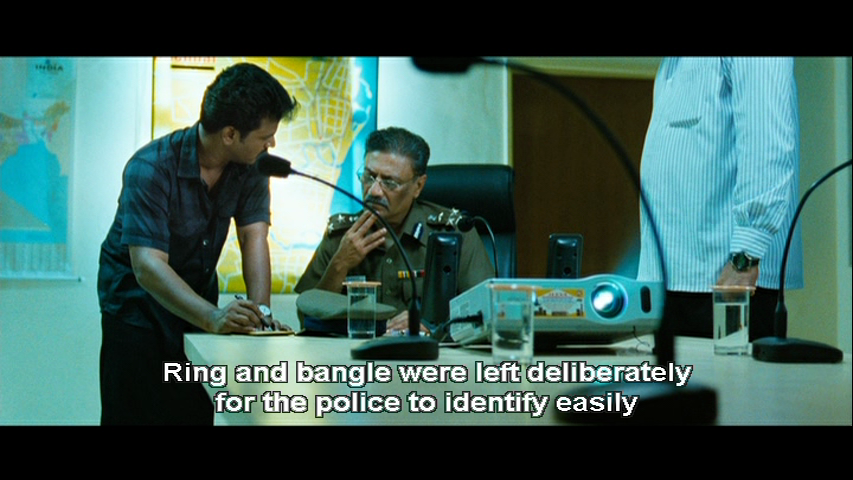
Generally the second half moves more to action and the more that is actually seen to be happening rather than just implied violence, the less effective it all becomes.  So the scenes of torture and the completely over the top reaction of Lakshmi Ramakrishanan in her role as the doctor’s wife end up without much impact.  It doesn’t help that once the full story is revealed the final show down is inevitable although the almost pedestrian and petty nature of the original crime is a good touch.  Just for once though I’d like to see a police officer call for back-up before heading into an abandoned factory full of criminals and usefully breakable objects!

While most of the first half seems very carefully plotted, the second half has a number of leaps of faith and convenient discoveries which become more and more dramatic and detract from the simpler style used earlier in the film.  However on the plus side there is no annoyingly irrelevant comedy track and no tacked-on-for-the-sake-of-it romance angle so I can forgive Mysskin his tendency to over-dramatise a few scenes.  The cinematography by Sathya is excellent and keeps up the suspense with many of the critical scenes shot at night or in dim light.  Kay’s background music also adds to the atmosphere and is generally used to very good effect.  There is one song in the film, and although the placing is fine, I think it would have worked better as a short snippet rather than as a complete dance routine which does seems a bit superfluous. Impressive gold lungi though!

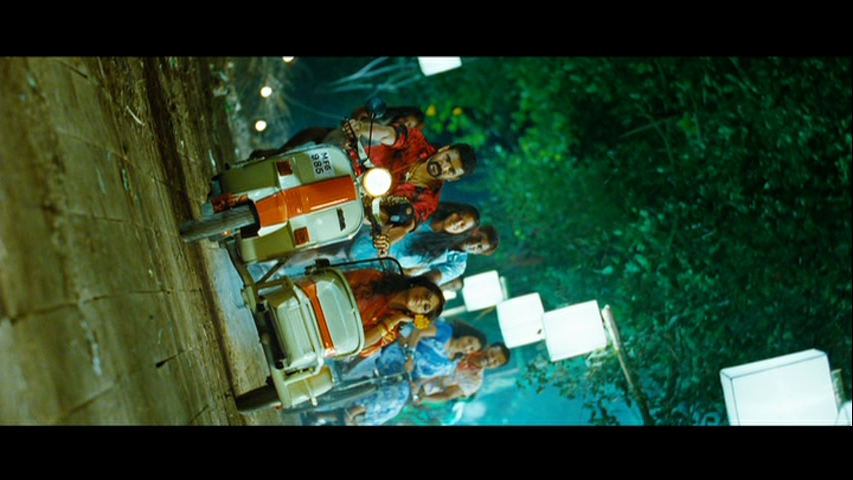
Overall Yutham Sei starts off like a European police thriller but ends up more like a Hollywood horror film. If Mysskin had managed to maintain the early tension and suspense right to the end this would have been a fantastic film. But even with the issues I have with the second half, I think it’s still interesting – somewhat different from the usual hero-centric Tamil action film and definitely worth a watch for the excellent development of the plot in the first half and an impressive performance from Cheran. 3 stars.

Kandan Karunai

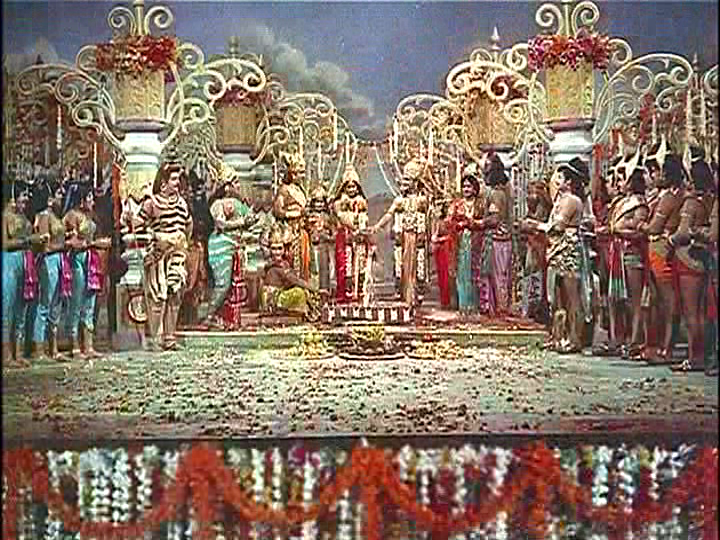
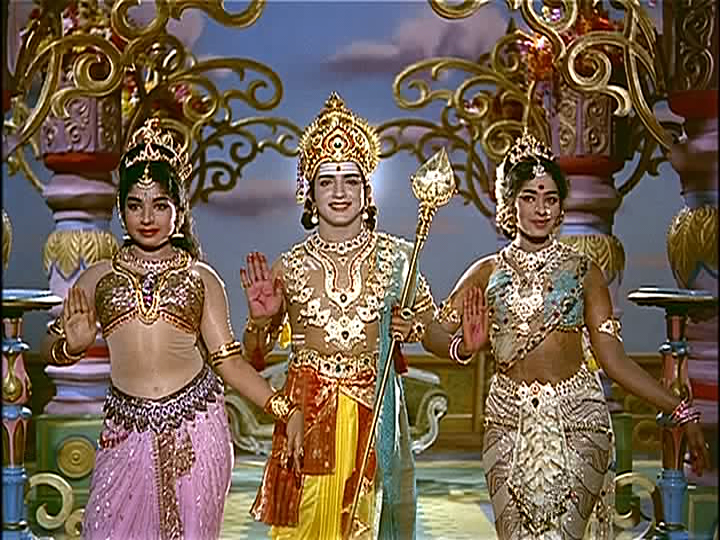
This is one of the few Tamil mythological films by A. P. Nagarajan that I’ve been able to find on DVD with English subtitles, and despite its sometimes pedestrian and almost documentary-like telling of key events in Lord Murugan’s life, it’s still worth a watch mainly due to the great cast and an excellent soundtrack.  The film covers the major incidents which define Lord Murugan and his place in the Hindu pantheon and it gives a good insight into why he is often regarded as the God of Tamils. Despite his more minor role Sivaji Ganesan is the star of the show but Gemini Ganesan, Savitri and various other stars of the time make an appearance, including an incredibly cute 4-year-old Sridevi in her first ever role as the young Murugan.  There are plenty of glittery costumes and even more sparkly jewellery set against some incredibly colourful sets which prove that there are no colours which clash in India. It’s garish but pretty and personally I’d like to see every army adopt the gold boots worn with such aplomb by Sivaji’s Veerabaghu.

The film starts with a devotional song to Lord Murugan by renowned singer and actress K. B. Sundarambal who appears in her characteristic role of Avvaiyyar.  She introduces the story of the demon king Surapadman (Ashokan) who is terrorising the people of heaven but cannot be killed due to a boon he and his people received from Lord Shiva.

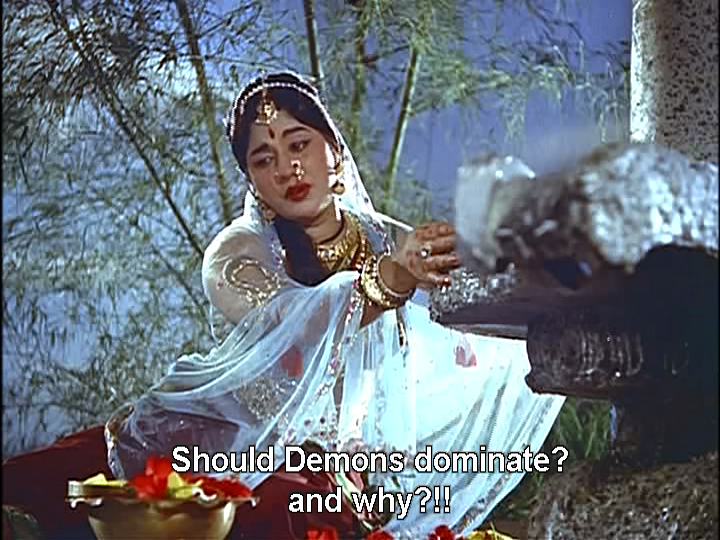
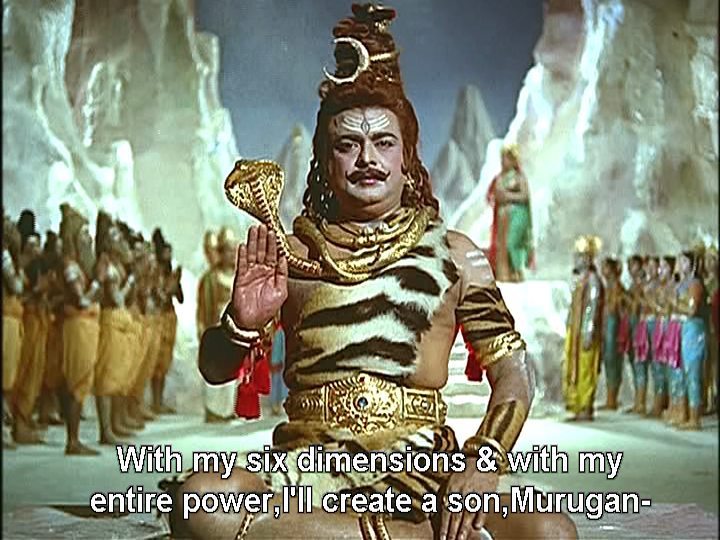
When Surapadman’s sister Ajamugi attempts to kidnap the king of the heavenly people’s wife Indrani (S. Varalakshmi) as a present for her brother, subsequent events force Lord Shiva to become involved. Rather than kill the demons directly he creates a son to deal with Sundarambal but gets rather more than he bargained for with Murugan.

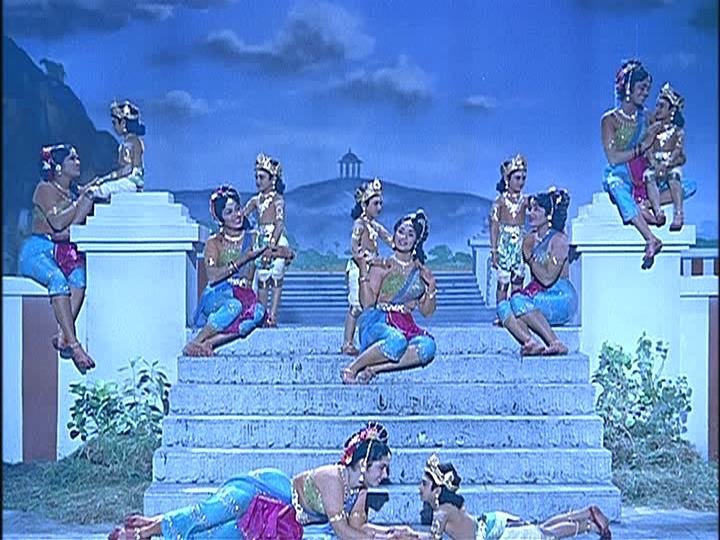
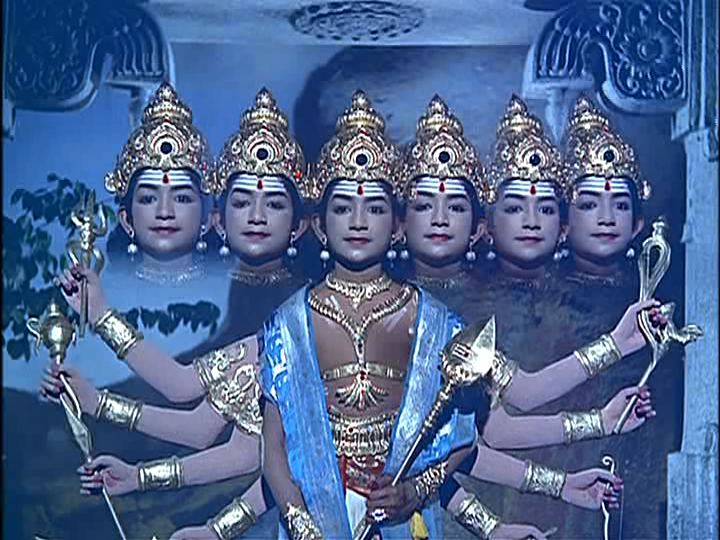
Murugan is clever, even as a child and faced with six divine girls as potential nannies, he rather practically splits into six versions of himself so that they each have a child to look after.  Later his mother Parvati reunites all of the children to create the god with six faces while the divine girls are rewarded by being transformed into stars. These first few stories dealing with the young Murugan are mainly told in song, although when there is dialogue Master Sridhar as the young Murugan holds his own in scenes with the older actors Gemini Ganesan as Shiva and Savitri as Parvati.

The adult Murugan is played by Sivakumar who sadly doesn’t give Murugan much personality at all,  and he plays the role rather passively.  However the ‘good man’ Veerabaghu, who comes to help Murugan in his war against the demons, provides plenty of attitude and Sivaj Ganesan brings the film to life in this role.  He acts first of all as a messenger from Lord Murugan to Surapadman, defying the demon’s arrogance by creating his own throne and servant girls when Surapadman denies him a chair.  He is instrumental in instructing Lord Murugan how to fight the various demons and later he gets to strut around in his wonderful gold boots as the army celebrates Murugan victory.

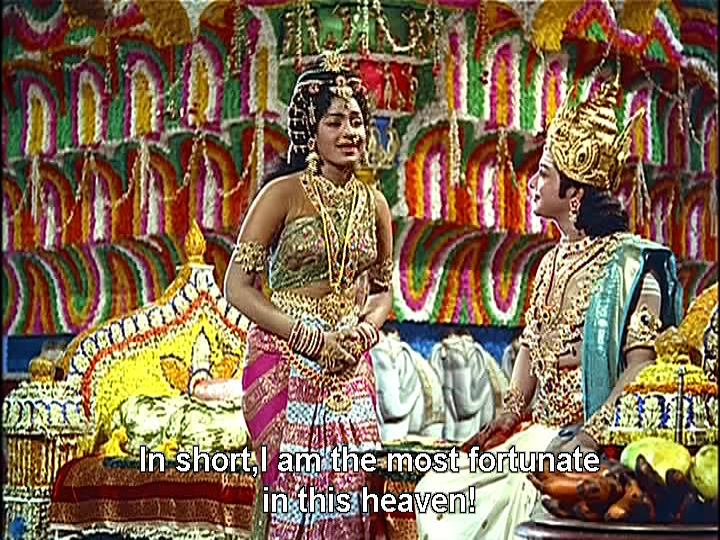
The latter half of the film deals with Murugan’s two marriages.  The first of these is to Indira’s daughter Deivanai (K. R. Vijaya) who manages to stay cool when faced with the riot of colour that accompanies her marriage and subsequent first night with Lord Murugan.

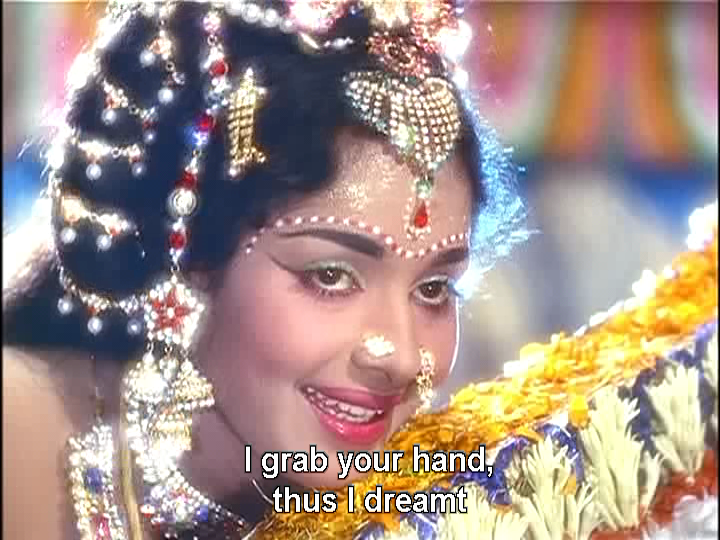
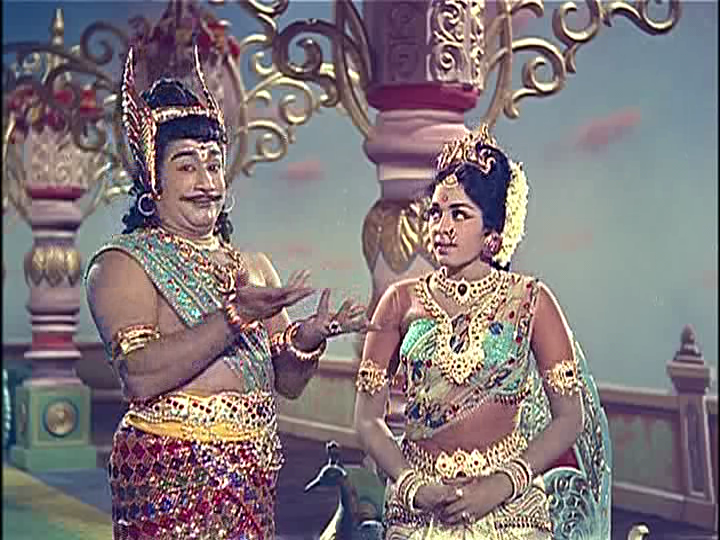
The explanation of marriage and a woman’s place in society sounds incredibly patronising, particularly when Deivanai is told that she has to remain faithful to her husband while Murugan goes off and finds a second wife.  However, since the basic theme of an obedient wife still seems to be expounded as the ideal even in India to-day it probably sounds more reasonable to its intended audience, particularly back in 1967 when the film was made.  Deivanai is still understandably outraged when Murugan comes back with Valli and there are some funny moments as Veerabaghu has to deal with the two angry women, which he does with great charm and lots of sparkle.  K. R. Vijaya looks beautiful but doesn’t have much scope to do anything else as her character is very one-dimensional.  Jayalalitha as Murugan’s second wife Valli has a better role with a little more substance including this lovely introduction.

Valli is the daughter of a tribal chief and her friends include Manorama and Tamil comic actor Nagesh who provide a little relief from all the noble deeds and dramatic pronouncements of the other characters.  Jayalalitha is charming and her Valli is graceful and elegant even in her simple village girl persona which translates well to her rise in station as the consort of Lord Murugan.

The film is very stylish and looks beautiful but lacks the warmth of other Nagarajan films I’ve seen, particularly in the character of the older Lord Murugan.  Perhaps it’s because Murugan has outgrown the mischievousness and arrogance which livened up the early scenes and it’s hard to portray worthiness and knowledge as being anything other than a little dull. Sivakumar is pleasant enough but is eclipsed by Sivaji who has much more presence.  The battle scenes are very stylised and the demons don’t ever look to stand much of a chance against Lord Murugan and his trusty spear, although the internal squabbles in Surapadman’s court are well portrayed.  I really liked the actress who played Ajamugi who got her outrage and vindictive nature across very clearly.

The music by K V Mahadevan won him a National Award and it’s definitely  a highlight of the film with some beautiful vocals by P. Susheela in many of the songs.  This film worked more for me as an explanation of some of the symbolism I’ve seen on my visits to temples in Tamil Nadu, and a synopsis of Lord Murugan’s life, although of course I always enjoy a film with lots of sparkle! Worth watching for the songs, Sivaji and the younger Murugan – 3 stars.
Sivakasi

Let’s cut to the chase. Watch Sivakasi for the highly enjoyable songs, and you might find a few other little gems along the way. Perarasu (writer/director) has made a movie of two halves that doesn’t quite succeed in being a cohesive entertainment and is a bit too long. But likeable stars, some excellent action scenes, vigorous dances and a commitment to always choosing the silliest solution help the time pass pleasantly enough.

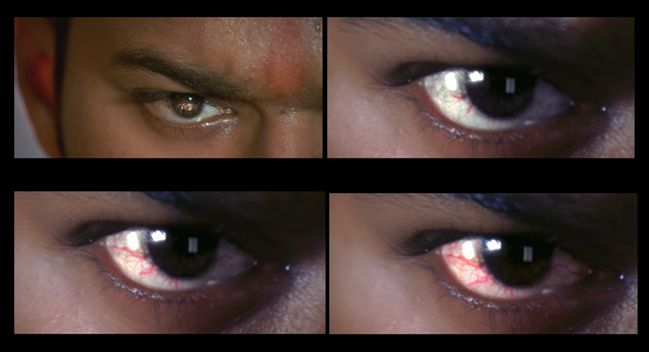
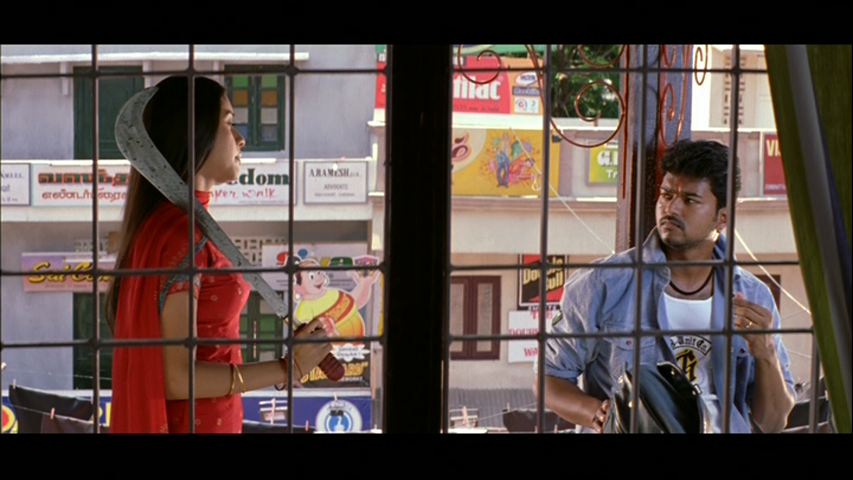
Vijay is the hero, Sivakasi. The police are largely useless against local thugs and he looks after the shop owners and residents of his area. His every gesture is underlined by a sound effect, he wears hideously embellished trousers and his eyes turn red whenever he is enraged.

In case that isn’t enough, a colour effect often emphasises the many (bad) moods of Sivakasi.


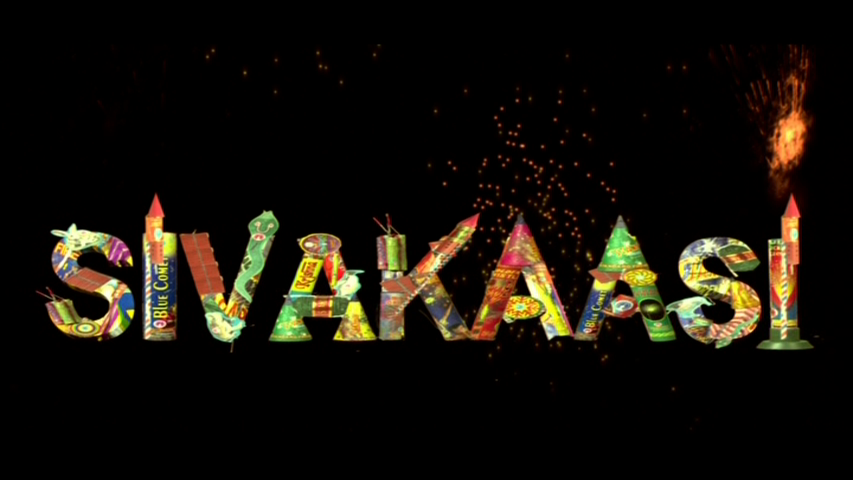
Perarasu also introduces himself by way of introducing Sivakasi, which amused me greatly (as did the spelling).

Sivakasi spends a lot of time blow-torching the same piece of perforated metal sheet so I am not sure how successful his business was. I suspect he was on commission at a local glazier as the number of window panes broken in fight scenes was HUGE. The character of Sivakasi is self-righteous and inflexible, and I could understand why he was single and stuck with a comedy gang as his only close friends. Vijay is good as a boyish prankster but once he has to deliver more serious dialogues, he is a bit lightweight and tends to overact in compensation. I can’t help comparing him with the other baby-faced killer in South Indian films and he just doesn’t stack up. But he is brilliant in the physical scenes, whether fights or dancing, and that is where I can more readily understand his star appeal.

Asin is Hema, the rich girl who sees no need to feel bad about being rich. She takes on Sivakasi at his own game. It’s a Tamil film with a big name hero so there was no danger of the story being skewed by her perspective but I enjoyed watching her challenge the hero.

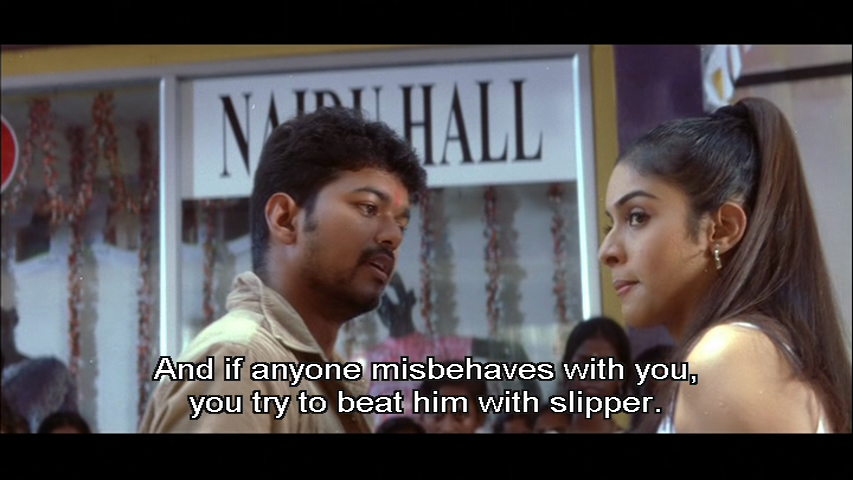
Sivakasi told Hema off for dressing skanky and western and said if she wore a sari men would treat her like the goddess Laxmi rather than trying to cop a feel. So when she arrives in a sari with a gang of sari-clad aunties and hijras, Hema calls his bluff.

Hema is a smart girl with a good heart and a healthy dose of mischief so she is not overwhelmed by the domineering Sivakasi. Asin more or less holds her own in the dancing too, going for maximum energy and not overly concerned with technique. She is a good counter to Vijay in all regards.

Her romantic song fantasy puts Vijay in a vintage pink suit so perhaps she has a more vengeful streak than was immediately apparent. I don’t like the female vocals at all in that song (Deepavali), but the dancing is fun.

The relationship between Hema and Sivakasi starts as a cartoonish battle of the sexes, with each trying to put the other in their rightful place. It is fun but goes on longer than it needed to. Eventually the two declare their feelings but Sivakasi’s pride and temper keep getting in the way. Finding out he is an orphan, Hema accuses him of not knowing how to be a decent person as orphans can never understand love or affection. He then tells her his tragic backstory. Sivakasi chose his alias based on a horrible incident in his past, but he is really Muthappa, estranged from his well-off family. Hema says she can’t possibly marry someone who would desert his responsibilities over such an issue as it is likely he would do the same to her. She will only accept him if his family come to make an offer, showing that he has mended those fences.

And this is where the story takes a turn into flashback and revenge. Rather than just turning up at home, establishing his identity and setting things to rights, Muthappa embarks on a long and complex series of  manipulations.

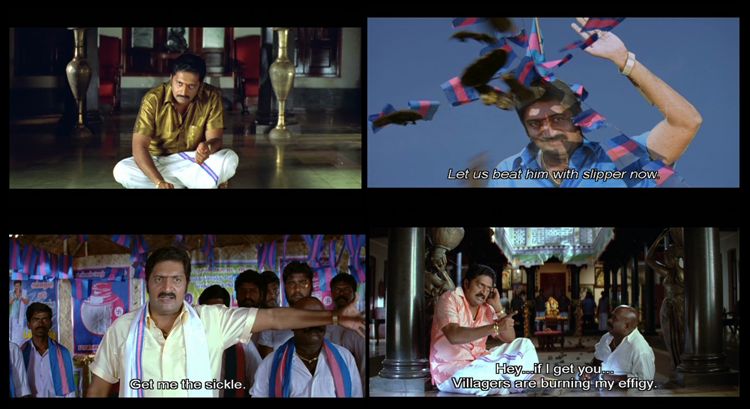
It becomes a bit tedious but there are some highlights. Prakash Raj is in good form as evil older brother Udayappa and sports a pleasing array of colourful shiny shirts. He is a local politician/industrialist/landlord/standover merchant. Some of Muthappa’s shenanigans work quite well. Having found a bunch of vintage film star impersonators to support his sister, Muthappa discovers Udayappa has one-upped him and hired Nayantara (as herself)  for his rally. She ends up lured into a dance-off with Vijay, which is actually one of his more practical schemes.

Muthappa isn’t really that much better a person than Udayappa when you get down to it. He manipulates his sister to ensure her election win – reprehensible behaviour, but it does produce one of my favourite campaign images.

There is a large support cast but they made little impression as the action is all about Sivakasi/Muthappa. No one really goes beyond the stereotype of crying Ma, suffering wife, comedy sidekick, bad guy, poor but honest villager etc, so they could have been played by anyone. Lakshana as Muthappa’s sister had the outline of an interesting character as the wronged woman turned politician, but true to the mass hero style everything was handled by her brother.

Hema and the Chennai gang turn up to see Muthappa, drawing all the storylines into one place. The stakes escalate as there are abundant hostages for the taking and the unscrupulous methods of both sides come to light. But there is nothing that can’t be fixed with an all in brawl or a group hug. There is little substance to any of the characters or the situations, despite all the dramatics. I found the ending neat but unsatisfying and I think that sums up the movie.

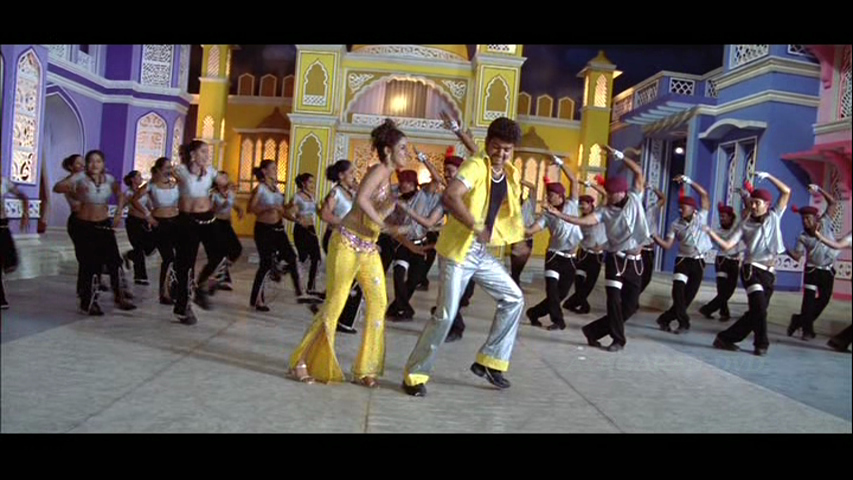
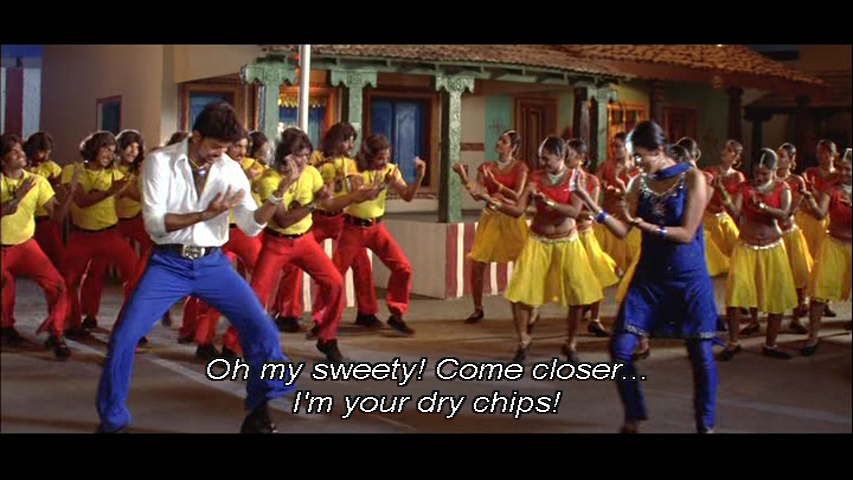
The songs (by Srikanth Deva) are what I expected – upbeat, loud, with colourful picturisations and flat-out dancing in exuberant mass filmi style. I must compliment the backing dancers, especially the guys. They are great fun and really enhance the dances with their facial expressions and uninhibited prancing. I particularly like this song, which is Muthappa’s romantic fantasy about Hema and again demonstrates his terrible taste in clothes.

Speaking of clothes, when I saw this film something niggled away at my mind. And then it hit me. I know plots and songs get recycled – but costumes?

Vijay has at least 2 costumes very similar to those worn by Bunny in and as Bunny in the song Bunny – the red & white ensemble and the silver and yellow number. Surely there are enough costume designers to ensure a rich and varied wardrobe for all?

Perarasu also made the dreadful Thirupaachi – I made Heather buy me lunch as compensation for forcing me to watch it – so I had low expectations when I watched Sivakasi and I was pleasantly surprised. Vijay and Asin are likeable and Sivakasi is more light and cartoonish than the usual gloom and nastiness common in Tamil romance films. 3 stars!

Heather says: I first saw the opening song for Sivakasi on a bus in Tamil Nadu with the local health workers singing and dancing along which at least partly contributes to why I like this film.  Then I bought a song DVD featuring Vijay in that awesome pink suit which was enough of a reason for me to sit down and watch the entire film, even if none of his other outfits in the movie come close to matching it.   Sivakasi is a typical mass entertainer to Vijay’s well-tested and regular formula, but since that formula does work well for him it’s worth a watch.  The first half really is all about the comedy and is a bit more hit and miss, although I do like the way Hema takes on Sivakasi’s prejudices and at least attempts to stand up for herself before the inevitable declaration of love.  When the action takes over in the second half the film gets much better and no-one can beat Prakash Raj when he fully embraces the evil villain character.  I also liked Lakshana as Sivakasi’s sister, both for her performance and the rather better than usual way her character is used, and I’m surprised I haven’t seen her in any other films.  I do get a little annoyed by the alternate mild violence towards women followed by the worshipping of mothers in this film, but it’s all so cartoonish that a mild irritation is the most I can feel.  The dancing is excellent even if sometimes the choreography is less so and the Vijay-Asin combination works well considering they don’t actually spend a lot of time together.  Even though every character is painted with very broad strokes it’s still an entertaining film, and definitely better than Thirupaachi (I don’t think I’ll ever be forgiven for that one!). One of Vijay’s better efforts.  3 ½ stars.