Tik Tik Tik

Tik Tik Tik

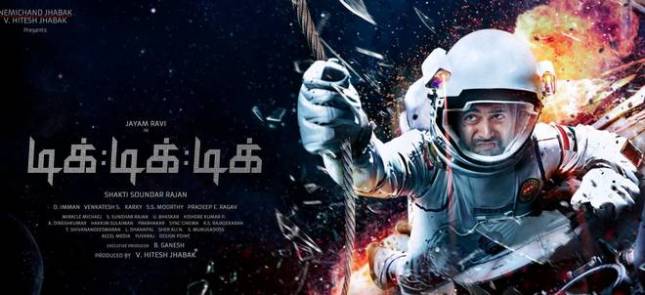
Tik Tik Tik is basically Armageddon meets Gravity meets Now You See Me set in space. Plus a whole mish-mash of ideas from other HW movies which may have been thrown in as an attempt to hide the planet-sized plot holes, of which there are many. It’s not that you need the usual suspension of disbelief to enjoy this film – Tik Tik Tik requires complete ignorance of scientific knowledge, in fact best to leave any common sense way out past Pluto too, as the film has little logic and few attempts to include anything resembling realistic scientific fact. Now that wouldn’t necessarily be a bad thing if Shakti Soundar Rajan had decided to make a comedy set in space, but despite the presence of Ramesh Thilak and Arjunan as bumbling side-kicks, Tik Tik TIk tries to be a serious space drama and that’s where it ultimately falls down.

The story goes like this: there is a giant asteroid hurtling towards the Earth, but somehow no other nation has noticed the impending disaster about to strike. But that’s OK, because it’s apparently a selectively damaging asteroid that’s going to hit the Bay of Bengal and only obliterate Chennai and the rest of Southern India. Naturally the Indian Army have a plan – which is to send a magician-thief and his two mates into space to steal a 200 mega-tonne nuclear warhead. This has been hidden in a heavily guarded space station because where else would you hide a highly illegal nuclear bomb? Then the team need to fire the bomb into the centre of the asteroid, which will split perfectly into two and narrowly avoid the Earth, not causing any problems at all as it easily avoids the Earth’s gravitational pull. Oh, and the team have six days (and a few odd minutes) to find the thief, train him how to be an astronaut, steal the bomb and save the world.

None of that seems too ridiculously far-fetched to be honest – after all, it’s no more ridiculous than the idea that only the USA can deal with any potential planetary threat. It’s what happens once they are in space where the really preposterous stuff starts. The plan to steal the bomb is terrible, badly plotted and riddled with convenient coincidences, although the action sequences themselves are actually quite good. However, rather more problematic is the addition of a secondary plot that includes a villain who tries to sabotage the mission. Unfortunately, the characterisation here is particularly weak and poorly written. The villain’s actions don’t seem likely or credible and there is no justification or good reason (other than the vague mention of money) for them to act the way they do. The introduction of the whole sabotage plot is also rather odd and fails to generate any of the required tension. After plenty of action where imprisoned thief Vasu (Jayam Ravi) is selected for the mission, demonstrates his credentials and learns how to deal with zero gravity, the villain’s addition feels lacklustre and feeble in comparison.

Jayam Ravi is fine a kind of modern-day Robin Hood – using his magic tricks to steal from the wealthy for the benefit of the poor. He’s obviously a nice guy who has been imprisoned by the ‘corrupt system’ and he’s made even more human by his relationship with his son Aarav. Vasu’s wife is dead making him a single father, and there is even a sweet song to show just how special his relationship is with his son. This is important later on, as Vasu is more concerned with keeping his son safe rather than saving the world, which is a major factor in how the mission plays out.

However, Jayam isn’t a natural action hero and although he does well in most of the choreographed action sequences, once in space he seems rather shell-shocked and passive while carrying out General Mahendran’s (Jayaprakash) orders or when attempting to trick the captain of the Chinese space station, Captain Lee (Aaron Aziz). It gives him the appearance at times of almost sleep-walking though some scenes, and ends up removing any tension that the film really needs. After all, the Tik Tik Tik of the title refers to the ticking clock that’s counting down the hours and minutes until the asteroid strikes and over 40 million people are wiped out, but you wouldn’t know that given the often laid-back approach to the mission from Vasu and his friends Venkat (Ramesh Thilak) and Appu (Arjunan).

On the other hand, Nivetha Pethuraj is excellent as Swathi, one of the co-captains running the space mission, and she is efficient and decisive throughout. Thankfully her character is vital for the mission and is shown to be a competent engineer with good reason to be in the story with no hint of any romantic interest at all. The unexpected equality also applies to the Indian army where two of the top generals are also female, as is a large part of the scientific team behind the space mission. It’s also good to see Vincent Asokan in a more heroic role for a change and he works well with Nivetha as the other captain on the space mission, although mostly he is unhappy with the inclusion of a group of scrappily trained thieves on such an important mission. And I have to say he does have an excellent point!

One of the other issues with the film is the lack of suspense and tension, as the time limit before the asteroid crashes into the Earth seems to be forgotten for much of the second half. There is some excitement with Vasu bouncing around in space and with the team fighting the Chinese onboard the space station, but there is none of the background tension that should come from an impending sense of doom if the mission fails. This ends up derailing the plot right when it should be at its most exciting and a ‘twist’ right at the end makes for a very unsatisfying conclusion to the film.

However it’s not all bad. Despite the problematic plot and dodgy science, there is still quite a bit to enjoy in this space heist/disaster movie. The special effects are pretty good and there is a real attempt to make the space mission more than just a glorified reason to roll out said effects. Much of the action during the space scenes is well done while the training and take-off sequences are excellent. The comedy around Vasu, Venkat and Appu trying to adapt to space is funny and both Nivetha Pethuraj and Vincent Asokan are good in their roles as ‘serious astronauts’. While the plot may have huge holes, the film is mostly entertaining and at just over 2 hours it’s also well edited to avoid any unnecessary or overlong scenes. Shakti Soundar Rajan also deserves some credit for attempting the genre and for setting a large portion of the film in space. While it may not be as successful in terms of plot, there is plenty of vision and some good ideas here which hopefully will encourage more filmmakers to aim for the stars.

Kaala (2018)

Kaala

As with his previous film Madras, Pa. Ranjith is out to deliver a message and the fact that he has Superstar Rajinikanth on board is almost irrelevant. The film is all about the politics of land clearance in the slums of Mumbai and the population of Dharavi who rise in revolt against unscrupulous developers. Where Pa Ranjith does make use of Rajinikanth’s star power is to emphasise Kaala’s role as ‘King of Dharavi’ (presumably only the Tamil-speaking part) and he adds just enough slow-motion walking and villain tossing to keep fans happy. But for the most part this is a story about people power and that makes it rather more interesting than the usual Superstar-centric flick. Best of all Rajinikanth plays an age-appropriate character who has a touching romance with his (relatively) age-appropriate wife, Selvi (Eswari Rao) while reminding us just how good Rajinikanth is as an actor.

Karikaalan (Rajinikanth) aka Kaala is the ageing leader of the slums who is pushed to defend his area from developers out to make Mumbai ‘Pure’ and beautiful. Once a gangster, he’s now a family man, and his introduction shows him playing cricket with his grandchildren and enjoying life at home. There are many domestic touches; Kaala’s relationship with his wife, the pet dog that follows him everywhere, and the rather more problematic relationship be has with his youngest son, but when it counts, Kaala still has the power to stop the bulldozers in their tracks when they show up to develop the dhobi ghat. He’s ably assisted by his eldest son Selvam (Dileepan) who dives straight into action and never lets dialogue get in the way of a good scrap, and his many loyal followers who believe that Kaala is still the ultimate authority in the area. On the other hand, his son Lenin (Manikandan) is an activist who prefers demonstration and petitions to direct action along with his girlfriend Charumathi (Anjali Patil). Manikandan is excellent and his portrayal of the frustrations with trying to fight a legal but slow and difficult battle against the background of his father and brother’s illegal but successful campaigns is brilliantly done. Anjali Patil stands out too as a force to be reckoned with, and her scrappy Charumathi is passionate and vibrant in her defence of the local community.

Opposing Kaala at every turn is corrupt politician Hari Dhadha (Nana Patekar) who is behind the developers plans to clear the land. He’s also a man with incredibly squeaky sandals. I’m not sure if India has the same superstition, but in Ireland squeaky shoes are a sign that they haven’t been paid for, with the implication that the wearer is someone who cannot be trusted. It fits Hari perfectly so I really hope this was intentional and not just a wardrobe glitch!

Dharavi sits on prime real estate and the developers want to rehouse only a small portion of the current residents, while saving the bulk of their redevelopment for the rich who will pay above the odds to live in such a convenient location. Hari and Kaala have a history, which makes their clashes personal, and Pa Ranjith ties their rivalry into the story of Rama and Raavana, but with a twist. Hari may always wear white and live in a house painted white with all white furnishings, but his Rama is a villain with no respect for the common man. Kaala wears black, lives in a house shrouded in shadows with a black settee, but this Raavana is the hero, fighting selflessly for the poor and oppressed who cannot stand up for themselves.

Rajinikanth steps easily into the role of the people’s defender, but what makes his Kaala so impressive is the relatability of the character. Despite his god-like status in the area he is a family man at heart and is simply trying to do his best for everyone. He is still in love with his wife and the scenes with Eswari Rao are brilliantly written to show the depth of their relationship while still allowing the couple to bicker continuously – typical of any long-term couple. The arrival of Kaala’s previous lover Zareena (Huma Qureshi) as a housing development specialist adds spice to the mix and the conflict of emotions from all involved is well worked into the narrative. However, Huma Qureshi’s character isn’t as well developed as that of Selvi and towards the end she’s side-lined just when I was expecting her to take a more prominent role. Zareena is a single mother and there is also an unfinished thread about her daughter which starts and then peters out into nothing, as if Pa Ranjith was so involved with everything else that he forgot to come back and tie off this part of the story.

Kaala also has support from his drunkard brother-in-law Vaaliyappan (Samuthirakani) who has some excellent lines in the second half when Hari successfully enlists police chief Pankaj Patil (Pankaj Tripathi) to burn down part of the slums. Ramesh Thilak also pops up as a reporter who has a more important role to play than first appears, while Sayaji Shinde, Ravi Kale and Sampath Raj are all good in minor roles. One of the best scenes though belongs to Lenin when he visits Charumathi in her building. He’s been campaigning for this type of development to replace the chawls but is dismayed by the endless stairs to climb when the lift is out of order and the over-crowding and lack of personal space in each small flat. It’s an excellent way to show the issues associated with rehousing schemes and the problems caused by squeezing people together into such tiny spaces, although it takes more drastic events before Lenin returns to his father’s side of the argument.

There are some excellent fight scenes although these don’t all feature Rajinikanth. However, the best (and my favourite) involves Kaala with an umbrella in a flyover in the rain. The final showdown in Dharavi is also well shot with excellent use of colour and plenty of symbolism for those who like to spot such stuff. I enjoyed the songs too, although there are a group of rap artists who keep popping up and look rather out of place. Rajinikanth keeps his moves basic and simple in keeping with his character, but he does look well and the choreography generally fits into the ambiance of the movie.

Nana Patekar makes a fantastic villain and is a suitable mix of wily politician and nasty thug throughout. His first scene with Zareena is very well written to portray the misogynistic behaviour so typical of politicians, but this time Pa Ranjith makes a point of letting the audience see exactly how petty and small-minded Hari appears as a result. Unfortunately, Nana’s dubbing isn’t always well done and the timing is out in a few scenes which is distracting. Along the same lines, the subtitles seem to be rather strict translations, which doesn’t always make sense in English and a few scenes suffer as a result.

Kaala is the film I wanted to see from the pairing of Pa Ranjith and Rajinikanth, and I enjoyed this much more than Kabali. There are strong female characters, a good support cast with well realised roles and an excellent performance from the superstar. There are a few glitches but for the most part the story is engaging with a simple message that translates well onto the big screen. Ranjith may prefer to use a wide brush for his political statements, but it’s the small details that work best here along with good use of the support characters. Highly recommended.

Aruvi

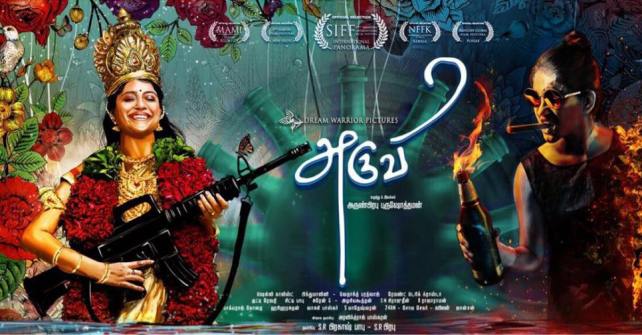
Aruvi poster

Arun Prabhu Purushothaman’s debut film is a difficult film to categorise. It’s a drama, a satire, even at times a comedy, but mainly it’s a delicious slap at reality TV, patriarchal society and that god of us all, money. Although by the end the film becomes overly mawkish and drags out the remaining scenes, Aditi Balan puts in a tremendous performance as Aruvi that powers through the final sentimentalism. Her top-notch performance, along with an absolutely incredible Anjali Varathan ensure that Aruvi is a memorable watch and another excellent addition to the new wave of Tamil cinema.

The film starts with a police interview. Aruvi (Aditi Balan) is a suspected terrorist and as Special Investigator Shakeel (Mohammad Ali Baig) tries to understand just who Aruvi is, Arun Prabhu fills in the background for the audience with short vignettes that dip into Aruvi’s life story. We see Arvui as a young child, growing up in the countryside with her adoring father, who stops smoking just because she tells him it smells bad. If only everyone else would listen to this simple truth! As she grows up Aruvi gets a brother, Karuna (Arnold Mathew) and the family moves into the city.

Aruvi misses the countryside and tells her father that she doesn’t like the move, but she soon adapts and fits easily into school life. She’s not a particularly nice person – she teases other students and in one memorable scene refuses to give a fellow student a sanitary pad – but she is a typical teenager making it hard to understand how she ended up being interviewed by the police as a suspected terrorist.

These background scenes are interspersed with the aftermath of whatever event has led to Aruvi’s arrest. Her father is called to be interviewed, her friend Emily (Anjali Varathan) is also arrested, and we see snippets of how they have interacted with Aruvi in brief flashes, just as if each question has stimulated the memory of the character. It’s beautifully done and keeps the audience guessing before slipping into a more traditional flashback starting with Aruvi in college. Aruvi is studying psychology along with her best friend Jessy (Shwetha Shekar) and the two seem totally normal until the day Aruvi throws up in class. Anyone who has ever watched an Indian movie before knows exactly what this means, and as the story then moves on to Aruvi arguing with her parents and brother before finally being thrown out of the house, that assumption seems logical. Except that Arun Prabhu keeps the reason for Aruvi’s estrangement from her family ambiguous until later events reveal exactly why her family has turned against her.

Aruvi takes shelter first with Jessy, but then moves in with Emily, a transgender who helps take care of Aruvi and helps her find a job. Emily then helps Aruvi get accepted on to a reality TV show, where guests tell their stories and are invited to confront the people they feel have ‘done them wrong’. Here, Aruvi gets to confront three men whom she accuses of raping her, and this is where everything starts to go wrong, leading to the terrorist accusations.

The TV show is a brilliant idea, and allows Arun Prabhu to satirise such shows, as well as the media in general – the headline chasing tactics, talking head opinions shows (of which India seems to have hundreds!), but also shows the police having to act responsibly due to the media presence. The hypocrisy is stunning. Presenter Shoba Parathsarathy (Lakshmi Gopalaswamy) acts like a diva despite working for a small TV company as a reality talk show host – she’s no Oprah! Shoba turns on the charm as soon as the camera is rolling and moves easily from discussing Aruvi’s trauma one moment to a tacky advertisement line for the sponsors before cutting to a break the next, something Aruvi parodies brilliantly later on. The hierarchy of the studio is lampooned, with the little people including the security guard, a runner for the show and the junior producer also getting their share of the ridicule as Aruvi turns the tables on the entire production. This section is brilliantly done and Arun Prabhu uses the talk show as a way for Aruvi to highlight the helplessness of women in Indian society. But Aruvi also comments on the evils of more than just rapacious men, describing the middle class as spending machines who further enrich the wealthy of the world, while themselves gorging on the poor and trampling them further into the ground.

What’s disappointing is that Aruvi forgives the three men, one of whom is unconscionably violent, and the full horror of their crimes is never brought to bear. Although Aruvi initially goes onto the TV show to demand an apology from these men, they are instead made out to be the victims of her ‘attack’, when in reality all three deserve to be arrested rather than Aruvi. But then that is part of the point. The patriarchy of Aruvi’s society does not allow her to be the victim here, and she has no right to complain about her life even though she has had no control over what has happened to her.

Aditi Balan is incredibly powerful in the lead role, first as a typical teen, then student and finally a young woman trying to cope when her whole world has fallen in around her. Her final dialogues, which could have come across as overly cloying and maudlin are instead transformed simply because of her poignant and heartfelt performance. Perfect casting and an excellent performance are what make Aruvi such a compelling story.

While all the cast are excellent, Anjali Varathan shines as Emily and it’s a lovely change in Tamil cinema to have a transgender as a sympathetic character. She’s easily the most compassionate and decent person in the entire film with some of the best lines too. Anjali makes her character come alive in after only a few short scenes, making Emily the most memorable character after Aruvi. I love her introduction as she good-naturedly searches for a possible underwear thief in their building, and her care of Aruvi is beautifully shown. In a film that’s all about those on the margins of society, Emily is an outstanding standard bearer to prove that people are just people. No more, no less.

There are many small throwaway moments that also help lift the film above the ordinary. Jessy’s reaction to Aruvi when she goes to see her after the arrest is perfect middle-class guilt. The interactions between the crew members in the TV studio are well captured as are the reactions of the various homeowners and a funeral party as the police prepare to storm the TV studio. The décor too rings true, while Aruvi and Emily’s wardrobe choices are perfect for the characters they play. No glamour and OTT make-up here, except for Lakshini Gopalaswamy as she hits the nail on the head with her portrayal of TV persona Shoba.

AruviAruviAruviAruvi

There is a secondary theme that deals with another issue that society in India seems to brush under the carpet, but I don’t want to reveal too much since Aruvi does a much better job of explaining. Suffice to say that Arun Prabhu wants to draw our attention to how poorly society treats those who are perceived to be different, although he does rather draw out the final scenes as a result.

The music from Bindhu Malini and Vedanth Bharadwaj is beautiful and suits the film perfectly. The songs develop naturally from the events and are incorporated well into the narrative. Shelley Calist’s cinematography makes the countryside stunning particularly whenever Aruvi visits one of her namesake waterfalls. The comparison between the clear water and Aruvi’s own problems might be a trifle clichéd but it’s effective, as is Aruvi’s gradual isolation in ever smaller rooms as a symbol of her shrinking horizons. Aruvi is not a perfect film, but it is different. It’s rare to get a female-centred film that doesn’t include a major romance or have male characters eventually take centre stage. This is a film that talks about the difficulties women face day to day but not as a rampaging feminist agenda, but rather simply shows how time and time again women are made to feel at fault even when this is blatantly untrue. One to watch for the excellent performances, novel approach to a story and a real heroine for our times. 4 stars.

Aruvi