An Open Letter on the Subject of Filmi Snake Identification and Research

The hallowed halls of the Academy of Applied Filmi Snake Research and Ethics are buzzing with the latest controversy. Our visiting snake expert responds to the (unfair, unjust and unreasonable) criticism levelled at her work by an anonymous  weasel professor. 

Professor,

I am gratified that you have provided the opportunity for further discourse and academic debate in response to the Filmi Snake Spotter’s Field Guide (The Guide)  in your comment about Beth’s scholarly analysis of the snake film Naag Lok.  Before I provide some additional comments in relation to the criticisms levelled at my work, I would also like to acknowledge the contribution of Beth (Illinois, 2011) to the evidence base of filmi snake identification.  As you noted, the principles of scientific rigour to which she has adhered, are laudable and set a new standard in the field.

Whilst Beth (ibid) has certainly identified two new areas for research in the roles of the transformative snake skin lens overlay and the serpentine tikka, I would like to draw your attention to some comments in the introductory section of The Guide:  (a.) “In this guide we will illustrate only a small sample of the many hundreds of filmi snake species featured in sub continental movies” (p. 1.)  and (b.) “Although scientific validation has been undertaken through consultation with both acknowledged experts and enthusiastic amateurs in the area, hypotheses are always subject to revision with an expanded evidence base.”

It is important, I believe, to acknowledge the audience for whom one is writing.  Whilst perhaps it can be argued that the scope of The Guide is broad, as explicitly stated, the intention was the provide some basic, yet practically helpful information, thus providing some guidelines and structure for filmi snake identification, for both professionals and lay persons alike.  At no point, I would like to emphasise, was The Guide touted as an exhaustive monograph.

I would specifically like to address the assertion that omissions of reference were made to the characteristic of venom and the role of the mongoose in filmi snake identification.

1.  Venom

Far from neglecting the role of venom in filmi identification, it is important to note that the results in this area are sufficiently inconclusive at this stage, for exclusion from The Guide.

The sample at the current time is simply too small to achieve any acceptable level of statistical significance.  Observational data suggests that venom may be a useful indicator, but we have conflicting information about both the impact of gender on venom, as well as some conflicting data about colour of venom (though it appears that venom is on the colour spectrum of clear to blue-violet).  The two things that the data demonstrates as emerging trends are (i) that all bodily fluids of the filmi snake appear to be venomous. And (ii) filmi snakes, unlike non-filmi snakes, appear to be able to suck their venom out of any fimi-snake victim and restore life (the Reverse Suck Manoeuvre).

2.  The Mongoose

The inclusion or exclusion of the role of the mongoose is indeed a vexed one.  As part of the extensive consultative process with a number of scientific and government authorities prior to the publication of The Guide, a submission was received form the Royal Society for the Prevention of Cruelty of Animals requesting that no reference be made to the role of the mongoose because of the clear instances of both mongooses and snakes being hurt, and even killed, in the course of filming snake movies.  Their substantial and compelling body of research suggests that publicity in these areas increases the likelihood of recurrence (to a 0.01 level of statistical significance).

This of course, posed a significant ethical dilemma regarding to the need for open scientific debate versus the need for a responsible approach to animal welfare.  In consultation with a number of eminent ethicists, it was determined that the scientific debate was best placed to occur in professional and academic snake forums rather than in a more populist publication like the Guide.  On that basis, the decision to omit was resolved.  For the edification of the scientific community however, a forthcoming article on the subject has been submitted and accepted for publication in the Journal of the Academy of Applied Filmi Snake Research and Ethics.

I hope this letter goes some way to addressing some of the concerns expressed about the perceived shortcomings of The Filmi Snake Spotter’s Field Guide and serves to further contribute to the spirit of open discussion and debate in the important area of filmi snake identification and research.

jenni
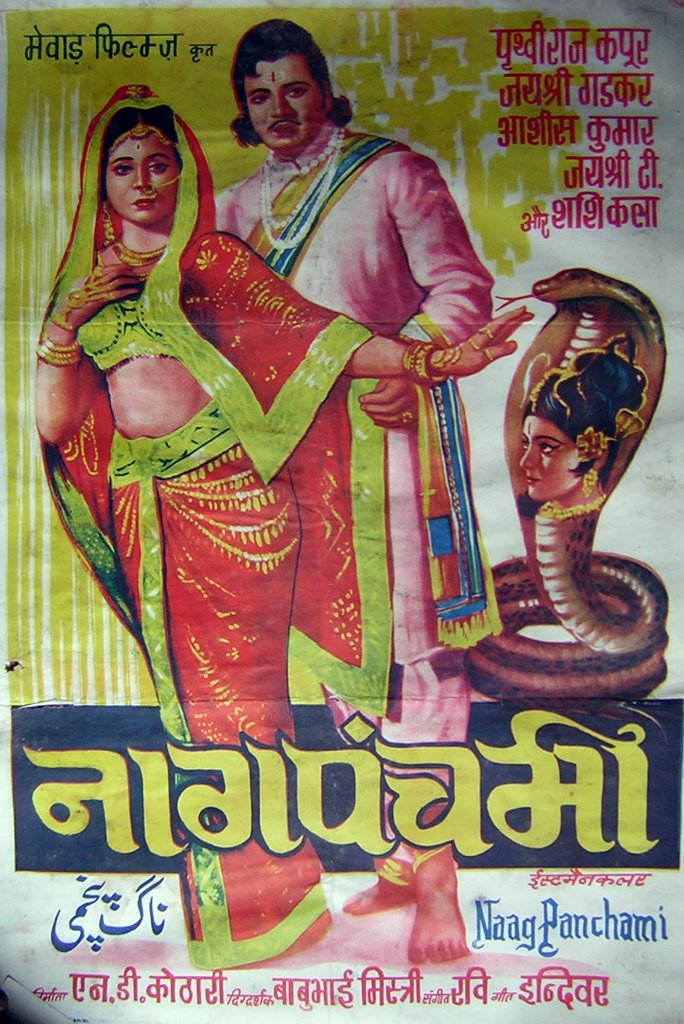
Naag Panchami (1972)

Snakes Galore!

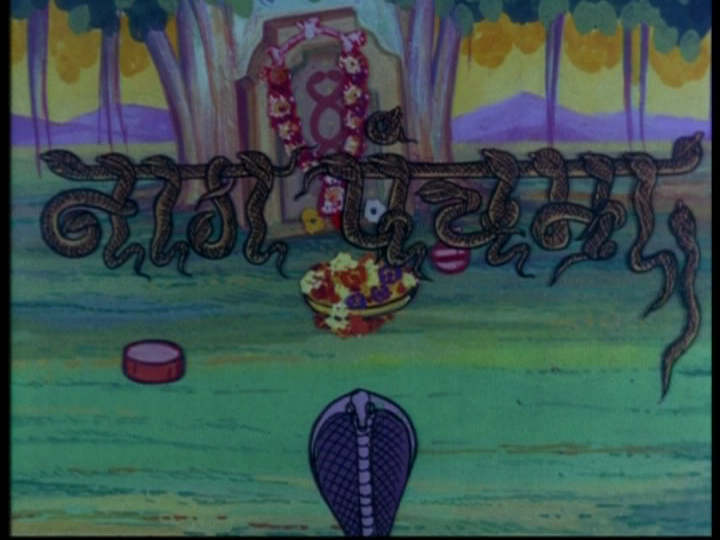
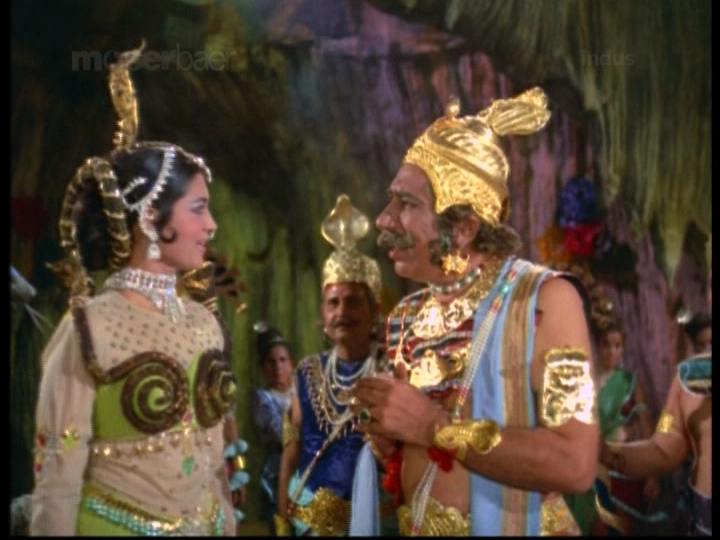
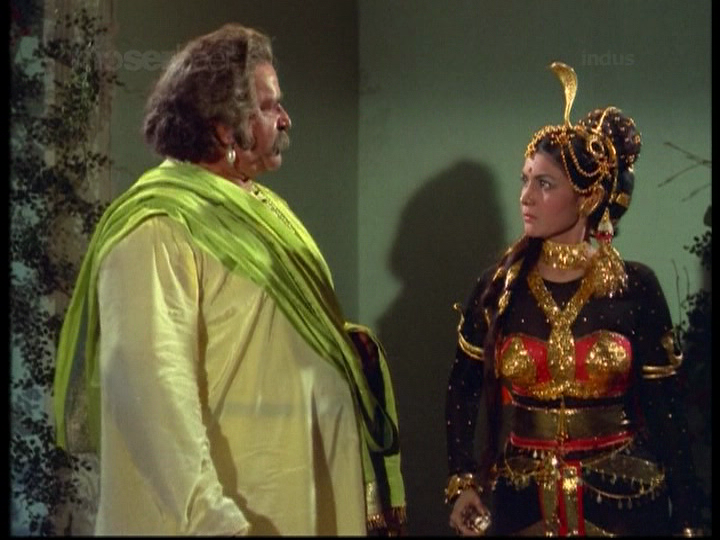
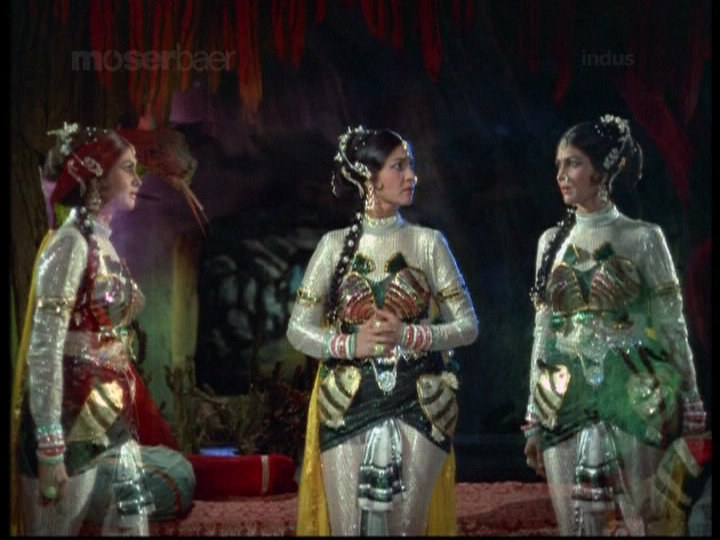
Perhaps as an omen of the awesomeness which is to come, the film opens with some excellent snake animations which include a very snakey title. Love it!This film is a feast for costumes lovers – every outfit seems to have extra glitz, glamour and shine with some really amazing fabrics and accoutrements. Just look at these bodice designs – very apt for the snake goddess and her poisonous serpent sidekick:


And just for some variation, later on Goddess Mansa decides to try out a fish theme with a wonderful headdress.But there are also plenty of real snakes throughout – not just on the costumes – although the film seems to use a combination of some really quite bad model snakes interspersed with the real thing. These are some of the real ones.

Naag Panchami starts with the rather petulant Snake Goddess Mansa having a bad day. It’s her birthday but she is restless and irritated by her followers in Naglok. Fortuitously Nagraj turns up and she manages to cajole him into revealing the name of her father, who is none other than Lord Shiva. Mansa is thrilled by this news and immediately goes to see her father who takes her to meet her mother and siblings in Khailash. Once there she discovers the existence of ‘the rest of the world’, and decides she wants to be worshiped just like Shiva and the other Gods. To achieve her aim she decides to make Lord Shiva’s chief devotee Chandrakhar her worshiper too, and to that end she appears to him on board his ship and demands his instant worship. But the successful merchant is unimpressed by Mansa and reviles her for her arrogance and presumption.

Various ploys by Mansa to force his worship fail to work and finally she kills all six of Chandrakhar’s sons. Mansa seems to work on the theory that the more insane her actions, the more likely it is that Chandrakhar will devote himself to her, which of course is guaranteed to have the opposite effect entirely. Lord Shiva very wisely declines to get involved so the scene is set to allow Mansa to do her worst.

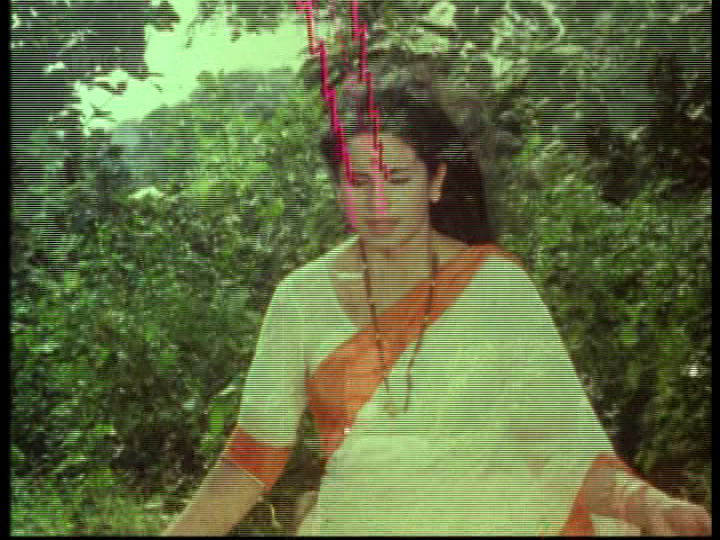
As part of her long term plan she then approaches Chandrakers wife Alta and gifts her with another son – not really a lot of consolation for the lost of the last six, but then that’s not her ultimate plan. Rivers flow, birds fly and suns set as he grows up incredibly fast to be the handsome and dashing Lakshmindra. Lakshminda crosses paths with the equally daring and beautiful Behula when she is out hunting. Naturally the two fall in love and in next to no time determine to marry.

Meanwhile, Mansa’s chief handmaiden Maithreyi has also married and as husband and wife are cavorting in the forest, Lakshmindra inadvertently runs over her husband in his chariot, killing him instantly.

Unaware of this fresh disaster Lakshmindra is now under threat of death from both Mansa and the vengeful Maithreyi – a situation with plenty of snakey potential. It all becomes very Sleeping Beauty-ish as Mansa turns up to the engagement and threatens Lakshmindra with death on his wedding night. Queue evil laugh Mwah ha ha ha! Even Maithreyi is starting to look a bit worried! To protect his son, Chandraker orders a house to be built of iron to ensure that nothing will be able to enter and kill his son. Now I would have thought that an iron house would be quite impractical , hot in summer and hard to keep warm in winter, and not necessarily the only way to keep snakes at bay. Nevertheless, the newlyweds end up in a supposedly impregnable house on their wedding night. Except of course it isn’t. Maithreyi turns up to seek her revenge, but Behula is resolved to save her husband and manages to convince Maithreyi not to kill Lakshminda.

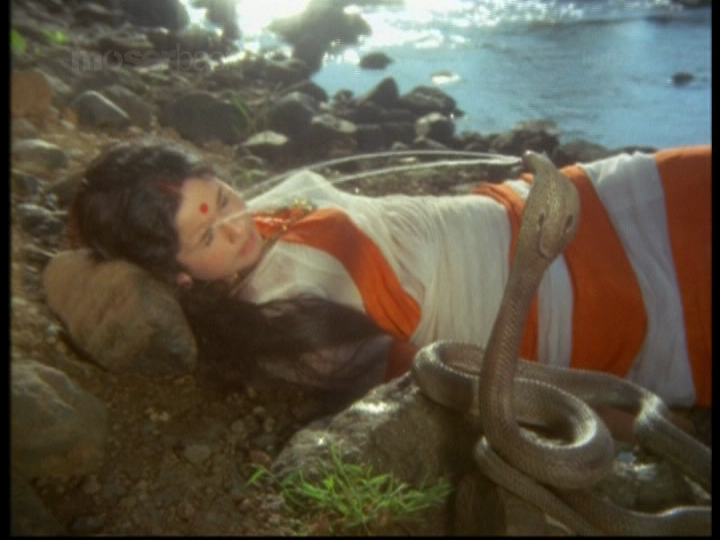
Sadly though, after Maithreyi leaves, neither Behula nor Lakshmindra think to bung up the hole in the wall and Mansa sends another snake which does manage to complete the job. Not one to be easily defeated, Behula resolves to carry her husband’s corpse on a pilgrimage around various temples in order to revive him. While on her quest, Mansa assails Behula with many really bad special effects including a huge crocodile and lightning induced blindness just to name a few.

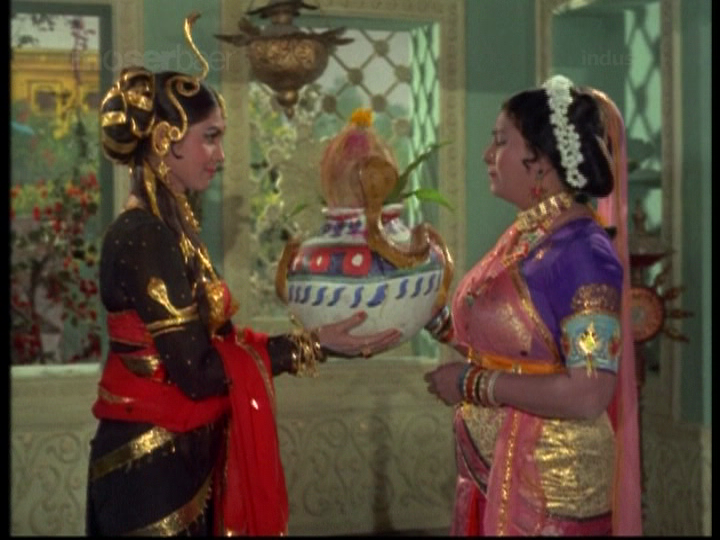
We also get to see that not all snakes are bad, or at least not all the time, as Maithreyi turns up to help Behula in her snake form, towing the body to safety and waking Behula up with a nicely placed spray of water. I really do think all of this would have been much easier to accomplish as a human, but probably nowhere near as much fun to watch.

I really enjoyed this film. The costumes are wonderfully sumptious and there is just oh so much evil that Mansa manages to accomplish. The songs are fantastic and with playback singers Asha Bhosle, Kishore Kumar and Lata Mangeshkar and music by Ravi it all sounds beautiful. There is even a great snake dance by Maithreyi as Mansa looks on in her fab fish ensemble – already mentioned by jenni, but I think it deserves to be seen again.

The snakes here do conform pretty much to the standard in the Filmi Snake Spotters Field Guide. There is the less is more approach to clothing, plenty of embellishments and headdresses, great eyes and plenty of snake inspired architecture to pose with. Mansa also has the ability to conjure snakes whenever she is feeling annoyed with someone and flings them around with gay abandon. She becomes more and more maniacal and Shashikala is wonderfully crazy, changing from self-indulgent and immature one minute to totally malevolent and insane in the next.  Her eyes get wider and wider and she is definitely a master of ’the look’. She even talks to herself.

Maithreyi (Jayshree T.) is much less vengeful despite losing her husband, and a much nicer person snake all round. Hers becomes the voice of reason which Mansa of course totally ignores.

Jayshree Gadkar is lovely as Behula. She invests her with grace and determination and plays the devoted wife perfectly. Out of her lavish costumes as the princess she looks beautiful in her plain sari when she is making the pilgrimages around the various temples. The other actors are all fine but are mainly just there as targets for Mansa. Prithviraj Kapoor is suitably imposing as the rich merchant, and Ashish Kumar does a good job as Lakshmendra. Satyendra Kapoor has a small role as Lakshmendra’s friend Vishwavardhan and makes the most of it.

The end involves various Gods and Shiva dancing to shake the world – yet more excellent costumes and ‘bad enough to be really good’ special effects. This is so much more than just another snake movie and I’m rather surprised that it doesn’t seem to have the recognition I think it deserves – if only from aficionados of shiny fabric and bejewelled headdresses. A great film for Nag Panchami Film Fessstival  I love it! 4 stars.

Sheshnaag

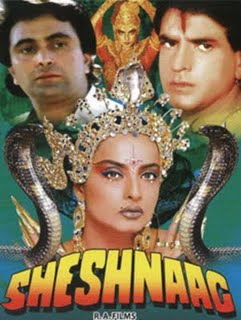
Sheshnaag is an excellent masala snakefest starring Jeetendra and Rekha, with a starry supporting cast and the added delight of Danny Denzongpa as the EVIL Aghoori. The Laxmikant Pyarelal soundtrack is mostly snake dance related, which means lots of snaky dancing! And I think director KR Reddy captured a vintage feel with Sheshnaag which doesn’t seem like a film released in 1990.

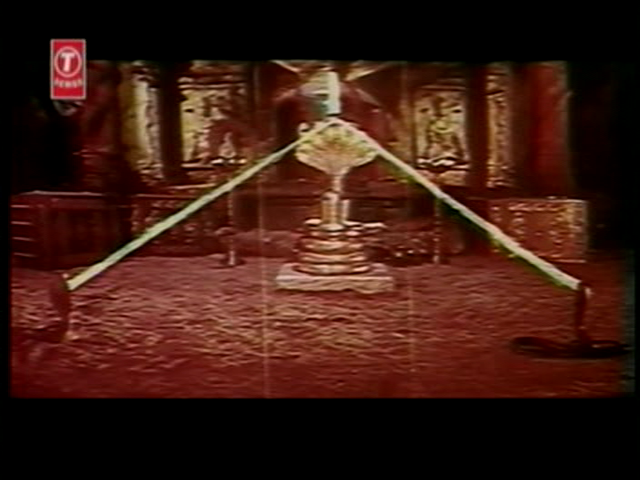
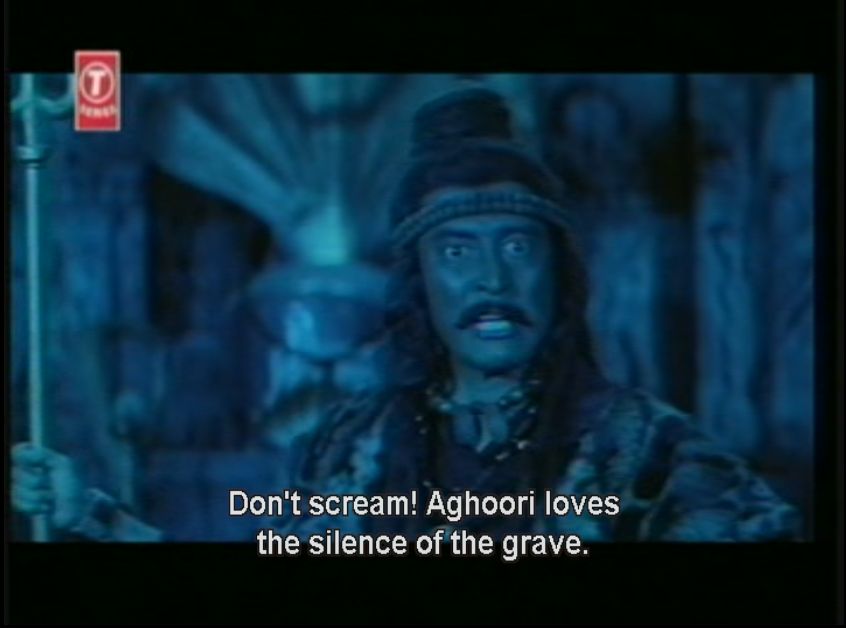
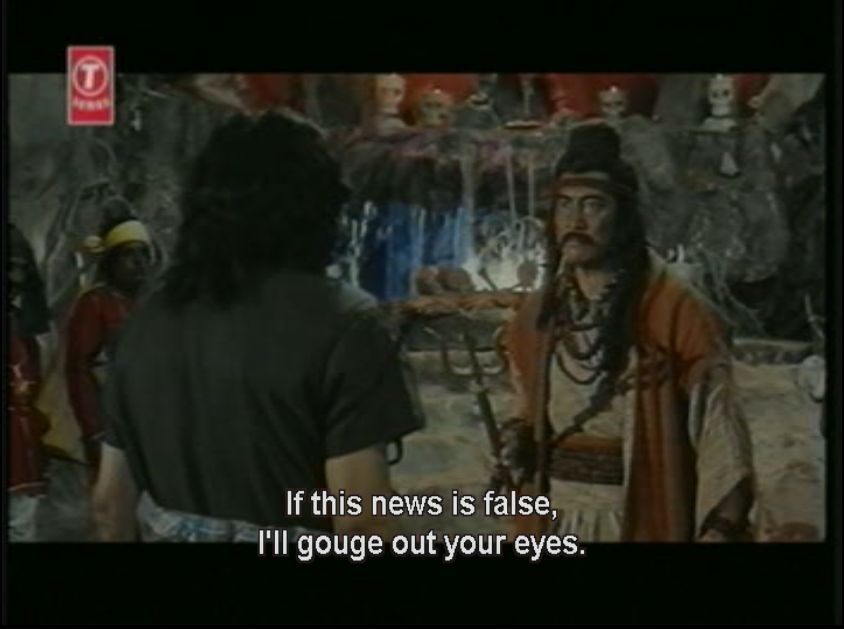
Allow Aghoori to describe his origins as a creation of the devil and show you around his cave:


My DVD has the worst picture quality but the most marvellous subtitles. Aghoori is hunting a nagin couple, Pritam and Banu, who unlock a treasure trove every lunar eclipse using amazing special effects.

They give the wealth to the needy and hold the key to immortality. Aghoori is obsessed with power and filled with venom, determined to become more powerful than the gods.

Identifying the snakes in this film is very easy as they are a) not shy and b) one of them is Jeetendra (ref The Jeetendra Effect).

While this epic battle between good and bad is being waged, there is evil afoot in the human domain. Champa (Rekha) is left to look after her mentally backward brother Bhola (Rishi Kapoor) and her horrible husband (Anupam Kher) after her father dies. Bhola is protective of all animals including snakes and he can charm any animal by playing his flute. He falls afoul of Aghoori’s henchman when he saves the female snake Banu (Madhavi), thus winning her gratitude. Champa’s husband wagers her mangalsutra and then her person in a game of cards – he is really vile. After calling on Krishna to help her escape a rape attempt, she runs away and leaps from a cliff to escape her pursuers. Just as I was bemoaning an appalling under-utilisation of Rekha, Banu uses her powers to transform into a replica of Champa and come to Bhola’s aid to repay her debt. They move into a nicely decorated mansion with excellent snaky decor and are set for the good life.


Jeetendra joins the household as a servant so he can be close to his wife and help look after Bhola. The rest of the story is then a crazy race to see if Aghoori will take over the world.

I really disliked Rishi’s acting, character and storyline in this. Bhola’s under-developed intelligence would have been challenging for any actor, but Rishi just opted for flattening his hair and mugging for the camera.

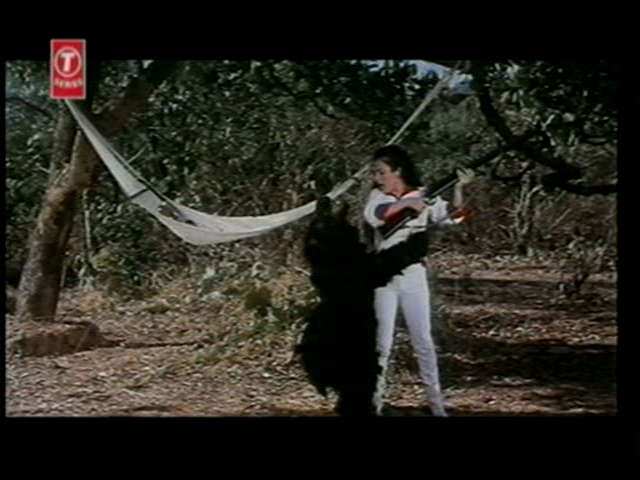
There is a romance track for him, as Kamini (Mandakini – not a snake despite those eyes and some questionable outfits) is driven into his arms by a startling bear attack. She’s a hunting, shooting type of gal from a family of animal hide dealers but clearly life had not prepared her for finding a small person in a bear suit humping her leg.

It doesn’t seem to be a good match, and Bhola’s utter stupidity doesn’t help matters. If you knew someone wanted to hunt game, would you call more of your animal friends to stand in front of the armed lunatics? Honestly. It’s a revolting episode and apart from all the fake blood pouring from animals, I think Rishi stepped on a pigeon for real. Bhola wins Kamini over with his gormless vapidity, and takes from her intended, a creepy gun toting cousin.  He swaggers around, confident that his sister will always protect him. When Jeetendra decides to make Bhola a warrior to protect everyone…well I’m sure you can imagine. Beth queried whether headbutting clay pots was a documented snake fighting technique. I suspect the technique was chosen as Bhola’s head was solid wood.

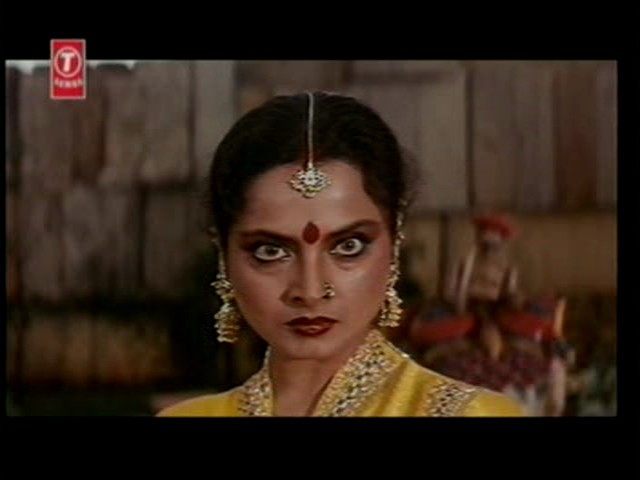
Rekha is a powerful actor and being a vengeful snake allowed her to unleash her forceful side. I question whether it was really worth jeopardising your immortality and powers just to save a backward fool. On the plus side she gets some awesome outfits. I preferred Madhavi’s dancing, but Rekha does handle the venom spitting (her venom strips paint) with aplomb and has mastered The Look.


Banu/Champa’s resolve and certainty drives much of the action and she takes responsibility for her family in both her human and snake roles. When Bhola drags her human husband back and expects Champa to accept him, she is unrelenting and cold despite the combined anger of the men.

I mentioned Bhola was annoying? Even allowing for times and morality having changed, how could anyone demand someone they love take back into their household a man who brutalised and humiliated them? It’s all wrong, and not helped by the bad acting. Rishi was lucky he had Anupam Kher in the same cast as it makes Bhola look marginally better. Anyway. Back to the snakes.


Rekha’s scenes with Jeetendra are sometimes quite touching as Banu/Champa is aware of the consequences of committing to helping the idiot human, and knows they are in danger from Aghoori too. They also get some more of those special effects. When (WHY?) she decides to sacrifice herself to save Bhola I was quite upset. WHY REKHA WHY???

Jeetendra is there. He really doesn’t have all that much to do apart from dancing, flying, biffo, biting, duelling and housework. He is not the dominant snake in the marriage and I think it’s safe to say that Madhavi/Rekha wears the lurex pants in the relationship. I swear he’d never seen a broom until this film, and he seems to torment Bhola more than he does anything else in that household. Jeetendra got some excellent snake powers including an array of coloured lighting effects and a unique fighting style.


His first fight with Aghoori is hilarious, and he also has a nice line in venom spitting (his is flammable).  His dancing…He is not good at partnering the ladies in their dancing. Luckily they seem to manage to navigate around him. He also did an interpretative vengeful Snake Dance which was memorable.

Madhavi had a much smaller presence in the film than Rekha, but her dancing is lovely and she had some fabulous snaky accessories.

She and Jeetendra employed a fighting style that involved jabbing the victim with their fingers rather than biting so I think maybe they had venomous manicures.  The outfits for all the snakes really are worth a look.


Danny Denzongpa owns the film. He is insanely evil and in cackling good form as Aghoori. I loved this performance and I cheered extra loud when Aghoori sent Bhola flying with a few well placed kicks. Not everything an evil person does is necessarily bad!

And what happens? I really can’t say. But I do give the film 3 1/2 stars!