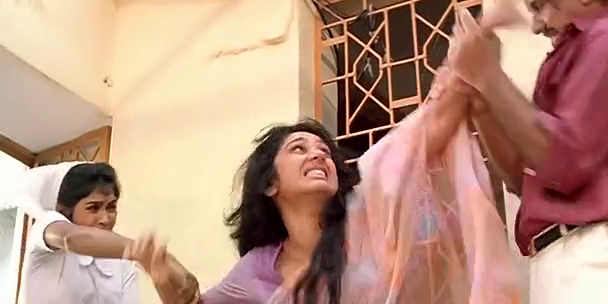
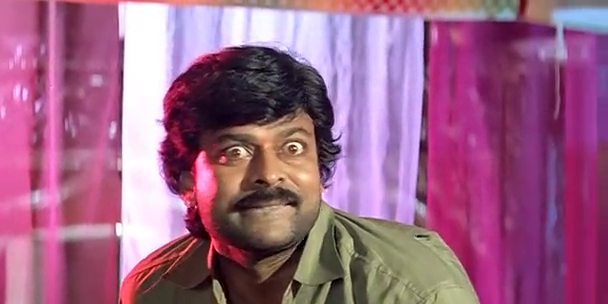
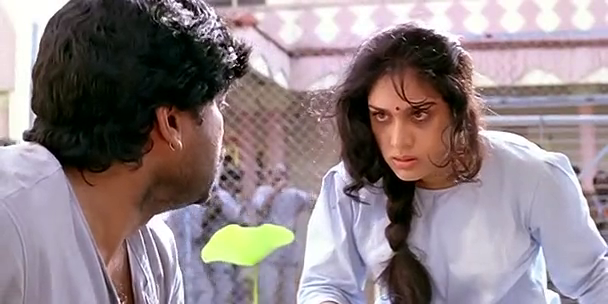
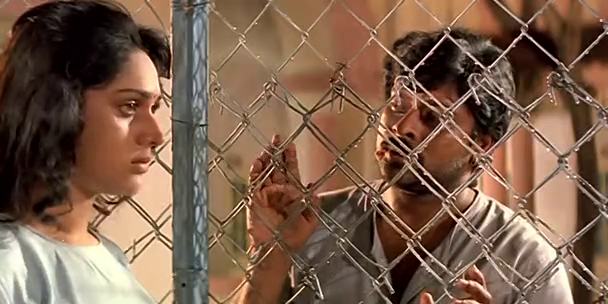
Neel Kamal (1968)

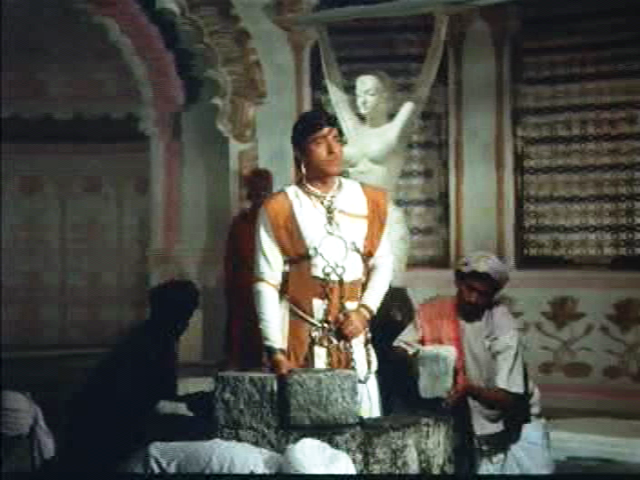
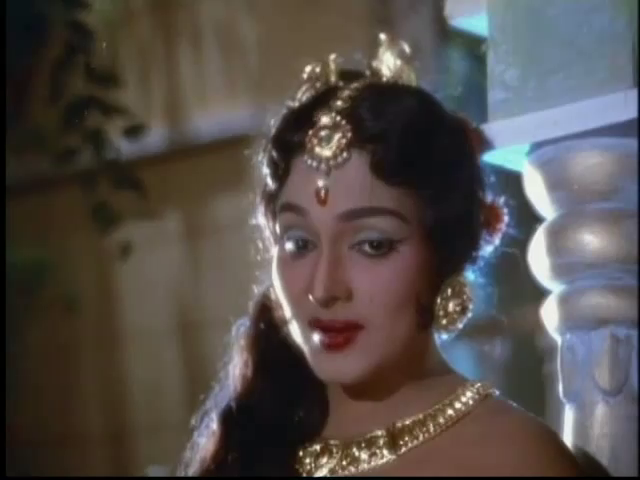
Rajkumari Neel Kamal (Waheeda Rehman) is in love with poet/architect/sculptor Chitrasen (Raaj Kumar). He designs a Rang Mahal for her father, and as a reward asks the king to give him Neel Kamal.  Instead he is walled up alive, and the king forbids anyone to mention Chitrasen ever again.

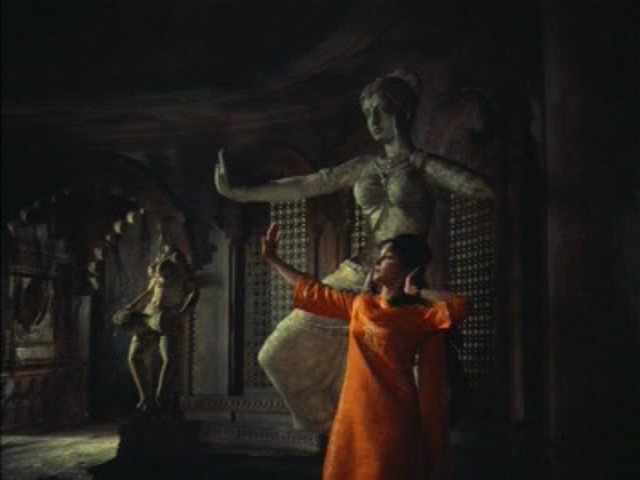
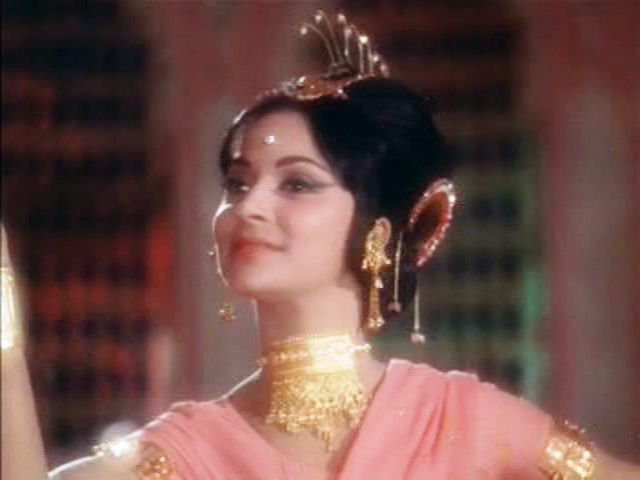
Sita Raichand (Waheeda Rehman) is a nice girl and good student. On a school visit to the ruins of the Rang Mahal she is overcome by a phantasm of music and dance. Thereafter she is afflicted with sleepwalking and has no recollection of why or where she goes.  She just has time for a very fun musical number before the drama kicks into melodrama.

She is lured out into the night by a voice, a voice beseeching his love to return.  Sita is the reincarnation of Neel Kamal, and Chitrasen is still waiting for her.
His voice is impassioned and yearning. This song is used in many scenes, and I particularly like this a cappella version.

The somnambulism is dismissed as something that may ruin her reputation and so needs to be hushed up rather than treated.  Her wedding is arranged with the help of a friendly local guru (David Abraham). As the doctor breezily assured Sita’s father, once she was busy running a household and looking after children she simply wouldn’t have time for any psychological affliction. Poor Sita. The name alone gives a clue that she will be tested over and over.

She marries Ram (Manoj Kumar) and moves in with his mother (Lalita Pawar) and sister Chanchal (Shashikala). Her sleepwalking continues, and no one seems to care about why or what is happening apart from the potential damage to their prestige. Ram is the kind of hero who instantly believes the worst of his wife just because his Ma says so. I have to admit Sita’s ability to walk, accessorise and elegantly drape a saree in her sleep may have made me suspicious, but surely they could have discussed it. Manoj Kumar is adequate but not overly interesting as Ram. I spent most of his scenes waiting for him to do the hand over face thing, but the closest he got was a half hearted effort (at 1 hour 28 minutes if you need to know).
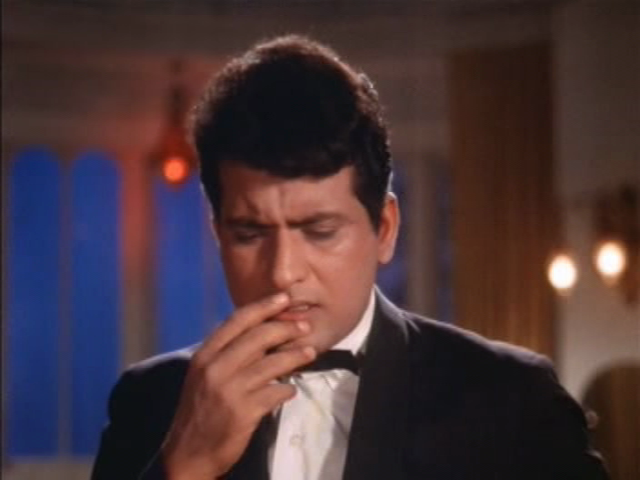
Their relationship, apart from all the judgemental and non helpful rubbish, is affectionate and quite passionate. With Sita’s romantic choices limited to a dead man or a mummy’s boy, I was pleasantly surprised to see her in a more or less happy marriage.  Of course, this also makes her suspect in the eyes of the mother-in-law. If she likes sleeping with her husband there’s no telling what else she might be up to. The floozy!

The Thakurin and Chanchal are the real baddies in this tale, not poor ghostly Chitrasen. Like Cinderella’s ugly stepsisters they take every opportunity to harass and punish Sita, casting her actions in the worst possible light. The word ‘slut’ featured often in the subtitles. Adding to Sita’s woes, Ram goes away on work (after promising a doctor not to leave her alone ever) and the Thakurin sacks all the domestic staff putting Sita to work running the house.
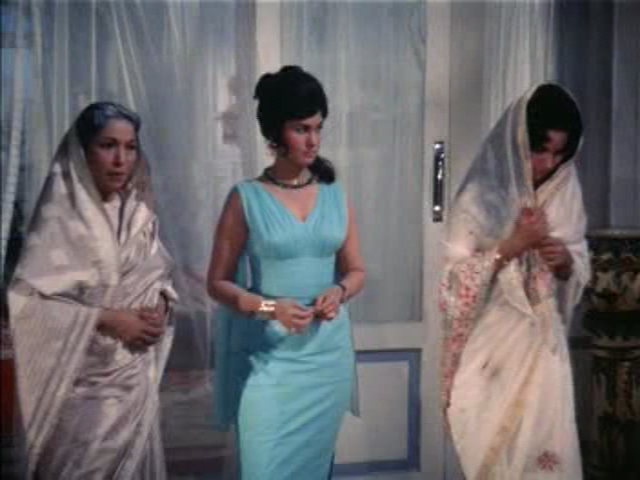
Shashikala is great as Chanchal. She seems to relish her mean character, and her mockery of husband Girdhar (Mehmood) is cruel but funny. All the love (or the pheromones) in the air seems to have quite an effect on Chanchal. She seems destined for dissatisfaction as Girdhar is not quite the soul of passionate romance. Mehmood is both useless and pivotal to the drama. His ‘comedy’ is not even slightly amusing, but the hen-pecked loser of a husband is the one who finally takes action. I like Mehmood in the right doses, but this is not him at his best. Lalita Pawar’s character is more obsessed with izzat than about just tormenting her daughter in law but she teams up beautifully with Shashikala to be really horrid. And they are so mean – they even take all of Sita’s lovely clothes!

Although both Ram and her father profess to love Sita very much, neither of them seems to trust her at all. They easily believe the worst, or refuse to see the evidence in front of them. Neither man seems to place as much importance on her health and well-being as they do on her honour and how it reflects on them. Mr Raichand (Balraj Sahni) eventually makes an attempt to help his daughter but Sita by name Sita by nature; she refuses to fail her ‘test’ by leaving.

Sita is not a doormat though. She is strong although, in my opinion, misguided. She could go back to her father, but lots of dialogue about izzat and a weepy pre-wedding song seems to preclude that. She tries to mend her relationship with Ram, and asserts her rights as his wife, but he doesn’t support her when it counts. The ‘haunting’ by her past life love is really well executed. It is a gradual process, wearing down her energy and resilience so that it is easier for her current day bullies to best her.  Her nocturnal wanderings place her life in danger more than once, and she is often tired and confused by day.  Waheeda possesses an elegant beauty that cannot be disguised by a dowdy old saree. She shows the exhaustion and suppressed emotions as Sita struggles to make sense of it all, as well as the happy, radiant young woman in love. I really like her performance even though Sita is one of the characters I might occasionally like to slap some sense in to.

Raaj Kumar is not an attractive man, but his performance as Chitrasen is quite compelling.  From his brief appearance in the opening of the film he somehow makes a strong enough impression that Chitrasen is very present in the rest of the story. The loss and confusion he feels as he lingers in the space between life and death is palpable. He tells Sita that he was killed for love, but couldn’t die because of that love. He reminds her over and over of who he was to her, and tries to make her recall their life and the happiness they had. On the downside, he is not a dancer. And there are not enough artfully placed pom-poms in the world to distract from that. Warning – the following clip contains flashes of nipple (his).

Ultimately Neel Kamal/Sita can’t continue being torn between two lives. Will the past be too strong for Sita? And if Chitrasen wins his Neel Kamal, what happens to Sita? And what will happen with Ram and Sita and their marriage?

Despite finding much of the story quite trying, I really do enjoy this film. I’m not sure how to articulate this other than to say it is an engrossing and atmospheric film with the supernatural and reincarnation aspects flavouring the everyday drama. The sets are stunning, with ornate design and statuary, very nice chandeliers and excellent moody lighting. My DVD looks terrible in screencaps or I would inflict many many more interior design details on you. Waheeda’s performance is lovely, her costumes are beautiful and suit her character. The music by Ravi builds a mood of love and regret and Mohd Rafi is just perfect as the voice of loss and sorrow. It’s a pleasure to watch, even though I occasionally want to slap a few people rather hard.

I do have to make some small deductions for Ram being so annoying, the poor mental health practices, too much teary self sacrifice, and some witless comedy.  3 ½ stars!

Heather says: I was a little disappointed by this film. The opening credits led me to expect something a little more eerie and the lack of any spooky ghosts or macabre happenings was a bit of a letdown. Then the movie skipped forwards in time and any hopes of suspense were totally lost when no-one seemed to really care why Sita was sleepwalking or where she was trying to go. Since I also knew why she hearing a haunting melody and wandering around there was no suspense in these nightly outings either. I really got very little sense of atmosphere from the film apart from in the first rendition of the beautiful tujko pukare mera pyar song. To compensate for the rather pedestrian story though there were some wonderful performances. Manoj Kumar was very appealing as Prem even if his character did seem to be a bit of an idiot at times. Waheeda was beautiful and periodically did manage to get across the confusion and mental disruption than Sita was experiencing. However, like Temple I was frustrated by her continual acceptance of the abuse from her mother-in-law and sister-in-law without even attempting to either explain her problem or object to their treatment of her. It made her character a bit of a wet blanket which I don’t think was the intent. I also found that the story veered off into overly dramatic scenes and declarations just when it would have been more effective to cut the melodrama and concentrate on the more simple interactions between Prem and Sita. The worst issue though was the constant interruption of the main story by the characters of Mehmood and his wife. Although I love Mehmood, and some of his scenes with the excellent Shashikala were genuinely funny, these breaks in the main story totally disrupted the flow of the film for me.

I loved the opening scenes though and Raaj Kumar was fantastic as Chitrasen. He had so much charisma and it was a shame that there was little interaction between him and Waheeda until near the end, as they did some have convincing chemistry together. I was a little surprised at how attractive he was here actually as I can’t think of another film I’ve seen where he had the same appeal. But I am now looking for more!

The best part about this film was undoubtedly the music. The melodies are beautiful and both Mohammad Rafi and Asha Bhosle are at their wonderful best in the duets. Although it’s not a film I would particularly watch again, except for those opening scenes with Raaj Kumar, I love the music and keep playing the songs. 3 ½ stars (which is mostly for the music and a half star extra for Raaj).

Aapathbandavudu

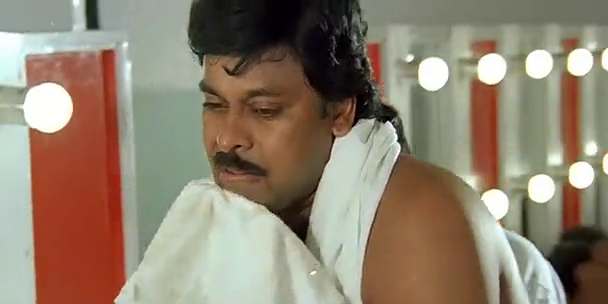
Aapathbandavudu is a melodrama by K Vishwanath that has a bit of action, a ‘will they won’t they’ romance, ‘medicine’ found only in films and some lovely MM Keeravani songs. The memorable performances by Chiranjeevi and Meenakshi Seshadri make their characters likeable and their predicaments seem meaningful. Even with the tear soaked dialogues, dubious plot devices and inexplicable decision making, it is very entertaining, sometimes funny, and often moving.  I admit my love of Chiru helped me get past the ‘oh no they didn’t!’ moments but there are interesting ideas and dialogues that help balance out the excesses.
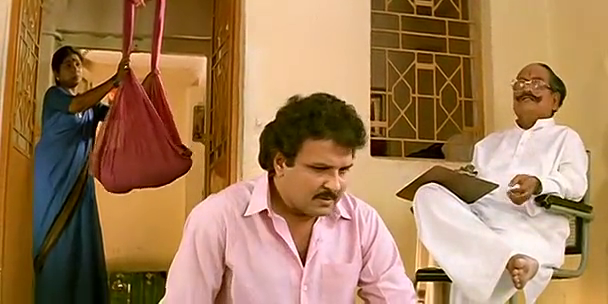
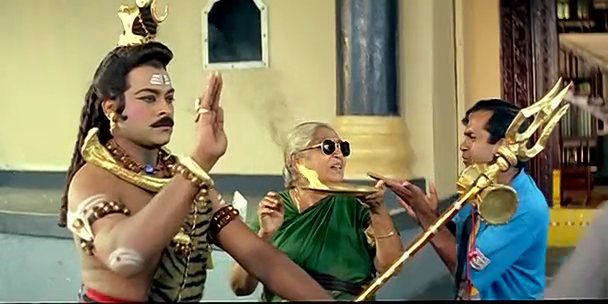
Good hearted low caste Madhava (Chiranjeevi) is attached to school teacher/poet (Jandhyala, who also wrote the dialogues) and his family. Apart from cow herding, Madhava is also the preferred Lord Shiva in district theatricals. Do not try and usurp his role – or this could happen to you:

Sigh. Did I mention this is a visually pleasing film?

Camera angles reflect the sense of elevation Madhava feels when he is compared to Lord Shiva, and he glows with pride at embodying the deity. But he is a country boy at heart and when his cow Ganga goes into labour his first thought is to get her off the train and into some privacy so she won’t be stressed. It’s a dynamic role that gives Chiranjeevi ample scope to use his mass hero shtick as well as delivering a nuanced performance. Most of the laughs come from situations and dialogues as well as Chiru’s knockabout physical comedy.

But I didn’t really need Madhava hamming it up in bovine (or ursine) ‘speech’.

People exploit Madhava’s generosity to make him fix their problems, but as Hema (Meenakshi Seshadri) says, it is usually him who pays the consequences. Despite his simplicity, Madhava is not stupid. He can find a loophole in an instruction as well as any lawyer, such as promising not to lay a hand on someone and still managing to rough them up. He takes on a local bigwig and employs a fighting style possibly inspired by Hanuman as well as Shiva, complete with his own vengeful song. In turn, the politician resorts to elaborate and inefficient methods to try and get Madhava out of the picture – including an attack by an enraged bull (mostly a fibreglass prop), and a murder attempt in a rigged performance. Luckily Hema realises what is going on and takes the guise of Shakti to protect Shiva. I love his dancing from around 5 minutes onwards as Shiva’s rage is unleashed.

But seriously – what is it with the rabbits?

Madhava has always called Hema a goddess, and when they dance as Shiva and Parvati he sees her as his goddess. He is very aware of the barriers between them.

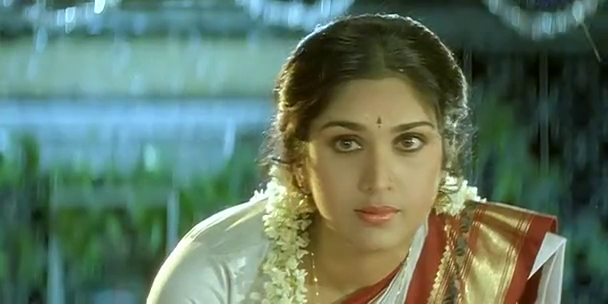
Meenakshi gives Hema a distinct character and intelligence, and her emotional development is well portrayed. She is becoming physically as well as emotionally drawn to Madhava, and is both disturbed and excited by these feelings.  Hema tells Madhava she wishes he had the sense to understand what is in people’s minds, but he doesn’t. There is yearning and dreaming on both sides.

The first section is mostly rural romance with a caste barrier and a few dishooming fights, and I really didn’t expect the twist to take the form it did. Have a happy song before things get dark.

Hema’s father dies suddenly in the middle of a ceremony to honour Madhava. Chiru is brilliant as he shows the overwhelming emotions surging through the grief stricken and furious Madhava. He crafts a clay lingam and berates Shiva for his neglect despite all the prayers and offerings.  A kindly priest points out that just as Madhava could destroy what he had made, man is god’s creation and god has a right over our lives too. That seems to comfort him, but Hema is just devastated.

While Madhava is away, Hema visits her sister Lalita (Geetha) and baby niece. She is assaulted by her lecherous brother-in-law and Lalita is killed when she tries to intervene. The police are paid off and that is that. The shock, her grief over her father and sister, fear of a repeat attack – all these things cause Hema to become unstable. She exhibits extreme aggression towards men and is committed to a psychiatric hospital as her family cannot cope. Apparently a punch-up and a food fight is all it takes to fake insanity, so Madhava is soon an inmate and watching over Hema. Most of the inmates act happy and childlike and mental illness is made to seem harmless.

Rape and mental illness should not be used as cheap entertainment fodder, and there are disturbing abuses of power by characters in the film. What I liked was that other characters found these incidents as reprehensible as I did, and tried to get some justice. The mental patients had a right to decent treatment. Hema wasn’t blamed for being attacked or having a breakdown, and her family never abandoned her. There was some empathy shown for the damaged people. Not everything was swept under the carpet, but the powerlessness of the average person in the story was so frustrating.

Meenakshi plays traumatised Hema as intensely angry and determined to fight any perceived threat, which includes all men. When the drugs kick in she becomes empty eyed and withdrawn. She can’t recognise Madhava as her friend but she does eventually recognise she can trust him. When a staff member tries to rape Hema, Madhava defends her and is given shock treatment as the doctors think he is psychotic.  He is further accused of being the rapist, and his suffering is palpable as is his desperation to help her.

Chiranjeevi adds an extra layer of pretence as he switches from Madhava to Madhava (over)acting crazy, and there is a marked deterioration in his appearance once he is an inpatient.  On that note, while the idea of Chiru dressing up and having himself delivered to me in a box has some appeal, this costume may have caused the more fragile patient to have a bit of a setback. But the dancing is great!

Madhava manages to spend some time with Hema and uses a very ugly doll to reignite her memories of home and loved ones, sparked by a favourite lullaby. Compared to some of the other goings on in the asylum that struck me as quite sensible and therapeutic, and indeed she is soon released.

Madhava is left beset by fear and sadness. He has given everything he can, including selling his herd to get money to help the family, and may have ruined his own life. He berates himself for his stupidity in a powerful speech to his reflection, but can’t see any way out of this mess, or the asylum.

The ending is so filmi incredible but I still found myself on the edge of my seat. Just how could it possibly work out? And why on earth were so many people overcome with bad luck and bad judgement all at once?

There are no comedy uncles as such. Brahmanandam is Madhava’s friend and provides some physical comedy but largely this is a straight character role for him and they share a nice rapport. Allu Ramalingaiah as the uncle resents Madhava’s position in the family and has a sharp tongue when voicing his disapproval. Like Brahmi, his role is dramatic, not the comedic turn I expect from him. Sarath Babu as Sripati wants to do what is right, and is the sympathetic ‘other guy’. There is something reassuring about Sarath Babu and having him as a friend does seem to make the good guys that much more resilient. Jandhyala is very fatherly, and suits his role as the unfashionable teacher and poet who refuses to cheapen his art.

The emphasis is more on characters than causes although the film does say something about caste, dowry and other facets of society. It is wildly melodramatic, but the writer and actors invest in the central characters and there is plenty to enjoy along the way.

My DVD cover says this is a ‘must see movie before you die’. I’m not sure about that, but I encourage you to at least look at the song clips. The village scenery is pretty and beautifully filmed, the music is lovely and the dancing is excellent. But really, this is all about the performances by Chiru and Meenakshi and they won me over from the start.

3 ½ stars!

Sorry Chiru.  4 stars?

4 stars!

PS – thanks tolly for the recommendation all those months ago – where are you tolly? It’s been ages!

Thiruvilayadal

Thiruvilayadal is a wonderfully embellished pastel confection of a film, supported by a powerful performance from Sivaji Ganesan as Shiva. Thank you to Suja and Ajit for their enthusiastic recommendations. I am also very grateful to the rajshritamil channel on Youtube for making the film available with subtitles. Suja asked how meaningful or interesting a vintage devotional film would be to a non-Hindu? The answer is – very!

I was raised Catholic which, as a friend said recently, is the glitzy end of Christianity. Catholicism incorporates numerous saints, some having their own specialities or areas of influence so the faithful can pray to the one best placed for their situation. They are identifiable by different visual elements and props, often referencing a gruesome means of death if the saint had been martyred. So the colour, pageantry, stylised imagery and iconography of a devotional film are familiar elements for me even though the philosophy and faith are different. One of the biggest differences is something I remarked on after watching Mayabazar. The relationship with God as depicted seems a lot more direct and personal than I am used to. And Shiva is not immune from displaying vanity and caprice as well as humour and tolerance, so I found it a more human interpretation of God.

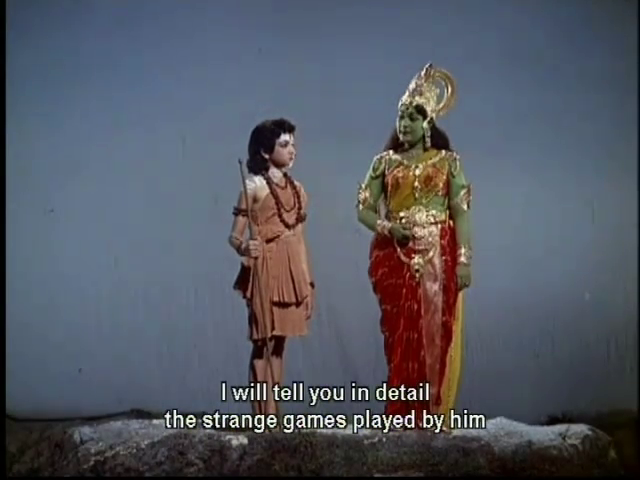
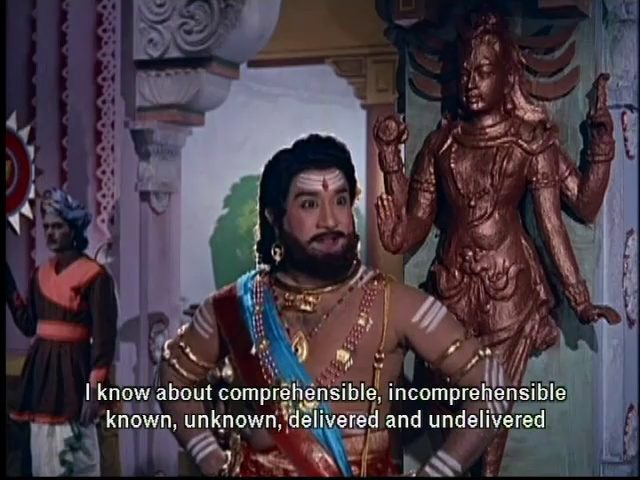
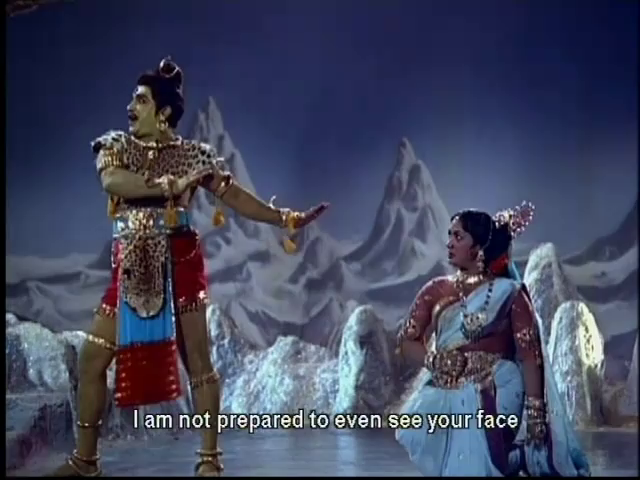
I suspect more than one team was responsible for the subtitles. Why? Lord Shiva speaks like this occasionally:

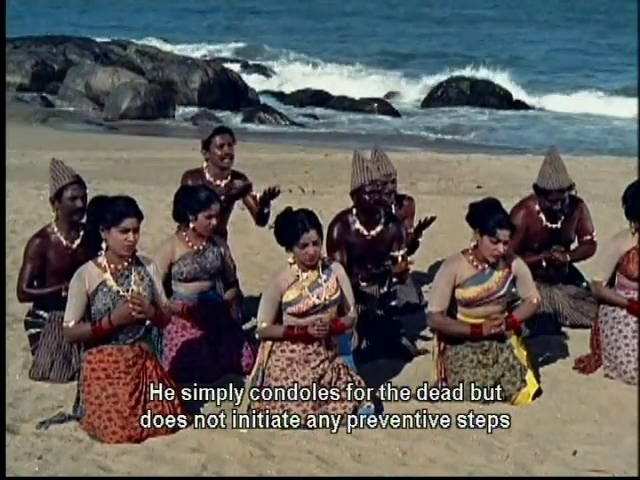
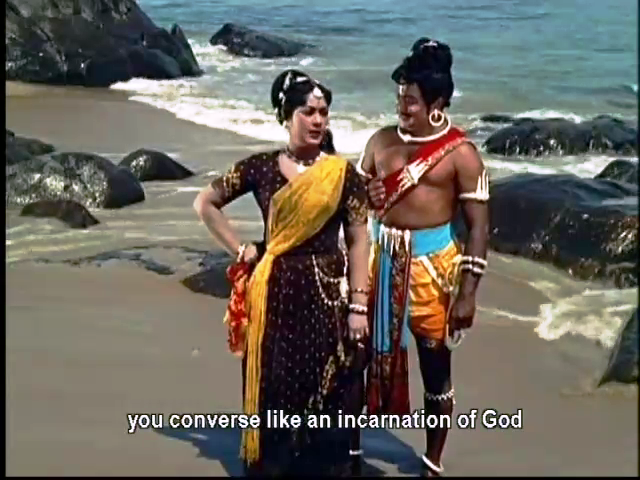
While fisherfolk in a rustic village complain thus:

Anyway, the story begins as a resplendent Shiva (Sivaji Ganesan) receives the praise of his devotees, including his wife Parvati (Savitri), which promotes that groovy mood.

Even divine families have their squabbles and a contest between Ganesh and Murugan ends when Ganesh uses his erudition to define the question and win the prize. Murugan is incensed by losing to his sibling and leaves home. Parvati tries to persuade Murugan to return, and explains that it is Shiva’s way to test his devotees.

She narrates several stories of Shiva’s ‘games’ to persuade her son that there was no insult intended. The stories are very entertaining and the format allows different aspects of Shiva to be explored in array of visually delightful settings. Again, the theme of God testing the faith of an individual is a familiar one to me, but the style and methodology do differ.

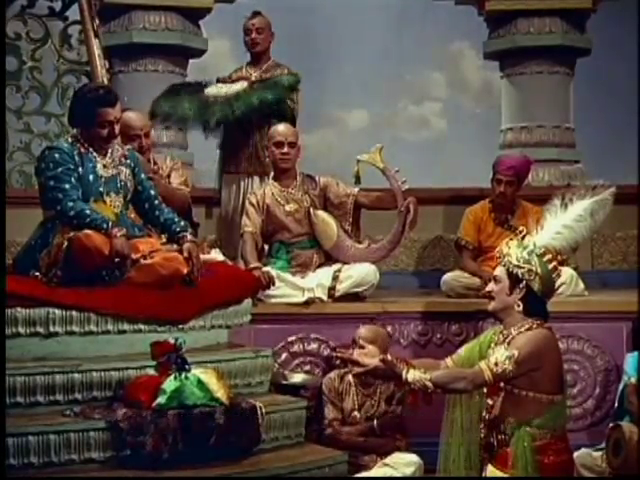
Shiva tests the knowledge (and ego) of a renowned scholar and teases a poor poet. Both get their rewards, but for Shiva the reward seems to be the fun of the game.

And for the viewer, we get an answer to the vexing question ‘Does a woman’s hair possess a natural perfume?’ Muthuraman and Devika are lovely as the King and his glamorous queen, and their ornate palace is stunning.

Sivaji Ganesan revels in the role, exuding a majesty and playfulness that makes him compelling. He is not what I would call handsome but he is absolutely magnetic. His larger than life style is perfect for Shiva. I love this song, performed by Shiva posing as a firewood vendor. An arrogant musician challenges the Tamil court to best him, and the kingdom is at stake. Shiva sets up outside the musician’s residence and psychs him out before the contest by singing a song so perfect it stops the birds in the air and the waves in the ocean. Even if you don’t love the music as much as I did, watch this clip for Shiva’s exuberance and joy in creation and art, and his pleasure in being really annoying.

Savitri is regal and composed as Parvati. She has endured Shiva’s whims for aeons. She is his equal in temper, but he wields his destructive power without fear of consequences where she is more restrained. Once, after momentarily diverting her attention from her husband to her son, she was punished by being born in a fishing village with no memory of her divine nature. I think that was a harsh reward for good parenting. Parvati showed herself to be a leader in a human incarnation while in the village. I also enjoyed seeing Manorama as one of her girlfriends.

Of course Shiva wasn’t going to let anyone else win his wife in the ‘he who is bravest’ competition, so he appeared as a mysterious heroic fisherman.

Their flirting was cheesy but lots of fun. And this episode includes one of my favourite filmi things. A shark fight! Admittedly it is more like a rubber whale with dentures in some shots, but look upon the mighty beast and despair!

Shiva defeated the shark, won the girl and kindly restored her to her former glory.

The comedy is character driven and fits into the main narrative. Nagesh plays a poor poet who becomes a pawn in Shiva’s game. His mix of rapacity and naivete is funny without being too much. Shiva’s answers to questions by mortals are often a witty partial truth or play on words. It’s a sprightly and engaging film.

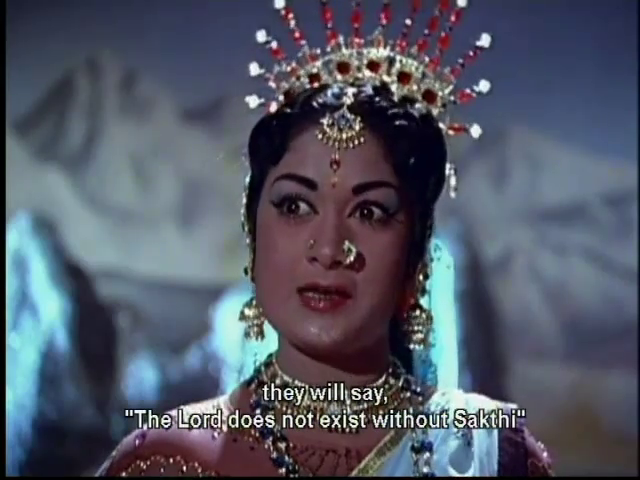
The subtitles are generally very good but I did have some questions about the translations. The balance of Shiva and Shakti is the subject of one story, with neither being able to exist without the other – the balance of opposing forces. After a squabble over her father Shiva uses his power as the destroyer and Parvati/Shakti’s lifeforce is vanquished. (The dance of destruction is dramatic but not terribly accomplished.)

The senior gods intervene and remind Shiva that without her the world becomes barren and dark and he relents and restores her. There are a couple of dialogue exchanges about how all women must submit to their husbands that seem at odds with the theological position. I wonder if it was translation that chose ‘submit’ when the actual word was more nuanced, or if it reflects other beliefs. This image seems to support a balance rather than the dominance of one aspect suggested by the script.

There is a strong theme of the purity and beauty of Tamil language and culture and Shiva rewards those who love and protect the tongue. Many key supporting characters are Tamil scholars and are accorded great respect and some indulgence by the gods. Since this is from the 60s maybe the positioning of Tamil culture and language as superior and preferred by the gods was a reflection of the Dravidian movement or other factors? I’m sure someone will tell me.

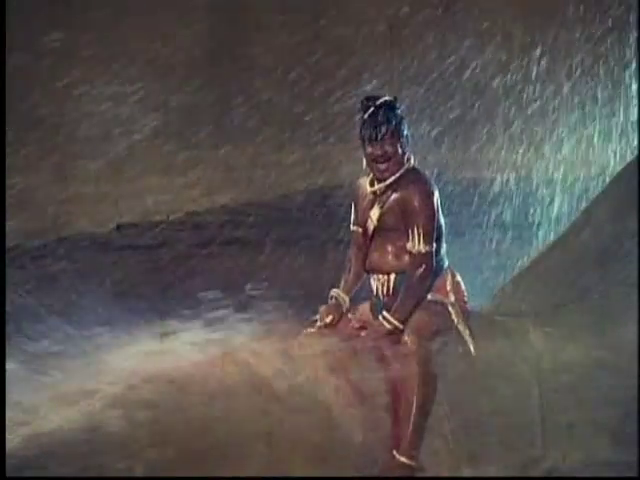
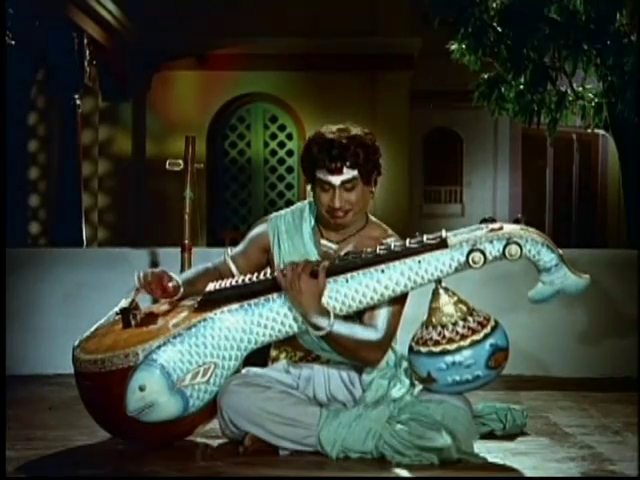
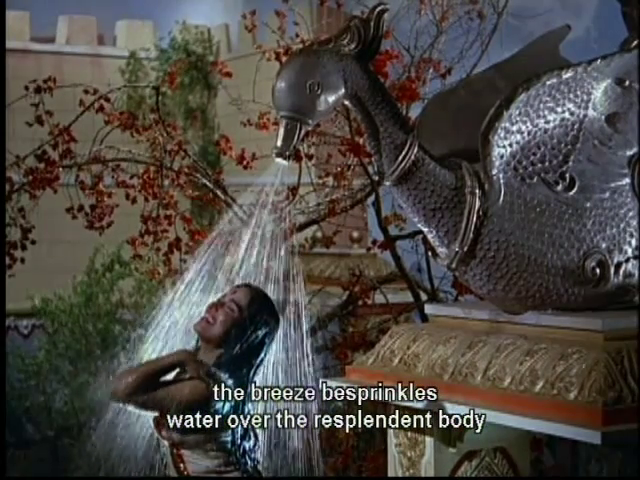
K.V Mahadevan’s music is not only enjoyable but is integral to the stories. The art design is just wonderful. There is such a wealth of beautiful detail, right down to treasures like the fish themed musical instruments and a fabulous bird shower.

The central performers are brilliant, the stories are engaging, and it is a pleasure to see and listen to. There is so much to enjoy in Thiruvilayadal whether you watch it as a colourful entertainment or with a more philosophical analysis. 5 stars!

Heather says: This is a simply a beautiful film. The colours are amazingly bright and it is incredibly iridescent and sparkly throughout. From the opening song and dance until the very end it is captivating with beautiful music and stunning performances. I think this was the first film I saw with Sivaji Genesan and he seems to be the perfect person to play Lord Shiva. He has such charm and brings so much character into the role. I particularly love his Tandava dance after the death of Sakthi where his facial expressions are superb and I love that he dances with his eyes. My dance teacher keeps telling me this is how to dance properly, and this is the perfect example of how much it brings to the performance. Even if as temple points out he’s not technically perfect otherwise. My favourite story is the one about the musician Hemanathan and the song above where there are multiple Lord Shiva’s playing different musical instruments is brilliantly done. Considering the film was made in the sixties and the special effects were presumably rather limited, it’s all put together very well and creates a magical effect every time I see it. And I totally agree with Temple’s comments about the subtitles – the ‘I feel groovy’ perhaps is showing the influence of the sixties, but some of the rest I have no explanation for at all.

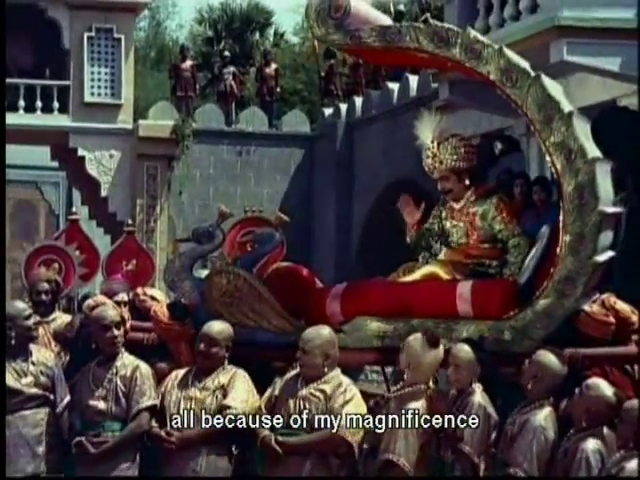
There is at times so much detail in the film that at times it distracts a little from the main action for me. The backing musicians during Hemanathan’s performance have amazing facial expressions and really get into the music. I tend to end up watching them and the various other servants and hangers-on rather than concentrating on the lead characters. But then again, so much of the detail is charming. There is the fish tika on Kayarkani’s forehead as the fisherman’s daughter, the wonderful peacock chariot that carries Hemanathan to the Pandian King and Shiva’s third eye that blinks just to name a few.

Thiruvilaiyadal is an absolute classic, and as a friend said when we were discussing the film, it’s one to watch again and again. 5 stars.