
Neninthe is an enjoyable mass entertainer with a dollop of romance and a splash of action, all set in the Telugu movie making world. There are plenty of references to popular Telugu film personalities starting right from the opening titles, and lots of opportunities to guess who various characters are based on. The humour is funny and cynical, and I really like most of the performances. But despite pointing out the blurred line between reality and film fantasy almost all of the conflicts and questions are resolved in ‘only in movies’ style, and not always in tongue in cheek fashion. I don’t think it’s meant to be a realistic expose of the film industry, and that isn’t how I viewed it, but the story would have benefited from a more careful eye on how these elements were blended.
 Ravi (Ravi Teja) is an aspiring director. He lives with his ailing ma (Rama Prabha), and is a driven character. Ravi navigates the ego traps and financial shenanigans of the movie industry, all with one goal – to direct his film, ‘Neninthe’. He is brutally honest at times and fiercely determined to succeed in directing his own story. Ravi Teja is a very good actor, especially when he tones down the sleazy uncle act, and this role is great as it spans drama, humour and action. Ravi observes the characters around him, often with a sarcastic muttered aside.
 With characters like the infamous director Idli Vishwanadham (Brahmanandam) and associates including producer Sayaji Shinde and production assistants Venu Madhav and MS Narayana, he has lots of material.
Ravi is pragmatic about love and expects marriage to wait on his priorities. I really liked seeing Ravi with his friends, especially his mate who is desperate to be a villain, and mother and they all had a nice rapport.
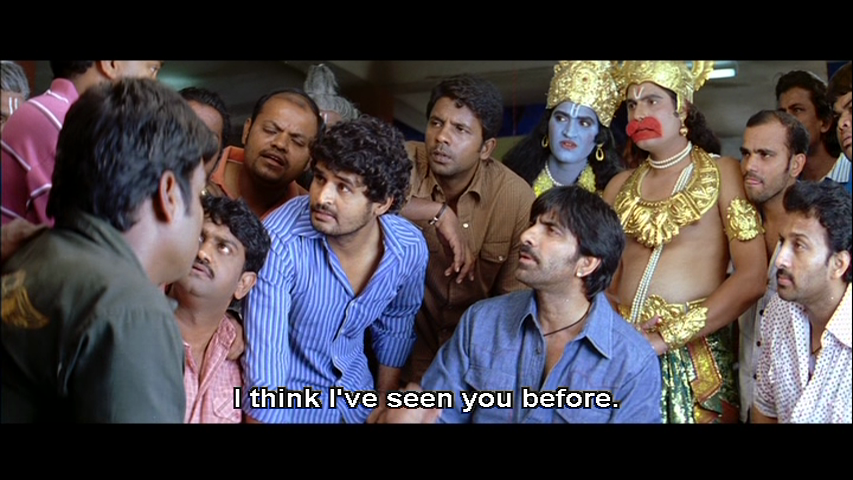 Ravi is a regular guy, albeit with heroic powers when required and can easily thrash a dozen hulking great rowdies. The trigger is more likely to be his career than a girl. Ravi is prepared to compromise over a lot of things, but not his film.
There are setbacks and sadness in his life, but he keeps going, even when it seems he must run out of energy. He represents the idealism and passion of film makers for their craft as well as being the vengeful, protective hero.
 Sandhya (Siya) is an alleged dancer who has no ambition other than her next meal and not getting pimped out by her creepy brother-in-law (Krishna Bhagawan). Both the actress and the role are quite insipid and I wanted to slap her on more than one occasion. Sandhya is pursued by Yadu (Supreet), a local thug accustomed to taking what he wants. She, of course, falls for Ravi and seems to think that she can just leave every problem in her life for him to solve because her love places him under that obligation. It is quite annoying to hear her whining about how Ravi never helps her when she does bugger all to help herself. I am sure it would be hard to ditch the sadistic brother-in-law, but it’s even harder to walk away if you have no spine to speak of. Anyway, she seems set on Ravi, and equally set on changing him.
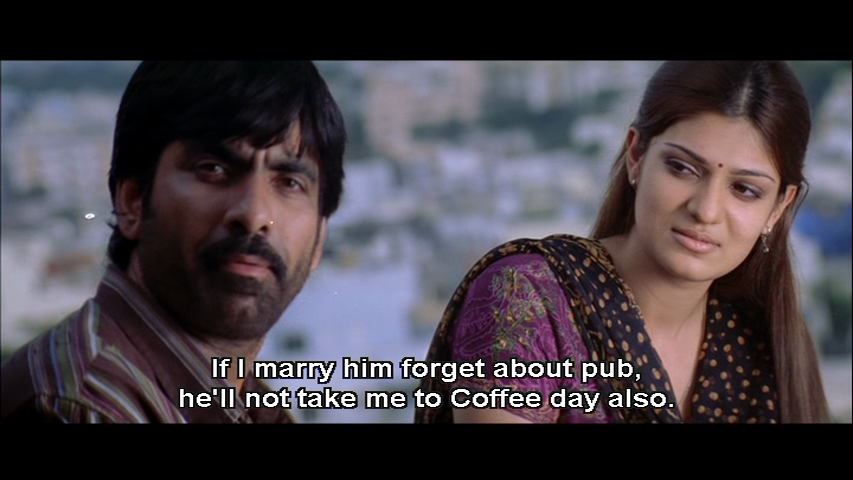 Ravi helps her get a starring role, and her fortunes improve especially as her brother-in-law stops trying to sell her, but the couple start to drift apart. The scenes where Sandhya and Ravi discuss their relationship are well written, and Ravi Teja is believable as the man in love but not blind to practicalities. Siya has some good moments, especially when she is annoyed at Ravi, but she fades when the other stars are present. There was potential for Sandhya to be more interesting but Siya is as convincing an actress as she is a dancer and the script is lightweight.
 Subbaraju is ‘Miracle Star’ Mallik. He was one of the first Telugu ‘That Guys’ that I could pick out from the pack. You know the guys – always a sidekick, policeman or henchman (not to be confused with ‘That Comedy Uncle’). I admit I may have paid particular attention because Subbaraju is rather good looking, even in the shirts they dug up for this film (see them hanging up in the screencap above). But I also noticed him as he seems to be more of a character actor than just a stock ‘type’ and can handle a range of roles. So that got me thinking about the trajectory from supporting actor to hero, and why there are so many ‘types’ and so few honest to goodness character actors in Telugu films nowadays.
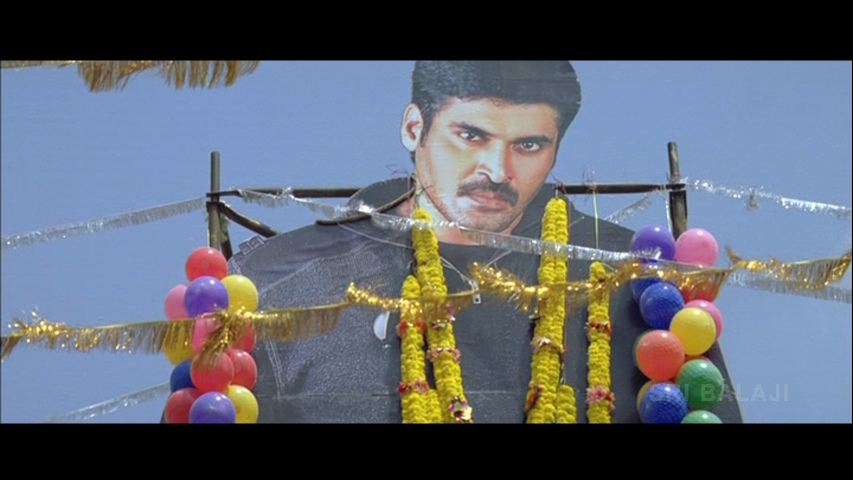

Puri Jagannadh has fun with Mallik as the stereotypical hero, and Subbaraju gives it the right balance of sincerity and parody. He spouts dialogue recycled from Pokiri and then asks if it isn’t a bit over the top, and has a flock of minions fussing over him. Mallik swans about like a total diva and he proves he isn’t above using his fame when it suits. But he also voices concern about the obsession of the die-hard fans and how far they go in the name of their idols, and that forms a substantial sub-plot.


There was a mix of gratitude, ego, and resentment in Mallik’s dialogue about the fans and the effect their expectation has on movie making. If he had spoken to one particular nutter at the right time there may not have been a funeral at which to make that speech, but I suppose that would have been too sensible.
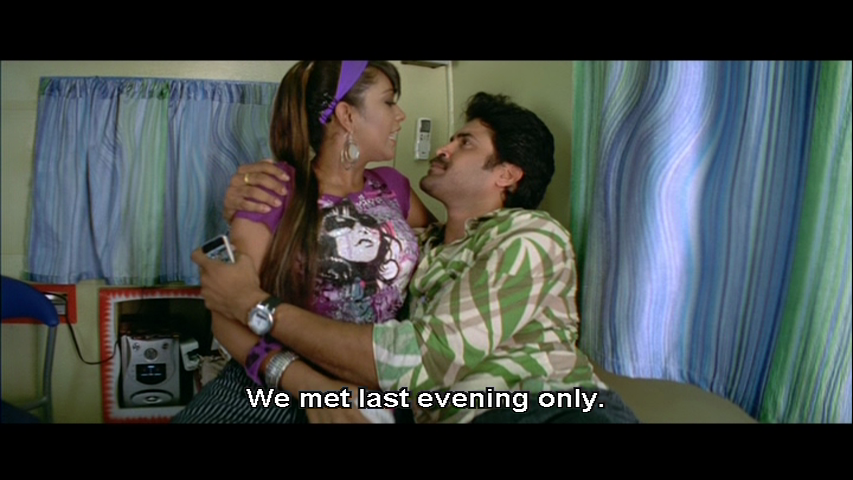 Mumaith Khan is the item girl, and her character is Malik’s girlfriend. Their scenes together are good, except for Mumaith’s occasionally stilted dialogue delivery. They serve more to comment on the obsessions of the press than to provide another romantic element in the film.
That song rhymes bus station with frustration. I just thought I’d mention it as Chakri’s music is pretty lacklustre and that’s all I ever seem to remember.
A confronting ‘movie meets real life’ moments occurs after Mumaith and Mallik break up over scurrilous rumours in the press. Mumaith overdoses, and on the way to hospital her car is hijacked by a couple of Yadu’s men who then rape her. She gets out of her hospital bed to deliver a speech (full of bleeps) to the press about their penchant for creating news with no regard for the individuals or the effect these stories have. It’s a sharp observation, but I wish it had been delivered in a different setting. Anyway, once again a valid point was made via a sensational set-up.
 There is a salacious element in the media when discussing many actresses, and I doubt the same journalists would approve if that tone was directed at their sister or cousin. This would have been an interesting story to film post the advent of Twitter, since that is often what passes for ‘news’ these days. I like Rana Daggubati as an actor but I don’t think his recent tweet about luggage going astray warranted several paragraphs in the Times of India!
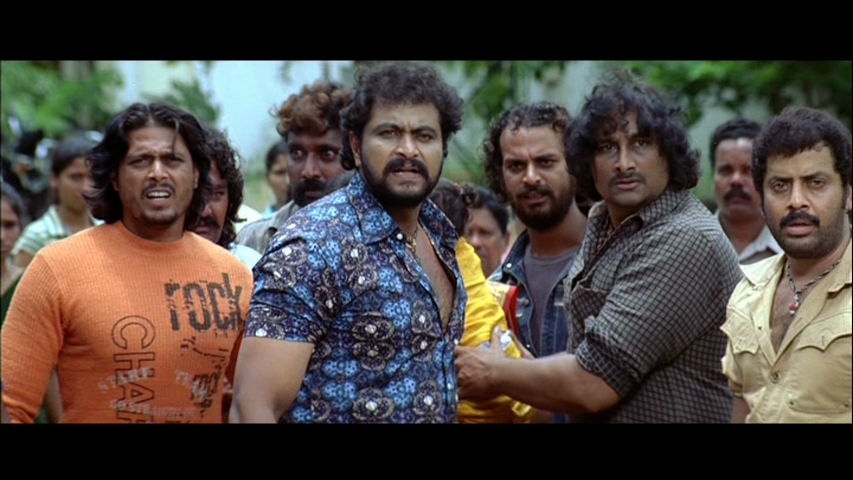 Supreet as Yadu is hilarious and utterly repulsive as he tries to woo Sandhya instead of just assaulting her as per his usual approach. Yadu’s attempts to be appealing are amusing even as my skin was crawling. It was like watching a bear trying to eat with chopsticks –unnatural and bizarre yet compelling. And his gang have some of the worst hair I’ve seen in ages. He is menacing, and doesn’t hold back on the crazy. Yadu’s obsession with Sandhya and the ensuing conflict with Ravi bring the film to a gory final confrontation.
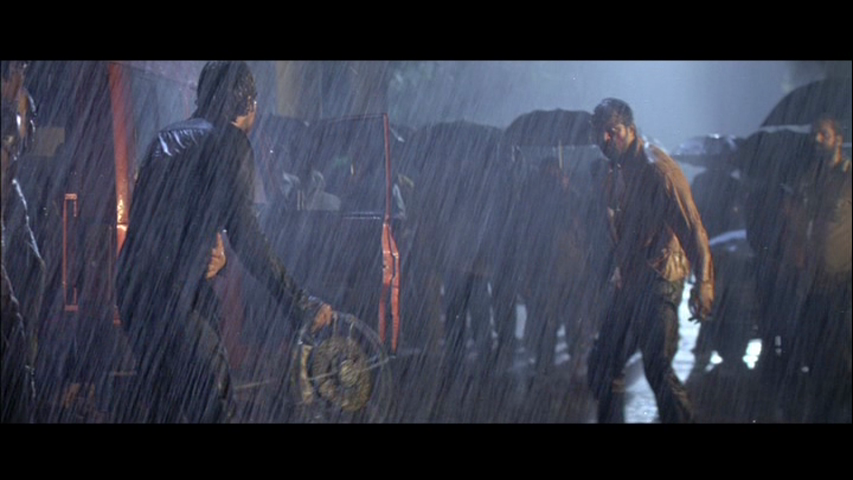

The other supporting actors are generally fine and their characters are integral to the story. There are ambitious would-be directors, assistants to uphold the status of their boss, financiers and distributors as well as family and friends. It’s a crowded film, but the story and relationships remain clear. There are some fairly awesome song costumes too!
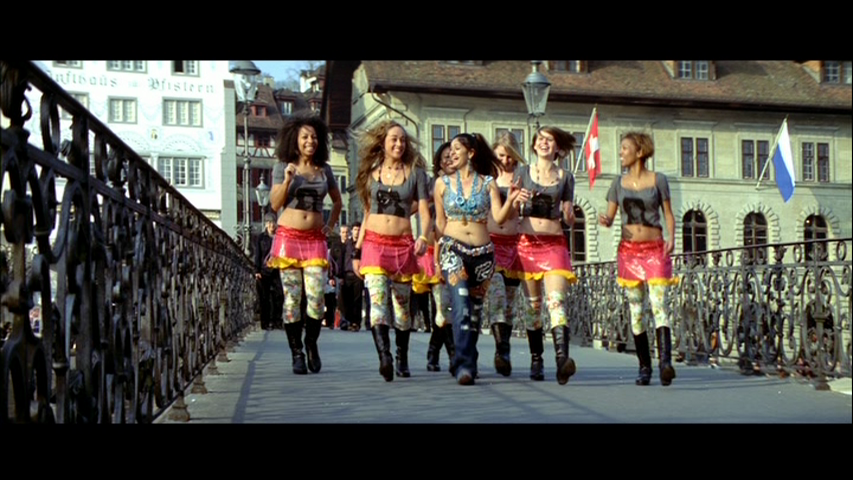
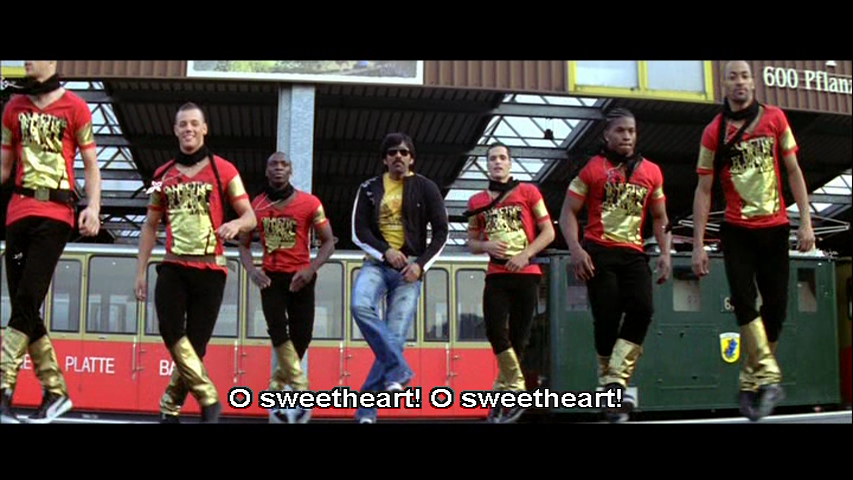
Puri Jagannadh doesn’t stop at movie references in the dialogue – he uses music snippets and visuals, and Ravi even uses a reel of film as a weapon. The dialogue sometimes sounds like a lecture but overall I find the subject and the characters engaging enough. It’s a very well planned and designed film. I just wish he had put as much effort into executing the story. 3 ½ stars.
Quite apart from the potshots at various industry types, I’m also convinced that Puri Jagannadh may hate a segment of his audience. Specifically, me. Why?
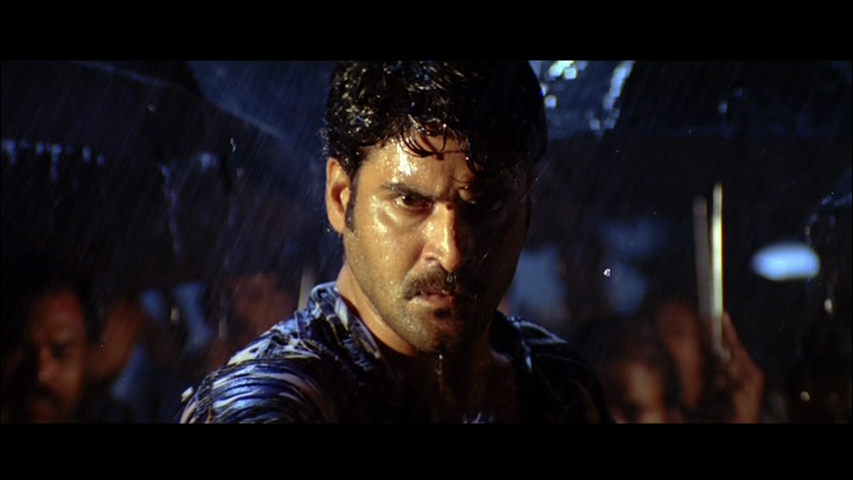
Exhibit A
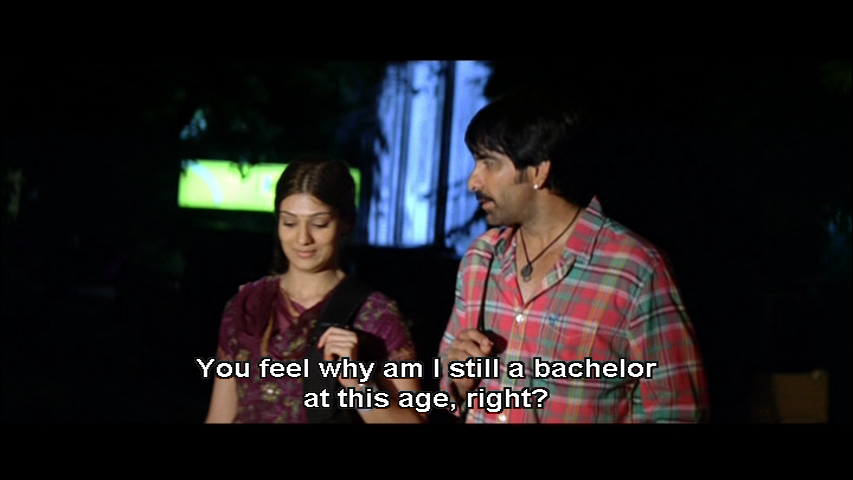
Exhibit B
So who gets a song requiring beachside cavorting?
You’ve been warned.

Heather says: Although there are a lot of elements I do like about this film, there are also a few I don’t like, and it was those that I noticed more on re-watching Neninthe for this review. However it’s one of the best performances I’ve seen by Ravi Teja who is very watchable and charismatic here, although (and I can’t believe I’m saying this) I do think I prefer him unwaxed! I also love the back-drop of the film industry as the setting for the story and the way that Puri Jagannadh manages to get across the routine repetitiveness associated with filming rather than the glitz and glamour that most people associate with movies. However I find the story rather bitty with elements that don’t gel together quite as well as they should. Sandhya has so much to deal with that perhaps it’s not surprising that she doesn’t seem to know where to start. Her character seems to veer between hang-wringing and ineffectual ‘woe-is-me’ to being quite strong and decisive when it comes to making sure that she gets exactly what she wants from Ravi. I found all this dithering to be annoying, and couldn’t feel very much sympathy for her character at all. In fact I think the film would have been better without the romance factor, as it could make just as much sense that Ravi helped her career because he was a nice guy who felt she deserved better. There didn’t seem to be any zing to the romance and apart from the songs, no chemistry between the two actors.
On the other hand I do like Brahmi’s bumbling director and think that the comedy is generally well integrated into the main story. Like Temple, I’m a big Subbaraju fan, and I totally loved him as the ‘miracle star’. Watching this for the second time and about a year and many films later, I did pick up more of the nuances in his performance, and in particular the way his character interacted with the cast and crew as well as the members of his fan association. I think he’s a great actor and apart from doing justice to his role as a stereotypical ‘hero’ he really looked the part too. Mumaith Khan is another of my favourite performers and while she seemed to be basically playing herself, I appreciated the way she appeared on camera with minimal make-up and gave a fairly convincing lecture about the evils of fame. As Temple has mentioned there are many good and valid points made about the way stars are treated by fans, the press and the industry but I agree that the set-up to deliver these messages tended to overshadow the points that Puri Jagannadh was trying to make.
I did notice that the subtitles appeared better than usual – there was a ‘shut your gob’ in there which I appreciated as a very English idiom rather than the usual more stilted direct translations and there were quite a few of these more colloquial interpretations. I also enjoyed the shots of the orchestra with real musicians playing violins properly rather than the usual half-hearted attempts that drive me crazy!
This is still an entertaining film despite the irritating heroine and lacklustre romance. I’d recommend watching at least once for some excellent performances and the general overall view of the movie industry. 3 ½ stars.














 Cinema Chaat