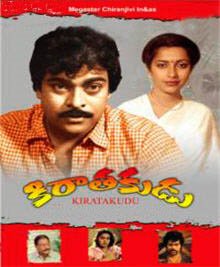
Kirathakudu (1986)

If Kirathakudu didn’t have Chiru and Suhasini in the leads I am not sure I would have persisted. The first hour or so is very trying indeed. But then I would have missed out on an unexpected reworking of John Carpenter’s 1981 classic, “Escape From New York”. If I see Chiru plus subtitles, the DVD is an automatic purchase so I didn’t read anything about the film before I watched it. There is a voiceover about criminals and the government, but the concept wasn’t well translated in the subtitles. Imagine my delighted confusion when it started to seem somewhat familiar.

Chiranjeevi is Charan, a poor rich boy who just wants his father (Kongara Jaggaiah) to show him some affection. Charan spends his time winning every possible sporting and aeronautical trophy, beating people up, carousing and brooding in his room.

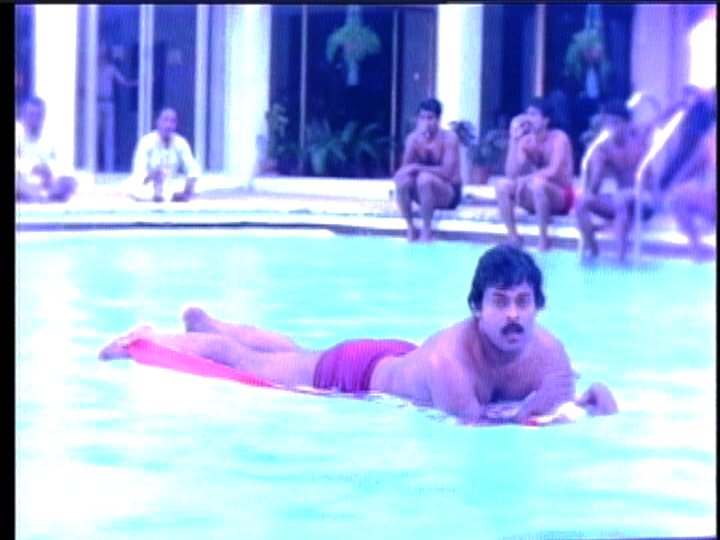
I enjoyed this sporting montage greatly, although it has prompted me to make a statement critical of Chiranjeevi.

His swimming style is splashy and inefficient and he would not have won a race against the under 9s in my swimming club. There – I’ve said it.

Maybe it’s not about winning the race, but about looking stylish on a lilo.
And making bad art.

He is a renaissance man, albeit one with questionable taste, a very bad temper and poor impulse control. He drinks heavily, and I think I was supposed to find this appearance a warning – but he looks so good!
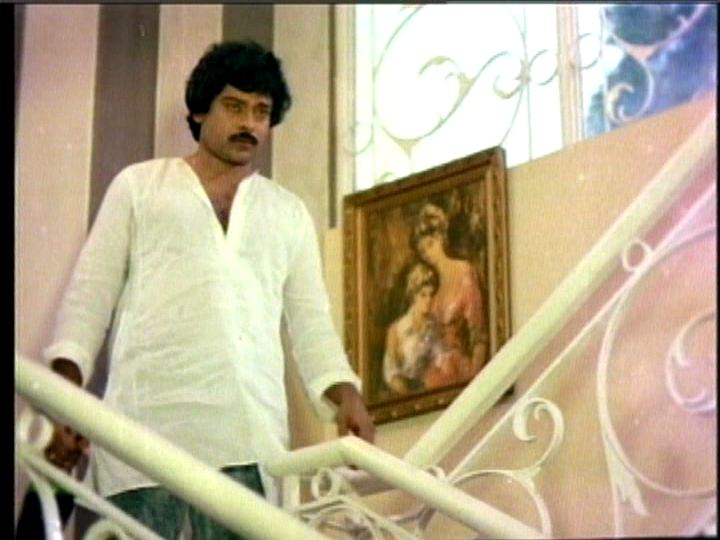
Charan sees a quite unimpressive statue in a local emporium and runs afoul of Swetha (Suhasini) who has purchased the one of a kind piece. His reaction to finding out he can’t have it is extreme.

Swetha is a psychology student, and daughter of the local police chief. She is smart, self assured and is not intimidated by Charan. She is also a raging narcissist from the looks of her house – pictures of her adorn almost every wall.
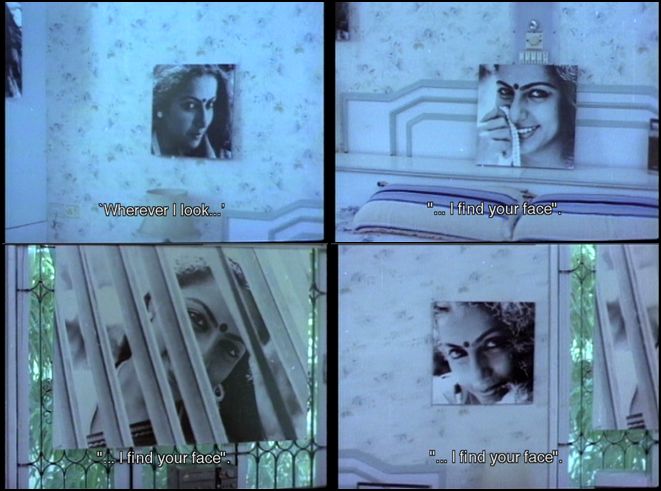
It is interesting that Swetha is given career aspirations and a brain, and yet the dialogues are often very disparaging of women. Suhasini is such a graceful and intelligent actress that I was pleased to see her in a reasonably involved role. She is drawn to Charan both as an interesting psychological study and because he is Chiru – those eyes!

Charan goes off the rails due to the influence of vampy Hamsa (Silk Smitha). Only Chiru could make Charan watchable as he broods, rants and sooks over why his daddy doesn’t love him and then commits crimes as a cry for attention.  Showing that she is smarter than most people in the film, Swetha finds Charan’s hideout and dobs him in to the police. He kidnaps her in a dramatic getaway and their forced proximity accelerates the already budding love.

Having been ruined by a tramp, he feels that the love of a good woman will let him live like a decent person. Yes. Surely it would be unreasonable to expect him to take responsibility or just grow up. She then takes on the burden of reforming Charan and settles in for a lifetime of prison visits. I found their song fantasies quite amusing – Swetha was all flowers and pretty colours, while Charan was much more, um, hands on. One thing they did have in common was their terrible taste in art.

Silk Smitha is Hamsa.

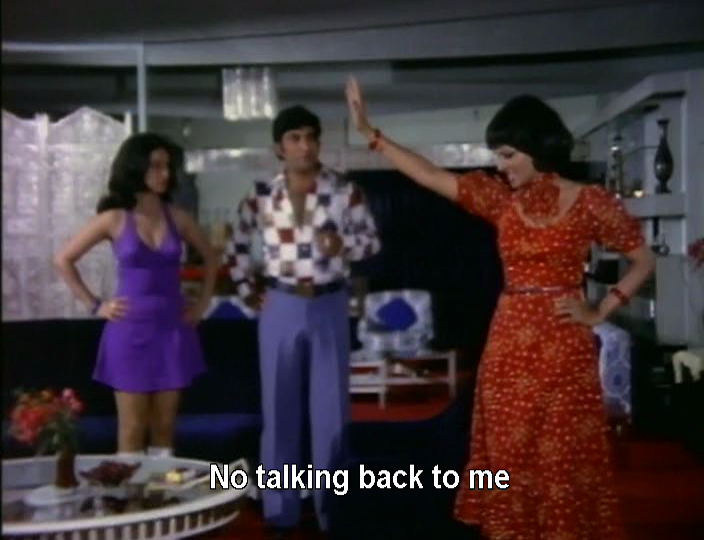
Well, Silk’s arse does most of the work thanks to the constant upskirting camera, but she sneaks the rest of herself into shot occasionally. Hamsa is a Bad Girl who entraps Charan and forces him to turn smuggler (bad) and wear pleather (not so bad). Again, I had to growl a bit at Charan crawling out of her bed the morning after and treating Hamsa like dirt for giving him what he wanted.

Mothers in the film are sacred but women who have sex are evil  – so I wondered briefly about how these idiots thought babies were made. I am not exactly sure why sleeping with Hamsa would be enough to place Charan under Snake’s control, especially given his cavalier attitude to the law and society, but it seems he was besmirched and that was it. The bad girl is usually a thankless role, but Silk gets a few pithy lines and an excellent confrontational cheerleading dance.

The second half of the film took a sharp turn towards awesome. Maybe because Chiru changed into this outfit?

The police need Charan’s help to take on Snake and rescue his dad (and the Top Secret papers) as they could not get into the badlands themselves. When Charan stole a car ferry and chuffed off about 10 seconds ahead of the cops, he managed to hide the ferry within walking distance of a sari shop and judging by the number of Swetha’s outfit changes, remain undetected for days. The man is a genius and I can see why the police appealed to him.

Armed with an array of gadgets and with deadly time release microcapsules implanted in his neck, Charan sets off to save the day. He lands a glider on top of a skyscraper in the crime quadrant, on a mission to rescue his father and protect Indian national security. He had to take a glider as there was no way in by land. In a puzzling development, Swetha and Baby (the cab driver played by Nutan Prasad) decide they have to follow him, and drive in through the front gate in a taxi, sedately avoiding the bombs planted along the route. While the residents look like a left over mob from a B grade post apocalypse horror movie, Swetha is able to glide around in her pristine sari without being spotted. The scenes in this second half are more closely aligned to the original film and the mood is both darker and more absurd.

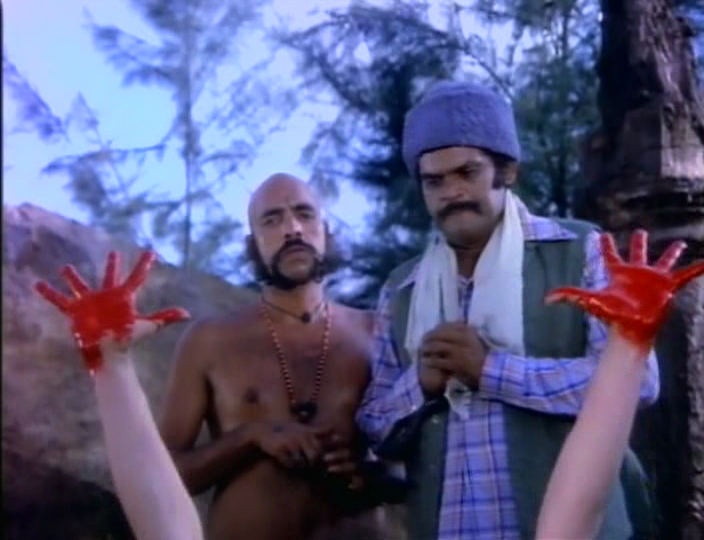
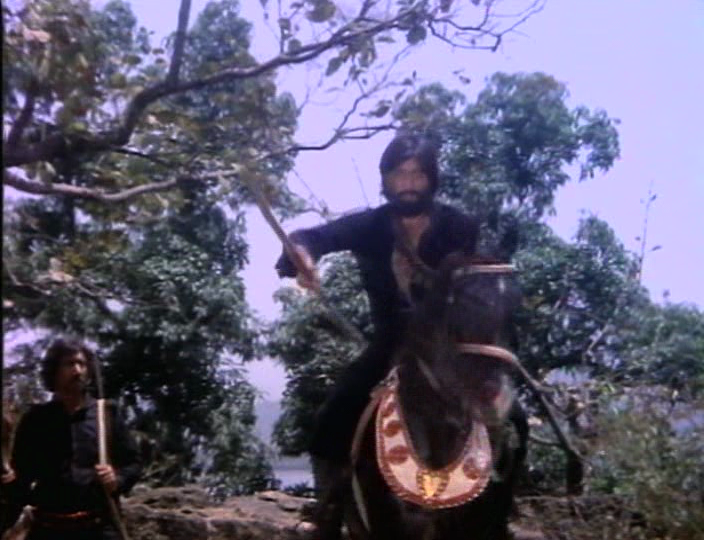
Snake (Kannada Prabhakar) is the kingpin in the sealed off criminal zone. While John Carpenter recreated Manhattan as his prison colony, Snake has to make do with a warehouse complex a few minutes from the downtown area. He has possibly the best DIY lair and henchmen I’ve seen to date, and I enjoyed deciphering the very random graffiti.

Snake is also a psycho killer on a very short fuse.

This guy is quite fascinating.

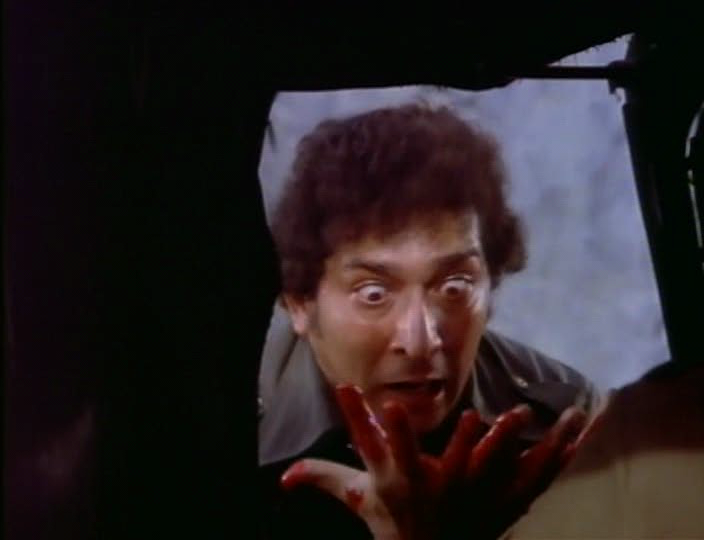
He plays his role of chief henchman with a blend of odd chicken inspired noises and statue postures, and walks with what I can only describe as a slow-mo mince. While wearing a dress (maybe toga).Who is he?
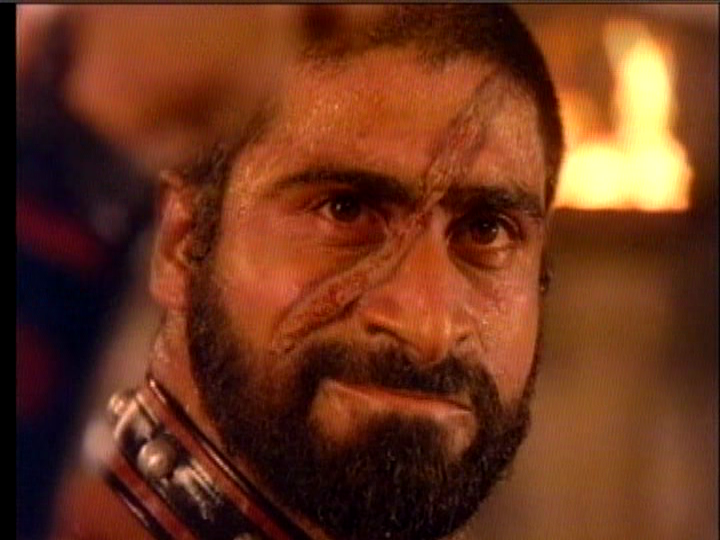
And the guy who would have been played by Bob Christo in a Hindi version of this is back! Last seen in Adavi Donga (the apple peeler Wolverine claws guy) here he is sporting a fake scar and some hideous trousers.

How does it end? Is there any doubt?

It’s a film by A Kodandarami Reddy so I expected crazy, and the second half delivers. I did have to chant the ‘it was made in 1985’ mantra a few times, but even allowing for that I was irritated by some of the dialogue relating to women and their evil powers. Grow up guys! Yandamoori Veerendranath gets a writing credit, but this is a reasonably faithful remake with the addition of loads of sentiment and a message about good family values.

Chiru and Suhasini inject a bit of class into their scenes, and the WTFery dial is set to 11. I’m totally biased due to Chiranjeevi but I’d give this a cautious 3 stars, for the curiosity value of the remake and for the dystopian second half.

Here is a snippet of Silk’s big song number – it is interspersed with the final action sequence so I won’t give away all the surprises!
Yari Dushmani

Or:

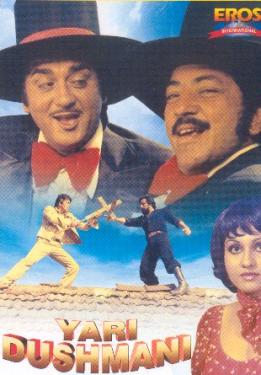
Should you buy a DVD just because Sunil Dutt is wearing a hat on the cover?

 Yari Dushmani is a crazy masala bromance starring Sunil Dutt, Amjad Khan and Reena Roy among others. Directed at a cracking pace by Sikander Khanna, with an incident packed screenplay and zingy dialogue (Aziz Qaisi) and music by Laxmikant Pyarelal, it’s not really a film to analyse but there was loads to enjoy.

Apologies/warning: It’s Easter Sunday and I’ve been surrounded by a gaggle of toddlers under the influence of chocolate for the last few hours, so I’ll be taking the easy way out and relying heavily on pictures for this post.

I happened to start watching this at the same time that Beth was watching another Sunil Dutt film. The films were different but the reason for buying the DVDs was the same – the cover featured Sunil Dutt in a striking hat. I’ve bought a number of DVDs on the strength of the cover and have been bitterly disappointed to find that there were no giant parrots or women dressed as Cleopatra in the film. Naturally we were each curious to see if the movie lived up to the promise of headgear, and if the hats enhanced the film in any way. Oh, and was the film any good. Are hats a reliable indicator of entertainment in a film?

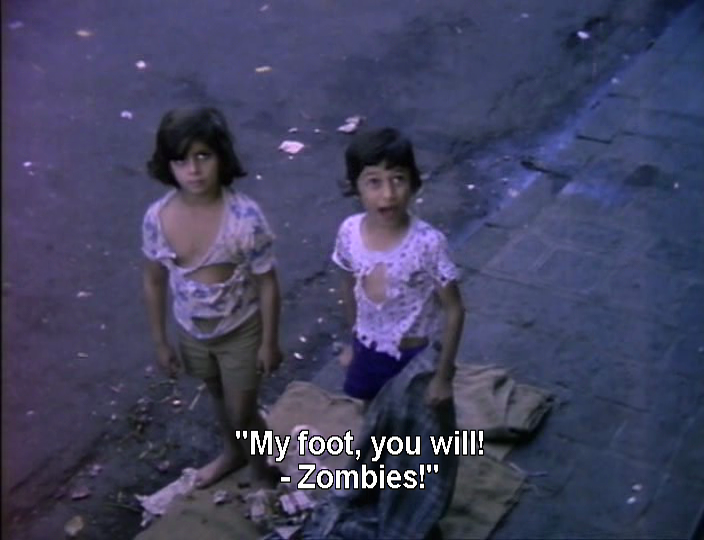
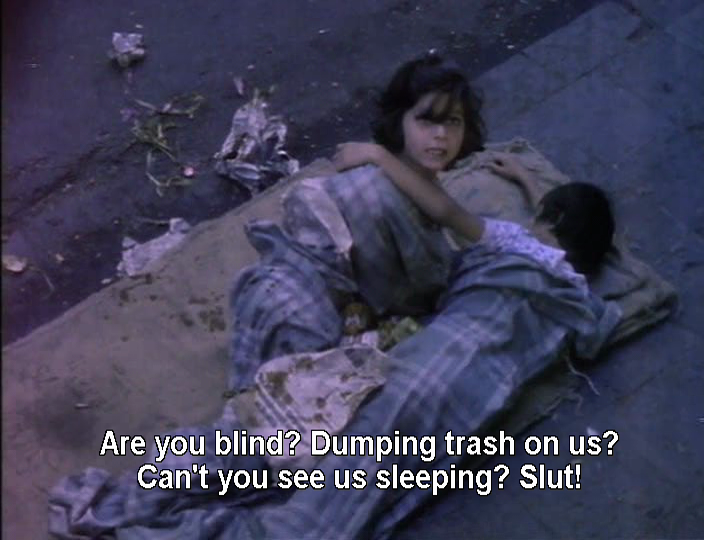
The story opens with two feisty and foul mouthed urchins (one is Master Bittoo but I’m not sure who the other kid is) living on the streets. They are resourceful, try to help people in need and they have a creative approach to finding paid opportunities.

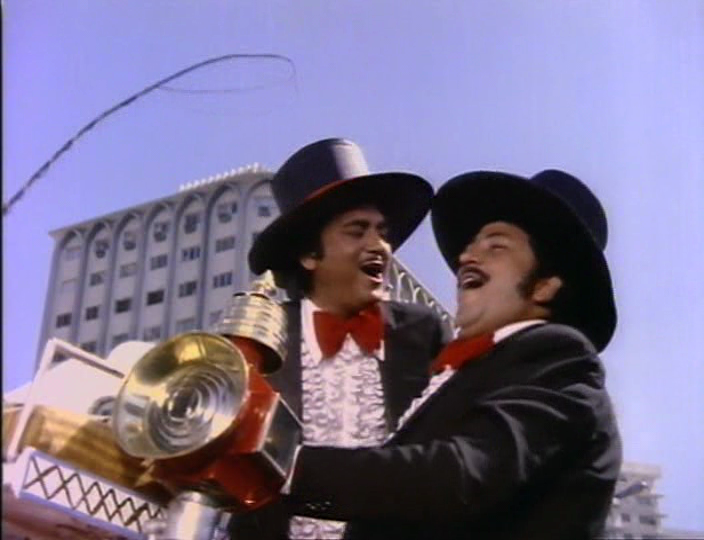
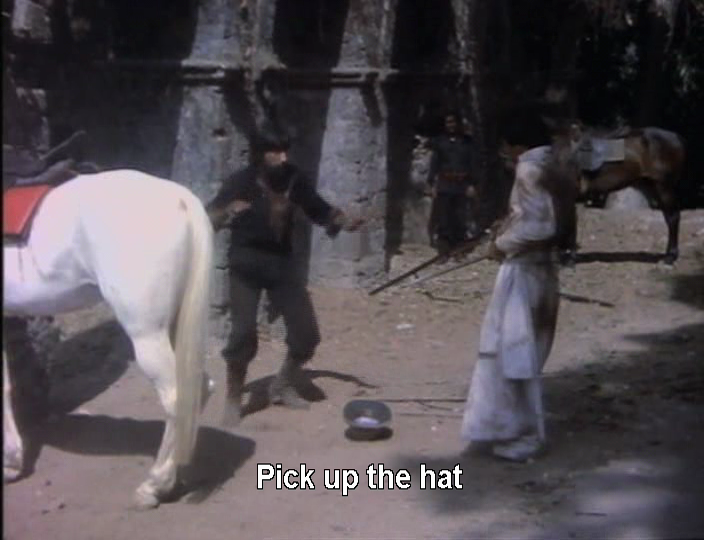
They grow up into Shankar (Sunil Dutt) and Birju (Amjad Khan). Thugs, thieves, crims call them what you will. They have a significant cigarette lighter and a jaunty song (Hai Hum Galiyon Ke if you’re interested) which includes a fight, the hats on the DVD cover, and a flashback to their orphan days.

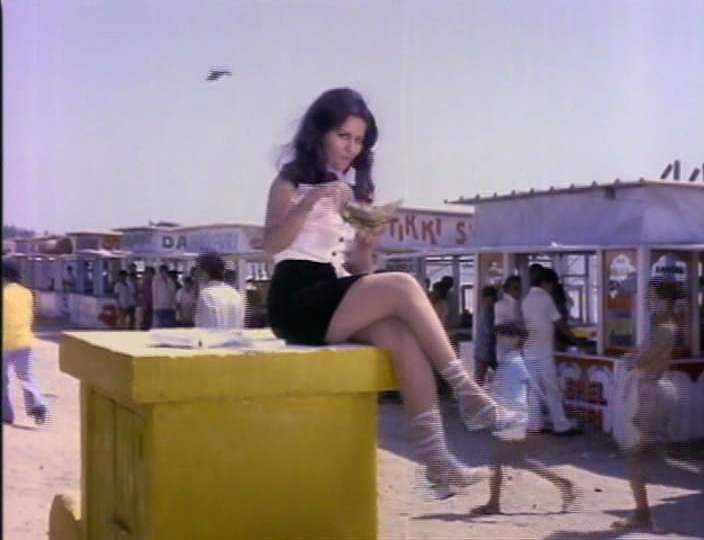
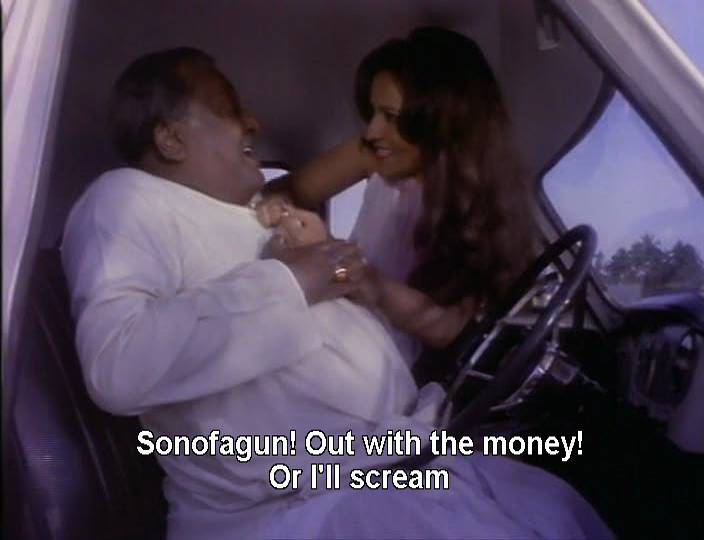
Pammi (Reena Roy) is also on the shady side of the law. She uses her charms to entrap men, and then threatens to cry rape unless they pay up. Her virtue is intact and she is a good bad girl, which is spelled out in the dialogue with her would be pimp Jumbo (Jankidas). She fleeces Shankar and Birju, but Shankar still comes to her aid when Jumbo threatens to sell her.

In an effort to make amends and help herself out of a tricky situation, she tells the chaps of a plan to rob a wealthy wedding and suggests they knock the place over first. This is a good idea as it includes Amjad Khan in bandleader get-up, and a qawwali featuring Reena Roy and Sunil Dutt (and more hats).

But Birju is in love with Komal (Daljit Kaur), a nightclub chanteuse. She sings about love, but only loves money. He cannot resist keeping the haul of diamonds to himself and he uses the loot to buy the discotheque Komal performs in, effectively buying her.

He gets a fancy house, flashy clothes, and a taste for the high life. His love for Komal seems to be tied to how much she is worth, and he expects her to entertain businessmen so he can win more contracts. His early Robin Hood ethic is nowhere in sight.

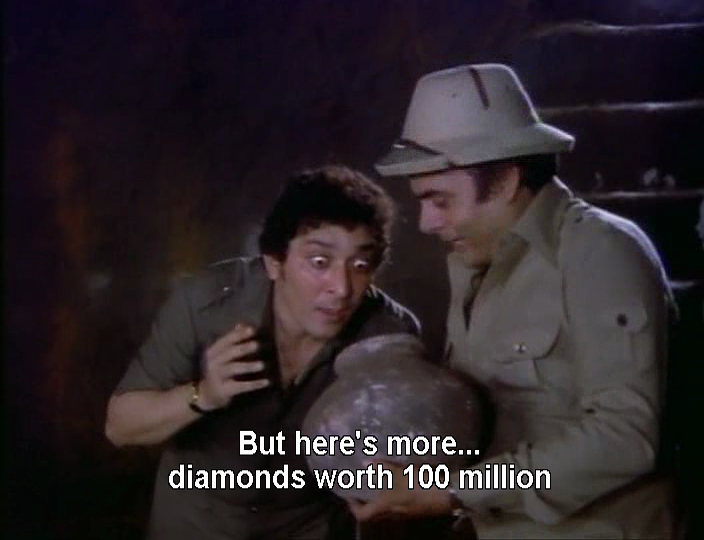
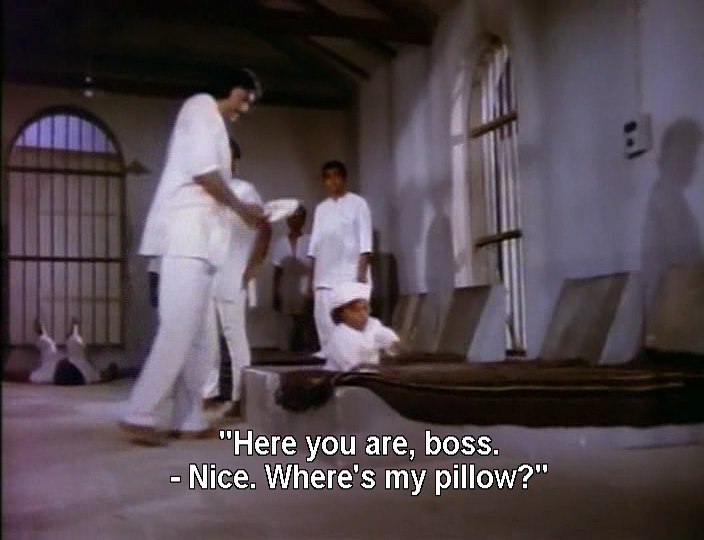
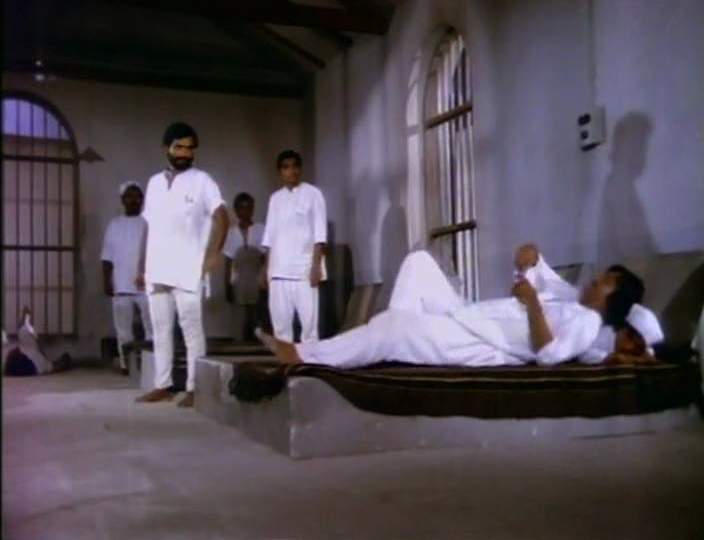
Shankar has no idea his friend betrayed him. He languishes in jail following the million dollar diamond heist, and obviously people are keen to know where he hid the gems. Doing time with him are murderer Peter Perera (Roopesh Kumar), thug Bhim Singh (Dev Kumar) and a little person. Bhim Singh is the brother of a notorious daku Darjan Singh (Shakti Kapoor). Peter killed his brother-in-law over 100 million dollars worth of diamonds.

Roopesh Kumar could not be accused of underplaying his flashback confession.

Shankar intervenes when Peter is beaten up. Now, I like to think I am not easily shocked or surprised but of all the things I fearfully anticipated happening when Shankar slung the dwarf over his shoulder, this was not one.

So added to the betrayal of friendship and the original theft, we now have a bigger stash of gems, a repentant murderer, a crazy and unrepentant daku, and a young mute boy who is the only living person who knows where the diamonds were hidden.

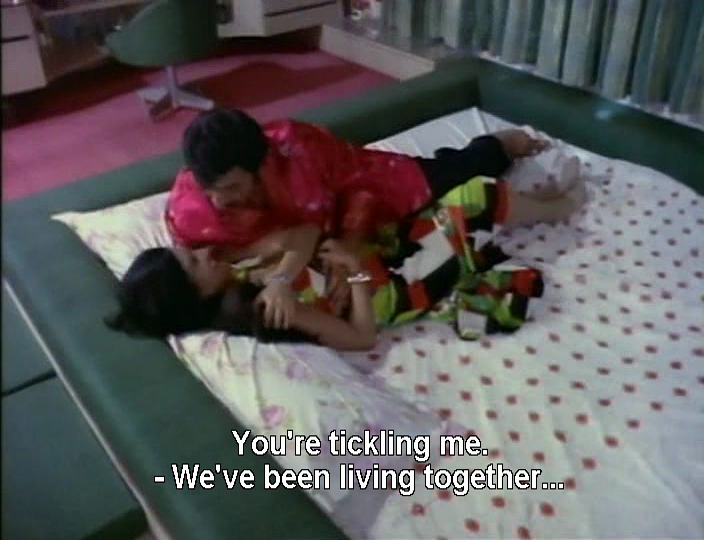
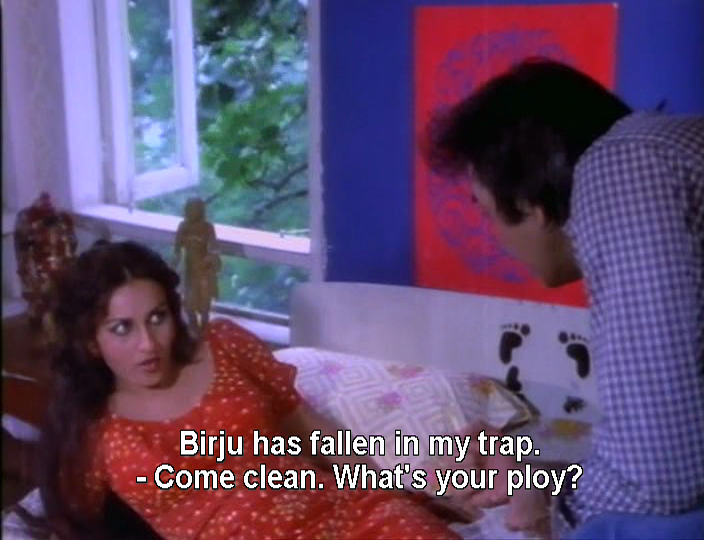
Shankar is released from jail, and thanks to Pammi he knows Birju has sold him out. Reena Roy gets some really entertaining scenes as Pammi outwits men who want to buy her, and uses the police to get rid of Jumbo. She is a smart girl in the midst of utter madness, and pretty handy in a fight. Reena Roy plays it to the hilt and I really enjoyed her presence in the film. Pammi moves into Birju’s house as his old friend. He suspects nothing, but she is working to protect Shankar from treachery. I will just digress again – what’s with the footprint motif on the bedhead?

Anyway. Birju makes several ill conceived attempts to kill Shankar as he cannot contemplate sharing his wealth.

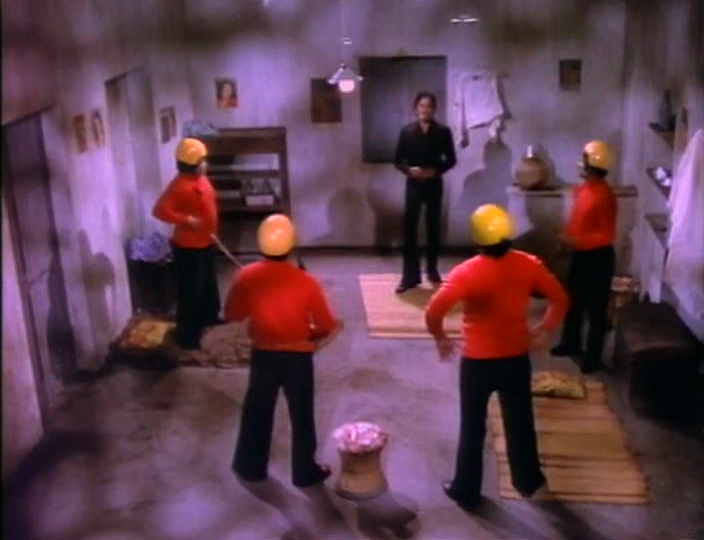
He even sends a gang of Lego men (more headgear!) to beat up his old dost.

The two men journey into the hills, and things come to a head. Shankar leaves Birju with his neck in a noose and his feet precariously balanced on a handy wagon wheel. They go their separate ways. Or do they? Despite the silliness of the plot, they are both very good in their roles. I don’t think I’ve struck a Sunil Dutt film yet that hasn’t at least been interesting. And Amjad Khan gets to be more than a one dimensional baddie.

Everything and everyone converges on Girijapur, Peter Perera’s home, and the location of the priest (Bharat Bushan) who received his last confession. As with all secrets, everyone knows that the priest knows, and various parties set out to make him talk.

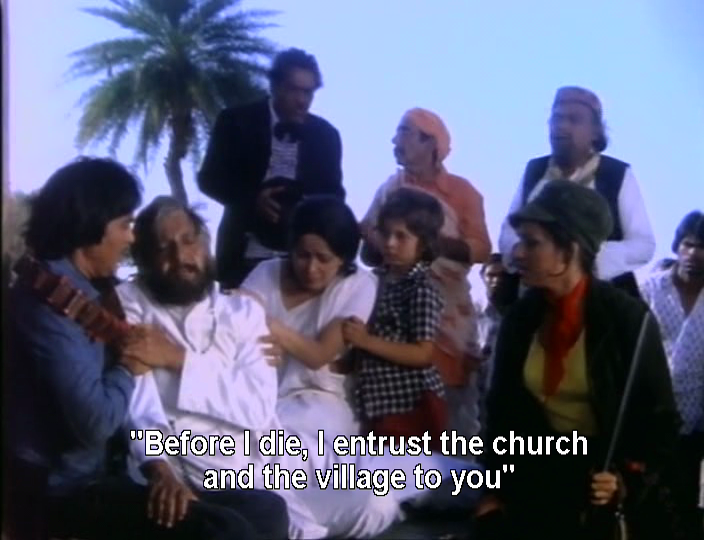
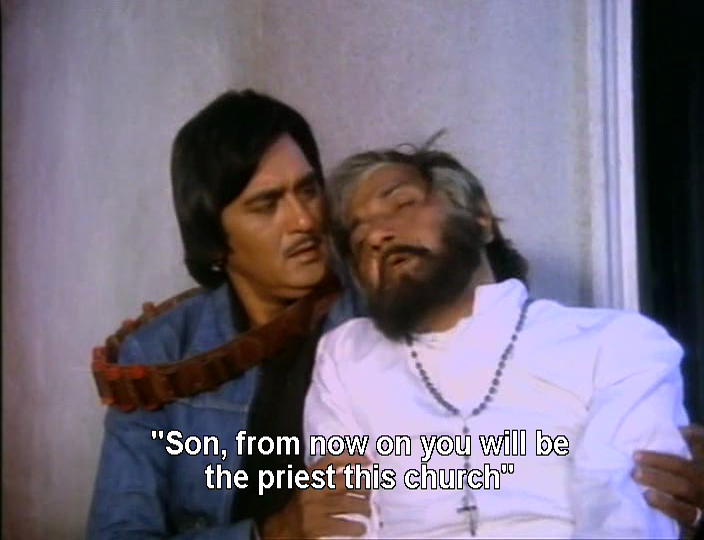
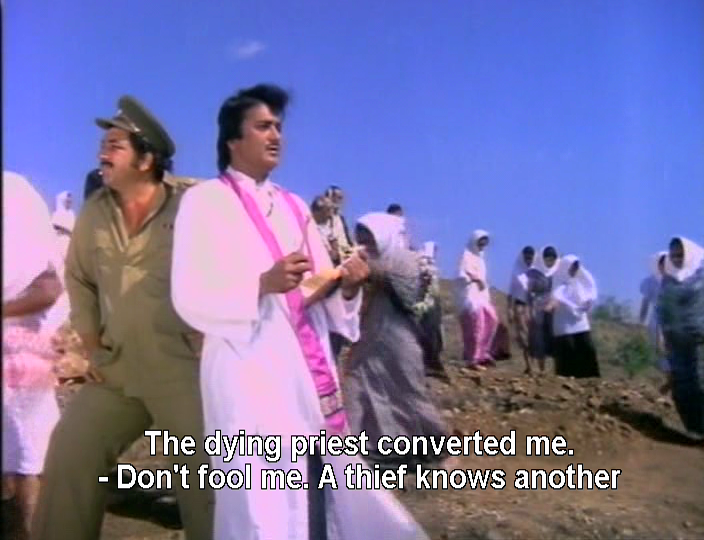
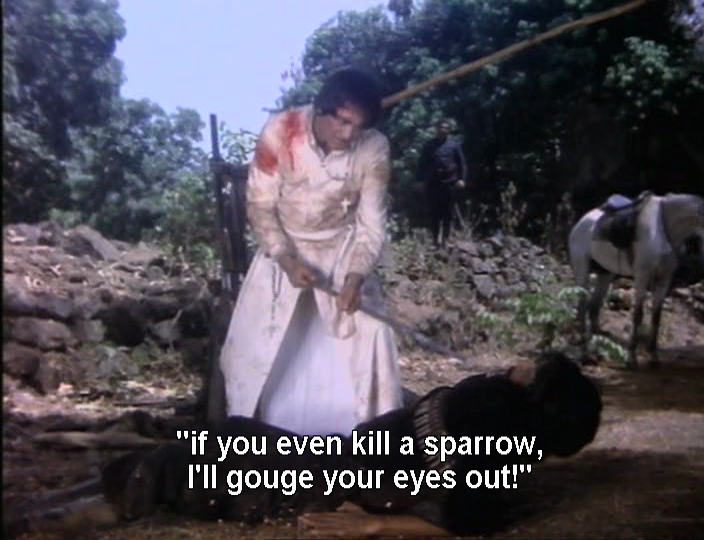
Shakti Kapoor and his gang raid the village in search of loot, interrupting a comedy wedding (Tun Tun and Rajendranath), and shoots the priest. And here is where I learned something never mentioned in my 12 years in a convent school.

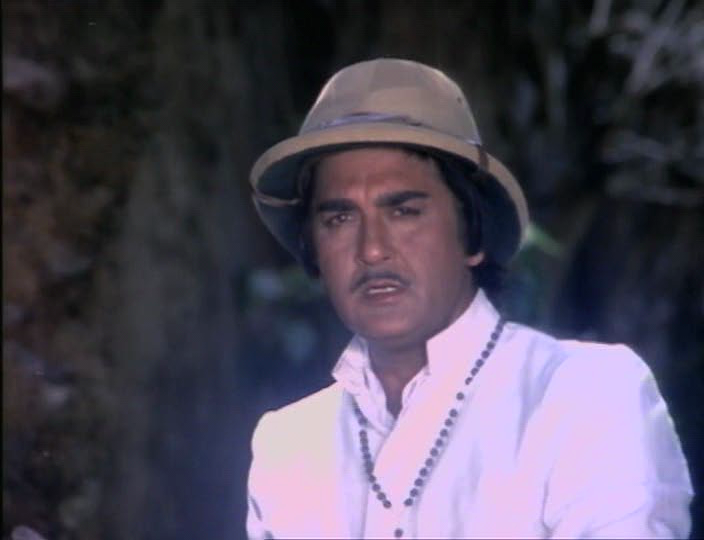
So that’s how priests are made. My Jesuit friend will be gutted he wasted so many years studying. Whether for spiritual or other reasons, Sunil Dutt starts wearing a pith helmet.

Amjad Khan meanwhile decides to move into the village and impersonate the police, perhaps for the hat or maybe for the roomy uniform.

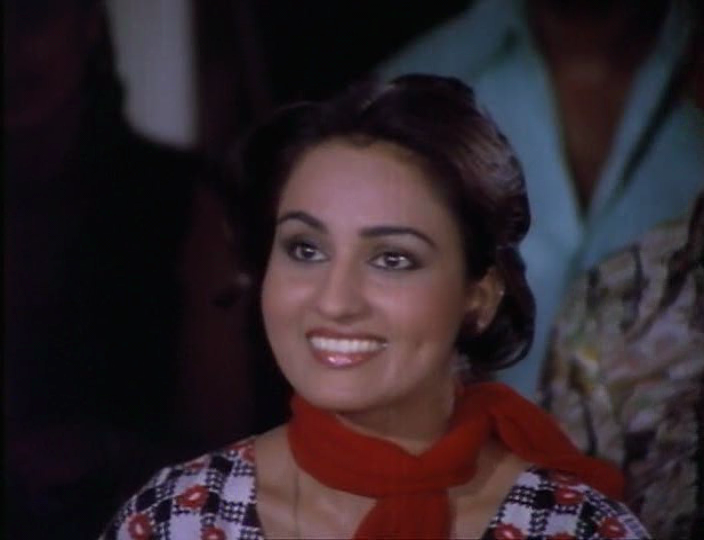
Reena Roy develops sharp shooting skills and has a nice line in 70s frocks and the occasional cap. She and Shankar are in love but I am not sure how that works with his being a priest and all. She is as active in defence of the village as he is, and she is also the caretaker for Komal who has turned up, pregnant and rejected by Birju. Pammi usually has a gun in her hand and the villagers accept her orders. And they develop some excellent defences including bombs and disguising themselves as haystacks.

Sunil gets to, well, joust in one fight with Shakti so I guess they felt the pressure to be really really macho.

The climax of the film involves gunfire, explosions, young Munna the no longer mute being tossed around like a rag doll, lots of punch ups and a moral dilemma. Will Birju finally value friendship over sparkly stones? Or will he take the money and run?

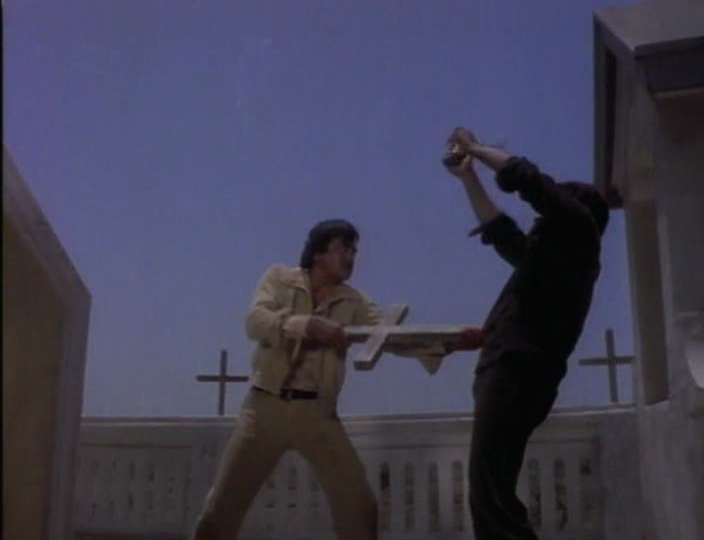
You’ll have to watch it to find out. But one thing I will share is a foolproof method for despatching Shakti Kapoor – the pointy end of a crucifix.

Happy Easter!

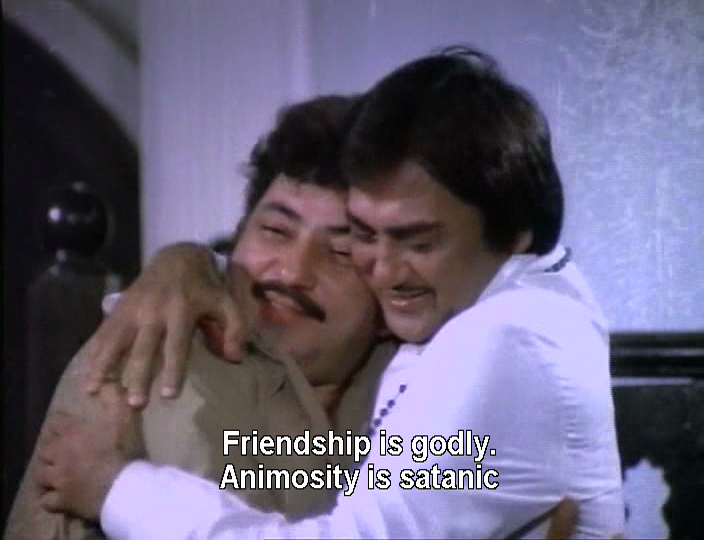
Oh I suppose I should make this a happy post. Here is how things look at the end:

And a little bit of advice next time you shop for DVDs.

Sarkar

I held out on watching Sarkar til a couple of years ago. I’m ambivalent about Ram Gopal Varma films. When he is good, he is terrific. But he has wasted some interesting ideas and great actors in projects that seem to be more about RGV than making a film (like RGV ki Aag, and that film all about Mahie Gill’s cleavage). I’m also on the fence about Amitabh Bachchan in this late career phase. He’s made some bad film choices (like Boom!) and not always acted to his ability. But Sarkar combines a focussed and controlled RGV with a complex performance from Amitabh and the result is a dark and gripping film.

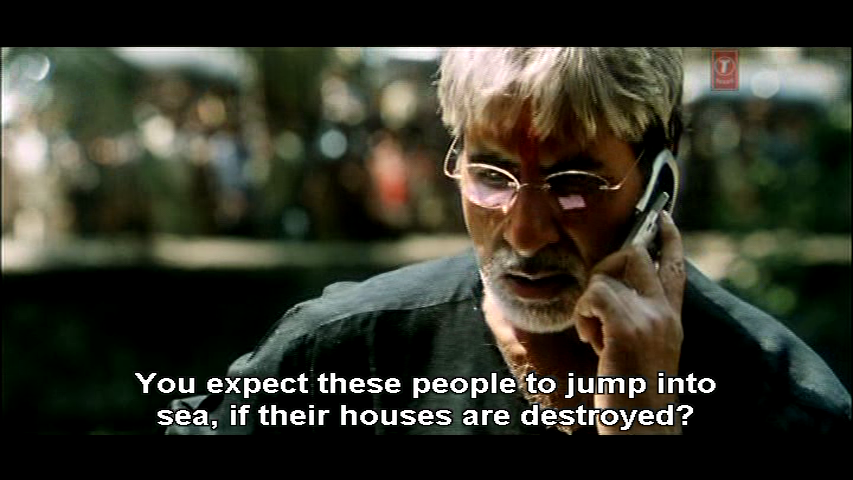
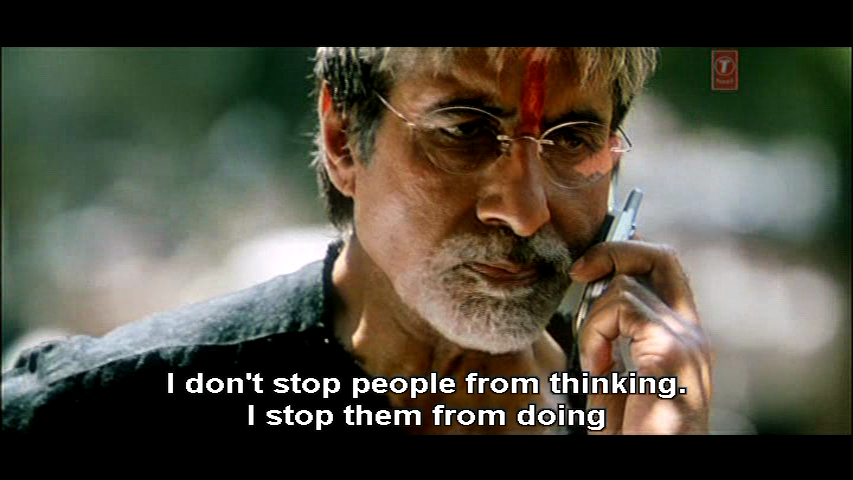
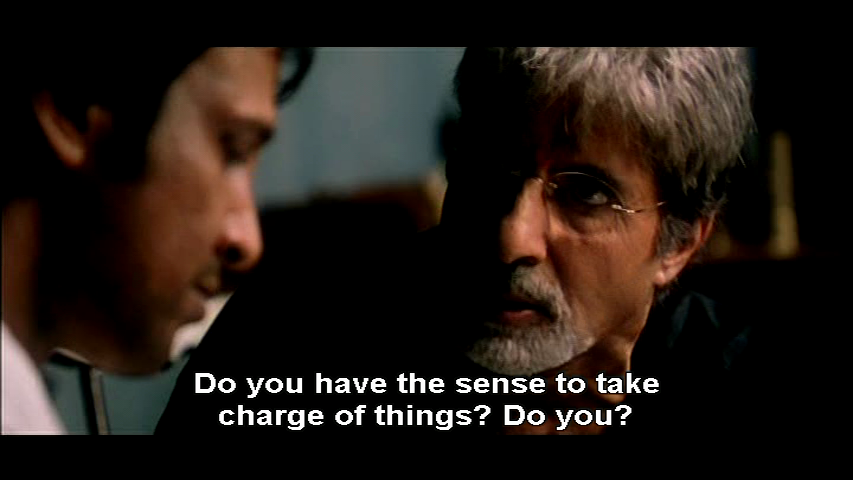
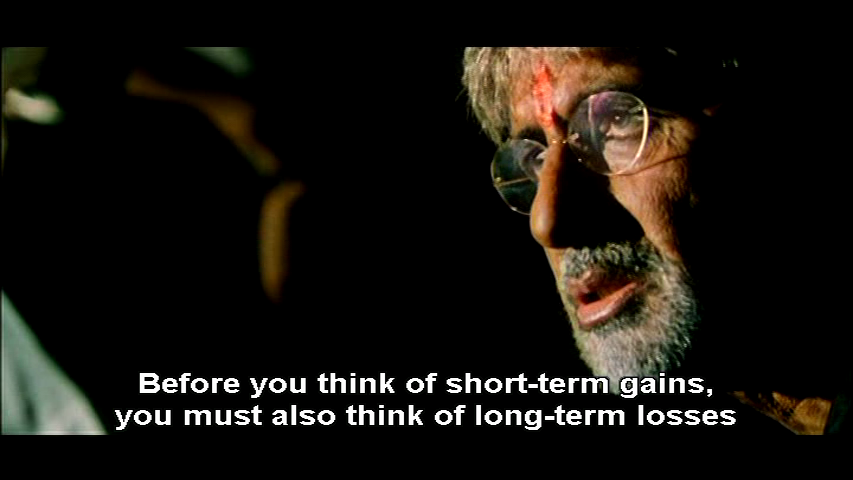
Subhash Nagre (Amitabh) is an old school mafia lord. He believes in family, honour and loyalty. He isn’t painted as really good or sympathetic but he has a certain integrity, an old fashioned set of rules that he adheres to and that he upholds. Nagre is connected to his community and neighbourhood, and thinks of the social cost as well as the profit and loss numbers. His people worship him, gathering outside his mansion to catch a glimpse of their Sarkar. They come to him when the system fails them, and he is their justice. Amitabh looks picture perfect. He creates a focal point in every scene with his stillness and his gaze. I found I was almost hypnotised by him, drawn to watching Subhash’s reactions no matter what else was happening. There is a carefully controlled rage in some scenes that is far more unnerving than any histrionics would have been.

While Subhash acknowledges that he operates outside the law, he says ‘I do what is right for the people’. When people come to him asking for solutions, he accepts their obeisance with little expression. He makes a semblance of not wanting people to touch his feet etc but I wondered what would happen to anyone who dared not to. Some scenes are accompanied by a religious chant(Govinda Govinda featuring Amitabh’s vocals) showing the deification of Sarkar. There are glimpses of the monstrous ego behind the facade, the steely will that does not tolerate opposition or failure, and the carefully checked anger. We also see the family man and affectionate grandfather. Subhash Nagre is a complex man and he is a master strategist. Amitabh shows all of these nuances without being too actorly and I was watching the character, not the performance.

Subhash Nagre is challenged from within and without his family. Rashid (Zakir Hussain) is the new type of criminal. His decisions are all commercial and he has no empathy or reserve. He is not the kind of man Subhash is used to. There is no whitewashing of how Nagre makes his money, but the clashes hinge on honour and intent. He will not budge from his principles. His enemies know that to remove the man they must first destroy his reputation.

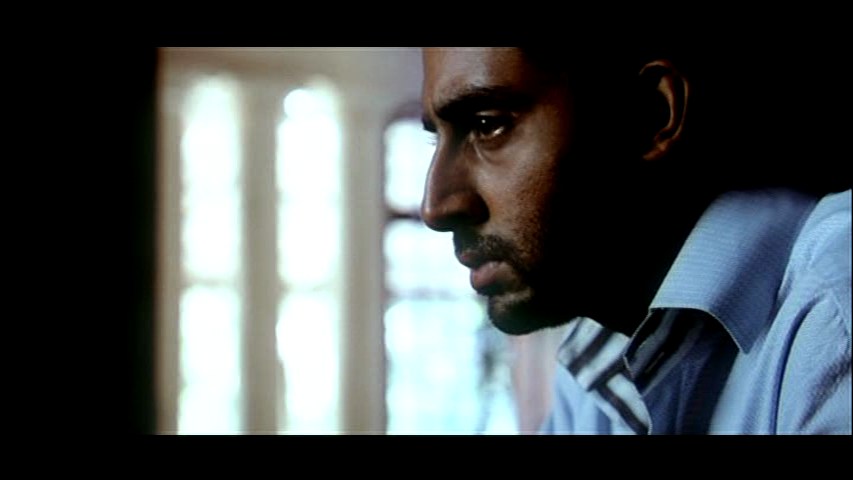
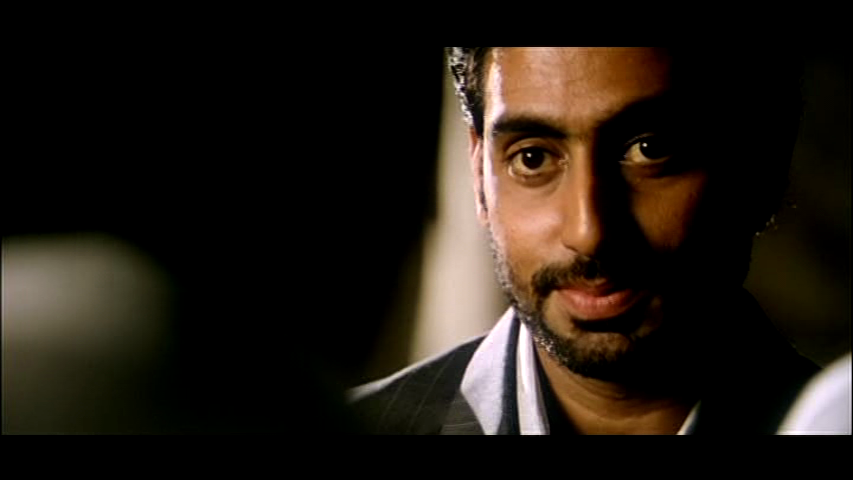
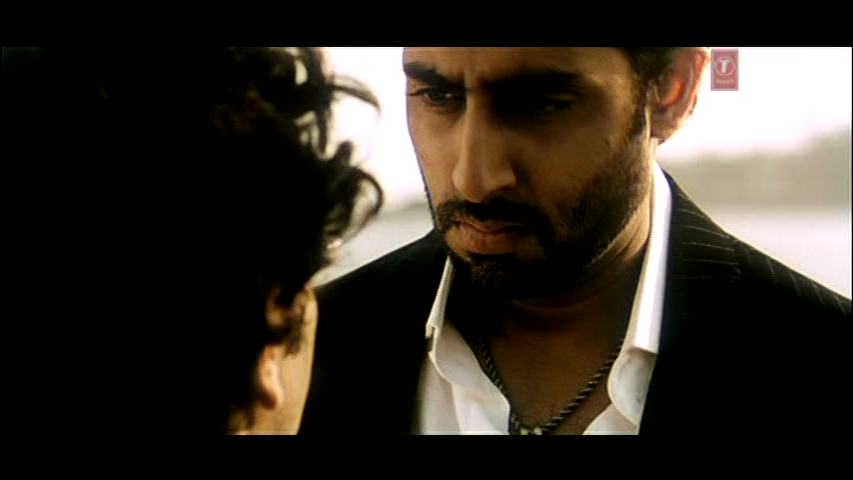
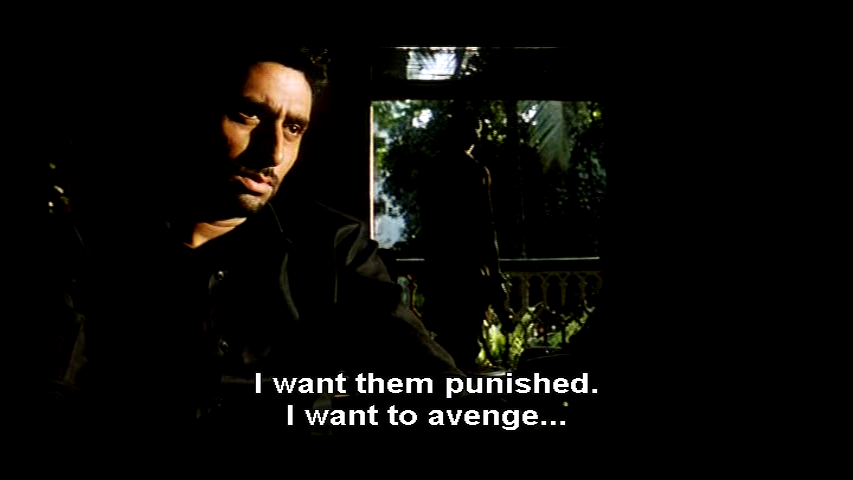
Son Shankar (Abhishek Bachchan) returns from the US. Baby B has a role where doing an impression of his dad is actually appropriate. Initially believing that his father simply helps others, his eyes are opened to the realities of the family business. In a conversation with Pooja (Katrina Kaif) they refer to the Sarkar empire as a parallel government, supporting the people and doing what is right, not just what is legal. Shankar is appalled at how his father is portrayed in the media. He is the golden boy, the one his father wanted to keep clean and safe from the business. The focus and decision making Shankar used in his corporate life are now applied to his family concerns. He is a quick learner and he will do what it takes.

Abhishek is not completely convincing but he does structure his performance well. Initially Shankar is relaxed and engaging and his body language is more open. As he is drawn more into the threats to his dad, he assumes more of Subhash’s mannerisms and strategies. Abhishek’s face becomes less expressive, he speaks more slowly and moves more deliberately. And he is ice cold, like his father.

Vishnu (Kay Kay Menon) is the son most like his father in ambition, but lacking focus and self control. The tension in father-son relationship is well depicted as Vishnu challenges his father’s authority and decision making. The dynamic between Shankar and Vishnu is also fraught as Vishnu desperately wants to be taken seriously, to be the next Sarkar. Quick to flare up or retaliate he has no ‘off’ switch and only intermittent self awareness.

The pain of rejection drives him, and makes him vulnerable to manipulation. Vishnu is co-opted by his father’s enemies, and spirals into confusion, hate, anger and regret. He is an oddly sympathetic character despite committing some of the most heinous acts. I think that is due to the complex and changing emotions Kay Kay invests him with. Kay Kay is expressive and emotional where Amitabh is smouldering control.

The Nagre mansion is a world away from the glaring light and sound of the streets. It is almost timeless, and full of shadows and silhouettes. All around there are men at arms working out and waiting for trouble. The family live in a small pocket of domesticity within the encampment. It’s a bit claustrophobic, but also serene and sometimes beautiful. It is the price Nagre pays as he needs to be safe but accessible to the people who give him his status.

All around Mumbai there are shadowy figures in dark room havings meetings and plotting Subhash’s downfall. The story is well written by Manish Gupta, and gains in intensity as more deceptions unfold. Kota Srinivasa Rao is the repulsive Selvaramani, chortling his way through schemes and double crosses. His idea of honouring a friendship is requesting a quick death for someone. Anupam Kher has a small role as an anti-corruption politician and still manages to try and upstage everyone with a hammy death scene. Raju Mavani as Vishram Bhagat is the everyman type of villain – he seems perfectly reasonable yet he is calculating and meticulous in scheming to dethrone Nagre. Telugu actor Jeeva as Swami is less successful. His mannerisms and dialogue delivery are hammy, and while I believed he was a serious threat his wig didn’t convince me at all.

Supriya Pathak delivers a good performance as the mother watching her son go off the rails and placing her family in deadly jeopardy. Tanisha is likeable as Avantika, the foster daughter who is in love with Shankar. Katrina Kaif is not entirely terrible as Shankar’s American based girlfriend Pooja. But the women in Sarkar are background – providing all the support systems and needs for the menfolk, but not often in the spotlight. These relationships are important, and there is a lot of affection between family members but the men take care of business while the women take care of the men.

The visual design and camerawork throughout Sarkar is excellent and reinforces the drama and emotion. The majority of the film is shot in tight close ups, making the characters the focal point. When things move out into a broader shot, the background detail and bustle of extras and locations gives a strong real world flavour. Amar Mohile’s music is dramatic but not intrusive and the sound effects and orchestration are very effective.

It’s a fairly grim movie. There are lots of unlikeable characters and they do some despicable things. But it is such an accomplished film and just drags me in to that world. Every time I see it Amitabh reminds me yet again of why he is such a legend. Sarkar Raj was a worthy sequel, and builds on Sarkar very well. I’m cautiously looking forward to Department to see if RGV and the Big B can do it again in a different story. 4 stars.

Heather says: This isn’t one of my favourite Amitabh films despite the fact that I think he plays the part of the aging gangster well.  I think the problem is that the story of the film doesn’t engage my interest until near the end and I just don’t care enough about any of the characters to want to know what happens to them. However it does have some good points and the end is almost worth sitting through the preceding hour and a half. I do like how cold and clinical Amitabh appears and that his ruthless Don does have a more compassionate side. However that’s not enough to make me like him and since he’s not a malicious criminal either I don’t find him very interesting to watch.  His son Vishnu is more engaging and Kay Kay Menon’s performance is good enough to make me feel at least some aversion for his sleazy character, but Abishek as Shankar is incredibly wooden and quite tedious throughout. The most enjoyable scenes in the film for me are those with Selvar Mani and Virendra Swami, partly because Kota Srinivaso Rao and Jeeva both put in a very good performances and because those two characters do have some personality. The rest of the cast are all fine, and in fact many of the support actors draw my attention much more than the main leads. However I have no idea why Katrina Kaif bothered to turn up as she may as well not have been there for all the impact her character had on the story. I thought her role was fairly pointless and much better reasons could have been used for Shankar’s initial reluctance to help his father.

There are a lot of meaningful pauses and significant looks throughout the film which make it even slower. I was distracted looking at the set dressing (which was excellent!) and when there was dialogue found that I was concentrating on understanding the Hindi and trying not to look at the subtitles, rather than watching the action. The film itself is well shot and the general idea of the story is interesting, but the characters are so lacking in any type of appeal that it never really connects.  It’s not even that I found them dislikeable, they were just rather dull.  I give Sarkar 3 stars, mainly for the ending and a convincing if uninspiring performance from Amitabh.