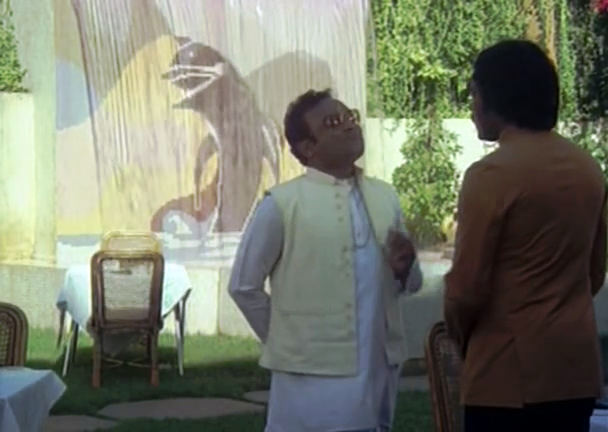
Department

Someone needs to take all of Ram Gopal Varma’s gadgets, lock them in the toy box and hide the key. A potentially interesting thriller, Department was swamped by RGV’s ‘rogue’ methodology. My guess is ROGUE stands for Ridiculously Overindulgent Gimmickry Undermines Everything. The nauseating (literally) camerawork and a dearth of story and character development made this a disappointing experience. But there were a few positives including an excellent effort by the wardrobe department and a handful of quite good performances.

Had the gimmick of cameras mounted on actors and props been used with restraint it could have been really striking.  For example, a chase around the Crawford market area – it looked great as the camerawork enhanced the sense of speed and confusion of the pursuit. But it is hard to appreciate someone’s acting when the camera crawls up one nostril and emerges from their ear, or is spinning around the bottom of a tea cup. The background score is what I’ve come to expect from RGV – loud, intrusive and annoying so combine that with the dizzying visuals and it is unpleasant.

The story is a standard of the cop genre: a young, slightly idealistic officer is teamed up with a shady older legend on the force. Sanjay Dutt and Rana Daggubati had a good dynamic between their characters and they played off each other well. Sanjay has a brooding reserve that suited Mahadev’s moral ambiguity, and he was world weary and cynical to the core. Mahadev has his own agenda, which is revealed all too slowly. Shivnarayan was no young ratbag to be easily distracted or lead astray– he was focussed on his career and working towards his goals. But he is realising there are many more shades of grey than he expected. Rana is a competent actor, and he certainly looks right for this role. He seemed more at ease in the second half when the action ramps up.
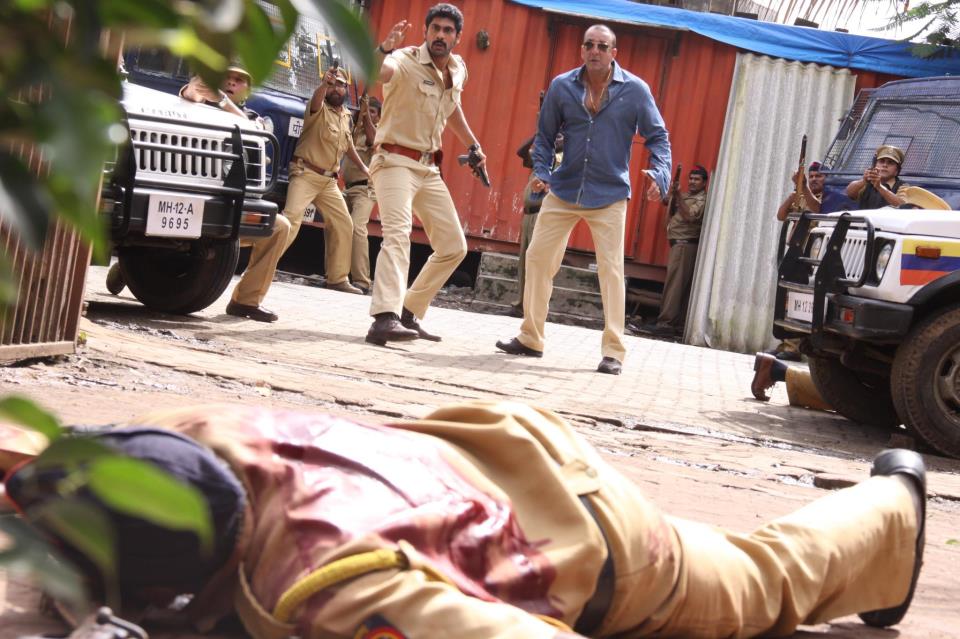
Mind you some of the dialogue is so stilted no one could make it work. There are great insights along the lines of “A mistake done intentionally is not a mistake”. If only I had been in charge of the Cliche Department, I would have found a much more inspirational desk calendar to pinch quotes from. A subtitle that spelled gangrene ‘gang-grin’ was another highlight.

The underworld aspect is less successful. Sawatya (wildly overacted by Vijay Raaz), and his opposition – a mysterious voice on the phone – are at war. But they didn’t provide adequate tension for the machinations of the plot to make sense or be interesting. Sawatya’s deputy DK (Abhimanyu Singh) is ridiculous, stupid, and not at all convincing. People keep banging on about Abhimanyu Singh’s intensity but I think he is just a really bad actor. Even as a corpse, he hams it up.

Amitabh as Sarjay Rao spent the first half chewing the scenery and the second being enigmatic. It wasn’t the performance I was hoping for although he was an interesting character. Excessive exposition drained the potential drama and made the characters less interesting as they did little thinking for themselves. The police would get news of their target’s whereabouts apparently out of thin air. There is no consistent internal logic, too many contradictions, and the story just doesn’t hold up. RGV seems to think he has discovered the concept of moral ambiguity and the idea is pounded home. It’s clumsy and tedious.

Lakshmi Manchu was quite good as Mahadev’s wife. Satya was from a police family so she had already worked through any moral issues she may have had about her husband’s activities. Shivnarayan’s fiancée, Doctor Bharti (Anjana Sukhani) made less sense. She seemed to have few concerns about her intended being an ‘encounter king’, and no thought about what it might mean to be married to someone who was pissing off gangsters at a rate of knots. Madhu Shalini as Naseer had a potentially interesting role – a female gangster who was as tough as nails. But her motivations weren’t clear or consistent, the relationship with DK was not believable and her acting ranged from terrible to mediocre. However I don’t think anyone would have fared well in the scene where she basically fellated a kulfi as she and DK fantasised about taking over and killing everyone. It was gross.

Nathalia Kaur got a lot of (RGV generated) publicity for her debut. Her assets are obvious and just in case you missed anything that camera gets right in there (the gold undies were unexpected and I am so glad she was wearing them). But for an item girl she lacks sensuality and relies on making what I can only describe as ‘porno face’.  Even with the minimal demands of the choreo, her ‘dancing’ was terrible. I don’t usually have a problem with the skanky item, and appearances by the likes of Mumaith Khan, Malaika Arora Khan, Rambha and others are often a highlight. This made me uncomfortable as between Nathalia’s performance and the dirty old man camera gaze creeping all over her body, it is just nasty.

Luckily someone in wardrobe realised the movie was off the rails and took a bold step that almost saved the day. Nasia and DK form their own gang – we dubbed them the Fashion Gang.


They dress really badly, over accessorise and spend too long fussing over their clothes when they should be running away from Rana. Meanwhile Shivnarayan has had an epiphany. He had temporarily lost his mojo once he was out of uniform and in civvies. There was some unfortunate double (acid wash) denim, and a regrettable lurex bandanna incident. But by the second half he had developed a signature style and was teaming jeans and a simple (very snug across the shoulders) linen shirt or a (so tight it looked painted on) polo shirt with minimal accessories – watch, shoes, belt and gun.


Classic and classy. He became the Fashion Police! He pursues and kills members of DK’s Fashion Gang – the guy in the green and purple stripy shirt, the guy in the gingham bandanna, the bedraggled beardy man, finally the leaders themselves. So when Sanjay Dutt turned up wearing double acid wash….well. It was riveting. Not enough to make this a film worth seeing, but it did keep me entertained just when I was giving up.

I feel bad for the actors in Department, especially Sanjay Dutt, Rana, Deepak Tijori and Lakshmi Manchu who I think gave solid performances. It’s a shame they have been undermined by RGV’s self indulgent antics and the lack of quality story and dialogue. Honestly I can’t recommend this is worth seeing. Unless you enjoy seeing those Crimes  of Fashion soundly punished!

Devadasu (1953)

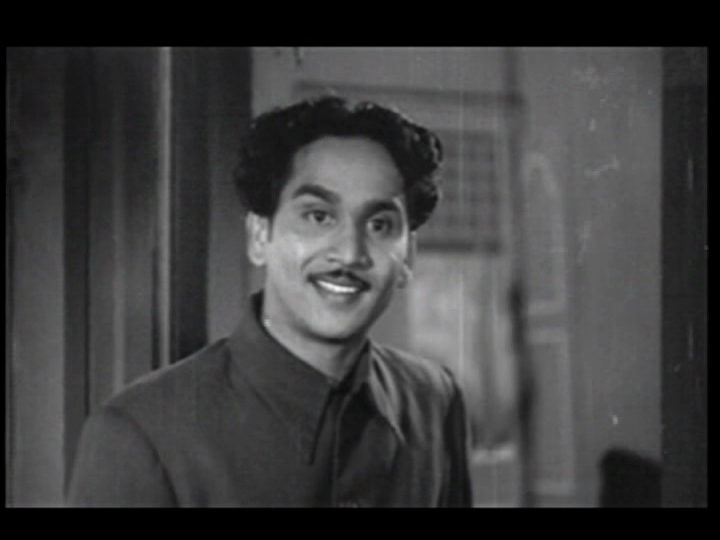
So many people recommended versions of Devdas when I started watching Indian films. Prior to seeing the Telugu Devadasu, I’d watched a few of the various adaptations in Hindi. I have mentioned before that the role of Tight Slap Administrator could be a dream job for me, but honestly I would have been exhausted about an hour into any film version of Devdas. I prefer romances to involve people I can care about to some extent, otherwise why bother? Whether we’re talking whinging Dilip Kumar, tear drenched Shah Rukh or aggressively self centred Abhay Deol, Devdas is one of my least favourite characters. This is a drawback when the story is just a long wait for Dev to work out how to drink himself to death. So it was a bit of a surprise to find myself not exactly liking but empathising with Devadas (Akkineni Nageshwara Rao) and feeling quite kindly towards Parvati (Savitri). Maybe it was the lack of subtitles that let me reshape the story to suit myself. I certainly had no trouble following the story –  there are so many adaptations of the book by Sharat Chandra Chattopadhyay it’s almost a plague – and it’s easy to find a synopsis if you need one.

Director Vedantam Raghavaiah’s version opens with Devadas and Parvati as little children, partners in crime, tormenting their teachers and causing mayhem. Devadas demands her obedient following, Parvati demands to be spoilt and adored and generally that is how things go. If one upsets the other, they retaliate with no thought of the consequences. And that sets the tone for their whole relationship even as they grow up. When he was sent away to school, he seemed to become that rich kid who funded his friends’ adventures and went with the flow. Meanwhile Parvati waited at home, confident he would come back and she would be part of his life.

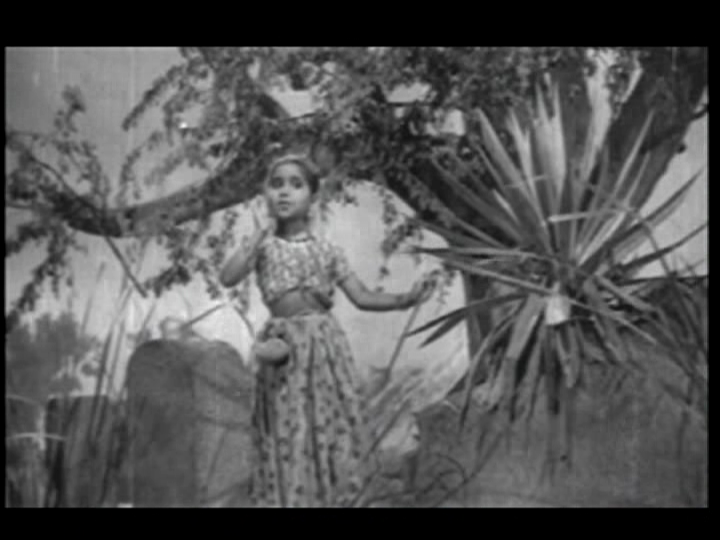
ANR’s Devadas is a man who knows he has screwed up and has no one else to blame. He conveys the frustration of a young man caught under the thumb of his domineering father (SV Ranga Rao), and the weakness that paralyses him. He and Parvati realise that they can’t continue to be inseparable as they were in childhood without formalising their relationship. There are some really lovely scenes early on when he and Parvati are rediscovering each other, as in this song.

There is also the infamous scene where Devadas strikes Parvati in retaliation for her pride. ANR looked appalled and remorseful after lashing out so viciously and Savitri portrayed a mix of shock, anger and sadness that spoke volumes about the way their relationship still played out. Her parents proposal is rebuffed as they are of a lower social status, and suddenly time is running out.

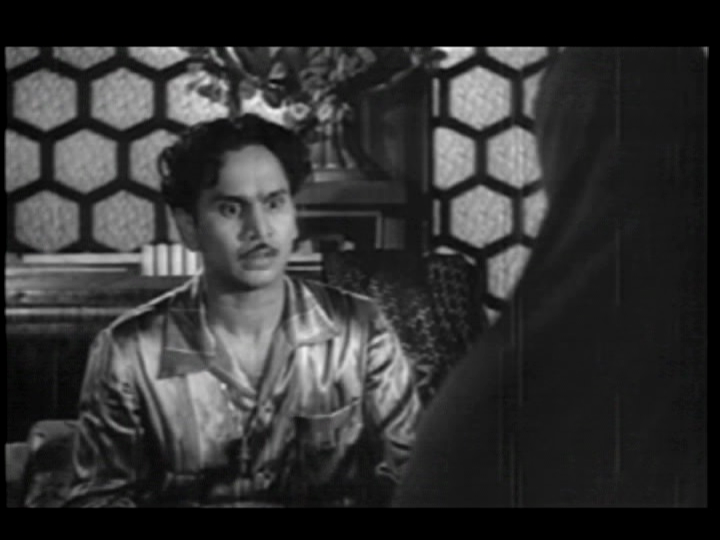
Parvati sneaks into his room to beg him to marry her before she is married off elsewhere but he cannot stand up to his dad (or whoever chose these pyjamas for him).

And so he loses her, cuts ties with his family and is ripe for a decline into self pity and booze.

Later, when Devadas returns home following his father’s death, he sees the married Parvati. They have a beautiful scene together where suddenly the old Devadas is visible just for a moment. They light up in each other’s presence even as they break down. He has no resilience or motivation – he is carried by the currents of luck and money and when the luck is bad, he doesn’t know how to change things.

His refuge in alcohol initially makes him happy as he hallucinates seeing Parvati. Once the addiction has hold of him, the euphoria starts to disappear and he becomes a shambling wreck. ANR portrays the gradual descent into self destruction very well. While I think Devadas is an idiot I had to look away in some scenes because he was so painfully frail and damaged.

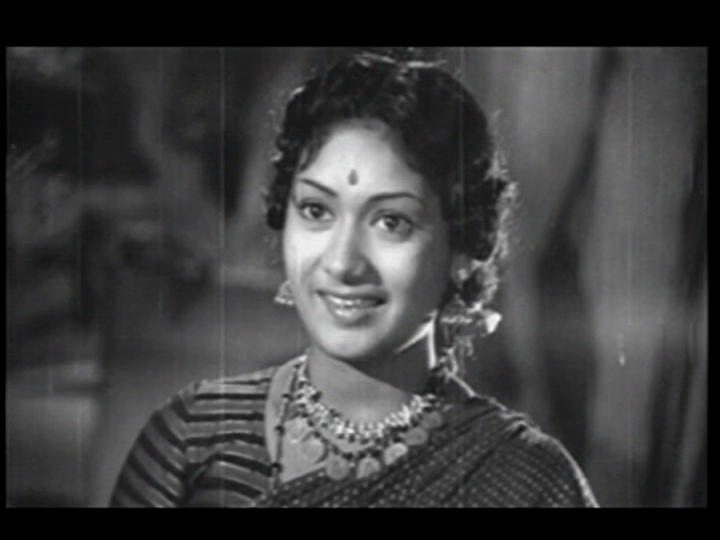
Parvati is a minx and gets her own way but she isn’t completely obnoxious. Savitri does a wonderful job of showing Parvati using her childish impulsive ways but aware of Devadas’ attraction to her, experimenting with her sexual appeal. When she sees Devadas after he has been at school for so many years, her affection is obvious. They talk about his father’s objection to her proposal and there is little game playing when it counts. When she is married off to an elderly widower who really seems to want a nanny more than a wife, her grief is evident but she tries to fit in.

I wasn’t quite sure about the physical side of her marriage – her husband mostly treats her like a niece or daughter, but there was one scene where he said something and Savitri looked quite ill and horrified so I wondered if a conjugal visit was on the cards. She is affectionate towards her stepchildren and wins over her jealous sister-in-law. She really does make the best of it and the kids seem very fond of her so her life isn’t shown as empty without her first love. In the final scene where she realises Devadas is near and tries to see him before he dies, the family seem to stop her because they are worried, not to punish her or protect their honour. Thanks to Savitri’s nuanced acting I really felt for Parvati.

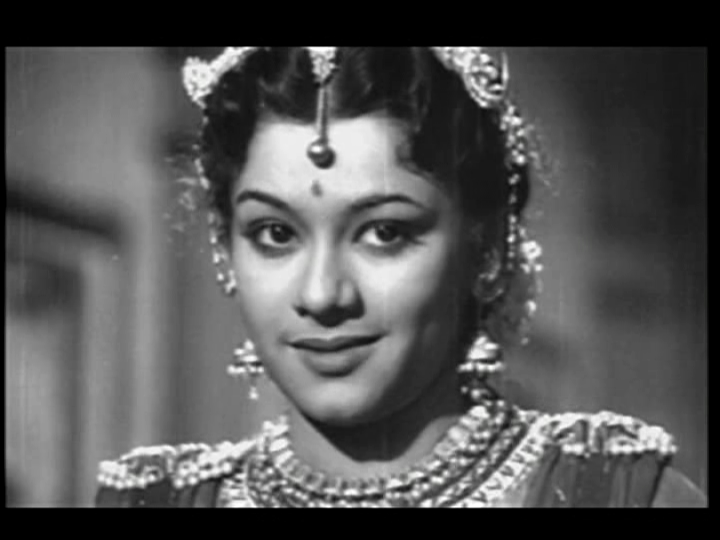
Lalitha, one of the renowned Travancore sisters, is Chandramukhi, the other woman who loves Devadas. Her role is important but doesn’t occupy as much screen time since Devadas usually prefers to pity himself in solitude.  She is flirty and practiced, a woman who knows what men want and knows she has it. Despite her commercial nous, she can’t resist the misery of her newest and most reluctant client. While he initially rejects her, a relationship of sorts does grow over time. She is prepared to lose her livelihood over him and argues with her staff, including a comically inclined orchestra, as she cuts back on working. When Devadas really deteriorates she searches for him and brings him home, offering practical care to keep him comfortable. Lalitha has great physical presence and really suits Chandramukhi’s self aware femininity. Her dancing is assured and she displays her body with confidence, again a perfect fit for this character.

I liked the less grandiose sets in this version as they suit the characters and allow them to be the focus. The music is lovely and as the duets often take the place of conversations, they fit the mood of the scenes. The dances at Chandramukhi’s brothel are quite simple and she performs alone to entertain her clientele – it’s clear what she is selling but the scenes aren’t overly vulgar.

It is really hard to comment on the technical aspects of the film as the DVD picture and sound are so bad, and there are clearly some scenes missing and abrupt edits. Once again I will have a whinge about the terrible print quality of a classic film, and wonder why this is almost the norm. If so many people can recommend a movie as a classic of their industry, why doesn’t anyone take on the task of preservation and restoration? I’m not sure who most of the supporting actors are, but they were all very good and suited their roles.

Anyway – I’ll never wholeheartedly love the story of Devadas and Parvati, but this is my favourite version to date. See it for the excellent acting that made two silly fools seem more relatable than I expected, and for some beautiful melodic songs. 3 ½ stars.

Heather says:  Devdas has never been my favourite story, perhaps because the first version I saw was Sanjay Leela Bhansali’s extravagant epic and I found it difficult to relate to the characters. However I’ve appreciated some of the earlier Hindi film versions a little more, and now agree wholeheartedly with Temple that this Telugu version is the best.

Devdas is certainly not an attractive character at all. He’s arrogant and selfish; almost child-like in his inability to deal with the world and ANR captures this perfectly. In the early scenes his conceit takes centre stage and despite the lack of subtitles his inability to deal with his family’s disapproval of Parvati comes through clearly.  As Devdas falls into self-recrimination and takes up a decadent lifestyle, ANR’s portrayal of the shattered and hopeless alcoholic almost manages to wring some sympathy, despite knowing that he brought it all on himself. So even although I want to dislike Devdas (and usually do), ANR makes his weakness understandable to such an extent that I end up pitying him. It really is an outstanding performance.

I agree with Temple that Savitri is excellent here as Parvati, giving her innocence and a child-like adoration of Devdas which makes her later actions more reasonable. I also loved Lalitha in her portrayal of Chandramukhi, but my favourite actor is the little girl who played the young Parvati. Her eyes were incredibly full of expression for such a young actor and every emotion was written loud and clear on her face. I ended up watching her scenes over and over again and would love to know who she was. Anyone know?

It is such a shame that this film isn’t available with subtitles as much of the beauty in other versions of the story is in the dialogues. I will add my plea that someone needs to please restore and re-release all these old films before they are too far gone to salvage, preferably with English  subtitles too. This really is a classic and should be required viewing for everyone interested in Telugu cinema! 4 stars.

Subhalekha

Once again, dodgy VCD quality and no subtitles mean that I have probably made up a lot of the story. But it is the characters (and actors) who made Subhalekha so enjoyable for me, not just the plot.

It’s a K. Viswanath film, so there is a message. In this case it is dowry, shown in this film as an outdated and bad practice. This is illustrated through montages of newspaper stories as well as incidents in the story. He targets men in particular castes and professions and their demands for a high price, particularly when they have no financial need. But he doesn’t go completely filmi and say love is all you need. Arranged marriage is not the issue – it’s the financial pressure of high dowry demands that can cause massive debt and stress on families. The relationships in the film develop in a believable way (well, most of them), and it seems that the marriages based on mutual respect and affection will probably work out. There is also some very nice character based humour to enliven the story, and I really enjoyed it.

Murthi (Chiranjeevi) is a waiter at a big hotel. He is naturally helpful and generous but not a push over. Unless the one menacing him is a dog. I’ve noticed something in a few Telugu films now – the overdubbing of animals by what is clearly a guy in a studio saying ‘Raaargh’. But don’t take my word for it.

Chiru dances his way to safety, catching the eye of Rao (Arun), an industrialist staying at the hotel. As a result, Rao casts Murthi as the hero of an advert for Allwyn fridges. This clip shows Chiru’s experiments in various classical dance styles, and is that ad within the film.

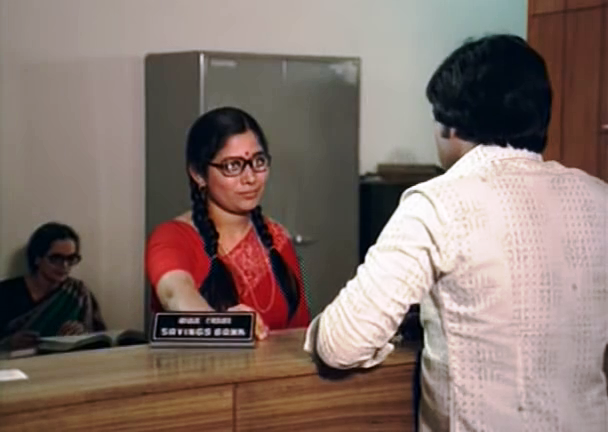
I like the exuberance, the vague attempt at accuracy and the expression on Chiru’s face throughout. I just love watching him dance. I laughed a lot in one scene when a lady in the bank started babbling over the ‘lovely, beautiful, wonderful’ Allwyn Hero when he came in to cash a cheque.

That would be me! And I’d totally buy that fridge.

Murthi exudes music and energy, singing his way through the day and even using song as conversation. He seems to be reasonably educated and working as a waiter was probably not his dream, but he does it well and picks up on opportunities. He deals with family problems, negotiates corrupt officialdom and is an everyman. Chiranjeevi gives Murthi a genial and easy going charm, with glimpses of the pride and self confidence that keep him going. That earnest vulnerability is worlds away from the mass hero style, and so endearing.

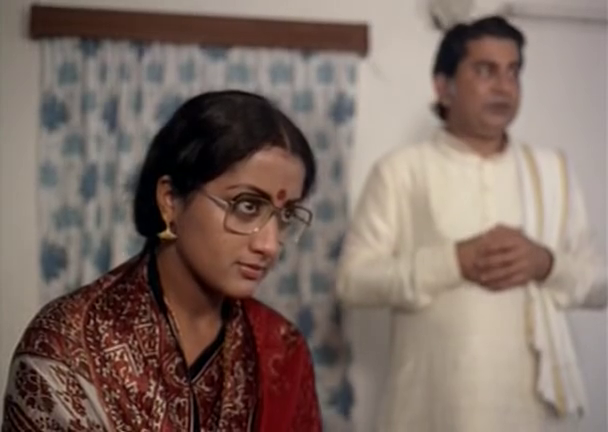
Also in the bank and checking Murthi out is Sujatha (Sumalatha). She is a serious young lady, a college lecturer, not a glossy glam heroine. She is due to be married to Mohan (Girish). The wedding negotiations stall over dowry. Her intended is from a rich family and has no need of money. Her father is forced to agree to the price, but Sujatha delivers a dressing down to prospective father-in-law Adisseshaya (Kaikala Satyanarayana) and the marriage is off. I really liked Sumalatha in Khaidi and she is impressive in this role too.  While being primped for her meeting with Mohan she brushes off her sister saying she wants to be what she is. Sujatha is resourceful, copes with setbacks and sometimes needs help, and is never a doormat. She and Chiranjeevi make a good couple, and I really liked their little disagreements and playful scenes.

Sujatha is sacked from her job and her parents throw her out when they decide she is having an affair with Murthi. Murthi is delighted she stood up for herself against the politician who refused to help his family. So he helps her find accommodation and they live in an idyllic version of poverty, with him acting as Sujatha’s household help. After insulting Adisseshaya, Murthi also loses his job, copping a beating along the way. Murthi uses his connections with Rao to get them both jobs – they never just give up. He might look after Sujatha, but she is an independent woman with her own earnings and a sense of worth. Murthi wants to see her settled, so approaches Rao who agrees to marry Sujatha. All this despite me knowing that Murthi loves her and she loves him. But I had faith it would all be set to rights.

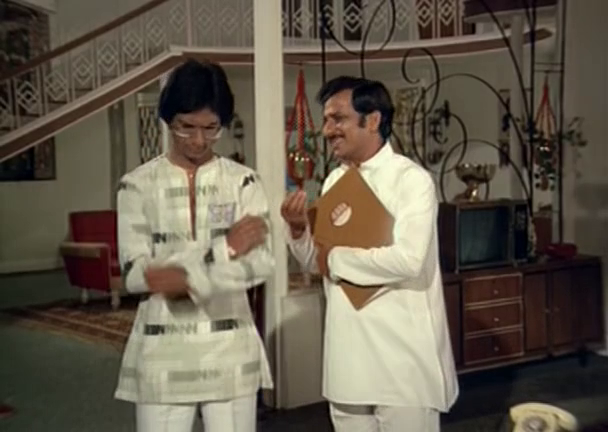
It isn’t just the central couple that have their moments. Sujatha’s sister Lakshmi (Tulasi) is an impulsive and extroverted girl. She spots the ultra groovy Murali (‘Subhalekha’ Sudhakar), Adisseshaya’s other son – really, how could you miss him in those trousers? She is smitten and he cannot resist. They are mostly a comedy diversion, but since their antics are actually moving the plot along I quite liked them. Plus Murali’s dance moves are just hilarious (as is the decor in his room). Even though the sight of him made me giggle, Murali is a strong willed young man and sticks to his guns. Murali and Lakshmi conspire to prove a point and sort their families out, showing surprising sneakiness. I dither between thinking they are perfect for each other and wondering what will happen when disco dies or their hormones settle. But I enjoyed most of their scenes and thought they both had fun with their characters.

Mohan –the original groom for Sujatha – also has a surprise for his dad. While everyone was running around like headless chickens, he went and got married to Murthi’s sister. He did what he thought was right, and avoided his father’s veto by not asking for permission. The younger generation in the film are educated and have opportunities, so they are able to challenge outmoded practices.

The film is firmly anchored in realism and there is very little glamour or fancy apart from the characters’ own mild daydreams. The houses, workplaces and clothes all seem appropriate and not too new. There are nice interior details, and someone in the hotel had a thing for feature walls. The humour is integrated into the story and characters and there is little pointless comedic shtick. When Murthi returns to his village, he sees a line of people outside his home, and suspects something bad has happened. But they are only lining up for food his grandmother (Nirmalamma) is giving out. The scene unfolds beautifully with tears, overacting, and laughs, showing Murthi at home and his relationship with his family. Rallapalli and Allu Ramalingaiah have smallish roles but provide good foils for Murali and Murthi. I really liked the way the story plays out, and how the different characters all come back into the picture at the end.

KV Mahadevan’s music is pleasant. I never wanted to fast forward through the songs but I really can’t recall any individual melodies. This is not a big song and dance type of movie and the music does match the story and mood. I can only assume the lyrics also reflected what was going on.

This is such a restrained and well judged film I had to check again that it was indeed the same director that made the far less sensible Aapathbandhavudu! The last few minutes lost me a little as the story was resolved by booming voiceover while the action continued. I would have preferred letting the characters do the talking, but it is a satisfying film.

See it for a nicely balanced romance with a social message and of course for the excellent Chiranjeevi. 4 ½ stars! (A small deduction for the dire picture quality which annoyed me greatly).

Heather says:

Right from the very opening scene Subhalekha is a mesmerising film and surely only Chiranjeevi could make a small incident with a dog into such an entrancing piece of cinema. The story flows smoothly from one scene to the other and despite my very poor quality VCD copy, the quality of the film editing stands out. It’s very disappointing that Subhalekha isn’t available with subtitles, as although the basic story is relatively easy to follow, I am sure that I missed so much from not understanding the dialogues. There are quite a few long speeches where, although the general idea comes across due to the way the character speaks, it’s very frustrating not to know the details, especially since everything points to the dialogues being well written.

Chiranjeevi is excellent as the faithful and kind-hearted Murthi but Sumalatha puts in just as strong a performance. I found her scenes when she defies her prospective father in law gripping, despite the fact that I didn’t understanding a word! As much as I enjoyed the developing relationship between Murthi and Sujatha, the romance between Sujatha’s younger sister Lakshmi and Mohan’s brother Murali was easier to understand and probably for that reason their interactions were some of my favourite moments in the film. With his snazzy clothes and the huge over-sized glasses, so typical of the times, ‘Subhalekha’ Sudhakar was perfect in his role as the hip and trendy younger brother, and Tulasi was lovely as the rather feisty and adventurous Lakshmi. I also appreciated the quarrels between Murali and his father, and the declarative way Murali ended every argument with “I love her!” made me grin every time. I enjoyed all of the songs in this film, but my favourite was one pictured on Lakshmi and Murali as they cavorted around on the beach. It was only just overshadowed by Chiru’s excellent fridge advertising which was brilliant but not quite long enough for me. Just a little Chiru classical dance is never enough and I wanted more!

Films with a social message can often end up with too much preaching and not enough actual story, but that certainly isn’t the case here. The characters all seem to have genuine reasons for acting the way they do, even Adisseshaya is following convention rather than just being difficult and greedy (although of course he is that too), and it is all feels true to life. I do wish though that more discussions in real life could be held in the form of song in the way that Murthi communicates here.

This is such an excellent film that I am amazed it hasn’t been restored and re-released with subtitles. Despite the often poor quality of the VCD, Subhalekha is well worth a watch for some great performances and a well told story. Plus of course no-one does shy and bashful as well as Chiru! 4 ½ stars.