Nache Nagin Gali Gali

nache nagin gali gali VCD cover

I’m surprised there isn’t more written about Mohanji Prasad’s Nache Nagin Gali Gali. It’s a late 80s B movie, sure, but it stars Meenakshi Seshadri  and is full of dancing and snakey masala plot twists. I was lucky enough to watch this with the virtual company of two most excellent friendly bloggers and snake film fanciers, Beth and Liz and with access to the helpful Filmi Snake Spotter’s Field Guide.

Nache-Nagin-Gali-Gali-Meenakshi

Mohini (Meenakshi) and Nagesh (Nitish Bharadwaj) are Icchadhaari Nagin; snakes who can transform into human shape. A magician (Sadashiv Amrapurkar) wants to steal Nagesh’s naag mani so he can enter a magical realm and find a cure for his leprosy.
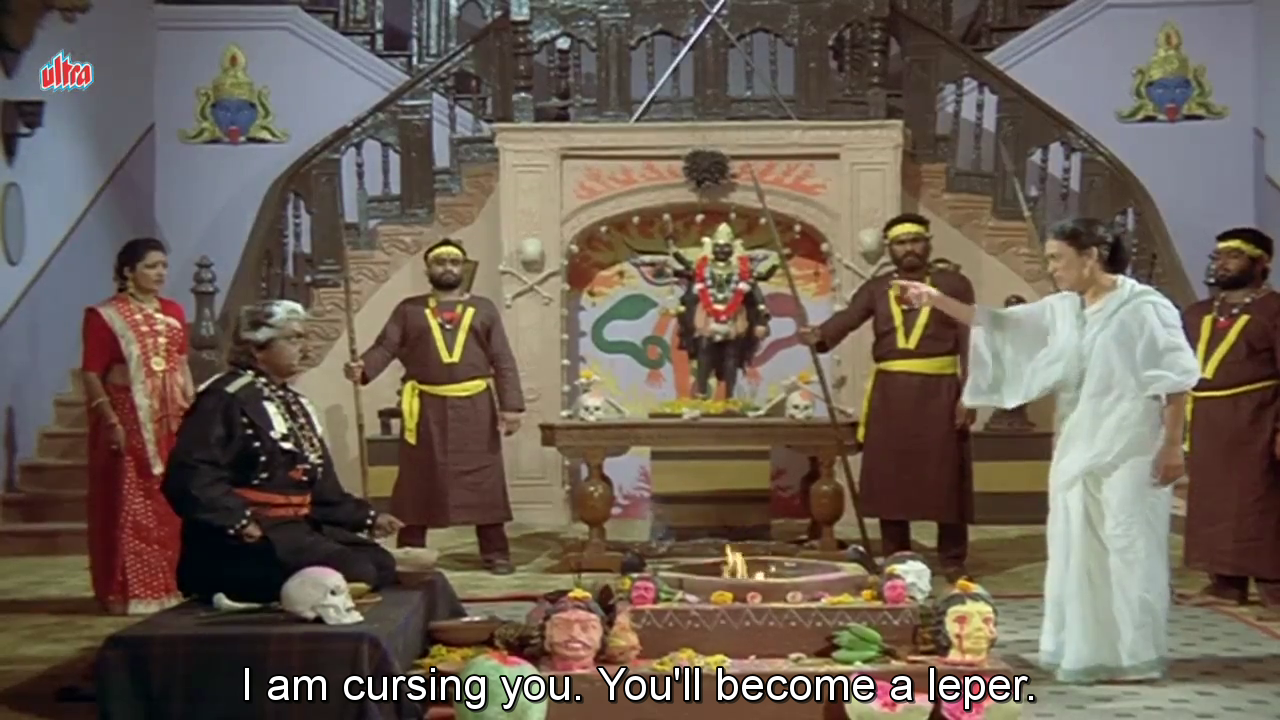
Nache-Nagin-Gali-Gali-cursed(He has a curse laid upon him by a grieving mother, the fiery Suhas Joshi, as payback for killing her son.) He could have asked his guru (Satyendra Kapoor) for help except he had him trapped in a giant bird cage and stole his power. He interrupts Mohini and Nagesh on their full moon night of love and they transform into children, hoping to hide in the crowd at a nearby fair.

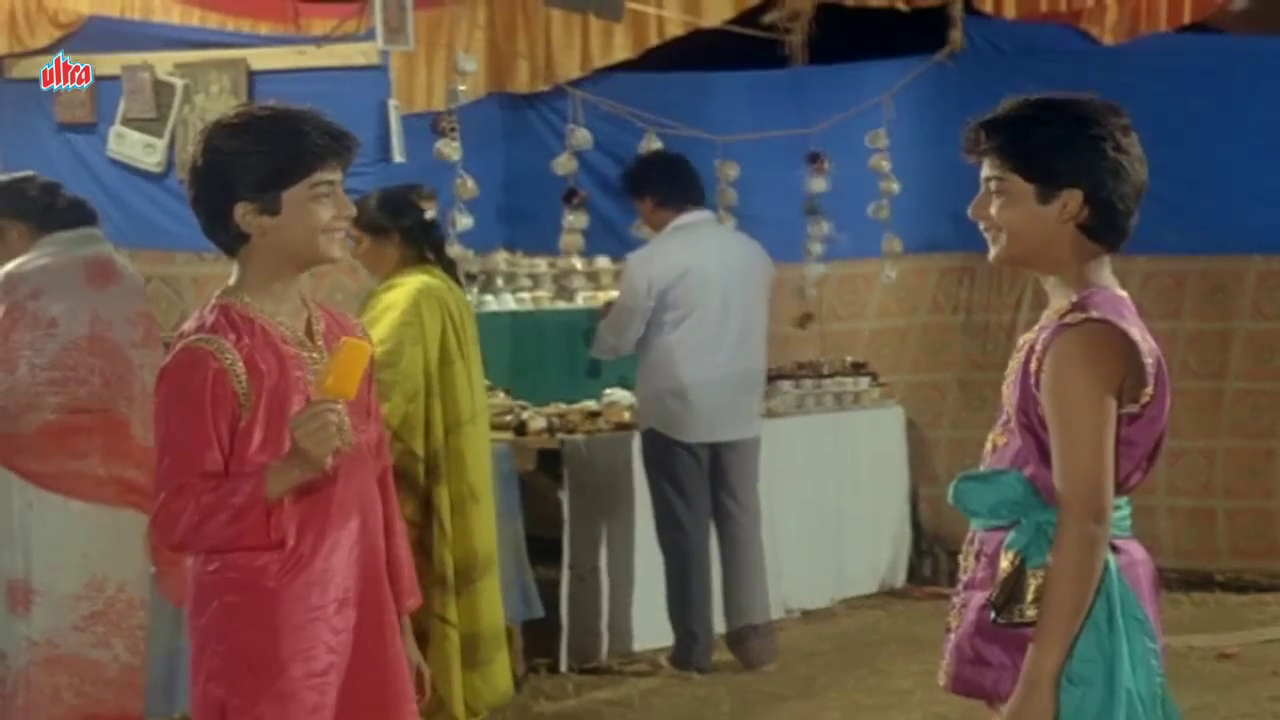
Nache-Nagin-Gali-Gali-little MohiniNache-Nagin-Gali-Gali-Duplicates

In all the confusion the children are separated. Nagesh is mistaken for Kamal, a landlord’s son who he saved from being sacrificed by ‘tribal’ people, and taken home despite his denials. Kamal is taken by the sorcerer who thinks he has captured the snake. His wife Subhadra pleads to keep the boy and raise him as their son, which Kamal takes to easily thanks to some filmi amnesia. And poor distraught Mohini is rescued by kindly gypsies and raised as their own. Time passes, and the magician is running out of time to find a cure. Kamal/Nagesh takes a vow not to leave Kamal’s ma as she becomes dangerously ill when stressed so he is stuck, waiting for a solution but not doing much to find one. Nagesh and Mohini find each other, Kamal and the baddies find them, and things rattle along to the exciting final confrontation.

I really like Meenakshi as Mohini, but was even more impressed that this is a film where the entire climax sequence happens without the purported hero. Mohini and the good guru take on the evil tantric to try and prevent him from gaining more power and overcoming his creeping rot.

There are loads of special effects and there is a fairytale feel to the battle between good and evil that contrasts nicely with a quite earthy romance. I was saddened by the use of animals in some scenes, but there is only one incident where I thought there was a genuine prospect of injury or death (a snake versus mongoose battle). For the most the death and destruction is stylised so the drama plays out as engaging and a bit exciting without being at all realistic.

Meenakshi is lovely despite the hair and wardrobe choices in most scenes.

My only explanation for the backward bustle or peplum on the white dress was that perhaps it was really an egg pouch. I know if I was a self willed married lady snake I would not want to be bothering with 40 weeks of gestation plus labour. Her Mohini is heartbroken and wants to find Nagesh more than anything. But she also forms a strong loving relationship with her adopted family, and retains her sense of self-worth.

Nache-Nagin-Gali-Gali-RomeoNache-Nagin-Gali-Gali-never mess with a snakeThere are some unfortunate comedy incidents, but I quite liked seeing a creepy Romeo terrorised by the pretty snake lady.

Nache-Nagin-Gali-Gali-The Look stage 2 with lensesNache-Nagin-Gali-Gali-Mohini attacksMohini dance-fights her way through the final encounter and Meenakshi shows both the disadvantage of a small woman trying to beat a man in a physical fight and the power of her will and determination to be victorious. Her posture and energy changes to show the gradual loss of strength and the corresponding increase in desperation.

Nitish Bharadwaj plays adult Nagesh and Kamal. I have to say, apart from his mullet and some interesting outfits in songs, he made little impression. The highlight of his performance is probably his comic aversion to Roop, the girl his parents want him to marry. There is a brilliant meta moment when Roop makes Nagesh/Kamal watch her dance against the background of Sri Devi in Nagin. Roop does a terribly cheesy and not at all alluring ‘snake dance’ as Nagesh is captivated by the music, leading to his, ahem, premature transformation. I love that even in that silly scene, there is room for more plot development and film references. Nitish is adequate without being particularly good or bad.  Since his characters main contribution to the plot is just to be who they are, it all works out.
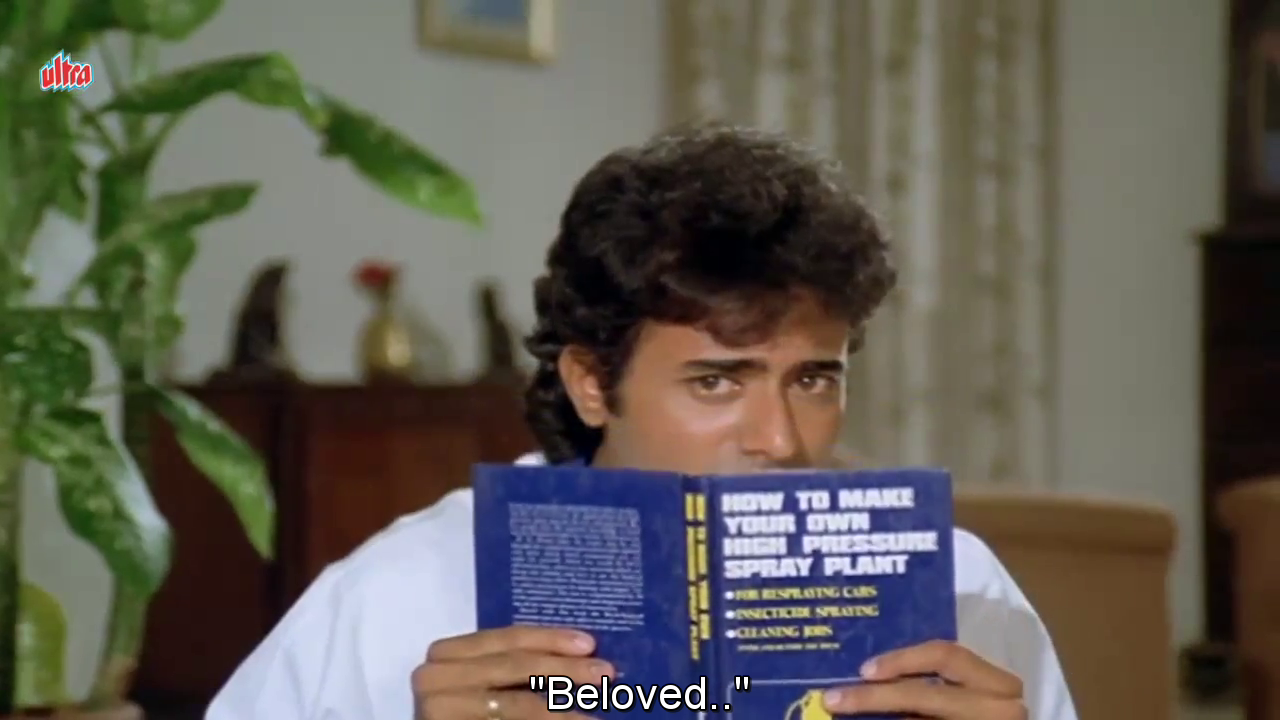
Nache-Nagin-Gali-Gali-romantic readingNache-Nagin-Gali-Gali-the chase


Was that book some kind of compulsory family reading? There are stacks of copies in the house. Perplexing.

Nache-Nagin-Gali-Gali-in chargeNache-Nagin-Gali-Gali-new interior designSadashiv Amrapurkar throws himself into the villainous role with gusto. He goes from ashram to megalomaniacal dictator décor in a heartbeat and seems content with being bad. If only he could get rid of that pesky leprosy! He spends much of the film trudging up hill and down dale, looking for the snake with the naag mani.
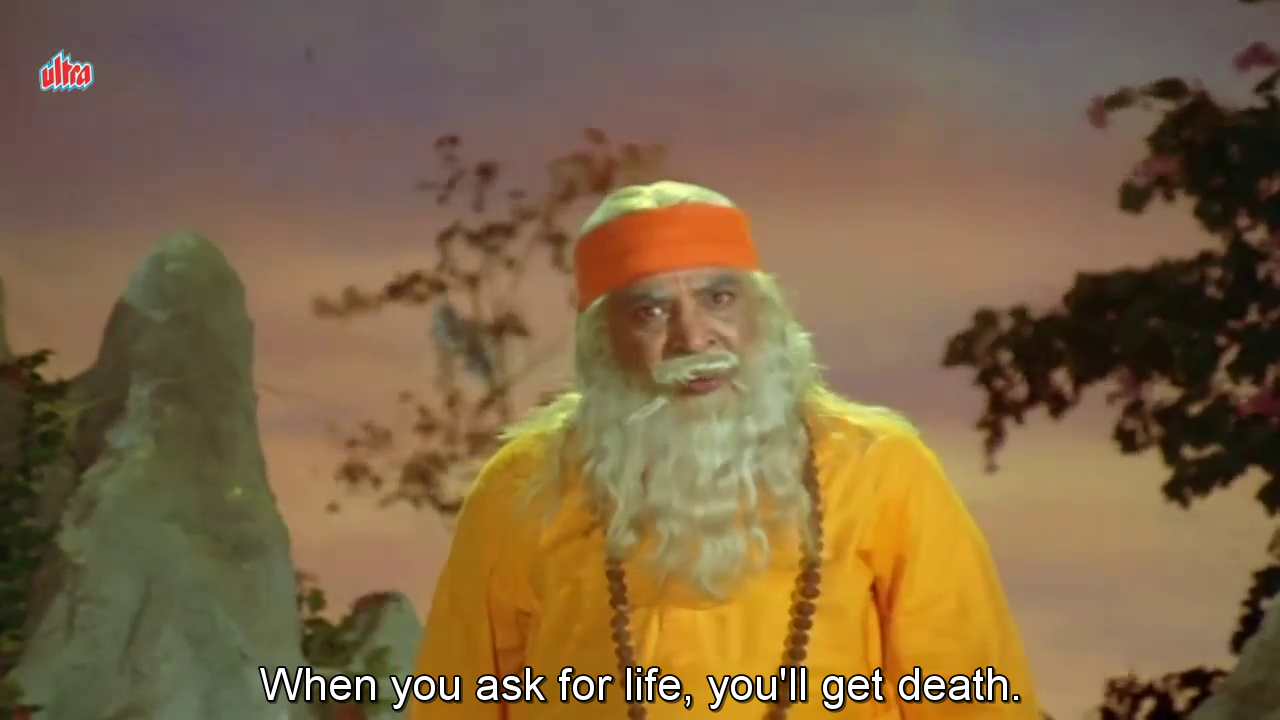
Nache-Nagin-Gali-Gali-Satyendra KapoorSatyendra Kapoor is stately and saintly in his flowing wig. He is like the voice of your conscience that never quiet goes silent. A lot of his role is done by voice over as the parrot got the most screen time. The final duel between guru and wayward disciple is something else as they transform into a series of animals with rich inner monologues.

Nache-Nagin-Gali-Gali-sporty bridal wearNache-Nagin-Gali-Gali-Sahila ChaddhaSahila Chaddha is Roop, but you could also call her Sporty Bridal Wear Lady or WTF Is She Wearing Lady. She is bubbly and determined to get her man.

I enjoyed her antics as she tried to anticipate his objections and overcome them, usually through multiple costume changes and a dance. Kamal’s mother enjoyed watching her son’s discomfort and encouraged Roop too. I never felt sorry for Roop as Kamal/Nagesh was so obviously not keen and yet she persisted. Plus she was needlessly vindictive and nearly got Mohini killed. Not cool Roop.

The songs (by Kalyanji-Anandji) are colourful and mostly uptempo. They didn’t have a huge budget for sets but they did get a good bulk deal on sequins so there is lots of sparkle.

Meenakshi does most of the dancing as Nitish Jeetendras his way around the set. He did do some slithering which was kind of interesting if not strictly speaking good. Or to quote Beth “Kya slither hai!” Both the hero and heroine were submerged in the water feature so were each subjected to the lingering clingy clothing shots. Considering snake attire, the subject matter, and the era, this film largely eschews sleaze.

Nache-Nagin-Gali-Gali-Reunited

There was some conversation about a certain “pajamas – now you see them now you don’t” scene, but these are married snakes of legal age so it is really no one business but their own.

If you want an entertaining film tinged with fantasy and magic, with baddies you can really dislike and goodies that are mostly likeable and right, packed with songs and visual effects, this would be an excellent choice. It is now available on YouTube with subtitles so why wait? 4 stars!

Kodama Simham

kodama-simham

Chiru as a cowboy! Hidden treasure! Radha as a jungle warrior princess!

While I love a lot about Kodama Simham I am going to begin with a caveat. There are some horse stunts that turned my stomach.  If that would worry you, have the fast forward button at the ready. In a couple of scenes it did look like the horse that went down got up and ran past the camera so maybe I am overestimating the likely damage. But it is something that makes me wary of this genre, no matter what industry made the film. And it seems a bit rough when it is a horse that saves the hero at a critical point.

Kodama-Simham-Bharath wants justice

Bharath (Chiru) is a gunslinger – the good kind – picking up the bounty on criminal types. Bharath manages to upset the local purveyors of iniquity. His parents are killed, but not before his dad tells Bharath he was adopted and to go look for his biological parents. His father Dharmadev (Satyanarayana Kaikala) hid some treasure to keep it safe, but was forced to go into hiding while Bharath’s Ma was jailed. Bharath must retrieve the treasure, clear his parent’s name, and give the bad guys their comeuppance. Simples!

I’m not sure what time period this film is meant to be set in. There are few reliable fashion indicators.

Horses are the only form of transport although there does seem to be a lit-up fish tank and a jukebox in the saloon.  There are what look to be Native American styled natives, as well as a forest dwelling tribe of non-specific plumage. Plus the (possibly) cannibal cat-people guarding the hidden treasure.

There are hangings and shootings galore, and justice seems to be an individual pursuit. Well, Brahmi is the local police so I can’t blame anyone for deciding to go DYI. Bharath disrupts an auction where young ladies are being sold to men or brothels, sets the captives free with a cheery “All the best” and that seemed to be the end of that. Swapna is chased for the umpteenth time by men of bad intent and runs into the jungle, leaving her girlfriends for dead. Nice. She meets Dharmadev who tells his boys off for their lack of manners and again, that seems to be the end of that. There is a pleasing finality to some of these issues: “You’ve been told, now bugger off and don’t do it again”. “OK”. If only that worked in real life.

While the title cards said K Muralimohana Rao directed, at times I suspected the film was being ghost directed by the Hat Department. Telugu cowboy films always turn it on for the headgear, and this was a corker. Behold!

Chiru’s hero entrance starts, as it should, with his boots before the rest of him swaggers in to view.

Kodama-Simham-The bootsKodama-Simham-the treasure

Unfortunately it is hard to tell on a grainy VCD print, but in one scene if his boots aren’t bulletproof, they come close. He has a laconic style and an extensive collection of guns. But what makes him an unstoppable Hero is his self-belief and righteousness. There is a touch of Clint Eastwood in how Bharath is styled – he wears a poncho with panache (probably all that practice Chiru has twirling capes) but Chiranjeevi puts his own stamp on the role. Bharath is a dancer and a ladies man as well as a capable fighter and filial son. Directors must have count their lucky stars to get a hero who could dance and fling himself around in action scenes and do the horse riding scenes as well as being ladybait. The story builds up to an all-in confrontation, and Bharath does follow a fairly logical path to that conclusion, even if the steps along the way strain the elasticity of my disbelief suspenders.

Could one heroine suffice for such an exemplary hero? No.

Kodama-Simham-SonamKodama-Simham-Swapna and art

Swapna (Sonam ) is the mayor’s daughter. She has a penchant for making bad art and wearing terrible outfits.

Kodama-Simham-the tribeKodama-Simham-Chiru and Radha

Bijli (Radha) could probably be described as a tribal princess. She likes hunting, shooting and wearing bad outfits. There is some common ground for these ladies if only they could see it. It took me a while to place Sonam but then it hit me. The vacant stare, the pout, the head tilted on the side – She was in Ajooba! Maybe her career is worth investigating further…. Radha of course was an established heroine in South films at this time, and Bijli is the more substantial of the female roles. She looks like she had fun playing the kickarse leader and Bijli and Bharath were the main drivers of many of the revengey plans. Sadly for Bijli, Bharath seemed to be drawn to the girl who did enough stupid things that he would be kept fully occupied in saving her.

Kodama-Simham-Pran the villainKodama-Simham-Pran!

Pran is the dastardly Mayor. He is first seen reading a proclamation off a fancy silk scroll before ordering the hanging of an assortment of extras. I was so pleased when I recognised him but somewhat disappointed that he was in such a stereotypical role with little scope for him to really work his villainy. Still, Pran! Always fun to see worlds collide even if he did try and have Chiru’s eyes out with a red hot poker.

Kodama-Simham-MohanbabuKodama-Simham-Sudhakar

Mohanbabu is the pungent Suddigaali – everyone sniffs when he turns up and no one looks pleased with the result. He is a cartoonish villain but his spaced out reactions and bizarre logic made for some entertaining scenes. Sudhakar is the Mayor’s bumbling accomplice and does his usual shtick. Kannada  Prabhakar is a more flamboyant and sociopathic bad guy.

Kodama-Simham-I shall call him Jaws

There is also that guy, who looks like a) Jaws from the Bond films and b) he stole one of Chiru’s costumes. There is a villain for all seasons in this film.

This is one of the films where I wait eagerly for the songs. Every picturisation has its own kind of awesomeness, largely fabric based. Raj-Koti’s songs are fun and Chiranjeevi makes the most of the choreography.  I choose to believe his dancing on the ceiling was a tribute to Fred Astaire rather than Lionel Richie.

Sadly few of these songs are available on YouTube or the like due to the egregious copyright claim shenanigans. I cannot fathom why a company with no apparent interest in promoting or preserving the old films they allegedly own would object to short clips being shared online when they don’t have their own version uploaded. I’d get it if they were worried about loss of ad revenue, but often I am mystified. Unless they’re worried someone will try and buy a copy.

See this, if you can find a copy, for the full tilt tongue-in-cheek mass style transplanted to Cowboy Country and the pleasing commitment to justice and hats. Chiru is in fine fettle and Radha is an excellent foil. The more is more approach means you’ll never have long to wait for the next song, dance, fight, demonstration of how to transport a treasure chest across a gorge or costume change. 4 stars!

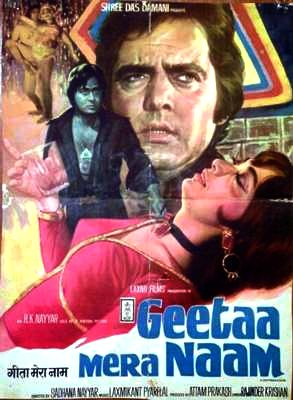
Geeta Mera Naam

Geeta-mera-naam

Sadhana’s Geeta Mera Naam is masala with an added dimension of weird.  The cast includes Sadhana, Sunil Dutt and Feroz Khan; all veteran stars with a diverse portfolio of work. Add in the usual suspects like Helen, Rajendranath, Keshto Mukherjee and even Jr Mehmood and you’ve got the ingredients for entertaining excess at your fingertips.

Geeta-Mera-Naam-monkey 1

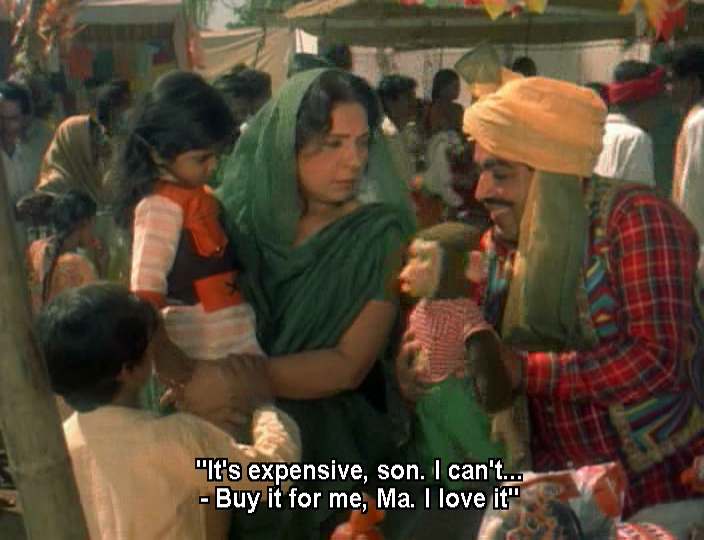
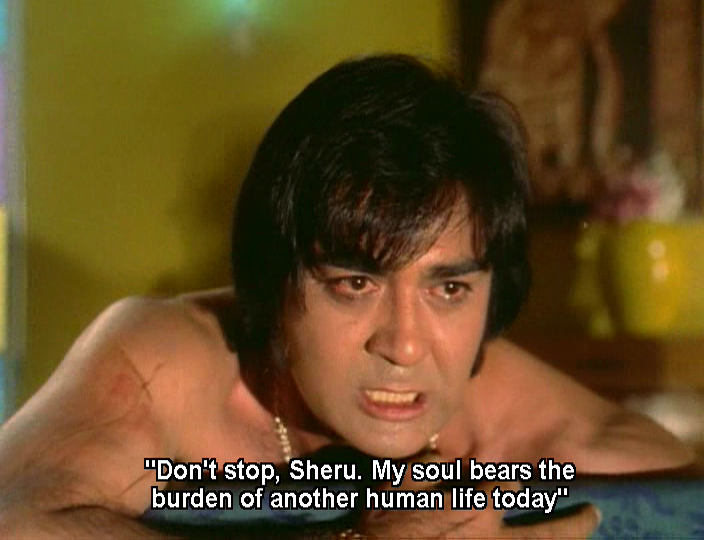
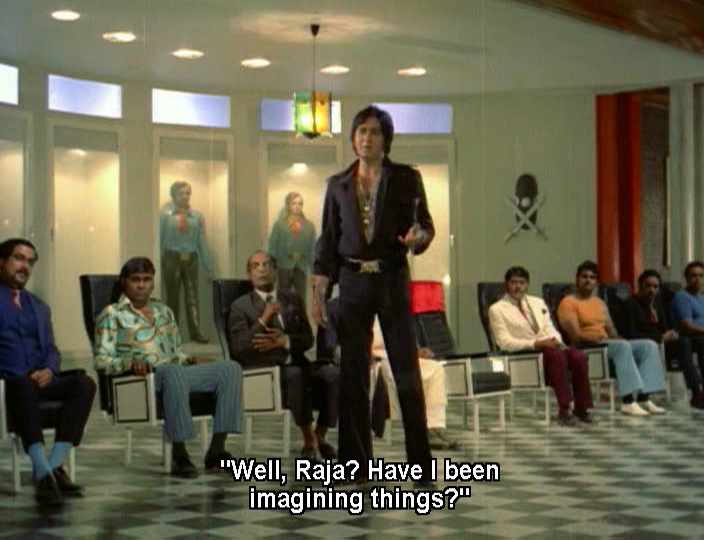
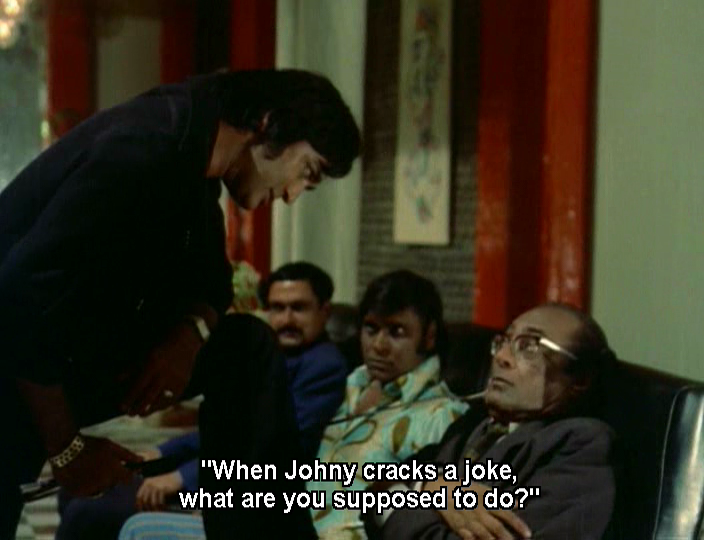
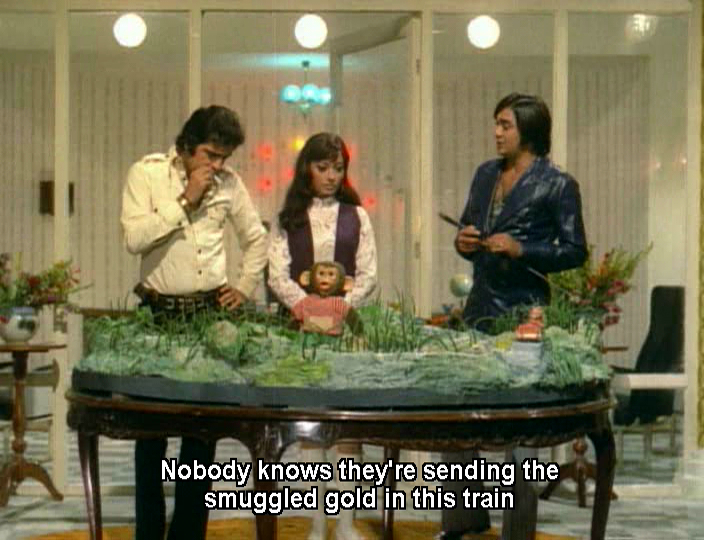
Widowed Ma Saraswati (Achala Sachdev) takes her four children to the fair. Experienced masala watchers know that any visit to any amusement with a child is bound to end in tears and separation. Bandits raid the fair, as they do, and in the ensuing mayhem Saraswati keeps hold of Geeta but loses her twin Kavita. The boys are swept away before their matching tattoos could be completed, leaving Chandu with half a monkey on his forearm. If only some people had worn short sleeves in key scenes. Suraj is taken by the bandit leader as a replacement for his dead son while his brother is adopted locally. Years pass. Geeta (Sadhana) is a petty criminal, in and out of the cells at the police station run by her(unknown to either of them) long lost brother Inspector Chandu (Ramesh Deo). Kavita, now called Nita (also Sadhana), is a nice girl who teaches orphans in her spare time.  Nita’s adoptive parents sell her to Mohanbabu who wants her for a few months, or until he loses interest. Then they can sell her again. As she fights to escape someone kills Mohan. Nita sees a shadowy figure in a hat but the police charge her with the murder. And what of Suraj? Now called Johny (Sunil Dutt) he is a successful smuggler with a gang and a pretty good lair and a masala death trap and … a man called Sheroo who whips him, and a toy monkey, his memento of that day at the fair. Johny’s best friend (other than the monkey) and lieutenant is Raja (Feroz Khan), equally ruthless and pragmatic about the business at hand but with more of an eye for the ladies.

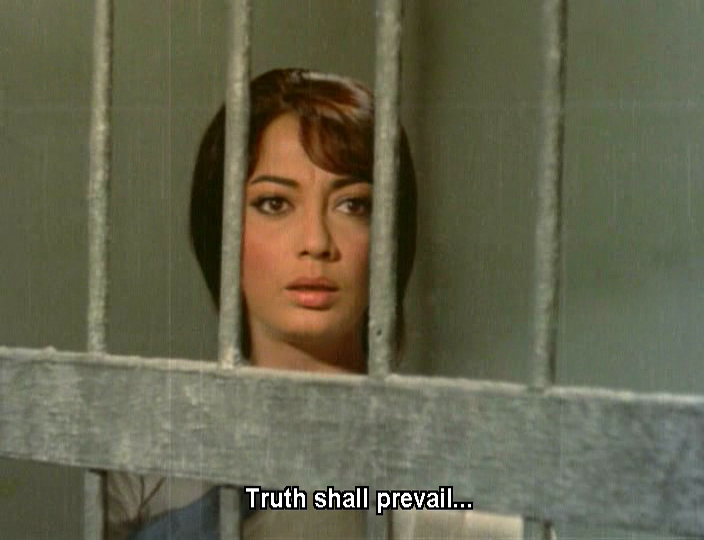
Geeta-Mera-Naam-NitaGeeta-Mera-Naam-Geeta

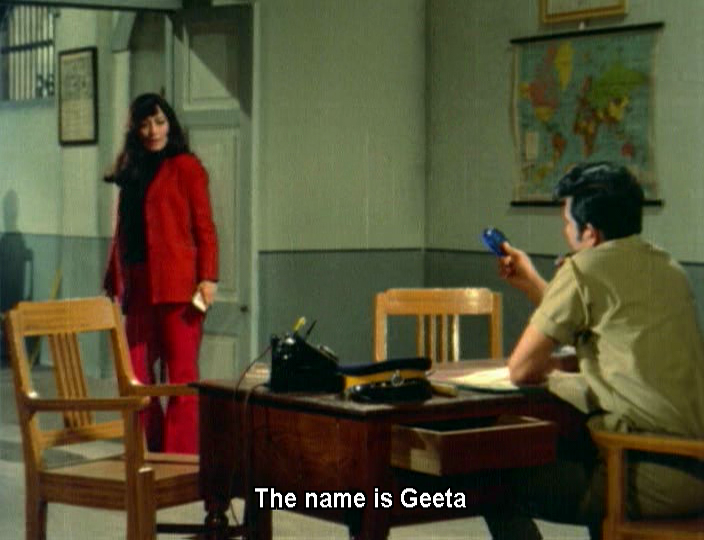
Sadhana didn’t exactly challenge herself with a double role as Nita, the good twin, is only seen for a short time and Geeta does all the heavy lifting. But Geeta is a great character. Feminine but independent and strong, she insists on being seen as an individual not someone who answers to “hey girl”. Sadhana’s clothes as Geeta were quite mid 70s frumpy and not what I expected from such a fashion icon. Geeta discovers her sister Nita in jail and decides to find the real killer. Learning that Johny did the deed, she infiltrates the gang through Raja.

Geeta uses her fearless attitude, kickarse fighting skills and feminine charms to gain his interest and for some reason, her feelings are also engaged, making vengeance a little more complicated.

Sadhana is a very capable actress but I found her direction more interesting than her performance. The film is a bit darker and more low key than the average masala flick, and there is an undercurrent of violence and power. Johny kills with tear filled eyes, then atones for his murders by having Sheroo flog him as penance. He is obsessed with rules and justice and blood in the sense of blood ties. Blood doesn’t recognise blood, but people do recognise their long lost identical twins and significant tattoos and remember where they were lost, all of which is handy. Geeta uses sex or at least the promise of sex to lure men but she has right on her side. She takes a strong stand against Johny partly to save her sister but also because she just doesn’t believe in his rules and why Raja feels bound by them. And his bad jokes should not be encouraged. I’m used to the first view of the heroine being restricted to various body parts, but Sadhana tries to level that playing field by having Sunil Dutt’s butt be his introduction.  Common masala themes of redemption, family, moral righteousness and the law are explored through characters struggles and insights. The standard masala requirements of separated siblings, elaborate death traps, convoluted revenge and audacious yet pointless criminal gangs are all present and accounted for.

Feroz Khan, or Fur-Roz as I mentally called him throughout, plays Raja with minimal facial expression but maximum wardrobe impact. I think there was some kind of battle raging in the costume department as he spends about half the film shirtless and the remaining half in puffy shirts. Raja is Johny’s most loyal friend but of course, once you add in such elements as a gold heist and Helen as the woman scorned, things get tricky. I’m not a fan of Feroz the actor but he did make some interesting films even if I am not always completely on board. Raja is not a very developed character but he does have presence and it is easy to believe in his authority within the gang.

Geeta-Mera-Naam-tormentGeeta-Mera-Naam-Sheroo at work

Geeta-Mera-Naam-Johny and gangGeeta-Mera-Naam-insight

Sunil Dutt turns in a solid performance although I would not say it is his finest moment. His portrayal of Johny is over the top but he does give a sense of the troubled person under the trappings of villainy (and the pleather outfits).

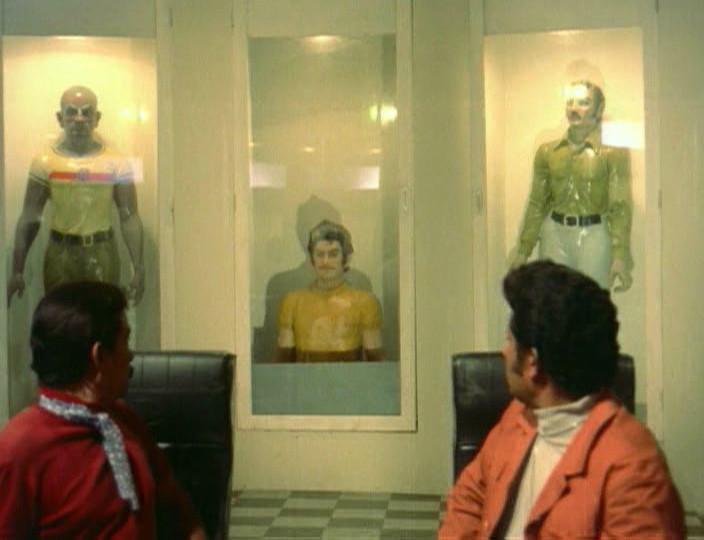
Geeta-Mera-Naam-jokesGeeta-Mera-Naam-lairHe and Feroz are in a race to see who can get their teeth into most of the scenery first but considering Johny disposes of disappointing employees by turning them into his own version of Madame Tussauds, realism was never on the cards. I did like that he didn’t play Johny as obviously crazy.

Geeta-Mera-Naam-evil laughGeeta-Mera-Naam-a cunning planDespite the occasional evil laugh, the peculiar behaviour was shown in a matter of fact way, so Johny seemed like a credible threat. He was capable of friendship despite his inner demons. Sure, the gang must have had rules about things like “Never mention the monkey” and “Don’t ask Sheroo where he buys his corsets”.

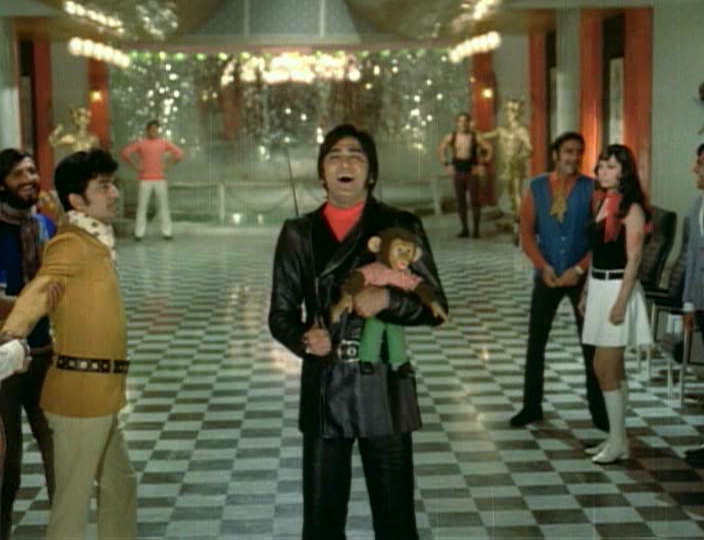
The background score is fantastic and I loved the punchy brassy tracks as well as the forays into surf rock and swing. Laxmikant-Pyarelal’s  featured songs are far less interesting although they do further the narrative somewhat. Helen plays Raja’s girlfriend and finds herself dumped for Geeta. She gets one big dance number, the incredibly strange and eyeball searing Mujhe Maar Dala. Geeta intends to sacrifice herself to save Raja who wants to save Geeta as Helen gleefully gyrates in a bubble filled water feature with Oscar, singing about pain, suffering and love.

Poor Oscar. A flesh coloured onesie is difficult for anyone to carry off, and the black belt doesn’t have the slimming effect that may have been intended.

Geeta-Mera-Naam-Helen and OscarGeeta-Mera-Naam-teeth

And I’d like to give Helen a special acting award for the bit where she unzipped Raja’s jacket with her teeth. There was not a flicker of expression on her face to indicate how traumatic it must have been as his fuzzy torso was revealed.

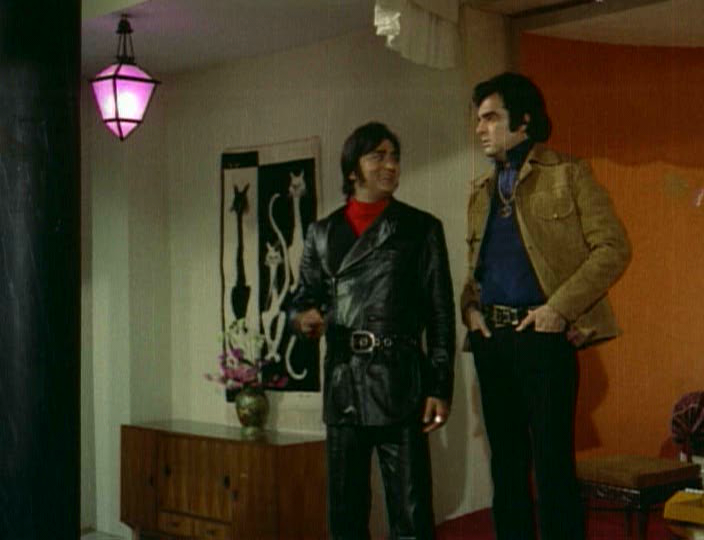
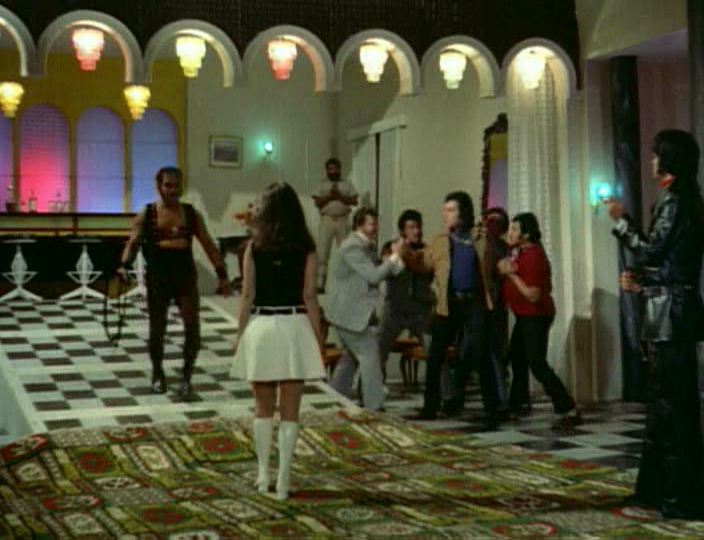
Johny’s lair is part suburban living room, part gallery and part obstacle course.

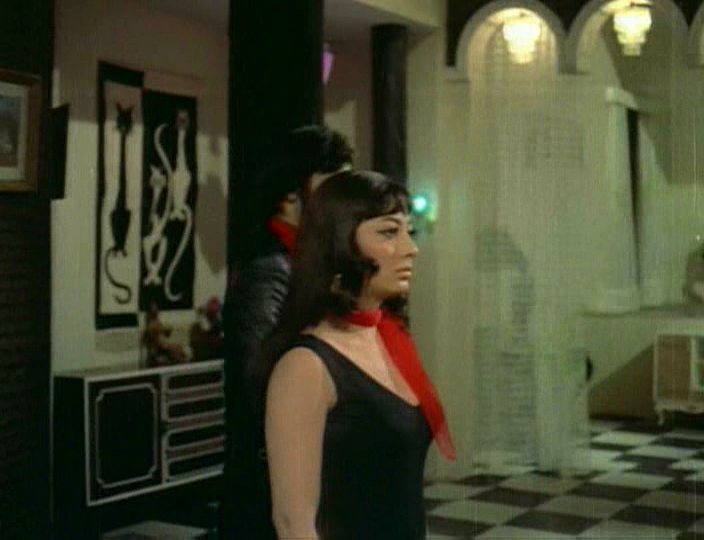
Geeta-Mera-Naam-Feroz and SunilGeeta-Mera-Naam-the other cat wall hangingThe famous Cat Wall Hanging appears. Raja’s apartment is the height of 70s bachelor style, complete with round rotating bed. Johny ends up with a cast of thousands in his relatively modest abode for the grand finish.

Geeta-Mera-Naam-carpet

I was amused to see some carpet placed over sections of the tiled floor and wondered if it was due to health and safety concerns for the actors, or reflected Johny’s experience of having to get bloodstains off the marble.

This is unlike most other 70s masala in terms of the psychology of the characters and the prominence of the women within the story. Sadhana chose Geeta Mera Naam as both her comeback and a farewell, wanting to go out as a memorable heroine.  I wish she had directed more films as this is highly entertaining and all the elements are well balanced.  3 ½ stars!

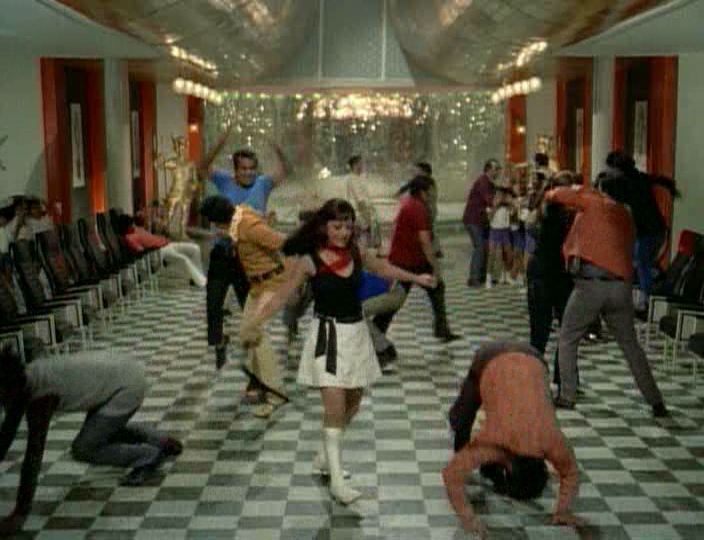
Geeta-Mera-Naam-Mayhem