Kismet (1943)

Kismet 1943 poster

Gyan Mukherjee’s Kismet was one of the biggest box office hits of the time and it still has a charm and elegance I find most appealing.

Kismet-Freedom

Shekhar (Ashok Kumar) is newly released from his latest jail stint. The first thing he does is to pick a pickpocket’s pocket and merrily resume where he left off, straight to his old fence (David). The owner of the much-stolen gold watch is an old alcoholic who was going to sell it to buy a theatre ticket. His daughter was going to perform and while he was estranged from the family, he dearly wanted to see her triumph. Shekhar seemed sympathetic and a little amused, but had no intention of confession. He just treated the old guy to a ticket and off they went.

Shekhar hears the old man’s story in a flashback that features Baby Kamala (Kamala Lakshman) dancing beautifully as his little daughter. Present day Rani (Mumtaz Shanti) sings a rousing patriotic song declaring India to be the property of Indians and not various foreign interlopers. She looks a frail but intense young lady, leaning on a crutch for support. But Shekhar wasn’t just on a social outing – he spotted a fancy necklace on the wife of Inderjit (Mubarak), the theatre owner, and decided that it would do nicely. Shekhar stashes the necklace in Rani’s belongings and manages to evade the police. He breaks into Rani’s house and really doesn’t explain why despite her half-hearted questioning. She decides Shekhar is a Nice Man as she assumes he is a friend of her father so therefore, Good. The police, led by Shah Nawaz as the inspector, know that Shekhar is a Bad Egg. He moves in to her house as a tenant, and while he initially uses Rani to improve his own situation he becomes emotionally involved and wants to help. He doesn’t do anything by conventional or honest methods and when worlds collide, Shekhar, Rani and their burgeoning love are all put to the test.

Rani’s leg could be cured if she could afford surgery and therapy, Leela is pregnant to her spineless boyfriend Mohan, and Shekhar is finding things to care about in life and weighing it all up against his relatively free existence. Who really owns the significant necklace? Will Rani dance again? Will Leela’s life be set to rights? Will Shekhar be able to live the life he wants with Rani? Will Rani accept his chequered past? And whatever happened to Inderjit’s long lost son, the one with his name tattooed on his arm? Oh masala, you’ve been around a long time!

Ashok Kumar is wonderful. He has a genial neutrality about him as Shekhar accepts that people are probably doing things for their own reasons, and those reasons are none of his concern. He isn’t a criminal out of any antisocial sentiment, and it could be argued that his brand of theft is generally not violent. My biggest issue with Shekhar was his choice of headgear. It just didn’t seem very stealthy for a thief! He is often seen through windows or doors, not really immersed in the action but appearing to be involved. And he always has an escape route. Shekhar may have a cynical outlook but his smile lights up the room. Ashok is charming and plausible as the gentleman thief, and it is easy to believe that poor sad Rani would be drawn to this competent, caring, and rather dashing beau.  Shekhar is an anti-hero who becomes heroic through his certainty of purpose and an ease in owning his choices and the consequences. He doesn’t play the blame game and actively tries to prevent his misdeeds harming others. Yes he even steals from the rich to give to the poor.

Rani and Shekhar had a nice rapport and their lullaby duet is sweet, with Dadamoni singing for himself. He isn’t as good a singer as he is an actor but there is something earnest and yet a bit cheeky in his vocal that is endearing.

Mumtaz Shanti plays Rani as melancholy and tending towards passive, but there is spirit in her teasing scenes with Shekhar and she faces down the rapacious manager and social snobbery of Inderjit with apparent ease. She must have been strong to carry on and keep her sister and crumbling household together after their father shot through. Mumtaz has a stagey and mannered acting style that hasn’t aged well so I found her less engaging than Chandraprabha or Ashok Kumar who were warmer and more natural.

Anil Biswas uses a full orchestra and chorus to provide a lush and melodious soundtrack. The songs range from patriotic anthems to wistful love songs. Ameerbai Karnataki sings for Rani, and her strong, earthy tone gives the character more substance than a more girlish or twittery vocal would have.

And if that isn’t enough, there is a young but recognisable Mehmood in his first film appearance as the childhood version of Inderjit’s missing son Madan. David as the fence was so young I almost didn’t recognise him. V.H Desai is fun as Banke, the inept but enthusiastic thief trying to get Shekhar to join in a big robbery. Kanu Roy is Mohan, the man who gets Leela knocked up but can’t man up enough to tell his father. And how nice it was to see a girl who was pregnant out of wedlock be treated like a human being by her family and friends. Leela contemplated suicide but her father didn’t hesitate for a second before taking her side. Chandraprabha gave Leela a nice dash of defiance that would have made such a pretty girl irresistible to wishy-washy Mohan.

I’d watch Ashok Kumar in just about anything, so when the awesome team at Edu Productions made Kismet available, I wasted no time in getting a copy. I often complain about how hard it is to get a decent copy of older Indian films, especially with subtitles. At last year’s Indian Film Festival Melbourne the print of Garm Hawa provided was in such bad nick it was unplayable.  I’ve read journalists taking potshots at actors like Amitabh and SRK, saying that they should do more to preserve Indian film heritage and that it is their duty. I’d like to know why such a huge industry that presumably tips a bit of dosh into the government coffers, as well as keeping the entire sequin industry afloat, needs to leave it all up to actors. Surely there has to be a better solution. And I am grateful to the lovely Edu Productions team who are doing their bit to find, clean up and most importantly share some enjoyable and beautiful films that are out of copyright. And I will stop before I get on my high horse and rant about unfair copyright claims on YouTube.

Kismet has everything I ask for in a romantic drama, namely romance and drama, and wraps it up with charm and humanity. There is redemption and a celebration of looking for gold, not for dirt.  4 ½ stars! (Minor deduction for Rani’s moping. Even when it is justified, excessive moping tries my patience. )
Bhairava Dweepam

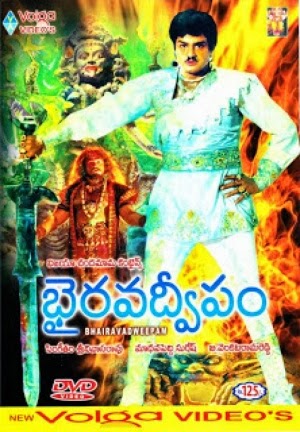
Bhairava Dweepam DVD

Released in 1994, Bhairava Dweepam is a lavish lolly coloured Telugu folk tale. Writer/director Singeetham Srinivasa Rao picked up a couple of awards and the film was both a commercial and critical success. Although I found it quite entertaining, there are a few things I couldn’t help but compare unfavourably with other similar films.

Bhairava-Dweepam-Vasundhara is rejected

The story is easy to follow, which was handy as I haven’t been able to find subtitles. Vasundhara (K.R Vijaya) had a baby, probably out of wedlock but certainly not to the liking of the royal family. When she takes her son to the prince, the father in question, she is turfed out into the stormy night. She has an accident in her small unstable boat and mother and child are separated. Vasundhara is taken in by a kindly hermit who also creates a magical (poorly trimmed fabric) flower that will thrive as long as her son is also alive.
The boy is adopted by a village leader and grows up to be Vijay (Balakrishna). The people rejoiced – except that baby in yellow. Vijay and his sidekick or adopted brother, (Mohan Babu), are out and about doing what boys in folktales do when they spy Padma (Roja). Vijay is instantly smitten and sets about finding his way into the palace to spend more time with her. Unbeknownst to Padma, an evil magician also has his sights set on her. Padma is rendered seriously ill by a spell and Vijay searches for a cure. Along the way he meets his mother but they don’t yet realise their connection. She gives him a protective amulet which comes in very handy. He discovers the nefarious plot and after much travail, confronts Bhairava to set things to rights.

The story is very similar to the gorgeous 1951 film, Patala Bhairavi. And that is where the comparisons start. Where Patala Bhairavi was stunning and NTR was effortlessly charismatic, Bhairava Dweepam is a bit less magical and Balakrishna is more workmanlike in constructing his performance. The special effects in 1994 have not moved on all that much from 1951. I did wonder what my 1994 self would have thought, but in 1994 I had already seen films like Ridley Scott’s Legend (1985). While there were some things about Legend I don’t care for (Tom Cruise for starters), it did look like a magical fairytale and the unicorns are beautiful. Compare and contrast these approaches to prosthetic horse makeup.

While I appreciate the spirit of making do, even if it does result in a grumpy looking horse with feathers stuck on, I was left a little underwhelmed. It was a mixed bag and often more amusing than enchanting.

There are other sequences involving a two headed rubber chicken dragon attacking the flying bed used to whisk Padma to the villain’s cave, some tiny miniature people who help Vijay obtain a magical necklace, a mirror monster in a peekaboo green rubber suit and so much more. It is kind of great but not really good. Ajooba-esque, perhaps. And there are some horse stunts that look horrible. One scene involved Vijay using a stick to trip horses, and not all of them looked like they were going to get up. I deducted Hero points from Vijay on seeing that tactic.

Balakrishna works harder than anyone else in the cast. Vijay is in almost every scene and usually throwing himself into a duel or bounding about rescuing the princess so this is a physically demanding role. If Balakrishna had been paid per leap he would have cleaned up. Vijay helps or liberates a number of magical beings along the way, and they give him valuable assistance in his quest. Balakrishna certainly has the confident swagger down pat even if his dancing is less than impressive. But making a film that is so similar to one of NTR’s acclaimed roles and trying to replicate his style is a big ask. I thought the same when I watched Sri Rama Rajyam. There is nothing wrong with his performance, but he doesn’t have the same expressive quality or panache and so comes off as less engaging. Tarak (NTR Jr) seems to take a slightly different tack by paying a tribute to his grandfather in his films but not trying to mimic him as closely. That allows for more individuality and he has developed a kind of everyman hero persona (with phenomenal dancing skills). Balakrishna is more closely tied to the legacy and so I find it hard to appreciate him as an individual actor, at least based on the handful of his films I’ve seen. Plus he will always be This Guy to me.

Roja is the love interest, Padma Devi. Padma is your standard damsel in occasional distress. She does nothing other than look sparkly, frolic with her handmaidens and wait to be rescued from Certain Death. Roja is pretty and lively, and she handles the numerous songs and dances easily. But I think she would have spent more time in hair and makeup than having to learn her few lines. I did wonder why, since Bhairava required a virgin for his spell, no one thought about how Padma could disqualify herself.

The supporting cast are all good without being outstanding. Rambha has one of the big musical numbers as Yakshini, the owner of both magical necklace and green mirror monster. Giri Babu and Subhalekha  Sudhakar play scheming brothers (and Vijay’s relatives) who not only depose their own father but have their eye on Padma’s kingdom as well.

K.R Vijaya is good as Vasundhara and she does get a couple of quite dramatic scenes, including a classic Nahiin Face Off with Balakrishna.

The design department certainly went for it. Their philosophy could be summed up as ‘all the colours, all the time’. Vijay has an extensive wardrobe of gaudy leggings and tunics, nicely accessorised with an array of ornate boots and matching wristbands. I was particularly impressed with the outfit that had canary boots to match the yellow terry-towelling trim and headband. Perfect for the active hero! Roja is very glittery, as are her attendants. Bhairava’s island cave lair is more impressive from the outside but he does have more than the usual number of talking statues so that was something. There are comedy demons that help Vijay, and they look like something straight out of the kindergarten dress up box.

Bhairava Dweepam is entertaining enough, but having seen it twice now I don’t think I’d invest the time on watching it again. See it for a relatively recent take on the folkloric blockbuster and for the sheer energy and enthusiasm of the cast. 3 stars! (But if you’re a diehard fan of Ajooba, add an extra star!)

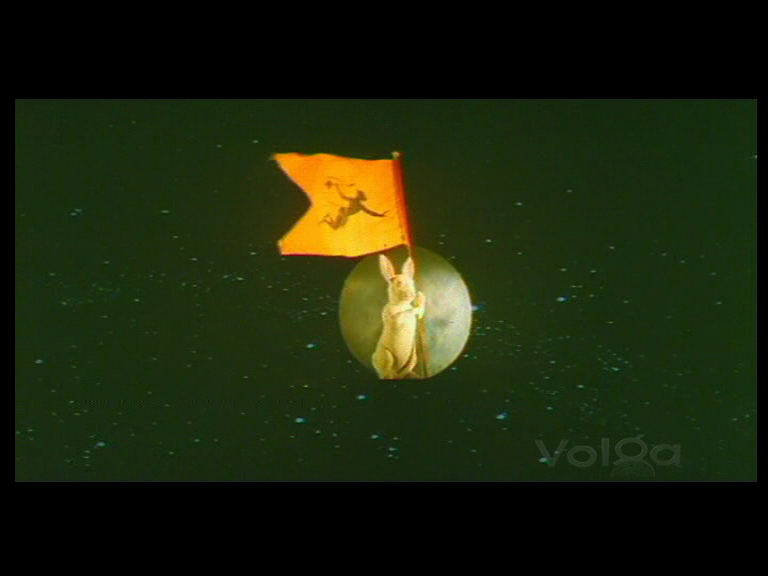
Bhairava-Dweepam-Rabbit

Also – I love this production house emblem.

Kanchivaram

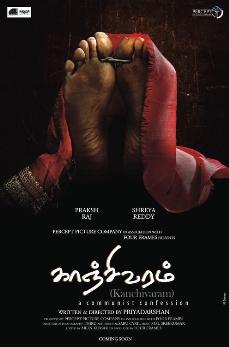
Kanchivaram (2008)

Kanchivaram is a slice of life social drama that largely rests on an excellent performance by Prakash Raj. Priyadarshan eschews the broad almost hyper style more common in his Hindi comedies and delivers a thoughtful and subdued film.

The film opens with a prelude explaining the significance of wearing silk at marriage and on death, and that the weavers were never in a financial position that would allow them to wear the fabric they wove. Vengadam (Prakash Raj) is an exceptional weaver and a natural leader in his community. A visiting writer (Sreekumar) introduces the village men to communism. Vengadam initiates collective bargaining for the weavers, which leads to a lengthy strike. But he had also promised that his daughter would be married in a silk sari, impossible to manage when he is not working. He steals silk, a hank at a time, and secretly weaves the sari he promised her. The conflict between his political and personal ideals and his love for his family is the root of the story.

The story is presented as a series of flashbacks. Vengadam is paroled from jail and travels back to the village by bus, with sounds and incidents on the journey triggering his memories of earlier times. This structure allowed me to concentrate on what was happening now, and to absorb the emotion of the story rather than wondering what would happen. His story unfolds from his marriage, birth of his daughter, the death of his wife and eventually the reason for his incarceration. The breaks in the flow as Vengadam was recalled to himself on the journey just sharpened the contrast between the bluff confident weaver and the broken man on the bus.

Priyadarshan frames the story in the political context of the rise of Communism before party membership was legalised. He efficently sets the scene of the industrial arrangements, the workers dependency on the factory, the clandestine political activism, in just in a few scenes. There are visual cues as to how things stand. The factory owner usually appears sitting or standing on a dais at a higher level than the workers. The communist writer who raises the political awareness of Vengadam and Sarathy skulks around in the dark, fearful of the police.

I’m always interested in industrial relations and the evolution of employee rights and the law so that aspect was appealing. And I particularly liked the villagers reaction to some social theatre – initially passive but on their feet and cheering like any mass movie audience when the ‘blood’ spatter started.

Prakash Raj is wonderful as Vengadam. Whether playing the younger carefree newlywed or the damaged man released on parole he is completely convincing. Vengadam has most of the dialogue in the film but many scenes rely purely on reactions and body language and Prakash Raj nails it. Often political leaders are depicted as single minded zealots, but Vengadam is more human. He understands his why wife is upset by the promise to see his daughter married in silk. He realises his daughter is in love with Ranga and goes to ask for the marriage to be arranged. He knows that when he takes a stand and strikes there will be consequences. And he knows what he is doing when he breaks the strike. Prakash Raj shows these internal struggles and questions and Vengadam’s eyes reflect his turmoil. I’m often intolerant of those who throw their families or friendships under the bus of ambition but this is more complex as Vengadam is not motivated by pure selfishness. He stole silk to weave something beautiful for his daughter, to break the cycle of not having. I could like him even as I rolled my eyes at his obsession with the sari.

Shriya Reddy is excellent  as Annam, Vengadam’s wife. Priyadarshan seems to have a knack for persuading actresses to tone down the glamour (as with Lara Dutta in Billu). Annam is smart, has opinions and politely challenges her husband in private when she thinks he has gone too far. From the initially awkward moments when Annam first comes to her new home, Shriya shows the growing affection and the playfulness in the marriage. Annam doesn’t have much dialogue so much of their closeness and the tensions in the relationship had to be conveyed through glances, the tilt of a head, the set of her shoulders.

She dies after being trampled in a crowd out to see the landlord’s new car, another symbol of the gulf between the workers and owners. Her final anguish is over whether Vengadam will be able to raise their daughter and he does his best to reassure her in his own way.

Family and village ties are revealed in many small interactions so the supporting cast are important and most are very good. I particularly like Jayakumar as Sarathy, Vengadam’s friend and one-time political ally. His rapport with Prakash Raj was excellent, and their friendship felt believably warm. I liked their stilted meeting to discuss getting their children married to each other that ended in affectionate hugs and relieved laughter. The deterioration of their relationship was shown simply but the pain on both sides and the definitive nature of the break was clear. Shammu is engaging and likeable as Vengadam’s daughter Thamarai. I do a certain amount of teeth gritting when I see little daughters made to replace their dead mothers in the home, but Thamarai was a distinct person and not just a household slave. She went to school for a while, then took sewing lessons, and her dad wanted her to be happy. So for a filmi girl in 1948 with no Ma, I thought she had it pretty good. Until things went wrong.

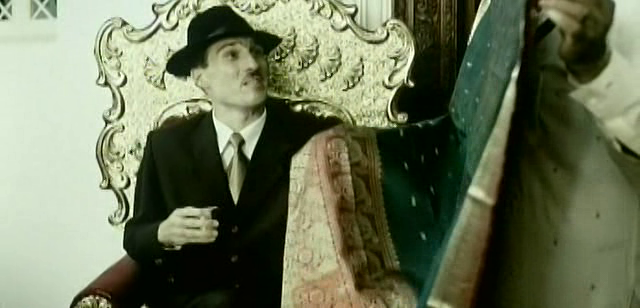
Kanchivaram-Bad actor lovely sariThere is an English character played by a truly bad actor. Well, I am not sure if the brightly over-enunciated yet almost expressionless dialogue delivery is his own style or was required by the director. There are so many good actors working across many Indian film industries yet the ‘English’ are almost uniformly laughable and seem to be reading at a pre-school level.  Who is casting these people?

The colour palette is simple and very effective throughout. The day to day scenes are muted and mostly use neutral and earth tones. The bus trip is drenched in the pale blues and grey of rain and twilight. Scenes at night are touched with the golden flicker of lantern flames. The flash of opulent silks highlights the gulf between the weavers and the eventual owners of those stunning garments, and punctuates the drama with bursts of saturated jewel tones. There are recurring motifs like the sickle, used as an emblem of communism and as a blade. Thiru’s camerawork uses lots of tight close ups of the actors and despite the dark interiors and low lighting in some scenes he catches every expression and gesture.

Despite the period and politics of the setting, Kanchivaram can be watched as a personal and intimate story rather than a didactic message film so I was impressed by his handling of those elements. But I’m not completely sold on the ending. The sensitivity of the characterisation and performances is what stands out for me. The film is available on YouTube with subtitles. 3 ½ stars!