Billu (2009)

Billu-title

So. If you are considering a leap onto the “original is best” Malayalam bandwagon and insist that I must see Kadha Parayumbol, please take a moment, breathe, perhaps go make a cup of tea instead. I’m perfectly happy with this film! What makes Billu work so well for me is that I have a high degree of awareness and appreciation of Shah Rukh’s career so the references and sly jabs at and by SRK really resonate. I wouldn’t have that to the same extent with a different regional cast, even if it is Mammootty in the big star role.

Priyadarshan directs a deceptively simple slice of life drama. Billu (Irrfan, in no surname mode) is a barber in picturesque Budbuda. Sahir Khan (Shah Rukh Khan in King Khan mode) is a massive movie star. Sahir suggests Budbuda as the location for the village scenes in his current project. Filming in the village was essential to the story as otherwise how would the Martian brother find his long lost sibling who was wearing a matching locket that beeped. I liked the interplay of real life and filmidom, in scenes when Sahir was enduring the plot narration, or when the villagers watched the shooting as though they were seeing life on Mars.

Mayhem erupts in Budbuda once the villagers find out that Billu and Sahir were childhood friends. Everyone wants to get an autograph, to get their brush with fame, and all the bigwigs demand that Billu introduce them to Sahir. But Billu repeatedly dodges the issue, even when his wife Bindiya (Lara Dutta) and annoying kids keep asking. Eventually the villagers start to believe he lied and accuse him of defrauding them of the gifts they had willingly pressed upon him.

Irrfan relies on his slightly oddball, rumpled, everyman persona for Billu and it works a treat. He comes across as good hearted but a little cynical, proud in himself but overwhelmed by the difference in status between himself and Sahir. Billu has told his family of a childhood friendship with Sahir, but is totally unprepared for how his village reacts when they find out. He is reluctant to contact Sahir, citing bygone time and the difference in their positions. But Billu’s inarticulate objections fall on fallow ground. It’s interesting that when Billu was negotiating with the school or others he could be quite glib, if apparently simple. Billu did go to the shooting and marvelled at the spectacle of Kareena’s duckface in Marjaani along with everyone else, but he flubbed all opportunities to speak to Sahir. I think he just wanted fate to intervene and take care of the logistics so he could see his mate without forcing himself upon Sahir.

Lara Dutta is beautiful but not too filmi glam as Bindiya. I could feel her frustration, not at being poor, but at having to be subservient and cop all the crap that comes with being seen as a beggar. Bindiya dreams of meeting Sahir and of the benefits that knowing a big star could give her family, but isn’t greedy. She just knows how things are when you’re the outsiders, and wants to take opportunities where they arise. Bindiya obviously thinks the world of Billu and it took a lot for her to actually ask him if his friendship was real. I thought it said a lot that there was no rancour in the conversation, and Billu still walked her to the school to hear Sahir speak. They had a solid relationship and as more of their backstory was revealed I had more appreciation for her.

Sahir is often absent from the action, but his presence permeates everything. I like SRK as a bad guy, and as a hero, but I especially like him as a hero who still has a healthy reservoir of cynicism alongside the cheesy entertainer reflexes (I also loved OSO). I enjoyed his character’s observations on controversy, and expectations audiences have, and his little encounters with Chaubey the guesthouse manager. Some dialogue sounded very similar to things Shah Rukh has said himself so I found the added element which may or may not be a reflection of his own views very appealing. Apart from That Speech he keeps Sahil quite sensible and vaguely amused by all the shenanigans unfolding around him, with occasional flashes of crankiness that may be caused by chafing from all the bedazzled outfits.

Sahir’s moment with Billu is quite beautiful, and so much better than the big build up that preceded it. It’s a performance I enjoy both for the overt manifestation of star power and the glimpse under the glossy veneer, and the expert manipulation by a master of crowd pleasing.

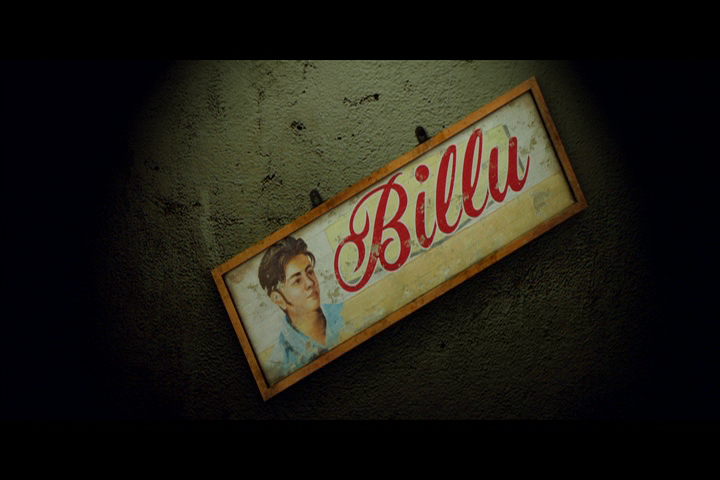
Shah Rukh’s own career is referenced extensively in posters on village walls, old movie stills and promo pictures, a montage celebrating Sahir’s stardom. The film within a film device also allowed some spectacularly silly and blinged out song concepts as they didn’t have to fit in with the plot as such, and could also use a parade of Shah Rukh’s recent-ish heroines. In every song there is a moment when he gets a goofy grin and he can’t help uncle dancing a bit despite the choreographers’ best efforts. I love it. Plus I think Evil Anthony makes an appearance.

Each shot serves to express the focal character’s universe, from set design to lighting to the framing. It’s a pleasure just to look at this film. Pritam made Billu’s songs and background music more organic than the filmi stuff, and they were accompanied by lush “real world” visuals lovingly captured by V Manikandan.

“Jaaun Kahan” is a bewildered meditation, while “Khudaya Khair” is a sweetly romantic dream that could star either your husband or Sahir Khan, mood depending. The village setting was glorious and while I’m pretty sure it was in Tamil Nadu I chose not to overthink the geography/language mash up.

The standouts in the support cast were Asrani as Naubat Chacha, a rare voice of moderation and always seeing Billu’s side, and both Om Puri and Manoj Joshi throwing their weight around as self-important and self-proclaimed VIPs. I also liked Rasika Joshi as the long suffering principal who turned out to be not such a bad old stick.

Would this film make you a Shah Rukh fan if you weren’t one already? Maybe not. But it is a departure from his Rahul shtick and there is enough of a gleam in his eye and a quirk to those famous eyebrows to make me think he had a bit of fun playing with his own image. And I’m a sucker for both sublime and ridiculous visuals. 4 stars!
Rudhramadevi (2015)

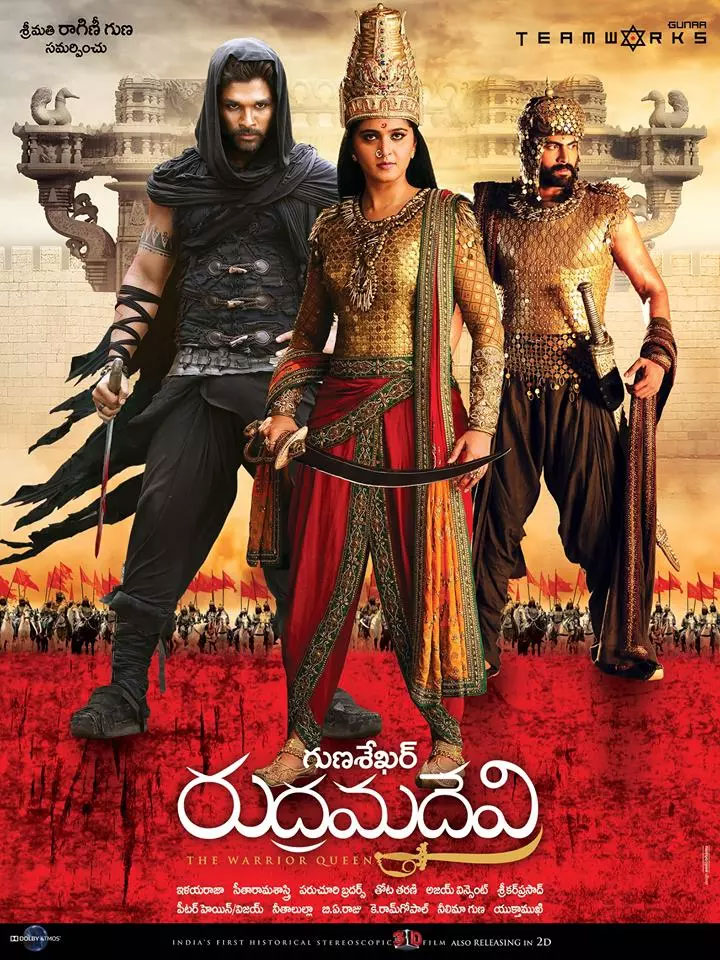
Rudramadevi-Posters-2

If Rudhramadevi had been made in 1956 I’d have loved it, no question. But Gunasekhar struggles to realise his grand vision and the ripping story drags at times. The main cast give their all, but they can’t compensate for some poor directorial decisions and sloppy execution.

The first thing that hit me was the VFX. I thought it was maybe a deliberate stylistic choice as there are animated montages that look like a childs picture book. But it is just shonky quality, used too liberally, and with poor judgement. At least it distracted me from wondering what Marco Polo’s stuck on beard was made of. And why Marco Polo was in the film.

The story is so interesting this should have almost written itself. A girl is raised as a boy and keeps up the pretence to protect her kingdom for as long as she can. But Gunasekhar spends far too much time with the various enemies and uses loads of clunky “As you know Bob” exposition. I felt that there were some holes in the film and Gunasekhar was trying to paper over those gaps with other techniques including a Mega voiceover and a peasant who announced every new character with bio as well as voicing the people’s dissatisfaction with their rulers.

Anushka owns every frame she is in. She adjusts her posture and facial muscles so there is a clear distinction between Rudradeva and Rudhramadevi and is convincingly commanding. She has some weird darkening makeup on as a boy, but it does allow her to look stunningly radiant when she girls up.

Her closest female friends are Nithya Menen as her wife Muktamba and Catherine Tresa as The Other One Who doesn’t Wear Much, and there is a lightness and ease in the way Anushka moves as she drops the pretence and heavy armour undershirt to dance in the “Yay! I’m a girl” numbers. She did her damnedest in the tandav but while her expressions told a powerful story, her dancing was not as compelling. Rudhramadevi used Veerabhadra’s feelings for her to get him back on task, but she evinced far more concern about Muktamba’s reaction and wellbeing. That ruthlessness and emotional intelligence wasn’t really explored and I felt the film needed to reveal how she ruled, not just show a sequence of events.


I put that clip in just for some shirtless Rana. He looks so chuffed when he is prancing almost in time.

Rudramadevi-Rana Anushka

I knew a “Zorro” moment was nigh when Rudradeva wore a blue tunic done up with pink princess ribbons, and the gender reveal is a bit ho-hum. Veerabhadra took the whole “Dude, you’re not a dude” revelation quite well, all things considered. There is little sexual chemistry between Rudhramadevi and Veerabhadra, but the actors have a nice rapport, like childhood friends. I enjoyed moments like when Rana playfully tweaked Anushka’s nose as he said goodbye. While the writing skimmed the surface of characters emotional lives, the actors added their own flavour.

Gona Ganna Reddy (Bunny) and his horse seem to have ridden in from a different film; something more gothic perhaps or even a KPop music video (Jaejoong’s stylist may be moonlighting as a Telugu horse costume designer).  Bunny plays his character as unrelentingly dour and with one facial expression, but his one liners got the audience cheering. And he rarely blinks. It’s intense and unsettling after a while.

Rudrama Devi Posters

The support cast is huge. Hari Hara Devudu (Suman) and Murari Devudu (Aditya) are the Statler and Waldorf of villains. They sit back and critique everyone else but rarely do anything themselves, unless you count letting their allies die horrible deaths. Their brother Naga Devudu (Baba Sehgal) shows commendable willingness to really go for the snake theme. Nithya Menen is underutilized as Muktamba. I enjoyed her scenes with Anushka and thought her decision to respect the sacrifice and say nothing was interesting. This contrasted with the shouty peasants who just flat out refused to accept a woman, despite a rousing Prakash Raj girl power speech. Prakash Raj is in good form as Shiva Devaiah, the mastermind of the scheme that sees Rudhramadevi raised as the boy Rudradeva. Villain Mahadeva (Vikramjeet Virk) spends most of the film prancing atop a phallic tower made of polystyrene. Amusing, but you know a great hero or heroine deserves a genuinely scary bad guy and he is not the real deal no matter how many people he kills out of spite. Hamsa Nandini is slinky and duplicitous, the Bond girl of courtly spies.

Gunasekhar’s massed set pieces lack richness. If you arrange a formation of extras with one or two carefully out of position people for randomness, but then use that same formation scores of times over it ends up looking ridiculous with the pattern repetition of those supposedly random bodies. A critical battle scene started with a cool idea – one army emerging in a serpent formation as their opponents attacked in an eagle formation. But it went on forever and looked far too fake. I was reminded of the similar but excellent lotus and arrow scene in Magadheera.

One of the few actors I could imagine would happily rappel down a structure (possibly without even checking there was a rope), Bunny was plagued with dodgy wire work. Anushka was also caught so that her feet didn’t quite hit the ground or was frozen in awkward and unconvincing poses in midair. Maybe it was supposed to look good in 3D but I can’t imagine it would. And too many fight scenes and chases were sped up to slapstick comedy pace.

There is abundant weird CGI, possibly a workaround for the 3D version, although I should have remembered the effects in Okkadu. For example, when a drawbridge is being lowered they faked the cogs and ropes too which you’d think would be doable and cheaper for real. The climax scene as Rudhramadevi and elephant bring doom upon her enemies should be thrilling but it is just opportunity to crank up the bad CGI. The use of CGI elephants seemed unnecessarily frequent especially when in many scenes there was no obvious risk of physical harm to an animal – why not use a real one? And there seemed to be a bit of tusk whitening done in post production that was distractingly odd.

A big shoutout to the helmet and armour department. No design was too silly or impractical for them to try. I really wish I could find a picture of Bunny’s Glomesh helmet from the final battle, but you will just have to make do with Rana’s special dressing up armour.

Despite the negatives I really appreciate seeing Anushka as the lead with so much screen time in an awesome story. Bunny and Rana bring more interest to their characters than the screenplay demands. I would have liked to see more relationship development generally, and especially between the ladies given the story is of a woman pretending to be a man. I really wish the film had been better executed as I can see what it might have been, and the gap between what was delivered and that potential is frustrating.


James Bond 777 (1971)

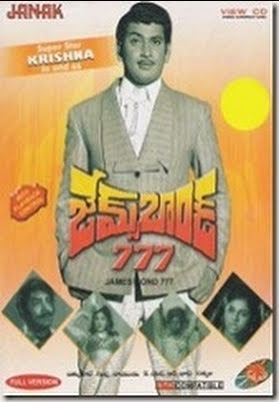
James Bond 777 DVD cover

K.S.R Doss, Superstar Krishna, Jyoti Laxmi in a double role – James Bond 777 is enormously entertaining from the funky opening music (James Bond, Triple Seven! Seven! Seven! Seveeeeen!) to the triumphant finale. And did I mention the gang of dogs who are highly skilled and organised jewel thieves?

My DVD only had the strength to share its secrets once before expiring with a load of histrionics and a strange grinding noise. The movie, missing a few songs, is online in several versions of varying quality and length (Note I screencapped from YouTube – if anyone knows who put that revolting logo on the print, please feel free to go slap them into the middle of next week for me).

Young Kishore is left orphaned after the man who will become The Boss (Satyanarayana Kaikala) breaks into the family home and kills his parents. Kishore takes off after the baddie armed with righteousness and a handy carving knife, but is wounded and thrown from the speeding car.

One alarmingly abrupt edit later, a shirtless cowboy (Shirtless, Mahesh. Your dad was SHIRTLESS) with a scar is Superstar Krishna and the theme music suggests he is James Bond Triple 7! James Bond appears to be a catchall term for a spy or intelligence officer and there is no character answering to the name, although there is some familiar music at times…Hmmmm. Krishna flings himself around with as much verve as a laid back leading man can muster, easily evading the gang who can’t shoot straight and who then wait politely for him to shoot them all in turn. It turns out that was a training exercise and Kishore has passed with flying colours. He will now go in search of The Boss to both get revenge and make the world a safer place.

Kishore disports himself with a bevy of styled up lovelies but sadly no matter what they shake or how vigorously they shake it, they can’t make his dancing actually look like dancing. Although, Krishna’s fight style is a little dancey as it seems to mostly go punch-twirl-punch-twirl so maybe the fight and dance choreographers just needed to collaborate more. I expect it is quite hard to look suavely heroic on a swing but he does his best.

Sopa (Vijayalalitha) is introduced when she sneaks up on her dad and threatens to shoot him, all in jest of course. Her dad makes a trip to Chennai and is next seen dead, in a box in the police office. In a Get Smart golden moment Kishore finds a bug planted in his mouth. And in a classic almost every Telugu film ever moment, Sopa vows to get justice.

Boss is a high tech criminal. He has a lair with all the accoutrements – Vat 69, girls looking at screens, machines that go ping, and a full array of audio-visual equipment linking him to his minions. Luckily Kishore is wise to the likes of the old exploding phone trick. Kishore does have a few tricky techie tricks of his own, and I particularly liked the watch-phone and the exploding onions. And both hero and villain are happy to go old school and use silly disguises, sleight of hand and even that filmi classic – “Snake in a Box”.

Jamila (Jyoti Laxmi) is one of Boss’s henchwoman, and she operates out of a Beauty Paraloure. A very industrial looking Paraloure, one with a branded truck. Maybe Paraloure doesn’t mean what I think they thought it meant. There is another evil henchlady, Cindy who works out of her own mini lair. She has anger management issues and a confused fashion sense, as well as excellent canine communication skillz.

Sopa and Kishore cross paths on a train, but are too busy arguing about the lights on/off etiquette of eating fruit at night to realise they have a common mission. Of course they are also staying at the same hotel, across the hall from each other. Sopa is under cover as the dancer Miss Kiss Miss, and Kishore is…Kishore. At least Sopa is well equipped for the random dance item which is an essential part of her cover.

When the dogs break into Sopa’s hotel room and menace her with their smiley faces and demands for pats and ear scratches she runs away, straight into an ambush. Luckily, Kishore is in pursuit and handily enough catches her when she jumps off a cliff pretending to have been fatally shot. Unluckily for him, she steals his motorbike and leaves him stranded. Luckily, Jamila comes by and picks him up.

Cut to Sopa pretending to be a man while talking to Boss on the walky talky while the increasingly unlucky Kishore spins around on a rapidly revolving round bed, swinging punches at assorted baddies. That Jamila, such a minx. When Sopa is chased on her motorbike, she tricks the henchmen and doubles back to steal their car. She doesn’t seem to need Kishore for much, if at all. Although she does hitch a lift with him at the end, off into the sunset, so maybe he had his uses when it came to logistics.

I could describe in detail all the brilliance of the dogs breaking into a heavily secured bank vault with naught but their briefcases, an exploding toy dog, and a whole lot of licking at complicated door mechanisms, but you really should just watch it. Go. Watch. It.


As seems common in B movies, the women are feisty and independent and don’t sit around waiting for some bloke to arrive. Kishore spends the whole film working within police channels, where Sopa is more DIY in her approach, and happily executes on her strategy regardless. Jamila and Cindy report to Boss but have some autonomy when it comes to how they carry out the big evil plan. Any woman who can dance in a sparkly outfit may do so, and men are excused from all but the most modest gyrations. After seeing her in Pistolwali, I am not really surprised that the only worthy adversary for Jyoti Laxmi is herself, and her catfight as twin sisters Rani and Jamila is a highlight (not just for the outfits, but that certainly doesn’t hurt).

James Bond 777-a cunning plan

There are lots of familiar-ish faces in the supporting cast, although I can’t put names to all of them and IMDB is not much help. Cindy’s role was relatively small and segregated from Jamila and the Kishore/Sopa plot. Kishore has a sidekick who has a propensity for comedy uncle shtick but also does useful things. And there are squads of ostentatiously kitted out bad guys and the usual light sprinkling of law enforcement personnel.

If there wasn’t enough to keep you on your toes in the plot, there are scenes combining rapid cuts, spinning camera work, extreme zoom, crazy angles, and some outfits and sets that made me very thankful this is a black and white film. And if you didn’t care to watch the film, it is really worth a listen. The soundtrack is funky and slightly grungy with surf guitars and brass overlayed with exuberant vocals.

I love this style of low budget high ambition spy caper, and with a likeable cast and fab soundtrack, this is pure gold. Plus did I mention the robber dogs? 4 stars!

Also – go read good friend Beth‘s review. This film deserves some love!