Magalir Mattum (2017)

Bramma’s female centric film has a lot going for it, from the fantastic cast to the gentle mood of nostalgia and friendships that transcend time. But if you’re expecting a robust feminist statement, look elsewhere.

Warning: SPOILERS AHEAD!

Prabhavati (Jyothika) arrives on the scene like a hero. She rides a motorbike, wears jeans and t-shirts, calls all the shots with her film crew, abbreviates her elders’ names and speaks casually to all. This is how we know she is a modern, empowered woman. She has a close relationship with her soon to be mother-in-law Gomatha a.k.a Goms (Urvashi). Prabha comes to know that Goms had a couple of very close friends at school but when one of the girls was expelled, the trio went their separate ways and haven’t seen each other in close to 40 years. She decides to use Facebook to track down the ladies, and get the gang back together. Rani (Bhanupriya) is married to a chauvinistic politician (Nasser) and describes herself as a glorified servant, looking after the family in return for food, lodging, and a little bit of affection. Subbu (Saranya Ponavannan) is married to a drunk (Livingston) and stuck at home with his ailing mother, cleaning bedpans and listening to endless complaints. Prabha coerces them all into taking a road trip for just 3 days, time to be themselves.
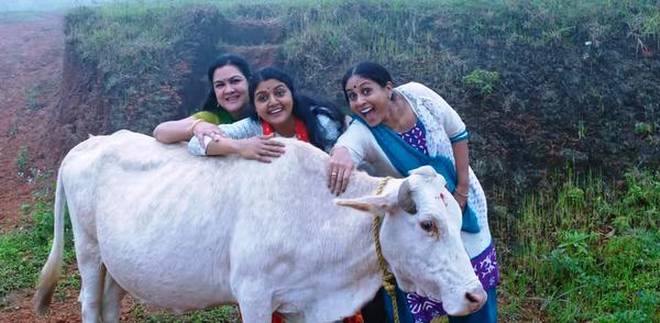
Bramma uses flashbacks to the friends’ college days and the three young actresses who play Rani, Goma and Subbu are delightful. The dynamic between the women hasn’t really changed, even though their circumstances and lives have forced them into different shapes. They quickly fall back into Rani being the firecracker, Subbu being daring, and Gomathi being timid but refusing to be left out. The links between timelines serve to remind the ladies who they used to be as well as showing the audience.

Prabhavaty eggs them on, wanting these women to live for themselves and stop holding back, to have the freedom she has. She is effusively informal, persuasive, and persistent. I had a bit of a chuckle at her being “like a hero” as, like many male stars, she is only about 10 years younger than her screen mother. I like Jyothika and she looks great and delivers a well-modulated performance as part of the ensemble.

Prabha says “men aren’t the problem, the system is the problem” which neatly overlooks that “the system” is largely constructed and maintained by men for their own benefit. But baby steps. Mainstream Tamil films tend to congregate at the rapey and misogynistic end of the spectrum so this is quite a departure and I’m grateful to the heavy duty star cast for getting this off the ground. Maybe that is the real feminist statement – Jyothika’s continuing film career that doesn’t require her to play Suriya’s mother!

Rani (Bhanupriya) is living a life of determined fortitude. Through the flashbacks we see Rani was the leader, always getting in trouble and loving it. Her husband (Nasser) and son Karthik (Pavel Naganeethan) see her as a fixture, nothing you need to consult or consider. When their ward is designated a ladies ward, Karthik’s political ambition is thwarted and his dad cautions him against letting his wife step out of the house to run for office. They put Rani up as their candidate as they are so confident she will never have an opinion of her own. It’s such a sad waste of Rani’s sharp mind and good heart. She blossoms on the trip away, but is resigned to going back to the status quo. But does she? There are signs that at least her kids learn to see Rani as a human being, and she does take the wheel again. Bhanupriya is elegant but also mischievous and I really wanted to see more of Rani’s story.

Subbu (Saranya) projects a polished and controlled exterior. Her life behind the veneer of her beauty channel set is far less appealing. Her husband drinks constantly, and sprawls around the house singing old love songs until he bursts into pathetic tears in a never ending cycle. While Subbu is immaculate, the house is verging on squalid and there is no sign of pride in her surroundings. Subbu eventually reveals the reason for her disillusionment and anger, and there is nothing that can really fix that. It’s just heartbreak after heartbreak as the women reveal the decisions made for them and how they live with the aftermath. One of the highlights is a sequence where all the ladies tell their story of first love, with the results ranging from tragic to wryly amusing. Saranya plays Subbu as outspoken but with an increasingly warm twinkle in her eye as she casts off the grinding routine. She and Bhanupriya dance and joke around, fire up at each other and then gang up on Urvashi.

Gomatha’s life is not explored as thoroughly as the others, and Urvashi doesn’t have the same complexity of material to work with. Goma was less well off than her friends and struggled to keep up appearances at college. She was more conservative but would follow Rani and Subbu into the fire. She loves her son who works overseas, and worries about her life after the wedding when Prabha will go to live with him. The rapport between Prabha and Goms seems a little forced initially as Urvashi overreacts constantly, but she eases off once the ensemble is in place.

The supporting cast is excellent but the roles are sketches with minimal detail or depth. The men are either jerks or SNAGs, nothing much in between. I was delighted to see Maddy as Suri, Prabha’s fiancé. I quite like slightly unkempt and stubbly Maddy and liked that Suri wasn’t a manscaped picture of perfection. He’s a nice bloke who appreciates Prabhavati, and that is perfect. Nasser, (who Goms describes as looking like an eagle with diarrhoea), and Pavel Naganeethan are very effective at being horrid, and Livingston as Subbu’s husband Mangalamurthy is the kind of man who is nice but such a deadweight that he has the same effect as a total bastard.

Bramma gets a bit bogged down in a sub plot, and doesn’t really carry all the good ideas through into action. But the film looks great, the acting is generally top notch, and it’s a rarity to see female friendships celebrated on screen.

See this to enjoy the presence and fine acting of some wonderful female actors, and for the emotional resonance of their friendship and shared memories.

Dus Lakh (1966)

What happens when a vain and money hungry old man inherits millions? He alienates his family and hooks up with ne’er-do-wells who intend to part him from the money. Is this entertaining? Yes, surprisingly so. It’s the 60s so the design is of the more is more school, the songs are brought to life by Asha Bhosle and Rafi among others, and the cast is spot on. Devendra Goel keeps it all moving along despite the actors sometimes lapsing into melodramatic wallowing and scenery chewing.

Gokulchand (Om Prakash) is a widower, living comfortably with his married son and daughter-in-law (Ramesh Deo and Seema Deo), younger son (Sanjay Khan) and grandchildren (Master Ripple and Baby Sonia aka Neetu Singh). He is obsessed with money and feels that anyone else’s good fortune has somehow been at his expense. But finally his prayers are answered when his reviled brother dies and leaves him everything. Gokulchand tells Manohar to quit working, buys a big fancy house, and goes to a hill station to practice being rich and snobby. He meets Jerry (Pran!) and Dolly (Manorama), con artists who see him as easy pickings once they get his kids out of the picture. Is blood thicker than whisky and soda?

Om Prakash and Manorama get the bulk of screen time. While I have no patience with a vain, horny old man and his poor decision making I did quite like seeing the story develop around an older less glam pairing. But it is both funny and infuriating to see Gokulchand preening as Jerry and Dolly manipulate him so easily. Om Prakash is at his best when Gokulchand is very angry or very sad, and his moods permeate the whole family.

Dolly has a son, William (Brahmachari), to her Indian husband and a daughter, Kitty (Helen) to her English husband. Jerry fancies Kitty and money, Dolly likes booze and money, and Gokulchand takes to drinking and wearing shorty shorts like a duck to water. There is a lot made of English versus Indian manners and morals, with Dolly and Kitty representing the corrupting influence of Westernised women and Jerry as a Goan of convenient morality, and William as a simple lad who can’t afford long pants. Manorama does her usual shtick and her expressions are priceless. I really loathe Dolly as a character though, and not because she was a con. I allow that women had limited options and not everyone can be a builder’s labourer. But the way she pimped Kitty out was appalling, and William wasn’t treated much better.

Ramesh Deo and Seema Deo are charming as Manohar and Devki. Devki borrowed a diamond necklace from a friend to give to Rita as an engagement gift, promising to return it. Losing the necklace on top of being kicked out of the family home drove the little family to the brink. And while there was much agonising over loss of honour and standing, Manohar simply rolled up his sleeves and went to work as a labourer to make the money they needed. And so did Devki. I realised while watching the film again that their story reminded me a little of stories my Nan told me about how she and Poppy got through the Depression. I love a battler!

Manohar and Devki are too good to be true but even when the acting gets dialled up too many notches the actors stay connected to their characters and each other. Manohar slaps Devki in one scene but in context it was understandable while not being at all acceptable. And none of the bystanders held back on telling him off. So I was pleased to see the social rules in the film were anti wife-beating. They also had some really nice scenes talking about the family or their own relationship. And that is something that the film does well. People have to sort out their own problems, they need to talk about things, and then come up with a plan. And all that goes on in between everyone else erupting into dances, fights, and silly outfits.

Kishore (Sanjay Khan) is the youngest son, indulged by his older brother and sister-in-law, and the hope of his father. He’s an engineering student and like so many filmi heroes, appears to have been studying for a long long long time. He is in love with girl next door Rita (Babita). Rita seems to understand that Jerry is a crook and that Gokulchand is an idiot well before Kishore does. Kishore is both annoying and impractical without her influence. I don’t like Babita but he is a sap.

Rita is a bit of a drama queen and doesn’t mind a mock fight for the fun of making up afterwards. But essentially she is quite pragmatic and gets things done. When she sees an opportunity to get the necklace back, she bargains hard with Kitty. Rita did look like she’d rather lick a slug but she lets Jerry hold her hand and then executes her plan perfectly. Babita faced Helen in a dance-off and then again in a collaborative dance of pre-nuptial snark so I give her points for trying.

Kitty (Helen) is not happy at being raffled off like the meat tray at an RSL, but she can’t just up and leave her family so she treads a line. She steals the necklace from Jerry, which Dolly thinks is brilliant. Kitty agrees to help Rita in exchange for Rita winning Jerry’s dubious affections and thus freeing her up for a more salubrious affair with Kishore.

While the kids are crooks, they look out for each other and try to help Kishore as they know he is being unfairly accused. Her brother William is probably the most decent of this bunch. He might steal but he doesn’t like to lie. Kishore apologises to Kitty at one point for misleading her and while she is too quick to forgive, I liked that he still felt she deserved an apology despite the taint of association with Dolly and Jerry.

Pran plays the reprehensible Jerry for laughs, and the occasional flashes of menace don’t quite land. He speaks a Yoda-esque English, saying things like “Leave not father rich” and wears loud checked suits. His expressions are even less subtle than Manorama.

I realise this doesn’t sound all that entertaining or comedic. But if you know that the finale takes place during Gokulchand and Dolly’s wedding which is also a costume party complete with a man in a giraffe suit, Helen and Babita playing keepings off with a bag of money, a duel between Kishore and Jerry, and Manohar languishing in hospital being transfused with what looks like a bottle of tomato sauce, then all is indeed well that ends well.

I have a lot of affection for Dus Lakh despite feeling that watching a family torn apart because of greed is not comedy gold. Babita and Sanjay do nothing for me but luckily they are not the main event. See it for excellent use of Helen and a whole lot of decent character actors getting more than just a comedy subplot. 4 stars!

Sneham Kosam

K.S Ravikumar’s film gives us double the Chiranjeevi in an outstanding dual role performance, and about three times the plot of a normal film. There is a lot going on in this convoluted tale of family strife and the meaning of friendship. The last 20 or 30 minutes alone has enough revenge, melodrama, blood, sweat, and tears for any average film. Warning: some spoilers ahead.

Chinnayya (Chiranjeevi) is the valued servant of the landlord Peddayya (Vijayakumar). Chinnayya is bossy and dramatic, as is the landlord. They have a warm relationship and the other servants enjoy their regular tiffs. Peddayya has cut off his daughter Gowri (Sithara) and son-in-law Peddabbayi (Prakash Raj) although it’s clear Gowri wants to reconcile and she tries over and over. When his youngest daughter Prabhavati (Meena) comes home, she also wants the family reunited but she has a different method in mind. She sets her cap at Chinnayya, and sets him up for an accusation of rape. Having kicked him out of the house her true feelings become clear. She blames him for the separation of her father and sister, and cannot stand to see him living comfortably in a home he ruined. And then Simhadri (also Chiru) returns after doing time for killing Prabha’s mother. Peddayya is delighted to see his old friend, the servants seem cautiously accepting, but both Chinnayya and the girls furiously reject him.

I love Chiranjeevi’s acting in both roles but I really do not like the decision making in this film. I don’t think there is a single significant life choice made that didn’t have me muttering “oh come on, you’ve got to be kidding”. Anyway, back to the plot. Simhadri took the blame for Lakshmi’s murder so as not to make Gowri the wife of a murderer. Because it is better to be married to a murderous weasel than it is to be divorced, widowed, or single? Eventually justice must be served and it is, in spades.

The Megastar stamp is all over the opening credits, but Chiru is in actor mode and delivers excellent characterisation as well as buckets of tears and adrenalin.

Chinnayya is a more typical hero role for him, and he breezes through the fights, the dances, and all the shenanigans. But there are emotional currents that run deep, and when Chinnayya confronts Prabha over her scheme to ruin him, Chiranjeevi blazes with fury.

Simhadri is both intensely lovable and kind of infuriating. He sacrifices everything for his landlord boss, everything, but never shows anger or resentment. I believed absolutely that Simhadri would do anything for his beloved friend and boss, but I didn’t need so much of the “he is our god-like benefactor, we’re nothing without him” hand-wringing over the master servant relationship. Regardless, Simhadri is such a vivid and quietly commanding presence. His feeling of guilt and responsibility was misplaced but achingly raw, and those Mega Eyes conveyed volumes. The scene where he had to sneak a glance at Chinnayya via a mirror just to see his son’s face could have been ridiculous but it works because of Chiranjeevi. I liked Chiranjeevi’s use of similar but subtly altered mannerisms and posture to convey both the resemblance and the differences. Chiru’s expression is softer and more world-weary as the father, and while Chinnayya is a chip off the old block he doesn’t have quite the same substance. And when you get Chiru emoting at Chiru, it’s just too too good.

While this is Chiranjeevi’s film, I liked that other characters were given some depth and development. Prabhavati is a bit of a nutter, and has minimal self-control when it comes to getting what she wants. She wants it NOW. Meena is screechy at times but when she needs to command attention, she does it despite all the macho chest beating going on around her. I found Prabhavati too neurotic and impulsive to be relatable but I felt the conviction in the performance. Her teary declaration that since she had no mother she wanted to be her sister’s daughter was both moving and mind-boggling. Her duplicity was breath-taking and audacious in execution. She was no passive victim, although she had been sadly misled. Meena’s rapport with Chiranjeevi was patchy but that was befitting this half fake half real love hate thing going on. They were a good match in terms of energy and commitment to the role, both in the fun scenes and the more intense moments.

And while I don’t concur with the sentiment that a man with laser eyes who can make another man’s head explode into flames is necessarily ideal husband material, her imagination was fertile and that can help a girl through some bad times.

Sithara starts out as a wet rag, crying all over the place, but in the flashbacks and the post revelation scenes she gives Gowri some spirit. Poor Gowri got a raw deal on pretty much everything. Her husband was a rat, her father disowned her for no good reason other than the rat, and she had no idea of the truth. But I liked that she kept trying to mend fences, even though she couldn’t work out what was really wrong. She was persistent and resilient. And finally, she chose doing the right thing over supporting her husband.

Vijayakumar as Peddayya is the other pillar of the drama. His petulance and dramatic flouncing is tempered by the respect and loyalty he shows his friend Simhadri and the boy Chinnayya. He genuinely treats Simhadri as a mate, scandalising his servant with hospitality and unselfconscious affection. There is not a lot of subtlety in the drama but Vijayakumar draws out some strong emotion, especially in his scenes with Chiru and with Sithara. I just couldn’t get past his willingness to let Simhadri take the fall, and also to lie to his daughter and then disown her partly because of that lie.

But his character solved most disputes with Simhadri with a song and a tickle fight so he’s not all bad.

Prakash Raj is so slimy and craven, I was itching to slap him and frequently booed as he weaselled his way around. He gives a great performance as a horrible person. Peddabbayi prefers to wheedle his way out of trouble but if that doesn’t work he flies into a rage. I’m glad they cast a good character actor in this role as if they’d gone for a comedy uncle villain, it would have sapped a lot of the energy from the quite exhausting climax.

The support cast is loaded up with comedy uncles but they are low key and their characters serve some purpose. Brahmanandam is effective as Prakash Raj’s nasty sidekick with minimal gratuitous comedy uncle shtick. MS Narayana, Babu Mohan, and Kota Srinivasa Rao are among the more heavily featured household staff and like Brahmi, are comparatively restrained. Nirmalamma is cheeky as Simhadri’s gambler mother. Sujatha makes an impression in her few scenes as the much loved and lamented Lakshmi. And poor whatsisname who played Chinnababu made it seem he may have taken after his older brother but was actually a decent boy, left devastated and jilted at the altar.

The film looks beautiful, and the few special effects are used wisely. And I think they employed all the camels in Rajasthan for one day. While it probably could do with a more assertive edit, I really enjoy almost every moment of the film. Unless I get too riled up about Simhadri assuring Gowri’s marriage to a homicidal mongrel and her father’s 15 year temper tantrum.

The Hindi dub is on YouTube with English subs, or you can do what I do and grab those subs for your Telugu copy and tinker with the timing because hearing another voice coming out of Chiru’s face is All Wrong. 4 ½ stars! (A tiny deduction for terrible decision making, and for the director’s cheesy guest appearance, another dodgy decision.)