Rangasthalam

Sukumar’s Rangasthalam is a sprawling rural epic set in the 80s and chock full of plot. There’s probably enough for two films, but despite being 80s influenced in running time too, I found it highly engaging.

Chittibabu (Charan) hires out a water pump to service the village crops. He’s a bit dim and lazy, very proud and impulsive, but essentially a decent bloke. And he has a hearing impairment that he is ashamed of. His inability to hear unless shouted at is used for comedy but also is important in keeping him a little isolated and clueless. When golden boy big brother Kumar (Aadhi Pinisetty) comes back from Dubai, he is appalled by the corrupt lending and eviction scam run by the local association. He gets the support of MLA Dakshina Murthy (Prakash Raj) and decides to run for President, setting up a colliion course with the incumbent (an evil eyed Jagapathi Babu). And meanwhile Chittibabu has fallen for the lovely Ramalakshmi (Samantha Akkineni). But does he have the time or the capacity for love when he has heroic duties to attend to and a brother to protect? And if it isn’t the President pulling all the strings, then who else might be involved? What is a simple man to do?
Charan was instantly recognisable even in the long aerial shot that opens the film. His hair is magnificent and deserves an acting credit. But apart from the mane of glory, he delivers a solid performance. Chittibabu is quite childish and demanding, but has a generous heart. He is only able to devote himself to one task or thought at a time though, which meant that the relationship with Ramalakshmi kind of disappeared for a while as he was busy with other matters. Charan and Samantha had a nice rapport and I quite liked seeing the man be disconcerted and flustered by being on the receiving end of some determined attention. And he did some truly excellent lovestruck prancing. But he is an 80s style mass hero and will not be winning any awards for feminism. The fight scenes are intense and brutal, with only a few fancy effects to diminish the reality. Predictably Charan excels in the action and dances, but that solid physicality also translated well to his character.
Charan and Aadhi were really nice as brothers. It would have been very easy for Sukumar to make Kumar the saintly one and Chitti the dumb one but they each had some elements of the other one’s personality and their little fights and jokes seemed natural and lively. Chittibabu had to grow up a bit through the film and Charan handled that quite well. I thought the hearing aid Kumar got for him was used nicely as an indicator when he decided to put personal vanity aside. Aadhi played Kumar with less bravado and more empathy than the younger sibling. His reactions when things turned violent seemed genuinely fearful, and true to the character. He found a groove to work in as the second fiddle in the film but the star of the family who absorbed all their attention.
Samantha made Ramalakshmi funny and warm, the kind of girl that would always be in the thick of the chatter when there was a break from work. She wasn’t impressed by Chittibabu despite his obvious attraction to her, and somehow was the only person in the village who didn’t know he was hearing impaired. The comedy of errors stuff went on a bit too long, but I enjoyed her uninhibited enthusiasm, especially in Rangamma Mangamma where Ramalakshmi took on some of the typical hero pursuit song shtick. Samantha’s face is so expressive that even the terrible subtitles didn’t interfere too much with her scenes. The moment when she weighed up her father’s emotional blackmail against Chittibabu’s open door on their future was darkly funny and so good to see. It was sad that she along with almost every one else was then sidelined for a substantial chunk of the story. Because Hero stuff.
Jagapathi Babu is the villain this film needed. He infuses every scene with a menacing sociopathic coolness, and has no need of pointless histrionics. He has ample followers to carry out his wishes and can keep the dirty business at arm’s length. He’s like a shark. Something sends a chill down your spine on first sight, even if he doesn’t seem to be an immediate threat. Prakash Raj has a small but pivotal role, and is his usual reliable self. Brahmaji is his usual angry self as a government official. It’s good that some things never change. Mahesh Achanta, Rohini, and Anasuya Bharadwaj are notable in the large ensemble.
Sukumar did some interesting things within what does feel like a solid 80s mass drama. The women were often in the background but when it came to crunch time there was no fuss as they took a more active role or their expressions gave the men permission to act. Rathnavelu’s cinematography created a beautifully rural idyll with long sweeping views of the landscape but moved away from fixed camera positions in the action scenes, giving it a more modern and dynamic feel. The soundtrack is exactly what you’d expect, which is not a bad thing. I liked Charan’s dancing and thought he did well in the folk influenced choreo, maintaining his Mega cred while staying in character.
I learned some new phrases thanks to the (possibly drunk) subtitle team. I hadn’t heard of the Dazzle King or even the Mangoose, but now I feel they sound like something I should have known. And I will be wary of doctors offering the “eternal injection”. I know subtitles are a luxury, but surely someone read them before they were published. No?
I thoroughly enjoyed Rangasthalam. It’s a big meaty story that takes its time. The casting is good, the visuals are great, and in mass style the film has a bit of everything. Recommended!
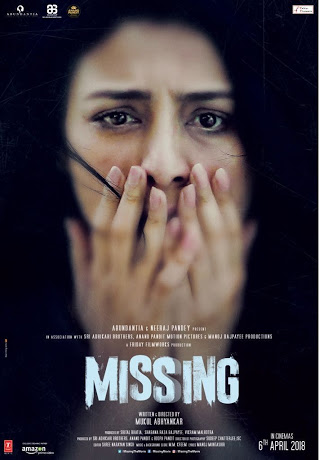
Missing (2018)

Missing has some things going for it. Well, Tabu and her outfits mostly.

Sleazy Sushant Dubey (Manoj Bajpayee) is on a business trip with Aparna (Tabu) and their three year old daughter Titli. They check in to a fancy resort in Mauritius and Sushant checks out the receptionist before fielding a call from another woman, Kamya (Neelam). It’s clear what his priorities are. But since no other options present, he resorts to sex with his own not very keen partner in an awkward scene that had all the sensuality of Greco-roman wrestling. When Aparna wakes in the morning she discovers that Titli has disappeared from their room. She flies into a panic, while Sushant seems a little too calm. The hotel staff are not very useful, and the police seem to have read the Keystone Cops training manual. Then there is the guy downstairs who seems to be obsessed with little girls. So what happened to Titli? And will her parents find her?
That sounds like the basis of a reasonable thriller. But sadly writer-director Mukul Abhyankar squanders both the idea and his cast in a messy, screamingly obvious film that signals every twist and turn. Just in case you managed to black out and miss anything, listen out for the blaring dun-dun-DUNH! at key moments. One of the twists was evident from the get go, and the only way a red herring could have been any more obvious would have required an actor to wear a red herring mascot suit.
Tabu is stunning as the stricken and slightly unhinged Aparna Did she harm her child, was she the target of a revenge plot, was it just a crime of opportunity, or is something entirely different playing out? Tabu shows great range, from raw and gut-wrenching fear to more subtle and calculating expressions as the truth of her relationship with Sushant is revealed. The film feels quite stagey and is exposition heavy, but she imbues even her more passive scenes with an inwardly focussed energy that constantly drew my attention. Aparna is much more complex than she initially seemed. I really wish the writing had been better. I liked her costumes, but I’m pretty sure I wasn’t supposed to be checking out the embroidery on her kurtis rather than fretting about the little girl.

I hated everything about Sushant so I guess that is an acting triumph for Manoj Bajpayee. Sushant was craven, opportunistic, and creepy. Bajpayee struggled with some bad writing both in terms of the dialogues and the logic of what Sushant was doing. His feeble obfuscation may have been supposed to build tension and create doubt but it was just annoying and often didn’t serve a purpose. I was so annoyed when the cops nearly pulled the pin just because Sushant claimed Aparna had become mentally ill after being diagnosed as infertile. It was typical of the lazy plotting that tried to jazz hands past inconvenient details, and showed everybody believing women are just a walking uterus with the sole purpose of popping out babies. Sigh. But I cheered up immensely when Sushant copped a tight slap. That made up for a bit of my suffering.
Annu Kapoor is atrocious as Inspector Budhu but the material couldn’t have helped. I was amused that everytime he threw in a few words of French (seeing as he was a Mauritian policeman with an entirely Hindi speaking team and suspect set) the subtitlers gave up and wrote [Foreign Language]. But at times it felt like the lead characters were all in different films, weirdly edited together. Their performances just didn’t gel.
I was so pleased to see Tabu back in a leading dramatic role. I wish the film had lived up to its potential and to the lead pair’s characterisations.

Love and Shukla

So many films end with the wedding and a vague hand wave in the direction of “ever after”. Siddhartha Jatla starts with the wedding and then challenges really begin, with the household and marriage.
Note: I was given the opportunity to see Love and Shukla by the director. Nobody associated with the film has made any requests for editorial approval or even to know what I might write, or if I chose to. You have to love this very connected world where people can find an audience on so many different platforms.
Shukla (Saharsh Kumar Shukla) lives in a cramped one room home with his drama queen soapie addict Ma (Aparna Upadhyay) and near silent father (Loknath Tiwari). His parents arranged his marriage and his friends do that drunken bloke thing of scaring him with stories of disaster if he can’t sexually satisfy his wife. Laxmi (Taneea Rajawat) moves in to the house, and to Shukla’s dismay he never gets a moment alone with her. His Ma immediately starts with every mother-in-law cliche and bosses Laxmi around. Laxmi is obedient and almost silent. And when sister Rupa (Hima Singh) leaves her husband and moves back in, there is even less space, physically and otherwise. Will they ever get together on any level? How can anyone conduct their private life in full public view? If you marry a stranger, how do you find the space to get to know them and build a life together?
Saharsh Kumar Shukla delivers a nicely calibrated performance. He’s a reserved guy, unless drunk, and has observed many passengers in his auto and their various relationship issues. Shukla is keen and anxious about sex but he’s also interested in who Laxmi is and what she’s really like. He’s aware despite his bravado in front of his mates that watching porn is not actually good research. He wants intimacy, so much more complex than just scoring a quickie behind the wall of suitcases his dad placed for their privacy. He’s delightfully awkward as he goes shopping to buy her presents, giving serious consideration to different shades of nail polish. Taking Laxmi to a hotel for some privacy turns to disaster as the local cops raid his room, thinking that she must be a prostitute because no man would ever pay money to spend time with his wife. There’s a sense that he wants to be understood and be loved, so he gets that she probably feels the same.
Taneea Rajawat looks lovely but I spent quite a lot of the film wondering if there would ever be a resolution for her character or would she just go from being a mute slave of Ma to a mute slave of Manu. But despite not having a single line of dialogue for almost 30 minutes into the film she conveys an awareness of Shukla and a reciprocal interest in getting to know him. She’s passive but not averse to his fumbling attempts, and she lights up when he shows her particular consideration. I admit to being a little disappointed when Laxmi started speaking because she is quite dull. And finding out her favourite actor was another question mark! But her relief and delight in finally being allowed to voice her opinions was quite sweet, as was Shukla’s happiness at having a simple conversation.
Aparna Upadhyay and Hima Singh are a little over the top and rely on being loud and louder, but their characters were emotionally tone-deaf so if they were out of synch with the rest of the ensemble it wasn’t necessarily a problem. Ma and Rupa are so self absorbed they don’t seem to have any awareness of how hypocritical they are. Both bemoan Rupa’s treatment by her mother-in-law and in the next breath, order Laxmi around as a servant. Shukla eventually calls his mother out on her behaviour and while it is satisfying that he does so, the scene goes on for far too long. But I enjoyed seeing family dynamics changed by Laxmi’s presence although Laxmi herself never challenged anything. Loknath Tiwari may as well have been a painting, both his character and his performance merged into the background. The gaggle of friends played by Amol Deshmukh, Shanawaz Alam and Ganesh Kumar are types rather than fully fleshed out characters, but they help Shukla by giving him an outlet to articulate his irritation.
I like films with a strong sense of place, a feeling of a fully realised world. Jatla creates a neighbourhood, full of the detail of how people live cheek by jowl and how they afford each other the small courtesies that stand in for privacy. The domestic scenes show much without resorting to telling. There are some darker moments and the dog eat dog life in a big city is only a wrong step away.
While this is largely Shukla’s story, the female characters are given their dues and are not overly sentimental or idealised. It’s an engaging and thoughtful look at relationships and the concept of a private life with no privacy. Hopefully this will get a wider release following the festival circuit. Do keep an eye out.