Margarita, With a Straw


Margarita, With a Straw

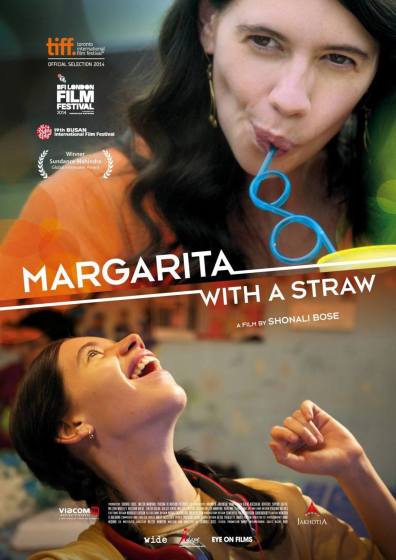
Shonali Bose’s 2014 film follows Laila (Kalki Koechlin) as she navigates her way through the usual rites of passage that mark the transition to adulthood. The difference here is that Laila has cerebral palsy and spends most of her time in a wheelchair. It’s rare to find a story about a disabled protagonist that’s not about overcoming great adversity, but Margarita with a Straw is simply a look at Laila’s life as she navigates her way through college. Laila may have some physical limitations, but her dreams and desires are those of any young person and she doesn’t let her disability stand in her way as she moves to New York to go to college, embarks on a same-sex relationship and starts to take control of her life. The film does have a few flaws, but with strong performances from Kalki Koechlin and Revathy, and a generally upbeat approach, it’s definitely well worth a watch.

Bose based her story on her cousin who also has cerebral palsy and the film was made in consultation with an Indian based disability agency, ADAPT which ensures the situations seem true to life. The issues Laila faces are mainly due to problems with accessibility, such as when the lift at her college isn’t working and she needs to be carried upstairs, or when her wheelchair gets bogged down in the snow in New York. For the most part Laila is a regular student and her family encourage her independence, seeing her disability as just part of Laila rather than as a liability that will hold her back.

Laila is a student at college in Delhi where she has a number of friends. Sameera (Shuchi Dwivedi) plays guitar for a rock band and Laila writes lyrics for their songs, partly because she loves music but she also has a crush on the lead singer Nima (Tenzin Dalha). However, when she reveals her attraction, his awkward response devastates Laila to the point where she feels she cannot continue at college. Luckily for her, at this point she receives an offer to study in New York and over the objections of her father, but with the support of her mother, Laila moves to the US and a new chapter in her life.

While at home Laila experimented with her developing sexuality, including surfing pornographic websites, masturbating and becoming intimate with her friend Dhruv (Hussain Dalal) who is also in a wheelchair. All of this is shown in a very matter of fact way and I can’t remember any Indian film dealing with developing sexuality in such a realistic manner, let alone one that approaches it from the viewpoint of someone with a disability. The film deserves recognition for that as well as the authentic manner in which the friends interact. Dhruv broaches the idea that Laila has ‘normal’ friends simply to try and ‘fit in’, but Bose shows her isolation as the group chat and jam outside while Laila is left alone inside in her wheelchair. These scenes are sensitively handled without ever showing Laila as self-pitying or becoming overly sentimental, which makes the situations realistic and plausible. Also well done is the reaction of Nima when faced with Laila’s attraction which seems completely typical of any adolescent when faced with a declaration of love from someone they like, but are not attracted to in a romantic way. Although these are small moments, the film is made up of many such scenes which ensure the story is about Laila and not about her disability.

Laila’s move to New York brings her into contact with an attractive fellow student Jared (William Mosely) but this time Laila is more careful after her experiences with Nima despite Jared’s seeming interest in her. However, Laila then meets Khanum (Sayani Gupta) after getting mixed up in a demonstration and their friendship develops into an intimate relationship. Khanum is blind and Sayani Gupta is good in her portrayal of someone who cannot see, but unfortunately for the most part, her character is superficial and poorly developed. Khanum appears to exist only as a means to allow Laila to explore her independence, and their relationship generally feels clunky and odd.

The film is most successful in exploring the family relationships, particularly Laila’s relationship with her mother (Revathy). Laila’s desire for independence and privacy ensures there are moments of conflict, while Revathy is excellent as a mother trying to reconcile her need to protect her daughter with the realisation that Laila needs space to grow. Towards the latter half of the film Bose tries to cram too much in to this relationship including an unnecessary illness and a rather forced scene where Laila reveals her bisexuality to her mother, but where she keeps it simple it makes for some excellent and emotional cinema.

Kalki Koechlin does an amazing job with her portrayal of someone with cerebral palsy although it does seem a shame that there wasn’t a disabled actor playing the role. The level of disability she portrays does fluctuate a little throughout the film, but overall her body language is good and convincing while the emotional highs and lows are well done.  My DVD includes a ‘making of’ which does give some insights into the difficulty of portraying the character, and it’s to Kalki’s credit that she has invested so much time into getting her characterisation of Laila right. Revathy is also excellent while the rest of the supporting cast are also good. Kuljeet Singh doesn’t have much to do as Laila’s father, but he is fantastic in the emotional scenes near the end and really impresses by how well he conveys strong emotions so subtly.

Overall, Margarita, With a Straw is an unconventional film that may be a tad uneven but succeeds due to the excellent performances and strong emotional content. Bose paints a sympathetic picture of a young woman with cerebral palsy without dwelling on the disability, but rather focusing on the issues that everyone faces as an adolescent, whether able-bodied or not. Laila’s journey towards acceptance, by her family and by herself, is often funny, frequently emotional but always engaging. 4 stars.

Margarita, With a Straw

Ondu Motteya Kathe

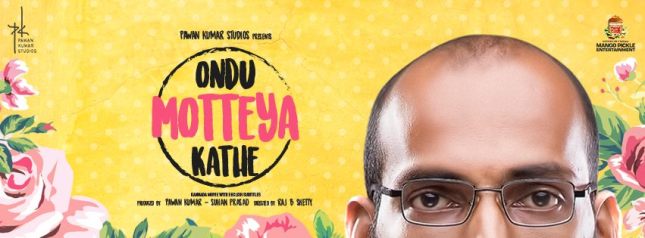
OMKRaj B. Shetty is not your typical leading man material. His character Janardhana is 28 years old, thin, shy, and, according to the marriage broker, has two major problems. One: losing his hair and two: working as a lecturer in Kannada. Despite these apparently significant drawbacks, Janardhana is determined to find his perfect bride, although for most of the film he seems to have set his sights unrealistically high. Ondu Motteya Kathe (Story of an Egghead) is an amusing and well-written rom-com that follows Janardhana’s quest to find the woman of his dreams and all the ups and downs associated with his search.

Although it’s the name bestowed upon him by his students at college, Janardhana isn’t really an egghead as he does still have hair, but he is definitely thinning on top. It’s noticeable enough that when he visits a potential bride she rejects him based on his developing baldness, leading to Janardhana’s decision to ditch the broker and find a wife himself. The problem is that although Janardhana himself isn’t top husband material in the looks department, he still wants his wife to be beautiful and that gives him a greatly reduced chance of success.

His gaze initially settles on the economics teacher (Amrutha Naik) but despite her friendliness towards him, Janardhana is too shy to approach her himself and enlists the help of the college odd-job-man, Sreenivas (Prakash Thuminad). When the arrival of a new English teacher destroys Janardhana’s chances, and another potential romance turns out badly, Janardhana reconnects with an old friend on Facebook. Sarala (Shailashree Mulki) has recently been ditched by her fiancé, so she too is on the look-out for a potential husband. However, when the two meet, it’s definitely not a case of love at first sight. Sarala thinks Janardhana is ugly and bald, while Janardhana instantly dismisses Sarala as she is (in his words) fat.

Just like Janardhana isn’t really ‘bald’, Sarala isn’t ‘fat’, rather she’s just a little overweight and not Janardhana’s idea of the perfect partner. However, she is very pretty and has a lovely personality which Janardhana can’t see as he’s focused more on her physical shape. Unfortunately for both, although they are resigned to remaining friends, Janardhana’s family believe that they have a love match and immediately start to arrange their wedding.

This a comedy that works partly due to the excellent writing but also because the characters are all relatable and generally sympathetic. Janardhana evokes sympathy with his male pattern baldness but in reality he is a typical nerd, and it’s inevitable that he is ridiculed by his students and further embarrassed when he goes to the college principal to complain. The dialogue is natural and even subtitled is laugh-out-loud funny while the situations are routine day-to-day events that are easy to relate back to personal experiences. Despite his determination to only look for a beautiful bride, Janardhana isn’t arrogant, rather he’s just clueless and totally inept in social situations, while being continually frustrated by his well-meaning but equally awkward family. His mother (Usha Bhandary) is overbearing and overly protective, his father (Vishwanath) keeps the peace by agreeing with everything his wife says and his younger brother (Vineet) spends all his time talking to his girlfriend on the phone to Janardhana’s continual frustration.

What makes it even better is that as the film progresses, our initial sympathy for Janardhana starts to wane when he rejects Sarala purely on the basis of her looks and is cruel and hurtful into the bargain. It’s a bold move to make the lead character so unattractive as the story develops, and it’s successful because we know the rejection and despair that Janardhana has had to deal with, making his own rejection of Sarala more poignant and thought-proving as a result. Although it is a very funny film there is an undercurrent of sadness too as both Janardhana and Sarala struggle with rejection based purely on their physical appearances.

Another clever touch is the inclusion of Dr Rajkumar as a character in the film through Janardhana’s obsession with the actor and by dialogues and film snippets that crop up throughout, at times inspiring Janardhana to act rather more impetuously than expected.

Raj B. Shetty not only acts in the lead role, but he is also the writer and director of the film; an impressive feat given that it’s his first film and his character doesn’t hog all the limelight as can happen when the director is also the ‘star’. Shailashree Mulki is wonderful as Sarala, while Prakash Thuminad is excellent as an unlikely confidante and relationship advisor, with the rest of the support cast equally impressive and genuinely funny. Midhun Mukundan’s music is put to good use and this is a very funny song with some great clothing choreography and a poignant plea to potential partners.

Ondu Motteya Kathe is a great début and Raj B. Shetty joins the growing number of Kannada directors who are producing films that are just that little bit quirky and different, but still appeal to a large audience. The comedy is good, the romance believable and the characters appealing despite their many flaws. Recommended watching for the clever concept, intelligent writing, excellent dialogue and wonderful performances from the entire cast.

Vikram Vedha

Vikram Vedha

It’s rare that a Tamil film gets a round of applause from a Melbourne audience, but that’s exactly what happened at the end of Vikram Vedha last night. And well-deserved applause it was too. Pushkar-Gayathri’s crime drama pits a righteous police officer against a ruthless criminal, but the line between the two rapidly becomes blurred with a series of moral dilemmas that throw Vikram’s beliefs into question. Both Madhavan and Vijay Sethupathi are outstanding and with a well-written story, clever dialogue and insightful characterisations, Vikram Vedha is an absolute gem of a film and definitely one not to be missed.

Madhavan’s Vikram is a member of a police task force whose mission is to remove notorious gangster Vedha (Vijay Sethupathi) and his men from the streets. Vikram is totally convinced that he is on the side of the angels and that the men he kills deserve to die, which as he continually states, means that he has no problem sleeping soundly at night. However, almost immediately Vikram hits some dodgy moral ground when he shoots in cold-blood one of the gangsters who tried to surrender and then reworks a crime scene to his team’s advantage. Already Vikram doesn’t seem quite as shiny white as he wants the world to believe, although as a police officer he stills stands on the right side of the law.

Vedha continues to elude Vikram and his men, resulting in a planned raid into the area of North Chennai where Vedha is rumoured to be hiding out. As the numerous police officers and riot police are gearing up, ready for action, Vedha calmly walks into the police station and surrenders. As entrances go, this has to be one of the best, particularly since no-one seems to recognise the gangster until he sets off the metal detector alarm as he walks into the building. Vijay Sethupathi is always good in the role of a gangster, but his swaggering Vedha is brilliantly executed here with exactly the right amount of confidence and bravado to suit a character who calmly surrenders to a room full of armed police.

Vedha’s surrender seems like sure suicide, but he’s planned everything well in advance, and without any evidence the police can’t hold him. However once faced with Vikram in a cell, Vedha starts to tell him a story which ends with a moral conundrum. The question posed at the end starts to lead Vikram to realise that the world isn’t as black and white as his and Vedha’s respective shirts, and that sometimes the identity of the bad guy is not as clear-cut as first seems.

Vedha is released by his lawyer who happens to be Vikram’s wife Priya (Shraddha Srinath) which leads to another moral dilemma for Vikram. What do you do when your wife is representing the criminal you’re trying to kill in an encounter? Priya is a strong character who won’t back down and refuses to let her husband destroy her first chance to make a name for herself in Chennai. The scenes where the two work to resolve their fundamental differences in opinion and approach to Vedha are brilliantly written and work well as another factor in Vikram’s gradual realisation that good and bad are just relative terms.

As the film progresses, Vedha manages to tell Vikram another two stories, always ending with a question about what is the ‘right’ action to take in each situation and that Vikram struggles to answer. The situation becomes more and more tense after Vikram’s best friend Simon (Prem) is killed during the investigation and Vikram is desperate to know why Simon died. But as Vedha’s tales seem to be leading Vikram to a greater understanding and may hold the clue to why Simon died, they also add more and more grey into his previously monochrome view of the world.

Vikram Vedha

Each story is told in flashback and introduces a number of key characters including Vedha’s younger brother Puli (Kathir) one of the men shot by Vikram in the raid at the start. Varalaxmi Sarathkumar plays Puli’s wife Chandra, another strong character whose behaviour as a child is an excellent foreshadowing of her actions as an adult. I loved her character, particularly when her immediate reaction to Puli slapping her was to slap him back straight away, and her down to earth attitude was wonderfully normal in the middle of all the intrigue and drama associated with Vedha and his gang.

Madhavan and Vijay Sethupathi work together brilliantly and the chemistry between the two is the main reason why the film works so well. Madhavan is perfect as the gravel-voiced cop who strongly believes that he is always right (and good), while Vijay Sethupathi completely gets into the skin of a Chennai gangster out for revenge. The short flashbacks are beautifully put together to highlight the main clues, but there are so many twists that the final outcome is kept relatively obscured until close to the end. Kudos to the make-up team who successfully aged the characters naturally and the wardrobe team who managed to find so many different shades of grey for Vikram and Vedha as the story progressed! The shift in clothing sounds really obvious, but it’s done subtly and is more effective than it sounds, particularly as the changes echo the shift in Vikram’s thinking. The premise of what is good, what is bad, and how can we really tell is intertwined throughout every part of the film which also works well to highlight the change in perception Vikram undergoes as he learns more about Vedha and his life.

It’s not just the storyline and the performances that make the film so watchable. P.S. Vinod’s cinematography is excellent while the background score by Sam C.S. enhances the action without becoming intrusive. The songs fit surprisingly well into the narrative without disrupting the action and of course  it’s always a treat to watch Vijay Sethupathi shake a leg – especially as part of a drunken gangster party!

Vikram Vedha is such a clever film, but Pushkar-Gayathri never get too carried away by their own brilliance and keep the underlying story simple. The mixture of morality, crime thriller, action and suspense are expertly blended together without making the central debate of good vs bad either preachy or clichéd. I totally enjoyed every single minute of Vikram Vedha and it’s definitely a top contender for my favourite film of the year. Simply perfect!