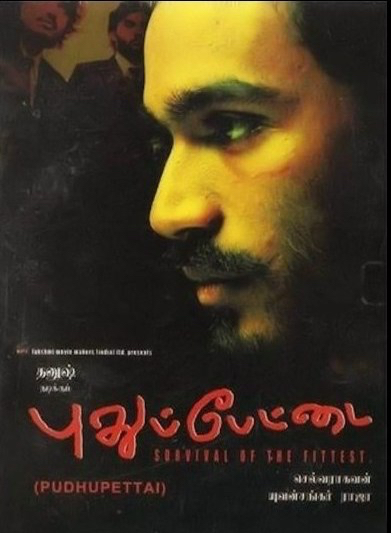
Pudhupettai (2006)

Pudhupettai

Pudhupettai is Selvaraghavan’s ode to gangster life, telling the story of the rise and fall of Kokki Kumar in the slums of Chennai. It’s brutal and violent, and for the most part Selva doesn’t give his ‘hero’ any redeeming features making this a departure from most other Tamil gangster flicks. At the end of the day, the only real priority for Kumar is himself and trying to keep himself alive, which reflects the film’s tagline ‘survival of the fittest’. The film is shot almost like a documentary, following the wandering path of Kumar’s life rather than having a distinct narrative, and it’s this realism and attention to the details of the characters and their harsh lives that makes Pudhupettai such a fascinating watch.

The film opens with Kokki Kumar (Dhanush) in jail. He seems disorientated, perhaps mentally ill, as he shouts out for anyone who might be listening to him. These opening shots feature Kumar in green with contrasting red light from outside the cell, further isolating him and accentuating his odd behaviour. This colour scheme replicates throughout the film, maybe to illustrate Kumar’s almost split personality but it’s also used to highlight important moments in his life. It’s part of how Selva pulls the story together, using images and brief vignettes rather than long drawn out scenes to develop his characters.

The film then moves to a flashback of Kumar’s early life in the slums of Pudhupettai. He seems a typical young man as flirts with girls and is chastised by his mother for dancing in the streets rather than hurrying off to school. However, violence is never far away. His father is violently abusive and finally one night Kumar returns to find his mother has been murdered by his father. Fearing for his own life, Kumar flees onto the streets to try to make his own way in the world.

He’s not terribly successful at this and eventually turns to begging in the streets where he is accidentally picked up by the police during a raid on drug sellers operating under local thug Anbu (Bala Singh). Anbu’s men take Kumar under their wing and introduce him to their boss, managing to secure him a spot in their gang. Interestingly, Vijay Sethupathi has a small role here as one of the gang, and there are a few other familiar faces including Aadukalam Murugadoss who also pop up in the background.

Kumar gradually learns how to be a gangster and there is some good humour worked into the scenes where he learns how to use a machete and case the scene before a crime. He also has a mean temper and when backed into a corner by a rival gang lead by Murthy (Prudhviraj) he fights back, killing Murthy’s brother and turning Murthy into an enemy for life. The film follows Kumar as he meets and falls in love with prostitute Krishnaveni (Sneha) and subsequently takes over the area from Anbu after killing his former boss in a dispute over his treatment of Krishnaveni.

Kumar has grand ambitions and with the gang behind him he takes Anbu’s place working for corrupt politician Thamizhselvan (Azhagam Perumal). The body count rises as Thamizhselvan commissions murders and Kumar steadily makes inroads into Murthy’s territory. But then Kumar sees Selvi (Sonia Agarwal), the sister of his main henchman Mani, and he falls instantly in lust. Forgetting Krishnaveni he marries Selvi instead of the real groom at her wedding and immediately has another enemy out for his blood. Mani joins forces with Murthy and the two conspire to bring Kumar down.

This is the seedy side of gangster life and Selva shows the grubby political deals and bloody in-fighting between the rival gangs as something to be expected, rather than as exceptions to the rule. No-one comes out of this looking good and Kumar in particular is not a nice man. At first there seems to be some attempt to explain Kumar’s violent tendencies on his early experiences, but during a drinking session with the gang one night, it’s revealed that everyone has a similar story. It’s even a source of entertainment for the gang as they each tell their stories of abuse and murder and decide who has the funniest story.

It then seems as if there may be some compassion in Kumar when he fights Anbu for Krishnaveni’s freedom, but this doesn’t ever seem to be a grand passion or even much of a love story at all, and Kumar tends to treat Krishnaveni more as a possession rather than a lover. He’s able to completely ignore her when he sees Selvi and isn’t at all bothered by Krishnaveni’s attempt to leave him, until she announces that she is pregnant. That of course makes all the difference, and this is the one part of the film where Kumar genuinely seems to care for someone else. The birth of his son is a momentous event in his life, which makes his son’s loss later in the film more effective than expected.

There are signs that Kumar might be a better man than first appears when he takes on cases where the local people have been affected by corruption and crime after overthrowing Anbu. But this appearance of trying to help the poor turns out to be just an easy way to develop a power base and get support – something that Kumar needs if he wants to further his political ambitions and make a name for himself. I love how each time Kumar seems to be acting more responsibly it’s shown to be just another way to make sure he comes out on top. The pragmatism and cunning he shows seem to be reasonable requirements for someone who aspires to be a top politician, while the extreme violence and disregard for human life explain why Kumar makes such a good gangster.

Throughout, Dhanush is excellent despite a tendency to overact in the prison scenes where he has to explain his story directly to the audience. His transformation from a scared adolescent to a violent and cold-blooded criminal is brilliantly achieved, and his tendency to become completely feral when he loses his temper gives the character a chilling authenticity. Here is someone with few morals, who decides what they want and then goes ahead and takes it without worrying about the consequences or the possible price. Sneha does a fantastic job with the character of Krishnaveni and gives her dignity and grace despite her profession and her association with the gang. Krishnaveni seems to genuinely love Kumar, although some of this may be gratitude for helping her escape the brothel, but she brings some normalcy into the storyline and provides a good contrast to all the violence. She’s not completely innocent either and her entrapment of Kumar by mentioning her pregnancy after he marries Selvi is a clever twist, as is Selvi’s nasty dig when she points out that Kumar can’t be sure that the baby is his. It all rings true and despite the buckets of blood and excessive use of knives (check out Kumar’s impressive machete storage cupboard!) this doesn’t seem to be too fantastical a story. The characters all seem plausible too, particularly in the way they let their petty squabbles and problems spill over to affect the whole area.

The rest of the cast are uniformly good too – Sonia Agarwal has less to do than Sneha but she is excellent as the reluctant bride, while Azhagam Perumal has so many backflips that it’s a wonder he can work out which way to look at the camera. Clever writing and good dialogue ensure that everyone has a role to play while the good performances mean it all flows beautifully.

The film is enhanced by excellent cinematography from Arvind Krishna, who makes Chennai look stunningly beautiful one moment and then grimly ugly, just as Selva juxtaposes Kumar’s dreams with the harsh reality of life as a gangster. The songs and background music by Yuvan Shankar Raja also suit the film well with the songs seamlessly flowing into the dialogue and some hauntingly beautiful instrumentals.

At almost 3 hours Pudhupettai is a long film and at times it does tend to drift into indulgent territory, but then it’s so well made that it’s hard to complain. This is a film that seems to get better and better with repeated viewings as more of the story becomes clear. As with most Selvaraghavan’s films, the subject matter is dark and his characters flawed, but the subject matter here suits this type of delivery and as a whole the film works very well indeed. Not one for the squeamish given the preponderance of edged weapons and gory bloodshed but for anyone who enjoys a gangster film, this is one of the best. 4½ stars.
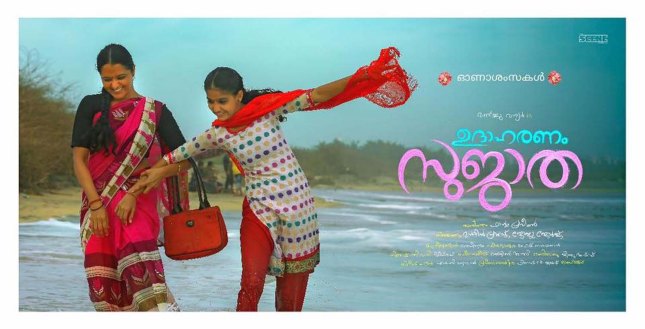
Udaharanam Sujatha

Udaharanam Sujatha

Udaharanam Sujatha tells the story of Sujatha, a hard-working single mother, and her attempts to ensure her daughter Athira studies and passes her year 10 school exams. Sujatha has big plans for her daughter, but the problem is that Athira isn’t interested in studying and rather than thinking about her future, her dreams involve movie stars instead. Phantom Praveen has directed this Malayalam remake of Hindi film Nil Battey Sannata by Ashwini Iyer Tiwari (who has also remade the film herself in Tamil), with a more Kerala-centric screenplay from Naveen Bhaskar and a few changes to the lead characters. It’s a simple story that focuses on the mother-daughter relationship and features excellent performances from both Manju Warrier and Anaswara Rajan as her somewhat rebellious daughter. I did have a few issues with some parts of the film, but the overall feel good factor and balanced mix of drama and humour ensures Udaharanam Sujatha is well worth a trip to the cinema.

Sujatha (Manju Warrier) gets up well before dawn to start her seemingly endless round of jobs to raise enough money to pay for her daughters education. Sujatha herself left school after 9th standard which she feels has severely limited her choice of occupation, and as a result, she resolves that her daughter needs to do well at school. However Athira (Anaswara Rajan) doesn’t care at all about her studies and has no thought for her future. She lives in the present, watching music videos on TV, playing with her friends and day-dreaming about Dulquer Salmaan. Athira doesn’t appreciate the long hours that her mother works to fund her education and even tells Sujatha that a doctor’s daughter will be a doctor and an engineer’s daughter will be an engineer, so since she is the daughter of a kitchen maid, that is all that she will become. Since Athira also regularly and quite spectacularly fails her tests at her school it seems unlikely that Sujatha’s grand plans will succeed no matter how hard she pushes Athira.

For one of her jobs, Sujatha works for prominent script writer George Paul (Nedumudi Venu) who listens to her daily recitation of her worries and fears about Athira with a surprising amount of tolerance. He finds a friend (Alencier Ley Lopez) who runs a tutoring service and who is willing to offer Sujatha a substantial discount, but only if Athira scores more than 50% in her maths exam. When Sujatha complains to George about the unlikeliness of Athira reaching this target, he suggests that Athira needs some competition and persuades Sujatha to go back to school herself and complete her Year 10 education.

A scene where Athira discovers her mother’s plans and attempts to cajole her mother with promises of improved study interspersed with pleas and general teenager angst is brilliantly written and perfectly performed by Anaswara. Her mother’s response is just as good and gets to the heart of the relationship between the two. Sujatha is determined to make her daughter succeed in life and is willing to go through the humiliation of going back to school to force her daughter to study. Athira’s subsequent tantrums and her refusal to acknowledge her mother’s presence in the classroom are also well handled, while Sujatha’s gradual acceptance by the other students seems plausible given her ability to cook! The good points though are mixed up with some terrible clichés such as the bespectacled nerd of the class who helps Sujatha understand maths, and the horribly abusive teachers who seem out of place in a film about the benefits of education.

Also problematical is the inference that doing a job such as working in a factory or as a maid is somehow shameful and to be avoided at all costs. While I can sympathise with Sujatha’s desire that Athira gets a good education and has options to choose from, it doesn’t follow that working in these jobs is wrong. Every parent wants the best for their child and particularly would prefer to see that they have a comfortable life, but this doesn’t mean that a house maid should be looked down on, just because of her occupation. However, aside from these points, the rest of the story is a heartening tale of the importance of a good education and how Sujatha manages to change her daughter’s attitude. It’s surprising that Sujatha manages to attend school at all, given her busy schedule of work but Naveen Bhaskar doesn’t let logic get in the way of a good story and after all, perhaps Sujatha has a time-turner hidden away somewhere.

The star here is undoubtedly Manju Warrier who is excellent as the harried mother desperate to wake some ambition in her daughter. Her work ethic is amazing and well portrayed, but what really stands out is the love she has for her daughter and her strength of will to make sure that nothing will get in the way of her dreams. She is fantastic as a concerned mother and completely inhabits the character of a cook/pickle-maker/house-maid/cleaner from a slum area of the city. Anaswara Rajan is also excellent as the bratty and ungrateful Athira who resents her mother’s interference in her life. Her whining is brilliantly irritating and her self-absorption typical of a teenager who naturally knows better than her mother. Together the two actors make a formidable team and it’s the warmth of their relationship that takes the film up a level to make it more than a simple moral tale about the value of education.

Udaharanam Sujatha

The other characters all have a small but significant part to play in the drama, and do it well. Joju George is excellent as Sreekumar, the headmaster and maths teacher who reluctantly agrees to take Sujatha on as a student. His role provides much of the humour, but he also succeeds in making his eccentric character more sympathetic than first appears and he plays a part in assisting Sujatha to further her own dreams. Nedumudi Venu is excellent throughout and he also adds some more light-hearted moments as does Sujatha’s potential suitor while Abhija Sivakala provides drama as a coconut seller who has lent Sujatha money and wants it paid back. Mamta Mohandas is also good in a small role as the local collector who takes on the task of bringing a supply of drinking water to Sujatha’s area and acts as the inspiration for Sujatha’s dreams.

The songs from Gopi Sundar are generally upbeat and suit the mood of the film, but one or two in the second half slow down the narrative and could have been excluded without losing anything from the story. Technically the film looks good, although Manju Warrier’s face is distractingly shiny at times, presumably due to the lack of make-up to give her character more authenticity. The moral message is hammered home a little too heavy-handedly at the end, but for the most part it’s the drama between mother and daughter that takes centre stage and gives the film its appeal. I like that Sujatha has the confidence to go back to school to improve her prospects and that she sees education as vitally important to secure her daughters future. It’s also heartening that she doesn’t need a man to prove her worth and prefers to manage alone despite having a suitor with a good job who could make her life easier. There are enough good points here to balance out the few negatives, and even if the dialogue is occasionally a tad shaky the performances are excellent and the story captivating. Recommended for Manju Warrier, Anaswara Rajan and a reminder that it’s never too late to follow your dreams.


Karuppan (2017)

Karuppan

After recently watching Rekka, Karuppan feels rather familiar with another foray into ‘mass’ territory for Vijay Sethupathi. R. Panneerselvam’s film is a standard plod through family relationships in a village near Madurai that fails to bring anything new into the genre, despite a few good ideas that unfortunately fizzle out midway through. Vijay Sethupathi, Tanya and Bobby Simha all do justice to their roles, but unfortunately the film lacks the fire it needed to make this a more compelling watch.

The story is set around the time of Jalikkattu and features a number of scenes involving bull wrestling. I really hope that the opening credits had the usual advice that ‘no animals were harmed during the making of this film’ but since everything was in Tamil with no translation I really couldn’t be sure (although these scenes did mainly seem to be CGI). I’m aware that Jalikkattu is a big thing in Tamil Nadu, but from the footage shown here the whole thing seems rather pointless to me and wasn’t at all enjoyable to watch. The reason for including Jalikkattu is that Maayi (Pasupathy) has a bull in the competition and decides that it would be a good idea to wager his sister’s hand in marriage to the man who manages to win the contest. Naturally the hero of the hour is Karuppan (Vijay Sethupathi) who wins the wrestling medal and the hand of Anbuselvi (Tanya) when he manages to make Maayi’s bull fall over.

Needless to say Anbu is not happy about her prospective groom and the method her brother has used to decide on the match, but like any good Tamil girl she threatens to kill herself if Maayi forces her into marriage. By this point I was ready to walk out – surely not even Vijay Sethupathi was going to be able to salvage this one, but then there was a twist to the story and it started to get more interesting. (Mild spoilers ahead)

Maayi had previously matched Anbu and Karuppan’s horoscopes and had already decided that he would be the perfect husband for Anbu, while Anbu had seen Karuppan take a stand against a seller of blue films and liked him for his values. And possibly also for his rather impressive moustache – sadly no subtitles for the songs means I may have made that part up, but it seems just as plausible (it is a magnificent moustache)! So, after a brief song and dance to introduce the prospective bride and groom, Anbu declares that she is ready to marry Karuppan just as soon as he can be convinced that the wedding is not solely due to his winning of a wager. Karuppan has the previously mentioned values you see and doesn’t take the wager seriously.

Unfortunately for the future happiness of the couple, there is a potential cloud on the horizon. Kathir (Bobby Simha), Maayi’s brother-in-law, had his heart set on marrying Anbu and when he can’t persuade Maayi that the whole wager idea is wrong, he decides to break the couple up by any means he can. Kathir is a sneaky villain and rather than gathering a gang of men to beat Karuppan into submission straight away, he goes for subtle and insidious goading of Maayi and the other villagers. This is done well with the odd piece of gossip dropped into the conversation, a nudge on one of the villager’s shoulders during a town meeting to get him to say his (obviously pre-prepared) piece and plenty of slanderous hints dropped around the village. Kathir is sweetly two-faced too, supporting Karuppan and speaking well of him to his face, but back-stabbing him as much as possible behind the scenes, and Bobby Simha does an excellent job of making this all seem very plausible.

Karuppan doesn’t help the situation by falling into Kathir’s traps which include getting outrageously drunk and insulting his in-laws at a temple function for his marriage. Kathir ensures that one of the people insulted by Karuppan is local gangster Varusanadu Sadha (Sharath Lohitashwa), setting Karuppan up to be dealt with by the gang if Kathir’s other plans fail to break up the marriage. Bobby Simha is very good here and he ensures his character has no redeeming characteristics. He keeps the characterisation low-key but effective to deliver a rather less physical but no less nasty villain.

Anbu is frustrated by her new husband’s failure to keep on the straight and narrow and when an estrangement occurs between her brother and her husband, she’s back to trying to kill herself without making any attempt at reconciliation. Sigh. Thankfully, apart from her suicide attempts, Anbu is a sensible and down to earth character, so there is hope that the whole situation can be resolved – after a major fight scene of course.

What works well here is the relationship between Karuppan and Anbu which quickly develops despite the unconventional betrothal. Vijay and Tanya have good chemistry together, while the mix of love scenes and quarrelling is typical of any couple trying to make a life together. One of the standout scenes is when Karuppan learns that Anbu is pregnant and his joy and happiness are perfectly portrayed. Vijay Sethupathi fits well into the role of a blustering but good-hearted farmer who adores his mother and his new wife, and he ensures the emotional scenes are effective without being too over the top.

Also good are the interactions between Karuppan and his uncle (Singampuli), particularly as they indulge in old Tamil film song karaoke together when drunk. They enact the different male and female roles, mouth the words and generally amuse the crowd with their antics in a couple of sequences that are very well put together.

Anbu is an interesting and generally strong character, although I couldn’t understand why her first impulse was to kill herself every time she ran into a bit of bother. Unlike most film heroines, Anbu isn’t afraid to let her husband know that she finds him attractive and she has enough confidence in their relationship to handle the ups and downs of Karuppan’s drinking. She’s decisive and doesn’t shy away from difficult conversations in her marital relationship and in effect she is a much better ‘bull-tamer’ than Karuppan could ever be, particularly since the bull she is taming is Karuppan himself. So, it doesn’t make sense that she isn’t able to deal with the issues between Karuppan and Maayi and effectively discourages the two from talking to each other. Or that she doesn’t confront Karuppan more directly in the second half of the film and slap some sense into him, as she does in the first half.

The film starts badly, gets steadily better throughout the first half, but loses its way in the second before an unexciting and overly contrived finale. The songs from D. Imman are good and mainly well placed, although the lack of subtitles made them less effective for me given that at least two were used to move the narrative forwards. The best are pictured on Vijay Sethupathi and Tanya, although Vijay does some inspired uncle dancing which is definitely a highlight!

Karuppan has an interesting heroine, a more complicated than usual villain and a charming hero, so it should work better than it does. Despite the good characterisations, the story itself is pedestrian with everyone tending to behave quite traditionally despite the set-up suggesting more unconventional approaches. However, still worth watching for the chemistry between Vijay and Tanya, an excellent take on a sneaky villain and those uncle dances.