Padmaavat

Padmaavat

Note – this review contains spoilers

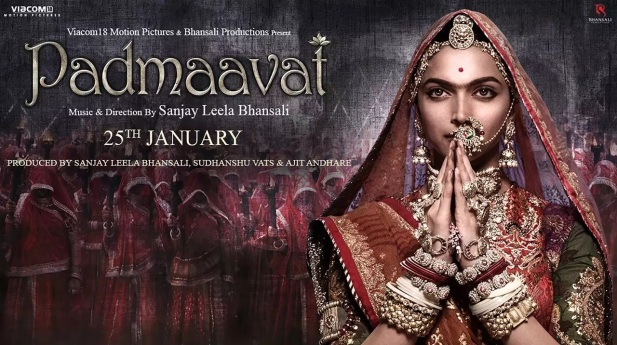
After all the hype, the protests and controversy, Padmaavat finally released in the cinema last week. And now that’s it’s actually here, it’s hard to see what all the fuss is about. With sumptuous costumes, lashings of sparkly jewellery, fantastical sets and very one-dimensional characters, the only possible way to describe Padmaavat is as a very expensive fairy tale. The main characters are all either very, very good, or very, very bad and there is no grey, no hint of any depth or any room to move outside the very strict boundaries of each persona. The film is based on a poem by Malik Muhammad Jayasi, so it’s obvious that Sanjay Leela Bhansali hasn’t set out to make a factual historical drama, and there are plenty of disclaimers at the start to drive home that point. And while there are some problems with the story, most particularly around the problematical ending of the film, it is exquisitely made, stunning to look at and a beautiful work of art. But it’s a work of art that has no soul and even with all the pomp and circumstance, ultimately Padmaavat ends up being surprisingly dull.

The story follows the exploits of two kings, Ratan Singh (Shahid Kapoor), the Rajput king of Mewar, and Alauddin Khilji (Ranveer Singh), ruler of Delhi. Ratan Singh is very, very good. He often wears white clothes, talks a lot about honour and Rajput bravery and is committed to following his rather strict principles. Alauddin Khilji is very, very bad. He murders his uncle to take the throne, sleeps with prostitutes on his wedding day and is generally portrayed as a rapacious monster, instantly ready for any kind of depravity. Ratan Singh is always very clean, Alauddin Khilji wears black and has dirt or blood smeared all over his face. There is no middle ground; these two are the quintessential opposites – the white king and the black king, pure good and pure evil – what else can Padmaavat be other than a fairy tale?

Ratan Singh meets Padmavati (Deepika Padukone) when he takes a trip to Sinhala to buy pearls for his first wife Nagmati (Anupriya Goenka). Padmavati is beautiful and clever, the white queen to Ratan Singh’s white king and although they meet when Padmavati mistakes Ratan Singh for a deer she is hunting and shoots him, they are instantly attracted to each other. The romance is stylised and extravagant. When Ratan Singh is recovering and getting ready to leave, Padmavati takes her dagger and slices open the wound, declaring that now he has to stay longer. But even with all this posturing, there is little chemistry between the two – smouldering looks aside there is very little substance to their relationship even after they are married and back in Mewar. Possibly it’s all the formality and ceremony that comes between them, the application of colours at Holi for example feels cold and ritualised rather than the usual spontaneous flurry of powder, but Ratan Singh’s Rajput pride seems a major barrier to any genuine relationship.

This is partly why Ranveer Singh’s Khilji makes more of an impression. Being totally evil, Khilji gets to do whatever he wants, whenever he wants with whoever he wants, and as a result is exuberantly happy, even when he is pining for Padmavati. A woman whom he has never seen, but still desires because he has to have everything that is unique in the world. Some of his excesses are so ridiculous that they are simply hilarious, such as spraying perfume on a female servant and then rubbing himself against her to transfer the scent.

Ranveer throws himself into the role with such passion and energy that of course by comparison Shahid’s Ratan Singh appears rigid and cold. He is, but the contrast between the two men makes the white seem insipid, while the black resonates with evil intensity.

While both men turn in excellent performances, Ranveer stands out for the sheer lunacy of his portrayal. Khilji is a monster, and Ranveer conveys his evil nature and total obsession while still managing to make the audience laugh. He brings everyone with him on his madcap ride into depravity and ensures that he is the central focus of any scene, no matter what else is actually happening around him.

Deepika Padukone has more to do since Padmavati has a fraction more depth than her husband. Think ivory rather than pure white. She’s also got more common sense than everyone else in the film put together, illustrated by her detailed plans and well thought out rescue of Ratan Singh after he is captured by Khilji. Of course, most of that could have been orchestrated by her two faithful generals, but Padmavati gets the chance to prove that she can fight and develop a plan of attack. Better than her husband to be honest, who bizarrely keeps believing Khilji will act with honour despite never seeing any indication that this will be the case. All of which makes it seem odd that Padmavati would commit all the women to jauhar rather than grab her trusty bow and arrow and die fighting. Regardless, Deepika Padukone looks stunning, even managing to rock a unibrow, and looks perfectly graceful and regal whether she is dancing for Ratan Singh, running through the forest or explaining her strategy to the generals.

A few of the peripheral characters also fare rather better. Jim Sarbh is excellent as Malik Kafur, Khilji’s assistant, general and sometime lover. Aditi Rao Hydari is also very good as Khilji’s first wife Mehrunisa and Raza Murad is excellent as Khilji’s uncle Jalaluddin.

However, Ranveer’s histrionics, the wonderful fabrics and stunning sets aren’t enough to disguise what is a rather lacklustre story. Every scene seems to be drawn out unbearably long to add yet more speeches about Rajput honour and bravery, or showcase beautifully designed costumes and breath-taking scenery that simply distract from the plot.  It’s also predictable and that makes it somewhat dull, no matter how stunningly beautiful the film looks, or how ridiculous Khilji’s excesses become.

However, much of that is as expected for a Sanjay Leela Bhansali film – his attention to detail is amazing and every single scene is constructed as if it is a still-life painting with wonderful balance of light and shade, colour and depth. We expect extravagance, and that is what he delivers. What is more problematic though is the final scene where all the women commit jauhar rather than submit to Khilji’s victorious army. Despite the disclaimers at the start of the film, Bhansali seems to glorify the women’s march to the flames and adds many unnecessary details. It also goes on for a very long time so that the inappropriateness of the camera angles and discordant notes of the triumphant theme are emphasised. While the final act of jauhar may be true to the poem, and a historical reality of the time even if Padmavati herself is perhaps not, it doesn’t seem right that such actions should be seen as a ‘victory’ for the women and not a tragic loss of life. This is disturbing on many levels and while I don’t disagree with Bhansali’s addition of the final chapter to the story, I do feel that such celebration and exaltation is completely the wrong way to approach the subject. It’s a disturbing and jarring end to the film and simply doesn’t fit into the fairy-tale of the preceding two and a half hours.

Padmaavat is a stunningly beautiful film with much to enjoy in the sets and costumes. I could spend hours pausing this film on DVD and marvelling at the fabrics, the details in the palace floor tiles and even the plates and cutlery. Ranveer too is amazing despite his Khilji being such a one-dimensional construct and Padmavati is generally a strong female character. But the finale seems a direct contradiction to the disclaimer at the start while the story, for all its fantasy elements, never really comes alive. All of which makes Padmaavat a visual treat for anyone who enjoys the artistry of Bhansali films, but unfortunately not essential viewing for anyone else.
Kaddipudi

Kaddipudi

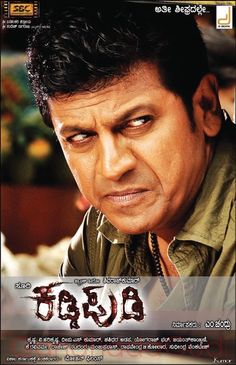
Kaddipudi is a journey into the underworld of Bangalore as the film follows the exploits of Anand, aka Kaddipudi (Shiva Rajkumar) as he tries to leave the world of rowdyism behind. As expected there are corrupt cops and dodgy politicians, but the gangsters too have few redeeming features, being violent and intent on committing the vilest of crimes whenever possible. Against this backdrop, Kaddipudi stands out as a lone honest man, along with his friend Jinke (Rangayana Raghu) and a few of the police officers. It’s an interesting film that isn’t quite as successful as Kendasampige but still entertains thanks to good performances and a reasonably well-developed story.

ACP Satyamurthy (Anant Nag) narrates the story of Kaddipudi’s early life to new police officer Tejasu who is on a mission to clean up the city and remove its gangster element. Satyamurthy explains that it’s not the gangsters who are the problem, but rather the rapists and thieves that he wants to get off the streets. It turns out that Kaddipudi is the one helping Satyamurthy in his endeavours and the rest of the first half explains the reasons.

The story starts with political rivalry between Kaddipudi’s local candidate Renukaji (Renuka Prasad) and Shankarappa (Sharath Lohitashwa). Shankarappa arranges for an accident in an attempt to kill Renukaji but instead manages to paralyse the popular politician and alienate his son Gaali (Rajesh Nataranga) and Gaali’s friend Kaddipudi. Incensed by Galli and Kaddipudi’s threats, Shankarappa pays one of their friends to kill Gaali, but this too fails as Kaddipudi saves his friend’s life. However, this sparks off rivalry between Manja’s family and Kaddipudi which draws him further into violence. Since he turns out to be quite good at it, Kaddipudi gains a reputation as a gangster, but when a friend’s sister is attacked and more people die, he vows to give up his life of violence to avoid drawing his friends into the crossfire.

This first part of the film is rather confusing as various people pop up and are killed without there being any real explanation of who they are. However, once the relationships start to become clear (and many of the cast have already been killed off) it becomes easier to follow as it boils down more simply to Shankarappa and Manja against Renukaji, Gaali and Kaddipudi.

ACP Satyamurthy acts as a mentor to Kaddipudi who seems to be doing quite well as a police informer and general helper to Renukaji. He turns in some of his own men who have been guilty of raping and murdering women in the area, but although this is appreciated by the police it earns him yet more enemies. Just when it looks as if Kaddipudi will manage to turn his life around, Shankarappa arranges for Satyamurthy to be transferred and his own man, ACP Vijaya Prasad (Avinash) to be installed in his place with instructions to get rid of Kaddipudi.

The second half moves into more familiar territory as Kaddipudi has to deal with corrupt cops as well as his gangster rivals and the machinations of Shankarappa. To break up the violence there is a love story with Uma (Radhika Pandit) and some comedy added by Jinke which is generally successful. Kaddipudi also adds to his do-gooder persona by saving a brothel worker, although this part of the story seems to be rather hurriedly tacked on and doesn’t gel with the rest of the screenplay. What does work better is the romance, and Soori allows Uma to have a good back story and believable personality. Perhaps rather less credible is her election as a politician, but it’s good to see a female character, who starts off with a relatively minor role, develop throughout the film to become one of the major characters by the end.

Jinke too has more to offer than just Kaddipudi’s comical friend, while Gaali is interestingly written as a selfish and demanding character who uses Kaddipudi in spite of their good friendship. I’m assuming that the actor playing this role is the same Rajesh Nataranga who wrote the screenplay along with Soori, and it’s interesting that he gave himself a more ambivalent role, which he does an excellent job in portraying too.

The story starts off rather slowly and isn’t helped by Shiva Rajkumar looking rather too old and tired for the role of an upstart young gangster. However, his performance is first class and time moves on and Kaddipudi becomes more jaded with the gangster life, Shiva’s appearance suits the character more. He does an excellent job throughout of portraying Kaddipudi’s conflicting desires; on the one hand he wants to settle down and live a normal life, but on the other, he can’t bear to see injustice and he is quick to respond to defend his friends and adopted family of Gaali and Renukaji.

Also good are Renuka Prasad, Anant Nag and Sharath Lohitashwa, but I really enjoyed watching Radhika Pandit as Uma. The growth of her character was very well written and her development of Uma from scared young girl to confident wife and politician excellent, making Uma a realistic persona who could fall for a reformed gangster and develop the confidence to enter politics. After all she was an actor, and what is a politician if not a performer? Radhika does a fantastic job of bringing her character to life and making her much more than the romantic interest for the hero.

There is a lot of violence in this film, and it’s of the bloody and realistic sort rather than theatrical herocentric acrobatics. There is violence against women and plenty of police brutality, but Soori keeps the film moving, ensuring that there is a reason for all the fight scenes and drives home the precariousness of life as a rowdy in the underworld. Soori has crafted a thought-provoking story that has a lot to offer once you get past the rather slow start and a few side-plots that don’t lead anywhere. Not one for the fainthearted but definitely worth a watch if you enjoy gritty gangster films and don’t mind the bloodshed. 3 ½ stars.

Thaanaa Serndha Koottam

Thaanaa Serndha Koottam

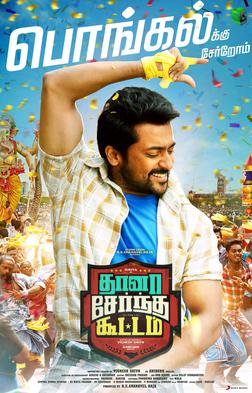
I really enjoyed Suriya’s latest movie, although I haven’t seen the original Special 26, and wasn’t sure what to expect. What I got was a rollicking heist movie, with Suriya playing a kind of modern-day Robin Hood, albeit in 1987, as he and his merry gang thieves disguise themselves as CBI officers to rob various high-profile victims of their ill-gained wealth. With Suriya on top form, the support cast generally excellent and plenty of humour in the engaging screenplay, Thaanaa Serndha Koottam is well worth catching in the cinema if you can.

The film is a remake of Neeraj Pandey’s 2013 hit, Special 26, although director Vignesh Shivan has apparently given it a Tamil twist. Both films are based on a real-life robbery that took place in Bombay in 1987, and Thaanaa Serndha Koottam is set in the same timeframe, allowing for some period features such as the white ambassador cars that Iniyan and his gang use to pose as Government officials, and posters of old films displayed in the background. It also means we get such delights as the costumes and sets in this wonderfully OTT song from Anirudh Ravichandra:

The story goes like this. Suriya is Iniyan, an aspiring CBI officer who is rejected for his dream job mainly because corrupt officer Uthaman (Suresh Chandra Menon) holds a grudge against his father (Thambi Ramaiah). At the same time, many of Iniyan’s friends are struggling to find work due to corruption within the system and the high bribes needed to secure a position. Iniyan’s solution is to gather together a team of like-minded people who are willing to take part in his audacious scheme to rob the rich. And because the money they steal hasn’t been declared to the government, the victims are unwilling to report the crime, ensuring that Iniyan and his team escape scot-free every time.

Iniyan then gives all his ill-gotten loot away, ensuring that his character keeps an altruistic image despite his criminal activities. As the heat builds in Tamil Nadu, the gang move their operations to Hyderabad where they can’t speak the language. I could totally relate to their default use of words they had learnt from Telugu movies, although I’ve never found it to work quite so well for me, and the resultant confusion is perfectly developed into a very funny scene. Brahmi makes an understated appearance as a Telugu CBI officer while the Charminar is visible in almost every shot to make sure we know the action is now happening in Hyderabad!

There is a romance too as Iniyan falls for a girl who is drawn into his schemes. He doesn’t ever seem to find out her name, and I wasn’t clear on her connection to the original robbery, although to be honest I suspect there may not actually be one. Keerthy Suresh is fine as Iniyan’s love interest but really has little to do apart from appear in the songs and create the odd diversion in the storyline.

The rest of the gang get better characterisations and even some back story to flesh out their various personas. Ramya Krishnan in particular is fantastic here and makes a scarily believable CBI officer. As “Jhansi Rani’, she uses her piercingly chilling glare (perfected in Baahubali) to excellent effect as she storms into various establishments demanding they hand over their illegal savings. Then in a blink of an eye she becomes regular housewife Azhagu Meena, planning her eldest daughter’s wedding and dealing with her disabled husband. I love her in this role, and it’s fantastic to see her in such a strong and effective role that combines comedy and drama so well.

The others in the team, KP (Senthil), Ondi (Sivashankar) and Muthu (Sathyan) have smaller roles, but still add plenty of interest to the proceedings, and ensure that the team appears as a real gang rather than just an odd collection of people Iniyan has gathered together.

Against them are the real CBI officers and Kurunjivendhan (Karthik), an honest if somewhat overly enthusiastic police officer who helps Uthaman in his search. Nandha is also good in a small but important role as a rookie police officer who is conned by the gang while Yogi Babu, RJ Balaji and Anandaraj all have successful cameos.

Anirudh Ravichander just keeps producing the hits as he delivers yet another great soundtrack, managing to make the songs all sound as if they really do all come from the eighties. For the most part they’re well integrated into the film too with appropriate picturisation that suits the ambiance.

The only real miss in this film is the end, where the story switches gear and becomes a more typical Tamil herocentric finale with action, drama and a few too many pontificating speeches. It’s a disappointing end to an otherwise engaging film, but thankfully there are some last-minute shenanigans over the end credits to make the audience leave with a smile.

Overall this is a fun film and with such a great cast of characters and the always charismatic Suriya, Thaanaa Serndha Koottam turns out to be an enjoyable and overall very funny watch. Worth catching for Suriya, Ramya Krishnan and Anirudh’s soundtrack.