Ira (2018)


Ira posterIra is billed as a thriller but unfortunately it rarely manages to elicit any suspense or excitement as it plods through an investigation into the murder of a politician accused of corruption. All the elements are there, but the execution is clunky with the sort of dialogue where the characters carefully explain to each other exactly what they are doing and why. Unni Mukundan is good as the main lead, but the rest of the cast get little opportunity to make an impression while director SS Saiju seems to have let the film take its own meandering course.

The film starts with a crowd of reporters waiting outside a hospital for Minister Chandi (Alencier Ley Lopez) to quiz him on a corruption scandal within his administration. However, the mood quickly changes when the minister dies of a heart attack during his check-up and the plot thickens when junior doctor Aryan (Gokul Suresh) is accused of his murder. Right away this seems strange. Why would reporters gather for an interview at a hospital when the intended interviewee is there for a check-up? Surely this is ghoulish and unethical. Also odd is the speed with which the police decide that the death was murder and not a heart attack, since there never seems to be an autopsy or any internal investigation. The decision to blame Dr Aryan is also difficult to understand, since there are a few other potential suspects who never seem to be considered at all. However, the media are quick to follow-up with the story and move quickly to suggest Jacob Chandi (Shanker Ramakrishnan) as his father’s successor in politics.

The police torture a confession from Dr Aryan, but that’s pretty much the whole extent of their investigation and they almost vanish from proceedings to allow Special Investigator Rajeev (Unni Mukundan) free rein to carry out his own enquiry. This mainly consists of speaking to various work colleagues of Dr Aryan at the hospital while some of the other gaps in Aryan’s history are explained in a good flash-back.

However, what’s particularly annoying is the treatment of these character witnesses at the hospital. All are female and are solely defined in terms of their relationship with Aryan despite both having taken part themselves in the events on the day of the murder. Nurse Tara (Neeraja) and Kavya (Mareena Michael) go through exactly the same process of denying any romantic relationship with Aryan before carefully explaining how wonder Aryan was and how happy they were to work with him. Even his girlfriend Jenny (Niranjana Anoop) is simply seen as ‘the girlfriend’ even though she is also Jacob Chandi’s daughter and her relationship with Aryan may provide a possible motive for her grandfather’s murder.

After ignoring plenty of potential clues and viable suspects, the second half starts with an extended flashback that develops some backstory for Rajeev. Unfortunately, it takes a long time to reach the point where any of this is relevant to the main story and the central character, Karthika (Mia George), is just as poorly written as Jenny and Tara. From here the plot continues to unravel as coincidences abound, and the bad guys reveal their secrets at opportune moments for no good reason. Saiju throws in a few songs at random moments and adds key characters late in the screenplay, adding to the overall haphazard feel of the film.

Performance wise everyone is fine, although for the most part the roles are straight forward without too much emoting required. Unni Mukundan has the most to do and is generally good as a police officer investigating a crime. Niranjana Anoop and Mia George have the best female roles, but they are simply there to provide a reason for Aryan and Rajeev to act the way they do, so there is little else for them to do once that reason has been established. Gokul Suresh is fine as the rather naïve Dr Aryan, although the character is too one-dimensional to say anything more than he gets across the idea of wrongly accused innocence well.

Disappointingly, Naveen John’s story just doesn’t feel plausible and there are too many plot holes and contrivances to allow any suspense to develop. Small details are explained by the characters in blatant disregard for the cardinal rule of ‘show, don’t tell’, while other crucial points are introduced and then completely ignored. There is a really important message at the very end of the film too, but it’s glossed over so quickly that I’m not even sure if this was added intentionally or not. Ira isn’t a terrible movie and it’s even reasonably well filmed, it’s just very average without anything that stands out to mark it as sufficiently different from the great commercial sea of current Indian cinema.


Vetagadu (1979)

Vetagadu

K. Raghavendra Rao’s 1979 film is a classic featuring N.T. Rama Rao and Sridevi in a mystery/romance full of stupendous seventies fashion and glorious home décor. Jandhyala’s story seems to have all the required elements but despite having 2 DVD copies of this film that say ‘with English subtitles’ neither my copies, nor the versions available on YT are subtitled, so I’m really just going with my interpretation of events. And there is a lot going on. As well as a jewellery theft, there is a murder, a feud between two rich families, some shenanigans in a tea plantation, a tribal village with a propensity for celebrating by dancing, a cosy villain’s lair and a convoluted plot to expose the criminals. N.T. Rama Rao looks a little old to be romping around the forest and fighting off the bad guys, but he does it with plenty of style while Sridevi is simply stunning as the heroine trying to find out what really happened to her mother. Apologies for the poor quality of the screencaps – in addition to no subtitles the DVD’s are of equally bad quality.

The film starts with Gayatri (Pushpalata) performing a musical interlude for her family, including her husband Ananda Bhupathi (Jaggayya) and young daughter Roja, at what seems to be a house-warming for their new palace. During her performance Gayatri wears a super-sparkly necklace which quickly attracts the attention of the palace’s steward, Sivananam (Rao Gopal Rao). Sivananam hatches a plot to steal the necklace that involves kidnapping Gayatri the next time she attends the temple. However, Gayatri manages to escape from her captors and runs into the forest where she meets Kalyana Gajapathi (Kanta Rao), a friend of the family who lives in the neighbouring palace. Kalyana Gajapathi attempts to fight the kidnappers but is killed in the struggle, while Gayatri manages to give her necklace to a local tribesman before the thugs catch up with her too.

The film moves to the present day where Ananda Bhupathi has moved back to the city after losing his wife, and the young Roja has grown up into Sridevi. Sivananam has taken over running the estate where he runs various shady businesses, including trafficking young women, with the help of his son Hari (Satyanarayana). As with all good villains, Sivananam has a lair, which judging by the fishy view, appears to be underwater and is furnished with the usual accoutrements including a handy trap door and convenient crocodile for disposing of recalcitrant girls. Hari wanders around the tea plantation, acting as a lord of the manner in his fancy suits with matching hat and flower, selecting the women he wants and disposing of them in his father’s business.

Sivananam has grand plans to marry Hari and Roja, which he puts into action when Roja visits for a hunting trip. However, he’s reckoned without Raja (N.T. Ramo Rao), the son of Kalyana Gajapathi and a hunter still living in his father’s old palace. Roja meets Raja on her way to the forest and immediately dislikes his rather sleazy approach to romance. After crashing into her car and harassing her on the train, Raja then follows the tried and true method of tormenting Roja and stalking her to make her fall in love with him, but to Roja’s credit this doesn’t seem to work. However, Raja’s heart is really in the right place and when he rescues Roja from a gang of thugs she changes her mind and the two can get down to some serious prancing.

One night Roja hears music coming from the old abandoned palace, and when Raja investigates he finds a masked man attacking a young woman in the building. Further investigation leads him to suspect something shady is going on, but it’s not until he rescues another young tribal woman and meets her father (Chalapathi Rao) that he starts to put everything together. Since he’s a man of good sense, he enlists Roja’s help with his investigations, and between them they discover the real story of what happened to Gayatri and her necklace.

Of course that’s not nearly enough drama, so added in is a feud between Ananda Bhupathi and Raja’s family as he believes Kalyana Gajapathi was behind the theft of the necklace and disappearance of his wife, resulting in his refusal to allow Roja to marry Raja. There’s also something about a little girl who was killed in a road accident, who I think was Raja’s sister, which may explain why his father was off hunting in the forest when Gayatri went missing. Or may not – I’m not clear exactly how her death fits into the rest of the story. Naturally there is a comedy track too and Nagesh and Allu Ramalingaiah ham it up between them in a feud over one of the women from the tea plantation. There is also a rather sad and toothless tiger who gets dragged into the mix and is supposedly part of the ‘comedy’, but for the most part Nagesh and Allu Ramalingaiah play well off each other even if their antics seem rather dated now.

What helps Vetagadu immensely is the mystery-based storyline and the enthusiasm and energy of the leads. Rao Gopal Rao is good as the villain of the piece with a generally benevolent air as he plots and plans his way through various schemes. Satyanarayana is also excellent as his son, with all his affectations which he drops easily once he’s involved in a fight scene. There’s a particularly good moment where he swaps shoes during an item song to pick up some diamonds and has to carry off the disruption to his perfectly matched outfit. I do like his style!

But the real stars are NTR and particularly Sridevi who manages to make her romance with the ageing superstar reasonably believable. NTR helps things along by some energetic fight sequences and a number of good dance numbers including this one in the tribal village where he imagines Roja and himself as the lead dancers.

Sridevi is simply stunning and has plenty of scope to demonstrate the full range of her acting skills Her initial comedy scenes with Raja are good, and I definitely think she gets the upper hand even though she does eventually succumb to Raja’s charms, or at least his ability to get them out of a sticky situation. Roja also gets a chance to turn detective as she partners up with Raja to find out what happened to her mother and the heirloom necklace, vamping it up and flirting with Hari as well as schmoozing up to Sivananam. She’s also gorgeous in the dance sequences and manages to carry off the various ruffles and seventies fashion (even a crocheted dress) with plenty of style. NTR does well to keep up with her, and he’s excellent in scenes where he is chasing down the answers to the puzzle of his father’s disappearance and the mystery of the missing necklace.

Although the finale, where Raja attempts a disguise to fool Sivananam and Hari doesn’t work quite as well, the rest of the story is a good mix of romance and action, just the way a masala should be. I would love to see this properly restored with English subtitles but until then, this was an enjoyable watch, even without understanding the dialogue– worth it for Sridevi, N.T. Rama Rao and Chakravarthy’s catchy dance numbers. 3½ stars.


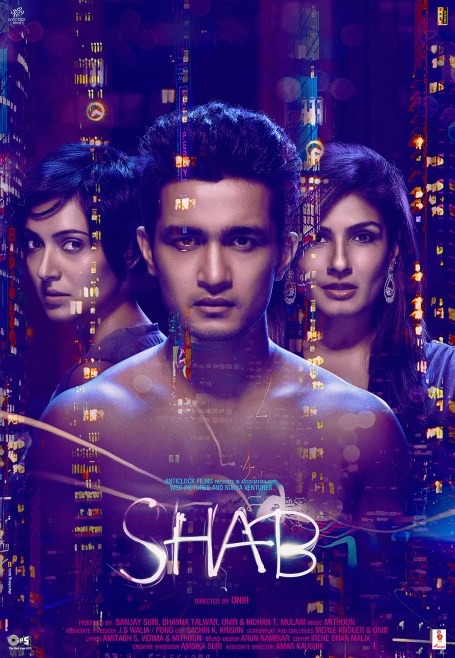
Shab (2017)

Shab

Shab was released last year but was only shown at the Indian Film Festival without a general release in Melbourne, so I’ve had to wait for the DVD release. I loved Onir’s previous films, I Am and My Brother Nikhil, so I was looking forward to this tale of love, lust and loss in the big city. Unfortunately, Shab doesn’t have the same instant impact despite strong characters and intertwining complex relationships. That complexity is part of the problem, since at times the connections are diffuse and confusing, but the main problem is with the dialogue, which often sounds contrived and unnatural. Shab ends up as a series of beautifully posed moments where the underlying relationships are only vaguely described and the expected passion surfaces only in brief spurts – usually from the supporting cast.

The film tells the story of Mohan (Ashish Bisht), a wannabe model from Uttarakhand who comes to Delhi to take part in a competition. Despite his impressive physique and tight silver shorts, Mohan’s small-town attitude fails to impress the judges and he’s sent packing from the show. Depressed and broke, Mohan finds his way to a café where the owner Neil (Areesz Ganddi) feeds him and gives him a place to wait until his bus leaves later that evening. However, Mohan has one last card to play, and calls one of the competition judges who invites him to her house. Sonal Modi (Raveena Tandon) is a rich socialite in an apparently loveless marriage with an industrialist who is rarely at home. She takes Mohan as a lover, christening him Azfar and deciding that he will be her ‘trainer’. Mohan seems happy enough with the arrangement – he’s dazzled by Sonal’s house and flattered by her attention, but as time moves on his arrangement starts to sour, as exemplified by his changing expression in the mirror where he practices his smiles before leaving to meet his lover.

Meanwhile Neil has problems of his own. His lover Nishant (Shray Rai Tiwari) treats their relationship casually and is also preparing to get married to satisfy the wishes of his family. Neil relies on his friend Raina (Arpita Chatterjee) for support as he weathers his on-off relationship with Nishant and she provides sensible advice and the odd kick up the arse when Neil becomes too maudlin to cope. But Raina has issues too. She lives with her younger sister Anu (Aniha Dhawan) who resents the time Raina spends at work when Anu is home from boarding school in Mussoorie. Raina’s life is shrouded in mystery for much of the film, with veiled references to her work outside of her regular gig waiting tables for Neil and strange encounters with people who call her Afia. She’s also good friends with Benoit (Simon Frenay), a French national who has just moved in to the apartment across from Raina and who works as a French teacher and a waiter in an upmarket restaurant. These five lives all become connected through their various friendships and relationships as they wrestle with their hopes and dreams while juggling the pressures of day-to-day life.

The best realised of the characters is Mohan, and newcomer Ashish Bisht is good as the country boy adrift in the big city. Ashish combines naiveté with charm in his interactions with Raveena Tandon and is also suitably desperate in his pursuit of designer Rohan Sud (Raj Suri), but his performance is let down by inconsistencies in the character. It doesn’t seem logical that Mohan should wait so long before approaching Rohan for a modelling job, and his romance with Raina never rings true. While Ashish nails the puppy dog looks and lusting from afar, when the relationship moves up a gear it appears false and unrealistic, which isn’t helped by Arpita Chatterjee’s disconnected performance. Mohan’s gradual realisation of his real relationship with Sonal is treated much better and helped immensely by Raveena Tandon who does a wonderful job with her limited role.

Raina is the thread that connects all the characters, but she’s the most disappointing and the character whose story is the least interesting. Her ‘secret’ is easy to guess after a few confrontations but her lifestyle is not well explored or explained. She works for Neil so it’s not clear why she still carries on in her previous line of work since money doesn’t seem to be an issue. There’s never any explanation of why she made the choices she did with Anu, and since most of those don’t make much sense it would have been interesting to try and understand her motivation. Similarly her rejection of Mohan seems odd given her advances towards him, although the whole relationship is strange and always feels manufactured.

Thankfully the other threads are better. Neil’s story is good, although there are a few too many coincidences that mar an otherwise interesting look at a same sex relationship that’s falling apart. The emotions here are given more screentime and appear much more genuine, while Areesz Ganddi’s portrayal of a man suffering through a relationship breakdown is realistic and believable.  Although Benoit’s story seems rather superfluous since a foreigner in Delhi can be expected to feel alienated at times, Simon Frenay is good and there are elements in his story that help develop the other characters. More could have been made of his antagonism towards Mohan and the reasons behind his dislike, but Benoit is generally inoffensive even if his story seems somewhat incomplete.

Each of the characters has a story that includes loss and feeling alone while surrounded by thousands of other people which should have been the basis for an interesting exploration of alienation in the city. However, the main reason it fails to engage and deliver on that expectation is the clunky and unrealistic dialogue. This doesn’t appear to be a subtitle issue either as even with my limited Hindi, I can understand enough of the dialogue to know it sounds stilted and unnatural. When Sonal taunts Rohan with comments about wanting Mohan in his own bed rather than on the runway, the remarks sound unbelievably immature. It’s also incredibly unlikely she would say anything like this since the two are supposed to be ‘best friends’. Conversations between Mohan and Raina sound equally forced and the only realistic dialogue is when Mohan discovers Neil is gay and blurts out that he doesn’t look ‘like that’. For the most part it feels amateurish and unlike Onir who is normally sophisticated and clever in his use of language.

On a more positive note, the film looks gorgeous and each set is perfectly staged with exquisite attention paid to detail. Ashish spends most of the time shirtless, but his clothes are a good reflection of his personality, including a truly terrible see-though shirt he buys for himself. Perhaps if the film had focused more on Mohan’s story this would have been a more satisfying watch. I would definitely have preferred to see more of Sonal’s story and less of Raina. As it is however, while it is beautifully shot with an excellent soundtrack, Shab seems no more than a superficial glimpse into a small portion of Delhi society. 2 ½ stars.