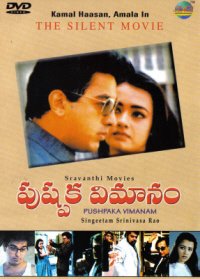
Pushpak

Although made in 1987, Pushpak is a silent film with no dialogue. However there is background noise and a very funky soundtrack. Presumably inspired by the early silent films from the start of the last century, director Singeetham Srinivasa Rao has included plenty of situational and physical comedy but Pushpak manages to be a compelling, if somewhat moralistic drama at the same time.

The story centres on an unemployed graduate played by Kamal Hassan. He lives in a one-roomed apartment on the roof of his building, and spends his days wandering around the streets unsuccessfully looking for work. By chance, he comes across an alcoholic millionaire (Sameer Khakhar) lying at the side of the road and recognises him from an earlier encounter near the Hotel Pushpak.
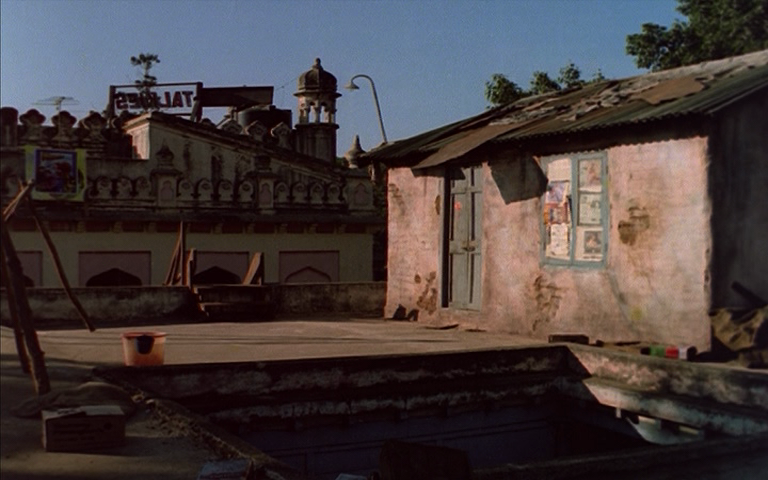
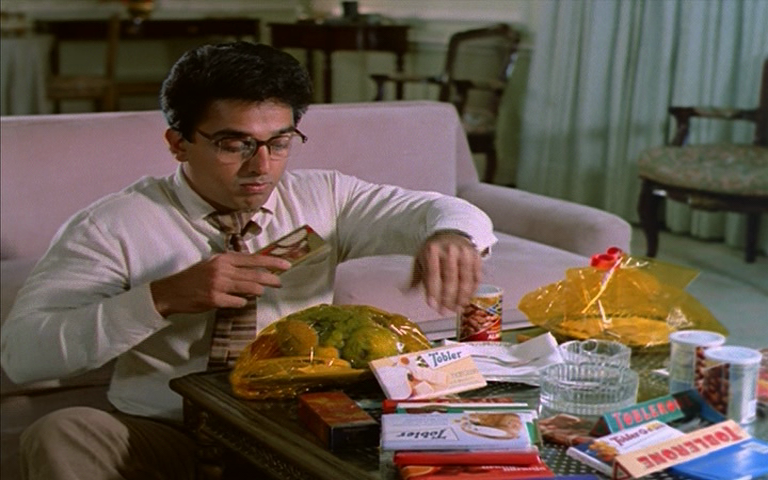
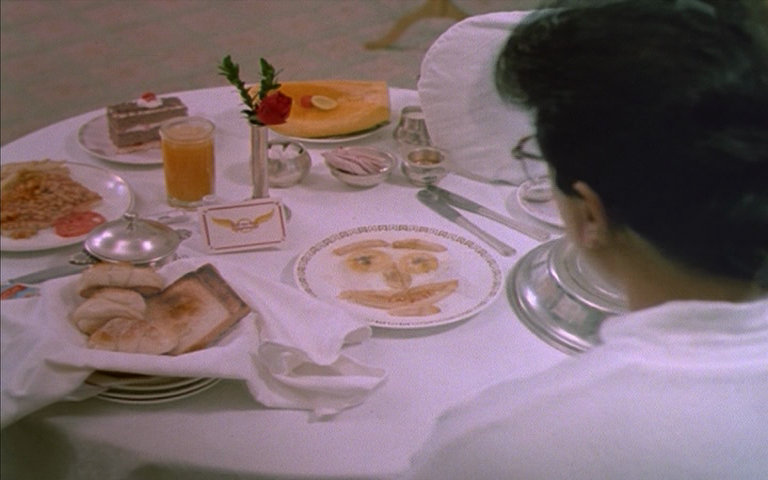
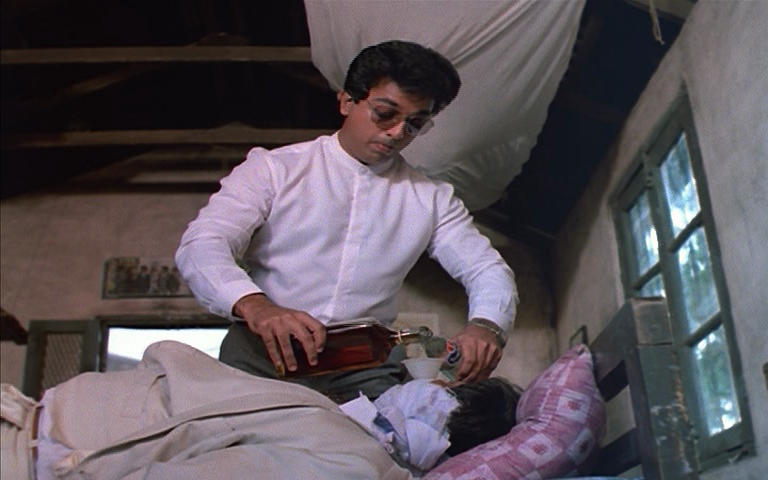
Kamal Hassan decides to kidnap the unfortunate millionaire and carries him back to his meagre apartment where he restrains and gags the unconscious man (although he does thoughtfully turn on the fan), and then heads off to Hotel Pushpak where he assumes the millionaires identity. He sleeps in the millionaire’s room, eats his food and uses his cash to buy smart new clothes. Kamal Hassan is perfect in his indecision as he tries bread sticks, then some nuts and finally cannot decide which chocolate bar to eat – too much choice for someone who has been used to no choice at all. And I love the way they serve breakfast in the hotel.
Clever shots of photographs in both the hotel room and the millionaire’s home allow us to identify the millionaire’s wife, to whom he appears devoted and the millionaire’s best friend, who appears to be devoted to the millionaire’s wife. The two are having an affair and we learn that the best friend has hired an assassin to get rid of the husband for good.

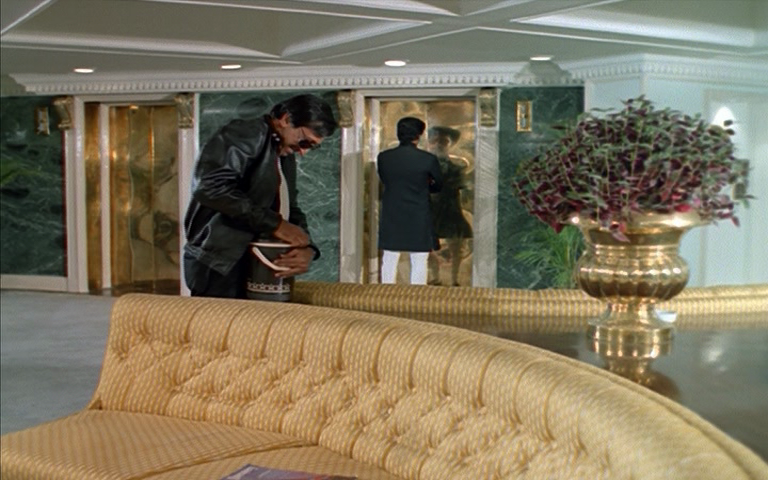
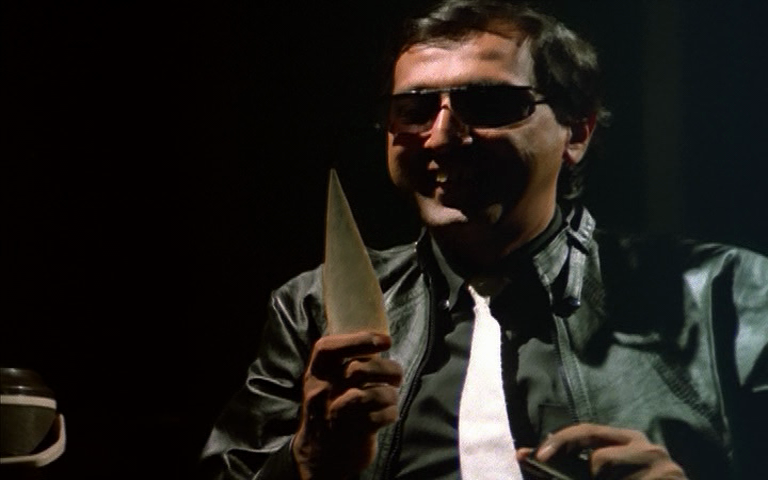
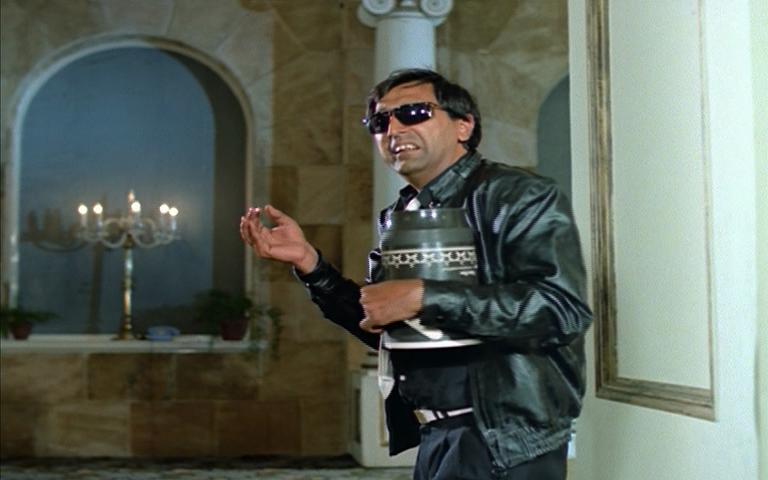
The role of the assassin is played by Tinnu Anand who throws himself into the role and seems to have a great time stalking his target. However as he has only the hotel name and room number, he clearly doesn’t know that he is attempting to kill the wrong man. His weapon of choice is a throwing dagger made of ice which he carries around in an ice bucket (of course!). His efforts to remove the lid of the ice bucket, pull the ice dagger from the mould and then throw and hit his target are wonderfully inept leaving me wondering why he didn’t just bring one of his large collection of guns along as a back-up plan. The daggers also seem rather friable although they work well enough in the dummy he has brought along to the hotel room in order to practice his technique.
Added in to all this farce, there is a rather sweet romance which develops between Kamal Hassan and the hotel magician’s daughter, beautifully played by Amala. The film builds to a moralistic but somewhat poignant ending where everyone appears to have learned that money cannot buy everything and that there is more to life than wealth.

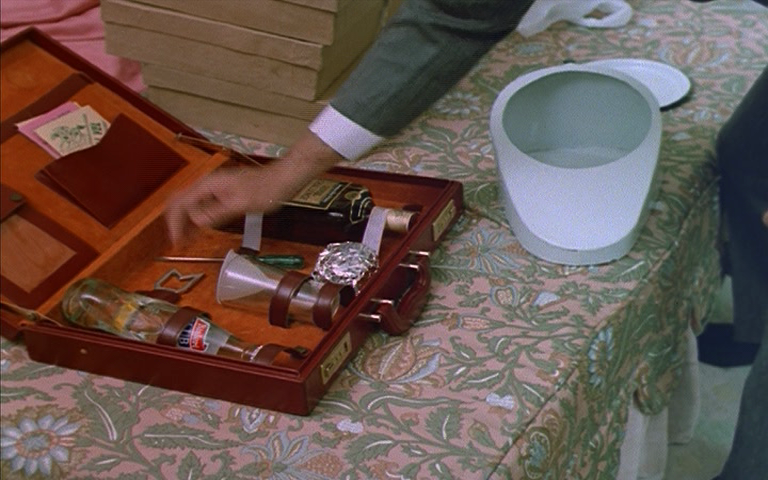
Of necessity the acting in a silent film has to be more obvious when there is no dialogue to explain the reasons behind people’s actions. However the various characters here are explained by a few simple scenes which give a clear understanding of their personality and there isn’t really any heavy-handed overacting by the lead actors. As with many of the early silent films there is a high reliance on slap-stick humour and most of this involves the efforts by Kamal Hassan to keep his prisoner quietly hidden and the assassin’s attempts on Kamal Hassan’s life. There is a lot of toilet humour as Kamal Hassan goes to rather detailed lengths to make sure his prisoner is relatively comfortable throughout his captivity and there is perhaps a little too much detail for it to be really funny. Rather, I was impressed by the ingenuity shown in the ‘waste disposal’ plan, although perhaps this is to be expected in a college graduate.
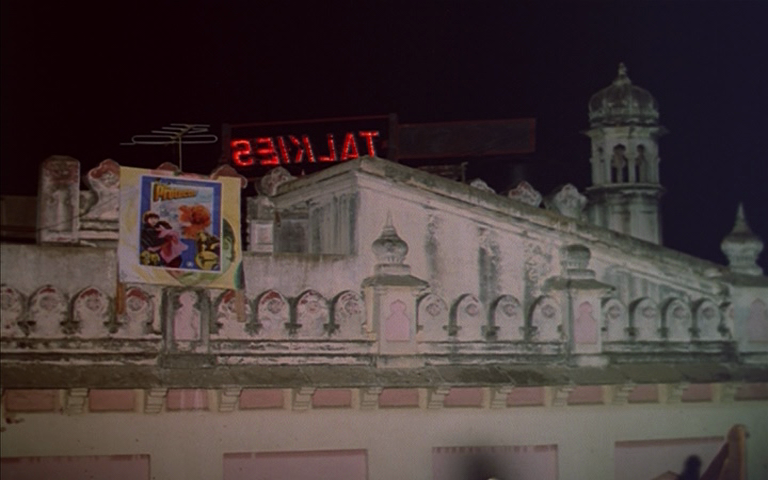
Where the film works best is in the small details. For example the large sign on top of the adjacent cinema which reads ‘Talkies’, and Kamal Hassan flexing his muscles with a Rambo poster in the background above. One of the standout moments in the film is the intricate choreography enacted as a number of building residents vie for the bathrooms in the morning.  
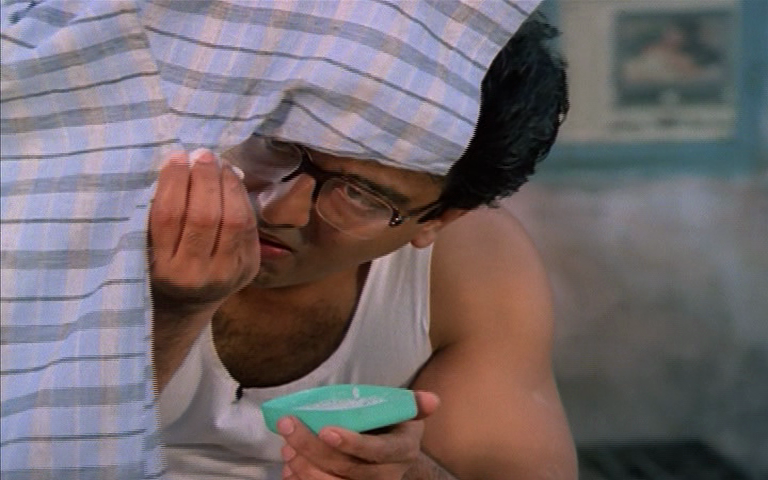
The opening scenes of the film give a snapshot view into the lives of the various residents of the building and also show the type of man Kamal Hassan is. He is not averse to spying on his neighbour as she fixes her sari, carefully washes only the underarms of the shirt he means to wear that day and tries to skip ahead in the employment lines. All these little traits allow us to build up the impression of a man who, when tempted, would possibly be amoral enough to kidnap a man and take over his life.

I also like that frequently there is a reason for there to be no dialogue as part of the storyline and this makes it easy to forget that it’s a silent film. The magician’s daughter and Kamal Hassan communicate by gestures across rooms and from balconies on opposite sides of the hotel as well as when she is onstage with her father, while the millionaire is both drunk and incoherent or gagged.
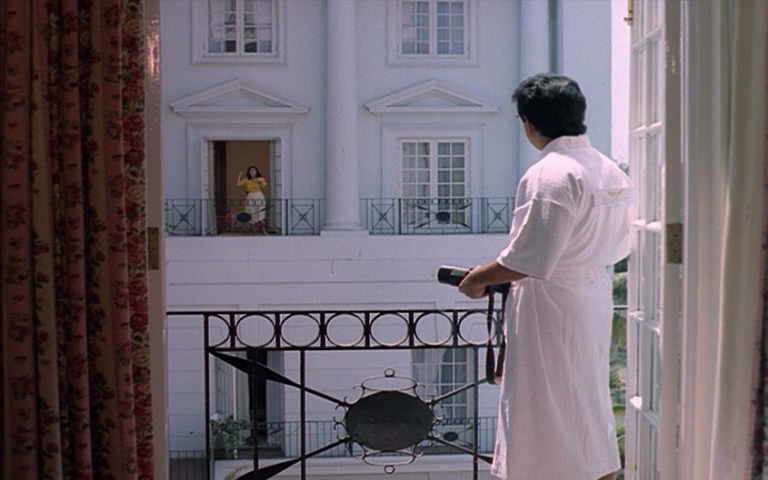
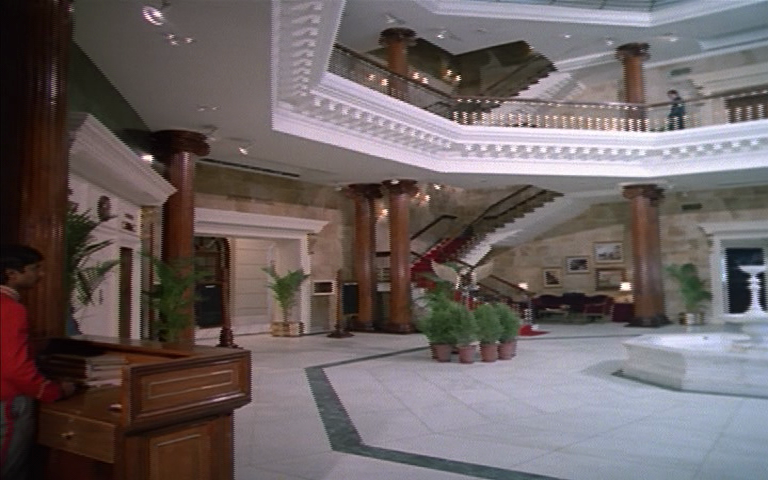
The film looks fantastic and the contrast between the two social worlds is reflected in the different lighting between the rooming house and the hotel. The hotel décor is lavish and there is plenty of attention to detail throughout. I kept wondering if the Windsor Manor Hotel in Bangalore where this was filmed still has all those huge lift lobbies and chandeliers as it looks amazing.

The hotel logo of a circle and wings recurs a number of times, and I agree with other opinions that it is meant to represent dreams and wishes. When an ice-cream is dropped on the ground, it’s Kamal Hassan’s shadow that we see reaching out for the treat, and again it’s fallen right in the middle of the shadow of the hotel symbol. I think that his inner feelings are very well represented in this way.
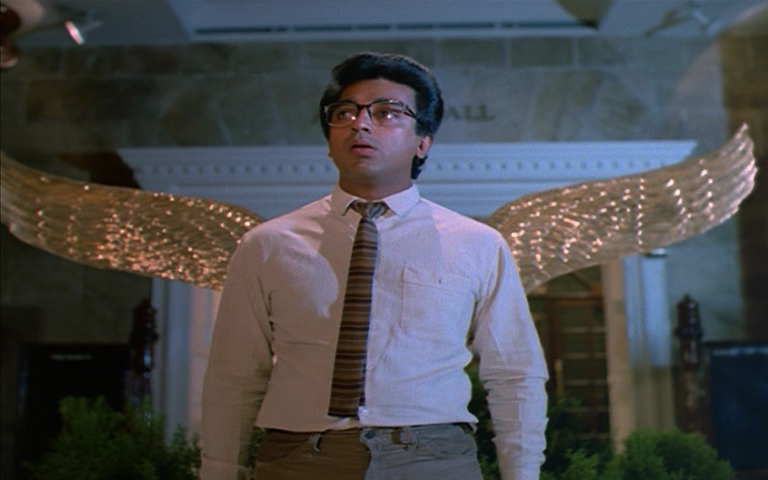
Much is also made of the death of a beggar, who actually has much more money than the unemployed Kamal Hassan, but whose corpse is unceremoniously dumped at the side of the road when his stash is revealed and everyone fights to get a share. This is also contrasted with the death of the hotel owner who has a parade of people who come to mourn him, but their grief isn’t all genuine either. Just in case Kamal Hassan was slow to get the message about money not buying happiness, Amala turns down his offers of clothes and household white goods (yes really!) when he takes her shopping, and asks for a wild flower growing on a ruined building instead.
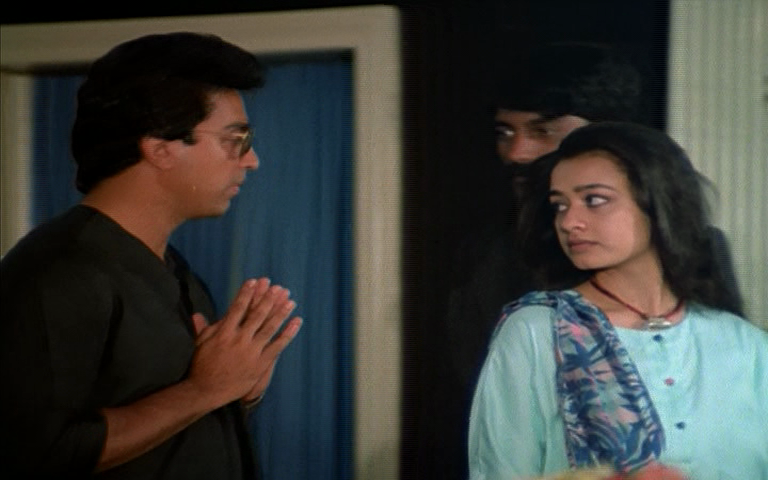
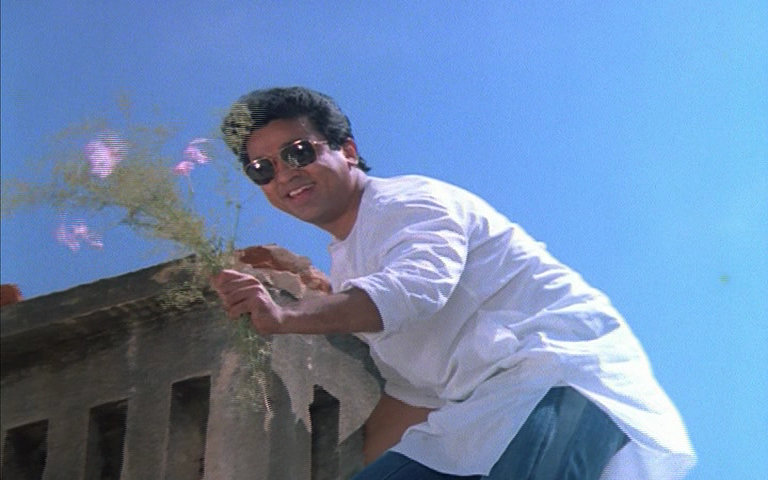
Kamal Hassan is excellent in his portrayal of the unemployed and perpetually unsuccessful graduate, as he manages to express so much very simply without words. His economies with toothpaste and washing powder initially made me a little more sympathetic towards his character and although his treatment of the millionaire was terrible, it was all made a little more believable by the amount of detail shown in the scenes where he was looking after his prisoner.  Amala was beautiful as the magician’s daughter, although as usual for a Tamil heroine, she didn’t really have much to do. She was the moral compass for Kamal Hassan and as such played her role perfectly. Both Tinnu Anand and K. S Ramesh as the magician looked to be having the time of their lives in their roles and I suspect they spent a lot of their time laughing about what they were actually getting to do on-screen.

I do have a few small issues with the film even though overall I think it’s an entertaining watch.  The story is really quite simplistic and without dialogue it occasionally feels like a collection of very good ‘moments’ all strung together with some unnecessarily long repetitive comedic scenes. These don’t really add anything to the story or to my understanding of the characters and tend to just be irritating instead. The long scene where Kamal Hasan dresses up as a hotel employee to give the magician’s daughter some earrings could very easily have been skipped for example. In contrast the inept assassin and the magician scenes are funny and well handled. I also think that keeping someone tied up and insensible with alcohol does seem very extreme and it’s very unlikely that the millionaire would just go home without contacting the police. Especially in this instance where he had evidence that the whole experience wasn’t just an alcohol induced dream. And really while money may not buy you happiness, it certainly can buy comfort which is not to be sneezed at – the overly moral tone in parts was a little overbearing. But there are so many good things about this film that I can ignore these little irritations and just appreciate the acting skills that bring this silent movie to vibrant life. It’s an interesting and quite unusual film and I think that Singeetham Srinivasa Rao and Kamal Hassan deserve praise for attempting something so very different and managing to pull it off in such style. 4 stars.

Shock

Ravi Teja has a dedicated fan following and I’ve read good things about his films so I decided it was about time I watched one of his movies. I bought this film on my last trip to Chennai on the recommendation of a friend, and since the blurb on the DVD suggested it would be more of a thriller than the typical mass masala fare it sounded more to my taste than some of the comedic roles he has played. And I did enjoy it, well mostly, at least up until the last 30 minutes anyway.

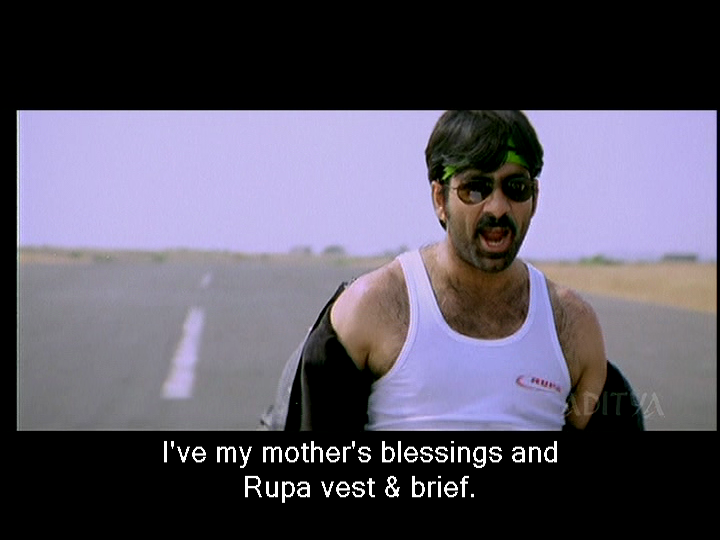
Ravi Teja plays an advertising agent Sekhar, although a look at his pitch for Rupa underwear suggests that perhaps it’s not his true calling.

He’s happily married to another advertising agent in his office, Madhurima (Jyothika). She has to take a back seat to her more ebullient husband who is clearly the office favourite. Brahmi makes a brief and understated appearance as Sekhar’s boss but for a change there isn’t much comedy in his role. There is some humour in these scenes but it mainly arises from situations with Sekhar and his wife and generally is well placed and actually quite funny.

The relationship between Sekhar and Madhurima is convincingly portrayed and they seem to have a strong and loving partnership. I could do with less of Ravi Teja’s back hair on view to demonstrate this, but other than that I think writer/director Harish Shankar is accurate in his portrayal of a working couple.They live in a block of flats where the lift never functions and there are constant disruptions from the neighbours and their children. When Madhurima becomes pregnant, they decide to relocate and quickly find a recently vacated house. However just as they move in, two men burst through the door and shoot Sekhar. He wakes up handcuffed to the bed in hospital and is immediately interrogated about his terrorist connections. He learns he has been mistaken for a Maoist by two encounter specialist police officers, Nagesh and Divaker. Although the pair realise their mistake almost immediately, they decide not to take responsibility for what has happened and instead salt Sekhar’s house with evidence to make sure that their error is not discovered.

In the meantime Madhurima protests Sekhar’s arrest and manages to hire a lawyer. By the time of the trial however, the lawyer has been paid off by the two cops and has convinced Sekhar to plead guilty, telling him he will get a short sentence and that will be the end of it. Of course this is not the case and Sekhar is sentenced to 8 years in jail. Madhurima immediately vows to get him released and is aided by Geeta, a journalist interested in the case.

There are various moments of drama in the prison: Sekhar is fortuitously sharing a cell with an inmate Tilak who has certain rights and privileges with the guards but he is also menaced by the self styled boss of the jail, Syed. This is all conveyed without recourse to cliché, or over the top drama and serves to give an idea of Sekhar’s true character as well as set up subsequent events in the jail. Madhu’s struggles are also convincingly portrayed. Geeta doesn’t take over the defence or engage in unrealistic methods to help Madhurima find justice, but instead advises her of which organisations to contact. This is all very plausible and fills out the background of the story well.

But just when you think this is going to be a battle played out in the courts and among informers in the back streets, there is more drama as Madhurima is threatened and Sekhar escapes from jail. Up until this point the film is very good; a slightly different story, well paced and told with good performances from the cast. But from here the film starts to rely on violence and bloodshed and the storyline becomes more predictable and clichéd as Sekhar plans his revenge. There are some unpleasant torture scenes and the realism that was built up so very well in the first half of the film is lost as Sekhar suddenly becomes able to fight his way out of any situation. However there is still a very ‘Hollywood’ feel to the action, and the slickness of the production carries through right to the rather unsatisfactory end. There seems to be an obsession in the Telugu film industry with making sure there is a happy ending (of sorts at any rate), and in this case I would have preferred to see something more in the way of consequences for everyone’s actions.

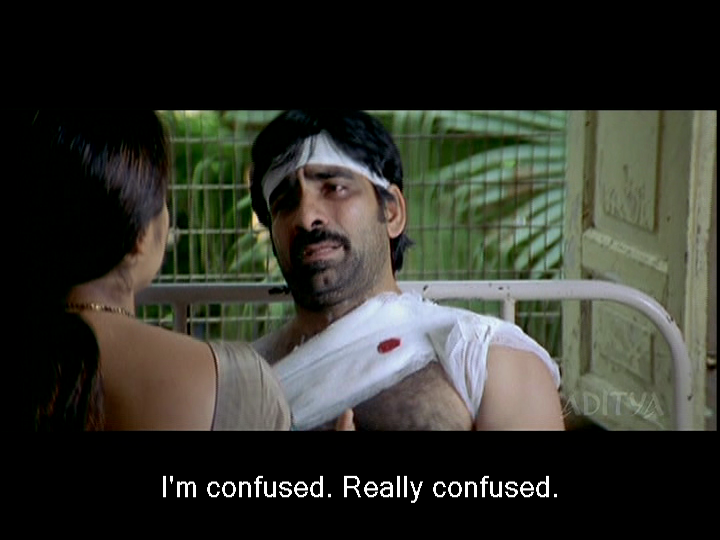
Despite the collapse of the plot in the second half, the film sets up the basic story well and the leads are all excellent in their roles. Sekhar’s confusion and distress at the situation he finds himself in is well portrayed by Ravi Teja. I was very impressed by the vulnerability he was able to convey as the injured and baffled victim in hospital and then as the somewhat shell-shocked and stunned prisoner in jail. He was even reasonably convincing in the action roles up until he had to take on a number of much more muscled and bigger extras. I know he is the hero but there is a limit to what I can believe!

Jyothika has a much more developed role than is usual for the heroine in Telugu films and I really thought she was excellent as Madhurima. Her relationship with her husband is very realistically drawn and the romance is sweet without being cloying. Her distress at her husband’s situation is perfectly depicted as is the change in her character as she first breaks down and then becomes a driven and determined woman out to get justice for her husband. The only scenes which didn’t fit were when the story of the couple’s initial meeting was shown as a flashback scene later in the film. This felt misplaced and disrupted the story just when it really needed to be tighter. Although it does mean we get another good song from Ajay-Atul. Although this is out of place in the film it is nicely pictured – I cannot explain the gloves in the opening shots though!

Apart from the two main leads there are a number of the usual suspects in the film who all play their roles with their usual competence. Kota Srinivasa Rao is a perfect fit as the corrupt lawyer and both Subbaraju and Ravi Kale were fine as the deceitful cops. Raghu Babu shows up in a familiar role as a nasty warden in the jail along with Raja Ravindra as the useful Tilak. It’s a little surprising that the small role of Geeta is played by Tabu and it does seem a waste to have such a good actress only on screen for a few short scenes. But it’s always a pleasure to watch her even if it is only in a few scenes. There is some attempt at comedy in the second half with the CBI officer Surendra Kumar (Nagendra Babu) and his incompetent assistant Bapanna (Ram Jagan) but this falls very flat and thankfully the Harish Shankar seems to have realised it wasn’t appropriate fairly quickly.


I would have found it this a much more interesting and appealing story if the film had dealt more with Madhurima’s fight for justice and Sekhar’s struggles in jail rather than going for the straight hero driven revenge drama. But then again that probably wouldn’t have been as popular at the box office. As it is, the second half of the film is a disappointment after the excellent build-up in the first half, and the attempt at a happy ending particularly jarring. I am favourably impressed with Ravi Teja though and Jyothika was fantastic. For those two excellent performances, and a good first half, this film gets 3 stars.

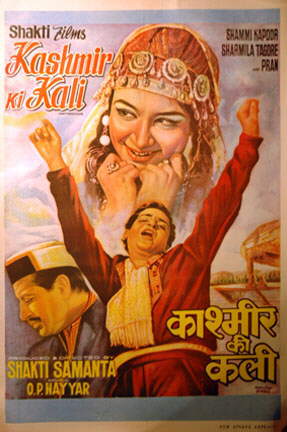
Kashmir Ki Kali

This is one of my favourite Shammi movies, although I’ve never been able to clearly decide why I prefer it over some of his other equally fabulous films. Maybe it’s because there is plenty of Shammi shimmying and trademark contortions going on? Or perhaps because Sharmila is beautifully innocent and the love story is sweet with a fantastic soundtrack? Whatever the reason, it’s always a film I watch to the very end and enjoy every second.

The film opens with Seth Rajiv Lal gaining control of his father’s businesses. He is a millionaire’s son and wants to give the business profits back to the people who actually do the work. His mother is appalled by this regrettable instability in her son and decides that the most appropriate way to curb his socialist tendencies will be to marry him off. Almost overnight, the house is full of prospective brides and their hopeful parents but Rajiv manages to get rid of them all by a not very convincing display of madness.

Deciding that he has to get away from his mother and thus avoid more potential brides, Rajiv leaves to visit the family holiday home in Srinagar with his friend Chandar (Anoop Kumar). Along the way he has to spend the night on the veranda of a small hotel as the rooms are full with Champa and her friends who have come to dance at a local fair.  Rajiv’s first meeting with Champa isn’t too auspicious as she empties a bucket of water over him and his smoking stove, but her kindly nature is revealed when she later takes him a  blanket to stop him from freezing overnight.  It’s not long before Rajiv has succumbed to her charms, but he is a wealthy man and she is a flower seller who has no time for the indolent rich. At their next meeting, he pretends to be a driver so that she will look more kindly on him.

There is a slight diversion here as the family caretaker Bola Ram (Dhumal) has rented out Rajiv’s house to a party of 3 girls and their guardian Rama Devi (Tun Tun). In an attempt to get rid of them all Rajiv reveals his true identity and then immediately has to pretend to be the insane friend of Chandar, who in turn pretends to be the real Seth Rajiv, to make sure that Champa doesn’t find out the truth. This allows for some mix-ups between the three girls, Chandar and Rajiv as the former try desperately to snare a rich man as a husband, Chandar enjoys the attention, and Rajiv only has eyes for Champa. Confusing? Well, not really, as most of the time Rajiv just acts insane unless he is with Champa, so it all makes sense – honestly!

This is a wonderful song where Rajiv romances Champa while sailing on the lake – only Shammi could get away with these contortions in a boat!

Just as Ravi and Champa are falling in love, intrigue is added as local bully Mohan threatens Champa’s blind father Dinu. Mohan is also determined to marry Champa and  warns Dinu that he will reveal the truth about her parentage if he doesn’t get his way.  The plot thickens as Mohan does some investigating and finds out exactly what did happen the night that Champa’s father lost his sight.

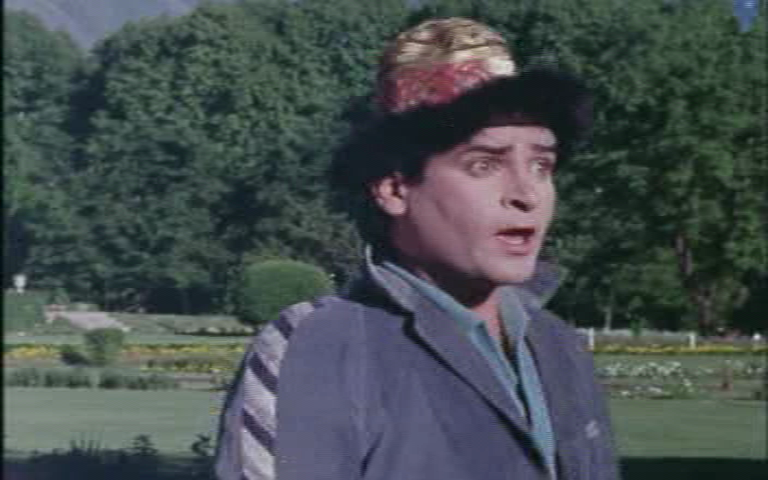
There are many complications on the way to the film climax but naturally there is an old family servant who reveals the truth just before she dies and almost everything is explained by the end. The obstacle of Mohan in the way of Champa and Rajiv’s romance does make for some great disguises such as this one at a local fair.

While the story is improbable at best, there is so much going on that the many plot holes don’t really matter. I adore Shammi in this film. He cavorts around with plenty of trademark hair twitching, and looks to be having the time of his life. And really, who can blame him when Sharmila looks so totally fabulous. This is one of her very early films and she does look very sweet and natural as a Kashmiri flower girl,  instilling her with grace and beauty which contrasts well with Shammi’s more over-the-top persona. She has a wonderful collection of massive earrings and hair adornments. I would love to know how she managed to dance without them either hitting her face or getting caught in her hair as this is a skill I’ve never mastered!

Pran is suitable slimy and conniving as the villain, although I do wonder how he always knew the right place to be lurking at precisely the right time. Nasir Hussain does a very good job of being blind Dinu here and in the flashback scenes is very convincing as the alcoholic father. I’m not entirely sure that Dinu’s blindness was enough of a reason for him to change his ways, but there were enough shades of grey in his later actions to make him a more plausible character. The comedy track with Chandar, Bola Ram, Rama Devi and the girls works well for me within the main story, although with so much else happening in the plot it probably was an unnecessary addition.

Another highpoint of the film is the soundtrack. Mohammed Rafi and Asha Bholse are perfect as the playback singers for the two leads, and the music by O. P. Nayyar is beautiful.

This is probably a film more for the Shammi fan as he really does throw himself into the role with great gusto and it might be a little too much for anyone not accustomed to his mannerisms. But Sharmila is excellent, the pair have good screen chemistry as a couple together and the story really does have almost everything. A 4 ½ star film for me.

Temple says: I like Shammi but I don’t think this is his finest work. Every time I watch this film I remember, just a bit too late, that I hate the first hour. Shammi is just so annoying with his zany animal noises Paagal Act!Ing! and Sharmila looks about twelve years old and that creeps me out a bit. But once all the characters are settled in Kashmir, things improve greatly. The location is one of the biggest attractions for me – I love being able to see places that I may never get to visit and the lake scenes are very pretty. The O.P. Nayyar soundtrack is beautiful and all the songs are delightful, especially Isharon Isharon which I think is a perfect romantic duet. After the first hour, for some reason Sharmila looks less like a schoolgirl, there does seem to be some appreciable non–creepy chemistry with Shammi, and her Kashmiri costumes are beautiful. Shammi drops a lot of the OTT mannerisms and goes for brooding romantic instead which is more successful and more appealing in this kind of story. Well, he does wear a hot pink burqa in one song but cross-dressing is par for the Kapoor course. I much prefer him in ‘Evening in Paris’, ‘Rajkumar’, ‘Bluffmaster’ and ‘Teesri Manzil’ where he is a bit less self consciously whimsical and more character focussed. The story is the typically convoluted romantic comedy blend with none of the surprises actually coming as much of a surprise to anyone but the lead pair. See it for gorgeous scenery, lovely costumes, a wonderful soundtrack and count your blessings that on DVD you can skip the boring bits! 3 stars