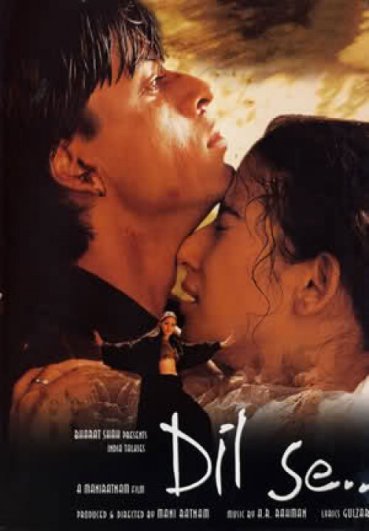
Dil Se..

Dil Se..

Dil Se is the third film in Mani Ratnam’s terrorist trilogy following on from Roja and Bombay. This was actually the first of these that I watched, mainly due to the presence of Shah Rukh Khan who was the major draw for me at the time, but also because the film is in Hindi, which I was trying to learn. It’s remained one of my favourite Mani Ratnam movies though and I find it hard to believe that it’s now 20 years since its release in 1998. I love this film for so many reasons, the amazing music, wonderful choreography and stunning scenery but also because the story grabs hold and remains captivating – every single time. Dil Se wasn’t a hit in India, despite winning awards at festivals and doing well in the USA and UK, but it now has a deservedly classic status and is well worth watching or revisiting if you haven’t seen it for a while.

Dil Se is the story of a Dehli-based radio journalist who falls in love with a mysterious woman he sees on a deserted railway platform one night. Amar (Shah Rukh Khan) describes it as “the shortest love story ever” when she leaves on the next train after sending him off to get a cup of hot tea. What I love here is the contrast between them, even in these first few minutes. She doesn’t say a word except for ‘a cup of hot tea’ while Amar never stops talking. It’s an early clue that these two aren’t likely partners but also raises questions about why Amar becomes just so obsessed by this woman based on this one brief meeting.

Amar’s assignment for All India Radio takes him to the north of the country where insurgents have been engaged in terrorist activity and Amar wants to speak to them as well as garner regional thoughts on the 50thAnniversary of Indian Independence. When he does finally reach his destination, after the wonderful Chaiyya Chaiyya on the train, he spots the same woman in the crowd and immediately runs after her. While Meghna (Manisha Koirala) is perfectly plain that she wants absolutely nothing to do with him, Amar refuses to take no for an answer and pesters her persistently until her friends take matters into their own hands and beat him up.

This starts out as the usual stalking = love trope seen in so many Indian films. It is really annoying that Amar fails to take no for an answer and is completely relentless in his pursuit. What I do like though is that Meghna is brutally clear, trying everything from ignoring Amar, to telling him that she is married, just to get away from him. All my sympathies are with her at this point, and I really don’t like Amar who just seems to be selfish and frankly obnoxious. But this seems more than just stalking. Amar is completely obsessed with this girl who won’t even give him her name and even the beating fails to dampen his desire.

Amar follows Meghna on a bus, walking with her when the bus breaks down and even attempting to force her to kiss him. Meghna has a panic attack at this point and hints that she has had experiences in the past that may have contributed to her determined refusal of Amar. She also continually tells him that she isn’t what he thinks she is, and finally we learn that she is part of the terrorist organisation. Manisha Koirala is completely amazing here. She appears ethereal and wraith-like, as if a strong gust of wind would blow her away, but also shows such incredible mental strength demonstrated by her continual refusal to yield to Amar. It’s clear as the story develops that she does have feeling for him, but her allegiance to her cause is deeper, possibly just more entrenched, and her emotional turmoil fleetingly moves across her face each time she has to interact with Amar. It’s a brilliant performance, particularly in the scenes where she reveals what has happened to her and tries to explain to Amar why she has turned to terrorism.

Gradually rapport develops between the couple, but Amar is left devastated when Meghna leaves him during the night and he ends up returning to Delhi alone to prepare for his upcoming wedding to Preeti (Preity Zinta). Preita is wonderful here in her début role portraying a confidently independent but still innocent girl from Kerala. Ok, the Malayali bit is a tad strange, but the rest is brilliant! I love how she refers to sex as “honka bonka bonks”, and her directness is refreshing after all the mystery and secrets surrounding Meghna. She also gets a cool song in Jiya Jale, which has some of my favourite picturisations in the whole film.

I’ve read a number of times that the film depicts the seven stages of love from Arabic literature comprising attraction, infatuation, love, reverence, worship, obsession and death. Using this theme, Amar’s obsession makes more sense and it helps to explain why he continually follows Meghna despite her apparent disinterest. There is the moment of attraction when he glimpses her face on the railway station. Infatuation where he sees her everywhere and thinks about the mystery woman before this deepens into love. Reverence and worship are pretty much covered in Satrangi Re where Meghna appears in all seven colours of the song. Like most of the songs this seems to be another fantasy sequence, although it’s not clear if this is Amar or Meghna’s dream.

Throughout, the contrast between Meghna and Amar is stark. Meghna is at home in the mountains and dresses in all enveloping costumes that hide her identity just as much as her refusal to speak. When she does talk, she is clear and articulate – she knows exactly what she is doing and why, and has little time for anything that will take her away from her mission. Amar is a city boy whose father was in the Army and he has little understanding of the world outside Delhi. In an interview with one of the terrorist leaders, the questions he asks and his comments make it clear that he has no understanding of the issues faced by minority groups or why they feel so betrayed by the government. This makes his refusal to leave Meghna even more poignant as he will stand with her even though he cannot believe in her view of the world.

There is so much detail in this film too. Right from the start there is the threat of violence with soldiers stopping and searching Amar’s taxi on the way to the train station. In Assam there are army checkpoints and barbed wire barricades, some of which even make an appearance in the song picturisation for Dil Se. The scenery the north of India here is beautiful and stunning with the first sequences set in Assam and then later in Ladakh. Cinematographer Santosh Sivan does a fantastic job and brings surrealness to the scenes shot in Ladakh where Meghna and Amar are alone and able to talk to each other without the pressures of his family and her responsibilities. Back in the city the contrasts between Meghna and Preeti are emphasised by clever camerawork including a memorable scene where Amar’s mother (Sheeba Chaddha) asks Meghna to be a stand-in model for Preeti’s bridal jewellery. Added in to the wonderful visuals is the superb soundtrack, one of A.R. Rahman’s best, and I love every single song. Farah Khan’s choreography is spectacular too, and it’s hard to believe that there could ever be a better dance routine on top of a moving train. This is also one of SRK’s best ever performances where he moves between joy and despair at the drop of a hat and really nails the role. He throws himself into the choreography too, and his facial expressions are brilliantly expressive, particularly when he is trying to understand Meghna’s actions.

Dil Se is simply a great film. The subject matter is tragic but there is a lot of joy in the film too and the combination of stunning scenery with a good story and excellent music means there really is something for everyone. The cast are all fantastic and with so much detail to the story there always seems to be something new to pick up on with every viewing. This is a film I rewatch regularly and I highly recommend it if you’ve never seen it before. 4 ½ stars.

K.G.F: Chapter 1

K.G.F: Chapter 1The first Kannada film I saw in a cinema was Ugramm, where I loved Prashanth Neel’s style and approach to story-telling, so it is reassuring that he has kept to a similar form for his latest epic KGF. The violence is bloody and excessive, the story ultra-masculine but with plenty of reference to the importance of mothers and the soundtrack is an important part of the film. But KGF has a grandeur and magnificence that comes with working with a larger budget and with a number of the Kannada industries top talent involved, KGF is an impressive venture indeed. There are a few issues, the lack of a decent female lead and some OTT and excessively dramatic dialogues for example, but Prashanth Neel has kept his eye firmly on the story, making KGF an excellent addition to the world of Kannada action cinema.

The film uses a framing device where TV journalist Deepa Hegde (Malavika Avinash) interviews ageing reporter Anand Ingalagi (Anant Nag) about his book, which was banned and burnt by the government of the time. Prime Minister Rimika Sen decreed that all mention of a certain ‘criminal’ should be wiped from history but Anand is prepared to share the story, although he jumps around in time which adds a non-linear aspect to the tale. In this way, Anand acts as a narrator of events, which span from 1951 to the present day and start with the seizure of land rich in gold by Suryavardhan (Ramesh Indira). Suryavardhan clears the land and establishes an illegal gold mine, worked by slaves and disguised as a limestone works. At the same time, local villager Saraswathi (Archana Jois) gives birth to a son she names Raja Krishappa Bairya who later becomes the infamous Rocky (Yash).

The story spans Rocky’s life from his birth to his infiltration of the mines in an attempt to assassinate Suryavardhan’s son Garuda (Ramachandra Raju). In between is the tale of Rocky’s rise to fame as a gangster in Mumbai and his desire to own ‘the world’ which eventually leads him into the gold mines. Along the way, Rocky has flashbacks to his childhood and to his mother’s words of advice which have helped to make him the man he has become. Since these are mainly words to make her son the richest and most aggressive man in India, they have stood Rocky well in his attempts to become the pre-eminent gangster in all of Mumbai. Rocky is a man who thinks nothing of killing anyone who stands in his way, often in the most bloody and gory ways possible. Luckily for our hero’s welfare, the thugs never manage to co-ordinate for more than two at a time to attack, and even when armed with guns they seem to forget how to aim to kill. However, I did appreciate stunt choreographer Anbariv’s goal of finding the most imaginative way to impale, garotte and otherwise dismember Rocky’s opponents – one of the best being with a handy anchor although Rocky’s prowess with a shovel was also superb!

Yash powers his way through his role as Rocky without ever demonstrating much emotion as the strong silent type who wades through rivers of gore to reach his objective. Although there are the flashbacks with his mother (featuring an excellent Anmol Vijay as the young Raja Krishnappa Bairya) and a rather uncharacteristic but brief romance with Reena (Srinidhi Shetty), for the most part Rocky is as stonyfaced as his nickname implies. However, to ensure that we know he’s not quite as much of a villain as his actions would suggest, Rocky is also shown to have a softer side, usually when faced with young mothers in extreme situations or when faced with gangs of poverty-stricken children. Nothing new or ground-breaking then, since this is typical Southern Indian hero behaviour, but it suits the character and storyline well, so there’s really no need to break the mould. 

The non-linearity of the story is one of its strengths and also works well to set up expectations for KGF:Part 2 as we are given tantalising glimpses into the next of Rocky’s adventures along with the puzzle of why the government decided to suppress his story with such assiduousness. Jumping around from the seventies (with flares and wide collars – love it!), where the action in the Kolar gold fields plays out, to adventures in Rocky’s youth explains much of his motivation and firmly establishes the other characters in the film. This is really helpful since there are multitudes of minor characters who are important to the story but who are all introduced quickly by Anand, making it difficult to remember who exactly is a gangster, who is a politician. And then decide if it even matters given they are all nasty pieces of work. This does allow for major complexity in Prashanth Neel’s world and he paints a grim picture indeed of corrupt politicians, lawless gangsters who have the police on their side and a poverty-stricken and joyless existence for the rest of the population. Into this dark world, it seems to make sense to inject some light by adding a romance, but the introduction of Reena with the usual stalking = love trope always feels like an add-on extra.

Reena is the daughter of Rajendra Desai (Laxman), one of Suryavardhan’s accomplices in the goldmine and as such she is portrayed as arrogant and heedless of the general population. Rocky sees her and is instantly smitten, following up his initial advances with some terribly cheesy dialogue while Reena does her best to let him know she isn’t interested. Until she sees his compassionate side, which is apparently enough to change her mind. Sigh. Srinidhi Shetty doesn’t have enough screen time to make any impression, but for the most part she too is fairly dour, grim-faced and like Rocky, prone to making declarative speeches. Rocky doesn’t have much dialogue at all, but when he does speak it’s generally overly dramatic and interspersed with plenty of threats and promises of violence. Even the minor characters rarely seem to speak normally to each other and instead there are bold announcements of bravery and threats of violence that do start to wear after a while. The narrative from Anand is in stark contrast and is more minimalistic and factual although this is occasionally confusing when characters are only briefly mentioned once.

Ravi Basrur and Tanishk Bagchi provide the music which suits the atmosphere of the film well. There is one introductory dance number with Yash which is appropriately exhilarating and an oddly placed dance number with Tamannaah, but for the most part the songs are used to help drive the narrative forward. Along with the soundtrack, they succeed in adding emotion and suspense to the film, and unlike Ugramm the music here is kept to a reasonable volume. Cinematographer Bhuvan Gowda keeps the film to grey and dark tones, and doesn’t have much opportunity to vary the colour palette, although scenes in the mine and at a temple ceremony are beautifully done to add red tones to the darkness. Kudos to the fashion designers for recreating the seventies in a relatively subdued fashion and not dressing the characters in ridiculous costumes. The sets and clothes are set in the right time period but not ostentatiously so, and as such don’t take away from the action unfolding onscreen. Thanks to the distributors for ensuring reasonably good subtitles, although the white text was often obscured by the background. Still very grateful to have Kannada films subtitled – even the songs!

KGF is basically another gangster action drama, but what lifts it above the rest is the sheer scale and complexity of the narrative along with standout performances from Yash and the literal cast of hundreds that add depth and texture to the plot. Be warned that the film is incredibly violent, and the fight scenes are frequent, fast and furious but they do fit the story and act to showcase a world that is brutal and uncaring. The story points out that power is the only thing that matters and Rocky’s power is that of his fists. Throughout, it’s those with power who dictate events, and Rocky is determined to control the gold and therefore the money, giving him all the power in the world. There is a lot to take in with the story but the mixture of fast-paced action and slower framing narrative works well to bring it all together. Overall Prashanth Neel has crafted a good story, told it well and pictured it beautifully to draw out the desolation and despair of the gold fields, and the gritty underworld in Mumbai. After all the excitement of Chapter 1, I’m definitely looking forward to Chapter 2!

KGF