One Cut of the Dead

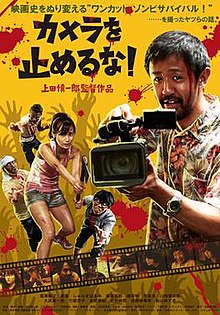
Ueda Shinichiro’s One Cut of the Dead was a highlight of the recent Japanese Film Festival in Melbourne, and possibly my favourite film of the year. It’s a budget horror flick, a movie about movie-making, and a sweet story about the shared love of things that can bring people together.

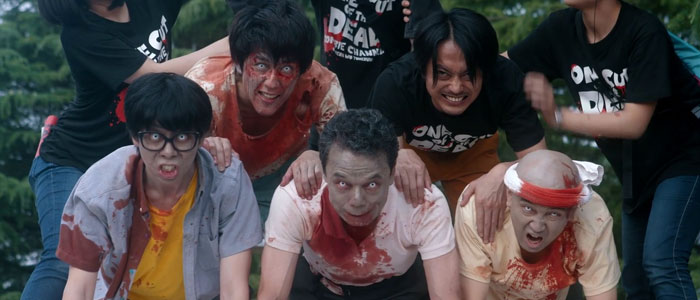
Opening with Director Higurashi making a low budget zombie movie in a spooky abandoned facility, the film quickly takes a turn as the cast find themselves under attack by “real” zombies. He sees this as an opportunity to get genuine emotion and real horror from his cast so he will not stop shooting and actually pushes the actors into more peril. Bloody, profanity laden, decidedly B movie, unintentionally funny, the story speeds to its conclusion. All in one epic 37 minute take. But then the clock winds back and we get to see how Higurashi and his crew came to be in this place, all the planning and preparation for their movie, and what motivated them to do it. And finally, Ueda takes us back to the day of filming, but this time we see the things happening on and off camera and what that means for Higurashi and co.

The director Higurashi is completely over the top, threatening his performers and demanding they keep filming even when their life may be at risk. He has one shot at making the film and will do what it takes to deliver. I really enjoyed Takayuki Hamatsu’s performance as he would swing from politely earnest to literally spitting with rage and back, all in the service of his film. His relationship with his sulky teenaged daughter Mao (played by Mao) and retired actress wife Nao (Shuhama Harumi), who are both on the set, gives the film an unexpected sweetness amidst all the gore and dismemberments.

Akiyama Yuzuki and Nagaya Kazuaki play Chintatsu and Ko, the stars of the film. I enjoyed their deliberately bad acting in the movie within the movie, and the contrast with their vacuous celebrity sides. When things started to go awry they were the least prepared and therefore, among the funniest. Shuhama Harumi’s Nao is a walking cliché in some respects, intoning warnings and urban legends straight out of every other horror movie. Her hobby and practical application of her skills almost brought the house down, and her character really comes to life in the latter part of the film. The rest of the cast includes stock types like the has-been actor who drinks to steady his nerves, the goofy AD who never challenges an order, the finicky cameraman, and his enthusiastic assistant who just wants a chance to try her style.

Things move at a frenetic pace but there are beats where you can simply enjoy what’s going on before plunging back into the thick of it. I was constantly delighted by small details like the appearance of a hankie wiping blood spatter off a lens as the cameraman gamely ran in pursuit of a screaming actor and zombie.

The narrative structure is brilliant and the editing is timed to perfection. Things that looked like bad acting or glitches in the movie might later be seen in a different light and instead make you want to cheer for this game little bunch of movie crazy people. The jokes were sometimes funnier from the second perspective too, which is quite an achievement. Dolly Parton once said it takes a lot of money to look this cheap. Ueda Shinichiro has managed to make a highly technical and polished film look like it was made on a shoestring, but in a good way. It’s a tribute to the spirit of making do.

I flinched, I groaned, I cheered, I laughed so hard I cried. If you can stand a lot of swearing and fake blood splashing around, see this.
2.0

2.0.jpg

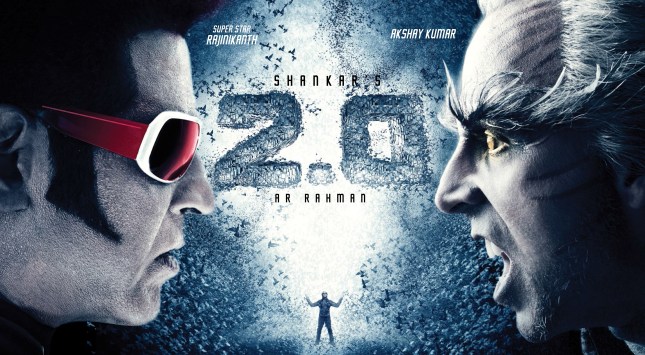
Shankar’s 2.0 is an amazing visual spectacle with incredible special effects and jaw-dropping action, but despite all the thousands of Rajinikanths, clouds of flying mobile phones and an unusually charismatic Akshay Kumar as the villain of the piece, it fails to fully impress due to a garbled and, at times, dull story. Not that the lack of a credible story really matters for a large-scale Superstar movie, but the transition between one incredible VFX scene to another really needed some sort of rationale to develop a relationship with the characters and bring in some suspense. And 2.0 just doesn’t have that connection. No matter how good Rajinikanth and Akshay Kumar are in their roles, or how truly magnificent the visual effects are, at the end of the day for me the film needs a little more soul.

The film opens with mobile phones suddenly gaining a life of their own and zooming off into the sky all over Tamil Nadu. These opening sequences are excellent as Shankar shows just how pervasive mobile phone use is, including the moment when we see an entire family all staring at their phones just as the father announces that of course he spends quality time with his family. Everyone is here – those obsessed with taking selfies, people using their phone for work, for family connections, even one man using a mobile phone as a plaything for his child, and it for a time it seems that Shankar might be making a statement about overuse of mobile phones. But it’s not that simple.

Naturally Chennai is thrown into total chaos by the “great mobile phone disappearance” but the problems are only just beginning. A massive cloud of mobile phones transforms into a bird’s talons and starts ripping cell towers out of the ground, prominent mobile carrier company owners are attacked and a gigantic bird, formed out of mobile phones starts attacking people in the streets. This is seriously inventive stuff, and Shankar has allowed his imagination free rein to create magnificent visuals that really are spectacular, while the fast-paced action just never stops.

Dr Vaseegaran (Rajinikanth) is aided this time round by an android called Nila (Amy Jackson) whose body proportions are reminiscent of a Barbie doll, but who does at least get the chance to show off her superhuman skills in the battle against the villain, Pakshi Rajan (Akshay Kumar). Pakshi Rajan is an eminent ornithologist who ends up suiciding after he fails in his attempts to stop the radiation from mobile phones killing off his beloved birds. Thanks to ‘negative energy’ and all those dead birds, he somehow transforms into an entity capable of animating mobile phones, and sets out to destroy the humans who have caused all the problems in the first place. There is a flashback sequence that paints Pakshi Rajan as an environmental hero with Akshay Kumar playing him as an old, broken man who wears baggy cardigans and weeps for a dead sparrow – so naturally he’s a more sympathetic character than the self-absorbed Dr Vaseegaran. And that’s part of the problem I have with the entire film. Dr Vaseegaran seems to simply want to bring Chitti back to life, and show off his new-fangled invention to save the day, while Pakshi Rajan has a legitimate issue and a real crusade that’s easy to support. So, when Chitti arrives on the scene, it actually appears that he’s fighting on the wrong side since Pakshi Rajan doesn’t come across as a bad guy until much later.

Thankfully when the 2.0 reboot Chitti takes over, his swagger and snappy dialogue helps lift the second half, ably helped by the excellent visuals and inventive ways that a cell phone can be used to kill. Pakshi Rajan develops a villain-worthy sneer and his casual disregard for the thousands of people who end up having to dodge bullets and large pieces of football stadium during the finale does start to make him seem a least a bit nastier. Team Chitti though has an equal disregard for bystanders and finally pulls a stunt with pigeons that’s even more vicious than all of Pakshi Rajan’s gory killings. That has the effect of making Pakshi Rajan actually seem more moral than Team Chitti despite his murderous tendencies. To try and compensate, the last scene makes some attempt to promote Pakshi Rajan’s cause while still chastising him for killing so many people, but it just doesn’t work, although the final action sequences are brilliantly done.

I’m not usually a fan of Akshay Kumar, but he is impressive here and he does an excellent job of humanising Pakshi Rajan and giving him an almost plausible reason to attack mobile phones. I also appreciated his bird-like mannerisms when he transforms into a giant birdman and his dedication to the role by using feathers for eyebrows. For the most part he simply screams at the camera in bird form, but during the flashback sequence he does display the demeanour and despair of a broken man very well.

Rajinikanth is on screen for most of the film in one or more of his different characters – Dr Vaseegaran, Chitti or 2.0. He is as charismatic as ever in every appearance, although Dr Vaseegaran is even more annoyingly self-absorbed here than he was in Endhiran. Despite playing a robot, as Chitti and his alter ego 2.0, Rajinikanth gets to display plenty of personality and each time he appears he brings life and energy to the screen. Thankfully the annoying Sana only appears as a whingey voice over the phone this time round, while the rest of the cast only appear briefly, either to be killed by Pakshi Rajan or as part of the government trying to cope with the crisis. Sudhanshu Pandey appears as Dhinendra Bohra, the son of Bohra from Endhiran, but this seems to be a real wasted opportunity and his character isn’t well utilised despite a promising start.

I’m not sure exactly what Shankar was trying to say here – if indeed he was trying to say anything at all. Could this be a film against mobile phones and the way they have come to take over our lives? Is there really an environmental message here about radiation and the dangers purportedly associated with cell towers? It’s all rather muddled and the emotional back-story for the villain doesn’t help matters either. However, as an all-out action adventure 2.0 works well enough. A.R. Rahman’s music is used sparingly throughout the film, although there is one montage song and a dance track over the end titles, which is fun. Thanks to Rekhs for the excellent subtitles (in yellow too, so very readable) and kudos to cinematographer Nirav Shah for making the regular shots just as good as the VFX. Yes, most of the money has been spent on the effects in this film, and little on the screenplay, but given the end result I’d say overall it’s money well spent. I didn’t see the 3-D version, but even in 2-D the effects are simply superb and for that alone the film really does need to be seen in the cinema. For the rest, Rajinikanth is excellent, Akshay Kumar totally nails being a murderous birdman, Amy Jackson does well as an animated robot, and best of all with this plot, no-one was using their cell-phone during the show. That’s definitely a win!

Destiny: The Tale of Kamakura

The Japanese Film Festival is on in Melbourne and I’ve found lots of gems to enjoy in this year’s programme.

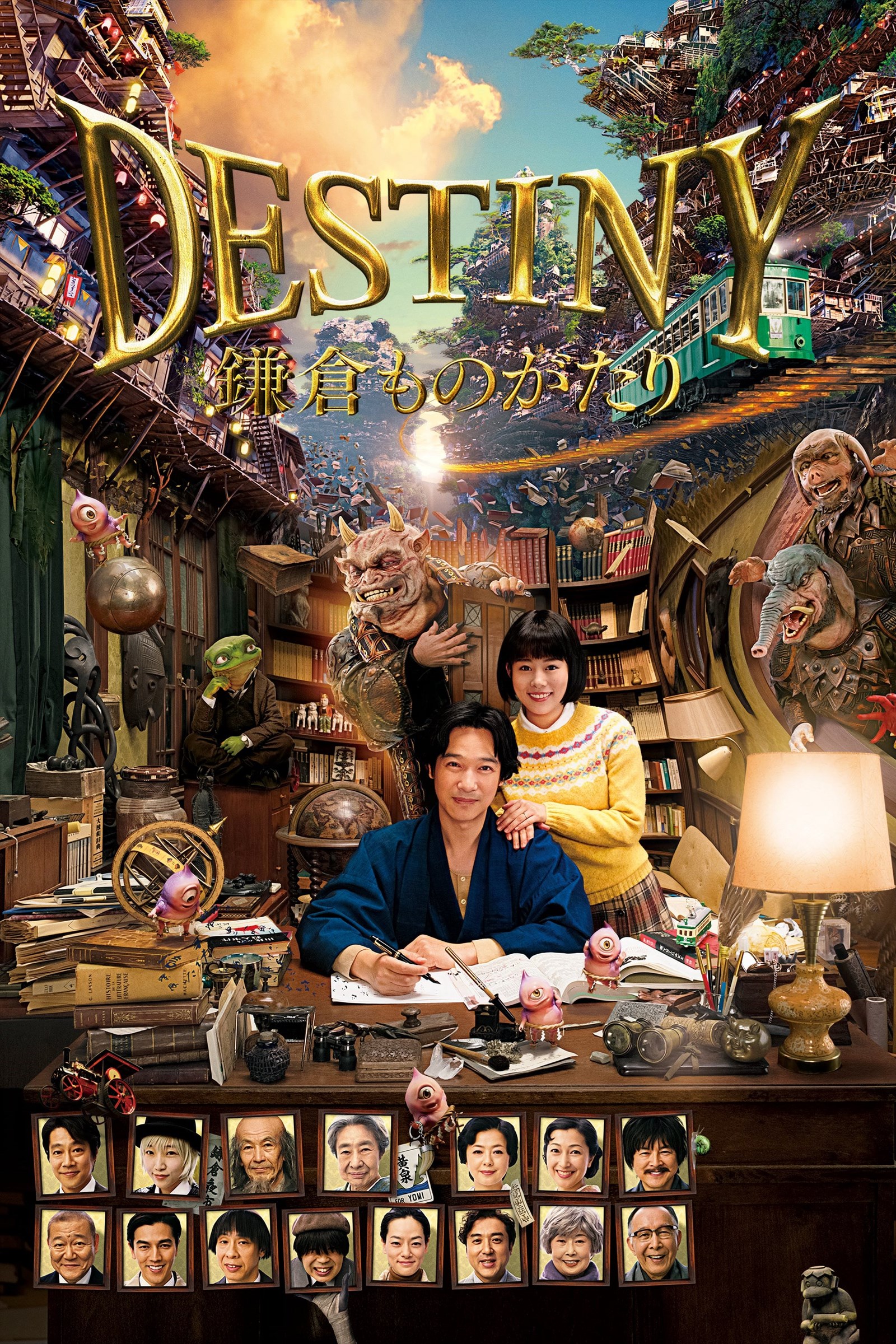
Yamazaki Takashi’s adaptation of Saigan Ryohei’s manga, Destiny: Kamakura Monogatari, is beautifully odd and charming.

Akiko (Takahata Mitsuki) moves to Kamakura after marrying Isshiki Masakazu (Sakai Masato), a popular author. The town is unusual, and there are supernatural creatures living alongside the human residents. Akiko is a high spirited and curious young woman, and she generally enjoys her new home and the strange goings on. However an entity from the underworld takes an uncomfortable interest in her, a bad luck god sneaks into the house, and things start to go very wrong. She is separated from her husband all too soon. But Masakazu is Kamakura born and bred, is matey with a grim reaper, and he finds a way to travel to the underworld to rescue Akiko’s spirit.

The film is as much a rom com as it is a fantasy. Akiko is quite a bit younger than her husband Masakazu, and she is worried she won’t be able to be a proper wife to a fancy author. He is a little worried about his precarious work situation, how she will settle in, and if she will be able to deal with the supernatural. They are both quirky characters and the actors sometimes go for energy over subtlety. But I was won over by their mutual affection and sense of fun. Sakai Masato is wry and charming, unless Masakuzu has a deadline. Then he becomes a panicky work avoiding child, obsessed with toy trains. Masakuzu also has a side line in helping the police with hard to solve cases, and they act as small episodes within the story, showing more about the village and how things operate between the communities.

Akiko learns some household tips from elderly and enigmatic Kin (Nakamura Tamao) and finds out more about the mysterious side of Kamakura. She is generous and impulsive, and that is both a curse and a blessing, quite literally. Takahata Mitsuki plays Akiko as wide eyed and a bit too perky, but she has an endearingly goofy energy that plays well off her co-stars. I particularly enjoyed the quieter scenes between the couple when they were just happy to be together, and the warm contentment was palpable. She wants to do the right thing for her husband and that gives her strength to make some hard choices. And when they are separated, she stays strong because she has faith in their love.

I liked Ando Sakura as the administratively overwhelmed and under-resourced grim reaper. It’s quite a change of pace from her amazing performance in Shoplifters (the film that had me crying in public at MIFF earlier this year). This grim reaper is kindly disposed towards humans, fancies clothes at the more garish end of the all black wardrobe spectrum, and seems to enjoy having local celeb Isshiki Masakuzu as a new friend. Masakuzu’s mate Honda (Shinichi Tsutsumi) strikes a deal with her and his story takes quite a turn. Again, his story is about family and regrets as much it is about magic or gods. The bad luck god Binbogami (Tanaka Min) is loud and blustering but develops a soft spot for Akiko who treats him like a welcome guest. Guests are god, after all.

The visual effects are often jawdroppingly lovely, and I think anyone would want to go to Kamakura as a result. Every shot counts, and some things that seem to be a bit of whimsy become more meaningful later in the film. Scenes at the Goblin Market were both magical and relatable, with a blend of real world and supernatural. Little creatures scuttle in the background, or ramble around in Akiko’s garden apparently unnoticed and unremarked. The yokai can look very elaborate and non-human, but some blend in quite well unless they choose to reveal themselves. The underworld is where the effects skills get a serious work out, creating a vast expanse of structures and landscapes with incredible detail. I love that they catch a train to get there, and the journey on the way in was gorgeous. Getting out was a bit less relaxed!

I was in the right mood for a feel good film with tons of charm, and this was perfect.