Sameer (2017)

poster.jpg

Sameer is an interesting attempt to make a political thriller that delves into the reasons for radicalisation and subsequent acts of terrorism carried out by young Muslim men in India to-day. Unfortunately, the film fails to deliver, mostly due to a surfeit of clichés in the characterisations but there are also some major flaws with the plot that derail the political agenda. Where Sameer does work however is as a thriller, and Dakxin Chhara does a good job with keeping the tension high in the second half as the ATS try to stop the terrorists and their bombing campaign. Mohammed Zeeshan Ayyub is excellent and despite the rather flawed reasoning behind his involvement in the bomb plot, it’s his performance as a mole within the terrorist group that makes Sameer worth a watch.

The film starts in Hyderabad with a series of bomb blasts around the city, including in the area around the Charminar and Mecca Masjid. That seems an odd choice of location given the perpetrator is supposed to be Muslim, but it works in terms of shock value. The prime suspect is a young student from Ahmedabad called Yaseen Darji, and the ATS are quick to send in a team to track him down. However, the only person they find in the deserted accommodation block is Yaseen’s roommate Sameer (Mohammed Zeeshan Ayyub) and the ATS Deputy Chief Desai (Subrat Dutta) decides to arrest him as an accomplice. Sameer is brought back to the ATS headquarters in Ahmedabad, and Desai threatens his prisoner with torture if Sameer doesn’t attempt to find Yaseen and turn him over to the authorities.

There are a number of problems with the plot set-up but the most glaring is the assumption that Sameer will be able to infiltrate the terrorist group in Ahmedabad. He has no connection to the city and his only link, that of being Yaseen’s roommate at college, seems a very thin thread to pull. Desai illegally kidnaps Sameer, tortures and threatens him, and then dumps him into an unknown city to try and win the trust of a group of terrorists – it never sounds like a plausible scenario and the film compounds this by adding the stereotypical caricature of a Muslim terrorist to the characterisation of Yaseen’s older brother Shaheed (Chinmay Mandlekar). It just doesn’t seem likely that a government organisation such as the ATS would be given free rein to torture and kill unlimited numbers of citizens in their hunt for potential terrorists, while Desai’s reaction to later events is equally improbable.

Desai’s character is also a mess of contradictions. One minute he’s threatening and intimidating Sameer, while the next he’s trying to charm journalist Alia Irade (Anjali Patil). He’s fanatical about catching the terrorists and seems happy to commit any number of crimes in his pursuit of justice, but he’s such an unstable persona that it seems highly unlikely that anyone would put him in charge of sensitive operations. His scenes with Alia Irade are also painfully awkward, which may be intentional, but It would seem more probable that Desai would bluster and try to bully Alia rather than try to develop a relationship. Subrat Dutta does his best with each facet of his character’s schizophrenic personality, but Desai seems too flaky a character to be in such a critical role.

Sameer is instructed to find a way to stay with Yasin’s mother Mumtaz Khala (Seema Biswas) and gain the trust of Shaheed. Unsurprisingly Mumtaz doesn’t want anything to do with Sameer and refuses to let him stay, while Shaheed is suspicious of Sameer and doesn’t believe his declarations of support. As Sameer wanders the area he meets a street-theatre group who enact scenes of discrimination and social injustice, just in case the audience hasn’t yet realised that this is a marginalised community with plenty of reasons to be discontent. Mumtaz decries the violence and denies she has a son called Yaseen while Sameer cites the Gujarat riots and his father’s death as the reasons behind his brother’s radicalisation. This is politics drawn with a very broad brush and there is no subtlety in Dakxin Chhara’s description of a society under siege. Just in case anyone was still missing the heavy-handed symbolism, Manto’s (Alok Gagdekar) street theatre includes a young disabled boy, Rocket (Shubham Bajrange) who idolises his ‘grandfather’ Gandhi, and whose simple faith allows him to break up a potential fight between the Muslim and Hindu residents of the colony. You just know it’s not going to be a happy ending.

At the same time, journalist Alia Irade (Anjali Patil) is investigating the disappearance of 55 children 10 years ago during the riots, which allows her to mention these previous atrocities every time the subject of terrorism is raised. Her character is basically the ‘voice of reason’ who points out that every story has two sides. However, her attempts to humanise the terrorists are generally unsuccessful, mainly because the terrorists’ violence is directed against the local communities.  This has the effect of ensuring the terrorists really are the butchers Desai describes. I did like Alia’s uncompromising attitude and refusal to willingly help Desai in his crusade against Yaseen and his family, and the final twist to her story at the end is clever, although ultimately cynical and sad.

If you can ignore the clichéd political agenda and instead watch Sameer’s story as a straight-forward thriller, then it all becomes somewhat more palatable. Mohammed Zeeshan Ayyub does an excellent job with his cringing and pleading student being threatened with torture, and his later attempts to wheedle information from Shaheed and his mother are plausibly clumsy. Sameer isn’t a nice person and Ayyub doesn’t try to make him likeable, he just gives him a valid reason for acting the way he does and then gets on with it. His characterisation helps make the race against time to find the information about the bomb plot seem much more urgent than it really is, while his demeanour during the final scenes is chilling.

I wish Dakxin Chhara hadn’t tried to put so much politics into his film and instead left the story to speak for itself. So much of the window-dressing to humanise the terrorists and explain their back-story really wasn’t necessary and it all detracts from the really quite good thriller underneath. And there are good ideas here. The use of a high-pitched whine throughout and then after the bomb blasts works well, and the final scenes deliver a good twist to the story. The performances are good too – Mohammed Zeeshan Ayyub and Anjali Patil both suit their roles and Seema Biswas stands out in her small role. Sameer isn’t a great film but it does have it’s moments, and it’s always good to see something a little bit different, even if it doesn’t quite hit the mark all the time. 2 ½ stars.

Lady James Bond (1980)

There is very little written about this film. I can’t say I’m entirely surprised nobody wants this to grace their filmography. You may be delighted with the prospect of another Silk Smitha starring film, or perhaps just glad I watched it so you don’t have to. Check out this song!

That really is amazing. The hideous styling distracts from the lewd choreo which distracts from the hideous styling. It’s ingenious.

(You know, Chiru would have rocked that outfit. Just saying.) And while everyone is distracted, cat stroking villain Supreme’s Henchman 1 launches a kidnapping attempt!

The Professor has a folder of Important Research that is always in The Briefcase. It feels like everyone in the film is after The Briefcase at some stage. Luckily the government assigns Lady James Bond (Silk Smitha) to protect him. His daughter Indu’s boyfriend Kapil (Kapil Dev but not that Kapil Dev) is blackmailed into stealing The Briefcase. Apparently this is very bad for the country. Kapil lives in the equivalent of a lighthouse with a very long spiral staircase up to his lounge room, quite challenging for poor Indu trying to make a dramatic entrance and confront her deceitful fella. He admits to the theft, she pulls a gun, they struggle and she is both shot and falls out of a window. Lady J drops by to suss out the situation but Kapil sends her away.

And then – a blackface song.

Sadly for Lady J the baddies see right through her disguise and sadly for us we have to witness this at all. A rooftop fight shows off her latest horrible outfit complete with neoprene leg warmers AND arm warmers. She is chased, beaten, then maced. And the baddies run off. These people have no idea she still has half a movie to go and they are not yet safe. She is criticised by her commanding officer for being hopeless, either at her job or at disguises, I don’t know which. Either could be valid.

Undeterred by her lousy luck with disguises, 001 Lady James Bond pretends to be a food vendor and ends up drinking with Henchman 2. Finally an explanation for the ubiquitous black socks in skimpily clad dance numbers – it’s where she hides her pills! They spike each other’s drinks and this causes another terrible song. Lady James Bond recovers first, takes a hit of her special smelling salts and ransacks the house, finding The Briefcase. H2 seems to keep a hockey playing gang on retainer, or maybe they were just opportunistic thugs who play hockey in between assaulting women. Anyway, she has another epic fight on her hands as she runs the kilometres and kilometres to get from his house to the end of the driveway.

Lots of things happen but there doesn’t seem to be much to connect them all. There is a skanky item girl waiting for Nagendra in the lighthouse but just as the horror of that starts to settle, policemen are being garrotted and the director is under attack. Lucky for him Lady J doesn’t hold a grudge. I think she might resuscitate her boss by electrocuting herself on a desk lamp and passing the current through her hand to his body. That’s commitment. But the baddies are still after The Briefcase, which now has a new file in it. And Lady J has so much more high kicking and back flipping to do.

She rescues Nagendra from the gang, only to then be captured by “tribals”. Of course they strip off her snazzy purple jumpsuit and kit her out wearing the skin of a teddy bear, just for the sake of another skanky dance number. And then they tie her to a tree and leave her. There’s a theme with not finishing things off. People just leave Lady J and expect her not to come after them.

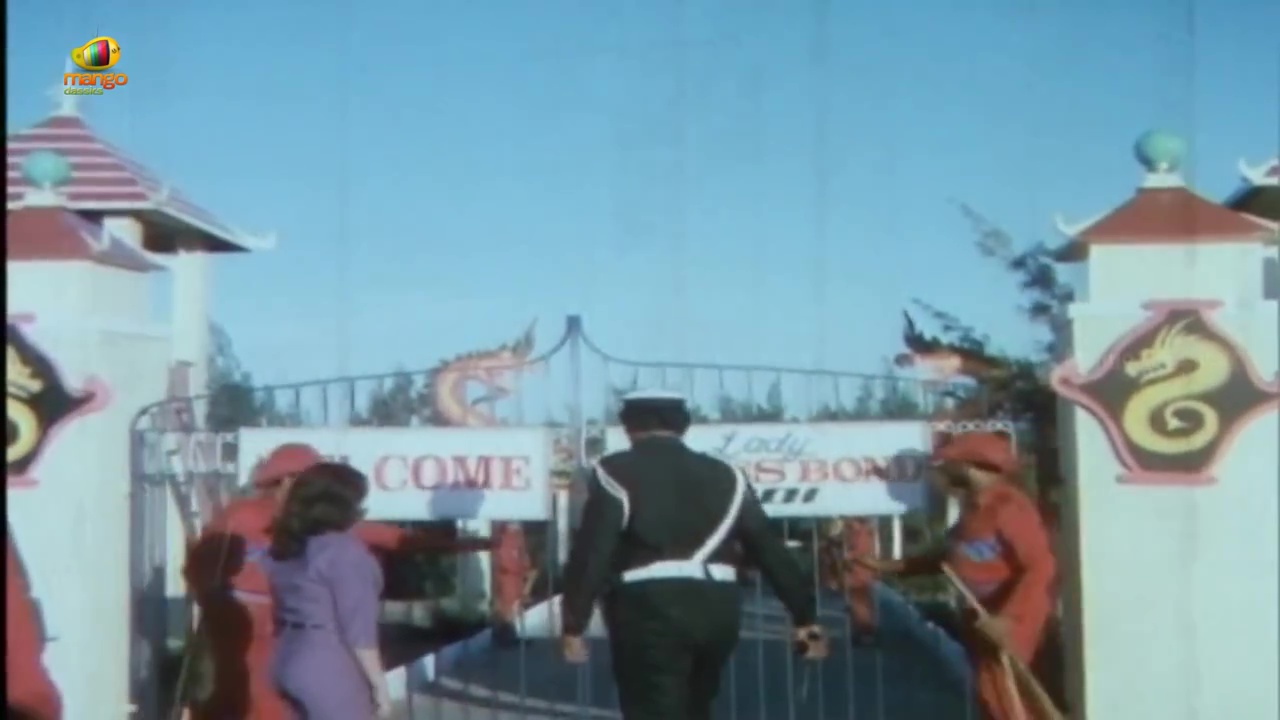
She wanders through the wilderness, again, and suddenly someone releases the hounds. She is taken to Supreme’s secret hideaway, more like a high school adventure camp or low budget theme park. Lady James Bond blows everything up, Suthivelu turns out to be both smart and useful, almost everybody else dies, and the baddies are taken away. But I still have no idea what they were up to.

So many men in this film “accidentally” kill the woman they say they love. And cry their teeny selfish hearts out about it. I’m not confident anyone in the film knows how to confirm people are actually dead either as they seem very reluctant to consider trying any form of treatment. But what goes around comes around, so…

Silk Smitha is actually pretty good. Despite the near constant gyno-cam and detour into sleaze at any and every opportunity, she is fun as the top secret agent. She is pleasant and professional with her charges, but can switch to a cold eyed rage when she is taking on the evil doers. She wears some hideous clothes, but as a skanky item specialist that wouldn’t have worried her. And the fancy agent gadgets were a triumph of imagination over budget and science. She uses her transmitter detecting boots to find a secret phone in a tree and uses another spy gadget aka a shirt button to disguise her voice. I think Silk carried on the legacy of ladies like Jyotilaxmi very well indeed. And all her snake dance appearances may have held her in good stead with Lady J’s trademark rolling away from trouble move.

My other favourite thing about the film was the prevalence of photo mural walls. Every house had at least one.

The excellent 4DK has written a much more thoughtful analysis of Lady James Bond.

Since this is, at least in English, almost undocumented I haven’t put names to many of the faces in the film. Feel free to leave a comment if you would like someone’s film legacy blighted by including their appearance in this.

It’s a film that goes beyond So Bad It’s Good and dives into Almost Endearingly Awful. I can mostly overlook the sleaze of the times and appreciate Silk doing her thing and Lady James Bond triumphing over the men, despite the men, without the men. Maybe 1 star for effort, 2 ½ stars for WTFery and entertainment. If you’d like to share your thoughts, just speak into the flowers!

Mahanati

Mahanati

Nag Ashwin’s Mahanati is a spellbinding biopic that celebrates the life of Savitri in sumptuous colour with haunting re-enactments of her most famous scenes. Keerthy Suresh invokes the magic of Savitri’s screen presence while Samantha ties it all together as a journalist researching the legendary actor’s life for a newspaper article. At just under three hours, the film still only scratches the surface of Savitri’s story, but with an impressive cast and convincing dialogue, Mahanati is a mesmerising look at one of the most successful film actors from the South.

The film opens with Savitri falling into a coma and being taken to a hospital whose bemused staff have no idea who they have just admitted. One year later, on the anniversary of her illness, journalist Madhura Vani (Samantha Akkineni) is given the task of writing about the film star for a short article in the newspaper. Vani is shy and frumpy, struggling to make her mark in the male-dominated profession of journalism and she is dismayed at what she thinks is a throw-away assignment. But once she starts speaking to the people who knew Savitri, Vani becomes intrigued by the star and her generous and compassionate personality. As she learns more, Vani draws inspiration from Savitri and becomes empowered to make changes in her own life and stand up for herself. This interweaving of Vani’s story into the life of Savitri is ingenious and allows Nag Ashwin to focus on the more positive aspects of Savitri’s legacy, although he doesn’t avoid the drama either.

The film shows Savitri’s early life after her father dies and her mother goes to live with relatives. Even as a child, Savitri was a force to be reckoned with. Her determination and will to succeed is demonstrated as she learns to dance despite the dance instructor telling her she lacks discipline and will not be able to master the skill. I loved these early scenes and the young actor playing the child Savitri who is a real find. She is full of life and totally charming with plenty of attitude – perfect for the role!

Savitri is shown taking part in theatrical shows under the supervision of her Uncle, K.V. Chowdary (Rajendra Prasad), and her abortive first trip to Chennai to become an actress is also depicted. This is beautifully done, with Savitri in full fan mode as she tries to get glimpses of her favourite actor Akkineni Nageswara Rao (Naga Chaitanya), and being almost totally oblivious to the man who takes her photo, Gemini Ganesan (Dulquer Salmaan).

Nag Ashwin doesn’t dwell too much on Savitri’s rich film history but focuses instead on the real-life drama of her marriage to Gemini Ganesan and subsequent estrangement from her uncle. Her iconic roles are shown in a montage and Keerthy Suresh does a fantastic job in re-creating these accurately, including a poignant song from Devadasu and the wonderful scene in Mayabazar where Savitri is playing Ghatotkacha impersonating Sasirekha.

I’ve been waiting for a film that showcases Keerthy’s talents as an actor, and finally she gets her moment to shine. She really is amazing here and completely nails a wide range of emotions. From the early bubbly and happily carefree girl all the way through to the devastated wife who turns to alcohol, Keerthy makes us live every moment and completely believe in her portrayal of a legendary actor. A standout is the moment when she learns Gemini Ganesan is already married and her dreams of romance turn to ashes. This, and her subsequent difficult decision to marry the man she loves despite everything are simply perfect, with none of the actors overplaying the emotion, but still managing to make the audience feel every heartache and each moment of elation.

Dulquer Salmaan is also a perfect choice for the ultimate romantic actor of the time; Gemini Ganesan. He has plenty of charm and when he sets out to woo Savitri, she doesn’t stand a chance! Their romance sparkles on screen and Dulquer is just as convincing when he portrays Gemini Ganesan’s jealousy at his wife’s success and subsequent alcoholism. The story is told from Savitri’s viewpoint, so Dulquer has less screen time after Savitri finds out about his affairs, but throughout it’s an excellent performance that makes the drama and emotion behind their relationship very real.

The secondary story of Madhura Vani and her struggle to be accepted as a serious journalist is well integrated into the main plot. Nag Ashwin uses Vani to introduce key witnesses to events in Savitri’s life that allow the film to move back into flashback. But is also emphasises the importance of Savitri as a role model and inspiration, while Samantha’s success over the other, male reporters is an important step for Telugu cinema. Here is a film that has a female lead who isn’t defined by her romance with a male character and who is allowed to have a personality and story of her own. Although there is a romance (with Vijay Devarakonda in a very bad wig), it’s very much part of Vani’s own story and important mainly as a way for her to assert her independence from her father’s plans.

There is a plethora of other actors who appear in cameo roles as various screen legends of the time. Just a few are Mohan Babu as S.V. Ranga Rao, Prakash Raj as director/producer Aluri Chakrapani and Krish appearing as K.V. Reddy. It’s a real who’s who of Telugu/Tamil cinema of the time and I was inspired to read up on some of these directors and producers whose names I recognised when I left the cinema. Mickey J. Meyer’s music fits the film perfectly too and Dani Sanchez-Lopez does an excellent job with the cinematography. The effects team have managed to recreate Chennai in the fifties and the costume department deserve special mention for the wonderful outfits worn by Keerthy and Dulquer. The end credits juxtapose shots of Savitri with those of Keerthy in the same film role and the resemblance really is astonishing.

Overall there is fantastic attention to detail for both the scenes in the early eighties and Chennai in the fifties that ensure the film feels authentic, although I did sympathise with Samantha and her selection of ruffled shirts and long skirts. Everything about the film seems to have been well researched and the sets dressed to add plenty of authentic flavour. Including the film segments in black and white also adds to the whole period feel of the film and emphasises just how much impact Savitri had at the time. I also have to comment on the excellent subtitles by Rekhs that ensured the drama of each scene was well conveyed. After the last few Telugu films I’ve watched where literal translations have made a mockery of important scenes it is such a relief to have proper idiomatic English that makes sense and doesn’t detract from the dialogue. Until I can learn Telugu (a vain hope given my lack of success with Tamil) Rekhs subtitles are the next best thing to understanding the dialogue myself and I always cheer when I see ‘Subtitles by Rekhs’ appear on screen.

Mahanati is an excellent dramatisation of the life of one of South India’s best known and well-loved actors. I don’t know enough about the details of Savitri’s history to comment on its accuracy but from all I have read, Nag Ashwin has captured the essence of Savitri’s story while Keerthy Suresh has brought her memory to vivid life. It’s ultimately a sad story but also a lovely tribute to Savitri and a reminder of what a wonderful actor she was. Mahanati is a real treat for fans of both classic and contemporary Telugu cinema – don’t miss it!