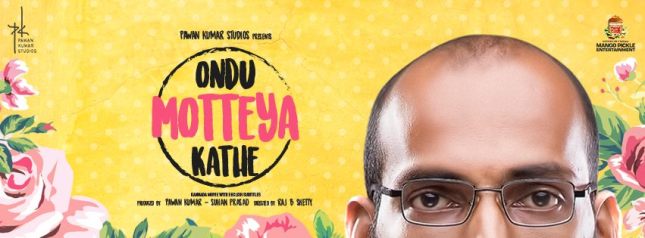
Ondu Motteya Kathe

OMKRaj B. Shetty is not your typical leading man material. His character Janardhana is 28 years old, thin, shy, and, according to the marriage broker, has two major problems. One: losing his hair and two: working as a lecturer in Kannada. Despite these apparently significant drawbacks, Janardhana is determined to find his perfect bride, although for most of the film he seems to have set his sights unrealistically high. Ondu Motteya Kathe (Story of an Egghead) is an amusing and well-written rom-com that follows Janardhana’s quest to find the woman of his dreams and all the ups and downs associated with his search.

Although it’s the name bestowed upon him by his students at college, Janardhana isn’t really an egghead as he does still have hair, but he is definitely thinning on top. It’s noticeable enough that when he visits a potential bride she rejects him based on his developing baldness, leading to Janardhana’s decision to ditch the broker and find a wife himself. The problem is that although Janardhana himself isn’t top husband material in the looks department, he still wants his wife to be beautiful and that gives him a greatly reduced chance of success.

His gaze initially settles on the economics teacher (Amrutha Naik) but despite her friendliness towards him, Janardhana is too shy to approach her himself and enlists the help of the college odd-job-man, Sreenivas (Prakash Thuminad). When the arrival of a new English teacher destroys Janardhana’s chances, and another potential romance turns out badly, Janardhana reconnects with an old friend on Facebook. Sarala (Shailashree Mulki) has recently been ditched by her fiancé, so she too is on the look-out for a potential husband. However, when the two meet, it’s definitely not a case of love at first sight. Sarala thinks Janardhana is ugly and bald, while Janardhana instantly dismisses Sarala as she is (in his words) fat.

Just like Janardhana isn’t really ‘bald’, Sarala isn’t ‘fat’, rather she’s just a little overweight and not Janardhana’s idea of the perfect partner. However, she is very pretty and has a lovely personality which Janardhana can’t see as he’s focused more on her physical shape. Unfortunately for both, although they are resigned to remaining friends, Janardhana’s family believe that they have a love match and immediately start to arrange their wedding.

This a comedy that works partly due to the excellent writing but also because the characters are all relatable and generally sympathetic. Janardhana evokes sympathy with his male pattern baldness but in reality he is a typical nerd, and it’s inevitable that he is ridiculed by his students and further embarrassed when he goes to the college principal to complain. The dialogue is natural and even subtitled is laugh-out-loud funny while the situations are routine day-to-day events that are easy to relate back to personal experiences. Despite his determination to only look for a beautiful bride, Janardhana isn’t arrogant, rather he’s just clueless and totally inept in social situations, while being continually frustrated by his well-meaning but equally awkward family. His mother (Usha Bhandary) is overbearing and overly protective, his father (Vishwanath) keeps the peace by agreeing with everything his wife says and his younger brother (Vineet) spends all his time talking to his girlfriend on the phone to Janardhana’s continual frustration.

What makes it even better is that as the film progresses, our initial sympathy for Janardhana starts to wane when he rejects Sarala purely on the basis of her looks and is cruel and hurtful into the bargain. It’s a bold move to make the lead character so unattractive as the story develops, and it’s successful because we know the rejection and despair that Janardhana has had to deal with, making his own rejection of Sarala more poignant and thought-proving as a result. Although it is a very funny film there is an undercurrent of sadness too as both Janardhana and Sarala struggle with rejection based purely on their physical appearances.

Another clever touch is the inclusion of Dr Rajkumar as a character in the film through Janardhana’s obsession with the actor and by dialogues and film snippets that crop up throughout, at times inspiring Janardhana to act rather more impetuously than expected.

Raj B. Shetty not only acts in the lead role, but he is also the writer and director of the film; an impressive feat given that it’s his first film and his character doesn’t hog all the limelight as can happen when the director is also the ‘star’. Shailashree Mulki is wonderful as Sarala, while Prakash Thuminad is excellent as an unlikely confidante and relationship advisor, with the rest of the support cast equally impressive and genuinely funny. Midhun Mukundan’s music is put to good use and this is a very funny song with some great clothing choreography and a poignant plea to potential partners.

Ondu Motteya Kathe is a great début and Raj B. Shetty joins the growing number of Kannada directors who are producing films that are just that little bit quirky and different, but still appeal to a large audience. The comedy is good, the romance believable and the characters appealing despite their many flaws. Recommended watching for the clever concept, intelligent writing, excellent dialogue and wonderful performances from the entire cast.

Fidaa (2017)


Sekhar Kammula’s Fidaa benefits from a talented cast and suffers from some underwritten characters and lazy plot manipulation.

Fidaa bills itself as a love-hate-love story, but I felt it was more about growing up and knowing yourself, identifying where you will and won’t compromise. Medical student Varun (Varun Tej) lives in Texas with his older brother Raja (Raja Chembolu) and younger brother Bujji. One morning they all decide Raja should get married, and minutes later he chooses Renuka (Sharanya Pradeep) on a matrimonial site. Raja goes to India to meet her, but waits for Varun to come and give the final OK. Renu’s younger sister Bhanumathi (Sai Pallavi) is naturally curious and concerned about the man her sister will marry so goes about sussing out her prospective in-laws. She and Varun fall for each other but where Raja and Renuka are easy going to the point of invisibility, Varun wants to stay in the USA and Bhanu cannot conceive of leaving home. They break up without really breaking up or talking about it, and unhappily go on with their lives. But then Renu falls pregnant and develops a mystery syndrome that lasts just long enough for Bhanu to have to go to the USA.

Considering the number of co-directors credited I half expected a lack of cohesion in the direction but not so. Visually this is a beautifully composed film, making the most of natural looking light and locations. Unfortunately the writing relies on half-baked contrivances to move the action along. The characters are not particularly well developed either.

Sai Pallavi should win all the awards for her performance as Bhanumathi. The line between uninhibited and unhinged is tricky to negotiate, but she rocks both the energy and subtlety required. What could have been a mere hair swishing manic pixie dream girl becomes a delightfully quirky and real young lady. I guessed from the audience reaction that a lot of her dialogue is in a regional dialect and there was much cheering at some of her one liners. Bhanu is doing her undergrad degree in Ag Science, and demonstrates this by driving a tractor around one field, just one muddy field, and pointing at different grains. I’d never considered the pros and cons of wearing a half-saree while driving a tractor, but here it looked stylish and appropriate. It’s easy to see when Bhanu is putting on an act but never easy to see that any part of Bhanu is a performance. Her reactions seem spontaneous and her eyes look like there is somebody home. On a shallow note, I also loved that she has minimal makeup on that expressive face, spots be damned. It’s a departure for a mainstream Telugu film heroine. And she can really dance.

Varun Tej is tall, dorky, and may never get all that hair product out. Ever. Not even vigorous frolicking in the rain could flatten that bristly up do. Varun the character is kind of bland and I never found his dreams or change of heart convincing. At first I put that down to his acting but when I considered Bhanu too, I realised that neither character had much explicit motivation or development. The film relies on the actors to make the situations engaging. Varun was just overshadowed a little, playing the slow steady counterpart to the firecracker Bhanu. He was at his most lively in scenes with her, and I liked their rapport. The fight scene seemed out of character, but Bhanu was a huge film fan so I guess that was Varun showing support in a kickarse language that spoke to her. He was less successful in the angry and emotional post breakup phase when Varun keeps taking stupid advice from a comedy sidekick. He’s lucky he inherited the smouldery Mega Eye gene for the crying scenes because it distracted me from wanting to slap him for excessive wallowing. He certainly missed out on the Mega Dance gene…or at least, he got that one from his father not his uncle.

The plot used any old excuse in pivotal moments. Renuka required 3 months of total bed rest, but then was well enough for Bhanu to leave on a roadtrip for a week (judging by the outfit changes), and then turned up heavily pregnant at home in Banswada for a wedding. You or anyone else with a pen and a post-it note could easily write six reasons that were more believable. The roadtrip was beautiful and I’m sure everyone had fun with the drone shots, but if you’re in a hurry perhaps…a plane? Investment in building up characters and relationships was notably lacking. Some of the side characters have no reason to exist other than being a sidekick or whatever. There is also a fair amount of “do as I say, not as I do” advice. It’s disappointing because there’s a whole stack of Kammula films that show he is a keen and empathetic interpreter of human behaviour. This looked like he either couldn’t be bothered or perhaps gave way to an improvised approach that fell over.

Satyam Rajesh’s Ali is one character who added no value to the proceedings. And the kid who played Bujji did nothing to diminish my dislike of high pitched overly peppy kid actors. Of the supporting actors I most enjoyed Sai Chand and Sharanya Pradeep as Bhanu’s dad and sister. I still get irritated when people in possession of all their faculties and full mobility sit and wait for their daughter to come and give them their daily essential medication, but whatever. He was a caring and quite progressive father in many respects. Renu had a masters in psych but there is no indication she will ever get to use it, or wanted to. Another why???? element in the script. But Sharanya Pradeep was calm and lovely, playing Renuka with a maternal solidity.

Shakthi Kanth Karthick’s songs were diverse enough in style that they meshed with the key scenes rather than being a musical interruption. Vachinde was suitably flirty and hectic, setting the scene perfectly. I was pleased to see both the dialogues and songs were subtitled, although the quality of the English subs was atrocious. I hope that is reviewed before a DVD release. Unless there really is a w in hellow. And I’m pretty sure Fidaa doesn’t directly translate to “flat”.

Fidaa is well worth seeing for the charm of the actors and the beautiful visuals. Just prepare to suspend your disbelief a bit. On the bright side, there were no CGI talking lizards!

Vikram Vedha

Vikram Vedha

It’s rare that a Tamil film gets a round of applause from a Melbourne audience, but that’s exactly what happened at the end of Vikram Vedha last night. And well-deserved applause it was too. Pushkar-Gayathri’s crime drama pits a righteous police officer against a ruthless criminal, but the line between the two rapidly becomes blurred with a series of moral dilemmas that throw Vikram’s beliefs into question. Both Madhavan and Vijay Sethupathi are outstanding and with a well-written story, clever dialogue and insightful characterisations, Vikram Vedha is an absolute gem of a film and definitely one not to be missed.

Madhavan’s Vikram is a member of a police task force whose mission is to remove notorious gangster Vedha (Vijay Sethupathi) and his men from the streets. Vikram is totally convinced that he is on the side of the angels and that the men he kills deserve to die, which as he continually states, means that he has no problem sleeping soundly at night. However, almost immediately Vikram hits some dodgy moral ground when he shoots in cold-blood one of the gangsters who tried to surrender and then reworks a crime scene to his team’s advantage. Already Vikram doesn’t seem quite as shiny white as he wants the world to believe, although as a police officer he stills stands on the right side of the law.

Vedha continues to elude Vikram and his men, resulting in a planned raid into the area of North Chennai where Vedha is rumoured to be hiding out. As the numerous police officers and riot police are gearing up, ready for action, Vedha calmly walks into the police station and surrenders. As entrances go, this has to be one of the best, particularly since no-one seems to recognise the gangster until he sets off the metal detector alarm as he walks into the building. Vijay Sethupathi is always good in the role of a gangster, but his swaggering Vedha is brilliantly executed here with exactly the right amount of confidence and bravado to suit a character who calmly surrenders to a room full of armed police.

Vedha’s surrender seems like sure suicide, but he’s planned everything well in advance, and without any evidence the police can’t hold him. However once faced with Vikram in a cell, Vedha starts to tell him a story which ends with a moral conundrum. The question posed at the end starts to lead Vikram to realise that the world isn’t as black and white as his and Vedha’s respective shirts, and that sometimes the identity of the bad guy is not as clear-cut as first seems.

Vedha is released by his lawyer who happens to be Vikram’s wife Priya (Shraddha Srinath) which leads to another moral dilemma for Vikram. What do you do when your wife is representing the criminal you’re trying to kill in an encounter? Priya is a strong character who won’t back down and refuses to let her husband destroy her first chance to make a name for herself in Chennai. The scenes where the two work to resolve their fundamental differences in opinion and approach to Vedha are brilliantly written and work well as another factor in Vikram’s gradual realisation that good and bad are just relative terms.

As the film progresses, Vedha manages to tell Vikram another two stories, always ending with a question about what is the ‘right’ action to take in each situation and that Vikram struggles to answer. The situation becomes more and more tense after Vikram’s best friend Simon (Prem) is killed during the investigation and Vikram is desperate to know why Simon died. But as Vedha’s tales seem to be leading Vikram to a greater understanding and may hold the clue to why Simon died, they also add more and more grey into his previously monochrome view of the world.

Vikram Vedha

Each story is told in flashback and introduces a number of key characters including Vedha’s younger brother Puli (Kathir) one of the men shot by Vikram in the raid at the start. Varalaxmi Sarathkumar plays Puli’s wife Chandra, another strong character whose behaviour as a child is an excellent foreshadowing of her actions as an adult. I loved her character, particularly when her immediate reaction to Puli slapping her was to slap him back straight away, and her down to earth attitude was wonderfully normal in the middle of all the intrigue and drama associated with Vedha and his gang.

Madhavan and Vijay Sethupathi work together brilliantly and the chemistry between the two is the main reason why the film works so well. Madhavan is perfect as the gravel-voiced cop who strongly believes that he is always right (and good), while Vijay Sethupathi completely gets into the skin of a Chennai gangster out for revenge. The short flashbacks are beautifully put together to highlight the main clues, but there are so many twists that the final outcome is kept relatively obscured until close to the end. Kudos to the make-up team who successfully aged the characters naturally and the wardrobe team who managed to find so many different shades of grey for Vikram and Vedha as the story progressed! The shift in clothing sounds really obvious, but it’s done subtly and is more effective than it sounds, particularly as the changes echo the shift in Vikram’s thinking. The premise of what is good, what is bad, and how can we really tell is intertwined throughout every part of the film which also works well to highlight the change in perception Vikram undergoes as he learns more about Vedha and his life.

It’s not just the storyline and the performances that make the film so watchable. P.S. Vinod’s cinematography is excellent while the background score by Sam C.S. enhances the action without becoming intrusive. The songs fit surprisingly well into the narrative without disrupting the action and of course  it’s always a treat to watch Vijay Sethupathi shake a leg – especially as part of a drunken gangster party!

Vikram Vedha is such a clever film, but Pushkar-Gayathri never get too carried away by their own brilliance and keep the underlying story simple. The mixture of morality, crime thriller, action and suspense are expertly blended together without making the central debate of good vs bad either preachy or clichéd. I totally enjoyed every single minute of Vikram Vedha and it’s definitely a top contender for my favourite film of the year. Simply perfect!