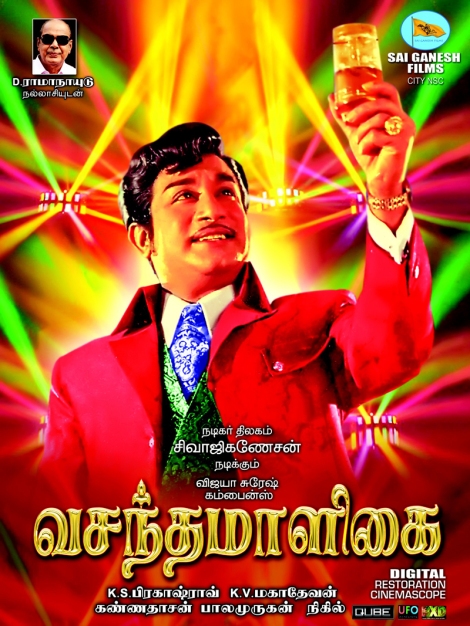
Vasantha Maligai (1972)

Poster

It’s been a while since I watched some seventies masala, and what better way to indulge than K.S. Prakash Rao’s wonderfully dramatic Vasantha Maligai. Sivaji Ganesan and Vanisri star in this adaptation of Koduri Kausalya Devi’s novel about a rich prince and his romance with a middle class woman working to support her family. Like all good masala films there is a dash of everything – romance, tragedy, filmi medicine, an evil overlord, oppressed villagers and even a comedy cook, but it’s the performances from the cast along with some beautiful songs that make Vasantha Maligai well worth a watch.

Anand (Sivaji Ganesan) is the alcoholic younger son of a royal family and the film opens with a song detailing his drunken antics on a plane where Latha (Vanisri) is working as an air hostess. The opening scenes focus on Anand with Latha merely a figure in the background concerned about fastening seatbelts when the plane hits turbulence, so it’s a surprise when the next scene shows Latha returning home to her family and attention moves to her situation. I like this way of building anticipation for the next meeting between the two, while providing the back story that establishes Latha’s character.

Latha is the main wage earner in the family as her brother (Sreekanth) is a wastrel and her father (Major Sundarrajan) is crippled from an accident. Her mother (Pandari Bai) is unhappy about Latha’s job and persuades her to look for something safer where she doesn’t have to risk life and limb in an aeroplane every day. However, Latha’s subsequent venture into employment turns out to be much more dangerous than her work as an air hostess and Anand returns to the story when he rescues Latha from her amorous new boss. Anand just happens to be grooving the night away in the same hotel celebrating his birthday party, and our hero is such a style icon that he even takes time during the ensuing fight scene to fix up his hair – such panache!

Despite his drunkenness and playboy appearance, Latha accepts a job as Anand’s personal secretary where her kind heart and overall decency start to have an effect on his behaviour. However Latha is also proud and her self-esteem leads her to appear arrogant, particularly when she clashes with Anand’s servant and drinking buddy Panchavarnam (Nagesh). Nagesh is determined to keep Anand drinking to ensure his own supply of grog, while Latha is equally determined to wean Anand off the demon drink and make him a useful member of society. In the end it’s Latha’s concern for his well being that starts to win Anand over but it’s not until he injures Latha during one of his drinking binges that he finally starts to mend his ways.

While Anand is intent on drinking himself into an early grave, his elder brother Vijay (K. Balaji) terrorises the local villagers who work on the estate. Vijay is a nasty piece of work and Balaji has a great demonic laugh and seems to be thoroughly enjoying his role as a brutal despot. His wife Vimala is equally evil and plots to get rid of Latha before she can redeem Anand, although whether this is to keep her husband in control of the estate or just because she is a horrible person is hard to decide. I’m not sure who the actress is playing Vimala but she has a great sneer and is wonderfully condescending in her attitude to just about everyone else although she does seem to care for her husband and child.

Her concern is valid since Anand secretly builds a wonderful palace for the woman he adores, although he refuses to name her until the building is complete – no surprises for who his secret love is, although he does win marks for the way he finally reveals his love.

I know tastes were different back in the seventies but even then surely this would be considered over the top pastel décor:

There are endless ornate pillars, arches, and latticework with tacky silver statues practically everywhere. The indoor pool has giant lotus flower fountains, and the room where Anand reveals the face of his true love is full of mirrors (expected) and revolving pillars (totally unexpected) that don’t seem to have any purpose whatsoever. And what else will they ever use this room for? Latha however is enraptured by the palace and the discovery that Anand loves her, ending up leaping through the gardens in true masala romance style in the gorgeous song Mayakkam Enna.

However there is still a long way to go before the end and Vimala and Vijay manage to turn Ananad against Latha, ultimately resulting in Anand becoming very ill. According to his doctor his cough and general malaise are caused by his sudden drop in alcohol consumption, and no-one ever mentions his chain smoking habit as a possible issue. Aah – the seventies – life was so much simpler back then – unless you were the heroine in a masala movie of course. Poor Latha has many more trials and setbacks to endure before true love wins out, and she has plenty of opportunity to practice her emoting skills while enduring gallons of fake tears. Although she does have the benefit of industrial strength no-run mascara to ensure her make-up stays perfect despite all the crying.

Sivaji Ganesan is perfect as the hero and makes the most of both his drunkenness and his illness later in the film. He spouts dramatic lines and clutches at his chest, a convenient pillar or a chair while gazing adoringly at his glass of brandy one minute, and then switches to amused indulgence as he watches Latha try to make him work the next. It’s not all just over the top drama either, he does have some moments where the subtle raise of an eyebrow is just as effective as his later histrionics and he manages to make his character more than just a typical rich playboy. Balaji too is effective in his role as the elder brother, although I would have liked to have seen a little more interaction between the two brothers.

Vanisri looks gorgeous and wears some stunningly beautiful saris that stand out, even in the opulent surroundings of the palace. She does wear a couple more than once too, which fits nicely with her character needing to work for a living. Her Latha is a determined young woman with plenty of attitude and no tolerance for bad behaviour. I like that even when she is distraught she still fights back and has no hesitation in saying what she thinks, no matter who she is speaking to. She has good chemistry with Sivaji Ganesan too, and the romance between the two works well despite the limited time they have together as a couple.  The support cast are all good too, with Nagesh a good fit as Anand’s upstart servant, although the comedy track between him and the cook (V.K. Ramaswamy) is rather less successful.

The songs by K.V. Mahadevan are beautiful and T.M. Soundararajan provides the voice for Anand, ensuring the songs are just as dramatic as the action.

The film looks gorgeous too – the colours of the fab costumes are vivid and bright, even in my unrestored copy and I love the seriously over the top décor of both palaces. The bar in the palace is as seedy as in any hotel, Anand’s bed is a glorious ornate version of a gondola, and I almost didn’t notice the stuffed animals in the main hallway with the enormous and imposing staircase taking centre stage. This is exactly what I want from my masala films – determined hero, tragic heroine, plenty of melodrama, beautiful costumes and sumptuous settings. Vasantha Maligai delivers on all fronts and is even more readily available now that the film has been digitally restored and re-released. Highly recommended. 4 stars.
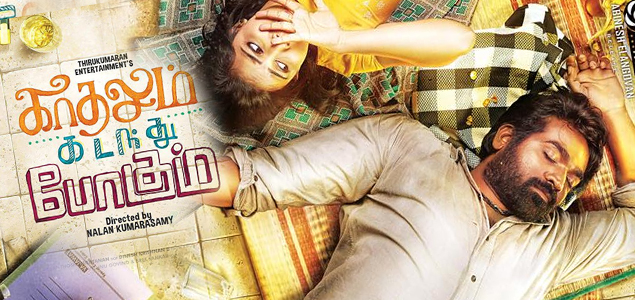
Kadhalum Kadandhu Pogum

Kadhalum Kadandhu Pofum

After the success of his début venture, Nalan Kumarasamy unexpectedly follows Soodhu Kavvum with an official remake of a Korean film; Kim Kwang-sik’s My Dear Desperado. I haven’t seen the original but the story of an unlikely friendship between a gangster and a young IT graduate translates well to Chennai, while Vijay Sethupathi and Madonna Sebastian are both excellent in the lead roles. Despite the title (which translates to “Love too shall pass”), there is little romance in the film, but instead Nalan’s screenplay includes plenty of comedy, a good dash of drama and only a smidgen of violence. Nalan keeps to his trademark witty dialogue and quirky characterisation too with plenty of funny one-liners, making Kadhalum Kadandhu Pogum engaging and definitely well worth a watch.

The focus of the story is Yazhini (Madonna Sebastian), newly graduated from a small regional college and desperate to escape her confining life with her parents in Viluppuram. Somehow she manages to secure a job in Chennai and escapes to a shared flat and the realisation of her dream, but unfortunately her happiness is short-lived. The company folds, her job goes and Yazhini is left looking for somewhere less expensive to live as she struggles to find a new job.

Yazhini’s move downwards into cheaper digs brings her into contact with the seamier side of life in Chennai, and she quickly discovers that her neighbour is a rowdy who works as an enforcer for the local area councillor. Kathir (Vijay Sethupathi) is newly released from jail and wants nothing more than to run his own bar, but his boss decides that his talents lie more in dealing with petty disputes and training up a new recruit. While Yazhini thinks that Chennai offers a world of opportunity, Kathir knows that even a small dream can be impossible to achieve and this difference in outlook is what makes their eventual friendship even more unlikely.

Initially Yazhini is frightened of Kathir and the world he represents, but gradually she warms to her neighbour and discovers that he’s not as violent as first appears. Madonna Sebastian’s Yazhini is confident but not reckless and her determination to succeed makes her a likeable character. She suffers numerous setbacks but rarely loses her optimism and for the most part her dilemma feels genuine and plausible. I really liked Madonna here after her excellent performance in Premam and I hope she gets more of these kind of roles where there is something more to her character than simply eye candy. Yazhini is a strong character who knows exactly what she wants and isn’t afraid of trying almost anything to achieve her dream. Kudos to Nalan for not making Yazhini follow the usual heroine path in a Tamil film, and avoiding a conventional romance and an unhappy end even though she’s an independent, modern career woman.

Kathir on the other hand is laconic and laid back, possibly because he isn’t a very good gangster! It’s rare that the main male lead loses his fights so emphatically, but despite instigating much of the dishoom, Kathir is the one who ends up bruised and bloody by the end. Even Yazhini comments on his frequent injuries and when added in to Kathir’s impulsive and erratic nature it becomes obvious why his boss doesn’t trust him with the management of a bar. Vijay Sethupathi excels at these kinds of roles where he can mix up comedy with fight scenes and a fair amount of melodrama to make a surprisingly convincing character. He has an excellent rapport with his co-star and his bumbling thug with a tender heart has plenty of quirks that make him seem more authentic. My favourite is his ability to rustle up a mean curry despite his deficiencies as a fighter. Jail may not have taught Kathir how to fight but it did teach him how to cook!

The support cast mainly have small roles, but all are good and effective with Samuthirakani the most notable as a corrupt police officer. For the most part the film concentrates on Yazhini and Kathir, their individual failures, small successes and the support each gains from the other as time goes by. To succeed, both Vijay Sethupathi and Madonna Sebastian need to be balanced in their performances and they manage it beautifully – making sure that the film doesn’t lose momentum even when the story switches between the two characters. Together they are even better and their relationship is the reason the film does work so well.

While Kadhalum Kadandhu Pogum may not pack the same punch as Soodhu Kavvum it’s still an enjoyable film with plenty of comedy and a well written storyline. Although there are no major twists it’s still never predictable or dull and I found quite a few surprises along the way. A film about friendship rather than romance between a man and a woman is relatively rare in Tamil cinema and this is an excellent example of just how good a story can be without adding in unnecessary love scenes. Add the always very watchable Vijay Sethupathi and Kadhalum Kadandhu Pogum is definitely well worth a watch.

Stri

Stri-Stri

Stri is a beautiful film about an infuriating relationship. K.S Sethumadhavan directs with restraint, and the intimate scale lets the cast really shine. The story feels complete, with the focus on the important things and people and a pleasing complexity to some of the characters. Maybe that’s because it’s an adaptation of Palagummi Padmaraju’s short story and not purpose built for a filmi audience. Stri won the National Film Award for Best Feature Film in Telugu in 1995, with leading actress Rohini also getting a special mention at those awards.

The film opens with no dialogue or music at all for the first 5 minutes or so as a girl on a ferry cranes her neck to look anxiously towards her destination. They arrive and she pushes her way through the disembarking ladies, hurrying to where or to who?

Rangi (Rohini) has come in search of Paddalu (Thalaivasal Vijay), who is getting out of jail today. He is not wildly attractive but has a roguish charm as befits a singer, actor, thief. She gets him cleaned up, dressed, and fed. Rangi beseeches and berates him to go straight and ditch his “other woman”. She’s left her family to be with him, is unmarried, and is very aware of what people think of her.

Paddalu is famed as a singer and actor in devotional and folk plays, but he is losing his audience to the movies and his old fashioned patron is short of cash. Rangi knocks herself out trying to think up legal and positive ways for them to make a living, but Paddalu simply doesn’t want to work hard. He comes up with a scheme to make some money and convinces Rangi to just go along with it. They scam a lift on a riverboat, meeting the author of stories about poor people just like them. The writer (S Bheemeswara Rao) clearly hasn’t mastered the art of ignoring ones neighbour when Rangi and Paddalu are up for some action. But he is a sympathetic audience when Rangi finds herself left behind as Paddalu scarpers with some of the cargo.

The film shows their intense mutual attraction, although nothing else about the relationship is healthy. And the more you find out about Paddalu’s behaviour, the more questionable and destructive it all becomes. Rangi continually alienates herself from others for the sake of his dubious affection. He tries to get her into bed and she demurs but says abstinence is hard for her too. She says she may as well sleep with all of his friends because he has turned her into a street woman, and if he likes variety why can’t she have some too. It’s a one way street of course – only Paddalu can sleep around. Rangi should either go back to her parents, or let him do as he will.

After a night of ‘celebrating’ Paddalu carefully feels under their pillow and searches around the waist of Rangi’s saree, looking for her purse. He tries to sneak out but Rangi has locked the door. She knows she can’t really hold on to him, but she tries so hard to stop him from running. Even when he abandons her on the boat she tries to believe that he will still be her man somehow and she will get him back. There are issues galore in this relationship.

Rangi’s behaviour fluctuates between immature and girlish to sadly knowing. Rohini is beautifully simple and raw as Rangi, emotions playing across her face in an instant as Rangi battles to hang on to her man. She judges the performance and characterisation to perfection. Seeing Rohini stride around, a diminutive figure with her saree tied in what I think is a Madurai style, she just exuded determination. I hated the relationship but I really felt for Rangi, and wanted her to come to her senses. And it was interesting to see a female who was a bit of an outsider behaving in an often aggressive and entitled way as she claimed Paddalu as hers. She is subservient to her man but a feisty woman to all others. I also liked seeing Rohini in a lead role as I’ve mostly seen her recent work like Ala Modalaindi and Baahubali.

Vijay gets the short end of the stick as Paddalu is utterly despicable, but he also gives his best to try and make the character a little more nuanced. He sometimes looks at Rangi with sympathy or regret, but nothing will stop him from chasing another woman or another scheme. He is a clown at times, but has a violent streak and seems to post rationalise his way out of accepting any consequences of his actions. He and Rohini have great chemistry and whether the scene is a light hearted tickle fight or an intense confrontation, there is always a sense of connection between the two.

P.L Narayana, K.K Sharma and S Bheemeswara Rao have the main supporting roles as travellers and crew on the boat. Their characters provide some backstory for Rangi and hear her version of life with Paddalu. The other women in the film are mostly Paddalu’s paramours or nosey neighbour ladies who taunt Rangi about her loser of a man. They all shout a lot.

The style is intimate and realistic, and there is no background music to obscure the sounds of village or river life. There are a couple of songs but they are part of the narrative and the style is in keeping with the characters. The rural setting is not overly sanitised and no one is glammed up or filmi looking.

See this for a strong female character played to perfection by Rohini, and for a beautifully made and quite depressing slice of life. I want to be moved by a film, even if that does mean feeling sad and angry. 4 ½ stars!