
I love this film! It was probably the very first SI film I ever bought back in the days before I had any idea about the industry. I watched Bhool Bhulaiyaa in the cinema and then read that the dancing was better in the original movie, so immediately hunted down a copy. And really, it’s not only the dancing that is better! Manichitrathazhu was released in 1993 and has since been remade in a number of different versions but of the three I have seen, the original is definitely the best.
In contrast to the more comedy orientated Bhool Bhulaiyaa, Manichitrathazhu actually works well as a ghost story with some genuinely eerie scenes and unexplained happenings to set up the story. Nakulan (Suresh Gopi) and his wife Ganga(Shobana) move in to his ancestral home, Madampilli house to live for a few months while Nakulan works in the area.


The house is reputedly haunted by the vengeful ghost of a Tamil dancer Nagavalli and that of her murderer, the rich nobleman Sankaran Thampi. Their spirits are said to be held in a room of the mansion and the door is locked shut with the ‘ornate lock’ of the title. Ganga and Nakulan both disbelieve totally in such fanciful ideas, but Ganga is fascinated by the story of the doomed dancer and with the help of Nakulan’s cousin Alli (Rudra) she contrives to open the room. To my disappointment, and possibly hers as well, no vengeful spirits rush out, and she only finds the dust of ages and a box of Nagavalli’s jewellery.


Once the door is opened however there are a number of strange happenings around the mansion. Various articles catch fire and the sound of ghungroos and music are heard at night. The head of the family Thampi (Nedumudi Venu) and his bumbling brother Unnithan (Innocent) move their families into the house to try to protect the couple as well as attempt to confine the spirits back to their room.

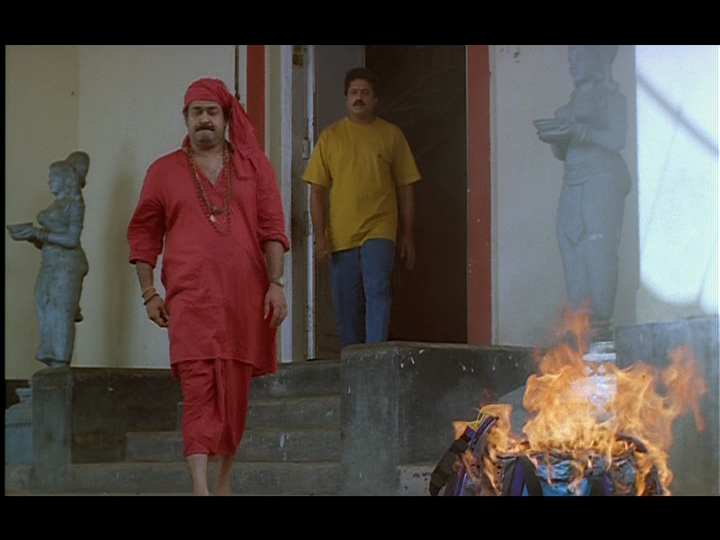
This part of the film is captivating with the juxtaposition between science and superstition and the various ways the family deals with the apparent ghostly manifestations. On the one hand Thampi and his family tie charms to ward off evil spirits, employ priests to hold ceremonies and engage a tantric expert to pacify the spirits, while Nakulan steadfastly refuses to believe in any supernatural entity and calls in his friend and renowned psychiatrist Dr Sunny Joseph (Mohanlal). Although from Dr Joseph’s introduction it’s hard to know which of the two methods is the better choice.

Nakulan suspects his ex-fiancée, Thampi’s eldest daughter Sreedevi, of causing all the incidents around the house. Sreedevi is a quiet and withdrawn girl who apparently has an unfortunate horoscope and who also seems to turn up at the wrong place every time something strange happens. With the arrival of Dr Joseph the story shifts from the supernatural into more of a psychological thriller as the psychiatrist does not believe in the existence of a supernatural entity either and decides that there is a mentally disturbed human agency behind the disruptions. Dr Joseph goes about tracking down the culprit with his unique methods, and then has to deal with the consequences of his discovery.


The only thing I don’t like about this film is the character of Dr Joseph despite Mohanlal’s best efforts and terrible shirts. I find that the over-the-top comedy aspect detracts from the more serious side of the story when it starts to delve into the issues of mental illness, and a lot of the antics Dr Joseph engages in are just irritating. However it’s not supposed to be an exploration of mental illness and I don’t find the attitudes of the other characters annoying in the same way. The patronising and condescending manner of Dr Joseph in his ‘comedy moments’ is horrible though and I don’t like way his character sleazily tries to woo Sreedevi at the same time as’ accusing’ her of mental illness. And yet, when the action takes over and the jokes stop, Dr Joseph is much more likeable and I wish that Mohanlal had played him as a straighter character for the whole film.
Shobana on the other hand is amazing as Ganga. She plays the character so well and thoroughly deserved the awards she won for her performance. Vinaya Prasad as Sreedevi doesn’t get as much screen time but she plays the quiet and unassuming character with the appropriate dignity and reserve. The two uncles Thampi and Unnithan together form a ‘comedy-light’ track and it’s generally well done and fits into the story without detracting from the main action. However the comedy track involving the tantric expert Brahmadattan Nampoothirippadu (Thilakan) is a little too slapstick for my taste and just isn’t very funny. Suresh Gopi is fine as the rather utilitarian husband dealing with the unexplained happenings in his ancestral home, but he is frequently overshadowed by Shobana and Mohanlal. The other minor characters are all good in their roles and I really like the actress who plays Unnithan’s wife. She had some great comedy moments and was very natural in her role.
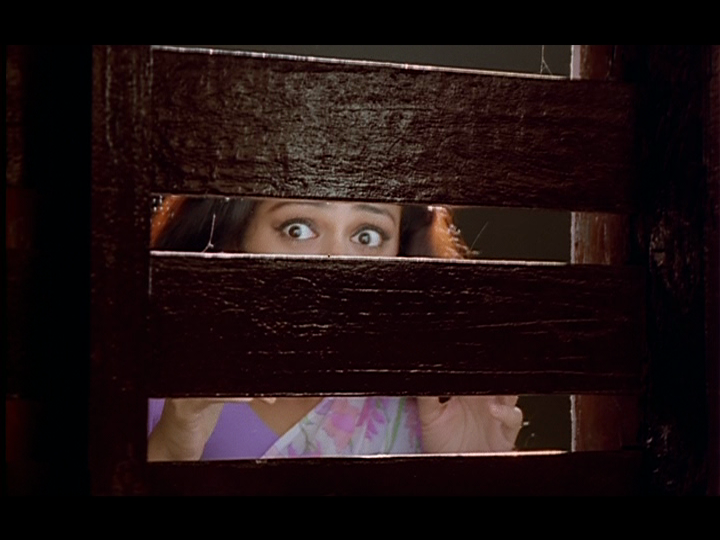

I haven’t said much about the dancing which was the whole point of watching this film initially, but the highlight is the final climax song. It does give away the identity of Nagavalli though so skip it if you don’t want to know. Otherwise click here for the best depiction of Nagavalli I’ve seen. The whole sound track by M. G. Radhakrishnan is lovely too and this is another beautiful and moving song from the film.
As seems to be the case with most Malayalam films, no matter what the subject matter, the film looks beautiful. The house used for the shoot appears to be a labyrinth and the various characters often have to run up and down stairs, along corridors and through innumerable doors to get to the scene of the action. Nothing ever seems to be shot against a blank wall, but instead is filmed against doorways, windows or beautiful shots of the country side. While no actual ghost is seen, there are shadows and suggestions all made more chilling by the use of claustrophobic corridors and shapes glimpsed through far doorways. The décor of the house is also well thought out with the couple’s room having the feel of one where the occupants are only there for a short time. And of course I also noticed the clocks.

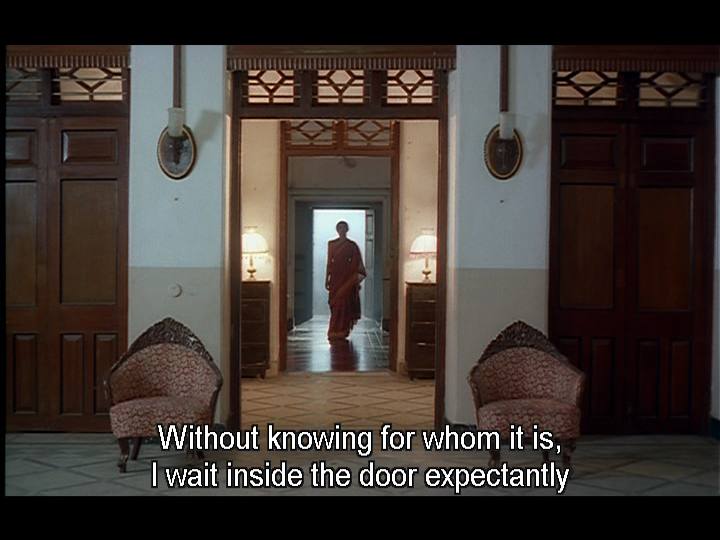


I love the music and the whole feel of the film. It’s a great story by Madhu Muttam and Fazil has done an excellent job with his direction to bring it to life. My only complaint is with Mohanlal’s overly jocular psychiatrist and I can manage to live with that since the rest of the film is so well presented. No matter how many times I watch it I still get totally involved in the story again and eagerly wait for that wonderful dance. 4 ½ stars

Temple says:
I really like ghost stories, and Indian cinema has some good examples of spooky, understated and haunting (ha!) films. I like a lot about Manichitrathazhu, and totally agree with Heather on the beauty of the house and location that add so much to the atmosphere, and the excellent dancing in the denouement. Shobana is a compelling and beautiful heroine, and gives Ganga a great deal of emotional depth and energy. There is much more to Ganga than the dutiful wife who mutely follows her husband’s lead, and Shobana brings her to life. But Mohanlal really spoils it for me. I disliked his characteriation of Sunny Joseph on first sight and thought he failed miserably to balance the unconventional prankster with the more serious practitioner and friend. Watching it again, and knowing how it ends, there is no suspense left to distract from the shortcomings of how things happen. This may be considered sacrilege but if I could play mix’n’match, I would replace Mohanlal with Rajnikanth (in the Tamil version, Chandramukhi) who at least has enough charisma to overcome a fairly silly character. And I would probably want Vidya Balan (Bhool Bulaiyaa) or Anushka Shetty (Nagavalli, the Telugu sequel to Chandramukhi) in the supporting cast with Vinaya Prasad as long as they left the dancing to Shobana! I initially watched the film on the strength of one dance sequence and that is still the most memorable element for me. The songs from the Tamil and Hindi versions are also worth a look even if you don’t fancy the whole film, especially the final classical styled songs that feature Vineeth.
Manichitrathazhu is a pretty looking film, has some excellent atmospheric scenes (although it never caused me the slightest goosebump), and the soundtrack is pleasant. I recommend watching it, but unlike Heather I don’t think it stands repeat viewings unless you have a serious interior design fetish, a very poor memory or a very high tolerance for Dr Sunny. 3 1/2 stars.



 Cinema Chaat