Duvvada Jagannadham (2017)

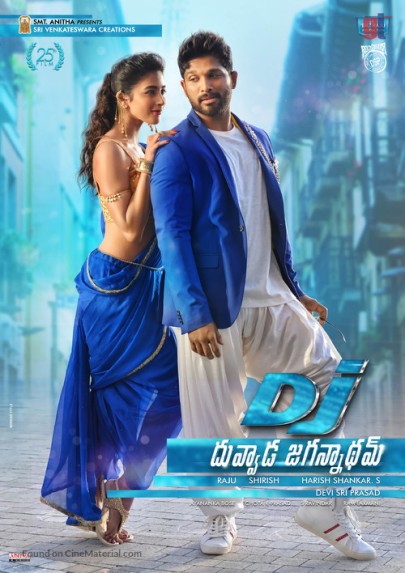
duvvada jagannadham poster

In his latest release Harish Shankar sticks closely to the standard formula for Telugu hero-centric films, which makes Duvvada Jagannadham rather less exciting than it could have been. There is hardly any suspense and few surprises as the hero flexes his muscles, obliterates the bad guys and romances the heroine while recouping lost money for the victims of a property scam. What makes it watchable are the excellent performances from Allu Arjun, Rao Ramesh and Subbaraju who add life and energy to an otherwise pedestrian plot. The story might be plodding along, but the cast give it their all, and with many other veteran performers including Murali Sharma and Posani Krishna Murali, and some good songs, DJ ends up as a reasonable timepass.

The story opens with a young Duvvada Jagannadham Sastry picking up a gun and executing a gang of thugs who attack policeman Purushottham (Murali Sharma) in his local market. Not content with his body count so far, he then turns the gun on a suspected rapist in the police station and shoots him too. Bizarrely the police officer in question rapidly recovers from his previously incapacitating wound and then doesn’t bat an eyelid at the young multiple murderer, instead enlisting him as a vigilante in his never-ending war against crime. Because of course there is nothing abnormal about a young boy killing in cold blood (and also being a fantastic shot) – not in this film at any rate.

Moving quickly among to the present day and Duvvada Jagannadham (Allu Arjun), aka Sastry is a Brahmin priest who runs an all-vegetarian catering business in Vijayawada along with various members of his family. Sastry is devout, speaks in very precise Telugu and is passionate about his cooking, although he doesn’t take life too seriously as demonstrated by a recurring joke about using asafoetida in tamarind rice. Bunny is good here, particularly with the comedy scenes and dialogue, while the trio of Sastry, his father (Tanikella Bharani) and uncle (Chandramohan) make a good team as they feed the hungry hordes of wedding guests around Vijayawada.

However, when Sastry answers his phone he becomes a totally different person – his posture is different, his voice deeper and the language less classical. Going by the name of DJ, Sastry’s alter ego is still a vigilante killer working for Purushottham eliminating criminals permanently from the streets of Hyderabad. DJ is super stylish and ultra cool, which ensures that Bunny remains ‘the stylish star’ despite spending much of the film in more traditional attire. Naturally DJ is also an accomplished killer, although quite where he learnt his skills is as much of a mystery as his motivation to cleanse Hyderabad of all criminals. The action scenes here are all beautifully choreographed by Ram Lakshman and Bunny carries out the various impalings, defenestrations and executions as smoothly and effortlessly as he performs his dance routines, and with just as much style. Sadly, there isn’t much else to the character of DJ beyond the dapper surface and efficient bloodshed. There is no rationale behind why his character is driven to such violence, particularly since he has been raised as a priest and generally seems to be a kind-hearted and benevolent priest at that. There is a brief comment by his father at the start, questioning why his son has so much rage, but this is not explored at all, and of course Sastry never shows any sign of the explosive ferocity that is characteristic of DJ.

Naturally there is also a heroine, and as might be expected from the formulaic plot, Pooja Hegde’s presence is completely superfluous to the story with her only purpose seemingly to be to appear in as many skimpy costumes as possible and dance in a few songs. The brazen character of Pooja seems unlikely to appeal to the traditionally minded Sastry, and although her designer credentials might interest DJ, her nasty, childish behaviour when they first meet is unlikely to impress. The camera spends more time focused on Pooja’s navel than on her face and it’s a shame that the only real emotion she gets a chance to display is when she’s shopping in Abu Dhabi – her excitement here is the only genuine moment her character has throughout the entire film. Still, she does look stunning, and has good chemistry with Bunny in the songs, but it’s a shame that she has no opportunity to do anything more.

DJ becomes personally involved in the case of a property scam where the real criminal Royyala Naidu (Rao Ramesh) hides behind a proxy (played by Prabhakar). Royyala’s son Chintu (Subbaraju) also becomes involved when Royyala conspires with Pooja’s father Minister Kusuman (Posani Krishna Murali) to marry their respective children. Subbaraju is excellent as a crook with an unusual idiosyncrasy, particularly in the final showdown with DJ and Royyala.

Throughout the film Bunny excels with his comedic dialogue as Sastry and does a good job of keeping the two sides of his character quite separate and different. As always his dancing is superb on every level and I did appreciate his collection of sparkly sneakers in various colours too. Devi Sri Prasad’s songs are good, although the song sequences aren’t connected to the plot of the film and seem to be simply added in as part of the standard formula – “fight scene/ family scene/ romantic moment/ song”, and repeat. However, the dance sequences add in energy and give Pooja and Sastry/DJ a chance to develop their romance that otherwise appears rather lacklustre.

Duvvada Jagannadham is disappointing, but the action sequences are impressive, the songs are excellent and Bunny is always watchable. There are some good dialogues that were well appreciated by the audience here in Melbourne, and the comedy with Bunny, Vennela Kishore as his cousin Vighneswara Sastry and the rest of the family is generally pretty funny. The major issue here is the formulaic plot and uninspiring screenplay that feels dull despite the good performances from the cast. However it’s not all bad and there are some scenes that work very well, it’s just that it doesn’t all gel together as it should. Worth watching for Bunny, the songs and the action, just don’t expect too much from the plot.

Janatha Garage

I want to grab Koratala Siva and shake him till his teeth rattle, then kick him into the middle of next week. He has managed to get a top notch cast and the beginning of a good idea and turn it into something far less than the sum of its parts.

Sathyam (The Complete Actor Mohanlal) is the head of Janatha Garage, a leader, and is genuine in his desire to give the little people a fair go. Mohanlal has great conviction and gravitas when he speaks of what is right and fair, and he gives the impression of a man who seeks to take a balanced view but who will never take the easy way out. He gathers a small crew of like-minded men who also represent in shorthand the diversity of Hyderabad. Janatha Garage repairs engines and problems.

Anand (Young Tiger NTR) has an unusual hero entrance where he arrives to … plant a tree. Or actually, tell someone he’s busy and so can they please plant the tree. Anand’s environmentalism is very simple. Trees good, humans bad. He doesn’t seem to have a problem with wanton destruction as long as it is him dishing out the destruction. He is given an overblown fight intro where he beats some thugs up while claiming to be giving them a taste of Mother Nature’s temper. He tells people what to do and believes they will do it because he has told them so. Sathyam sees him as a good fit for Janatha Garage, and welcomes him into the fold.

Some of the movie’s highlights are the scenes between NTR Jr and Mohanlal. Their characters have a connection that is unknown to either of them for quite some time, so that added a bit of interest for the audience. They both bring more to the table than that flimsy screenplay required. The actors portray a nice dynamic – warm, mutual respect, and a recognition of the gradual changing of the guard and what that means. But there are too many gaps and things that Anand in particular just accepts too easily. This is not a lack in Tarak’s acting – I felt he added as much complexity as he could. Both Anand and Sathyam are so sure they are right, and that their right is more right than anyone else’s idea of right. Anand in particular brooks no discussion and has no compassion for anyone who opposes him. It robs his character of any inner life, and makes them both rather joyless.

And that lack of heart is the real problem with this film. For a story that should be so intimately tied to people and their daily struggles, once the story moves to Hyderabad Janatha Garage seems to take place in a lifeless bubble. The sound design makes it seem like they are on a stage with echoing dubbing and swelling string music every time Janatha Garage is invoked. In contrast, an early scene of Anand running through a slum area in Mumbai had a real sense of place and the vibrant, persistent signs of life in high density cities. Even in the impressively choreographed action scenes, Anand takes on all comers alone. He finally allows the other Garage guys in on the final fight but they are barely on camera. And he never even gets a mark on his linen shirts, let alone get his hair messed up. I wonder if his construction strength hair product was environmentally friendly? His apparent invulnerability also saps the drama of tension because you know how every fight will end before it starts.

The support cast are pushed so far into the periphery that I was actually a bit sad to recognise so many capable actors. The Janatha Garage family includes Rahman as Sathyam’s murdered brother, Sithara as Anand’s aunty, Suresh as his uncle, and Devayani as Sathyam’s wife. Perennial favourite Ajay is likeable and sympathetic, Brahmaji doesn’t look angry for maybe 40 seconds of his total screentime, Saikumar is suave as police chief Chandrasekhar, and I liked Vennela Kishore’s fleeting appearance as an inappropriate office manager flirting with Samantha. I have just spent as much time on developing their characters as Koratala Siva did.

The baddies were played by Sachin Khedekar and Ashish Vidyarthi who both exuded an urbane egotism in their pursuit of wealth. They both want to keep a distance from what is being done, but have no illusions about the outcome. Unni Mukundan plays Sathyam’s son Raghava who goes over to the dark side. Raghava is slimy and bit of a sook and I cared not one jot for his well-being. But I did wonder just how he turned out that way when everyone else even tenuously associated with Janatha Garage was lining up for sainthood.

Samantha and Nithya Menon are capable, and both project warmth and liveliness which was sorely lacking in the rest of the film. But their relationships with each other and with Anand were never developed, and their storylines just fizzled out. Even Anand, apart from one tearful scene, seemed largely to forget that he had a girlfriend and a spare.

Luckily there are beautiful visuals from cinematographer S. Thirunavukkarasu, especially when the story heads out of town and Anand gets his groove on while frolicking in the mountains. Tarak can express such joy when he dances and it was a relief to see Anand lighten up. Rock On Bro is exactly what you’d expect if you briefed a 70s metal cover band to write a theme for a tourism ad with a hippy vibe. Having said that, the Apple Beauty song has possibly the worst lyrics I’ve heard since Eurovision. I pitied the subtitle team for having to work with such gems as “when you devour me I am like the Apple logo on an iPhone”. But don’t take my word for it. Here is a sample:

And who on earth thought Kajal could deliver a skanky item? She’s very attractive, she gives it her all, but she has none of the sensuality or basic coordination required to dance her way in and out of trouble. And casting a Mumbai girl to perform a Telugu item called Pakka Local…Luckily Tarak decides he can’t see the excellent sets go to waste so he jumps in.

I’m putting the flaws in Janatha Garage firmly on Koratala Siva’s account. He had a super cast, a decent budget, and a good idea and he threw most of it away with shoddy writing and empty clichés. One for the Tarak or Mohanlal fans who will enjoy the star performances.

Babu Bangaram

babu-bangaram-poster


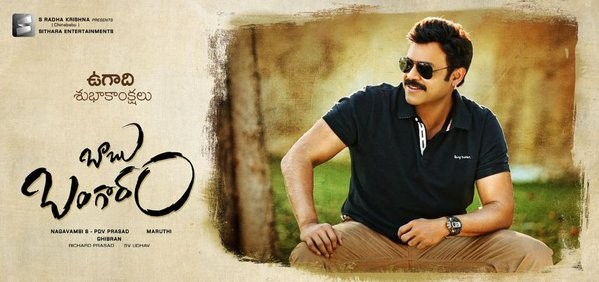
Maruthi has loaded the formulaic Babu Bangaram with lots of references and jokes that rely on Vekatesh’s earlier films and persona. But there are also some more fun and interesting supporting characters than you often get in a mass movie, and the silliness has a certain charm. And Venkatesh is just so likeable on screen that he gets away with it.

The film opens with a flashback. Ye Olden Venkatesh allows some whinging “Europeans” in a diverting selection of bad wigs to eat at his table, despite them being unwelcome in the country. He allows a pregnant woman to have surgery before himself despite being mid heart attack. So he dies a saint, revered as a truly unselfish man. Flash forward and Krishna (Venkatesh) is a policeman, with his grandfather’s soft heart as well as his looks. Indeed one of his subordinates calls him “the pity police”.

Babu-Bangaram-Krishna

After a hard day of beating up rowdies and then visiting them in hospital, Krishna is hanging out with his colleagues. He sees a woman in distress and is smitten by her integrity and her beauty, possibly in that order. Sailu (Nayanthara) is trying to keep her family together and financially viable in the absence of her father who is in hiding from crooked MLA Puchappa (Posani Krishna Murali) and his associate Mallesh Yadav (Sampath Raj). Krishna infiltrates her family in order to help solve her problem and to help himself find a wife.

Sailu sees through the machinations of her would be husband (Prudhviraj) and confronts him, making it clear that she is not interested nor is she stupid. She also says that Krishna has been helping her because of who he is and not because of an ulterior motive. Then she grabs Krishna by the wrist and drags him away. You go, girl! She’s a smart young woman, and her moments of annoyance, fear and anger are all quite proportionate to the stupidity and aggression of the men threatening her. When she finds that Krishna may not what seems she is equally firm in kicking him to the curb until he can prove his integrity.

babu-bangaram-smitten

The film is most enjoyable when Krishna is off balance and trying to woo Sailu while also doing his job and being taunted by his friends. Once the cat and mouse game with the baddies becomes the focus in the second half, the story is more prosaic and by the numbers.

The Daggubati Dance Curse does manifest in Venkatesh, although I think it has hit peak (nadir?) with Rana. But in the final fight scene, is Maruthi really saying there are few things more frightening than Venkatesh in full dance mode? Brave. And maybe true. But funny nonetheless.

One of the things I always like about Venkatesh is that he works well in an ensemble, and seems quite generous in allowing the rest of the team to take some of the limelight. He has a nice rapport with Nayanthara and while the romance between Krishna and Sailu wasn’t one of sizzling chemistry, they seemed happy and compatible. The film revolves around Venkatesh and his film legacy and his is the titular Golden Boy. There are quotes and references to his earlier films that had the audience whooping and cheering, and even some I could catch. For example, Krishna constantly indicates his dismay and regret with a lilting “Ayyo Ayyo Ayayoooo”. There is also song dedicated to Venkatesh in which Venkatesh pays tribute to himself in a dance off with an energetic hijra. The action scenes are tailored to Krishna’s preference for minimal violence, which is also a kindly approach for a hero past his spring chicken years. More than anything, Venkatesh brings both solid acting and a sense of fun to the proceedings.

Nayanthara delivers a nicely judged performance. Sailu is annoyed by Krishna stalking her, but she starts to see that he may have his uses. Like carrying her groceries. Also she observes how he treats other people and that is a good indication he is a generous and kind man. Sailu had a filmi dilemma but a realistic approach to problem solving, and didn’t just rush into peril. I also liked that while Krishna believed he could give her a better life, she actually quite liked her life and just wanted the gang to leave her, her dad, and her sisters alone. She was articulate about boundaries and what was unacceptable behaviour. She was only a little bit too glam, and I liked her sensible but pretty wardrobe that mixed Indian and Western styles. Her pretend cello playing is abysmal though.

How many times have you wondered why the hero’s friends don’t tell him he’s delusional or suggest he may need to rethink his plans? Giridhar and Vennela Kishore are delightful as Krishna’s colleagues. Giridhar’s expressions are priceless and Vennela Kishore delivers his wry one-liners with a sense of glee, eyeballing Krishna to see how much more he could get away with. They still go along for the ride, but sometimes it seems they do that for their own amusement as much as because they are contractually obliged to be supportive.

All the usual suspects turn up in supporting roles. Despite the film having humour woven into the plot, comedy uncle Brahmi wedged himself into proceedings in a mercifully brief appearance as a dodgy magician. Sampath Raj and Posani Krishna Murali are over the top and yet I liked having criminals who had small, real world, achievable objectives. I don’t think the onsite violinists and guitarists were necessary, but all evil masterminds must have their Thing and it’s hard to build a good lair in a family home. Sampath Raj’s gang also has the best and most diverse collection of bad haircuts I’ve seen in ages.  And Brahmaji maintained an impressive level of anger at everything all the time.

Ghibran’s soundtrack leans a bit too much to the cheesy ballads, but he ticks all the required elements off. The song picturisations are also cheesy, sometimes in a good way. But the more up tempo songs work a bit better as they provide a different texture and contrast to the rest of the film.

This screening had subtitles, which makes life easier for me. And the subtitle team may also have been doing their bit for the drama. In one action scene Krishna lays into his foes, leaving them dripping with what they assume is blood. But it isn’t – he’s such a softie!- it’s pomegranate juice, as he had been thumping them with a bag of fruit. Not content with that the subs explained it as “promo granite”. Now that would have hurt!

This isn’t a great movie, but it’s more entertaining and a bit smarter in some aspects than I was expecting, especially in the first half. And for a mass action romance it is quite restrained in depictions of violence, and I laughed out loud a few times. It’s all nicely packaged for the Venkatesh fans, but even if you aren’t hardcore target audience you could do worse than watch this for a timepass.