Fidaa (2017)


Sekhar Kammula’s Fidaa benefits from a talented cast and suffers from some underwritten characters and lazy plot manipulation.

Fidaa bills itself as a love-hate-love story, but I felt it was more about growing up and knowing yourself, identifying where you will and won’t compromise. Medical student Varun (Varun Tej) lives in Texas with his older brother Raja (Raja Chembolu) and younger brother Bujji. One morning they all decide Raja should get married, and minutes later he chooses Renuka (Sharanya Pradeep) on a matrimonial site. Raja goes to India to meet her, but waits for Varun to come and give the final OK. Renu’s younger sister Bhanumathi (Sai Pallavi) is naturally curious and concerned about the man her sister will marry so goes about sussing out her prospective in-laws. She and Varun fall for each other but where Raja and Renuka are easy going to the point of invisibility, Varun wants to stay in the USA and Bhanu cannot conceive of leaving home. They break up without really breaking up or talking about it, and unhappily go on with their lives. But then Renu falls pregnant and develops a mystery syndrome that lasts just long enough for Bhanu to have to go to the USA.

Considering the number of co-directors credited I half expected a lack of cohesion in the direction but not so. Visually this is a beautifully composed film, making the most of natural looking light and locations. Unfortunately the writing relies on half-baked contrivances to move the action along. The characters are not particularly well developed either.

Sai Pallavi should win all the awards for her performance as Bhanumathi. The line between uninhibited and unhinged is tricky to negotiate, but she rocks both the energy and subtlety required. What could have been a mere hair swishing manic pixie dream girl becomes a delightfully quirky and real young lady. I guessed from the audience reaction that a lot of her dialogue is in a regional dialect and there was much cheering at some of her one liners. Bhanu is doing her undergrad degree in Ag Science, and demonstrates this by driving a tractor around one field, just one muddy field, and pointing at different grains. I’d never considered the pros and cons of wearing a half-saree while driving a tractor, but here it looked stylish and appropriate. It’s easy to see when Bhanu is putting on an act but never easy to see that any part of Bhanu is a performance. Her reactions seem spontaneous and her eyes look like there is somebody home. On a shallow note, I also loved that she has minimal makeup on that expressive face, spots be damned. It’s a departure for a mainstream Telugu film heroine. And she can really dance.

Varun Tej is tall, dorky, and may never get all that hair product out. Ever. Not even vigorous frolicking in the rain could flatten that bristly up do. Varun the character is kind of bland and I never found his dreams or change of heart convincing. At first I put that down to his acting but when I considered Bhanu too, I realised that neither character had much explicit motivation or development. The film relies on the actors to make the situations engaging. Varun was just overshadowed a little, playing the slow steady counterpart to the firecracker Bhanu. He was at his most lively in scenes with her, and I liked their rapport. The fight scene seemed out of character, but Bhanu was a huge film fan so I guess that was Varun showing support in a kickarse language that spoke to her. He was less successful in the angry and emotional post breakup phase when Varun keeps taking stupid advice from a comedy sidekick. He’s lucky he inherited the smouldery Mega Eye gene for the crying scenes because it distracted me from wanting to slap him for excessive wallowing. He certainly missed out on the Mega Dance gene…or at least, he got that one from his father not his uncle.

The plot used any old excuse in pivotal moments. Renuka required 3 months of total bed rest, but then was well enough for Bhanu to leave on a roadtrip for a week (judging by the outfit changes), and then turned up heavily pregnant at home in Banswada for a wedding. You or anyone else with a pen and a post-it note could easily write six reasons that were more believable. The roadtrip was beautiful and I’m sure everyone had fun with the drone shots, but if you’re in a hurry perhaps…a plane? Investment in building up characters and relationships was notably lacking. Some of the side characters have no reason to exist other than being a sidekick or whatever. There is also a fair amount of “do as I say, not as I do” advice. It’s disappointing because there’s a whole stack of Kammula films that show he is a keen and empathetic interpreter of human behaviour. This looked like he either couldn’t be bothered or perhaps gave way to an improvised approach that fell over.

Satyam Rajesh’s Ali is one character who added no value to the proceedings. And the kid who played Bujji did nothing to diminish my dislike of high pitched overly peppy kid actors. Of the supporting actors I most enjoyed Sai Chand and Sharanya Pradeep as Bhanu’s dad and sister. I still get irritated when people in possession of all their faculties and full mobility sit and wait for their daughter to come and give them their daily essential medication, but whatever. He was a caring and quite progressive father in many respects. Renu had a masters in psych but there is no indication she will ever get to use it, or wanted to. Another why???? element in the script. But Sharanya Pradeep was calm and lovely, playing Renuka with a maternal solidity.

Shakthi Kanth Karthick’s songs were diverse enough in style that they meshed with the key scenes rather than being a musical interruption. Vachinde was suitably flirty and hectic, setting the scene perfectly. I was pleased to see both the dialogues and songs were subtitled, although the quality of the English subs was atrocious. I hope that is reviewed before a DVD release. Unless there really is a w in hellow. And I’m pretty sure Fidaa doesn’t directly translate to “flat”.

Fidaa is well worth seeing for the charm of the actors and the beautiful visuals. Just prepare to suspend your disbelief a bit. On the bright side, there were no CGI talking lizards!

Ninnu Kori

Ninnu Kori had the potential to be good. I like the concept, and it is rare to see a first love is not the only love story. Unfortunately Shiva Nirvana squandered a great cast on a badly written screenplay full of paternalistic BS.

Uma (Nani) meets Pallavi (Nivetha Thomas) when she suddenly decides he must teach her to dance. The moment he touches her, he falls in love. Pallavi takes longer to succumb, and their developing friendship and ensuing romance is among the few highlights. Uma rents the upstairs room at Pallavi’s family home, carrying on a clandestine romance under the eagle eye of her dad (Murali Sharma). Uma seems to have no family, is a PhD student with no job lined up, and he doesn’t seem inclined to try too hard. Pallavi begs him to marry her as while she will elope and upset her parents, she won’t disgrace the whole family by running away after they fix a match. He overhears her father interfering in another family’s elopement issue and the speech about what fathers know their daughters need hits home. Pallavi’s marriage is arranged in Vizag while Uma is studying in Delhi. She calls him in a last ditch attempt, but he talks over her about his own news. So Pallavi marries Arun (Aadhi Pinisetty) who seems nice despite a penchant for Disney songs. They move to the US and life is good. Until Uma turns up determined to “save” Pallavi from what he believes must be a loveless marriage.

The film sounds promising as it acknowledges that it is fine to have a past, and it is OK to move on from an unsuccessful relationship. Sadly almost every time someone made a good or thoughtful point, they then pretty much did the opposite of what they said. When Uma says not to interfere between Arun and Pallavi, the next scene is of Uma and others engineering a confrontation between the spouses.

According to Kona Venkat’s screenplay, under NO circumstances should you ask a woman what is important to her. Men must only ever discuss this with another man, preferably one with his own agenda or, even better, no idea at all. Rather than tell Pallavi the truth, Arun shared an admittedly touching scene with Uma where Uma was forced to realise he was the equivalent of a cocaine fuelled suicidal ex wannabe girlfriend. Several men in the audience applauded while I wondered why Arun couldn’t be honest with his wife but could spill his guts to the guy trying to replace him.

Shiva Nirvana takes all the cheap shots, and none of them necessary. Pallavi’s best friend Kavita had to be a fat chick and the butt of some mean one-liners. Addiction and mental illness were treated flippantly as a now you see it now you don’t excuse for Uma’s shenanigans. A black actor was cast as a knife wielding mugger while most of the other American extras were white.

At the end of the film Uma grandly states he has learned his lesson and will marry first, fall in love after. I have no issue with arranged marriages, but I take exception to the man who behaved like a dick being applauded for deciding to bestow himself upon some poor woman. He constantly put himself first, blamed everyone else if he didn’t get what he wanted, and took advantage of Arun and Pallavi’s kindness. What a catch. What a hero.

Nani is the Simon the Likeable of Telugu cinema and I blame him for making me stay beyond half time. In the first stage of Uma’s love for Pallavi, Nani plays him as a genuine, nice, boy next door type. He is playful and affectionate, and wants to get his degree and a job before marrying Pallavi. Once she marries Arun, Uma becomes an alcoholic which Nani demonstrates by sporting a beard and drinking so hard he almost bites the top off a hipflask. When Uma goes to stay with Arun and Pallavi he is all spite and manipulative snark. His snide remarks got lots of laughs but despite good comedic timing I wanted to kick him. Pallavi tells him she is happy, but Uma knows better. He couldn’t move on, how can she?

Pallavi starts out as a bit daft but eventually, perhaps in spite of the screenplay, Nivetha Thomas develops her character into a lovely young woman. Her grief at their break up and her anger at Uma’s selfishness are portrayed with restraint and judgement. When Pallavi thinks Arun has cheated, Nivetha made the melodrama feel grounded in Pallavi’s previous experience. She had some strong dialogue, and Pallavi was willing and able to articulate her feelings, but the men only listen to themselves. Pallavi was hurt to think that Uma was wallowing in pain because he assumed she was miserable while I was upset that he never listened to her.

Aadhi Pinisetty has a quiet energy that plays off Nani’s more extrovert childish antics. At first I thought Arun was a bit wet, but Aadhi shows the reaction and immediate squashing down of his feelings. He and Nivetha have a different chemistry, convincing as a settled couple. And because husbands are heroes, he also got to beat someone up. I was very distracted by his unfortunate 70s blow wave though. I’m going to blame the director because he bollocksed up so many other things he may as well cop the hair crimes too.

Tanikella Bharani is understated in a small role as Uma’s professor and mentor, in as much as a mentor calls on an ex to sort out his most brilliant student’s life. Balireddy Pruthviraj is Lovababu, Pallavi’s (comedy) uncle. I can’t really fault any of the support actors, except for the usual “any white person will do, especially one in a bikini” extras.

Gopi Sunder’s soundtrack is adequate without being memorable. The background score is hamfisted with crashing percussion to indicate drama, and strings and synths denoting romance. The visual language is clunky, and things that probably sounded cool look amateurish in execution (e.g. Uma splashing water on his face cutting to a crashing wave).  There are vague attempts to paper over some plot holes and some very awkward exposition. The pace is uneven, wallowing in Uma’s angst while speeding past pivotal moments.

The film is a mansplainer’s delight and Uma, who behaves appallingly, is constantly rewarded for being an arse. I was disappointed by Ninnu Kori, and don’t recommend it because of the stupidity and toxic messages disguised as respect for tradition and the power of love.

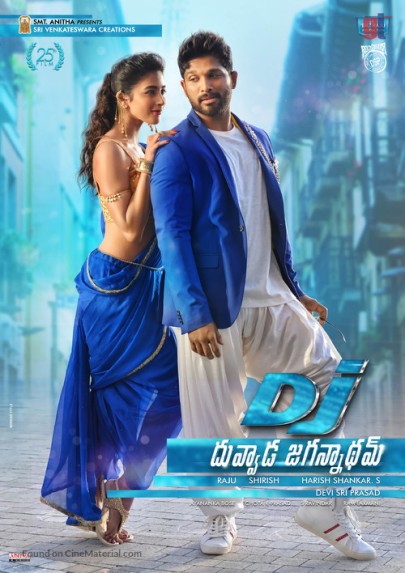
Duvvada Jagannadham (2017)

duvvada jagannadham poster

In his latest release Harish Shankar sticks closely to the standard formula for Telugu hero-centric films, which makes Duvvada Jagannadham rather less exciting than it could have been. There is hardly any suspense and few surprises as the hero flexes his muscles, obliterates the bad guys and romances the heroine while recouping lost money for the victims of a property scam. What makes it watchable are the excellent performances from Allu Arjun, Rao Ramesh and Subbaraju who add life and energy to an otherwise pedestrian plot. The story might be plodding along, but the cast give it their all, and with many other veteran performers including Murali Sharma and Posani Krishna Murali, and some good songs, DJ ends up as a reasonable timepass.

The story opens with a young Duvvada Jagannadham Sastry picking up a gun and executing a gang of thugs who attack policeman Purushottham (Murali Sharma) in his local market. Not content with his body count so far, he then turns the gun on a suspected rapist in the police station and shoots him too. Bizarrely the police officer in question rapidly recovers from his previously incapacitating wound and then doesn’t bat an eyelid at the young multiple murderer, instead enlisting him as a vigilante in his never-ending war against crime. Because of course there is nothing abnormal about a young boy killing in cold blood (and also being a fantastic shot) – not in this film at any rate.

Moving quickly among to the present day and Duvvada Jagannadham (Allu Arjun), aka Sastry is a Brahmin priest who runs an all-vegetarian catering business in Vijayawada along with various members of his family. Sastry is devout, speaks in very precise Telugu and is passionate about his cooking, although he doesn’t take life too seriously as demonstrated by a recurring joke about using asafoetida in tamarind rice. Bunny is good here, particularly with the comedy scenes and dialogue, while the trio of Sastry, his father (Tanikella Bharani) and uncle (Chandramohan) make a good team as they feed the hungry hordes of wedding guests around Vijayawada.

However, when Sastry answers his phone he becomes a totally different person – his posture is different, his voice deeper and the language less classical. Going by the name of DJ, Sastry’s alter ego is still a vigilante killer working for Purushottham eliminating criminals permanently from the streets of Hyderabad. DJ is super stylish and ultra cool, which ensures that Bunny remains ‘the stylish star’ despite spending much of the film in more traditional attire. Naturally DJ is also an accomplished killer, although quite where he learnt his skills is as much of a mystery as his motivation to cleanse Hyderabad of all criminals. The action scenes here are all beautifully choreographed by Ram Lakshman and Bunny carries out the various impalings, defenestrations and executions as smoothly and effortlessly as he performs his dance routines, and with just as much style. Sadly, there isn’t much else to the character of DJ beyond the dapper surface and efficient bloodshed. There is no rationale behind why his character is driven to such violence, particularly since he has been raised as a priest and generally seems to be a kind-hearted and benevolent priest at that. There is a brief comment by his father at the start, questioning why his son has so much rage, but this is not explored at all, and of course Sastry never shows any sign of the explosive ferocity that is characteristic of DJ.

Naturally there is also a heroine, and as might be expected from the formulaic plot, Pooja Hegde’s presence is completely superfluous to the story with her only purpose seemingly to be to appear in as many skimpy costumes as possible and dance in a few songs. The brazen character of Pooja seems unlikely to appeal to the traditionally minded Sastry, and although her designer credentials might interest DJ, her nasty, childish behaviour when they first meet is unlikely to impress. The camera spends more time focused on Pooja’s navel than on her face and it’s a shame that the only real emotion she gets a chance to display is when she’s shopping in Abu Dhabi – her excitement here is the only genuine moment her character has throughout the entire film. Still, she does look stunning, and has good chemistry with Bunny in the songs, but it’s a shame that she has no opportunity to do anything more.

DJ becomes personally involved in the case of a property scam where the real criminal Royyala Naidu (Rao Ramesh) hides behind a proxy (played by Prabhakar). Royyala’s son Chintu (Subbaraju) also becomes involved when Royyala conspires with Pooja’s father Minister Kusuman (Posani Krishna Murali) to marry their respective children. Subbaraju is excellent as a crook with an unusual idiosyncrasy, particularly in the final showdown with DJ and Royyala.

Throughout the film Bunny excels with his comedic dialogue as Sastry and does a good job of keeping the two sides of his character quite separate and different. As always his dancing is superb on every level and I did appreciate his collection of sparkly sneakers in various colours too. Devi Sri Prasad’s songs are good, although the song sequences aren’t connected to the plot of the film and seem to be simply added in as part of the standard formula – “fight scene/ family scene/ romantic moment/ song”, and repeat. However, the dance sequences add in energy and give Pooja and Sastry/DJ a chance to develop their romance that otherwise appears rather lacklustre.

Duvvada Jagannadham is disappointing, but the action sequences are impressive, the songs are excellent and Bunny is always watchable. There are some good dialogues that were well appreciated by the audience here in Melbourne, and the comedy with Bunny, Vennela Kishore as his cousin Vighneswara Sastry and the rest of the family is generally pretty funny. The major issue here is the formulaic plot and uninspiring screenplay that feels dull despite the good performances from the cast. However it’s not all bad and there are some scenes that work very well, it’s just that it doesn’t all gel together as it should. Worth watching for Bunny, the songs and the action, just don’t expect too much from the plot.