Gabbar Singh (2012)

Pawan Kalyan fans in Melbourne seem to be the loudest, the most enthusiastic and to prefer shredding rather than recycling their newspapers. The air was full of strips of paper right from the opening moments of Gabbar Singh and the paper storm continued well into the second half. A packed cinema, cheerleaders up the front to lead us in our favourite Pawan Kalyan chants as everyone pushed and shoved their way in and plenty of whistles and cheers meant a great start to another adventure without subtitles.

It’s a novelty to watch a Southern remake of a Hindi film since so often the shoe is on the other foot and after Osthe in Tamil, Gabbar Singh is the Telugu version of Dabangg. The film follows the same basic plot, but many of the other roles have been limited to allow more focus on Pawan Kalyan’s character. It’s his film the whole way through and while he has the charisma and capability to carry it off, the story loses much of its focus by dropping the back stories of Gabbar Singh’s wastrel brother and the conflicts within their family.
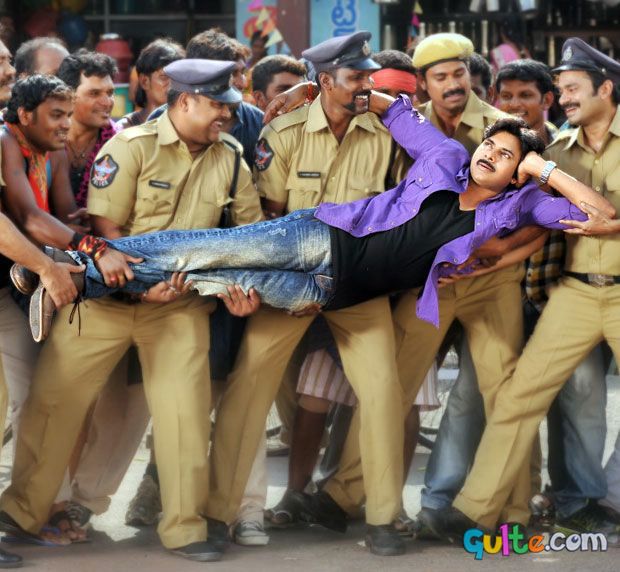
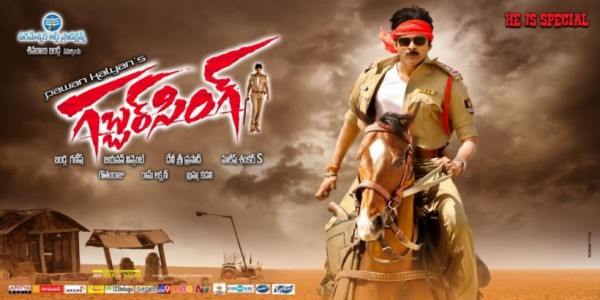
We start with young Venkat Ratnam Naidu and his stormy relationship with his adopted father Naidu (Nagineedu) who had married Venkat’s mother Suhasini after she was widowed. Naidu prefers his own son and makes no secret of the fact which gives Venkat a huge chip on his shoulder and a somewhat argumentative personality. Venkat ends up running away from his family, but returns years later as a police officer with the assumed name of his childhood hero, Sholay’s Gabbar Singh. He returns in style, renaming the police station after himself and single-handedly annihilating a gang of bank robbers after chasing after them on horseback so it seems safe to say that he’s not mellowed in the intervening years.

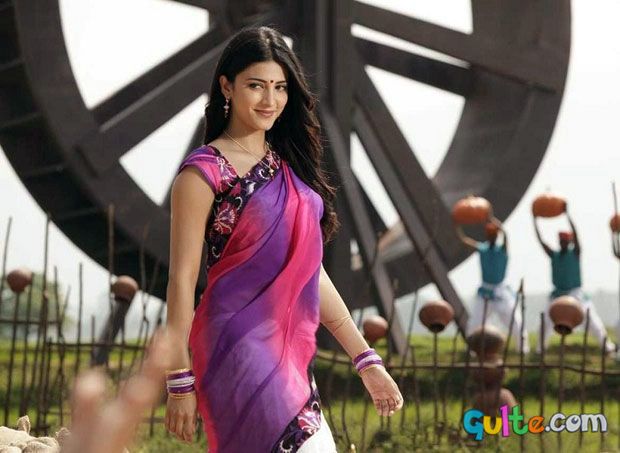
It’s not long before Gabbar Singh clashes heads with local rowdy Sidappa Naidu (Abimanyu Singh) and the feud between the two forms the plot for the rest of the film. In between all the gunfights and general mayhem, Gabbar Singh falls in love with Bhagya Lakshmi (Shruti Hassan) but her role is even more reduced than that of Rajo in Dabangg and Bhagya only appears briefly in a few scenes and a couple of dance numbers. Her friend, ably played by Gayatri, has almost as much screen time and judging by the audience reaction, seems to get the better lines too. Kota Srinivasa Rao pops up as Bhagya’s father but again the role has very little scope and he barely has any input.
Sidappa has political aspirations and Gabbar Singh disrupts his attempts to fund his career through various robberies and corrupt deals. Sidappa’s response is to have his henchmen beat him with clubs which is rather extreme but doesn’t really have too much of an effect on his arch nemesis. Abhimanyu Singh’s Sidappa is a typical Telugu goon and doesn’t have any of the flamboyance or appeal of Sonu Sood’s Chhedi Singh so the villain of the story is rather disappointing. As too is the item song. Although Malaika and the backing dancers did their best, Kevvu Keka just isn’t as catchy as Munni Badnam. I was also very disappointed that Ajay as Gabbar Singh’s brother only made a very brief appearance since he’s one of my favourite actors and I was hoping for more from him.

However the film was made totally worthwhile by a scene where Gabbar Singh forces the usual crowd of rent-a-goons to participate in a session of antakshari. This has to be the funniest piece of cinema I have seen this year and it had the crowd on their feet cheering for more! Generally the dialogue seemed to be of high quality since many of the lines had the audience applauding and both Ali and Brahmi’s comedic roles got plenty of appreciative cheers. Since I didn’t understand the dialogue I focused on the myriad of excellent details instead, such as the gun hood ornaments on Gabbar Singh’s 4WD and the incredibly happy and enthusiastic backing dancers. There is a reason why men in flak jackets are not often seen dancing and it’s a point well illustrated in the first song. Generally though the songs are good and Devi Sri Prasad’s music suits the feel of the film.
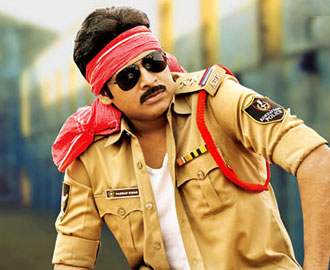
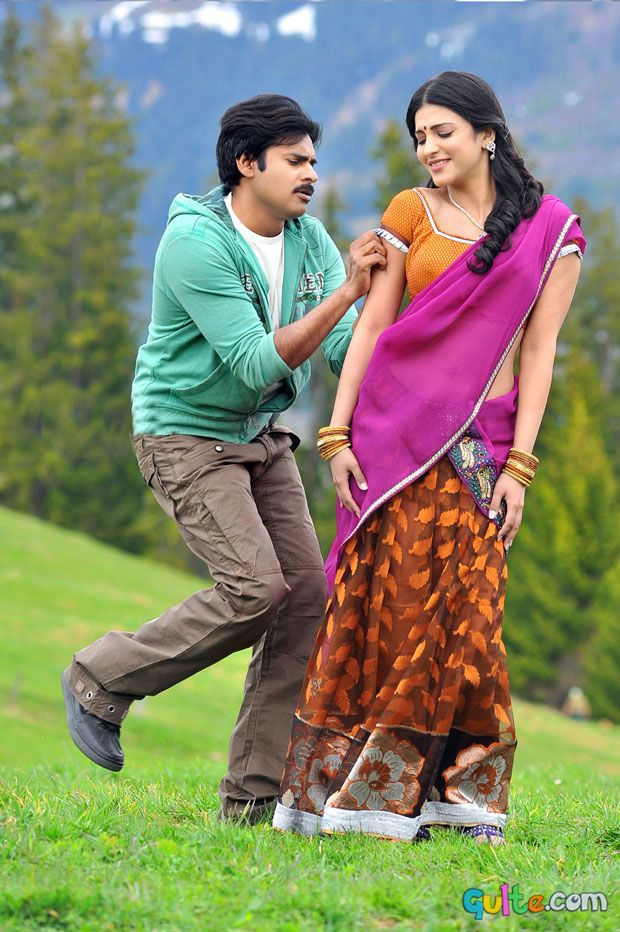
There is very little of Chubul Pandey in Pawan Kalyan’s Gabbar Singh. None of the mannerisms are there, although Gabbar Singh has plenty of the same chutzpah. The sunglass tricks are reserved for Brahmi apart from an opening scene where Gabbar Singh tosses his sunnies onto a colleagues face with impressive accuracy.  There are a few moments in one song in Switzerland where the normally smooth and co-ordinated Pawan Kalyan does seem to be channelling Salman Khan’s dance style, but thankfully not for long. I did feel sorry for Shruti Hassan dancing in the snow in sandals though.
The reason that Dabangg was such a hit was that it was a Southern style film incorporating plenty of the masala elements which have sadly been missing in Bollywood for some time with a hero who suited the part. Once that novelty element is removed and the film changed to a Southern locale and hero, the story is similar to most other Telugu films. The impact is further lessened by the South’s familiarity with the use of machetes, 4WD’s that roam in packs and acrobatic fight scenes and so Gabbar Singh doesn’t stand out in the same way as Dabangg, although it is more successful than Osthe. Harish Shankar has changed the screenplay to make the film suit his leading man and Pawan Kalyan is excellent as the unorthodox police officer in a rather more orthodox story. Gabbar Singh is still well worth a watch for his performance and I’ll definitely be looking out for the DVD to finally understand the dialogues and for that brilliant antakshari scene!

Dhammu

I’d been warned to pick up my ticket early for Dhammu and although I wasn’t expecting a big crowd given the response to NTR Jr’s last few ventures, I did dutifully turn up before the suggested start time. And the guys on the door were right. By the time the film was ready to roll, the cinema was totally packed, which meant a very loud and enthusiastic response to Tarak’s explosive entrance on screen. Despite a few issues with the sound and difficulties getting the second reel of the movie to play, the audience maintained their enthusiasm which helped turn a run-of-the-mill mass masala film into an entertaining Friday night ‘adventure without subtitles’.

Dhammu starts with a flashback, setting up the story and explaining the rivalry between two families in a rural village. Within the first few moments there is a decapitation followed by various scenes of death and dismemberment so it’s fairly obvious that this isn’t going to be a fluffy romance despite the promise of two heroines on the poster. The two families seem determined to use the Kilkenny cat principle of conquest and it’s not long before the remnants of Suman’s family are reduced to living under the yoke of Nasser’s sadistic thugs. Once the scene is set, the film jumps to the present day and Tarak enters via a suitably ridiculous leap from a window onto a black 4WD. This is the first of many such black 4WD’s that gave their lives during the making of this film, so be prepared for crashes, inexplicable explosions and general vehicular destruction often for no apparent reason other than the director seemed to feel that it was time for another car (or 3) to meet an untimely end.

Tarak plays Ramachandra, an orphan who is against violence although that’s not entirely obvious since he’s beating up bad guys single-handedly from his first appearance on screen. OK, so he does fight with his hands behind his back and shows a reluctance to actually kill anyone, but at first I took that to be a novel trick fighting technique just because it looks good.

Ramachandra meets and instantly falls in love with Satya (Trisha) and after some initial very mild reluctance she seems to reciprocate. But it looks as if the romance, brief as it is, seems doomed to failure since Satya’s father (Subhalekha Sudhakar) wants her to marry a rich guy. Trisha looks lovely in some beautiful traditional outfits, but apart from looking pretty and the odd dance routine she has very little to do. The appearance of Karthika as the second heroine seems totally redundant as she gets even less screen time than Trisha and the attempt to create some rivalry falls flat.  Karthika also has so much collagen pumped into her lips that it looks as if they might burst at any moment while she’s speaking and this is incredibly distracting, particularly since I think she looked much better and prettier in Ko.

Both Trisha and Karthika look very stiff in the Neelo Undi Dhammu song and their awkwardness seems to increase in direct proportion to the shortness of their skirts. They both do much better in the songs where they are wearing more traditional outfits and the choreography seems to suit them better too. Tarak is on excellent form in all of the dance routines and although the songs by M.M. Keeravani aren’t particularly memorable the choreography is less fixed on trick moves and more on coordinated steps which look very slick. The only exception is the song Ruler which has little dancing and lots of CGI which looks rather out of place compared to the rest of the film.

By some means Ramachandra’s friend (Ali) learns of a rich family looking for a son to adopt and Ramachandra promptly applies to become a member of the Vasireddy family, adopting the name Vijayadwaja Sri Simha. However it’s not long before he discovers the drawbacks, namely being expected to resolve the feud between the two warring families once and for all as well as dealing with his entire extended family.

The fight scenes are the best part of Dhammu which is fortunate because there are quite a few. Tarak is often shown in slow-motion leaping and pouncing like his adopted family mascot of a lion and it works well. Mostly the fight sequences are totally over the top and unrealistic but they are expertly choreographed by Ram-Lakshman and look fantastic. People ricochet off cars, buildings and other people if they don’t happen to hit anything else in the way, or bounce off the ground in totally gravity defying ways which most of the audience seemed to find as entertaining as I did. There are lots of declarative speeches in between the various bouts of mayhem which generally went down well too, although there were a few scenes where they slow the pace considerably and it takes a while to pick up again.

The supporting cast are all well known actors and generally do justice to their roles. Kota Srinivasa Rao is familiar as the aging patriarch, while Tanikella Bharani, Suman and Sampath Raj all appear in small roles. Nasser is good as the slightly psychotic head of the opposing family and he also sports a wild and strange moustache which looks incredibly impractical. Ali is fairly inoffensive as Vijay’s friend and he got plenty of laughs from the audience, although his comedy did seem rather muted. Brahmi pops up for a few scenes but I couldn’t work out exactly what his role was in the Vasireddy family and he had very little impact. Venu Thottempudi also makes an appearance as a member of the Vasireddy family and was good in a brief but important appearance.

Overall Dhammu has nothing new to offer and relies heavily on NTR Jr to make the most of an overused storyline with standard masala ingredients. There are plenty of good moments and NTR Jr puts in an impressive performance but there isn’t anything to make this film stand out from other similar action movies in his filmography. It’s not brilliant but it works well enough as a mass entertainer, especially with an appreciative audience and I’d recommend watching at least once for Tarak, his dancing and some excellent fight scenes!

Grahanam

Grahanam is about superstition, mistrust and sex. The story is based on a novel by Telugu writer Gudipati Venkatachalam, also known as Chalam, adapted and directed by Mohan Krishna Indraganti. The story follows the aftermath of superstition made fact by belief.

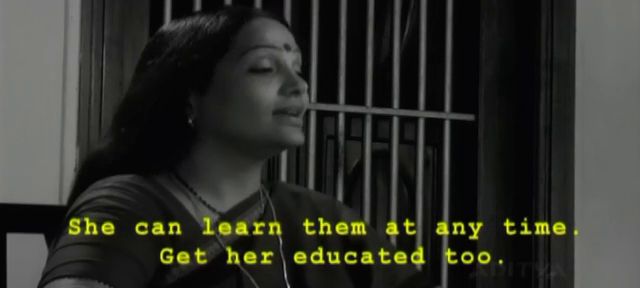
Set in a village in the recent past, the story has a timeless feel. Saradamba (Jayalalitha) is the wife of Swamy (Tanikella Bharani). They are the premier family in the village, and she is renowned for her charity and community support. Kanakayya (Monish Thallavajhula) is a poor boy with academic promise. Saradamba provides a meal for him each day, and is clearly fond of him. She is a strong advocate for education, and encourages the villagers to send all their children to school.

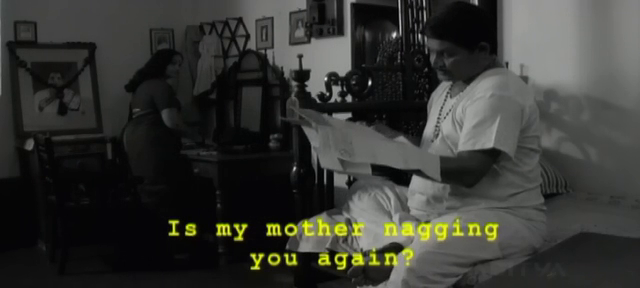
Swamy lets his wife deal with the daily routine, trusting her to do the right thing for the family prestrige.  Sarada is adept at biting her tongue when her mother-in-law is demanding, and has a strong sense of duty. Their relationship seems happy enough, and there is certainly a strong physical chemistry. They joke about his tyrant of a mother, tease each other about their marriage and seem to be compatible. Sarada is not above flirting to get her own way, but Swamy doesn’t appear to mind one bit.

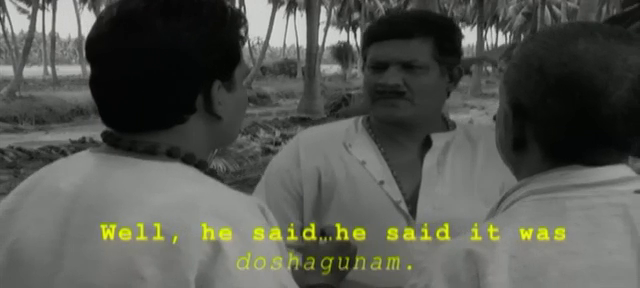
All seems tranquil. But Kanakayya falls ill with a fever and conventional medicine doesn’t seem to be helping. His uncle suggests consulting Gopayya (Sundaram Thallavajhula), a Kali devotee from the next village, who is purported to be able to cure mystery illnesses. Gopayya’s diagnosis is the catalyst for major drama. He says Kanakayya is sick with ‘doshagunam’, explained as an illness caused by having sex with an older woman.


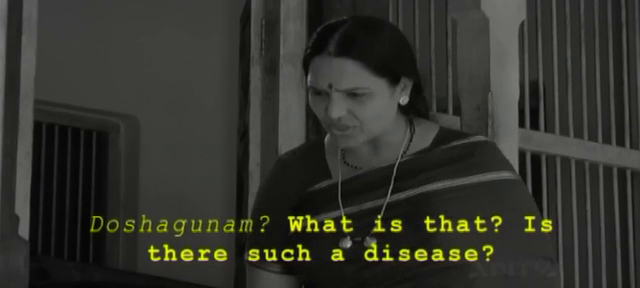
No one seemed to have heard the word before, but before long it is bandied about as though it is an established fact. Kanakayya’s parents reject the idea that their son would have done anything immoral, but he continues to sicken. In desperation, they seize on the cure Gopayya prescribes – a cure that requires blood from the thigh of the woman who ‘infected’ him.

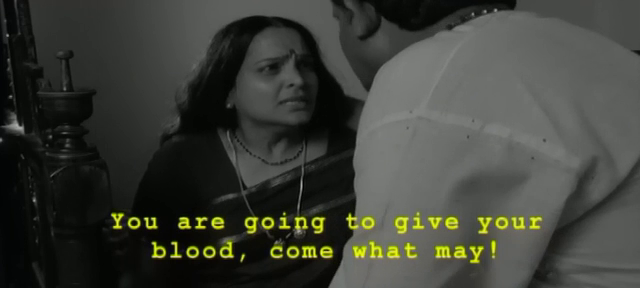
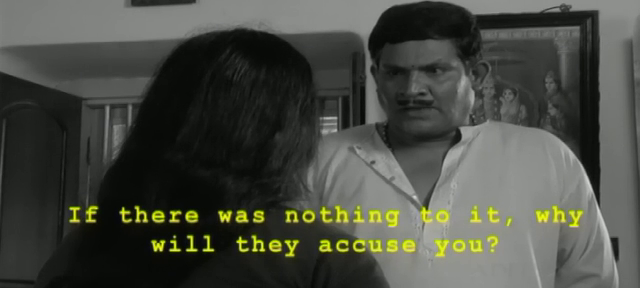
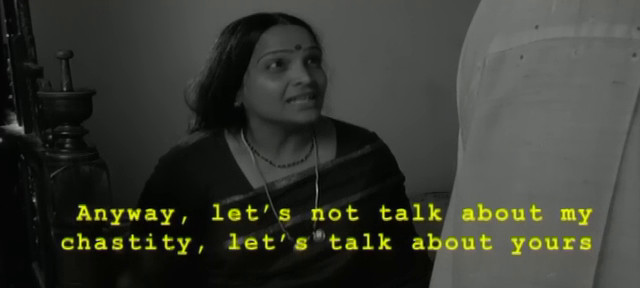
Suspicion falls on Saradamba and all the small kindnesses that used to be evidence of her charity and good nature are now seen as proof she seduced the boy. Lapses in protocol are twisted to show she was betraying her husband. Swamy is plagued by doubts. He accuses her of lying, of whoring behind his back and ruining his prestige. Sarada denies the accusations, but is she really as innocent as she claims?

The crux of the story is that a rumour, a suspicion, a superstition can take on a life of its own. Women are spoken of as impure, carriers of sin and ruin. Their sexuality is toxic and men cannot save themselves from a predatory woman. People are all too ready to believe the worst and seemingly only because she is female. Once Saradamba is accused, she is attacked verbally and physically. The damage done is real, regardless of the reason. But why are people so ready to believe in ‘doshagunam’ and to accuse a previously blameless woman?

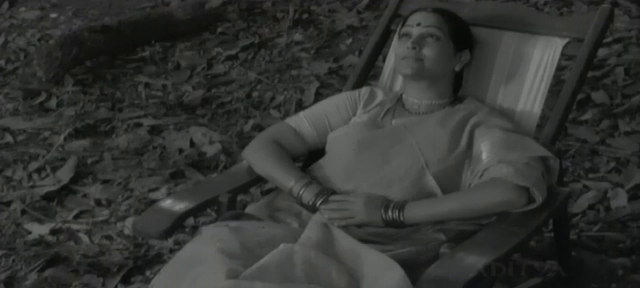
The story develops through a flashback structure, narrated by Surya as Doctor Raghu. This allowed me to work out the internal chronology of the story. The black and white film does give a sense of things happening a long time ago, but the events are quite recent. I thought this device worked well as it made the point that while Saradamba and Kanakayya’s story may be set twenty or thirty years ago, it’s not that remote from the present day.  A short segment in colour adds a dreamlike note and made me question my assumptions about some relationships.

Tanikella Bharani is excellent as Swamy. He shows the doubts and frustration gnawing away and the bitterness that creeps into his marriage. His confrontations with Sarada are threatening and venomous. Even though I thought Swamy was a fool at times, I could see the way the rumours poisoned his mind, and his resistance disappeared. It’s an unsympathetic role in many respects but he gives Swamy a dimension of sweetness that made me see what Saradamba saw in her husband, and made their estrangement even more painful. And after seeing him play uncle, sidekick or victim in so many films I really liked seeing him in a leading role for a change.

Jayalalitha is well cast as Saradamba. She has an earthy sensuality and a physical confidence that suits her character, and she dominates the film. When she is on the verge of losing her home and family she seems almost feral – all teeth and claws.  The confusion and indignation are evident but Jayalalitha also creates some ambiguity with her reactions and expressions. Those slight hesitations and the glimpses of behaviours that could be open to different interpretations or doubt were really well done. It meant that the story was a bit more complex than a ‘pure woman is besmirched by rumour’, even though my sympathies lay with Saradamba. I questioned whether I completely believed her, if she had done anything ‘wrong’, and if she had seduced the boy did that warrant what was happening.

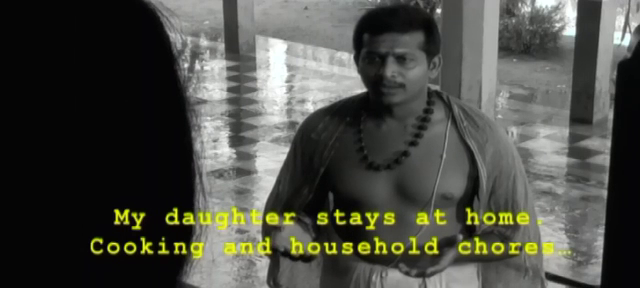
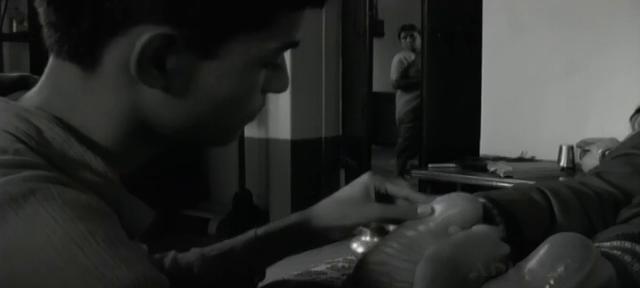
The black and white film is very atmospheric but the garish yellow subtitles on my DVD were a bit distracting. The interiors and doorways provide a frame or concealment, alluding to the secret lives of characters. Even the ornately carved bed changes from bed to barrier over time. The physical environment is used to illustrate the mood and emotion of the inhabitants. The camera sometimes sneaks up behind characters, sometimes settles in amongst a group of people talking or takes on the role of an observer judging what it spies. It adds a dynamic note to what is a very dialogue based movie.

I can’t opine as to whether it is a good adaptation of the original story, but there is a literary flavour to the dialogue and the concepts are clearly articulated. The dialogues are strong and meaningful, and reveal a lot about the people speaking. Mohan Krishna Indraganti seems to have an interest in what makes people tick and there are also scenes with no dialogue where small interactions, or reactions, speak volumes. I have seen Ashta Chamma and Golconda High School and I think his translation of story to screen is becoming more assured. I like his interest in everyday type people, and seeing what they do when confronted with a challenge or problem. The supporting cast are all very good but the focus is on Jayalalitha and Tanikella Bharani.

This isn’t the kind of film I want to watch every day as it is a bit self-consciously artsy and I alternated between being depressed and angry as I watched it. But I was interested to see a non-commercial Telugu film, and to see character actors take on leading roles. The story kept my attention, and made me think as well as made me want to throw things at the screen. It won a swag of awards and I can see why so many people have recommended it to me. 3 1/2 stars.

Katherine at Totally Filmi is coordinating a month long celebration of women in Indian cinema. Links will be collated at Delicious so keep an eye on that page for lots of other articles and blog posts to be added throughout March.