Mom (2017)

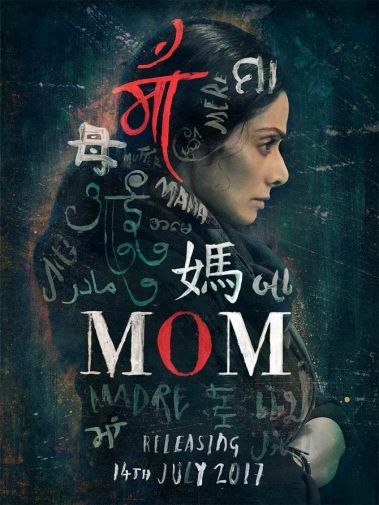
Mom

Mom starts out with an interesting take on the step-mother/daughter relationship but takes a turn midway to end as a standard revenge film with a haphazard second half and an overly mawkish finale. Thankfully Sridevi is outstanding as the mother hell-bent on revenge, and Sajal Ali, Nawazuddin Siddiqui and the rest of the cast are all excellent, making Mom better than average, despite the film’s flaws.

The first half of the film explores the tension between Devki Sabarwal (Sridevi) and her step-daughter Arya (Sajal Ali). Arya is the daughter of Anand (Adnan Siddique) and his first wife, and she bitterly resents Devki for taking her father away from her and her memories of her dead mother. Although Devki and Anand have been married long enough to have a child of their own, Arya still isn’t reconciled to her step-mother and the resulting acrimony affects every moment the family spends together. Adding to the tension is the fact that Devki is a teacher and Arya is a student in her class which allows Arya to continue the teacher/student formality even when they are at home by always addressing her step-mother as ‘madam’. The difficulties of dealing with a moody and resentful teenager are compounded by Arya’s animosity towards her stepmother, while Anand is caught in the middle trying to keep the peace. Generally Anand is a passive character who drifts along seemingly not too bothered by his daughter’s rudeness which I presume is to allow Devki the space to take centre stage later in the film. However, the relationship between Devki and her step-daughter is handled well with the family dynamic appearing authentic and the dialogues realistic, and perhaps it’s not too far a stretch that Anand avoids the situation at home rather than getting too involved.

Everything changes one night when 18-year-old Arya goes to a Valentine’s Day party at a farmhouse and doesn’t return home. She is abducted by four men in a black four-wheel drive, and Ravi Udyawar brilliantly builds and maintains the tension as he switches between a frantic Devki desperately trying to contact Arya by phone and horrifically effective overhead shots of the vehicle slowly cruising along deserted roads. The soundtrack adds to the sense of menace and there is a chilling, heart-stopping moment as the car stops and the men change who is driving. It’s horrifying because we know what is happening but all the more effective as nothing is ever shown of the violence until Arya is dumped at the side of the road.

Reading about the film and watching the trailer I was worried that Mom might go down the route of so many films about rape but Ravi Udyawar gets this part of the film totally right and sensitively handles an assault which is too often inappropriately sensationalised or set up to blame the victim. The anguish and despair felt by Devki is also well portrayed, as is Arya’s reaction, while for a change the police are rather more sympathetic although the process of gathering evidence does seem fatally flawed.

When the courts offer little in the way of justice, Anand puts his faith in an appeal and a more rigorous series of tests, while Devki has a more practical approach to her daughter’s rapists gaining their freedom. Anand’s reaction here does seem rather less plausible, but to some extent does fit with his earlier ‘ostrich in the sand’ approach to his daughter. Devki is aided by a private detective, Daya Shankar Kapoor aka DK (Nawazuddin Siddiqui) who is sympathetic to her mission. But with detective Mathew Francis (Akshaye Khanna) suspicious of Devki and Arya still as distant as ever, it seems that Devki has set herself an impossible task when she sets out to seek revenge.

Devki is shown as a strong character right from the beginning. She promptly and efficiently deals with an unpleasant incident in her classroom and appears determined to break down the barriers between herself and Arya, despite her step-daughter’s frosty attitude and carefully maintained distance. Sridevi looks radiant too while the scenes between her and Adnan Siddiqui have a genuine warmth and easy affection that speak of a good relationship. After the assault, her reaction to her daughter’s injuries is wonderfully histrionic but perfectly apt for the situation while her trepidation and uncertainty come across clearly as she embarks on her revenge. However, the screenplay doesn’t help here as DK insists that they meet in secret and the pair then proceed to arrange rendezvous in conspicuous public places where they speak to each other without seeming to take any precautions at all. Even the association with DK seems rather unlikely given their first meeting, but Nawazuddin Siddiqui runs with it regardless and manages to give his character plenty of appeal despite his slightly disreputable appearance. His DK is a more sympathetic character than first appears and he is excellent at conveying his own horror and understanding of the situation to Devki. The dialogue between the two tries to give some rationale for Devki’s actions and there is plenty of symbolism included during their meetings, but it’s really the performances from the two actors that allow any suspension of disbelief and make it even vaguely possible that Devki could act as she does.

Akshaye Khanna does the best he can with the role of the police officer assigned to Arya’s case but his character has little to do and doesn’t seem to know which side he should be on either. Mathew Francis seems to be a capable enough office but his investigations are only shown briefly and he never seems to be a serious threat to Devki’s plans. I also have some issues with the portrayal of transgenders and the completely evil nature of Abhimanyu Singh as one of the perpetrators which seems too over the top in a film that already has plenty of extreme emotion.

Anay Goswamy’s cinematography is excellent and the music from A.R.Rahman evocative and perfectly suited to each mood of the film. Where the film falls down is in the predictable nature of the second half and its failure to address the topical issue of violence against women except by suggesting the usual vigilante payback as the way to go. Naturally it makes for a more exciting film this way, but it would have been more satisfying to see more of the family’s reaction, more of Arya’s own story and her father’s struggle for justice. Better too, if Ravi Udyawar had stuck to the fractured relationships and the impact of assault, rather than following the well-trodden path of failed justice and pay-back. Even the scenes of revenge (as clichéd as they are) are glossed over swiftly and the police investigation relegated to a few brief dialogues with a bizarre about-face by Detective Mathew Francis appearing out of the blue, just in time for the film climax. Sridevi is always worth watching, but her co-stars here are all equally good, even though Girish Kohli’s screenplay limits their contribution to the story. Worth watching for the excellent performances, technically good presentation and well executed first half, just don’t expect anything more than a typical masala ending.
Vasantha Maligai (1972)

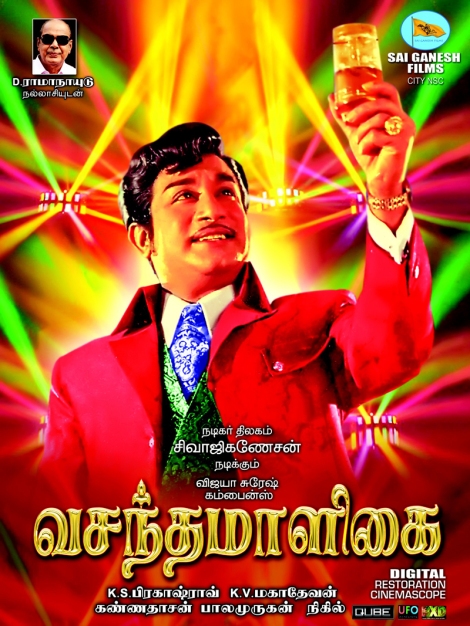
Poster

It’s been a while since I watched some seventies masala, and what better way to indulge than K.S. Prakash Rao’s wonderfully dramatic Vasantha Maligai. Sivaji Ganesan and Vanisri star in this adaptation of Koduri Kausalya Devi’s novel about a rich prince and his romance with a middle class woman working to support her family. Like all good masala films there is a dash of everything – romance, tragedy, filmi medicine, an evil overlord, oppressed villagers and even a comedy cook, but it’s the performances from the cast along with some beautiful songs that make Vasantha Maligai well worth a watch.

Anand (Sivaji Ganesan) is the alcoholic younger son of a royal family and the film opens with a song detailing his drunken antics on a plane where Latha (Vanisri) is working as an air hostess. The opening scenes focus on Anand with Latha merely a figure in the background concerned about fastening seatbelts when the plane hits turbulence, so it’s a surprise when the next scene shows Latha returning home to her family and attention moves to her situation. I like this way of building anticipation for the next meeting between the two, while providing the back story that establishes Latha’s character.

Latha is the main wage earner in the family as her brother (Sreekanth) is a wastrel and her father (Major Sundarrajan) is crippled from an accident. Her mother (Pandari Bai) is unhappy about Latha’s job and persuades her to look for something safer where she doesn’t have to risk life and limb in an aeroplane every day. However, Latha’s subsequent venture into employment turns out to be much more dangerous than her work as an air hostess and Anand returns to the story when he rescues Latha from her amorous new boss. Anand just happens to be grooving the night away in the same hotel celebrating his birthday party, and our hero is such a style icon that he even takes time during the ensuing fight scene to fix up his hair – such panache!

Despite his drunkenness and playboy appearance, Latha accepts a job as Anand’s personal secretary where her kind heart and overall decency start to have an effect on his behaviour. However Latha is also proud and her self-esteem leads her to appear arrogant, particularly when she clashes with Anand’s servant and drinking buddy Panchavarnam (Nagesh). Nagesh is determined to keep Anand drinking to ensure his own supply of grog, while Latha is equally determined to wean Anand off the demon drink and make him a useful member of society. In the end it’s Latha’s concern for his well being that starts to win Anand over but it’s not until he injures Latha during one of his drinking binges that he finally starts to mend his ways.

While Anand is intent on drinking himself into an early grave, his elder brother Vijay (K. Balaji) terrorises the local villagers who work on the estate. Vijay is a nasty piece of work and Balaji has a great demonic laugh and seems to be thoroughly enjoying his role as a brutal despot. His wife Vimala is equally evil and plots to get rid of Latha before she can redeem Anand, although whether this is to keep her husband in control of the estate or just because she is a horrible person is hard to decide. I’m not sure who the actress is playing Vimala but she has a great sneer and is wonderfully condescending in her attitude to just about everyone else although she does seem to care for her husband and child.

Her concern is valid since Anand secretly builds a wonderful palace for the woman he adores, although he refuses to name her until the building is complete – no surprises for who his secret love is, although he does win marks for the way he finally reveals his love.

I know tastes were different back in the seventies but even then surely this would be considered over the top pastel décor:

There are endless ornate pillars, arches, and latticework with tacky silver statues practically everywhere. The indoor pool has giant lotus flower fountains, and the room where Anand reveals the face of his true love is full of mirrors (expected) and revolving pillars (totally unexpected) that don’t seem to have any purpose whatsoever. And what else will they ever use this room for? Latha however is enraptured by the palace and the discovery that Anand loves her, ending up leaping through the gardens in true masala romance style in the gorgeous song Mayakkam Enna.

However there is still a long way to go before the end and Vimala and Vijay manage to turn Ananad against Latha, ultimately resulting in Anand becoming very ill. According to his doctor his cough and general malaise are caused by his sudden drop in alcohol consumption, and no-one ever mentions his chain smoking habit as a possible issue. Aah – the seventies – life was so much simpler back then – unless you were the heroine in a masala movie of course. Poor Latha has many more trials and setbacks to endure before true love wins out, and she has plenty of opportunity to practice her emoting skills while enduring gallons of fake tears. Although she does have the benefit of industrial strength no-run mascara to ensure her make-up stays perfect despite all the crying.

Sivaji Ganesan is perfect as the hero and makes the most of both his drunkenness and his illness later in the film. He spouts dramatic lines and clutches at his chest, a convenient pillar or a chair while gazing adoringly at his glass of brandy one minute, and then switches to amused indulgence as he watches Latha try to make him work the next. It’s not all just over the top drama either, he does have some moments where the subtle raise of an eyebrow is just as effective as his later histrionics and he manages to make his character more than just a typical rich playboy. Balaji too is effective in his role as the elder brother, although I would have liked to have seen a little more interaction between the two brothers.

Vanisri looks gorgeous and wears some stunningly beautiful saris that stand out, even in the opulent surroundings of the palace. She does wear a couple more than once too, which fits nicely with her character needing to work for a living. Her Latha is a determined young woman with plenty of attitude and no tolerance for bad behaviour. I like that even when she is distraught she still fights back and has no hesitation in saying what she thinks, no matter who she is speaking to. She has good chemistry with Sivaji Ganesan too, and the romance between the two works well despite the limited time they have together as a couple.  The support cast are all good too, with Nagesh a good fit as Anand’s upstart servant, although the comedy track between him and the cook (V.K. Ramaswamy) is rather less successful.

The songs by K.V. Mahadevan are beautiful and T.M. Soundararajan provides the voice for Anand, ensuring the songs are just as dramatic as the action.

The film looks gorgeous too – the colours of the fab costumes are vivid and bright, even in my unrestored copy and I love the seriously over the top décor of both palaces. The bar in the palace is as seedy as in any hotel, Anand’s bed is a glorious ornate version of a gondola, and I almost didn’t notice the stuffed animals in the main hallway with the enormous and imposing staircase taking centre stage. This is exactly what I want from my masala films – determined hero, tragic heroine, plenty of melodrama, beautiful costumes and sumptuous settings. Vasantha Maligai delivers on all fronts and is even more readily available now that the film has been digitally restored and re-released. Highly recommended. 4 stars.

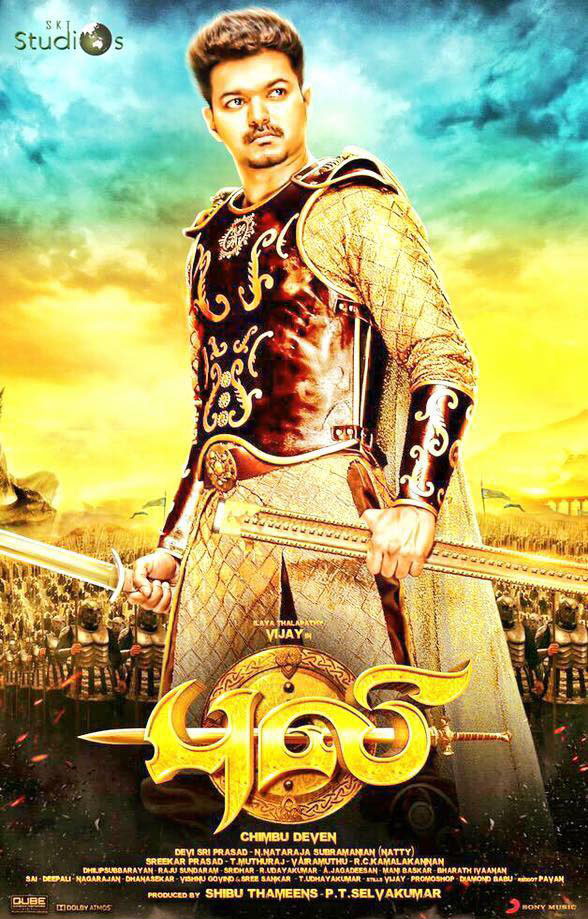
Puli (2015)

Puli

Chimbu Deven’s latest film may be set in a fantasy world of strange creatures and magical beings, but the story itself is mundane without any of the epic sweep required for such a tale. It’s also slow going, with most of the first half a dreary romance between Marudheeran (Vijay) and Pavazhamani (Shruti Haasan), although it does improve post interval once Sridevi and Sudeep appear onscreen. Despite the numerous fight scenes and explicit violence, the simplistic plot seems to be aimed more at children, with every obstacle easily overcome and the obvious outcome never in any doubt. That may also explain the relatively bloodless scenes of dismemberment and general carnage that would more usually be awash with gallons of fake blood, but instead the fight scenes here are frequently lacklustre, dull and repetitive. However there are a few reasons to watch, mainly down to Sridevi in her extravagantly evil queen avatar, good special effects and the always reliable Sudeep and Vijay.

Puli tells the story of a land which has been invaded and settled by a race of demons, who have enslaved the native humans. These Vedalam are easily recognisable by their blue eyes, tendency to sprout fangs when annoyed and ability to fly though the air, although their spiky armour and general arrogant grumpiness are a more distant and therefore safer method of identification. The young Marudheeran arrives in one of the subjugated villages as a baby, floating in a basket on the river, along with a mysterious egg that hatches into a talking bird. The talking bird is pretty well done as far as special effects go, and I was expecting it to be important to the plot in some way, but it really isn’t. Even though there is a sort of reason for the bird’s inclusion at the end, basically it’s a very under-utilized special effect that didn’t need to be able to talk and doesn’t get much chance to do so anyway. Overall this illustrates the problem with most of the special effects in the film. Although they are well done, the effects dazzle for a moment but are then relegated to background noise and ultimately have little to add to the plot. It’s a shame as the film looks fantastical but the uninspired story keeps it earthbound.

Marudheeran is adopted by one of the villagers and is trained by his stepfather in fighting and disguise as part of a general communal wish to overthrow the demons. However once Pavalamalli (Shruti Haasan) returns to the village, Marudheeran spends his time chasing after his childhood friend, much to the displeasure of her parents. Just as Marudheeran and Pavalamalli get married in secret, she is stolen by the demons and Marudheeran sets out with his trusty friends Thambi Ramaiah and Sathyan to rescue her from the impregnable city of Vedalakottai. They plan to disguise themselves as demons to get into the city and then hope they can find Pavalamalli and get out again, but that’s it in terms of preparation. There is no attempt to deal with the epic scale of such an endeavour and make the journey and planning part of the adventure. This means there isn’t any sense of danger or excitement, just a pedestrian slog to find the city and rescue the girl. Nothing new, and could just as easily have been set in the present time anywhere in India with much the same plot and ending.

Still, there are plenty of good ideas in Puli, it’s just that they get such short shrift and don’t have as much impact as they should. For example, Marudheeran and colleagues meet a race of miniature people where there is a brief ‘we can show you the way’ moment and then the little people are used mainly for comedy. However the effects and the cinematography are once again very good, with clever use of seeds and leaves as clothing, and wonderful peanut shell blouses that are simply inspired!

https://www.youtube.com/watch?v=hUuOW7-5hkc

Unusually, Vijay doesn’t fit as the hero of the film as well as he should, at least initially. His introduction and the subsequent fight scenes establish his character as more of a trickster and comedian while his pursuit of Pavalamalli is pedestrian and lacking animation. It’s not until the second half of the film where he comes up against his nemesis General Jalatharangam (Sudeep) that Marudheeran starts to properly fill the role of the warrior hero and Vijay gets a chance to throw his energy fully into the part. Just about at this time though there is a flashback sequence where Vijay plays his father – a man born to be in a shampoo commercial and doomed by his reliance on slow-mo fighting and accompanying wind-machine. I did appreciate Vijay’s mastery of the hair toss though and once he gets into full warrior mode, there is no stopping him.

Sudeep is good in a role that lets him convey volumes with just a look and a sneer, although he really needed more time onscreen being evil to make his character thoroughly despicable. Jalatharangam is a fairly standard villain but Sudeep imbues him with an arrogant coldness that works well and there’s just enough sliminess added for good measure. Sridevi too makes the most of her role as an evil queen and shows what a fantastic actor she is even with her limited time onscreen. She totally owns each scene when she appears and her sweeping presence lifts the energy of the film. She has the best costumes and stunning make-up but these go almost unnoticed beside her commanding presence and expressive eyes. And she plays a harp – perfect! I hope this, and her recent appearance in English Vinglish mean that we will get to see more Sridevi films in the future – she is the best thing about Puli for sure.

Hansika Motwani plays Queen Yamanadevi’s daughter and at least Chimbu Deven doesn’t make the mistake of trying to get her to actually dance in any of her songs. Hansika looks good and has an amazing peacock outfit at the end but doesn’t do much else of note in the film, although she does manage better chemistry in a few brief moments with Vijay than Shruti does in an entire romantic song. Overall Devi Sri Prasad’s songs are fairly uninspiring and the choreography rather repetitive, but Vijay is energetic and the backing dancers are enthusiastic in a range of diverse costumes.

Except for Sridevi, Puli mostly disappoints with a weak story and fairly nondescript songs. Sudeep and Vijay are fine but both characters need better definition and depth rather than simply relying on the ability and star power of the actors. Both do what they can, but the film could have been so much better with just a little more complexity. Good cinematography from Natarajan Subramaniam and great visual effects make Puli worth watching on the big screen but probably only for fans. Otherwise probably best to wait for the DVD where the fast forward button will make Puli a more enjoyable watch.