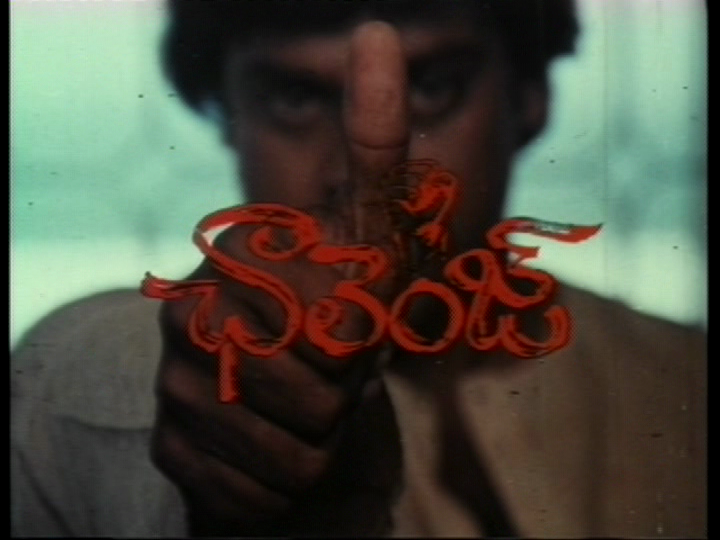
Challenge (1984)

Although the title conjures images of martial arts films and to me sounds as if it should be about a physical fight, Challenge begins rather conventionally with a dying mother whose son is desperate to get her medicine. However it quickly evolves into a more social drama as Chiranjeevi’s ambitious young entrepreneur Gandhi bets rich industrialist Ram Mohan Rao that he will make 50 lakh in 5 years despite his unemployed status. With Rao Gopal Rao, Vijayashanti and Suhasini Maniratnam along for his journey from rags to riches the film touches on poverty and unemployment, workers’ rights and even industrial espionage as Gandhi rises to his Challenge.

The opening scenes introduce Gandhi as a smart but penniless man who isn’t the type to back down or give up easily.  After his mother dies, he uses his intelligence to wheedle money for her funeral from Ram Mohan Rao’s daughter; but for all of his brain power Gandhi isn’t very canny and is easily swindled out of his windfall by the hospital mortuary attendant (Sai Kumar).

Although this introduces Mohan Rao and his ‘money can buy anything’ approach to life as well as his beautiful and more compassionate daughter Harika (Vijayashanti), both the money and Gandhi’s speech to the attendant become important towards the end of the film. I haven’t been able to read Yandamoori Virendranath’s original story but the screenplay uses a number of such incidents where apparently trivial events are used to illustrate different facets of Gandhi’s character and their importance to the plot only becomes apparent later on. It’s all very cleverly done, and I did have to go back and re-watch some of these early scenes to pick up on all the details, although perhaps I was just a little distracted by Chiranjeevi’s dancing!

Gandhi is a graduate with a first class degree and somehow feels that this means the government owes him a job. In fact he’s quite belligerent about his lack of employment but is rather taken aback when Lakshmi (Suhasini Maniratnam), a girl he has rescued from the river, takes him to task about his attitude.  It turns out that Lakshmi is a graduate herself, but rather than complaining about the lack of opportunity is working in a number of different jobs to maintain her independence. Her basic belief is that it’s more important to earn a living than worry about the status of the job and since she has such a practical and pragmatic attitude also sees no problem with offering space in her house to Gandhi. Although Gandhi is initially shocked by the suggestion that he should move in with a single girl, Lakshmi solves the problem by telling him not to think like a woman which quickly stops his objections. This song is another daydream and I do like how Suhasini gets to dance on Chiru’s back!

Gandhi ends up applying for a job with Ram Mohan Rao but at the interview is humiliated by the company owner, who is furious that Gandhi sent in his application without a stamp. However Gandhi is just as angry about the trickery used in the job advert and goads Ram Mohan Rao to such an extent that he challenges Gandhi to prove that money is not important. Gandhi vows that he will earn 50 lakh in 5 years and such is his belief that Gandhi will lose, Ram Mohan Rao promises the hand of his daughter Harika in marriage if Gandhi succeeds.
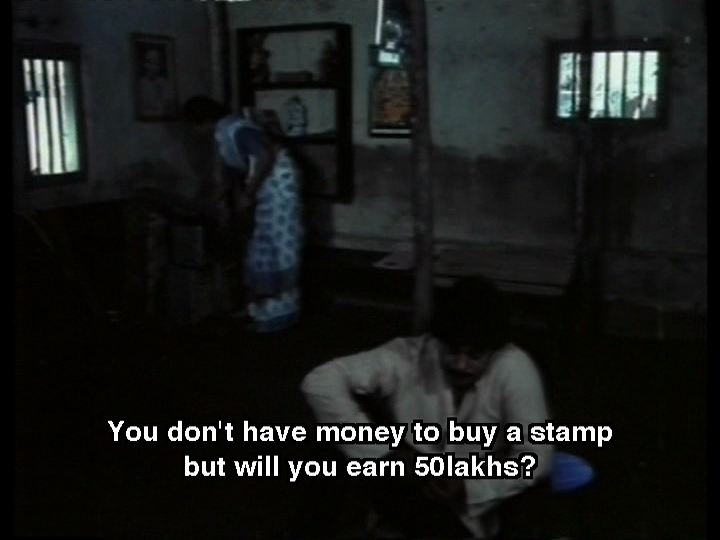
Game on then!

Gandhi makes the important distinction that he will make the money legally, although not necessarily honestly and with a coin he has been given by a beggar woman, he begins his rise to riches. However, as he becomes wealthier his attitude changes and he becomes more and more fixated on the money until nothing else, including his relationship with Lakshmi, seems to matter. Indeed it’s not even the money, but rather beating Ram Mohan Rao which becomes the driving force behind Gandhi’s various plans. This then is the real challenge –can Gandhi stay true to the ideas and principles he had as a poor man or will the power of wealth corrupt his values?
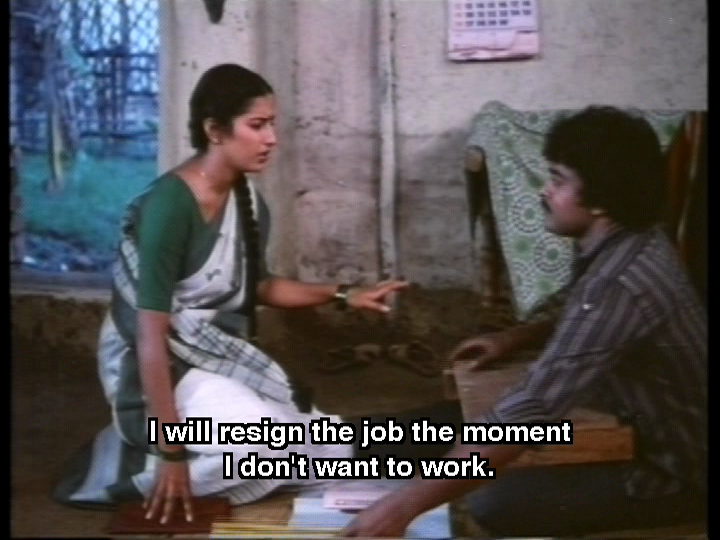
Lakshmi isn’t the only woman having some issues with Gandhi’s wager. Harika is initially appalled at her father’s pronouncement but as she meets with Gandhi, she gradually falls in love with him (who can blame her!) and she actively starts to help his cause. Since Ram Mohan Rao’s first action was to rip up the contract and set his goons after Gandhi, Harika has plenty of work to do in foiling her father’s plans to ruin Gandhi’s various business ventures. While Gandhi seems determined to win the bet and therefore marry Harika, he is still living with Lakshmi – although the two seem to have a strictly platonic relationship. To add more confusion, Lakshmi’s brother Hanumantha Rao (Gollapudi) and his wife Priyamvada (Silk Smitha) move in with Gandhi and Lakshmi. Hanumantha is secretly working for Ram Mohan Rao, while Priyamvada has designs of her own on Gandhi which seem to involve a rather short red toga and a rendezvous in the desert!

Chiranjeevi is riveting as Gandhi and his portrayal of the drive and determination with which Gandhi meets his various challenges feels authentic. Chiru made me believe in every aspect of Gandhi’s moral and physical struggle and I think this is one of his best performances.  A. Kodandarami Reddy has done a great job of developing such a complex story and has put a lot of detail into the characters of Gandhi and Laxshmi to make me feel every moment of their struggles. It’s a good story too and although there are a few points that require a little suspension of disbelief, the basic theme echoes stories of personal achievement that do occur in real life. The other lead actors are all excellent.  Suhasini is perfect as the strong-minded Lakshmi and she makes the most of her well written dialogues. Rao Gopal Rao is suitably villainous as Ram Mohan Rao and although Gollapudi is fairly irritating when he tries to be funny, he doesn’t appear often enough to make it a problem. I surprised myself and recognised a young  Rajendra Prasad, who has a small but important role as one of the graduates Gandhi employs as he builds his empire. Vijayashanti looks incredibly beautiful but her character is more than just the glamour element and she too has a strong role to play.

The songs by Ilayaraja are another highpoint. Generally they represent fantasies by the various women in Gandhi’s life and the upbeat music and dancing make a good contrast with the more grim reality of the story. Vijayashanti gets the best costumes and also probably the best line in the film – Mind it! Again it’s a shame that the film isn’t in better condition but at least Challenge is available with subtitles even if they appear at times to be rather literal.

I loved this film and it’s a great way to celebrate Megabirthday! Watch for what really is an outstanding performance from Chiranjeevi and his co-stars in a cracking good story. 4 ½ stars.

Julayi

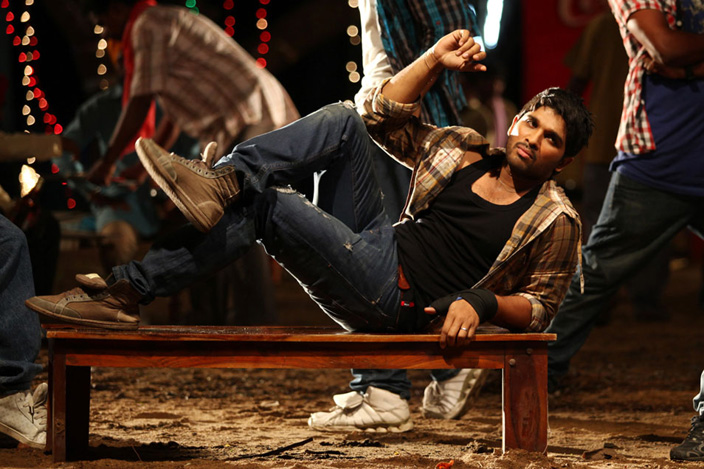
Trivikram films tend to focus as much on the dialogue as on the action, so it was inevitable that I missed the comedy that had the rest of the audience laughing and cheering through most of Julayi. Not that it really mattered. There was still plenty of great dancing, excellent action scenes, ample screen time for my favourite actor Allu Arjun, and a relatively easy to follow (if somewhat unbelievable) plot giving another enjoyable ‘adventure without subtitles’.

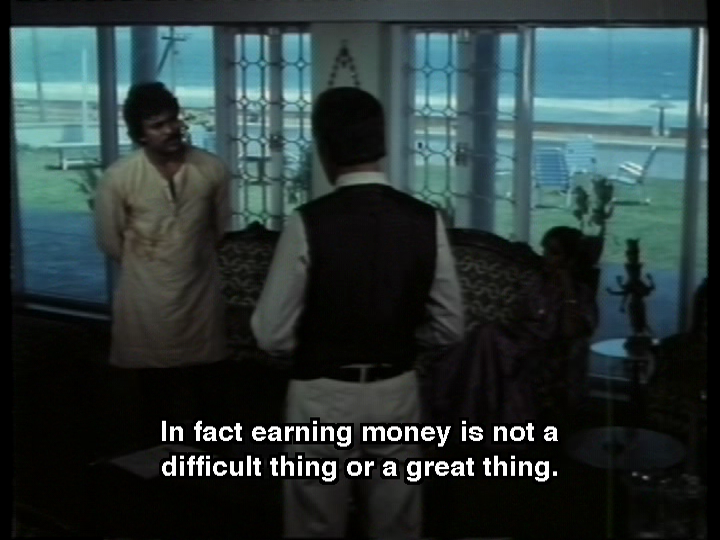
Ravi (Allu Arjun) starts as many a Telugu hero seems to do, by having an argument with his father (Tanikella Bharani in his customary role). Taking a cue from Chiru’s ‘money is easy to make’ speech from Challenge on a TV in the background, the argument seems to be based around Ravi’s lack of commitment to the conventional way to earn a living and ends with Ravi heading out to a gambling club. Since it’s raining heavily he cadges a lift, which just happens to be with a gang on their way to rob a bank. Because stopping to give someone a lift on the way to commit a major crime doesn’t seem like a risky thing to do at all – right?

Luckily for Ravi they seem happy to drop him off on a corner but that is their first big mistake. Ravi has awesome intuition, amazing powers of observation and a seemingly photographic memory and is able to lead the police to the site of the bank theft in time to partially foil the robbers’ escape. Head gangster Bittu (Sonu Sood) has already decimated his own gang, presumably to ensure a larger slice of the money, and Ravi helps lower the number still further by taking out one of Bittu’s trusted gang members (Shafi in a very brief appearance). This seems to spell war between the two, although the apparent destruction of the money and ensuring that Bittu is arrested and his plan foiled are also key contenders for the ensuing rivalry between Bittu and Ravi.

The bank heist is an odd mixture of some excellent ideas, such as the smooth way the robbers disable the cameras as they move through the building, and some gaping plot holes which just don’t make sense. This lack of logic reoccurs throughout the film where there is never any explanation for Ravi’s astounding ability to apparently read Bittu’s mind and predict how, where and when he will strike next. The police are also very ready to fall in with Ravi’s plans and have no objections any time he kills one of the gang. I was almost expecting that Ravi would be revealed as some sort of super-agent which might have explained the nonchalance towards his ever increasing body count and the willingness of everyone to follow his lead. But no, nothing quite so logical is allowed to intrude into the plot, or at least not that I could understand.

Sonu Sood is his usual impressive self as the villain Bittu, although he has a tendency to start cold and menacing but then over-do it just a tad and become almost comic. He too has amazing powers since he is able to interpret the sign language of his deaf henchwoman without even looking at what she is signing. It’s a talent she seems to share since she rarely looks at his replies either but at least she has better survival skills than the rest of the gang. To add some further complications, Bittu is collaborating with local MLA Kota Srinivasa Rao, who’s done some dodgy deal to cheat his investors and seems to be in it for the money. It’s the same crooked statesman role that Kota plays so well that now I don’t ever expect to see him without there being some dodgy deal involved.

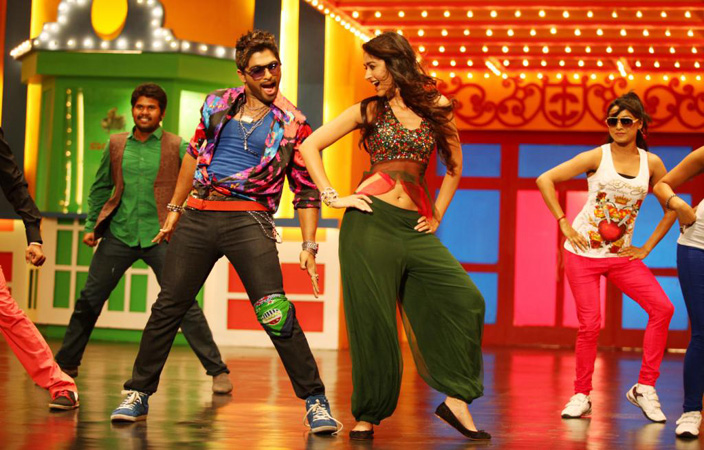
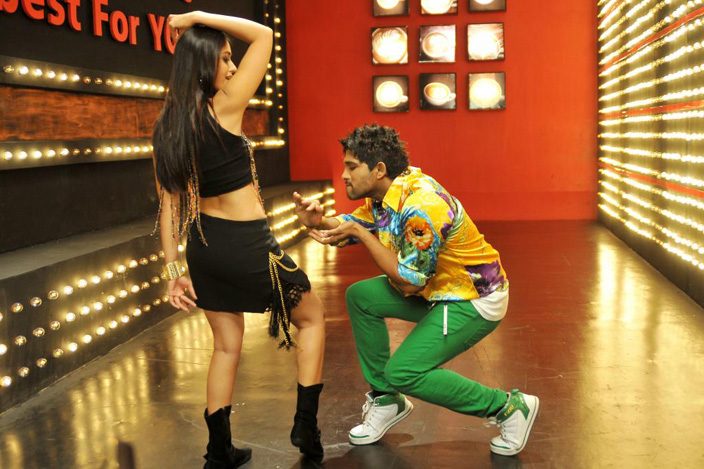
The action moves to Hyderabad when Ravi is sent to ACP Sitaram (Rajendra Prasad) as part of a witness protection scheme. Ravi falls in love with a girl he sees at the bus-stop which results in a succession of songs, in fact almost the entire soundtrack one after the other, as Ravi attempts to win Madhu’s heart. Ileana started off well as Madhu and I liked her glasses and general look, but after Ravi takes her shopping and persuades her into contact lenses and Western clothes she just looks too thin and out of proportion. Although none of her outfits are terrible, the majority aren’t very flattering either and the curse of the Telugu film shoe designer strikes once again with a terrible pair of black boots.

Bunny and Ileana have very little chemistry together and although there are some better moments in the songs, the romance never really takes off. The songs by Devi Sri Prasad are mainly pictured on Bunny who is energetic and wonderful to watch in better than usual choreography. For a change there are no special ‘feature moves’ – no sign of ‘the worm’ – and Bunny is given free rein to do what he does so well and just dance.  He also shows commitment to shiny multicoloured shirts which I did appreciate.

Every single possible comedy uncle turns up but thankfully their comedy is well integrated into the main plot and kept to a minimum. Trivikram seems to use most of the humour in snappy dialogues between  Bunny and Rajendra Prasad which were well appreciated by the audience. There is plenty of ‘action’ Bunny but a lot more ‘funny’ Bunny and both Allu Arjun and Rajendra Prasad work well together in these scenes. In fact the only major fail is Bunny’s hair which varies from OK in the frequent rain scenes (because it is flat and plastered to his head!) to really quite terrible with spikes at the back and flattened matting at the front. There is no hair continuity either and it becomes quite a distraction in a number of scenes as the number and position of the spikes varies – or perhaps I’m just becoming a little too obsessed. There is also the matter of his coloured contact lenses, but I’ll leave that rant for another time!

The film does look great, with some good use of locations in Dubai and reasonable special effects. The sets are also well dressed although Temple and I did have a discussion about the large assortment of really ugly ornaments that appeared on every desk. But there was commitment to family photographs and I did like the large picture of Michael Jackson in Ravi’s room. I liked the soundtrack before I saw the film and although it doesn’t sound too different from previous DSP soundtracks the music fits in with the general feel of the film. The songs could have been better paced though as there did seem to be a lot in the first half – not that I’m really complaining as watching Bunny dance is always worthwhile.

Julayi has plenty of action and strong performances from most of the cast which helps keep attention away from all the plot holes. Its slick and well filmed to make the most of Peter Hein’s excellently choreographed fight scenes. Definitely worth catching on the big screen if you can although I think this is a film that I will appreciate more with subtitles. Hopefully this doesn’t disappear into the same DVD black hole as Khaaleja and we do see a DVD release soon.

Aa Naluguru

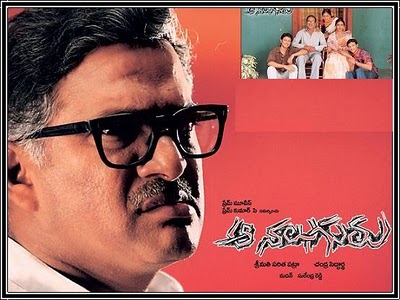
Aa Naluguru is a quirky little film about the rather unbelievably good Raghu Ramaiah and his rather unbelievably bad family. According to my subtitles, the four people of the title are those four people in your life that you must look after so that they will be inclined to carry your coffin after you die – quite a sensible idea really. However as the film unfolds it seems that it may also refer to the four members of Raghu Ramaiah’s family who make his life so difficult, or maybe even to his four friends and co-workers who also have a large influence on him. The film is a little slow to start and perhaps overly moralistic, but succeeds for me mainly due to fantastic performances by Rajendra Prasad and Kota Srinivasa Rao.

Raghu Ramaiah is an editor who is a great philanthropist, giving half of his earnings to his wife and children and the other half to the poor.  He is very idealistic and believes that nothing is as important as love and compassion which means that he is constantly fighting against the corruption, greed and intolerance he sees every day in his community. His best friend Subrahmanyam (Subhalekha Sudhakar) has no such problems. He pays bribes and seems content to ignore the injustices he sees around him. Raghu Ramaiah’s other friend is the miserly money-lender Kotaiah who is happy to tell everyone that his only interest is money, and is a man so mean that he rations absolutely everything at home.

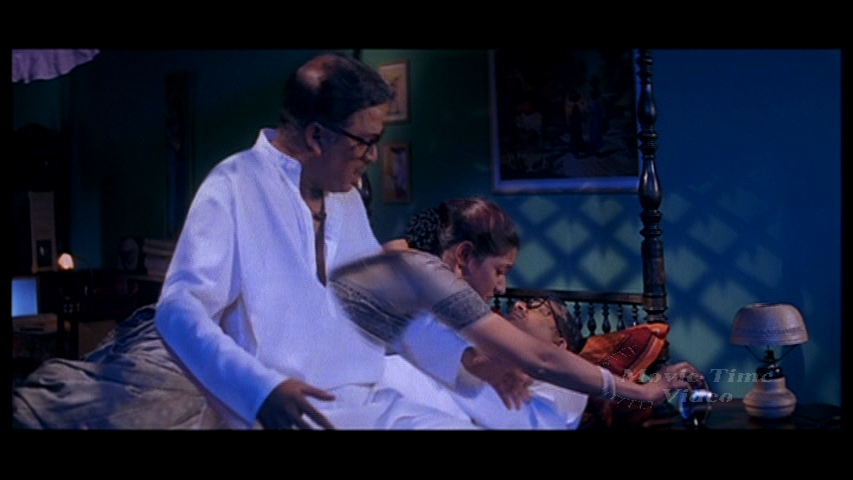
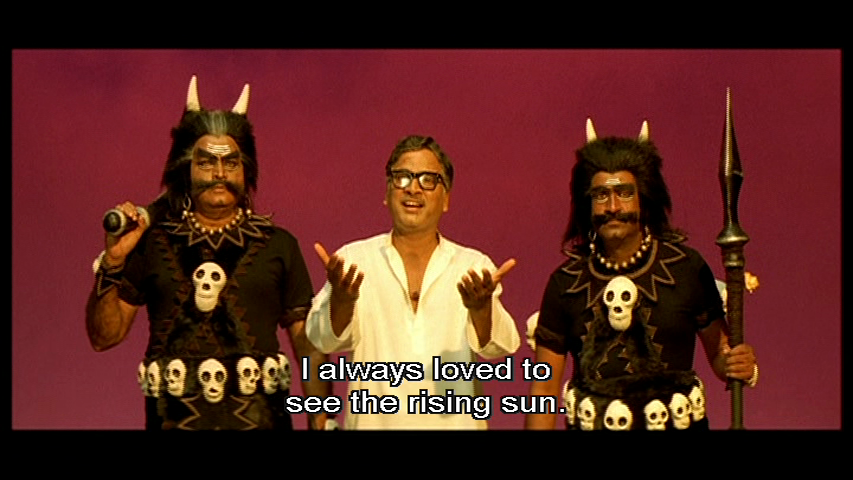
We meet Raghu Ramaiah at the end of his life, when two demons pop up in his bedroom to take his soul to hell.  This was just a little unexpected – firstly because I hadn’t expected a mythological aspect to the story but secondly why take his soul to hell when he had led such an exemplary life – or then again had he? Raghu Ramaiah turns out to be a little vain at any rate as he wants to be able to watch the mourners at his funeral. He successfully pleads with the demons to be able to stay longer on Earth, but this turns out to be a mistake since no-one seems to mourn him at all. As the demons ridicule him for this lack of affection from his family and friends he shows them scenes from the last few months of his life which explain the reaction to his death.

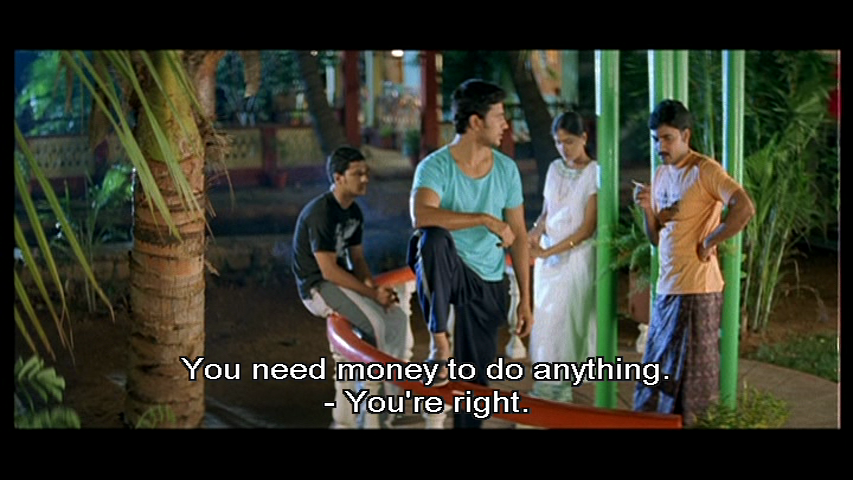
His children are all only concerned with money as they think this is what they need to achieve their selfish wants and desires. The eldest son Shekar (Raja) wants to become an SI in the police, but although he has passed all the necessary exams he finds that he can only get the job by paying a bribe.  Chinna, the younger son, wants to bribe a University to accept him into an Engineering course since he hasn’t got good enough grades to be accepted on his own merits.  Indra and her husband want to leave and start a new life overseas as he has no job, and doesn’t seem to be particularly worried about getting one.

They all keep pressing their father for money while he insists that they should be able to get by on their own merits, and in particular not pay bribes just because everyone else does.  However Raghu Ramaiah’s ideals are not accepted by his family and finally his son-in-law decides to capitalise on his father in law’s good name and start a finance company to cheat people.  This is the last straw, and Raghu Ramaiah finally breaks down at this threat to his reputation.  He borrows money from his friends and uses this to pay his children what they feel they are owed. After he dies, his sons and his son-in-law run away to avoid having to pay back the money their father has borrowed.

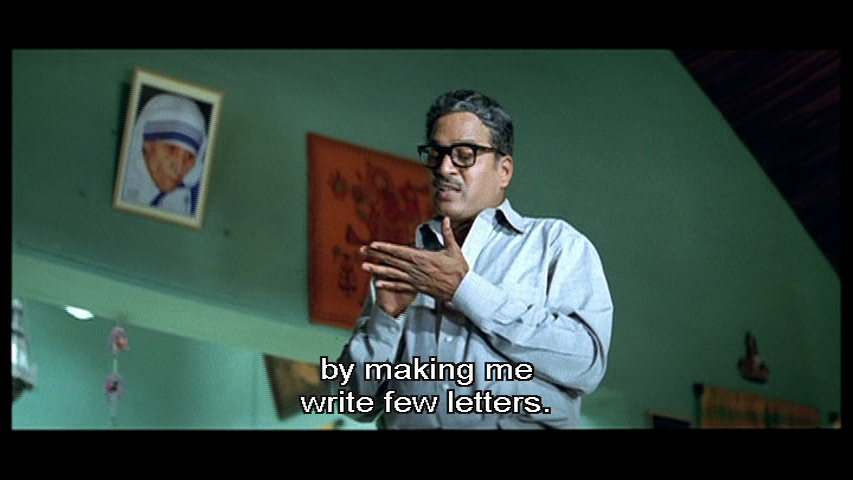
Note the prominent placement of Mother Theresa’s picture seen here over Raghu Ramaiah’s shoulder.

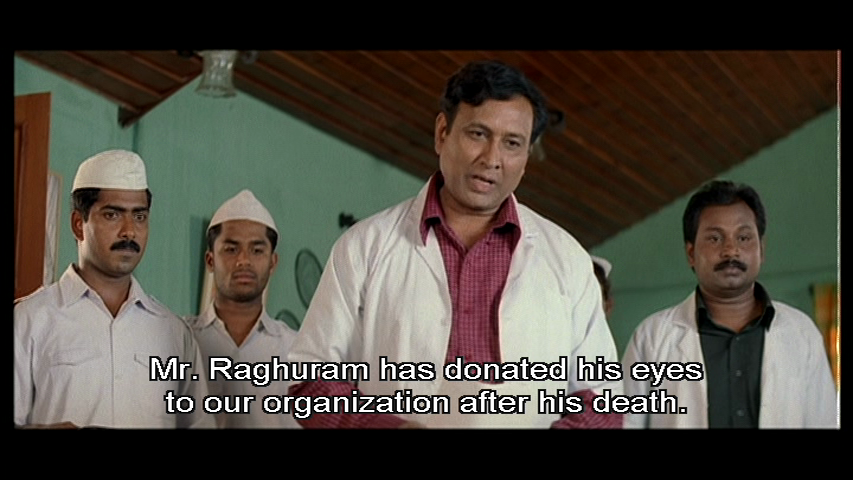
There is a great moment when medics come to collect Raghu Ramaiah’s eyes which he has donated, although this also brings to light the true circumstances of his death. But a story that involves eye donation is always a plus for me.

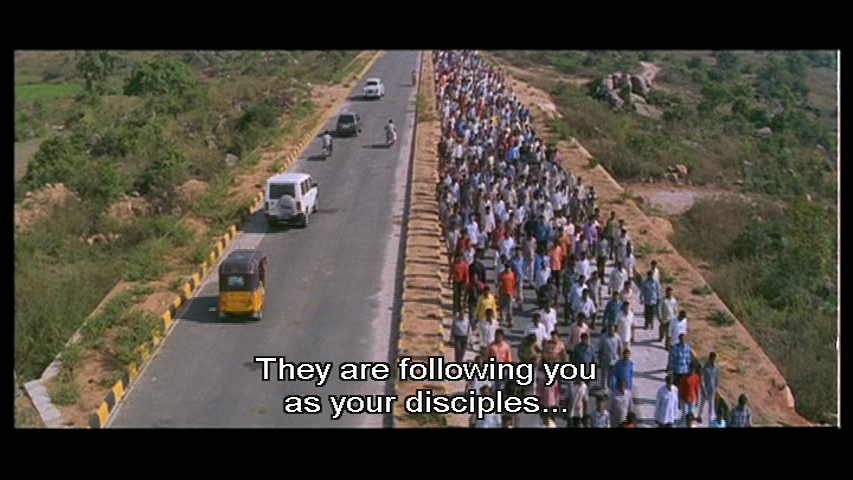
The rest of the film deals with the funeral and I have to say that no matter how many times I watch this film, the final scenes always make me cry. The simple outpouring of emotion at the funeral is very well done, and the grief in the loss of a man seen as a great humanitarian is very heartfelt.

There are a few problems with the story, written by Madan and the director Chandra Sidhartha. Raghu Ramaiah seems to be a very idealistic representation of a compassionate man and the story initially is very simplistic and moves slowly. It’s understandable that his family is frustrated with his overly charitable nature, although their demands for money and general lack of respect also seem unrealistic. Perhaps the director found this necessary to get his point across, but I think the same points could have been made more subtly. I don’t believe that anyone could be so overly benevolent to the detriment of their own family or adhere so rigidly to such morals. However while these flaws could have made Raghu Ramaiah very one-dimensional, Rajendra Prasad rounds out his character with a really fantastic performance. The interactions with his family are very well portrayed with a mixture of frustration, love and anger giving a more naturally human feel to the character despite the rather stilted language. Of course that could be the fault of the subtitles. Still, without the presence of Rajendra Prasad I don’t feel that this film would have had the same impact at all. Kota Srinivasa Rao is excellent as the miserly Kotaiah and the interaction between these two characters is the best part of the film. Aamani was good in her portrayal of the wife stuck in the middle, trying to keep everyone happy and failing, and it was interesting to see Raja in a more negative role.

While there aren’t very many songs in this film, the slow and sad version of the title song is used frequently as a background theme. But this fast version at Indra’s wedding does have some dancing at least.

Despite the problems I have with the story and the somewhat idealistic characterisations, the performances more than make up for these shortcomings for me. This is a film I’ve watched a number of times and still love the ending.  A film made by the performances and emotional final scenes and as such gets 3 1/2 stars from me.

Temple says:

I hate this film. I can’t decide if it is an amateurish attempt or a deliberately manipulative effort that insults the intelligence of the audience. I do need to discuss the plot as it is the supposed ‘twist’ that particularly annoys me, along with some poor writing.

I will leave a gap.

.

.

Now if you want to avoid the spoiler, keep scrolling until you see the next puppy.

Raghu Ramaiah committed suicide. He did this with no real sense of crisis apart from his customary self pity, and just after borrowing loads of money from various friends and associates. His death effectively dropped his family and friends in a hole as the loans were a bit shady and his wife had no means of repaying them. The grown up children were presented as selfish caricatures, constantly shocked by their father’s decisions (they were also slow learners – I mean, he NEVER didn’t put charity first). Surely he wouldn’t have expected them to look after his widow properly. He abandoned his philosophy and his vows to his wife in what was portrayed as a fit of pique. Now, this is a shocking action for a holier-than-thou too-good-to-be-true philanthropist so I was expecting some unfolding of his character or past that would illuminate his choice. None was forthcoming. He sat on his cloud, hoping to see how much he was missed and trying to hide the truth from his demon companions. This vanity and selfishness might also have made for interesting character development but was brushed aside. Chandra Sidhartha decided to make this man a role model and have everyone awash with tears at his funeral. So is the take out from this, kill yourself if people disagree with you and then they’ll all be sorry? None of it held together for me as there was insufficient motivation for him to drink poison and no satisfactory exploration of the repercussions, followed by a glorification of a very flawed and slightly unpleasant character. The sickly sentimental ‘boo-hoo we’re not worthy of such a great man’ ending was infuriating.

.

.

.

OK so now I have that rant out of my system. Rajendra Prasad did give a good performance. I was really hoping that a movie featuring the actors who are usually in supporting roles would be good as it is lovely to see them take the spotlight for a change. The scenes between Rajendra Prasad and Kota Srinivasa Rao are effective, and Rohit and Aamani were good in their supporting roles. I give this 1 star, only because some of the actors tried really hard.