Murari

One day our friend Indiequill asked for film recommendations, specifying that she wanted to see Mahesh Babu as something other than a baby faced killer. Murari was a popular pick amongst friends on Twitter, and for that reason as well as our commitment to research and possibly a bit of persuasion by The Mahesh Fan, we watched it too. And it wasn’t bad. There is nothing really out of the ordinary in the story, the jokes or the material so the film had to rely heavily on the appeal of the cast and the production design to keep us engaged.

The film opens with a bonus appearance by Prakash Raj in a wig (according to Liz he may have been channelling Jackie Shroff in this avatar) and it was obvious he was No Good. After insulting the deity at a local temple, he is promptly despatched by a green CGI monster and leaves a curse attached to family.

Goodbye and thanks for coming Prakash Raj.

The film skips forward several generations and we learn that every 48 years a member of the family dies to fulfil the requirements of the curse. Why 48 years is never explained, at least in our subtitles, and it really doesn’t seem to matter except as a device to show a few grisly deaths.  When we see Mahesh Babu leap onto the screen it is not only obvious he is the hero, but we were also sure that he is marked for death. He plays Murari, a bit of a too good to be true type who defends the defenceless and all that, but is saved from being a total prig by his good natured pranks and teasing. These were actually pretty funny and captured the adolescent nature of our hero.

This was apparently Peter Hein’s first film as a fight director, and certainly there are several heroic scuffles with bad guys thrown through the air like so much sweaty confetti. And one interesting fight scene in the water. But no baby faced killer.

Murari is from a feuding family. During one attempt to bring the two sides back together he meets his cousin Vasundhara, played by Sonali Bendre. Sparks and insults begin to fly as instant dislike signals the love story to come. Romance blossoms over pranks and practical jokes, as does some more dodgy CGI work.

In order to facilitate the growing relationship, Murari is intent on resolving the family schism as his grandmother Sabari is equally intent on removing the curse. Murari is blissfully unaware of the danger he is in, but the gods seem to like Mahesh Babu and his elephant Ganesh keeps a watchful eye on his owner. There are lots of close calls, and we know Murari is drawing closer to his death a long time before the family priest bothers to check the horoscopes.

Murari’s family approve of him marrying Vasundhara, hers are eventually persuaded and then grandmother puts the veto on this union. She is obsessed with saving Murari (who was named for her husband who was a previous victim of the curse), and keeping Vasundhara from being left a widow. In the midst of all the domestic drama, death is lurking and only an arduous and lengthy ritual can save Murari. Since the angry deity in question is Durga, the price for absolution had to be blood; and that is spilled in abundance before the film ends. Although the climax was powerful in its visual impact  the outcome was rather predictable as Sabari had always known what was needed to lift the curse. Along with all that blood of course. Why she held off on taking action until this particular generation is never adequately explained.

Mahesh Babu seems to be the actor who explains basic concepts in Telugu film, and we thank him for that. In Athadu he laid out the rules for killing and in Murari he explains the rules of obsessive filmi love. Apparently if he was thinking of Vasundhara, he needn’t worry about whether she loved him before going to politely kidnap her and bring her back to the family home. The reason he was thinking of her was that she was thinking of him. So his father told Murari there was no need for boring talking about feelings and plans and all that. She wanted him! It was all her fault! Just go grab her! Another filmi mystery solved!

It was interesting to see Mahesh Babu playing a young man who wasn’t a homicidal loner. This is also before maxi-layer Mahesh became quite so multilayered and developed his signature style. Although his favoured T-shirt and shirt combo make plenty of appearances there are quite a few scenes where only a single T-shirt was in evidence and nary a scarf in sight. We enjoyed his comedic flair in Khaaleja and he certainly milked the laughs from some of his scenes with Sonali. He did all the standard heroic stuff but this was much more character driven than action centred and relied on dialogue.  Sonali and Mahesh had some fun and flirty scenes that helped give the romance a bit more spark. Sonali is beautiful to look at and seemed to enjoy playing her more extrovert character in this.  She really excels at frustrated screams, and her performance appeared very genuine and heartfelt particularly in the latter half of the film.

Murari’s mother Gopamma was played by Lakshmi who did a great job of giving this teary filmi Ma some real character. She was very believable in her confrontational scenes when visiting her brother and family, and emanated a warm and loving personality in scenes with Mahesh Babu. The rest of the supporting cast were all OK without being exceptional. It’s often comforting seeing so many familiar faces in amongst all the cousins, uncles, aunts and servants but it does mean we tend to overlook them as they usually perform the same role over and over. The sets for the family homes were lovely and looked really lived in.

There were lots of knick-knacks and paintings scattered around to catch the eye and each house had a different feel that reflected the occupants’ tastes. The elephant fountain was fabulous and so was the actual elephant.

The music was forgettable, and so was most of the dancing although it was rather exuberant at times. See this film if you’re interested in watching one of the biggest stars in the industry before he adopted the cool calm killer persona and if you like a bit of domestic drama.

Temple says: This is an entertaining if unexceptional film. I like Mahesh Babu as an actor, and he did well in this romantic comedy hero style. It is kind of fun to see him playing such a young and flirty boy rather than the brooding loner role he has put his stamp on of late. Having seen Khaaleja recently, I am now surprised at how shocked everyone seemed to be at his ability to do comedy in that, as he had that under his belt in this film (along with snake wrangling skills). I particularly liked the teasing flirty interludes with Sonali as they each had their moments of triumph and of discomfort and the scenes flowed really well. I even tolerated the dreaded Filmi Child Actors as they were kept well under control and wore a pleasing array of stripey shirts. Speaking of costumes, Mahesh Babu in a lungi is always memorable (I’m thinking of you Jenni). It’s a shame the DVD copy is so bad as the visual design of the film is very nice, and it was a pleasure to watch – certainly these screencaps do it no justice. I don’t know that I would hurry to watch this again, but I did enjoy it for what it is – a romantic comedy with a bit of gore, a bit of divine intervention and excellent use of elephants. I give it 3 stars.

Heather Says: I liked Murari, but then it’s a romance and I’m a sucker for love stories. It also has elephants (an instant win), snakes (also a win), and the goddess revenge drama does spice up the storyline nicely. I enjoyed the way the two characters played it true to their supposed ages in the story and the little touches that were very typical of a guy trying to be macho and impress the girl. The teasing between Murari and Vasundhara appeared very natural and Mahesh showed that he has a natural flair for comedy. It was great to see him in a role where he wasn’t just a cool and competent killing machine, but had so much warmth and feeling. There seemed to have been quite a lot of thought put into the interactions between the various members of the two families as well, and I liked the way that they all had different characteristics within their roles in the family. Even the kids were ably utilised in this film, and the elephants weren’t just there for decoration.

My only complaint, apart from the terrible DVD quality, was that the ending dragged a little. The lead up to the climax was great, but then it seemed to take forever to actually get there. There were also perhaps a few too many near misses for Murari, especially since at least one appeared very contrived. However the rest of the film was fun and overall its an entertaining watch. I vote for more elephants and snakes in all movies! 3 ½ stars from me.

Orange

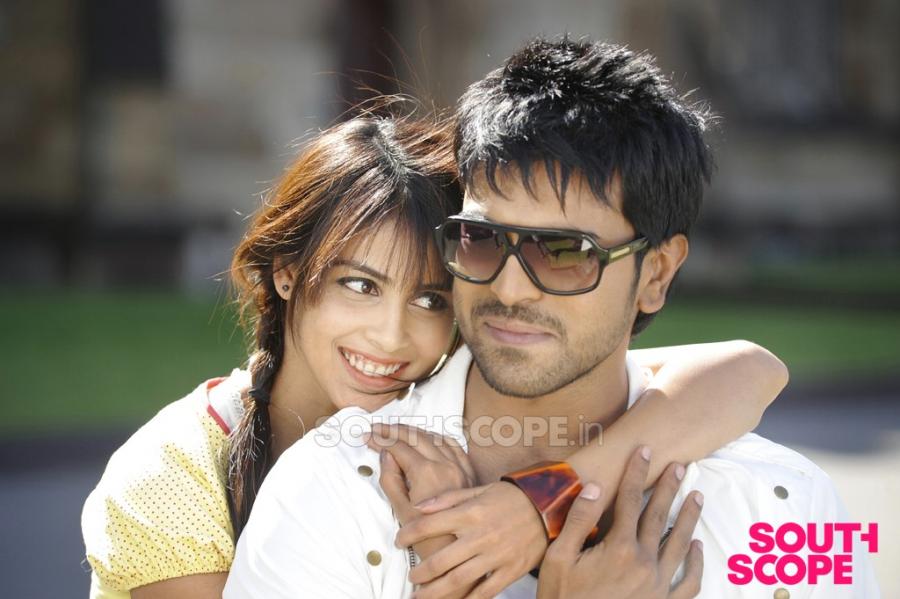
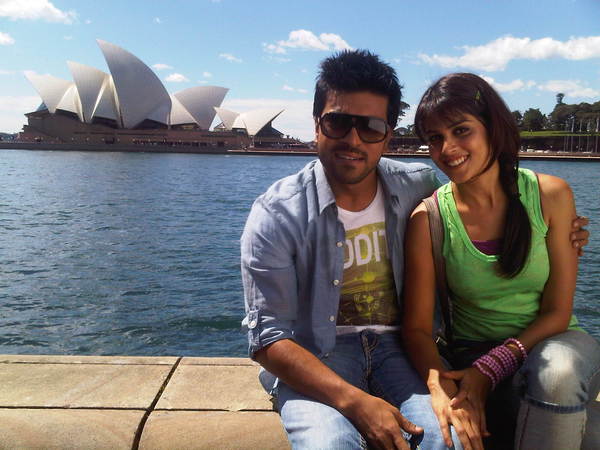
We had a vested interest in seeing Orange, having spent a lot of quality time loitering around the shoot as it took place in Melbourne. The lure of seeing Ram Charan on the big screen, along with the ever entertaining Genelia and our hometown was just too strong to ignore.  We avoid reading previews of new release films before we see them, as there is too much PR hype and politics to get much useful information, but the arrival of Charan on Twitter certainly got our attention! The cinema was full, and with a higher number of families and kids than we usually see at the South Indian films here.

Charan plays Ram, a wildlife photographer and graffiti artist with a truly excellent selection of t-shirts. He lives with his sister and brother-in-law in a fancy apartment and drives a flash car. He has strong views on love and honesty and won’t back away from his values. After an earlier relationship with Rooba (Shazahn Padamsee), shown in flashback, we see that he learned a lot about himself and what he wants from life. He doesn’t believe that simply saying ‘I love you’ makes for a relationship, and doesn’t believe it is honest or realistic to promise a lifelong love. He is affectionate, caring, demonstrative, but he is not going to commit to a lifetime, and he will not sacrifice just to keep his loved one happy. He doesn’t want his girlfriend to sacrifice anything for him either – he has been through this unhappiness and is genuinely trying to find an honest and respectful balance.

Genelia as Janu makes a ridiculously chirpy entrance to the film, cheering as she watches a marriage proposal and being as excited for the lovers as if it was her own relationship. She does believe in the idea of soulmates and lifelong love connection and wants that from her partner. She is in love with love, and looking for Mister Right. Several potential Mister Rights form part of the comic sideplot.

So of course, these lovely looking youngsters with completely opposing views fall for each other. The film is then about Ram and Janu getting to understand each other, and the choices they make.

With Puppy (Brahmi!) aiding and abetting Janu, the relationship develops in fits and starts. Ram is persistent and Janu is interested but wary of this charismatic suitor. We knew long before Brahmi mimed Krishna playing his flute that Ram was a ladies man! When he happily admits to having had NINE girlfriends, in relationships spanning from 1 to 387 days in length, Janu decides he is just too much to handle and tries to back off but cannot deny her feelings.

Although for the most part the film is a fluffy romance, there is a serious conflict at the core. While the audience can empathise with both sides, it is clear that something major would have to change for there to be a traditional boy gets girl happy ending.  We could maintain sympathy for both the romantic Janu and the more challenging Ram so found the conclusion to be reasonably satisfying and in keeping with the characters. However we suspect that if you can’t connect with Ram’s character, the film will not hold your interest.

Charan’s performance was great. He was charming, funny, energetic, emotionally engaging and totally looked the part. He was convincing as the school leaver Ram, and especially as the urbane young man about town and his body language really suited the different confidence levels of these stages of his life. The fight scenes were typically dramatic and physical, and Charan’s dancing is, of course, brilliant . The choreography was lots of fun and Charan seemed to have a great time sending up some cheesy romantic moves. Seeing these films without subtitles and having only a minimal understanding of language, we rely on the tone and expressions of actors. Charan made us see him as Ram and we understood his character’s views and feelings so we have to say it was a successful performance.

Genelia was her usual bubbly self, perhaps too bubbly, to start with but really showed some depth to Janu over the course of the film. She conveyed the struggle between having feelings for someone and knowing that it wasn’t going to work. We could see her grow from a carefree girl to a more independent young lady as she confronted her own beliefs and tested them for herself to see what she wanted.

Nagendra Babu had a small but pivotal role as Ram’s neighbour who was living in a stormy domestic situation.  Brahmi and Prakash Raj are always a familiar delight to behold. Brahmi got more to do in Orange , and his comedy was a bit more varied and often very funny. He also had a fine collection of t-shirts, and a habit of reading Mills & Boon before bed. Prakash Raj was the Telugu cop who gave Ram the reason to narrate his life story. He had little to do, and really it need not have been a Prakash Raj role although we are always pleased to see him. We did watch some of the scenes with him and Charan being shot so we certainly enjoyed that. The rest of the support cast were fine but as we have to concentrate on the main story, we didn’t really give them enough attention to be able to comment much.

We love the soundtrack and the songs looked amazing on screen. We are somewhat disappointed that Melbourne scenes are inter-cut with Sydney to give the impression of one Australian city, as the Melbourne -Sydney rivalry is HUGE, but we will forgive it as we got the opportunity to watch this film being made. Bhaskar managed to skirt the problem of geographic displacement by blending the locations well. The places Ram and Janu were seen were appropriate for their student lifestyle and helped the film’s credibility. We are always a bit judgmental about the skankily dressed white chicks in songs but Orange is family friendly for the most.

Some special notes: We greatly enjoyed Anand Ranga’s updates via Twitter, and shared his anxiety about the weather. When he casually mentioned filming with a lion, we expected maybe a fleeting appearance in a song. Not a full blown encounter with the King of the Jungle who apparently frequents the NSW forests. We cheered a lot! But the audience went wild when the Glen Iris tram was on screen – who knew the number 6 tram was that much of a star? We also enjoyed seeing a return of the pink panda t-shirt first spotted on Charan in  Magadheera, this time being worn by one of Ram’s friends. There was plenty for the alert viewer in Orange!

Brindaavanam

We can now confidently state that at least in Melbourne fans of one star do not seem to watch the films of another star.  As we picked up our tickets for this week’s adventure without subtitles, we encountered more questions about whether we were in the right cinema, and concern that we were about to see a film that we wouldn’t understand.  This is despite being at the same cinema at the same time every time there is a new release. We did advise everyone that we knew there were no subtitles and that it was in Telugu.  They did seem reasssured when we were able to name the stars in Brindaavanam. So we were given our tickets and took our place in the theatre.

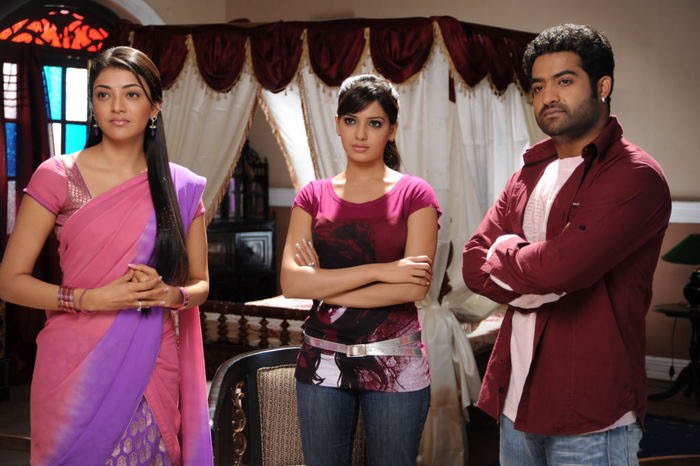
The film opens with a typical hero entrance by Tarak and an awesome fight scene which included some nifty bike moves.  Tarak, as Krish, is the son of a wealthy industrialist and lives a privileged life lacking for nothing.  He also has a girlfriend who is allegedly studying engineering but looks more like a fashion model in the form of Indu, played by Samantha.  For some reason she asks Krish to help her college friend Bhumi fend off an unwelcome suitor by pretending to be Bhumi’s boyfriend.  Now everyone knows this is a really bad idea, but perhaps she thought that her friend was too traditional to appeal to the sophisticated Krish.  It did seem strange that the two were friends, since they appeared quite different in their clothes and attitude, but perhaps this was explained in the dialogue. Or not.

Off our hero goes, leaving behind his fancy cars and superbikes to take a bus into the countryside. There was an opportunity for another fight scene using the bus as a weapon, which was great fun, and there were machetes galore to our amusement.

When they finally reach their destination, Brindaavanam, we find out that it is a beautiful house sumptuously decorated and furnished, but home to an unhappy family, divided and feuding with itself.  Krish resembles Krishna – flirting with the girls, alternately charming and infuriating the family members, pulling practical jokes, fighting, dancing and generally stirring up mischief while also righting wrongs.

Prakash Raj with the ‘Amrish Puri Eyeballs of Hate’ (TM PPCC) plays the head of one branch of the family, while Srihari heads up the other side.  Their father is the only one who can talk to both sides of the family as everyone else communicates by machete and there are many convoys of black jeeps travelling over the bridge between the two houses.

The wardrobe department excelled once again. There are two brothers who have an amazing array of psychedelic shiny shirts, possibly the left overs from Solomon in MAGADHEERA, worn in combination with clashing lunghis.  Venu Madhav plays another member of the family with the same bad taste in outer wear, while Krish has an impressive selection of T-shirts and stripey jumpers.

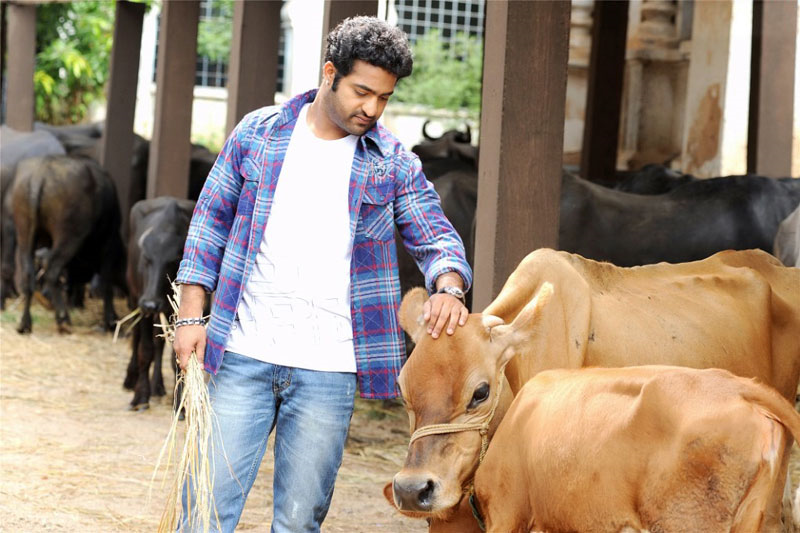
The set design is just stunning, especially the interiors. There is also a veritable Noah’s ark of animals featured including chickens, geese, cows, goats, a turtle and even rabbits!  We did have to pity the poor animal wrangler who obviously had instructions along the lines of – just get the goats to run through here in a diagonal line between the dancers.

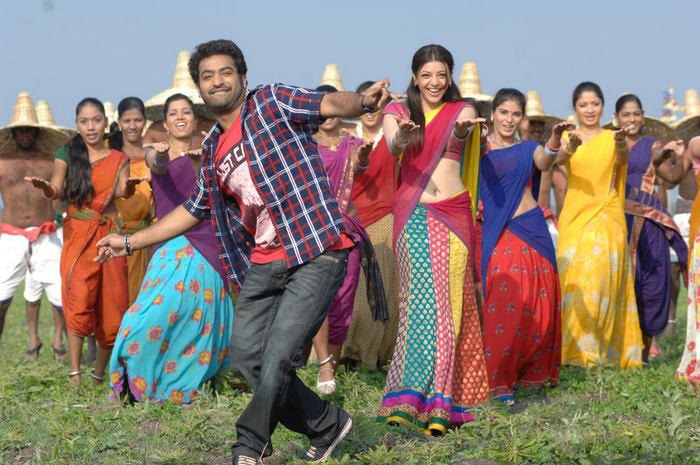
The dancing is excellent, although there was a little too much of skanky skin show in the first number. The visual effects and editing in the song picturisations were impressive and really suited the music.  We liked the songs before seeing the film, and they improved on screen with the expected excellent choreography and brilliant dancing by Tarak.  We did particularly like the bouncing men in their over large straw hats in the Eyi Raja song, and the colourful Vachadura. The traditional appearance of NTR via special effects was used very well and provided a fun conclusion to the film.

The dialogue was obviously very amusing as the audience was laughing throughout the speeches, and we suspect that there were a lot of older filmi dialogues included.  The second half did drag a little as the story was reiterated a few times as the various characters found out about Krish’s charade, but there was some excellent emoting from Srihari and Prakash Raj to make up for this.  In fact, Prakash Raj got to balance his Eyeballs of Hate with his excellent Googly Eyes of Love. Ajay was in great fighting form as the crazy suitor, but once again was destined not to get Kajal as his bride.  Tarak gives a high energy performance, with his usual excellence in dancing and physical scenes.  Both female leads fit their characters well despite those characters lacking any depth. Prakash Raj and Srihari make the most of their roles as feuding brothers.  The action sequences, by Peter Hein with a special fight choreographer also credited, were awesome, with plenty of bodies exploding from the inevitable jeep convoys, and machetes in practically every scene.

This was a good all round entertainer of a film.  We enjoyed it, and the audience’s reaction to the appearance of Brahmi’s bald spot!  We give this film 4 stars!