Indra

Indra is a really entertaining vehicle for Chiranjeevi, combining action, melodrama and music in a visual feast. I say entertaining despite a huge bodycount and an impressive gore budget. The violence is so over the top and cartoonishly bloody, the baddies are so one dimensionally bad, that I couldn’t take it seriously.I also had to laugh at this little moment in the opening credits. Really Paruchuri Brothers, you call yourselves ‘writters’?
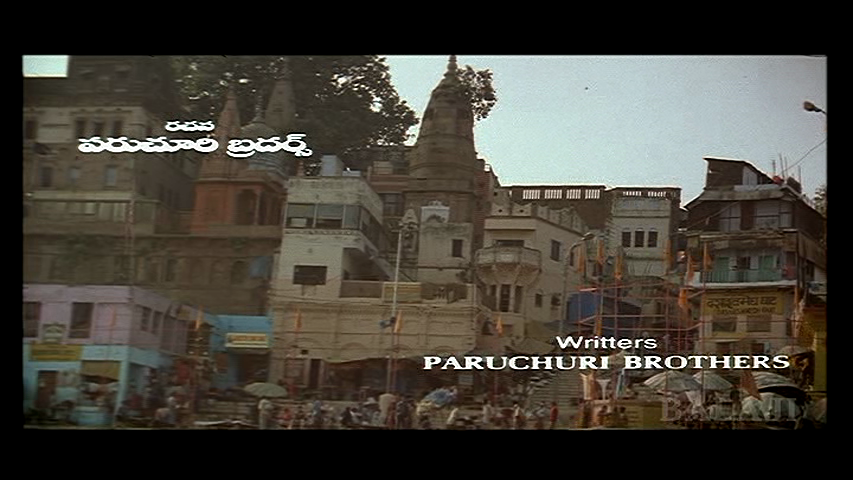
This is a film of many incidents and little introspection so I won’t delve into the plot too much or there will be too many spoilers. The action kicks off in 1975 with scenes of murder and betrayal. Young Indrasena Reddy assumes the leadership of his clan after God knows how many of his male relatives are killed. The boy shows signs of some kind of power:

Then we land in Varanasi in 2002. Sankaranarayana (Chiranjeevi) is a taxi driver, classical vocalist, philanthropist and deliverer-of-justice. His family mean everything to him, and Sankar does all he can to support their education and happiness. When his niece Nandhini says she needs inspiration to sing, he comes up with this little beauty:

What a guy! Isn’t Varanasi beautiful too? And I loved him ‘singing’ in front of SPB in another scene. [Edited to note: It seems Eros only want us to see the Hindi dubbed versions of the songs and I can’t find Telugu clips online anymore so apologies for that but the picturisations are really lovely.]

It’s clear there is a connection between the two episodes, but the first part of the film is all about the peaceful family man. Well–he is a man of peace, until he isn’t. Chiranjeevi is all hero and there is no doubt this is his film. The action scenes are action packed, the dancing is high energy and the speeches are compelling. This is not a film that demands subtlety but Chiru adds a bit more emotion and credibility than I expected. And he does it in plaid, in sequins or in a lunghi. So versatile! I don’t understand why people keep asking me why I love him – surely it’s obvious.

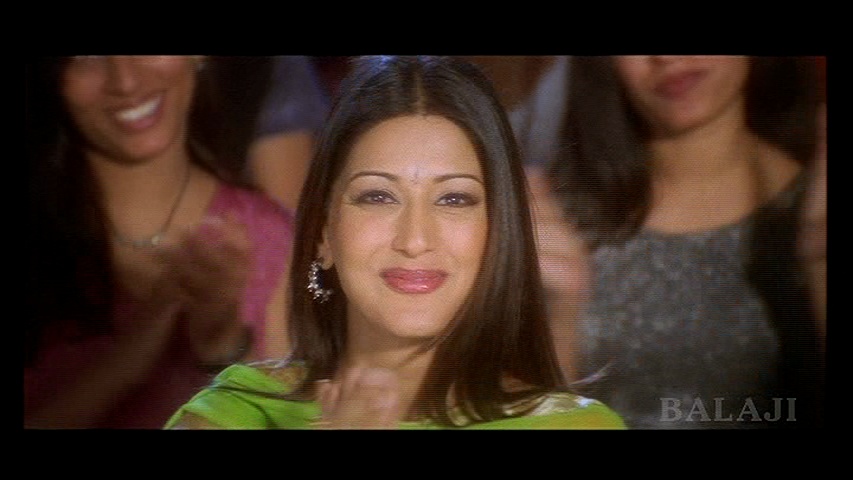
Sonali Bendre is the smitten Pallavi who pursues Sankar and schemes her way into his household (and incidentally, out of an unwanted marriage). Her machinations are highly amusing as is Sankar’s discomfort at her flirting and they have good comic chemistry. Sonali’s overacting is excellent, and her fake filmi gestures are spot on for this role. She also gets the full support of the wardrobe team, although I have my doubts about the footwear. Is she wearing yellow fluffy slippers?

I wish I could say the Comedy Side Plot was funny but it wears thin very quickly and Brahmi and gang overstay their welcome. Sunil does a more successful spot as a hapless brother-in-law and is on screen just enough.

The drama takes place on an intimate scale as well as in an epic feud saga.  Pradeep (Sankar’s nephew) is in love with Mumtaz, a Muslim, and their relationship is discovered. Later in the film Nandhini has her own troubles. I was perplexed by the suicidal tendencies of these young women but luckily they were not alone. Sankar never turns his back on his family and goes to bat for them, making a few message statements along the way.

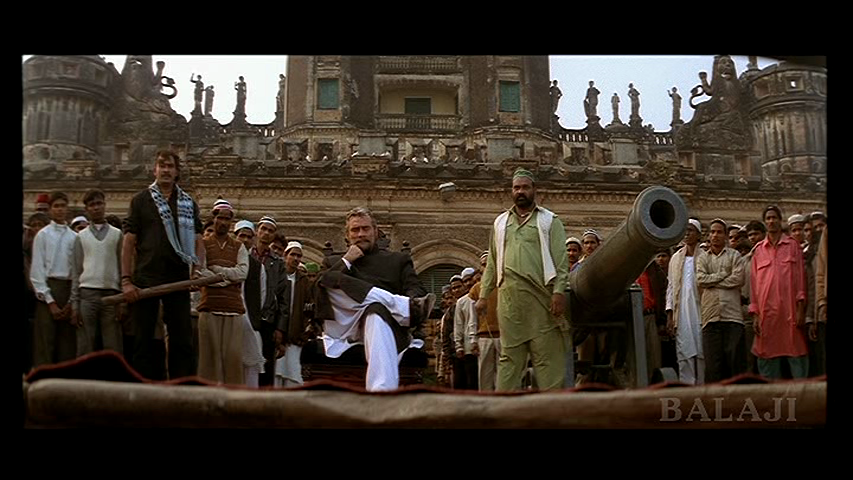
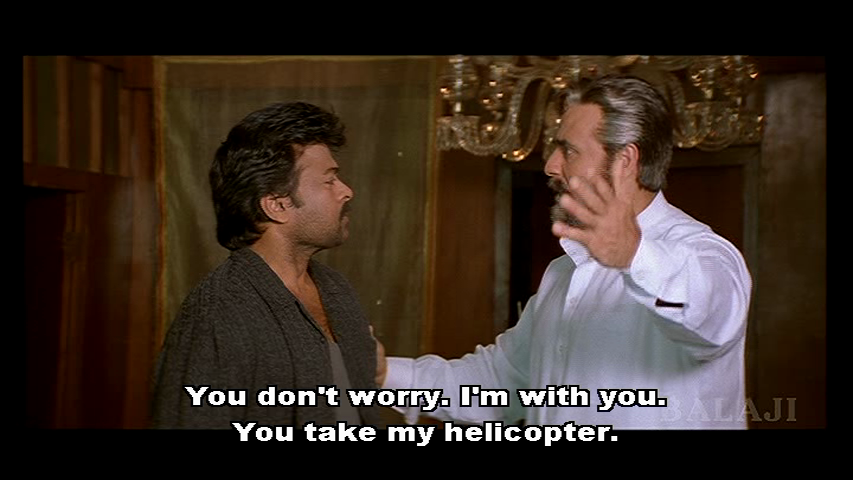
He also impresses Mumtaz’s father, the rich and powerful Shaukat Ali Khan (Puneet Issar). This comes in very handy when Chiru finds himself in need of a helicopter.
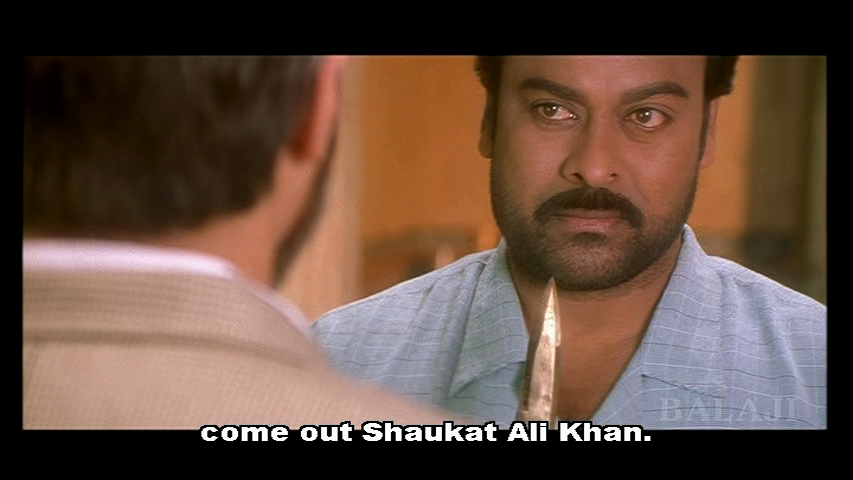
Prakash Raj comes to destroy the man he believes has ruined his daughter Pallavi, only to recognise Sankaranarayana as Indrasena. If you like your Prakash Dad frothing at the mouth screaming ‘shoot them all’ then this is for you. If you like your Prakash Raj and his Gaze of Blossoming Bromance, this is for you.
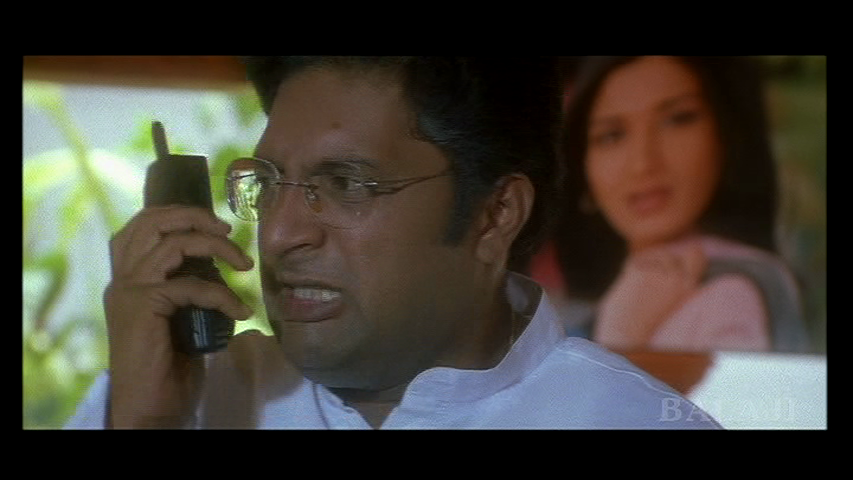
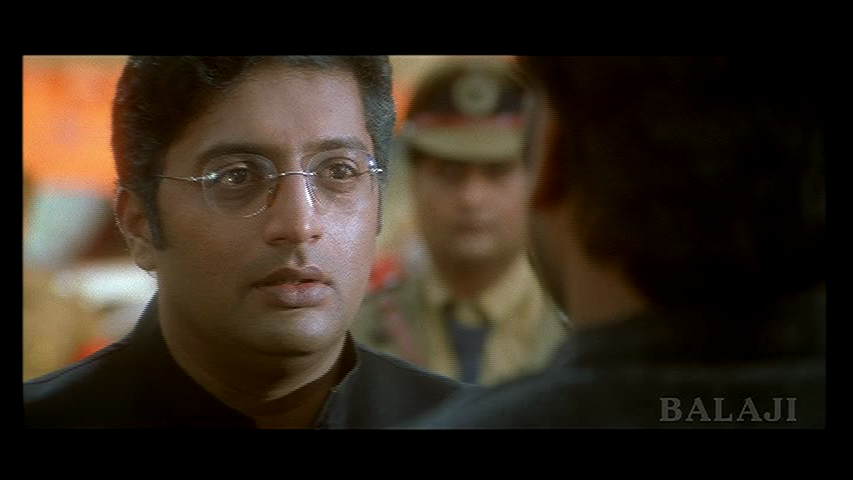
Sankar makes Nandhini’s wedding a condition before he is free to marry Pallavi (when Prakash feels the love, he really feels the love and his decision making process is as rushed as when he is feeling the hate) so plans proceed quick smart.

The wedding draws all the players out into the open. As soon as Mukesh Rishi dipped his toes in the Ganges, I knew bad things would happen. Tanikella Bharani is loyal Valmiki, apparently mute and certainly devoted to Indrasena. When things get ugly, he is the means of laying out the shared history of the characters. We also get an excellent montage of Chiru and heavy machinery as he displays his instant engineering skills.

Snehalatha Reddy (Aarti Agarwal) is the other heroine, and she is not averse to throwing her weight around. While I found her unpleasantly abrasive in some scenes I enjoyed her performance immensely. She was filmed as many heroes are –the first shot a chunky shoe emerging from one of a convoy of cars, the framing of her walk, how she sits–and she has her own irritating and ominous theme music. Snehalatha has her own priorities and her interactions with the men are on the same level.
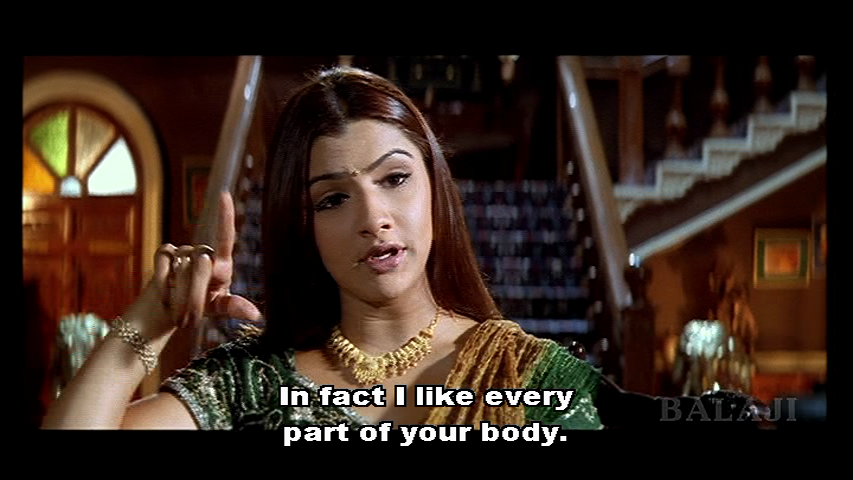
Snehalatha has set her sights on Indra. But given her family history of betrayal her motives are suspect. Or are they? Her character is more developed than Pallavi and she certainly makes the stronger impression despite arriving later in the story. The chronology of the film doesn’t hold up too well under scrutiny, but there is an excellent 90s style dance number. It’s perfectly vintage right down to the costumes and locations (I choose to believe the dated look is an intentional statement).

A hero as upright, generous and moral as Indra requires a weak, nasty and unlikable baddie as an opposing force. Veer Shankar Reddy (Mukesh Rishi) is that man. His villainy is more about excessive violence, obsession with supposed family honour coupled with total disregard for his wife and child, and finger pointing with a lot of “Rrrrrrrrrrey!” Mukesh Rishi has an excellent range of furious and outraged expressions, as does Chiru, and their confrontations are memorable.

There is a big spoiler after this picture so scroll past the next paragraph quickly if you wish and rejoin me after the following set of pictures.

There is a nasty incident in which Veer Shankar Reddy murders his young son rather than be indebted to Indra. This is ridiculous rather than real violence against a child but it shows how low the writers felt they had to go to make him bad enough. He is a liar and cheat, and sees no need to keep his word. This does put him at some advantage against his honour bound adversary but the final result is never in any doubt. Even the land he claimed seems to be against him at the end.

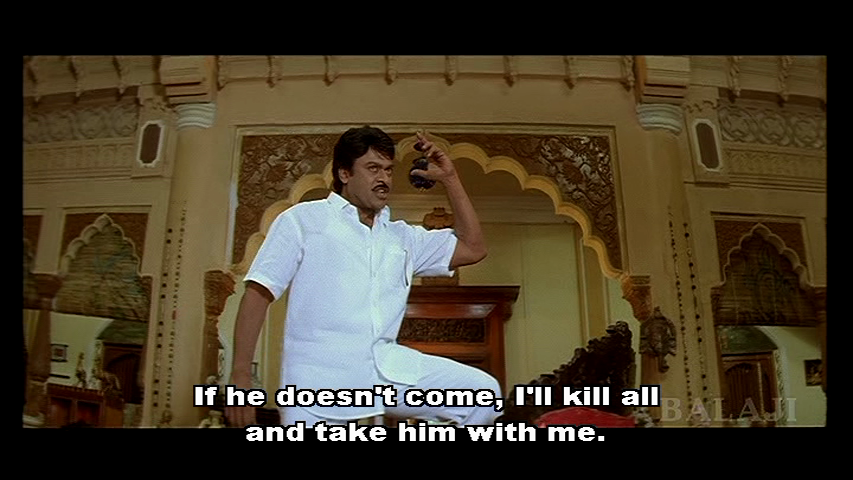
Indra is kind of predictable but still kept me glued to the screen, so Chinni Krishna and B. Gopal should be congratulated on getting the basics right. All the ingredients work, and the visuals in Varanasi are beautiful. The songs by Mani Sharma are great and flow well in the story, and Lawrence and the other choreographers work to their stars’ strengths so the picturisations are just brilliant. There is an inconclusive ending with the two women vying for Indra, but we can all make up our own resolution to that. And I think Pallavi gave a pretty clear clue as to what she might propose.

Chiru is awesome as the great hero, and Indra really is for the people! Well, for my kind of people anyway. I give Indra 4 stars (points off for unfunny funnymen and poor spelling).

Heather says: Indra is a film for the megastar made on a mega-scale with a mega storyline! There really is a lot happening in this film and it seems as if the writers were determined to embody every trait of the divine Indra in the character of Indrasena Reddy. The basic story of warring families is expanded to include a number of romances, star-crossed lovers, vengeful wives, the building of a reservoir ( the ‘bringing of water’ ), street cons in Varanasi and even some politics! I do like young Indra with his self-important declarations, and the fact that throughout the story many of the women are very strong and decisive characters. Everybody has at least one impressive declarative sentence in this film.  Initially I was concerned that Indrasena’s family are so very, very good while Veer Shankar Reddy’s family are so very, very bad, but then Indra starts hacking and slashing with the rest of them and it all becomes a bit too cartoon-like to be taken seriously. The whole side plot of Puneet Issar as Shaukhat Ali Khan, although I’m sure designed to show Indra’s compassion, courage and forgiveness, really seems to be just so that Chriu would have a helicopter to borrow – and that is absolutely fine with me!

Chiranjeevi is as fantastic as always and is the reason the film works so well. His dancing is amazing and Lawrence’s choreography is immediately recognisable. I was very impressed by Chiru’s moves as the dancing is very fast and physical and he pulls it off with nary a stumble.

I also really like Aarti Agarwal as Snehalatha Reddy, the sister who fell in love with the enemy. I think her portrayal is well done considering her limited screen time and she comes across as a very strong character. Sonali Bendre on the other hand, although adequate in her role, doesn’t impress me as much, although a lot of that could be that I don’t really believe in her character. I can understand that she would fall in love with Indra (after all – who wouldn’t!) but her subsequent actions seem out of place, and I would have thought that the daughter of a politician should be a little more aware of the consequences of her actions. Indra’s treatment of her is also a problem for me. On one hand he is very avuncular and treats her  appropriately as  his niece’s friend as he resists her advances, but then later on he involves her in his deception back in the village which I was  more uncomfortable with.

I missed a lot of the final fight scene between Chiru and the brothers as John and I were trying to decide which climbing area it was filmed at. We’re pretty sure it’s just south of Bengaluru (Bangalore) but perhaps someone could let me know exactly where? I did get a bit distracted by the lines on some of those great granite boulders!

Overall a very entertaining film as long as you don’t think too closely about some elements of the plot. I don’t think it would have worked at all without the star power of Chiru, but I still give it 4 stars – 3 ½ of those for Chiranjeevi and ½ for inspiring my husband to come back to India with me on my next trip to track down those climbing areas!

Kannathil Muthamittal

I watched Kannathil Muthamittal when a number of people recommended it to me after I worked in refugee camps in Sri Lanka. I think that my experiences there have really coloured my view of the film as I do focus more on Shyama’s story and less on the main characters. That said, I think the story is well told and the actors all do a good job – it’s just not the story I wanted to see.  It’s a classic Mani Ratnam film with strong female characters, great cinematography and attention to detail, so it’s no surprise that the film won six National Awards.

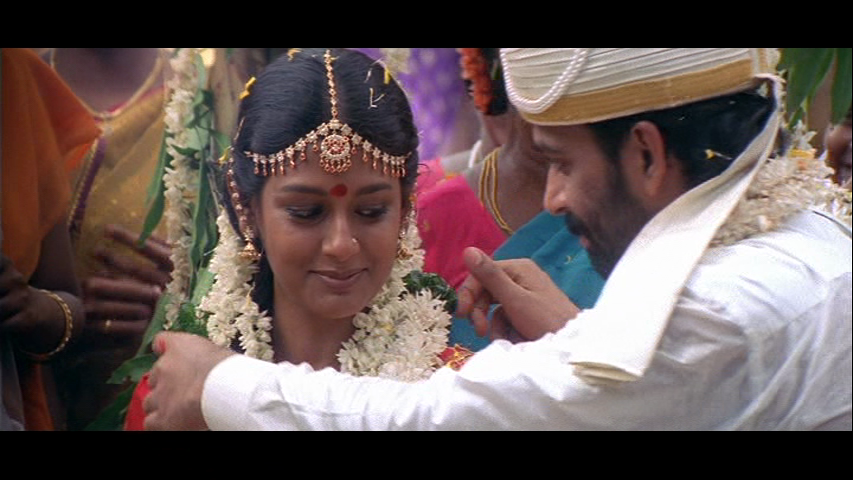
The film opens with the wedding of Shyama (Nandita Das) and Dileepan (J. D. Chakravarthi) in their village located in northern Sri Lanka. Despite this happy start it’s not long before Shyama is pregnant and on a boat heading for a refugee camp in India while her husband is missing, presumably fighting for the LTTE. Once she gives birth in the refugee camp, Shyama leaves her daughter behind and heads back to Sri Lanka to try and find her husband.

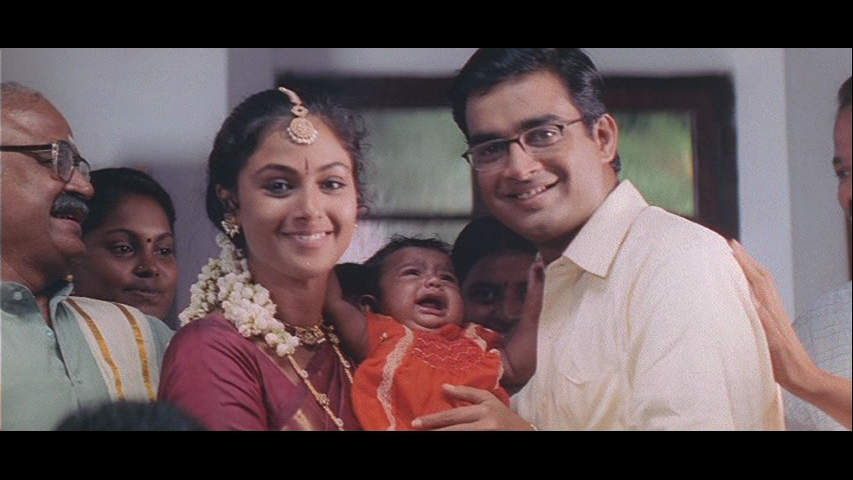
From here the film skips forward in time to introduce G. Thiruchelvan or Thiru (Madhavan) and his family, as seen through the eyes of his adopted daughter Amudha. Convincingly played by P S Keerthana, she appears to be a typical precocious 9 year old; playing with her friends at school, teasing her two younger brothers and very definitely the princess in the family. The story of her adoption is told in flashback and shows the development of the romance between Thiru and Indra (Simran).  I really like this part of the story as the two leads play their parts well and the intertwining of the adoption story and the romance is really sweet.

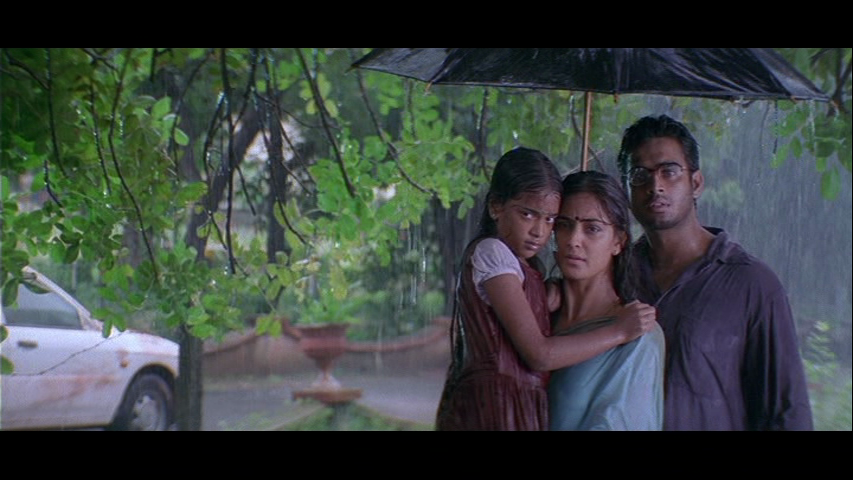
After she is told by her father on her ninth birthday that she is adopted, Amudha becomes moody and withdrawn and finally demands a chance to meet her real mother in Sri Lanka. For some inexplicable reason her parents accede to her demands and the family head off to the war-torn nation, although they did have the good sense to leave their other two sons behind.

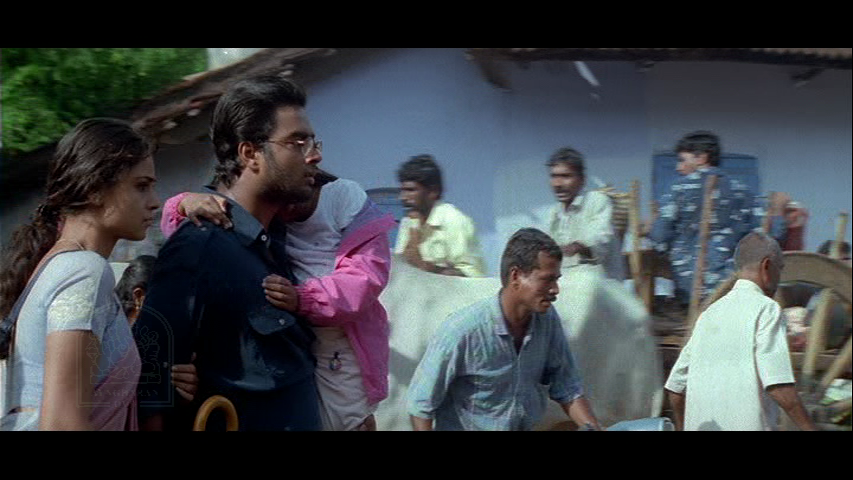
The scenes in Sri Lanka make me cry every time I watch this film. I have seen the same mix of resignation and total despair on people’s faces that is shown here when a village is evacuated. I worked on the East Coast and regularly travelled between LTTE and government controlled areas. The incredibly young soldiers with their automatic weapons shown in the film is very much true to what I experienced and for me this total realism clashes with the more idealistic search for Shyama. Mani Ratnam wisely doesn’t attempt to explain any of the conflict, only showing its effects on Indra and Thiru as they realise why Shyama left her baby behind.

Amudha becomes bratty and rude as she deals with her feelings of alienation from her family and as a consequence I lose much of my sympathy for her. I also disagree with her parents’ decision to try and find her birth mother, no matter how essential it is to the plot. However both Simran and P S Keerthana convey their conflicting emotions and fluctuating relationship well and Indra’s  inner conflict as she worries about her two sons left behind in India is effectively depicted. Although Amudha is irritating the young actor does hold her own against the more experienced cast and it may be more due to the over emotional story that I lose interest in her search. Madhavan’s character, although impressive in the beginning, seems to have little impact in the latter half of the film and Prakash Raj is wasted in his role as the doctor taking the family around Colombo. So while I enjoy the first half of the film, the second half tends to drag with the adoption story and the peripheral action is more engaging . Some of Amudha’s rebellion in this section could have been cut without losing the feeling of her isolation and separation from the rest of the family. The ending is also a little disappointing but Mani Ratnam shows restraint in not turning the final scenes into melodrama, which could easily have occurred given the subject matter.

What I do like about the film is that it looks beautiful and is well shot by cinematographer Ravi K Chanran. Lighting is used to good effect as the early scenes in the family home are filled with warmth in contrast to the rain and grey skies in the later part of the film. While the background score of the film by A. R. Rahman is both beautiful and haunting, some of the songs are a little intrusive. The story doesn’t really need dance numbers and they seem to interrupt rather than move the film forward.

This isn’t a film I particularly enjoy watching, probably more because of the memories it evokes, although I can see why it won awards and I do think it’s generally well acted. It’s just that I would have preferred to see more of Shyama’s story and less of the family drama.  3 stars from me, mainly for the first half.

Temple says: This is one of the first Tamil films I saw a few years ago, and I was prompted to pick it up because of the storyline and for Madhavan.

Thiru (Madhavan) fell in love with the idea of giving Amudha a home and family, and I always feel that if Indra hadn’t agreed, then someone else would have been procured to play wifey. His decisions all revolve around what he wants – the way he courts Indra, the adoption, telling Amudha and persisting when it was clear she wasn’t ready for this birthday surprise, and on it goes.  The job of explaining and reassuring was left mostly to Indra, and she had to bear the emotional burden of seeing her little girl in torment as she herself struggled to cope. Simran is lovely as Indra, but her character is surprisingly weak considering the way she met Maddy, and her being a news anchor. I expected more backbone, but the women in Mani Ratnam films are often written like this – a strong outline and not a lot of finer detail to make them seem more real.

I was adopted and my mother told me every day, long before I even knew what words were, so it would never come as a shock to me and to make it clear that ‘adoption’ isn’t a dirty word. My perspective is coloured by that and while I can understand the bratty Amudha wanting to know her own story, I will never understand her adoptive parents taking her into a war zone no matter how much she sulked.  Still, the treatment of her story in terms of her developing understanding, the legal adoption process, and the fallout once the truth emerged was handled in a much more credible manner than many other films with orphans scattered around the streets, under cabbage leaves, going free to a good home.

The prologue was excellent in setting the scene, but beyond that Shyama and Dileepa didn’t really fit. The context of the Sri Lankan conflict added another dimension, but also made the second half of the film too dramatic and improbable when they went looking for Shyama. So although a fascinating and moving topic, here it is just used as a background for the  family weepfest.

The soundtrack works well in the film, but I find the songs bland. The picturisations are beautiful, most are very stylised, however I can only take so much fabric blowing around and children running on the beach. They suit the mood of the film, but having seen them before, I made a cup of tea during a couple of songs this time. I felt the same about the story device for the flashback – the handwriting and drawings became a distraction and took my focus off the action. Pretty visuals just aren’t enough to keep the film on track.

When Mani Ratnam wants to belt you over the head with a message about peace, unity, love and what makes a family, he can make Bono seem subtle. I give it 3 stars.

Jagadam

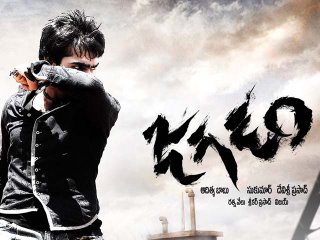
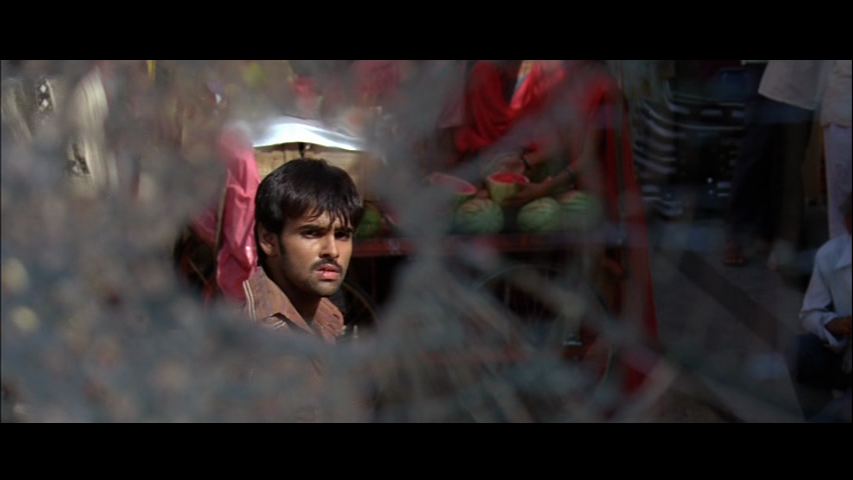
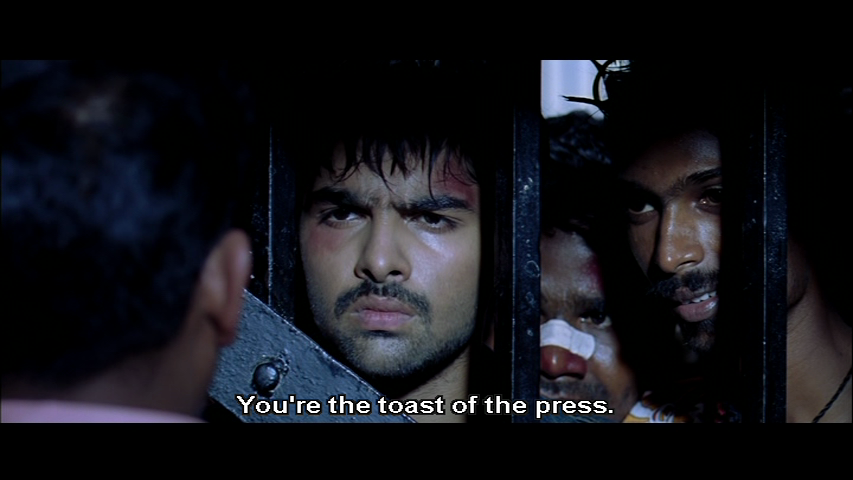
Ram’s second film, Jagadam, is a dark and violent gangster film and is certainly very different from his debut role in Devadasu. Supposedly loosely based on the Brazilian film City of God, it’s less an exposé of gangland life but purports to be a moralistic tale of the consequences of violence.

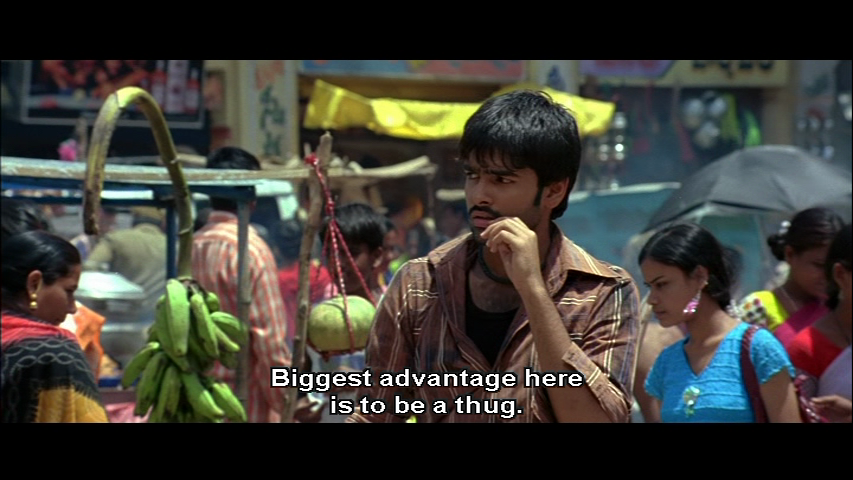
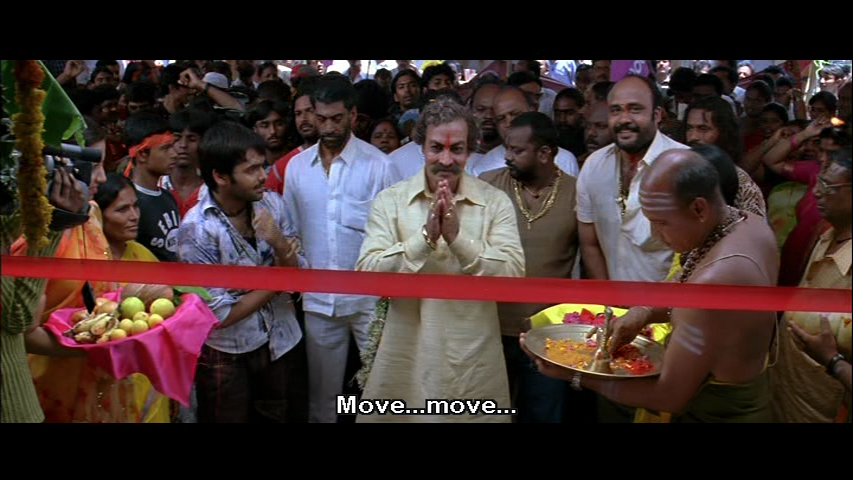
Ram plays Seenu, a wannabe rowdy who becomes fascinated by violence as a child.  Perhaps this is because the area around him is rife with thugs and petty crime, or maybe just because he is a rather warped child. The local community, including the corrupt police, both fear and revere the rowdies who control the area. Seenu dreams of becoming like his hero, the local Don, Manikyam (Pradeep Rawat).

Seenu has a talent for fighting which comes in handy as he works his way up the ranks from small time thugto head his own group of initially ineffectual youths.  His recklessness and lack of anything approaching common sense is amply demonstrated in one of the early scenes when his gang is outnumbered by a knife-wielding mob. Seenu is the only one who doesn’t retreat and ends up at the front of the group – the position that, in his eyes, makes him the leader. As such he is prepared to fight and of course, since he is the hero, wins against such impossible odds.

All of this is fairly normal gangster fare, but the film introduces some more interest in the character of Seenu’s younger brother Chinna. He idolises his brother and is fascinated by his knives and guns. The way in which this adulation is used to develop the story line in the later scenes is one of the strengths of the film, which otherwise is yet another blood soaked gangland war saga.

In the middle of Seenu’s rise to notoriety, he falls in love with Subbalakshmi (Isha Sahni). Subbalakshmi appears to be an intelligent girl; after all she is a Mahesh fan, albeit an obsessed one. Unfortunately director and writer Sukumar has given her every single characteristic we deplore in a filmi heroine. She is whiney, irritating and not just totally useless but an actual liability in a fight. She wears skimpy clothes when wandering round unsavoury areas at night. And as the final insult, Subbalakshmi tells Seenu that when a girl says no, she doesn’t actually mean it. At this point we were ready to slap her ourselves.

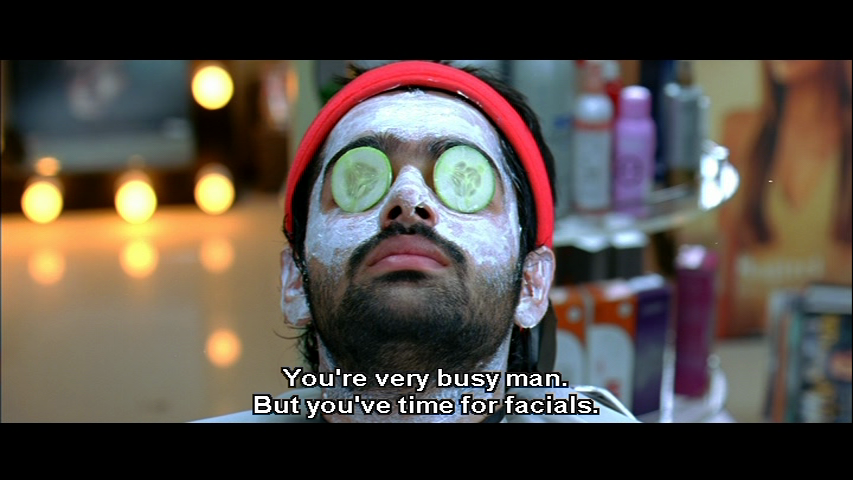
Why she falls in love with Seenu is a mystery as well, since he is totally inept in wooing her. He follows the usual stalker method and just assumes that since he likes her she will automatically love him back. Sadly, this does seem to be her only motivation, although perhaps his willingness to dress up in the latest Mahesh costume she bought for him was a factor. She also has an interesting, if not recommended technique for removing a foreign body from Seenu’s eye – hm!

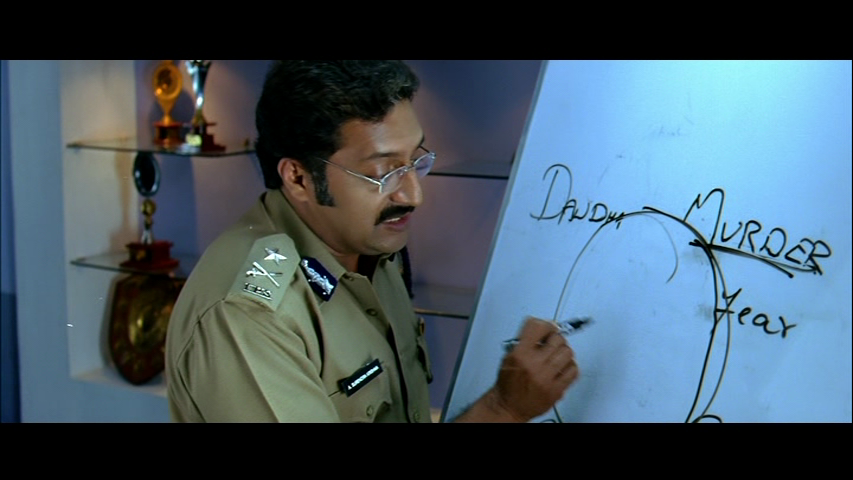
We do like that the intermission is called an interruption, but it does mark the point where the film starts to lose its way a little. Seenu eventually has a falling out with Manikyam and ends up crossing machetes with Manikyam’s source of political funding; the industrialist Yadav, slimily portrayed by Satya Prakash. The story is totally unbelievable at this point as the difference between the well equipped seasoned killers employed by Manikyam and Seenu’s youthful gang is ludicrous. However this doesn’t stop various members of the community approaching Seenu for his rather simplistic aid. Meanwhile Chinna has been avidly following his brother’s exploits and admiring his lifestyle, much in the same way that Seenu idolised Manikyam.  When finally Seenu heads off to kill Yadav, his younger brother wants to watch but events do not unfold as anyone anticipated. This does however mean that we get to see Prakash Raj in his familiar cop avatar expounding truth and justice and using a white board to illustrate the ‘cycle of violence’.

Ram plays the cocky and arrogant character of Seenu with ease. He manages to bring enough of his chirpy ‘boy next door’ persona to the rather dark role and makes Seenu a more sympathetic character despite his arrogance and obsession with violence. Seenu’s friends are from the usual pool of young actors, and in the main they manage to bring some individuality to their various characters. Pradeep Rawat is good in his fairly small role as Manikyam, and gives his scenes some badly needed menace. Ravikumar Chowdary also turns in a convincing performance as Ladanna in the first half, but disappears towards the end of the film. Ragubabu and Saranya are rather wasted as Seenu’s parents and Satya Prakash has very little to do in his role as Yadav. Isha tries, but her character has few redeeming features so she has to settle for pouting and crying in equal measures.

The music by Devi Sri Prasad is fine but not particularly memorable. Ram is a good dancer and the choreographer has utilised his skills well in the songs. We are happy to see that he shows plenty of commitment to the chicken step and is not afraid to dance while totally covered in mud. It’s always good to see this level of dedication even if it doesn’t totally make sense.

Overall the film doesn’t succeed as an edgy drama, nor does it succeed in its supposed anti-violence message . The moralistic tone at the end fails since it doesn’t seem as if Seenu will ever have to pay for his actions. Within the cycle of violence there is a sense that Seenu could stop any time he wants to, but at heart he is still that kid fascinated by killing. While it starts as an interesting attempt and is worth a watch for Ram’s performance, the film ultimately fails to rise above the standard gangland shoot ‘em up fare.

Heather says: Jagadam tries to be different and send a message about the inevitable consequences of violence. It just doesn’t succeed, as the story still glorifies aggression and shows that a life of crime gets you the girl, plenty of money and adulation from your peers. Take away the gang fights and there is really very little of substance left. The romance is just uninteresting and there is no chemistry between Seenu and Subbalakshmi. I really didn’t care about the couple at all and thought it detracted from what could have been a much edgier drama. Ram’s performance is what makes this watchable and I think he does an excellent job of showing the arrogance and sense of indestructibility that many young people display. His anguish at the end as he realizes the price he has had to pay for his lifestyle is well portrayed and believable. But then it’s promptly diluted by the horrific fight scene immediately afterwards. The sympathy shown by the police chief is at odds to the rest of the film as well, although it does fit better with the pacifist message that seems to have been intended. I’m professionally qualified to say that the best way to remove a foreign body from an eye is not to lick it. Be warned – saliva and eyes should never come into contact! Overall the film just fails to be anything other than average, so it gets 3 stars from me.

Temple says: This is 2 and a bit hours of ‘meh’. Once again, it seems the message the film is supposed to contain is not the message I get;  it glorifies violence, showing it to be the solution to many problems and the province of heroes. I know Seenu loses people he cares about but, as he hasn’t developed any sense throughout the film, there doesn’t seem much hope for character transformation despite a scene supposed to convince us of his redemption. Prakash Raj made the most of his character and opportunities but clearly his whiteboard was wasted on the director! Ram is quite memorable, partly because of his likeable presence, but mostly because of his annoyingly asymmetrical shirts. I don’t think contrast piping and looking like you’ve got your buttons done up wrong is really going to strike fear into your enemies or impress the ladies, but the costume designer had other ideas. Despite a handful of scenes that were strong and sometimes moving, the film just wasn’t grim enough to make the violence angle feel real and wasn’t entertaining enough for it to be a good popcorn film. The overt statement of the anti-violence message was at odds with the implied approval of the hero’s character and decisions. It just didn’t get the balance of light and dark right for my tastes. I give it 2 and 1/2 stars, mostly because despite seeing it twice now I can’t recall much outstanding or noteworthy apart from Ram, those shirts, and the eyeball licking scene. And that’s probably not a recommendation.