Jai Lava Kusa

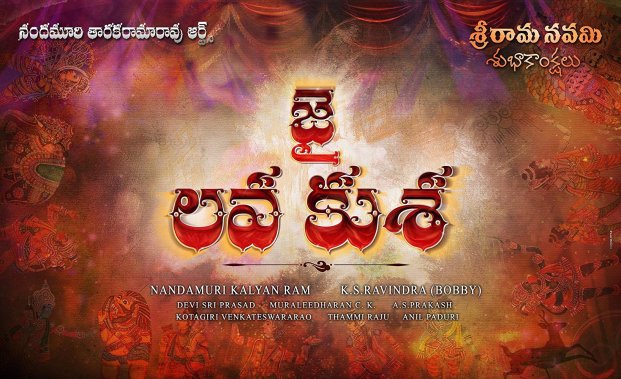
Jai Lava Kusa poster

NTR’s latest film takes the main masala ingredient of separated siblings as its theme, and weaves a standard tale of betrayal, revenge and political aspirations with plenty of fight scenes, the odd romantic moment and an exposé of bad parenting. Tarak plays three separate roles in the film, and to his credit he does differentiate all three characters well, particularly given their completely identical appearance by the end. However, with the exception of the child actor (?actors?) three versions of NTR means that no-one else gets a look in and the story suffers as a result. But if all you want is 2 ½ hours of mindless entertainment with big music numbers, even bigger fight scenes and plenty of Tarak, then Jai Lava Kusa ticks all the boxes.

The film starts with three identical triplets who are brought up by their uncle after their mother dies. I couldn’t work out if the same child actor plays all three or if K.S. Ravindra just happened to get three really similar kids (which seems more likely). Whichever it is, he (they) are excellent, particularly in the portrayal of the young Jai. The young actors here set up the interactions between the triplets which will go on to shape their adult characters, and I thoroughly enjoyed their frank portrayal of emotion and demonstration of just how nasty kids can be. At the same time, Posani Krishna Murali as their uncle and guardian shows exactly how not to deal with a child who has a speech impediment and generally fails at being a parental figure. The triplets perform on stage in mythological dramas but while Lava and Kusa are big stars, Jai is denied the same success by his stammer. Not content with ridiculing and humiliating Jai, his uncle also beats him which starts to take its toll, leading to Jai’s suitably theatrical response that leaves all three brothers separated and thinking the others are dead.

Moving forward a few years and Kusa (NTR Jr) has become a thief with a terrible haircut and a hopeless sidekick who soon fades into the background. A car accident reunites Kusa with his long-lost brother Lava, but here there is no need here for amulets, significant songs or other filmi contrivances since the two know each other immediately given that they are identical. Lava (also NTR Jr) is a mild-mannered bank manager with a crush on his marriage broker and after a haircut (thank goodness!) Kusa and Lava embark on a scheme of impersonation to let Kusa sort out problems in the bank while Lava attempts to woo Priya (Raashi Khanna). A scene about the impact of monetisation is excellent here, but for the most part there are some terrible clichés in this part of the film. Hamsa Nandini has a truly awful role as a vamp in the bank while the story itself is pedestrian and treads very familiar ground. What does work is the difference Tarak manages to create between the two brothers, despite looking identical. He keeps the personalities and the voice tone different, while the effects used to let the two brothers appear together work well

The second half is much better as Lava and Kusa find out what happened to the final brother, Jai (NTR Jr). While he still stammers, Jai has become the leader of a gang of thugs and goes by the name of Ravana, with all the symbolism that implies. Jai is totally different from the other two brothers and Tarak plays him with a brooding intensity that overpowers Lava and Kusa whenever they are together. It’s a fantastic performance and works to lift the second part of the film as Jai, in his guise of Ravana, terrorises a village with his gang. With his nifty retrievable axe on a chain Ravana deals out death on a daily basis, but needs a total image revamp when he decides to pursue a political career and win over the heart of Simran (Nivetha Thomas). There is also a plot thread that introduces a rival for Ravana in the form of Sarkar (Ronit Roy) to ensure that there are enough fight scenes and general mayhem for the film finale, while having three versions of Jai running around allows for some comedy to stop the film drowning in too much gore. The film doesn’t ever aspire to any kind of realism so the over the top fight scenes fit right in, and the lack of any appropriate authoritarian response to the excessive bloodshed seems perfectly logical. But it’s the more negative character of Jai that dominates and with plenty of melodrama and a deep voice, Tarak ensures that this is the character you remember at the end of the film.

This being an NTR Jr film there are big song and dance numbers which generally have little to do with the actual story, but which look fantastic on the big screen. Tamannah turns up in an item song, which was better than expected, and for the most part the songs are inoffensive and the dancing is first class. However they tend to appear out of nowhere and do act as distractions for the main storyline.

With all the focus being on the three brothers, there is little room for anything else. Ronit Roy’s character is a standard Telugu villain without any differentiating characteristics, while Harish Uthaman and Brahmaji pop up in blink-and-you’ll-miss-them roles. The other support characters only appear briefly to explain what happened to the brothers as they were growing up and both Raashi Khanna and Nivetha Thomas are under-utilised in roles that have minimal character development. This really is all about NTR Jr and his ability to successfully pull off a triple role with three very different characters. From that perspective the film is a huge success – Tarak is very impressive as Jai and makes me wish he appeared in more negative character roles, given how well he does here. It’s NTR Jr’s film all the way and he carries it easily with impressive performances in all three roles. It’s just a pity that the story doesn’t come together as strongly or leave such an impression. Worth watching for Tarak and for the whole visual spectacle, just don’t expect too much from the plot.
 

Simhadri

A story told in two parts, Simhadri is uneven. The things I love, I love. And the things I don’t, I really don’t. Rajamouli is always worth watching however, and it is kind of fun to look back at his earlier efforts even when the execution is a little laboured. Tarak is likeable enough, although his acting has improved greatly since 2003.

Simhadri (Tarak) is an orphan living in the household of Ram Bhupal Varma (Nasser) and his wife (Sangeetha). Simhadri is intensely loyal and has anger management issues, and his violence in service of the family is seen as endearing and almost a joke. Anyway, as they keep saying, it’s OK to kill or be killed if it is for the good of people. Tarak and Nasser have some nice badinage and their relationship does seem rock solid and a reasonable motivation for much of what follows. Simhadri is irresistible to women, especially Kasthuri (Ankitha), the daughter of the house. But he spends a lot of time and money with childlike Indu (Bhumika Chawla), and that becomes an issue when Kasthuri finds out. Apparently Simhadri’s style of beating people is medically identifiable and frequently lethal…Or at least that is what a visiting doctor from Kerala says happens when Singamalai beats someone up. But is Singamalai the same person as Simhadri? Why do truckloads of people with many and varied motivations turn up looking for him? Is he leading a double life?

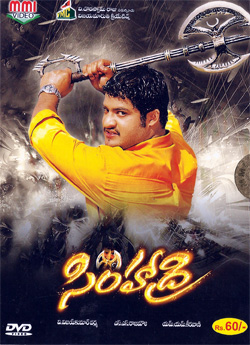
Tarak gets one of the best hero entrance scenes ever, and a quite impractical yet very impressive weapon of choice. The action scenes are crunching and generally humourless, with varying degrees of gore. And he really is delightful in the songs where he is the bumblebee of dance – it seems he shouldn’t be able to move like that but look at him go!

M.M Keeravani’s soundtrack has a dreary orphan song, some cheesy duets, and offers Tarak a range of opportunities to bust a move. It even includes that romantic Indian classic – Cotton Eye Joe!

But Simhadri has to participate in comedy disease shenanigans, and wear some very unpleasant headbands not suited to the hamster-cheeked gent. The obligatory scenes paying homage to the senior NTR are a little overdone, as well as suffering from early 2000s technical limitations. Seeing the younger actors try to leverage their family name while appeasing the inherited fan base and also create their own image is quite interesting to me.

The relationship between Simhadri and Indu is troubling given her childlike mentality. The portrayal is a little flirtatious or at least uses filmi romance visuals which is creepy. Even Simhadri’s family immediately assume she is a prostitute, despite her little girl braids and outfits. And I was appalled by her horrible neighbours. Orphanism isn’t contagious! But despite all this rich material, that renowned wet dishrag of an actress Bhumika uses at most two three facial expressions. The relationship between Simhadri and Kasturi is equally perplexing, although for different reasons. Apparently the way to spark romance is to either scare a man or be scared in front of him. So dropping an ant down your bra and all the following shrieking and jiggling makes perfect sense then. I was kind of glad Ankitha is terrible in this as it would have been sad seeing a good actress enduring the stupidity of the script.

Despite his dubious interpretation of the female psyche, Rajamouli did win a few “you go girl!” points for casting Ramya Krishnan as an item girl.

I found it highly amusing that the song is pretty much along the theme of “do you want fries with that”. But seriously, I am so impressed she has managed such a long and varied career and has made some super films along the way.

The support cast is rich with talent and recognisable faces. Nasser is all reasonable and understanding until someone disagrees with him, then it is “my way or the highway”. He is a great foil for Tarak. Mukesh Rishi is vile and compelling as Bhai Sahib, the big bad gangster. Rahul Dev is slimy Nair, who sparks about an hour of graphic violence including rape and torturing children. Sharat Saxena is the ultimate useless policeman who abdicates all responsibility to the vigilantism of Simhadri. Bhanu Chander has a small but pivotal role that relies on him never making a sensible decision. All of these actors are good, but all their characters need at least one tight slap or maybe a whack with the fancy significant weapon. You know I am close to despair when I can say truthfully that Brahmi and his character is one of the highlights. I also liked Rallapalli and Ragini as Indu’s carers, and Hema as the cheeky maid and confidante to Kasturi.

While the pace is a bit draggy, Rajamouli shines in the action sequences where he uses creative visuals to heighten the drama. Simhadri leaps over the threshold and is then seen landing on the road on a motorcycle. When Simhadri takes on Nair’s gang the fight is intercut with a religious festival, reinforcing that he is doing godly work and getting the adrenaline flowing. The final fight scene has Tarak moving at normal speed but the rowdies in slomo, which was an effective treatment compared with just speeding it all up.

There are some issues with the story, but this is not one to overthink the plot. I mean I can think of several other and better ways to solve the old “bomb in the suitcase” problem…but who wants the sensible masala version?

See this for all the mass tricks, a hero on his way to becoming a genuine star, and a director who backs himself to be playful with the big ticket elements. 3 ½ stars!

Simhadri-last word

Janatha Garage

I want to grab Koratala Siva and shake him till his teeth rattle, then kick him into the middle of next week. He has managed to get a top notch cast and the beginning of a good idea and turn it into something far less than the sum of its parts.

Sathyam (The Complete Actor Mohanlal) is the head of Janatha Garage, a leader, and is genuine in his desire to give the little people a fair go. Mohanlal has great conviction and gravitas when he speaks of what is right and fair, and he gives the impression of a man who seeks to take a balanced view but who will never take the easy way out. He gathers a small crew of like-minded men who also represent in shorthand the diversity of Hyderabad. Janatha Garage repairs engines and problems.

Anand (Young Tiger NTR) has an unusual hero entrance where he arrives to … plant a tree. Or actually, tell someone he’s busy and so can they please plant the tree. Anand’s environmentalism is very simple. Trees good, humans bad. He doesn’t seem to have a problem with wanton destruction as long as it is him dishing out the destruction. He is given an overblown fight intro where he beats some thugs up while claiming to be giving them a taste of Mother Nature’s temper. He tells people what to do and believes they will do it because he has told them so. Sathyam sees him as a good fit for Janatha Garage, and welcomes him into the fold.

Some of the movie’s highlights are the scenes between NTR Jr and Mohanlal. Their characters have a connection that is unknown to either of them for quite some time, so that added a bit of interest for the audience. They both bring more to the table than that flimsy screenplay required. The actors portray a nice dynamic – warm, mutual respect, and a recognition of the gradual changing of the guard and what that means. But there are too many gaps and things that Anand in particular just accepts too easily. This is not a lack in Tarak’s acting – I felt he added as much complexity as he could. Both Anand and Sathyam are so sure they are right, and that their right is more right than anyone else’s idea of right. Anand in particular brooks no discussion and has no compassion for anyone who opposes him. It robs his character of any inner life, and makes them both rather joyless.

And that lack of heart is the real problem with this film. For a story that should be so intimately tied to people and their daily struggles, once the story moves to Hyderabad Janatha Garage seems to take place in a lifeless bubble. The sound design makes it seem like they are on a stage with echoing dubbing and swelling string music every time Janatha Garage is invoked. In contrast, an early scene of Anand running through a slum area in Mumbai had a real sense of place and the vibrant, persistent signs of life in high density cities. Even in the impressively choreographed action scenes, Anand takes on all comers alone. He finally allows the other Garage guys in on the final fight but they are barely on camera. And he never even gets a mark on his linen shirts, let alone get his hair messed up. I wonder if his construction strength hair product was environmentally friendly? His apparent invulnerability also saps the drama of tension because you know how every fight will end before it starts.

The support cast are pushed so far into the periphery that I was actually a bit sad to recognise so many capable actors. The Janatha Garage family includes Rahman as Sathyam’s murdered brother, Sithara as Anand’s aunty, Suresh as his uncle, and Devayani as Sathyam’s wife. Perennial favourite Ajay is likeable and sympathetic, Brahmaji doesn’t look angry for maybe 40 seconds of his total screentime, Saikumar is suave as police chief Chandrasekhar, and I liked Vennela Kishore’s fleeting appearance as an inappropriate office manager flirting with Samantha. I have just spent as much time on developing their characters as Koratala Siva did.

The baddies were played by Sachin Khedekar and Ashish Vidyarthi who both exuded an urbane egotism in their pursuit of wealth. They both want to keep a distance from what is being done, but have no illusions about the outcome. Unni Mukundan plays Sathyam’s son Raghava who goes over to the dark side. Raghava is slimy and bit of a sook and I cared not one jot for his well-being. But I did wonder just how he turned out that way when everyone else even tenuously associated with Janatha Garage was lining up for sainthood.

Samantha and Nithya Menon are capable, and both project warmth and liveliness which was sorely lacking in the rest of the film. But their relationships with each other and with Anand were never developed, and their storylines just fizzled out. Even Anand, apart from one tearful scene, seemed largely to forget that he had a girlfriend and a spare.

Luckily there are beautiful visuals from cinematographer S. Thirunavukkarasu, especially when the story heads out of town and Anand gets his groove on while frolicking in the mountains. Tarak can express such joy when he dances and it was a relief to see Anand lighten up. Rock On Bro is exactly what you’d expect if you briefed a 70s metal cover band to write a theme for a tourism ad with a hippy vibe. Having said that, the Apple Beauty song has possibly the worst lyrics I’ve heard since Eurovision. I pitied the subtitle team for having to work with such gems as “when you devour me I am like the Apple logo on an iPhone”. But don’t take my word for it. Here is a sample:

And who on earth thought Kajal could deliver a skanky item? She’s very attractive, she gives it her all, but she has none of the sensuality or basic coordination required to dance her way in and out of trouble. And casting a Mumbai girl to perform a Telugu item called Pakka Local…Luckily Tarak decides he can’t see the excellent sets go to waste so he jumps in.

I’m putting the flaws in Janatha Garage firmly on Koratala Siva’s account. He had a super cast, a decent budget, and a good idea and he threw most of it away with shoddy writing and empty clichés. One for the Tarak or Mohanlal fans who will enjoy the star performances.