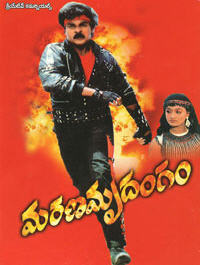
Marana Mrudangam

Marana Mrudangam is Chiranjeevi in his mass hero avatar – meting out justice, charming the ladies, fighting evil-doers and dancing up a storm. I never cease to be amazed by A Kodandarami Reddy’s imagination and Marana Mrudangam is full of crazy details, wild schemes, stunts and an array of dodgy looking props. Plus – Ranjeet!

Johny (Chiru) and Billu (Nagendra Babu, Chiranjeevi’s brother) run a small restaurant/bar.
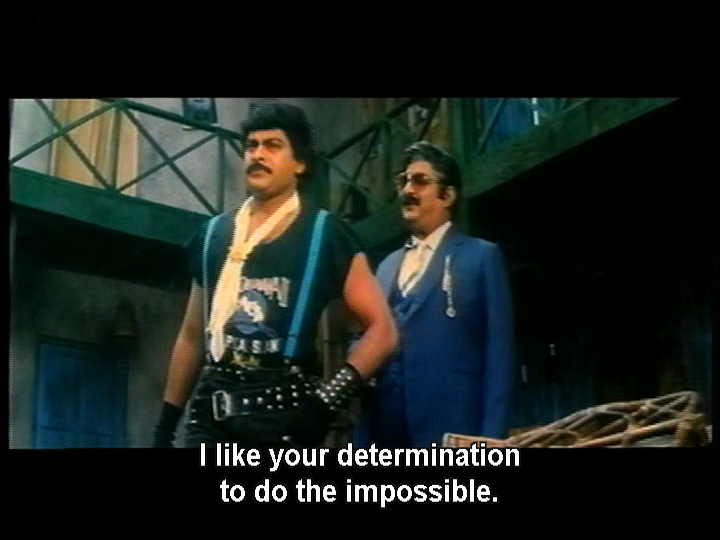
One day Johny stops to help Utpala (Suhasini) and Anusha (Radha) when their car has broken down. Utpala is a nurse, and Radha is a high powered manager of a hotel that also seems to trade in import export.
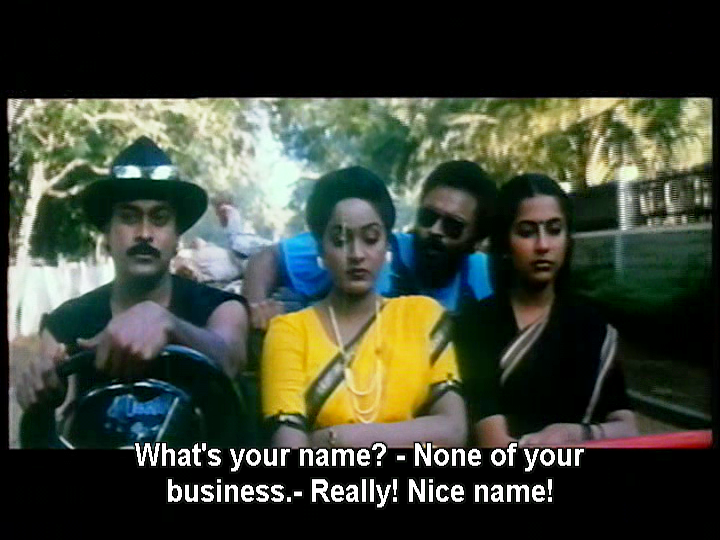
Two girls, two guys – it’s a love triangle waiting to happen. Utpala falls for Johny who has fallen for Anusha while Billu seems to fancy Utpala a little.

I don’t mind rom-coms when Chiru is doing both rom and com, but I was hoping for a bit more masala inspired action. Imagine my delight when Billu cracked an egg to make an omelette and found it was full of COCAINE!
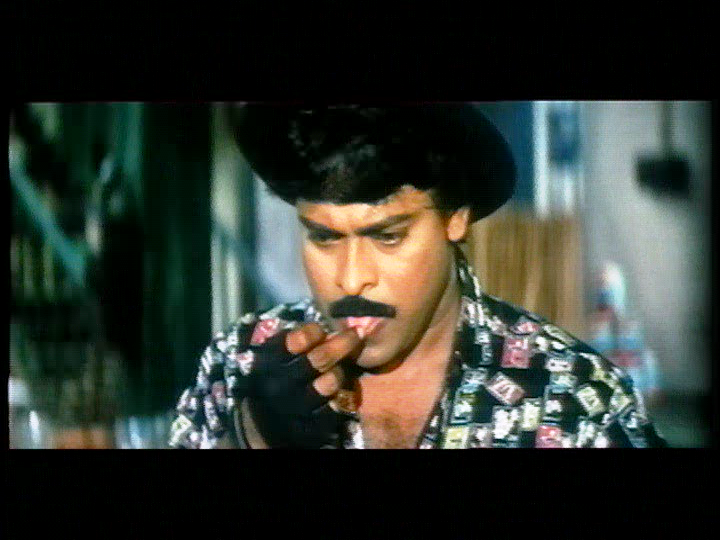
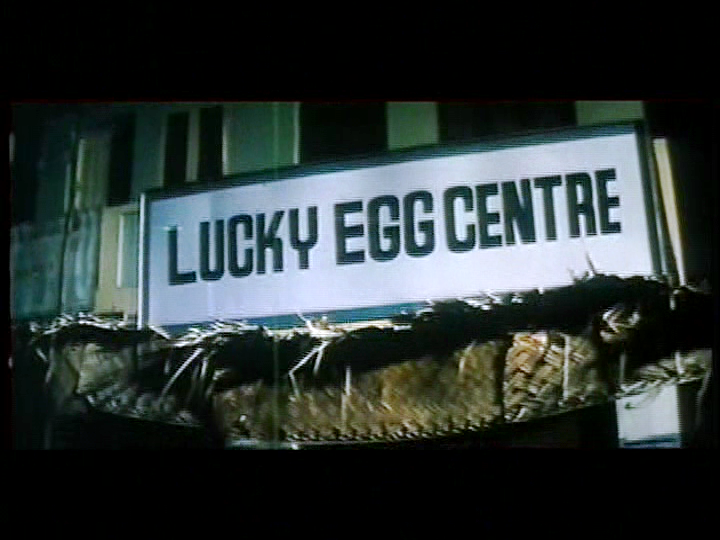
No I don’t know how Johny knew how to identify cocaine. But he also knew how to track the drug back to its origin and so the thrills and spills began!

Salim (Ranjeet) is a very bad man, and not just because he wears an excessive amount of very tight denim. He is a cold eyed killer and rapist and the enforcer in Vasantdada’s (Suresh Oberoi) gang.

He has no impulse control and his character could be summed up as ‘Rapey’. Ranjeet also has a thing for staking people out to die. It’s neither fast nor efficient but he does persist.
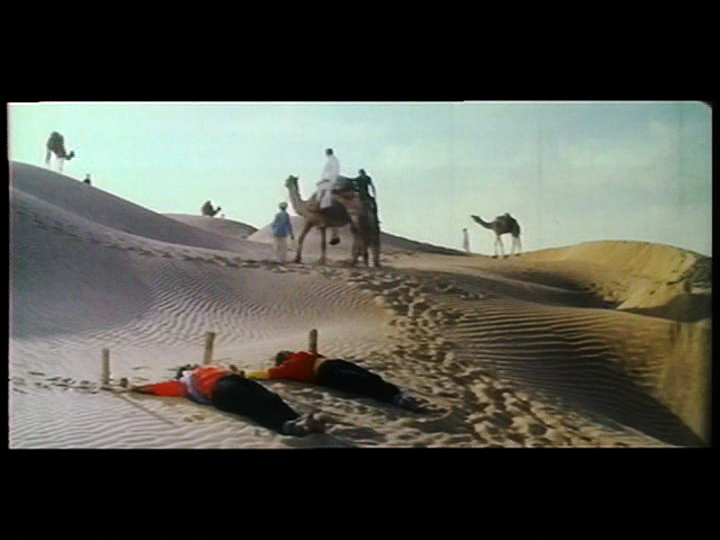
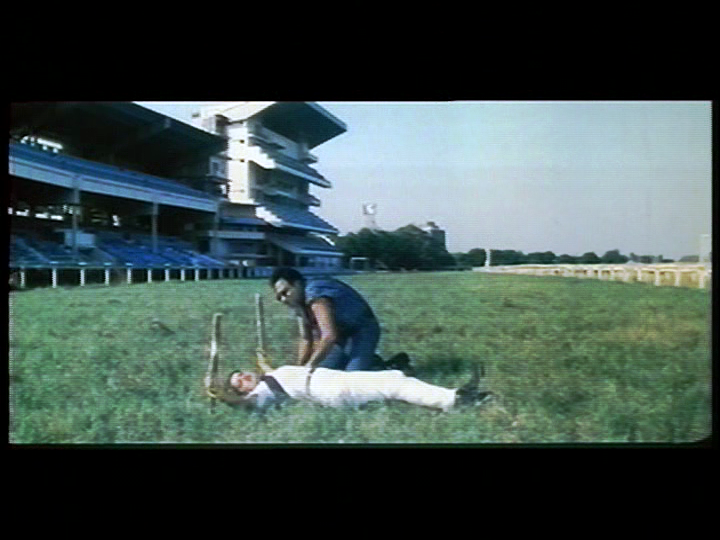
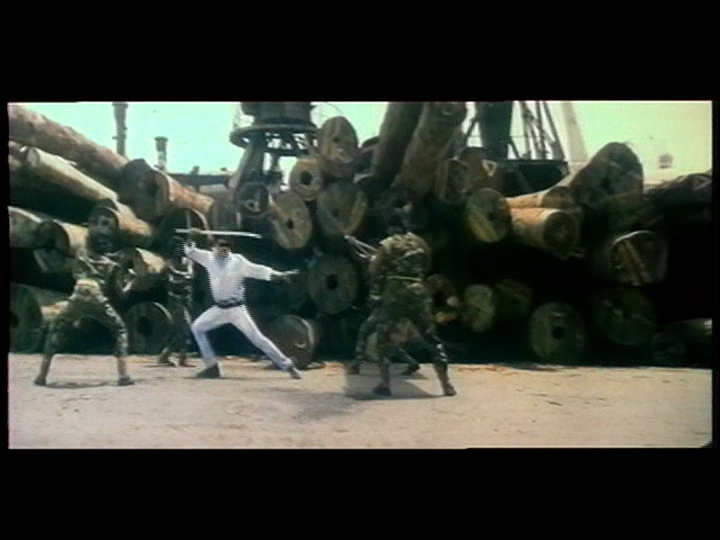
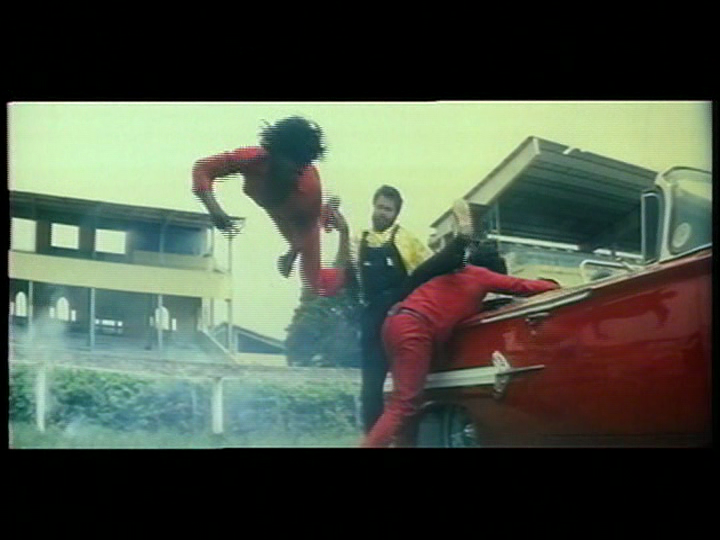
Salim impersonates a policeman and lures Anusha out of her home, intending to assault her, but Johny intervenes. Utpala needs help too. Her brother fell into the clutches of Vasantdada and before dying managed to write a letter that will bring the gang down. Johny and Billu rise to the occasion and decide to eliminate the gang and get revenge for Vasantdada’s past crimes. Vasantdada’s henchmen all wear matching outfits in different styles and colours each time they appear which was a nice detail (and helped me remember which fight was which).
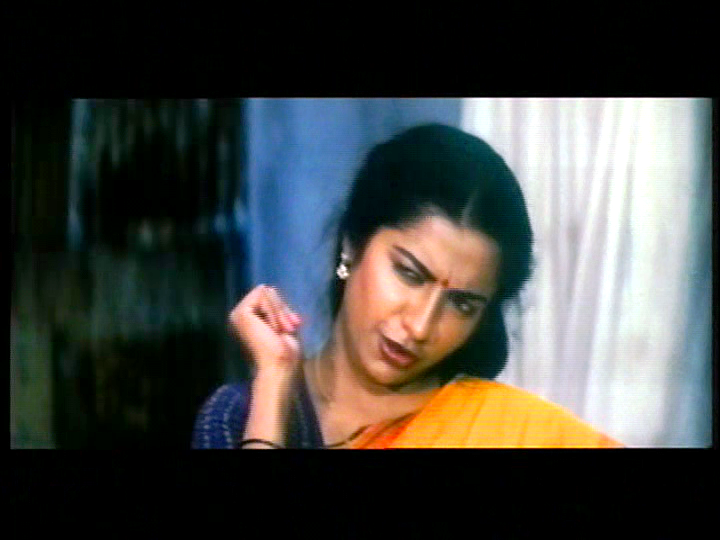
Suhasini is one of my favourite actresses and while this is a fairly small role she made an impression as the good natured and straight forward Utpala. She suffers terrible loss but is determined to do the right thing. Utpala isn’t confident to act on her own and relies on Johny and Billu for advice and to do what is needed. She has a comedy scene or two, and Suhasini is not a woman I expect to see rolling drunk on screen.  But she still looked lovely.
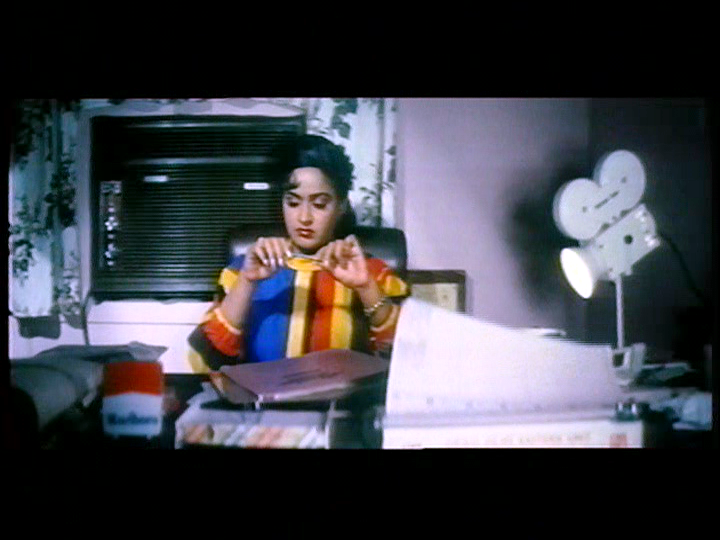
Anusha is a haughty heroine who doesn’t lack self-confidence at all. She is independent and determined but still needs Johny to save her on numerous occasions when having a sharp tongue isn’t enough.
And I haven’t mentioned the costumes. I think in this song the wardrobe guys were so horrified by this outfit
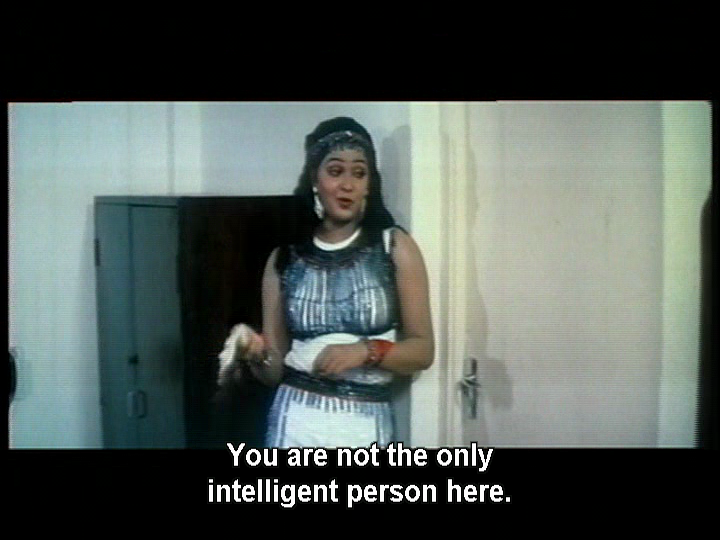
that they gave up on clothes for a while:

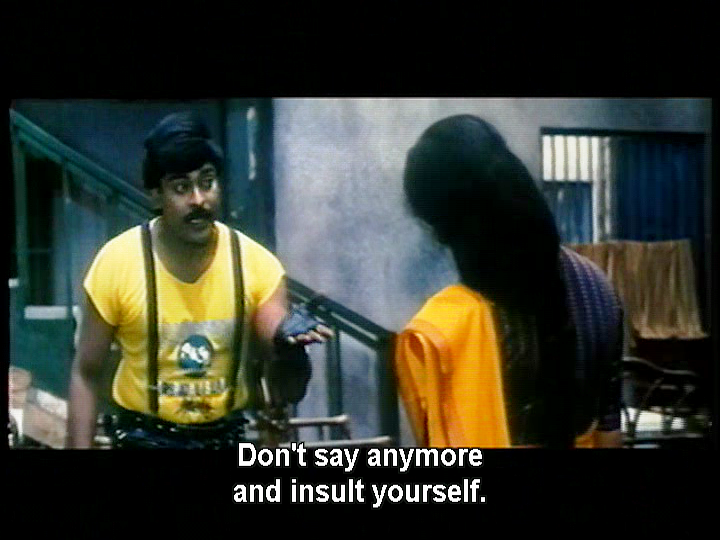
Chiru tends towards the high pants with the low belt, often doubling up on the fabric for both shirt and pants, and nicely accessorised with an eye catching array of gloves.
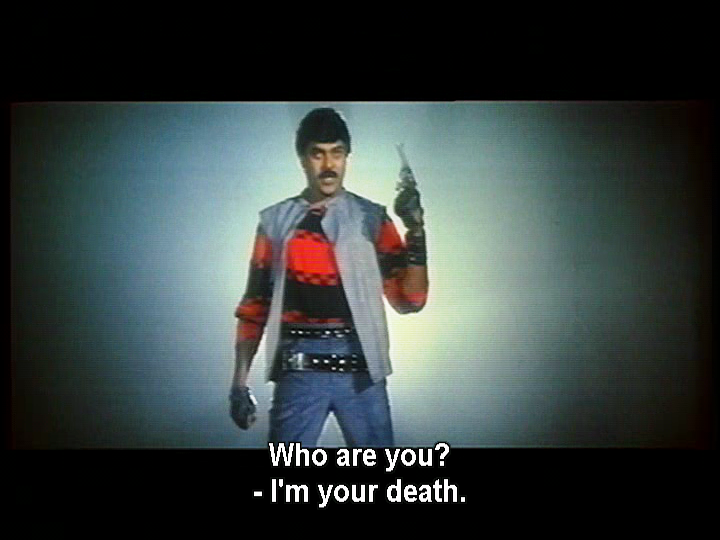
He opts for pleather for the big occasions, but as demonstrated in that song, costumes are not necessary for Johny to make a splash.

Chiru has better chemistry with Suhasini than with Radha, though perhaps that’s just my bias. It’s clear that the saucy Anusha is Johny’s type.
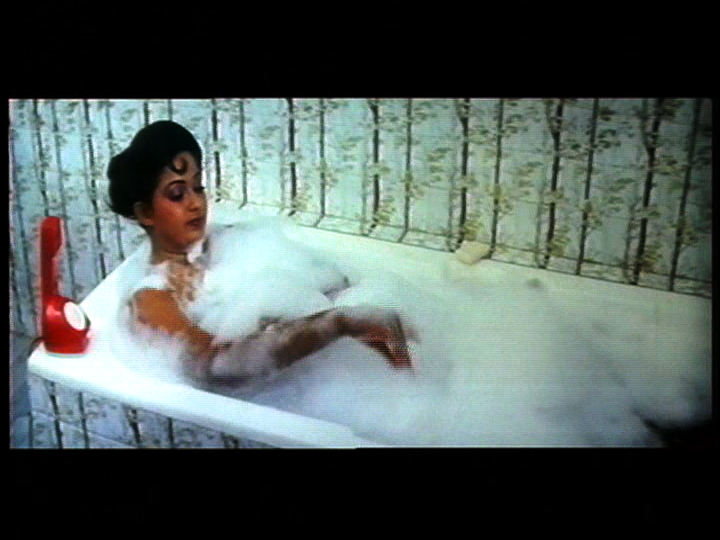
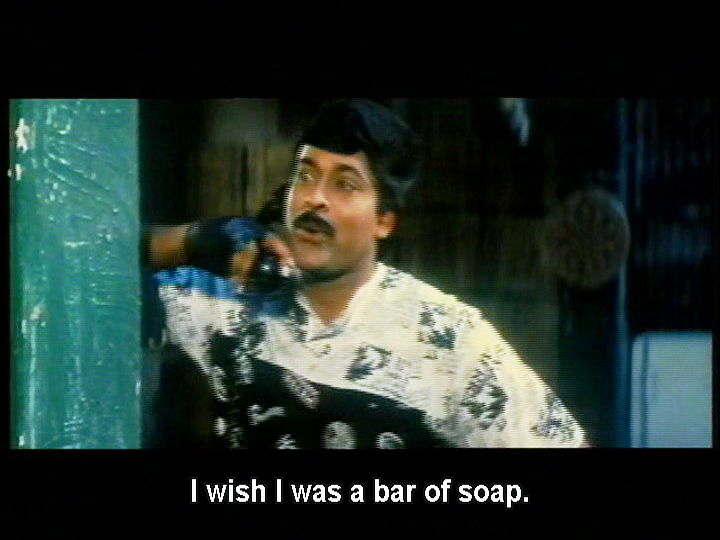
But really the focus of his performance is the heroics and that he does with his customary verve.

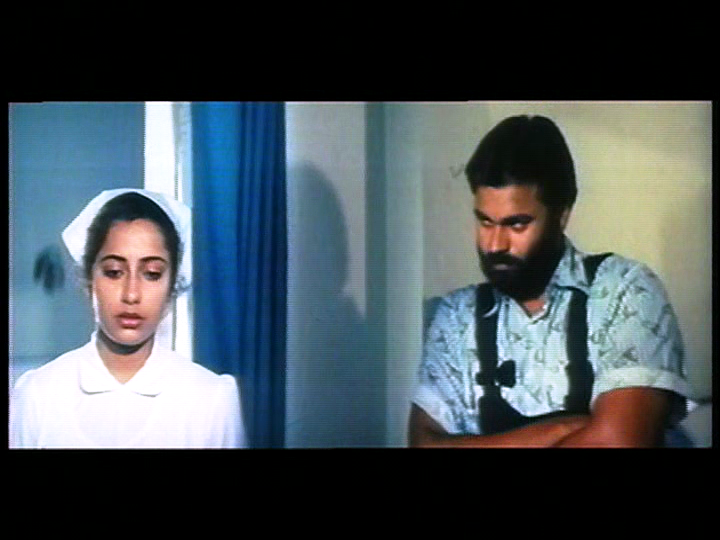
Nagendra Babu is sweet as Billu. Compared to Johny he is quiet and shy but he is handy in a fight. He favoured denim overalls and flowery shirts which added to the slightly comedic nice guy image. He is quite tall so the effect when he was flinging little bad guys around with abandon was very funny. It’s not surprising that he and Chiru have great rapport on screen and I liked seeing them bounce dialogue off each other in their scenes.

The story is based on a popular novel. The author Yandamoori Veerendranath adapted the screenplay himself and the pace and plotting is a strength of the film. There are obviously some scenes designed purely for maximum Mega presence, but Chiranjeevi manages to incorporate them all into the character of Johny so it flowed quite well.

The climax of the film is fantastic but I did have a horribly sick feeling in a couple of minutes of footage involving horse stunts. I am certain not all of the horses were unharmed and suspect a couple didn’t survive. If this worries you please don’t watch from around 2hrs 5 min to 2 hrs 8 min. Before that I was delighted by one of the most ridiculous fake aircraft I think I have ever seen and there were some nifty come-uppances for the baddies.

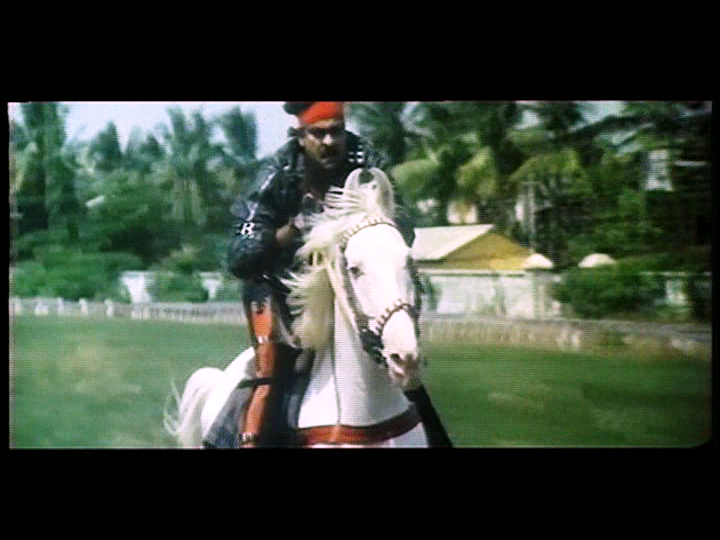
The Illaiyaraja soundtrack is nice enough but I struggle to recall the songs without the visuals. Chiranjeevi and Radha don’t have the greatest choreography to work with but give it all loads of energy and flair. Visually the film is very striking with lots of crazy camera angles, stylised compositions and reminds me a little of some vintage 60s spy shows, albeit with acid wash denim.
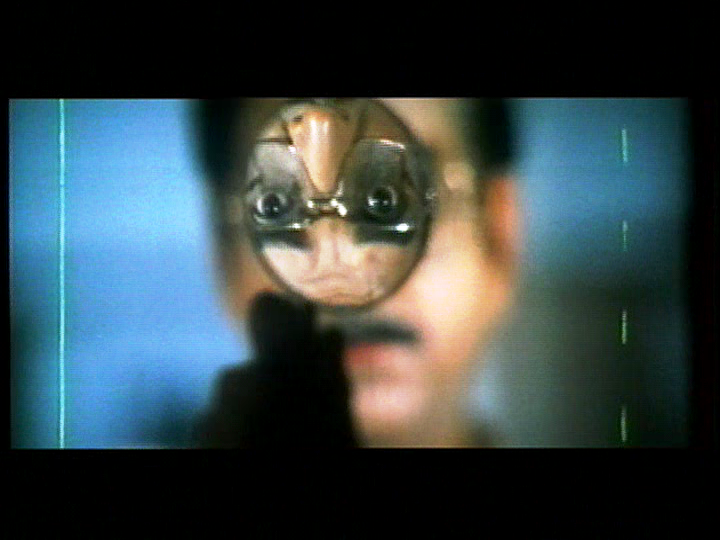
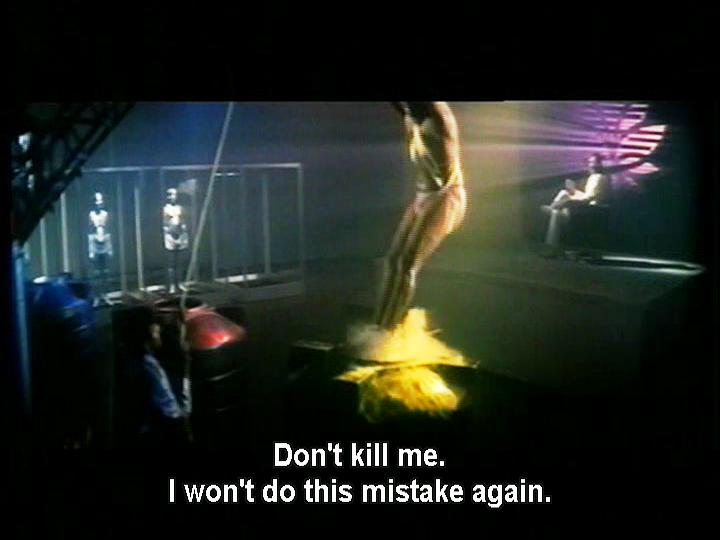
Marana Mrudangam is a pacey masala entertainment, and if you are prepared to perhaps skip the horse scene, this is very good fun. And really, it was worth seeing just for the surprise of the naked Chiru chicken dance. 4 stars!
Shock

Ravi Teja has a dedicated fan following and I’ve read good things about his films so I decided it was about time I watched one of his movies. I bought this film on my last trip to Chennai on the recommendation of a friend, and since the blurb on the DVD suggested it would be more of a thriller than the typical mass masala fare it sounded more to my taste than some of the comedic roles he has played. And I did enjoy it, well mostly, at least up until the last 30 minutes anyway.

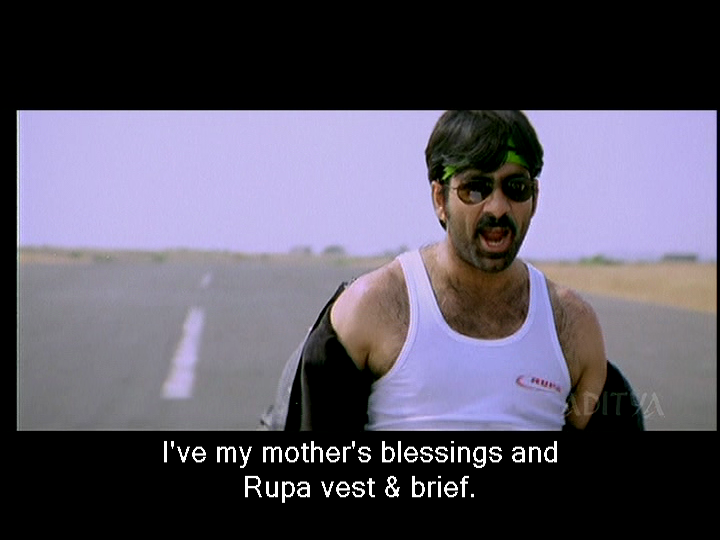
Ravi Teja plays an advertising agent Sekhar, although a look at his pitch for Rupa underwear suggests that perhaps it’s not his true calling.

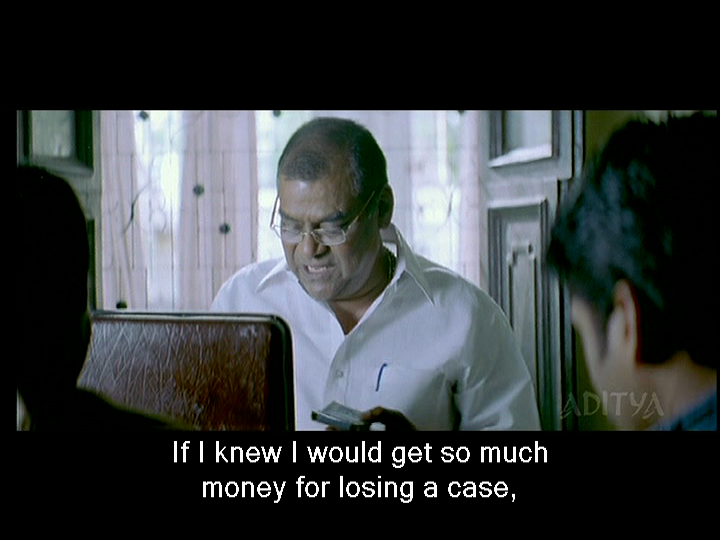
He’s happily married to another advertising agent in his office, Madhurima (Jyothika). She has to take a back seat to her more ebullient husband who is clearly the office favourite. Brahmi makes a brief and understated appearance as Sekhar’s boss but for a change there isn’t much comedy in his role. There is some humour in these scenes but it mainly arises from situations with Sekhar and his wife and generally is well placed and actually quite funny.

The relationship between Sekhar and Madhurima is convincingly portrayed and they seem to have a strong and loving partnership. I could do with less of Ravi Teja’s back hair on view to demonstrate this, but other than that I think writer/director Harish Shankar is accurate in his portrayal of a working couple.They live in a block of flats where the lift never functions and there are constant disruptions from the neighbours and their children. When Madhurima becomes pregnant, they decide to relocate and quickly find a recently vacated house. However just as they move in, two men burst through the door and shoot Sekhar. He wakes up handcuffed to the bed in hospital and is immediately interrogated about his terrorist connections. He learns he has been mistaken for a Maoist by two encounter specialist police officers, Nagesh and Divaker. Although the pair realise their mistake almost immediately, they decide not to take responsibility for what has happened and instead salt Sekhar’s house with evidence to make sure that their error is not discovered.

In the meantime Madhurima protests Sekhar’s arrest and manages to hire a lawyer. By the time of the trial however, the lawyer has been paid off by the two cops and has convinced Sekhar to plead guilty, telling him he will get a short sentence and that will be the end of it. Of course this is not the case and Sekhar is sentenced to 8 years in jail. Madhurima immediately vows to get him released and is aided by Geeta, a journalist interested in the case.

There are various moments of drama in the prison: Sekhar is fortuitously sharing a cell with an inmate Tilak who has certain rights and privileges with the guards but he is also menaced by the self styled boss of the jail, Syed. This is all conveyed without recourse to cliché, or over the top drama and serves to give an idea of Sekhar’s true character as well as set up subsequent events in the jail. Madhu’s struggles are also convincingly portrayed. Geeta doesn’t take over the defence or engage in unrealistic methods to help Madhurima find justice, but instead advises her of which organisations to contact. This is all very plausible and fills out the background of the story well.

But just when you think this is going to be a battle played out in the courts and among informers in the back streets, there is more drama as Madhurima is threatened and Sekhar escapes from jail. Up until this point the film is very good; a slightly different story, well paced and told with good performances from the cast. But from here the film starts to rely on violence and bloodshed and the storyline becomes more predictable and clichéd as Sekhar plans his revenge. There are some unpleasant torture scenes and the realism that was built up so very well in the first half of the film is lost as Sekhar suddenly becomes able to fight his way out of any situation. However there is still a very ‘Hollywood’ feel to the action, and the slickness of the production carries through right to the rather unsatisfactory end. There seems to be an obsession in the Telugu film industry with making sure there is a happy ending (of sorts at any rate), and in this case I would have preferred to see something more in the way of consequences for everyone’s actions.

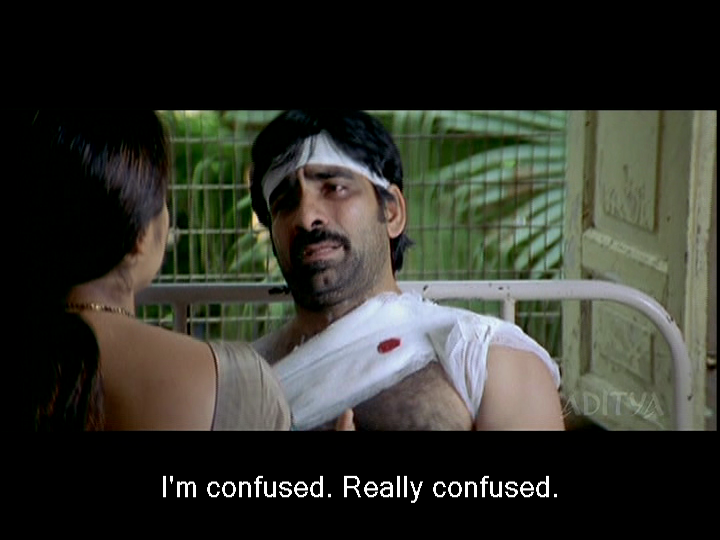
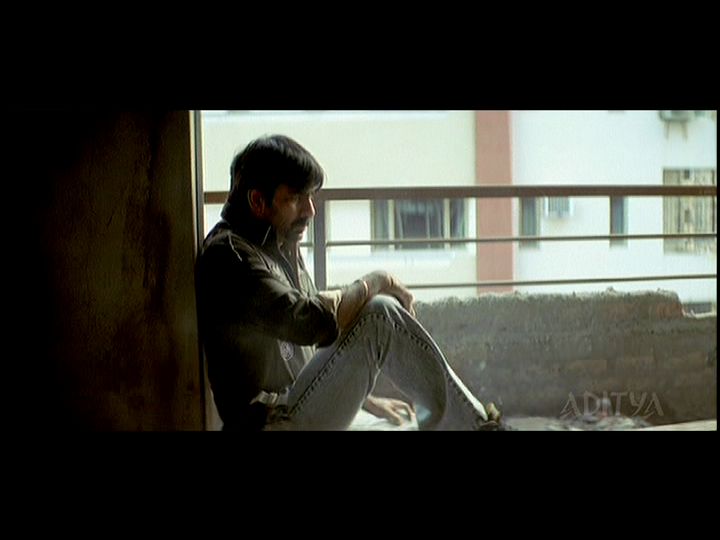
Despite the collapse of the plot in the second half, the film sets up the basic story well and the leads are all excellent in their roles. Sekhar’s confusion and distress at the situation he finds himself in is well portrayed by Ravi Teja. I was very impressed by the vulnerability he was able to convey as the injured and baffled victim in hospital and then as the somewhat shell-shocked and stunned prisoner in jail. He was even reasonably convincing in the action roles up until he had to take on a number of much more muscled and bigger extras. I know he is the hero but there is a limit to what I can believe!

Jyothika has a much more developed role than is usual for the heroine in Telugu films and I really thought she was excellent as Madhurima. Her relationship with her husband is very realistically drawn and the romance is sweet without being cloying. Her distress at her husband’s situation is perfectly depicted as is the change in her character as she first breaks down and then becomes a driven and determined woman out to get justice for her husband. The only scenes which didn’t fit were when the story of the couple’s initial meeting was shown as a flashback scene later in the film. This felt misplaced and disrupted the story just when it really needed to be tighter. Although it does mean we get another good song from Ajay-Atul. Although this is out of place in the film it is nicely pictured – I cannot explain the gloves in the opening shots though!

Apart from the two main leads there are a number of the usual suspects in the film who all play their roles with their usual competence. Kota Srinivasa Rao is a perfect fit as the corrupt lawyer and both Subbaraju and Ravi Kale were fine as the deceitful cops. Raghu Babu shows up in a familiar role as a nasty warden in the jail along with Raja Ravindra as the useful Tilak. It’s a little surprising that the small role of Geeta is played by Tabu and it does seem a waste to have such a good actress only on screen for a few short scenes. But it’s always a pleasure to watch her even if it is only in a few scenes. There is some attempt at comedy in the second half with the CBI officer Surendra Kumar (Nagendra Babu) and his incompetent assistant Bapanna (Ram Jagan) but this falls very flat and thankfully the Harish Shankar seems to have realised it wasn’t appropriate fairly quickly.


I would have found it this a much more interesting and appealing story if the film had dealt more with Madhurima’s fight for justice and Sekhar’s struggles in jail rather than going for the straight hero driven revenge drama. But then again that probably wouldn’t have been as popular at the box office. As it is, the second half of the film is a disappointment after the excellent build-up in the first half, and the attempt at a happy ending particularly jarring. I am favourably impressed with Ravi Teja though and Jyothika was fantastic. For those two excellent performances, and a good first half, this film gets 3 stars.

Orange

We had a vested interest in seeing Orange, having spent a lot of quality time loitering around the shoot as it took place in Melbourne. The lure of seeing Ram Charan on the big screen, along with the ever entertaining Genelia and our hometown was just too strong to ignore.  We avoid reading previews of new release films before we see them, as there is too much PR hype and politics to get much useful information, but the arrival of Charan on Twitter certainly got our attention! The cinema was full, and with a higher number of families and kids than we usually see at the South Indian films here.

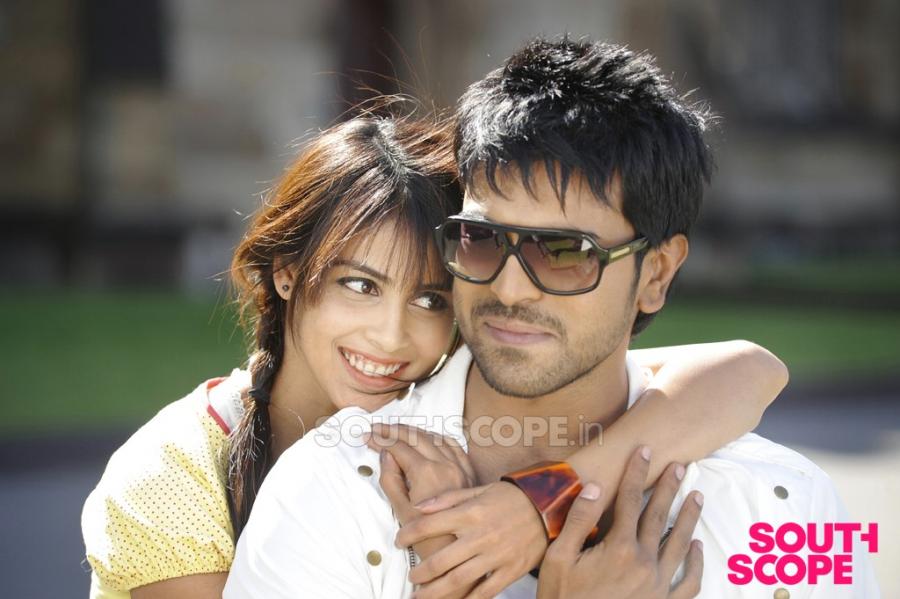
Charan plays Ram, a wildlife photographer and graffiti artist with a truly excellent selection of t-shirts. He lives with his sister and brother-in-law in a fancy apartment and drives a flash car. He has strong views on love and honesty and won’t back away from his values. After an earlier relationship with Rooba (Shazahn Padamsee), shown in flashback, we see that he learned a lot about himself and what he wants from life. He doesn’t believe that simply saying ‘I love you’ makes for a relationship, and doesn’t believe it is honest or realistic to promise a lifelong love. He is affectionate, caring, demonstrative, but he is not going to commit to a lifetime, and he will not sacrifice just to keep his loved one happy. He doesn’t want his girlfriend to sacrifice anything for him either – he has been through this unhappiness and is genuinely trying to find an honest and respectful balance.

Genelia as Janu makes a ridiculously chirpy entrance to the film, cheering as she watches a marriage proposal and being as excited for the lovers as if it was her own relationship. She does believe in the idea of soulmates and lifelong love connection and wants that from her partner. She is in love with love, and looking for Mister Right. Several potential Mister Rights form part of the comic sideplot.

So of course, these lovely looking youngsters with completely opposing views fall for each other. The film is then about Ram and Janu getting to understand each other, and the choices they make.

With Puppy (Brahmi!) aiding and abetting Janu, the relationship develops in fits and starts. Ram is persistent and Janu is interested but wary of this charismatic suitor. We knew long before Brahmi mimed Krishna playing his flute that Ram was a ladies man! When he happily admits to having had NINE girlfriends, in relationships spanning from 1 to 387 days in length, Janu decides he is just too much to handle and tries to back off but cannot deny her feelings.

Although for the most part the film is a fluffy romance, there is a serious conflict at the core. While the audience can empathise with both sides, it is clear that something major would have to change for there to be a traditional boy gets girl happy ending.  We could maintain sympathy for both the romantic Janu and the more challenging Ram so found the conclusion to be reasonably satisfying and in keeping with the characters. However we suspect that if you can’t connect with Ram’s character, the film will not hold your interest.

Charan’s performance was great. He was charming, funny, energetic, emotionally engaging and totally looked the part. He was convincing as the school leaver Ram, and especially as the urbane young man about town and his body language really suited the different confidence levels of these stages of his life. The fight scenes were typically dramatic and physical, and Charan’s dancing is, of course, brilliant . The choreography was lots of fun and Charan seemed to have a great time sending up some cheesy romantic moves. Seeing these films without subtitles and having only a minimal understanding of language, we rely on the tone and expressions of actors. Charan made us see him as Ram and we understood his character’s views and feelings so we have to say it was a successful performance.

Genelia was her usual bubbly self, perhaps too bubbly, to start with but really showed some depth to Janu over the course of the film. She conveyed the struggle between having feelings for someone and knowing that it wasn’t going to work. We could see her grow from a carefree girl to a more independent young lady as she confronted her own beliefs and tested them for herself to see what she wanted.

Nagendra Babu had a small but pivotal role as Ram’s neighbour who was living in a stormy domestic situation.  Brahmi and Prakash Raj are always a familiar delight to behold. Brahmi got more to do in Orange , and his comedy was a bit more varied and often very funny. He also had a fine collection of t-shirts, and a habit of reading Mills & Boon before bed. Prakash Raj was the Telugu cop who gave Ram the reason to narrate his life story. He had little to do, and really it need not have been a Prakash Raj role although we are always pleased to see him. We did watch some of the scenes with him and Charan being shot so we certainly enjoyed that. The rest of the support cast were fine but as we have to concentrate on the main story, we didn’t really give them enough attention to be able to comment much.

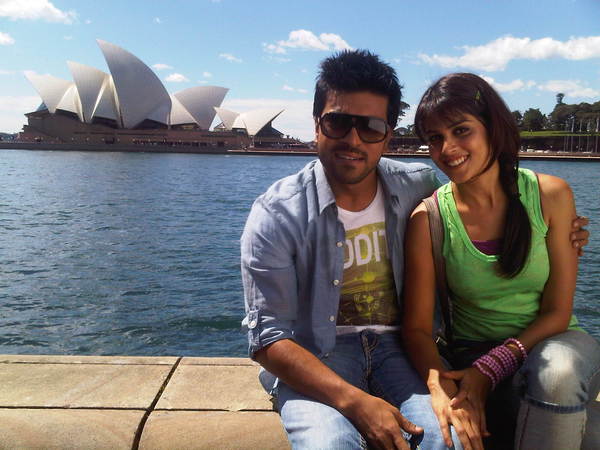
We love the soundtrack and the songs looked amazing on screen. We are somewhat disappointed that Melbourne scenes are inter-cut with Sydney to give the impression of one Australian city, as the Melbourne -Sydney rivalry is HUGE, but we will forgive it as we got the opportunity to watch this film being made. Bhaskar managed to skirt the problem of geographic displacement by blending the locations well. The places Ram and Janu were seen were appropriate for their student lifestyle and helped the film’s credibility. We are always a bit judgmental about the skankily dressed white chicks in songs but Orange is family friendly for the most.

Some special notes: We greatly enjoyed Anand Ranga’s updates via Twitter, and shared his anxiety about the weather. When he casually mentioned filming with a lion, we expected maybe a fleeting appearance in a song. Not a full blown encounter with the King of the Jungle who apparently frequents the NSW forests. We cheered a lot! But the audience went wild when the Glen Iris tram was on screen – who knew the number 6 tram was that much of a star? We also enjoyed seeing a return of the pink panda t-shirt first spotted on Charan in  Magadheera, this time being worn by one of Ram’s friends. There was plenty for the alert viewer in Orange!