Kannathil Muthamittal

I watched Kannathil Muthamittal when a number of people recommended it to me after I worked in refugee camps in Sri Lanka. I think that my experiences there have really coloured my view of the film as I do focus more on Shyama’s story and less on the main characters. That said, I think the story is well told and the actors all do a good job – it’s just not the story I wanted to see.  It’s a classic Mani Ratnam film with strong female characters, great cinematography and attention to detail, so it’s no surprise that the film won six National Awards.

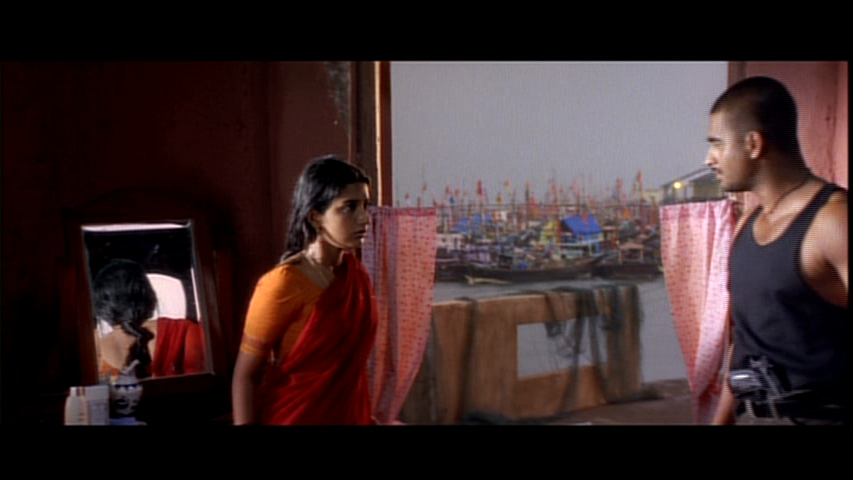
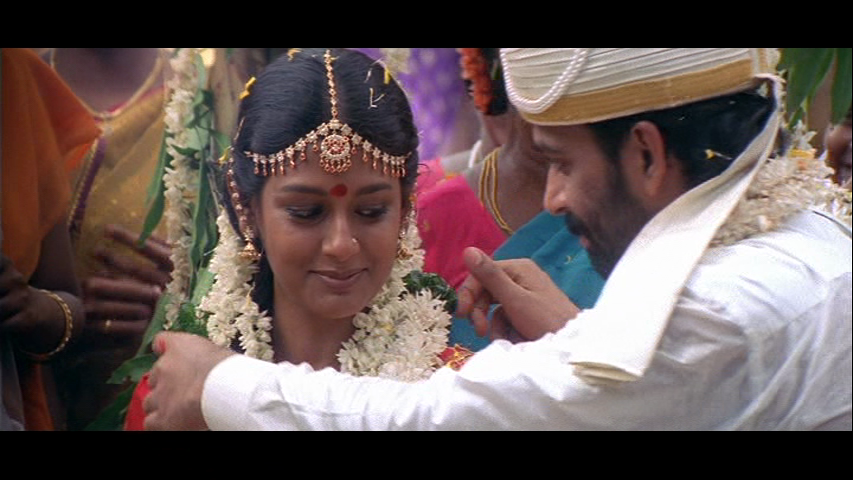
The film opens with the wedding of Shyama (Nandita Das) and Dileepan (J. D. Chakravarthi) in their village located in northern Sri Lanka. Despite this happy start it’s not long before Shyama is pregnant and on a boat heading for a refugee camp in India while her husband is missing, presumably fighting for the LTTE. Once she gives birth in the refugee camp, Shyama leaves her daughter behind and heads back to Sri Lanka to try and find her husband.
From here the film skips forward in time to introduce G. Thiruchelvan or Thiru (Madhavan) and his family, as seen through the eyes of his adopted daughter Amudha. Convincingly played by P S Keerthana, she appears to be a typical precocious 9 year old; playing with her friends at school, teasing her two younger brothers and very definitely the princess in the family. The story of her adoption is told in flashback and shows the development of the romance between Thiru and Indra (Simran).  I really like this part of the story as the two leads play their parts well and the intertwining of the adoption story and the romance is really sweet.

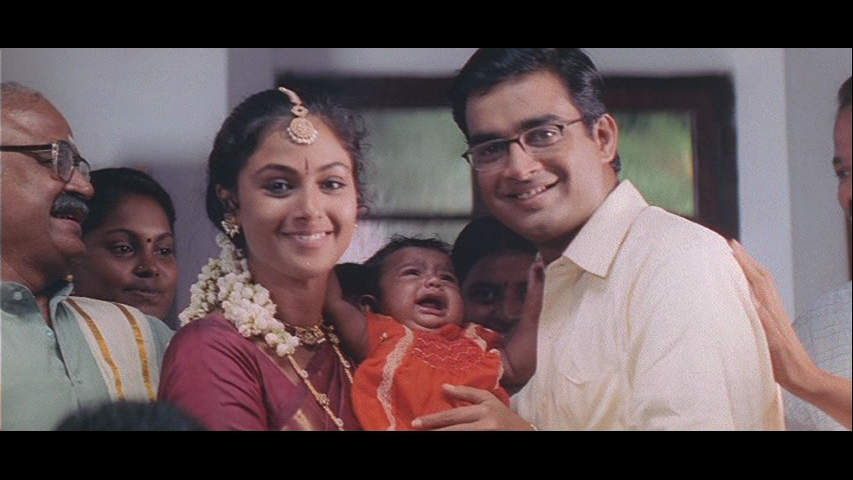
After she is told by her father on her ninth birthday that she is adopted, Amudha becomes moody and withdrawn and finally demands a chance to meet her real mother in Sri Lanka. For some inexplicable reason her parents accede to her demands and the family head off to the war-torn nation, although they did have the good sense to leave their other two sons behind.

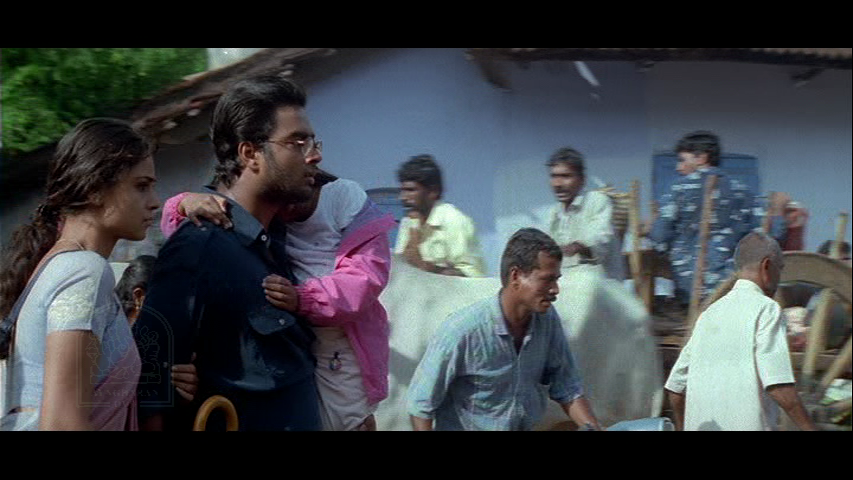
The scenes in Sri Lanka make me cry every time I watch this film. I have seen the same mix of resignation and total despair on people’s faces that is shown here when a village is evacuated. I worked on the East Coast and regularly travelled between LTTE and government controlled areas. The incredibly young soldiers with their automatic weapons shown in the film is very much true to what I experienced and for me this total realism clashes with the more idealistic search for Shyama. Mani Ratnam wisely doesn’t attempt to explain any of the conflict, only showing its effects on Indra and Thiru as they realise why Shyama left her baby behind.

Amudha becomes bratty and rude as she deals with her feelings of alienation from her family and as a consequence I lose much of my sympathy for her. I also disagree with her parents’ decision to try and find her birth mother, no matter how essential it is to the plot. However both Simran and P S Keerthana convey their conflicting emotions and fluctuating relationship well and Indra’s  inner conflict as she worries about her two sons left behind in India is effectively depicted. Although Amudha is irritating the young actor does hold her own against the more experienced cast and it may be more due to the over emotional story that I lose interest in her search. Madhavan’s character, although impressive in the beginning, seems to have little impact in the latter half of the film and Prakash Raj is wasted in his role as the doctor taking the family around Colombo. So while I enjoy the first half of the film, the second half tends to drag with the adoption story and the peripheral action is more engaging . Some of Amudha’s rebellion in this section could have been cut without losing the feeling of her isolation and separation from the rest of the family. The ending is also a little disappointing but Mani Ratnam shows restraint in not turning the final scenes into melodrama, which could easily have occurred given the subject matter.

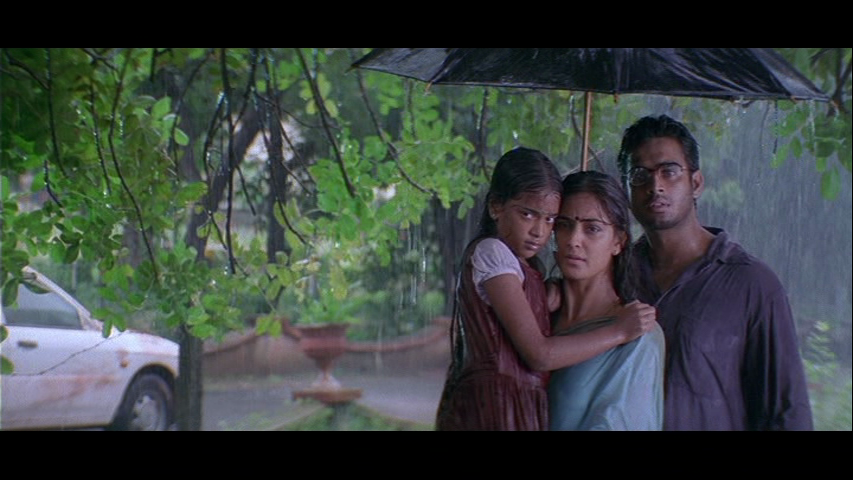
What I do like about the film is that it looks beautiful and is well shot by cinematographer Ravi K Chanran. Lighting is used to good effect as the early scenes in the family home are filled with warmth in contrast to the rain and grey skies in the later part of the film. While the background score of the film by A. R. Rahman is both beautiful and haunting, some of the songs are a little intrusive. The story doesn’t really need dance numbers and they seem to interrupt rather than move the film forward.

This isn’t a film I particularly enjoy watching, probably more because of the memories it evokes, although I can see why it won awards and I do think it’s generally well acted. It’s just that I would have preferred to see more of Shyama’s story and less of the family drama.  3 stars from me, mainly for the first half.

Temple says: This is one of the first Tamil films I saw a few years ago, and I was prompted to pick it up because of the storyline and for Madhavan.

Thiru (Madhavan) fell in love with the idea of giving Amudha a home and family, and I always feel that if Indra hadn’t agreed, then someone else would have been procured to play wifey. His decisions all revolve around what he wants – the way he courts Indra, the adoption, telling Amudha and persisting when it was clear she wasn’t ready for this birthday surprise, and on it goes.  The job of explaining and reassuring was left mostly to Indra, and she had to bear the emotional burden of seeing her little girl in torment as she herself struggled to cope. Simran is lovely as Indra, but her character is surprisingly weak considering the way she met Maddy, and her being a news anchor. I expected more backbone, but the women in Mani Ratnam films are often written like this – a strong outline and not a lot of finer detail to make them seem more real.

I was adopted and my mother told me every day, long before I even knew what words were, so it would never come as a shock to me and to make it clear that ‘adoption’ isn’t a dirty word. My perspective is coloured by that and while I can understand the bratty Amudha wanting to know her own story, I will never understand her adoptive parents taking her into a war zone no matter how much she sulked.  Still, the treatment of her story in terms of her developing understanding, the legal adoption process, and the fallout once the truth emerged was handled in a much more credible manner than many other films with orphans scattered around the streets, under cabbage leaves, going free to a good home.

The prologue was excellent in setting the scene, but beyond that Shyama and Dileepa didn’t really fit. The context of the Sri Lankan conflict added another dimension, but also made the second half of the film too dramatic and improbable when they went looking for Shyama. So although a fascinating and moving topic, here it is just used as a background for the  family weepfest.

The soundtrack works well in the film, but I find the songs bland. The picturisations are beautiful, most are very stylised, however I can only take so much fabric blowing around and children running on the beach. They suit the mood of the film, but having seen them before, I made a cup of tea during a couple of songs this time. I felt the same about the story device for the flashback – the handwriting and drawings became a distraction and took my focus off the action. Pretty visuals just aren’t enough to keep the film on track.

When Mani Ratnam wants to belt you over the head with a message about peace, unity, love and what makes a family, he can make Bono seem subtle. I give it 3 stars.

Aayutha Ezhuthu

A little bit of research informs us that Aayutha Ezhuthu was supposed to be a call to the youth of the nation to take up politics and generally to encourage political awareness. We really don’t know if this was true, since this film seems to show that life in politics is apt to be short, violent and fraught with danger. In addition, the wily politician who sets up the main characters seems to be thriving through his various corrupt dealings, so perhaps the film serves more to show what the problems are within the system. Aayutha Ezhuthu uses the converging storylines of three characters to set the scene and their subsequent interactions form the rest of the story. As the story unfolds the film becomes more of a straight ‘good guys’ vs. ‘bad guys’ although it’s not totally clear who exactly are the ‘good guys’ here.

The film opens with three main characters following their own storylines in traffic on a bridge. The same scene is shown from the viewpoint of each of these three and, after each vignette, we are shown that same character’s life in the few months prior.

First we meet Inba, played by Madhavan in an uncharacteristically brutal role for him.  He is a thug, who works for his brother mainly ensuring a local politicians campaign runs smoothly. Inba beats his wife and almost casually chooses violence over any other form of social interaction. Inba’s current employer, Selvanayagam the local politician played by Bharathiraja, is the spider in the centre of the web.  He employs Inba to police his rallies, and is in direct conflict with the second character in the drama, Michael.  Through their involvement with each other, the third, Arjun is drawn into the fray.

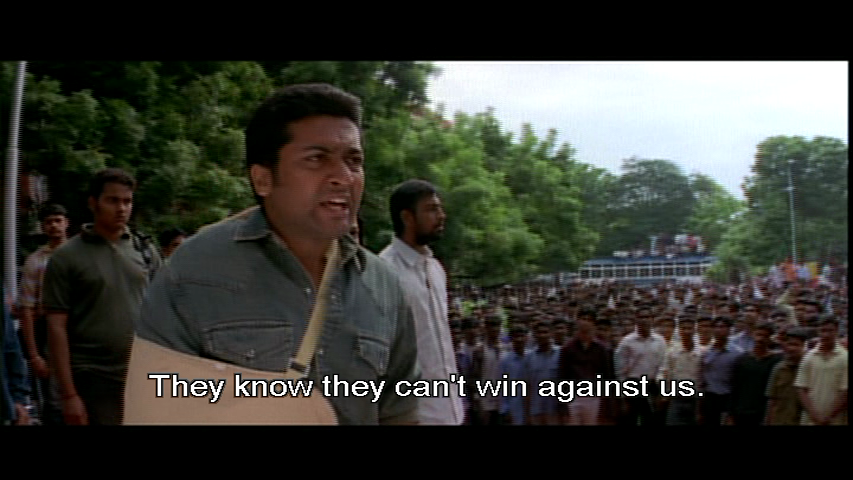
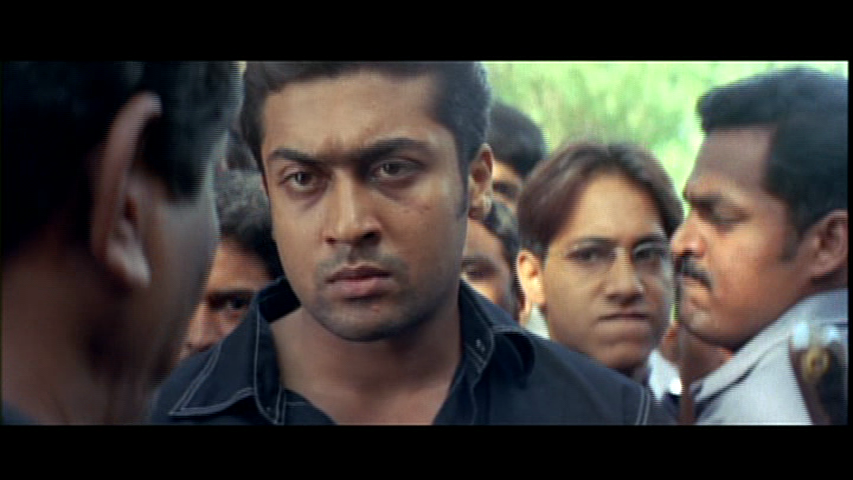
Suriya plays Michael Vasanth, a student, apparently a mathematical genius and also a political activist.  Not for him the more normal student methods of agitation such as demonstrations or debates, he prefers to be more direct in his approach and encourages retaliatory action.  This brings him into direct conflict with Selvanayagam and thus ultimately with Inba.  Suriya also seems out of place in his role.  He is muscular and obviously powerful, which doesn’t fit the image of a serious scholarship winning student.  His solution to problems faced by local villagers seems to be almost as confrontational as Inba’s violent tactics.  He appears belligerent and selfish as we see him brush off his mother’s concerns and treat his girlfriend badly. Although it is quite conceivable that students will use such extreme tactics, as has frequently been seen in many countries of the world, this approach just felt wrong with these characters. Perhaps this was partly an issue with the subtitles which may not have conveyed the dialogues accurately, but Michael came across as a very unpleasant character and his political aspirations felt more self-serving and less for the public good than perhaps was intended.

The final character in the drama is Arjun, played by Siddharth.  A playboy who has just finished his studies and plans to head to the US, Sid at least seems to fit the role he has been given.  His approach to life seems much more in keeping with his character and his pursuit of Meera, while typically filmi does feel much more genuine than Michael’s relationship.  By a series of coincidences all three are on the same bridge at the same time.  Inba uses this opportunity to get rid of Michael by shooting him, which sends him falling into the river past Arjun’s shocked gaze.

The storylines all converge at this point, and the aftermath of the confrontation is played out to its bloody and somewhat inevitable conclusion given the arrogance and brutality of the main characters.

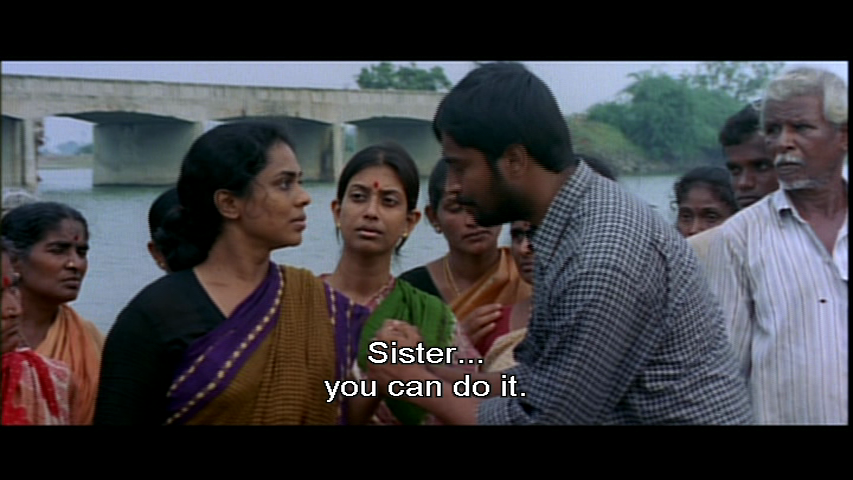
What are much more interesting about this film are the female characters.  Although she is regularly abused by Inba, his wife Sasi is a very strong personality who is determined to wean him away from his brother’s influence and stop his forays into crime. Their relationship is very realistically portrayed by Meera Jasmine who is fantastic as the battered wife. Despite her family’s objections to her husband, Sasi enlists them to help get Inba a job, so she obviously has great powers of persuasion.  Madhavan’s scenes with her are the best in the film and she was very compelling in her performance. Trisha in her role as Meera is less of a driving character, but she is part of the reason why Arjun changes his playboy ways as he slowly falls in love with her.  She is convincing and effective in the initial scenes, but towards the end of the film she appears to be sidelined. Esha Deol plays Geetha, who is involved with Michael.  There is a lot of potential in their relationship as he doesn’t want to get married and asks Geetha to move in with him instead.  This opportunity to look at the issues surrounding marriage and commitment is squandered as the theme is never really developed further.  Geetha lies to her parents and to Michael’s mother and never really becomes anything other than the woman in Michael’s life.

However these three women, as well as the various female characters that stand for election in the story, seem to be at least an attempt to show women as other than just the pretty wife, girlfriend or daughter.  There is more meat to their roles here, although it’s not sustained and ultimately only Sasi makes a lasting impact.

Because of the belligerence behind Michael’s actions it’s hard to see him as one of the good guys.  The virtual worship of him by the other students contributes to the impression of arrogance and he imposes his will on everyone around him without any seeming thought to the consequence.  Despite his thuggish ways, Inba appears as the more sympathetic character as he is genuinely trying to change his ways, but cannot get out of the cycle of violence he has lived with all his life.  The supporting characters all seem to have their own agendas as well, keeping the whole feel of the film as one of corruption and deceit.  The only genuine people seem to be the villagers caught up in the struggle for their village. While the film tries to be a statement on youth and politics, the end result seems to disregard Michael’s supposed motivation and political ambition and highlight the futility of anything other than corruption and violence as a means to achieve and hold on to power.  The secondary plot line of Inba’s attempts to escape his violent lifestyle is much better handled. While Meera Jasmine is the standout performance, both Trisha and Esha Deol ultimately aren’t given enough screen time to be effective.  A special mention for Sriman who played the character of Dilli, and was excellent in his role as Inba’s conscience.

Heather says: I really didn’t like this film.  For me it may have worked better if the casting of Madhavan and Suriya had been the other way round.  I found that Suriya didn’t fit the image of a student at all. He is too old and not convincing, while Madhavan in his role switches between mayhem and maniacally happy.  This didn’t seem to fit either the characters lifestyle or generally bleak prospects.  As a man recently released from prison, with a pregnant wife and no real job aspirations other than working for his brother, the ‘crazy happy’ was difficult to swallow.  Some of this was to show the reason why his wife stayed with him, and indeed some of these scenes were much less overdone.  This may have been a directorial decision as Abhishek Bachchan appears very similar in his characterisation of Beera in Raavan. I stuck with the film mainly because of the relationship between Inba and Sasi which was very well portrayed. Siddarth’s character was also quite watchable, and overall the story was interesting, but I was very tempted to fast forward every time Suriya was on screen. I have liked him in the other films I have seen him in and was horrified by him in this.  I really wanted his character to die as quickly as possible, just so that I did have to suffer through his flexing and belligerence.  I wish I had liked this film more but thought it was a potentially good story that for me was ruined by bad choices in the cast and poor directorial decisions. 2 1/2 stars from me.

Temple says:  This is another film that, like Leader, is well made but not likeable. I have issues with the character of Michael and his immunity from consequences. Everyone around him is made to pay for his activism but he escapes with a few flesh wounds. Surya was unappealing as he seemed to show only the arrogance of Michael and gave me nothing to respect in that character. Unlike Heather, I really liked Madhavan’s performance in this. I thought he really made sense of Inba and Sasi’s relationship, and showed the complexity of his character. He was boyishly impulsive, and casually brutal in turns. He showed the pressure Inba felt to be a man’s man and ignore his wife unless they were behind closed doors. Their relationship was compelling as Meera Jasmine showed the gamut of attraction and repulsion depending on which side of her husband’s nature was dominating.  I didn’t get the impression he was ‘crazy happy’, he was just a thoughtless guy who wanted what he wanted, and was happy so long as things ran his way. I thought the whole cast, with the exception of Surya, did a good job and made the most of their roles. I did have to laugh (a lot) at the idea of Esha Deol teaching French though! So, while I don’t like the inherent message that corruption is OK as long as you say you mean well, I do think this film was compelling and well made. The only disappointment was the lack of follow through on what seemed to be interesting roles for women. 4 stars from me.

Alaipayuthey

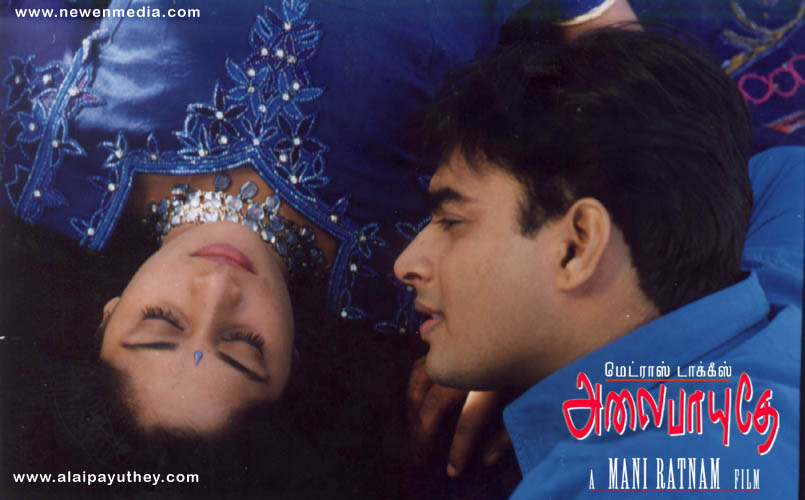
Having seen and quite liked the Hindi film “Saathiya“ some time ago (mainly for Rani Mukherjee) we were thrilled to know it was originally a Mani Ratnam Tamil language film starring the ever charming Madhavan.  In a broad generalisation, we find the interpersonal and romantic relationships in Tamil films to be more credible than their Hindi counterparts – people discuss their likes, dislikes and fears, sex is not such a secret, there  seems to be more thought given to how couples will live once they are severed from their families and people do get second chances. Alaipayuthey is no exception to this. Told in flashbacks, the story reveals layers of the relationship that go beyond the usual frothy boy-meets-girl rom-com.

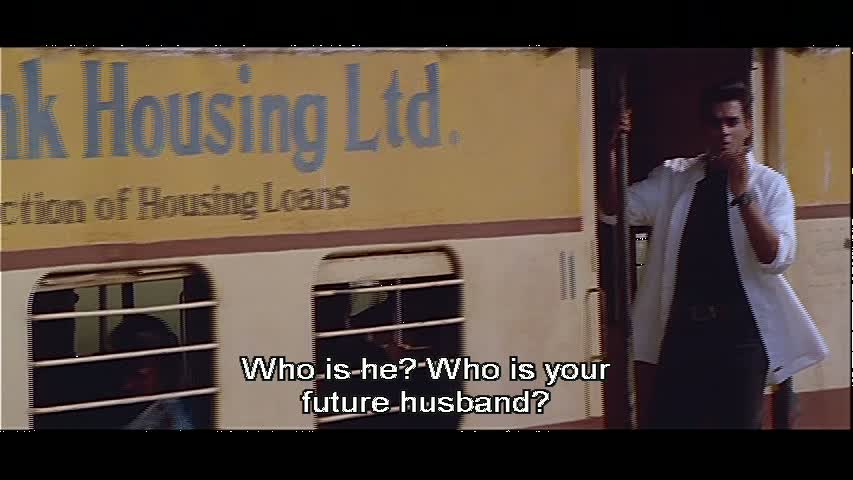
Madhavan plays charming middle class boy about town Karthik. He spots Shakti (played by Shalini) at a friend’s wedding and is immediately interested. Shakti is a smart, studious girl who is being educated with the support and financial sacrifice of her working class family, who want to see her move up in the world. Shakti isn’t a push over to be dazzled by Karthik’s floppy hair, dental perfection and easy manner, but eventually (after some traditional filmi stalkerish behaviour) she succumbs. They continue to see each other around town, sharing glances across the train tracks,  and Karthik continues to find ways of placing himself in Shakti’s path. The attraction is mutual, and the struggle between wishful thinking and practical considerations is well developed without being laboured.

The young lovebirds enjoy stilted phone conversations and long awkward silences as they attempt to keep their romance under wraps.

In due course, Karthik pops the question and the families meet. The casual manners of his more moneyed family clash painfully with Shakti’s father – the socialist with a chip on his shoulder – and the union is not agreed upon.

Fear of a forced marriage to a suitable boy pushes the couple into deciding on a secret marriage, which doesn’t remain a secret. Forced to leave both their homes, Karthik and Shakti move into a half built apartment and try to build their lives.  And this is where the story gets deeper and more engaging. This couple struggle. They are both used to having their own way, to being the golden child in their respective families, to following their own priorities and now each has to deal with someone equally determined and ambitious.

Shakti is never going to give up her medical career, and Karthik won’t back away from his dream of becoming successful in his own IT business. The relationship deteriorates and they fall into recrimination and an angry silence.  The half finished apartment then seems an apt metaphor for their hastily constructed life and the shortcoming become more noticeable despite attempts to decorate and patch over them.

Things come to a head when Shakti fails to meet Karthik at the station one evening and he fears that she has left him. How things are resolved does indeed travel through full blown melodrama but having built so much goodwill and emotional investment in these characters, we stay with it to the end.

Madhavan doesn’t shy away from showing the negative aspects of Karthik’s character – his arrogance, sense of entitlement and lack of empathy. Shalini plays Shakti as a girl caught between her traditional upbringing, her ambition to make something of her own career, and her love for Karthik. She is selfish, sulky, cheeky and loving by turns and all the more credible. Vivek Oberoi and Rani Mukerjee on the other hand seem to live in a much cleaner and more sanitised India which is almost Disney-like.  They look almost  airbrushed and never seem to be quite as real as their Tamil counterparts.

The soundtrack by AR Rahman is great, although there is too much of the dreaded montaging for our liking. We know Maddy is not famed for his dance ishtyle but he tries really hard and we would have preferred to see more dancing!

Heather says: I really enjoyed this film, – thanks to everyone who recommended it to me.  The young couples’ story is realistically portrayed, and rather than making marriage a ‘happy ever after’ the film shows the commonplace reality.  The end of the film is more contrived, but in such a way that it doesn’t seem to intrude too much into the atmosphere created earlier in the film.  Madhavan does seem to fall naturally into the role of the spoilt rich kid, but is also excellent as his character matures and has to deal with the reality of life without the support of his family.  Shalini fits her role as the medical student from a working class family, and the two actors are very well matched.  Their increasing frustration with each other as they try to live together and the problems they encounter within their marriage and are very believable, and certainly will ring true with most married couples.  Really good performances from the lead actors and the supporting cast who ensured the story’s realism.   I saw Saathiya a few years ago and thought it was a good Mani Ratnam film, but this version was so much better. Having seen both Hindi and Tamil versions of his newest film as well, I will try and stick to the Tamil in future. I am deducting half a star because there wasn’t quite enough dancing – 4 ½ stars from me.

Temple says: I’m so pleased Heather liked this! This is a well constructed story with memorable characters in a fairly realistic setting. I particularly enjoyed the low key portrayal of the growing discord in the new marriage as it was neither a happy ever after fable nor an overwrought tearjerker. While it follows a standard boy meets girl storyline, the relationship evolved in a way that I could identify with, and I was emotionally engaged. The soundtrack is never intrusive and the songs are well integrated into the story. Visually the film is lovely with rich sun-faded colours and lots of texture, and shot on an intimate scale which made me feel closer to the story. It seems to be a strength in the Southern films (I have seen so far) that there is diversity in the look of the backing dancers and extras that is really charming, and certainly seems different to the Bollywood Beauty Standard. Overall, while the romance genre is not my favourite, I did really enjoy Alaipayuthey. I would have liked more dancing too, but not sure the lack of it detracted from the film for me. I give this four stars – a deduction for the melodramatic ending which was almost too too much.