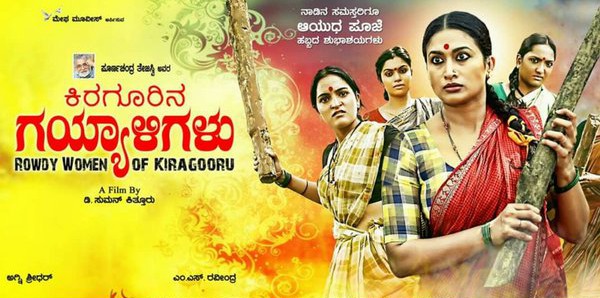
Kiragoorina Gayyaligalu

kiragoorina-gayyaligalu

Kiragoorina Gayyaligalu is a beautifully filmed adaptation of a novella by acclaimed Kannada writer Poornachandra Tejaswi. Director Sumana Kittur has teamed up with screenwriter Agni Shridhar (responsible for the excellent Aa Dinagalu) to give a colourful look at village life in rural Karnataka from the recent past. Various small incidents illustrate the relationships between the different groups in the village, but the usual routine is thrown into disorder when there is a plot to con the villagers out of their land. The situation escalates until it’s up to the ‘rowdy women’ of the title to restore order and deal with the corrupt officials behind the scam. I haven’t read the original story but the film is charming with a balanced blend of drama and comedy that still manages to address a number of social issues, albeit in a light-hearted way.

The film starts by showcasing the differences between the men and women of the village. While the women are out working, the men are lounging around the village, playing dice and utilising the services of the village barber. The women from different castes all work together without any issues but it’s a different story for the men of the village who are more inclined to take notice of someone’s place in society. The higher caste Gowdas negotiate the cheapest price they can for any work done for them by the lower caste Kulavadis although the men all congregate to drink together in the village arrack shop at the end of the day. The arrack shop is a point of contention for the women as they feel that this is the reason their husbands have become lazy and argumentative. All in all, Kiragooru seems to be a typical village with the usual colourful characters, petty disputes and plenty of potential for mischief.

Daanamma (Shwetha Srivatsav) is an outsider from a different village who is married to Subbaiah (Rahul Madhav), one of the Gowdas in the village. Despite being a relative newcomer, the other women look to her for support and she’s the one they ask to break up a fight between Kaali (Sukrutha Wagle) and Rudri (Manasa Joshi) when tempers flare. She’s just as competent at home, refusing to let Subbaiah leave when everyone else runs from a police jeep in the village and ensuring the household runs to her satisfaction, although she does seem to have a genuinely happy relationship with her husband. Daanamma also provides support to Nagamma (Sonu Gowda) whose husband Kaale Gowde (Kishore) is abusing her for failing to provide him with children. Kaale is desperate to marry for a second time and has fallen for Bhagya (Karunya Ram), a vegetable seller in the local market but doesn’t tell her the truth about his marriage to Nagamma. Rounding out the village are the Kulavadi farmers who include Maara (Nikhil Manjoo), Kariya (Sampath Kumar) and their families.

Shankrappa (Achyuth Kumar) is the government welfare officer for the village, but he also runs the arrack shop and is plotting with Bhootha Swamy (Sharath Lohitashwa) to con the villagers out of their land. When Daanamma threatens the visiting Tahsildar and runs him out of the village, Shankrappa files a complaint against her with the police that also accuses the Gowdas of cheating the Kulavadis out of their rightful wages. This results in the Gowda men being taken away to the police station where they endure a humiliating experience at the hands of the drunken Inspector. They immediately turn to Bhootha Swamy for help, but he lies and tells the men that it was the Kulavadis who filed the complaint. This widens the divide between the two groups, further fuelled when Bhootha Swamy lies to the Kuavadis too and the Gowdas fan the flames by employing an outsider to chop up the tree. No reconciliation seems possible until Daanamma takes matters into her own hands and enlists the rowdy women of the village to sort out the problem once and for all.

It’s a well told story with plenty of quirky characters, but the appeal of the film lies in the excellent performances from all the actors. No matter if the character is only on screen for a few moments such as the unethical Dr Appanna (S Narayan), everyone seems to fit their role perfectly. Shwetha Srivatsav has most time onscreen and is brilliant as Daanamma with her perfect mix of compassion, bravery and common sense making compelling viewing. This is very different to her role in Simple Agi Ondh Love Story but she again makes excellent use of her facial expressions and both looks and sounds the part of a rural villager. Sukrutha Wagle is appropriately shrill and combative as one of the Kulavadi rowdy women, while Sonu Gowda provides contrast as the silent but still expressive Nagamma. The scenes between the different female characters also ring true with plausible discussions of their routine chores and complaints about their husbands with the occasional small rivalry thrown in to demonstrate how they got their reputation. Their support for each other is also realistically portrayed along with their determined reactions which are a good contrast to the men’s vacillations and indecision when faced with a problem.

The men all suit their various roles too. Rahul Madhav, Sunder and Anathavelu are all good as the overly trusting Gowda men, while Kishore is excellent as the abusive Kaale. Although the character is mainly comedic, there is a serious side in the abuse he deals out to his wife and it’s a credit to the film that this is dealt with sensibly, both highlighting the abuse itself and giving a solution that shows Kaale to be the one at fault rather than his long-suffering wife. The film also raises the issues of drunkenness and caste division and although these are used to some extent for comedy, there is a serious side as these are shown to be real issues for the community. Naturally the women are the ones to solve these issues too with their practicality and common sense winning the day.

Kiragoorina Gayyaligalu is a film where everything just comes together perfectly. Manohar Joshi’s cinematography is complemented by Saadhu Kokila’s music and Sumana Kittur evokes a village atmosphere through colourful dialogue and fantastic attention to detail. The language is often beeped out but the subtitles are hilarious with the women not afraid to air their graphic opinions publicly and loudly! Each scene is complete in itself but also serves to establish and evolve the different characters and situations. Added together they all build up to a captivating story and satisfying finale. One I highly recommend for the excellent performances, well-written screenplay and some of the best female characters I’ve seen in Indian cinema. 4 ½ stars.
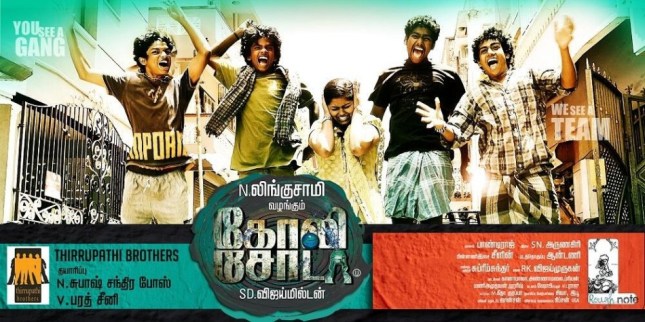
Goli Soda

goli-soda-poster

Goli Soda is a masala movie with a difference – there is the usual mixture of action, comedy and romance, but this time the protagonists are four adolescents from Koyambedu market in Chennai and the action mainly takes place within the confines of the marketplace. The four are all orphans who have grown up in Koyambedu and Goli Soda follows their struggle to discover their own identities and what happens when their livelihood and self-respect is threatened. While the scale of the story may be small, the theme of teenagers trying to fit in and develop their own self-worth is universal, even if most don’t have to face quite the same obstacles or start with quite so little. S.D. Vijay Milton’s film has engaging characters and an interesting and rather different story to tell, making Goli Soda well worth a watch.

Saetu (Sree Raam), Kuttimani (Murugesh), Pulli (Kishore) and Sitthappa (Pakoda Pandi) are all friends who live and work together in the market. They unload produce during the early hours of the morning, working for Aachi (Sujatha Sivakumar) who pays them according to the amount of bags they have carried into her business. The boys live rough in the market and spend the rest of their time running amuck, ogling the local girls on their way to school and wasting time with market porter Manthiravan (Imman Annachi). The relationship between the four is well depicted with the expected amount of teasing and banter in any group of young men, but there is also plenty of support for each other and together they form a tightly knit family. This is perfectly illustrated when they all share the same ‘best’ t-shirt to wear as they wave at their chosen girl from the safety of the building roof. Regardless of the fact that none of the girls can probably see exactly what they are wearing, they swap the t-shirt so that each feels he looks his best with the limited resources they have. It’s a brief moment but shows their easy camaraderie and how much they rely on each other.

When Aachi finds out that one of the girls they are chasing is her own daughter Yamini (Chandhini) she convinces the four that they ned to do something more with their lives and approaches market kingpin Naidu (Madhusudhan Rao) for a loan. Naidu gives them the use of an unused godown which the boys turn into a small restaurant, named Aachi’s mess in honour of their mentor. They are surprisingly successful too, and take everything very seriously, even down to selecting the right covering for their makeshift tables. They’re helped in their endeavours by Aachi and Yamini and also by Vanmathi (Seetha) another friend who has her own share of problems but manages to take a glass half full approach to life. However Vanmathi is quite committed to her philosophy of one plant, one flower in relationships and only being willing to help if it is definitely true love and not just time-pass!

https://www.youtube.com/watch?v=EyB9Nm4vGzk

Problems arise when Naidu’s brother-in-law Mayil (Vijay Murugan) starts to frequent Aachi’s mess, demanding alcohol and non-veg dishes, even spending the night there with his cronies. The subsequent fall-out when the boys turn on Mayil threatens Naidu’s hold over the market and it seems as if Saetu, Kuttimani, Pulli and Sitthappa will lose everything, including possibly their lives as they battle to hold on to the little they have. Aachi, Yamini and Vanmathi are also all affected and in a departure from the normal masala formula, the two girls end up taking part in the fights with Naidu’s men and help the boys in their campaign to regain their restaurant.

What Goli Soda does is take the usual masala issues of bad guys vs good guy and translate them into the world of four adolescents. Instead of land grabbing politicians and gangsters we get petty criminals who take over the boys’ space and take away their sense of self in the process. That space is important as it’s the first Saetu, Kuttimani, Pulli and Sitthappa have had that is theirs to do with as they please – or at least as much as they can in a rented shop. Their insistence on choosing the tablecloths and making tables and benches for the restaurant becomes significant as it’s the first time they have ever had any say in their surroundings. The restaurant becomes their space and defines how they appear to the rest of the market – they are no longer simply nameless coolies, but instead are Aachi’s mess boys.  The successful business confers a sense of self-worth they did not have before and makes each someone rather than just another orphan. Loss of their space means they are back to being nothing – and that’s not something they are going to let happen if at all possible.

The film has a number of fight scenes where the four adolescents take on Mayil and his gang. This could have been ridiculously unbelievable, although perhaps not any more so than in the usual mass film where the hero is able to fling villains around without too much effort, but the choreography here is better than that. There is a lot of slapping and basic survival tactics which makes it seem less incredible that the boys could take on grown men and not suffer horrendous injuries, while the casual brutality of the gang seems plausible. The story overall works as the boys are all typical young men with the usual wants and desires – new clothes to look cool in front of the girls for example, but they also have a sense of responsibility which comes from having something which is theirs alone. All the young actors are fantastic in their roles and each is completely believable – even down to the blubbering and pleading when they are first faced with the prospect of being beaten up by Mayil and his gang. Sujatha Sivakumar is also excellent in her role as Aachi, giving the boys a constant in their lives and imbuing discipline without losing their respect.

Although it’s a simple story, Goli Soda packs a lot into 2 hours. All the masala elements are there, but trimmed of any excess to suit the younger protagonists, making for a neat and crisp narrative that easily pulls the viewer into the world of Koyambedu market. The dialogue is fun, snappy and suits the characters while the documentary-style of the camera makes the scenes in the market feel very natural. Goli Soda is something just a little bit different and recommended viewing for a movie with a message that avoids being preachy or overly sentimental. 4 stars.

Karthikeya

karthikeya poster

Karthikeya is an interesting mix of supernatural suspense and crime thriller with a soupçon of snakey vengeance thrown in for good measure. Chandoo Mondeti’s début has plenty of character development and a good storyline, although it does take a long time to get to the meat of the plot. However it starts well and the second half has plenty going on making Karthikeya a better than average watch.

The film begins with the unexplained death of an endowment officer investigating the closure of a temple in Subramanyapuram, although his inquiry seems to be completely unofficial. Shankar (Raja Ravindra) has time to make a final phone call before his death, but naturally hasn’t actually managed to finish his report detailing what’s behind the mystery of the temple before calling his friend. Doesn’t anyone in these films ever realize that boasting about their achievements before actually completing them is a surefire way to ensure they aren’t going to make it to the end of the movie? Especially when there are eavesdropping snakes to consider!

Having set the scene for a mystery thriller, the film then moves away from the story of the temple to introduce Karthik (Nikhil Siddharth) and his family. Karthik is a medical student who puts his faith in science and has no hesitation in spending the night in a haunted mortuary to prove that there is nothing supernatural going on. However when his superstitious mother (Tulasi) calls to report that his horoscope has him meeting a girl who will bring him luck, despite his skepticism Karthik keeps his eyes peeled and pays attention when he meets Valli (Swati Reddy) on campus. I like Karthik’s combination of respect for his mother’s beliefs with a scientific curiosity that drives him to find an answer to every question. He seems more normal and down to earth than most heroes and his tendency to reach for reason makes him a likeable and possibly a rather more intelligent character, despite his rather inane approach to romance.

As in many Telugu films the romance isn’t well handled, and the heroine has little more to do than apply the usual romance formula.

Step One – reject the guy
Step Two – see him in a better light and reconsider
Step Three – fall for the guy and declare your undying love

Swati does all of that perfectly well, but I was hoping for a little more given that her character is a dental student who should know better. Swati and Nikhil have a sweet camaraderie but no romantic sizzle and appear more like friends than lovers for most of the film. However, given that the focus of the story is the temple mystery this is perhaps for the best since the romance really adds little to the plot and is fairly irrelevant at the end of the day.

The story behind the temple is explained using a series of beautiful drawings that detail the building of the temple and the subsequent miracle that occurred on the full moon night of Karthika month. However the mystery started the previous year when one of the temple trustees collapsed during the annual ceremony and a few days later two lovers were found dead in the temple with snake bites. Rumours then began about strange noises and the death of the chief priest was the final straw resulting in the closure of the temple.

Kathik and his friends are sent to Subramanyapuram for a medical camp and end up staying in the temple trustee’s bungalow – a grand building in the forest with an imposing five headed snake sculpture on the top. The mystery is just the thing to keep Karthik entertained in between working at the medical camp and romancing Valli, despite his mother’s warning that he is in danger from snakes and the whole mystery involves a number of deaths from snake bite Valli is also on the camp since Subramanyapuram is her home village and her father (Tanikella Bharani) is a prominent village elder and astrologer who provides a good counter for Karthik’s scientific beliefs.

There is some amount of suspense as shadowy snakes are seen around the bungalow but unfortunately Chandoo Mondeti never develops any real feeling of menace which would have helped increase tension as Karthik gets closer to the answer. Although the police officer ACP Shankar (Kishore) involved in the case is also killed, his death is over very quickly and isn’t used to increase the suspense either. However the plot itself is more realistic than usual and even the dodgy science has some basis in fact even if it’s not completely believable. Chandoo Mondeti also includes some social issues including female infanticide and the shonky practices of fake spiritual leaders, blending them well into the plot and avoiding too moralistic a stance.

Nikhil is good as Karthik and balances his scientific beliefs with respect for the village traditions well. Satya and Praveen have small roles as his friends and provide most of the comedy which is less slapstick and more successful than usual. The rest of the support cast are also good, including Jogi Naidu as the temple handyman and Rao Ramesh as the Head of the Endowments office. There are no big song and dance numbers, with most of the songs used to show the developing romance between Karthik and Valli, however they fit well into the narrative and are generally enjoyable too.

Overall Karthikeya is a good story that could have done with a little more suspense but still keeps enough tension in the plot to keep it interesting right to the end. A few more snakes and less romance would have helped, but I could say that of most films really, and the CGI works well here to make the snake moments work well. Definitely worth a watch for an interesting mix of supernatural and murder mystery along with some good performances and clever use of science. 4 stars.