Railway Children (2016)

Montage

Railway Children is a docudrama from writer/director Prithvi Konanur that is partly inspired from the book Rescuing Railway Children by Lalita Iyer and Malcolm Harper. The subject matter isn’t pretty – the film looks at the fate of young runaways in India who end up living on or near the railway station, but the story is told using a documentary style and the kids are simply awesome, making Railway Children an excellent film with a message of hope at the end. Railway Children was shown in Melbourne as part of the Indian Film Festival and has been shown at various other festivals including Mumbai International Film Festival and Zlin Film Festival in the Czech Republic.

The film starts with Raju (Pari) hiding from ticket inspectors on a train as he makes his way to Bangalore without a ticket. Arriving at the railway station, he’s immediately singled out by various people who prey on the new arrivals. First is ‘the Mongoose’ who works for an NGO that tries to reunite the children with their parents. However Raju suspects her motives and when she goes to buy him food is then picked up by Solution (Yash Shetty) who runs a gang of children based at the station. The children sleep in concrete pipes and spend their days collecting discarded water bottles which are then refilled and sold by more of Solution’s gang. The older and more trusted children such as Pappu (Syed Pervez) sell water, while Jollu (Manohara) is instructed to show Raju where to find water bottles and anything else that Solution can use.

Like most of the children, Jollu is addicted to glue-sniffing and he forces Raju to inhale the fumes too. The kids call the glue ‘solution’ and (presumably this is where Solution got his nickname), they buy it at the end of the day after Solution has paid them their wages for their work. Initially Solution seems to be a petty criminal who looks after the children by feeding them and giving them shelter, but selling them glue is just one of the ways he keeps the children under control. Solution is also a paedophile, and he drags the children off individually to abuse them whenever he feels they need disciplining. He also threatens to sell them to the beedi makers, where they will be kept in a factory all day and die from the chemicals, a threat that along with refusing to give them ‘solution’ keeps everyone in line.

Raju is smarter than the average kid though, and he has managed to run away with some money which he hides as soon as possible. He also regularly calls home to his girlfriend Usha, asking her to run away to Bangalore as he feels the freedom there is worth the rough living. Despite the harshness of the life, it seems to be better than Raju’s experiences at home and he starts to make the most of what he has. Although Jollu initially shows Raju the ropes, Raju quickly realises that they won’t make any money by selling bottles to Solution, and with the aid of Karthik (Karthik) and Jollu he sets up a scheme to sell water himself. However, his success is short-lived when Pappu finds out what he is doing, and Raju and Jollu eventually end up in the care of the Mongoose (Divya) in the NGO shelter.

According to the website, most of the characters are played by non-actors and Pari is actually a rescue child being looked after by an NGO. Given this background, Pari’s performance is outstanding, particularly in the way emotions such as helplessness and hope are portrayed. Manohara too is excellent as Jollu, and his scenes where he enacts the violence and despair of an addict being deprived of his fix are very well done. Yash Shetty is also good in an interesting role that explores the contradictions of the railway gangs. There is the predatory nature of using the children to make money, but Solution is telling the truth when he explains to Raju that the NGO will simply give him back to his parents, and his descriptions of the government homes seem chillingly true. Solution does provide the kids with an alternative and although much of what he does is self-serving, he does give them food, water and shelter and protect them from the other predators around the station. There is another thread to the story which adds an unusual twist at the end. I don’t want to reveal too much, but one of the highlights of the film for me was Divya’s reaction when she learns the truth about Raju – this was unexpected as I really thought she would be intolerant of the situation given her usually dour demeanour, but her compassion and understanding did bring a tear to my eye!


Life for these children is difficult and dangerous. As well as the predators like Solution, there is violence from other gangs, drug addiction, the ever-present danger of the trains and the risk of being caught by the police or social workers. The stories they tell of their home lives explain why many prefer to live rough rather than return home, and there is some happiness in the shared camaraderie of the gang. The documentary style of the film keeps it simple and works well to distance the film from the emotional impact of many of the scenes, although they still make a considerable and lasting impression. Railway Children is a fascinating look at an underside of Indian society and despite the bleakness of the children’s lives it does end with hope that there can be a different outcome.
Ondu Motteya Kathe

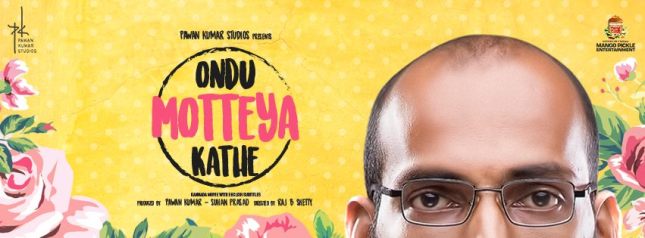
OMKRaj B. Shetty is not your typical leading man material. His character Janardhana is 28 years old, thin, shy, and, according to the marriage broker, has two major problems. One: losing his hair and two: working as a lecturer in Kannada. Despite these apparently significant drawbacks, Janardhana is determined to find his perfect bride, although for most of the film he seems to have set his sights unrealistically high. Ondu Motteya Kathe (Story of an Egghead) is an amusing and well-written rom-com that follows Janardhana’s quest to find the woman of his dreams and all the ups and downs associated with his search.

Although it’s the name bestowed upon him by his students at college, Janardhana isn’t really an egghead as he does still have hair, but he is definitely thinning on top. It’s noticeable enough that when he visits a potential bride she rejects him based on his developing baldness, leading to Janardhana’s decision to ditch the broker and find a wife himself. The problem is that although Janardhana himself isn’t top husband material in the looks department, he still wants his wife to be beautiful and that gives him a greatly reduced chance of success.

His gaze initially settles on the economics teacher (Amrutha Naik) but despite her friendliness towards him, Janardhana is too shy to approach her himself and enlists the help of the college odd-job-man, Sreenivas (Prakash Thuminad). When the arrival of a new English teacher destroys Janardhana’s chances, and another potential romance turns out badly, Janardhana reconnects with an old friend on Facebook. Sarala (Shailashree Mulki) has recently been ditched by her fiancé, so she too is on the look-out for a potential husband. However, when the two meet, it’s definitely not a case of love at first sight. Sarala thinks Janardhana is ugly and bald, while Janardhana instantly dismisses Sarala as she is (in his words) fat.

Just like Janardhana isn’t really ‘bald’, Sarala isn’t ‘fat’, rather she’s just a little overweight and not Janardhana’s idea of the perfect partner. However, she is very pretty and has a lovely personality which Janardhana can’t see as he’s focused more on her physical shape. Unfortunately for both, although they are resigned to remaining friends, Janardhana’s family believe that they have a love match and immediately start to arrange their wedding.

This a comedy that works partly due to the excellent writing but also because the characters are all relatable and generally sympathetic. Janardhana evokes sympathy with his male pattern baldness but in reality he is a typical nerd, and it’s inevitable that he is ridiculed by his students and further embarrassed when he goes to the college principal to complain. The dialogue is natural and even subtitled is laugh-out-loud funny while the situations are routine day-to-day events that are easy to relate back to personal experiences. Despite his determination to only look for a beautiful bride, Janardhana isn’t arrogant, rather he’s just clueless and totally inept in social situations, while being continually frustrated by his well-meaning but equally awkward family. His mother (Usha Bhandary) is overbearing and overly protective, his father (Vishwanath) keeps the peace by agreeing with everything his wife says and his younger brother (Vineet) spends all his time talking to his girlfriend on the phone to Janardhana’s continual frustration.

What makes it even better is that as the film progresses, our initial sympathy for Janardhana starts to wane when he rejects Sarala purely on the basis of her looks and is cruel and hurtful into the bargain. It’s a bold move to make the lead character so unattractive as the story develops, and it’s successful because we know the rejection and despair that Janardhana has had to deal with, making his own rejection of Sarala more poignant and thought-proving as a result. Although it is a very funny film there is an undercurrent of sadness too as both Janardhana and Sarala struggle with rejection based purely on their physical appearances.

Another clever touch is the inclusion of Dr Rajkumar as a character in the film through Janardhana’s obsession with the actor and by dialogues and film snippets that crop up throughout, at times inspiring Janardhana to act rather more impetuously than expected.

Raj B. Shetty not only acts in the lead role, but he is also the writer and director of the film; an impressive feat given that it’s his first film and his character doesn’t hog all the limelight as can happen when the director is also the ‘star’. Shailashree Mulki is wonderful as Sarala, while Prakash Thuminad is excellent as an unlikely confidante and relationship advisor, with the rest of the support cast equally impressive and genuinely funny. Midhun Mukundan’s music is put to good use and this is a very funny song with some great clothing choreography and a poignant plea to potential partners.

Ondu Motteya Kathe is a great début and Raj B. Shetty joins the growing number of Kannada directors who are producing films that are just that little bit quirky and different, but still appeal to a large audience. The comedy is good, the romance believable and the characters appealing despite their many flaws. Recommended watching for the clever concept, intelligent writing, excellent dialogue and wonderful performances from the entire cast.

Ulidavaru Kandanthe

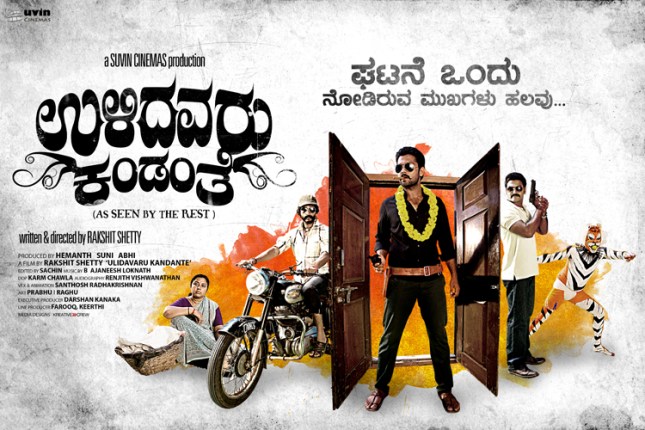
Ulidavaru Kandanthe-Poster

Not content with making a name for himself as an actor, in 2014 Rakshit Shetty turned writer and director with his foray into neo-noir crime drama in the excellent Ulidavaru Kandanthe. The English translation of the title is “as seen by the rest”, which refers to an incident seen from a number of different viewpoints that makes up the story of the film. Except it’s not quite as simple as that since the incident itself isn’t revealed until near the end, and even then, it’s not clearly defined. The inspirations are obvious, from Pulp Fiction to Sin City and many more gangster films in between, but it’s the way that Rakshit Shetty has (almost) seamlessly introduced a Rashomon style plot into a very Indian scenario that makes Ulidavaru Kandanthe an instant classic of the new-wave sweeping Kannada cinema.

The film takes the form of chapters based on a series of newspaper articles being written by Regina (Sheetal Shetty) where each interview she conducts gradually reveals more information about the characters and the incident itself. The plot revolves round an unseen MacGuffin that’s stolen by one of the main characters, although to be fair the entire incident is itself a MacGuffin since it’s the characters themselves and the random details of their lives that are the real focus of the story. As Regina interviews the people who were peripherally involved in the incident, we meet a cashew nut seller, a tiger man, a young boy and various gangsters who all have their own views of what occurred on the day in question. It all starts with an old story about 12-year-old Richi who stabbed another boy to death 15 years ago in defence of his friend Raghu. Richi was sent to a remand home for 8 years while Raghu disappeared, but one Krishna Janmaashtami, Raghu comes back.

The story unfolds in a non-linear fashion as each interviewee adds their perception of events. However, rather than just seeing a particular day, what Rakshit Shetty does is show the usual day-to-day events for that person going about their normal life. As far as the action goes, it’s the interactions with key players that inform us as to each major character’s role in subsequent events, but what we really get is an idea of the characters, their thoughts and beliefs and their own impressions of the people involved in the incident. This is partly why the film is so intriguing, as there is no clear-cut description of what actually happened on the fateful day. All we have are impressions, and eye witness accounts of parts of the day, but no-one knows exactly what happened and as the audience we are left unsure as to which version we should trust.

A number of events are shown more than once from different viewpoints, and the more times I watch the film, these repeated scenes throw up more and more questions! I love that my opinion changes slightly each time depending on whose testimony I decide to trust and that I still want to re-watch the film to see if I can spot any other clues. In fact, it’s not until the second watch that much of the film does start to become clear, and once the outcome is known, it’s possible to pick out foreshadowing and significant dialogue that seemed totally innocuous the first-time round.  It’s clever, but not so clever that the film is baffling first time round. It’s more that it becomes richer and more layered with subsequent viewings, and the subtleties of the writing are more easily seen.

The performances too are excellent and contribute to the film’s appeal. Rishab Shetty’s Raghu is somewhat subdued, but then he has escaped Bombay after stealing from his smuggling gang in a stark sequence very reminiscent of Frank Miller’s Sin City. His need to lie-low but desire to contact his mother are well portrayed and in the reunion scenes he is appropriately hesitant and unsure. Tara as Raghu’s mother Ratnakka is outstanding when she meets her son again after 15 years, but she is just as good when gossiping with her friends or selling fish around Malpe. Ratnakka’s story is a short film in its own right, and it allows us to fully appreciate her character and understand her reactions. Not that these are anything beyond what is expected – even down to the usual motherly insistence that her son have something to eat, but throughout Tara conveys Ratnakka’s feelings perfectly and does an excellent job in bringing her character to life. I like the way that Rakshit has given her a life outside of being a mother which gives her character more veracity and empathy.

While Raghu has returned in secret, Richie never left Malpe but instead has made a name for himself as an enforcer for local gangster Shankar Poojary (Dinesh Mangalore).  As Shailesha (Raghu Pandeshvar) puts it so succinctly when he meets Raghu in Bombay, Richie is still a bully and Rakshit Shetty plays him with all the swagger and bravado of a typical Hollywood gangster. It’s often a worry when a director plays a pivotal character as there is a tendency for everyone else to get pushed aside, but that’s not the case here. Rakshit is excellent and his Richie slumps into cars, hitches up his stolen police belt and ensures his reputation for violence is upheld while still ensuring that the rest of the cast are just as important to the story. However, Richie is still the centre of events as he interacts with all of ‘the rest’ from the title, including Regina herself who first saw him as a young by at the remand home. His two sidekicks Dinesha (Pramod Shetty) and Sudhi (Arun Prakash Shetty) have less to do, but each has enough small moments to ensure we have a good idea of their general characters and how they fit into the events of the incident.

My favourite characters though are Munna (Kishore) and Democracy (Master Sohan) who both have significant roles to play in the events of the day. Munna works on the boats as a mechanic, although he gets roped in to painting tigers as apparently that’s very similar to painting boats! Munna spends most of his afternoons following fish seller Sharada (Yagna Shetty) with whom he has fallen hopelessly in love. However, Munna never approaches her and is content to sit behind Sharada on the beach and follow along behind as she walks along the road. His romance adds a lighter note to the film, as does the character of Democracy and his friends who bring energy and life into the film.

I did mention tiger painting, and as part of the festival, one of the other main characters, Balu (Achyuth Kumar) is dancing as one of the tiger men. Achyuth is excellent in his role and the ambiguity of his character is one of the clever touches that Rakshit Shetty has added in to make the story even more captivating. Making Balu a tiger man was inspired and along with the Yakshagana drama ensures the film retains a uniquely South Indian flavour while incorporating many Hollywood themes.

My only issue with the film is that Rakshit Shetty tries to tie everything up neatly by linking events in Malpe to the item stolen by Raghu. I don’t think this works as well and almost seems superfluous given that it’s ultimately not as important as the characters themselves. However, that’s a small quibble and given how much I enjoyed the rest of the film, I’m happy to ignore the unrealistic coincidences and concentrate instead on the characterisations, dialogue and wonderful soundtrack.  It took me a while to track down a copy of Ulidavaru Kandanthe with English subtitles but it was definitely well worth the wait. This style of neo-noir may not be to everyone’s taste but for fans of the genre this is an excellent début from Rakshit Shetty and one I highly recommend. 5 stars!