Bachchan (2013)

Bachchan

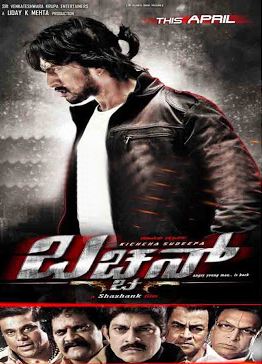
Bachchan was recommended to me by numerous people when I went to watch Ugramm a few weeks ago, and since I read that the film had won a number of awards in India plus it starred the usually pretty awesome Sudeep Kiccha I thought it would be worth tracking down on DVD.  But when I started to watch it I was very disappointed.  After about 20 minutes I just couldn’t watch any more relentless and seemingly pointless violence or blatant sexism and had to give up.   It took another two attempts before I managed to get more than 30 minutes into the film, and I spent most of that time wondering why this film had been recommended to me! But then I got further in, finally reached the excellent second half, and realised exactly why this film had appealed to so many people – even me eventually.  It does get immeasurably better in the second half, and looking back the opening scenes make more sense in retrospect, although I still feel a less chauvinistic approach would have made them easier viewing. However, if you can make it past the first thirty minutes, there really is a lot to like about Bachchan.

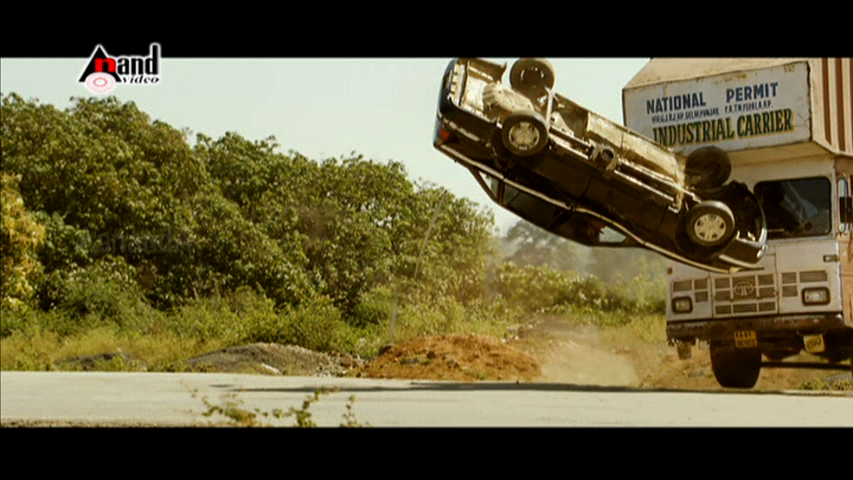
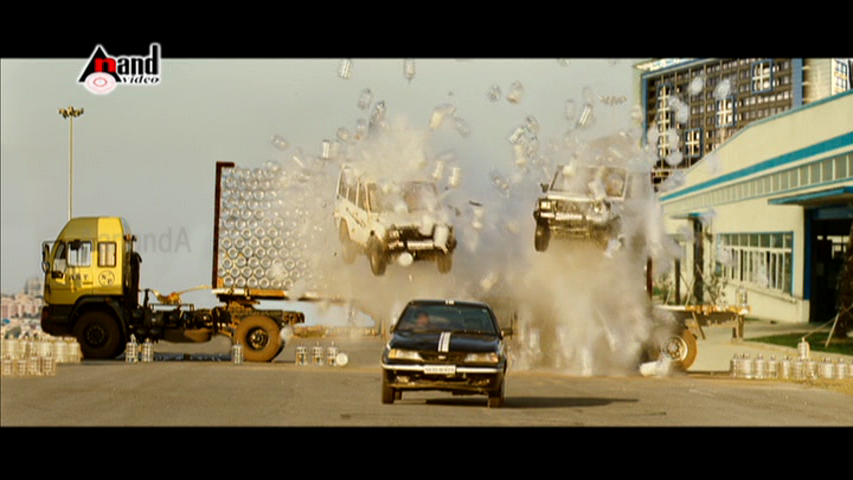
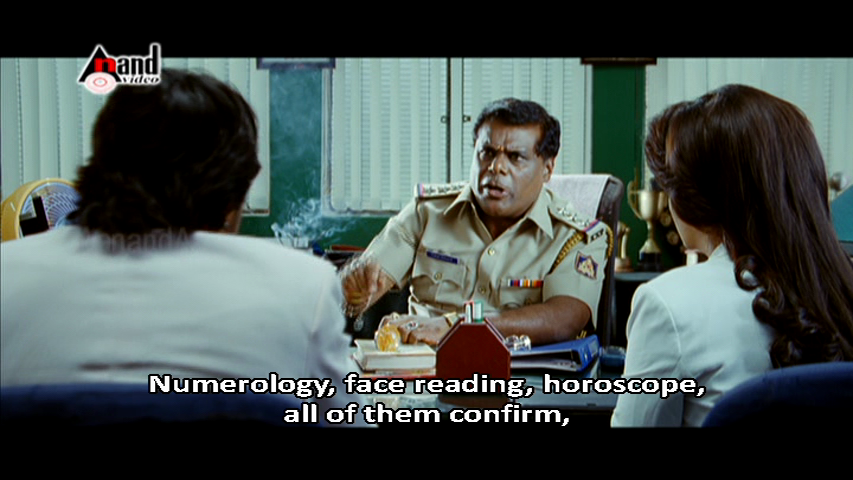
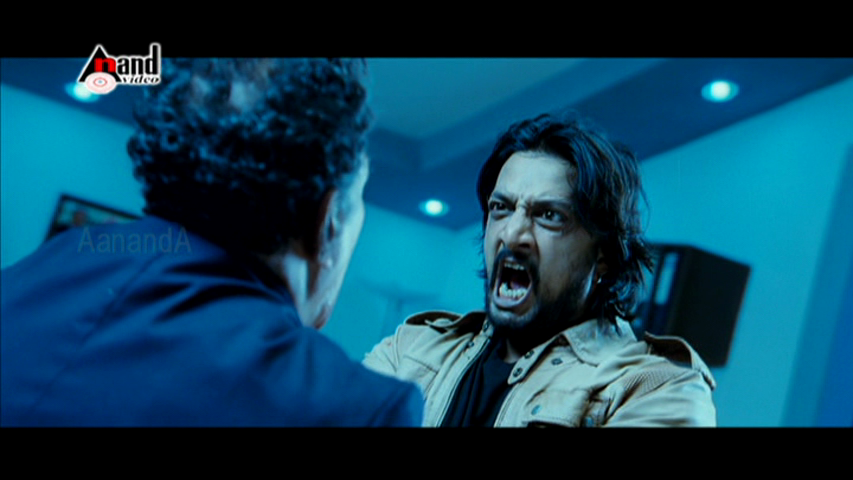
The film opens with a slugfest between Bharat (Sudeep Kiccha) and various members of the police force in a small police station. No-one is able to stop him as he smashes his way through the police station and ultimately kills Inspector Mahesh Deshpande (Ashish Vidyarthi) before escaping on a police bike.  Bharat then easily outwits the chasing police cars and heads to a hospital where he proceeds to defenestrate one of the doctors, Dr. Srinivasa Iyengar (Nasser) and escapes yet again.  This time though, we know he is going to get caught just as soon as a lorry full of water bottles appears in the middle of the shot.

BachchanBachchanBachchanBachchan


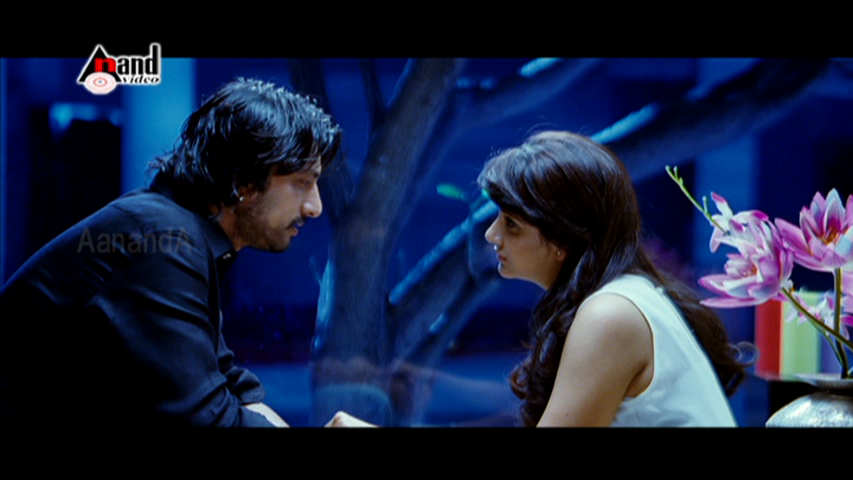
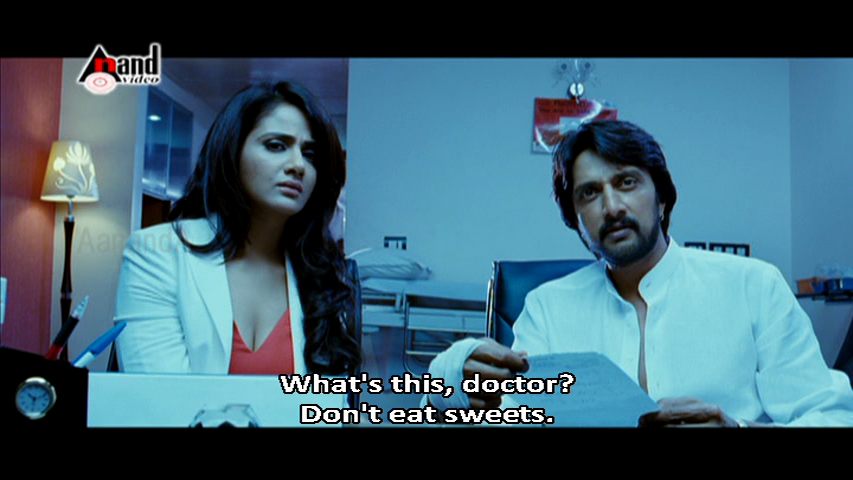
So once in custody for committing two murders (no mention of the destruction to property and general menace to society he represents) Bharat proceeds to tell his story to the investigating officer Vijay Kumar (Jagapathi Babu).  Seen in flashback, previously Bharat was a nice, happy (although rather patronising) real estate agent who was trying to be a force for good in the world, when he found himself hounded by a superstitious police officer and an obsessive doctor.  Inspector Deshpande fuelled jealousy in Bharat’s fiancée Anjali (Parul Yadav) by pointing out Bharat’s interest in a client’s daughter at every opportunity.  To be fair, Monica (Tulip Joshi) does seem to turn up everywhere and does show an unhealthy interest in a man whose attentions are otherwise engaged, but Bharat claims that this harassment was his motivation behind killing Despande.  Meanwhile Dr Iyengar sealed his fate when he refused medical assistance to Anjali and Bharat decided that he too had to die.
BachchanBachchanBachchanBachchan

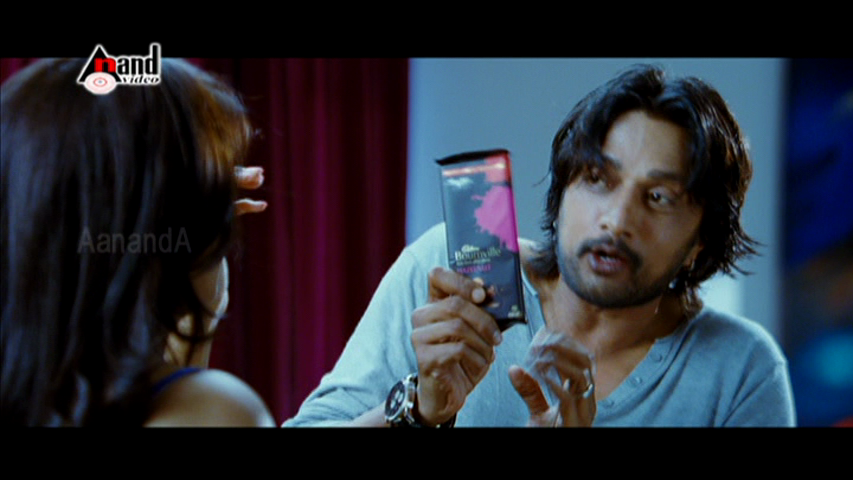
The problem I have with these opening scenes isn’t that the story is trite and clichéd, but that it’s all so completely overdone.  Both Despande and Iyengar are terrible caricatures while Anjali appears as a woman with absolutely no self-worth.  Bharat bribes her with chocolate when she accuses him of being rude to her at work (which he was), and when she accuses him of spending time with Monica, he has only to click his fingers and she immediately forgives him all.  There is a reason behind all of this but since it’s not explained until much later in the film, it does make for uncomfortable viewing first time round.
BachchanBachchanBachchanBachchan

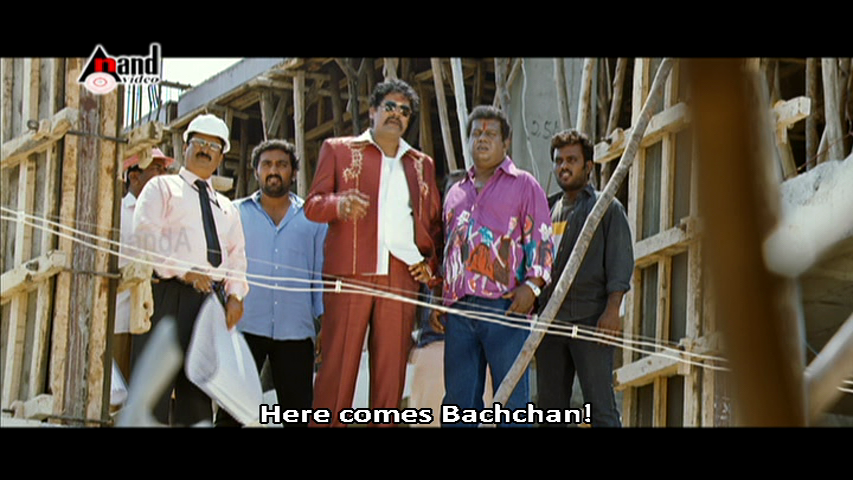
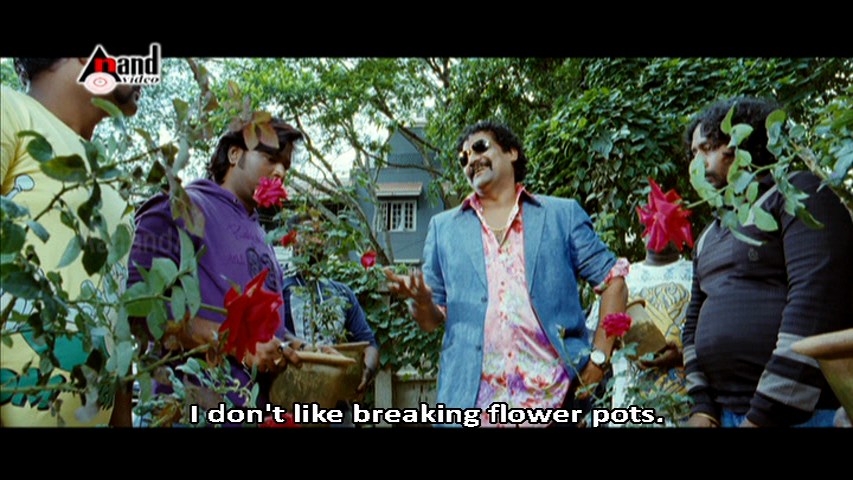
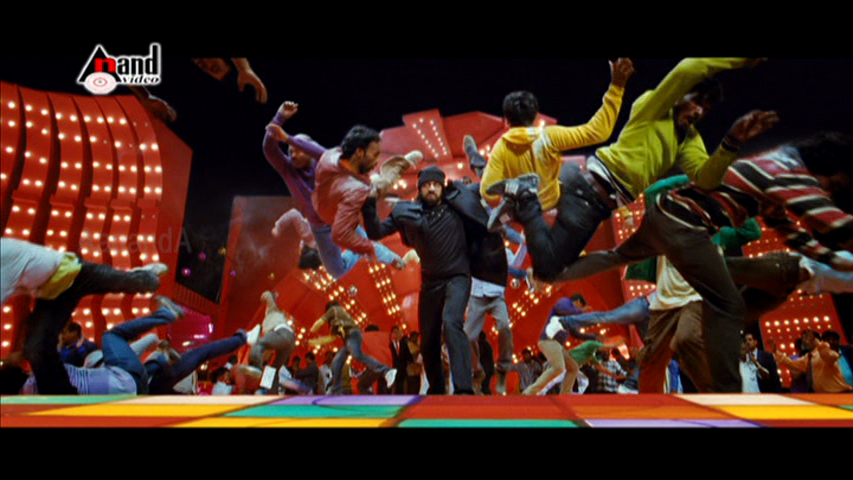
The first half isn’t all bad though.  There is a novel threat to a collection of flower pots, which is a welcome touch of humour and Sudeep is eminently watchable even when he’s being a complete pillock.  P. Ravi Shankar is also mildly amusing as the thug attempting to muscle in on Bharat’s business, and there is also plenty of excellent dorky uncle dancing in this song.

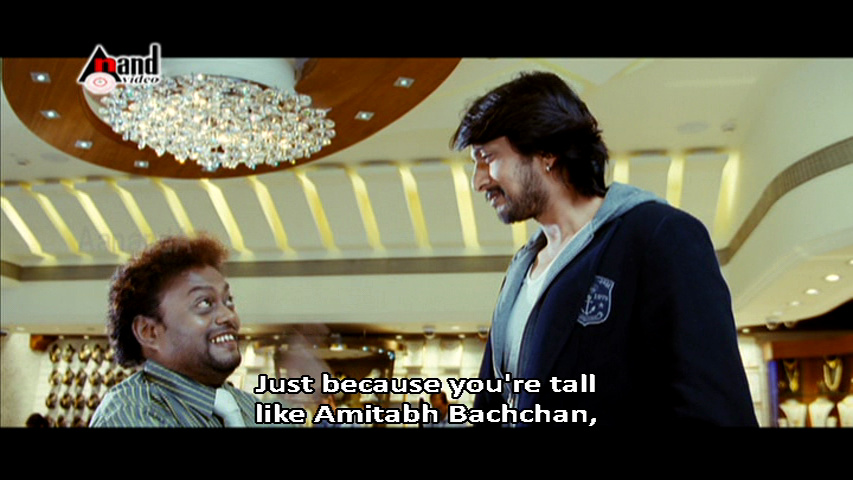
The film starts to improve when it’s gradually revealed that the story Bharat has told the police is a complete fabrication – hence the terrible characterisations in the first half.  The real Anjali proves to be a perfectly sensible and normal woman, while the other characters are nicely ambiguous until the real truth emerges.  There are plenty of twists and turns before we get there though and the second half turns out to be the out and out action thriller I was expecting from the start.  Throughout it all, Sudeep outclasses everyone else with chameleon-like changes of his character, and his performance is just enough to make up for the dodgy dialogue in the first half.  He does bring to life the film’s ‘Bachchan’ in Big B angry young man persona, although there is more to his character than just a generalised grudge against the world.  I’m presuming that director Shashank wanted to make a kind of homage to Amitabh Bachchan as there are many mentions of Big B and his films throughout, but he’s probably most referenced in this song with the bewilderingly badly dressed Tulip Joshi.  Poor Tulip – she really doesn’t come out of any of this well at all.

Bhavana makes a brief appearance as Anjali’s sister Ashwini, but probably the best performance from the three romance interests is from Parul Yadav.  Her character is more developed and despite the terrible beginning she does make a better showing in the second half.  Most of the rest of the support cast are fine but they are mainly there either to provide fodder for Bharat’s rage or to add layers of confusion to the plot, and are never any more than two-dimensional at best.  However the fight scenes are well choreographed even if they lean heavily towards standard Southern Indian tropes and the climax is satisfyingly OTT.

BachchanBachchanBachchanBachchan

The concept of Bachchan is good, but it is let down by the script in the first half (or perhaps just very bad subtitles) and a tendency to rely on standard filmi clichés.  Although the second half of the film is entertaining and very watchable, sitting through the first half to get there requires patience and perseverance.  Still, if you can make it through the first half hour, the rest up to the interval is ridiculous enough to be amusing and it is worth hanging in there to reach the excellent second half if you can.  I’d give the first half of Bachchan 2 stars and the second half 4 stars which gives an average of 3 – that seems about right overall.  Worth watching for Sudeep but I’d recommend leaving your brain behind for the first hour.

Gajakesari

Gajakesari

A very big ‘thank-you’ to Roopesh and Kannada Movies Melbourne for the opportunity to see Gajakesari in the cinema here in Melbourne.  This is the first time I’ve seen Rocking Superstar Yash, and I have to say he is pretty rocking!  However the real star of the film is an incredibly well trained elephant called Arjuna, who not only steals every scene when he appears but also perfectly defines the meaning of ‘on-screen chemistry’ with his co-star.  Noted cinematographer Krishna has stepped out from behind the camera to write the screenplay and direct this action adventure, which does mean that there are beautifully framed shots throughout even if the screenplay does drag a little at times. On the plus side there is an excellent flashback to a past life which helps lift the film out of the ordinary, and the combination of good fight sequences, an entertaining storyline and a charismatic elephant make Gajakesari better than average.

Gajakesari

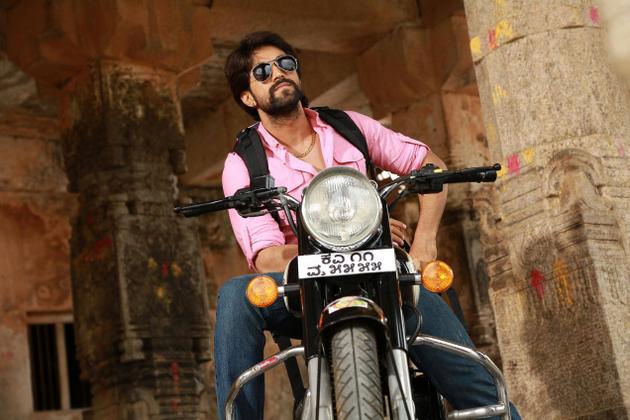
The story opens with the introduction of chief villain Rana (John Vijay) who intimidates the local politician into giving him the right to develop a tribal area somewhere in Karnataka.  After establishing that Rana has the nastiest henchmen and also the most googly eyes in SI cinema, the film moves location to a temple in Mysore to introduce Krishna (Yash).  Krishna is a modern guy who rides a Royal Enfield and likes to hang around with his two friends, but is about to discover that his freedom is coming to an end.  As a child Krishna was promised to the temple and is supposed to take over leadership from the current Mutt (Anant Nag), not something he has any real desire to do.  However there seems to be an escape clause – Krishna just has to donate an elephant to the temple and will then be free of his obligations.  Now I can see some of the logic behind this since an elephant would no doubt be much less trouble than a rowdy young man.  Still it seems to me that a herd of goats would possibly be more useful and easier to house than an elephant.  Regardless of convenience, the temple wants an elephant, so Krishna obediently heads up into the hills to find his pachyderm.

Gajakesari

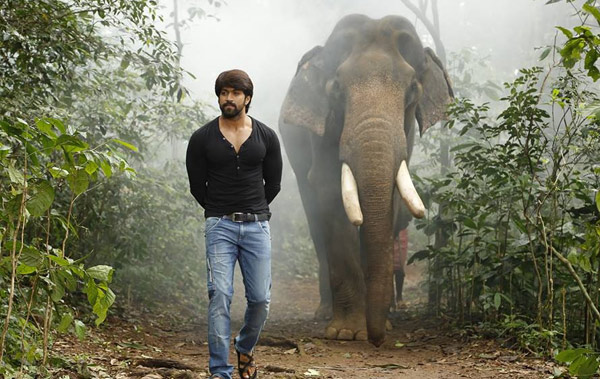
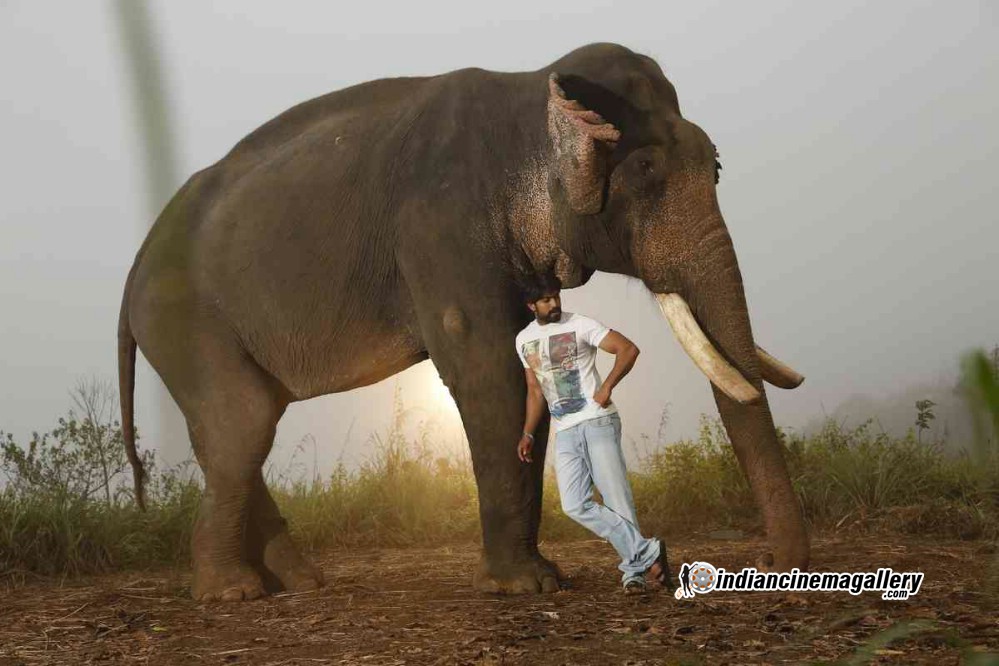
Luckily for Krishna he easily finds a small tribal village where there are plenty of elephants and the villagers are keen to help him in his quest.  However the local elephants don’t appear to want to leave their cosy jungle and since their leader is the particularly angry and intractable Kalinga (Arjuna!), it seems likely that Krishna may have to enter the temple after all.  Krishna though, is a man who seems especially blessed by his temple gods and he manages to calm Kalinga just in time to enlist his aid in fighting off Rana’s thugs.

Gajakesari

This is the start of a beautiful friendship, based (according to the village shaman) on the circumstance that Krishna is the reincarnation of hero Baahubali and Kalinga the reincarnation of his elephant.  This leads into an excellent historical flashback with plenty of heroism and action, although the low budget costuming for the attacking army is a little disappointing.  Baahubali and his elephant look awesome though!

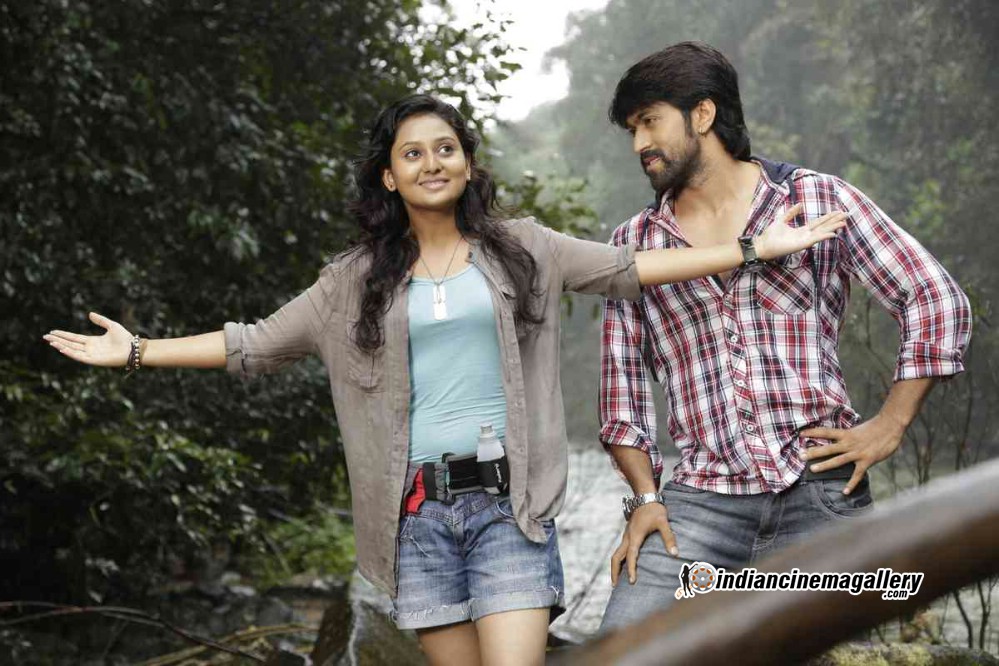
In the village Krishna also meets Amoolya, who ostensibly is there to record birds but really just seems to be looking for trouble.  She has a tendency to wear inappropriately short shorts around the village and while tramping around the jungle, and to add further insult indulges in patronising photography of the villagers.

GajakesariGajakesari

Sadly her character is poorly conceived as she looks nothing like the scientist she is supposed to be and instead is a 2 dimensional throwaway heroine with little apparent rationale for her romance with Krishna.  Amoolya does her best but there is very little she can do in such an unconvincing role while looking uncomfortable in most of the outfits.  Her best moments are in the songs where she does get the benefit of pretty and dance-friendly shoes, but it’s not enough to justify her presence in the rest of the film.

This really is Yash’s film and he is excellent in his role as Krishna.  He’s lackadaisical and perfectly casual as Krishna but takes on a completely different and more martial role when we see him as Baahubali.  The relationship between Krishna and Kalinga is the lynchpin of the plot in the second half and the two carry it off perfectly – excellent acting by Yash and great screen presence by the elephant combine to make an impressive duo.  Forget Amoolya, this is the real relationship that matters in Gajakesari!

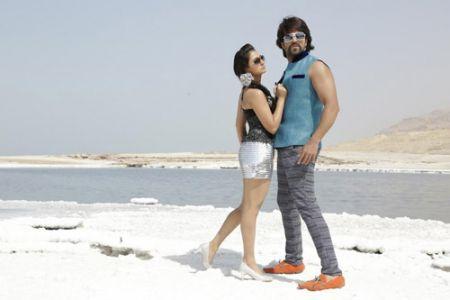
Yash also looks great in the songs, and not just because he always matches his shoes to his outfits.  He has plenty of charm and while his Krishna appears to be a lovable rogue, he also manages to convey an innate honesty and sense of moral integrity.  No wonder his elephant loves him and the villagers rely on him to defeat Rana and save their village.

Gajakesari

Overall Gajakesari works due to Yash’s strong screen presence and a good story.  It doesn’t need the added burden of a romance, particularly when it fails to ignite and the heroine seems so completely out of place.  The scenes set in the past are definitely a highlight, but the action in the present day is almost as good, and the inclusion of an elephant as a fighting partner is inspired.  Definitely one to catch in the theatre if you can and appreciate just how much star quality one elephant can bring to a movie.

Ugramm (2014)

Ugramm

A new discovery this weekend – Kannada films are being shown in Melbourne!  I found out about the weekend screening of Ugramm thanks to a message from my Hindi group and Roopesh at Kannada Movies Melbourne.  What’s even better is the news that there are more Kannada releases planned for later on in the year, and if the crop of recent films from Bangalore are anything to go by, they will definitely be worth catching on the big screen.

Ugramm is an action thriller that released in India back in February and has since become a major hit for director Prashanth Neel and its stars Srimurali and Haripriya.  Interestingly for me, the film starts with the story of the reincarnation of Vishnu as the half-man, half-lion Narasimha and provides an explanation of the title, which the film website tells me means ‘momentous anger induced by a great period of tolerance’.  I appreciate that Kannada has one word that says all of that so simply and it does sum up the storyline quite handily too.

Ugramm

After the initial animated explanation there is more background as a young Agastya witnesses his father’s death at the hands of a gangster, and begins his friendship with another young boy, Bala.  At the same time Jai Jagadish (as the heroine’s father) is forced to leave India after exposing the smuggling and criminal activities of gang-leader turned politician Shivarudra Lingaiya (Avinash).  So having set the scene, it’s time for action!  And there is plenty of that.  The modern-day story starts when Nitya ((Haripriya) leaves her father in Sydney to visit her mother’s grave in India.  No sooner does she get off the plane, than gangsters intent on settling the old score with her father kidnap her.  Luckily for Nitya, Agastya (Srimurali) arrives just in the nick of time to rescue her, and ends up taking her home to stay with his mother – what else could he possibly do?

Ugramm

Naturally our hero Agastya is a one-man fighting machine, who knows how to hit his victims so that they go down hard and stay down.  The fight scenes against a succession of different gangsters are completely over the top, but they are well choreographed and Srimurali is suitably grim as the reluctant hero.  That’s the whole ‘momentous anger induced by a great period of tolerance’ bit. The body count is high as many faceless gangsters are repeatedly smashed to the ground to the accompaniment of loud and intrusive background music.  However, like similar scenes in most Telugu movies, the violence is a little too cartoonish to take seriously.  Best of all are the moments where the last few villains standing turn tail and run rather than face Agasta and his momentous anger.

Ugramm

Meanwhile, in between the fight scenes, Nitya has to learn how to cook while dealing with a way of life completely different to how she grew up.  Romance blossoms as Nitya gets instruction in the names of different vegetables from Agastya, and even persuades him to help her cook.  Although Haripriya’s role is relatively small, her character is better developed than most heroines, and she does get the chance to be more than just a pretty face.  Since her character was a girl raised in Sydney I was expecting some totally inappropriate wardrobe choices, but for a change the costume department got it just right.  Haripriya is also a lovely dancer, and I was particularly impressed by her ability to dance convincingly in flip-flops.  There are a few brief glimpse in this song.

There is a brief comedy track based on two other guys living in the house, but I didn’t quite understand exactly what their relationship was to Agastya and his mother, and no subtitles meant that most of it passed me by.  It must have been funny though, as the rest of the audience were laughing at their antics.

The second half moves away from the developing romance between Agastya and Nitya to explain Agastya’s past and how he ended up working as a mechanic and resisting fighting unless there is no other choice.  The fights here are more menacing and there are some genuinely disturbing scenes as gangsters wreak havoc on the locals in the town of Mughor.  There are a plethora of different gangs and they are all equably interchangeable, particularly since a pre-requisite for gang membership seems to be a bad eighties style perm, and an inability to see that attacking Agastya is bound to turn out badly.  Agastya’s youthful friend is another gangster Bala (Tilak Shekar) and the second half focuses on their relationship and the reasons why Agastya finally moved away and got out of the gangster business.

Ugramm

While the tale of a gangster redeemed is not particularly novel, Ugramm delivers a few new twists and overall the story is well told with excellent characterisations and good performances from the main leads.  The added complication of Nitya and her back story helps keep the story from being overcome by the action sequences and actually helps keep everything moving long.  The support actors are also impressive with Atul Kulkarni appearing briefly as  Shivarudra Lingaiya’s son Dheeraj (although I couldn’t quite understand the importance of his character), while Padmaja Rao is good as Agastya’s mother.

Ugramm

Although the background music is at times overwhelming, mainly because it is just too loud, the songs by Ravi Basrur are good and well-placed in the narrative to provide a breathing space from the high energy action scenes.  The film also looks amazing, perhaps not surprising since cinematography is by the well-known Ravi Varman, although the addition of black screens in between the action is distracting and does disrupt the flow at times.

Ugramm is a well made gangster film that does perhaps overdo the violence, but makes up for it with a good storyline, sharp editing and excellent performances.  Definitely well worth a watch for fans of the genre, although if you didn’t manage to catch it at the weekend here in Australia that will mean waiting for the DVD.  Unless of course the recently reported remakes in Telugu and Tamil release here first!