Lingaa

Lingaa

Finally it’s here! Friday was not only the Superstar’s birthday but marked the release of his latest film with director K.S. Ravikumar. There has been plenty of hype and expectation for this film, so did the team who gave us the hits Padayappa and Muthu deliver another blockbuster? Well….. mostly. This is a Rajinikanth film so we all know what to expect, and it goes without saying that the outfits will be stupendous, the songs lavish and attention firmly focused on the star in every scene.There is nothing much new about the story, but that’s not really the point, since it’s the entire spectacle and the heroism that’s important and there is plenty of that to be getting on with. Lingaa delivers most of the Rajni ‘formula’ characteristics we’ve come to expect, and with good performances from Anushka Shetty and Sonakshi Sinha there is plenty to enjoy in full masala style.
Lingaa

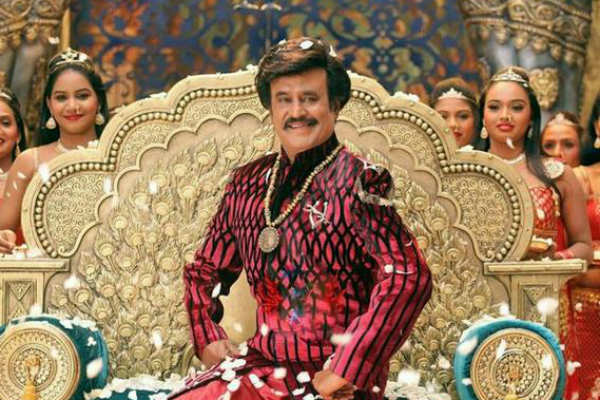
The film starts with the exploits of Lingaa (Rajinikanth), a thief and con-artist who, along with his merry band of Santhanam and Karunakaran, attempts a major heist at a jewelry exhibition. His outfits are classy and his concept equally sophisticated but Lingaa is foiled in his attempt to sell the jewels on by journalist Lakshmi (Anushka Shetty). Lakshmi is in search of the grandson of Raja Lingeswaran, the only one who can re-open a temple in her village and who just happens to be our jewel thief Lingaa.  Using tricks and flattery, Laksmi manages to get Lingaa to go to the village but not before she indulges in a full blown fantasy song with Rajnikanth as the pirate king come to recue her and her backing dancers, who perpetrate crimes on the high seas against the ruffle shirt amongst other fashion crimes.

Once in the village, Lingaa is taken aback by the respect shown to his grandfather, but since he himself feels no obligation to the man who lost all the family money, he is content to use the situation purely for gain. However in the course of events, Lingaa learns the full story of Raja Lingeswaran and exactly how he lost his money but won the respect of the people for his life-saving dam. We see all this in flashback mode with Rajinikanth also playing the role of his grandfather, in a beautifully drawn flashback to the 1930’s with period furniture and apparently CGI elephants. No mention though if all the horses, mules and buffalos were CGI too. Back in the thirties Rajni’s love interest this time is village girl Bharathi (Sonakshi Sinha) who has just as epic an imagination as Lakshmi, although she favours a more regal theme in her fantasy.

The thirties track starts with a superb fight scene on a train that features Dev Gill as a freedom fighter and touches on the Independence movement, the corruption and cruelty of the British Collectors, and the blind neglect of the Governors, the inequities of the caste system and the struggles of rural India as the farmers battle drought and flood. It’s a bit of a mish mash of ideas, but through it all Rajnikanth walks tall in some wonderfully spiffy costumes and what must surely be the best collection of sunglasses onscreen ever.

The film looks amazing with obviously no effort spared on the sets and outstanding costuming for Rajinikanth.  There aren’t all that many fight scenes, but they are all well choreographed and fit into the main narrative. The train fight scene is undoubtably the best with Rajni stylishly eliminating a train full of bandits with effortless ease, including a one on one with Rahul Dev on top of the train. The action scenes set in and around the building of the dam are also well filmed and the effects well integrated to give the impression of a truly massive construction.  The songs by A.R. Rahman are a little less successful, but since the dance numbers are mainly dream sequences, the total switch from the story is a little less disruptive. The songs which move the story forward such as the stirring Indiane Vaa more successful and the background music, also by A.R Rahman, is suitably evocative for each era. I do like the songs and actually like them more after seeing the visual to match, even with those ridiculous costumes in Mona Gasoline!

Sonakshi Sinha and Anushka Shetty don’t have a huge amount to do other than as the romance interest for the two Lingeswaran’s, but K.S. Ravikumar does give both of them a few important scenes in their relevant story lines. Santhanam and Karunakaran are also kept mainly in the background and when Brahmi makes a brief appearance early in the film it’s over almost before you realise it’s Brahmi. Still this means the focus is firmly on Rajinikanth and he makes the best use of every moment on screen with one liners, epic speeches and that twinkling smile.

Perhaps the only problem I have with Lingaa is the relative ineffectiveness of the villains, although I did appreciate the very normality of their respected self-interest. In the present day Jagapathi Babu does the honours while in the flash-back the actor playing the British collector is suitably sneery but a little too much of a caricature for me to completely believe in the character. The finale also seems a little rushed, especially since the computer graphics don’t work quite so well here as in the rest of the film. However it’s still Rajni doing several impossible things at once while saving the day and the girl (yet again) so for me it’s fine to accept the glaring unfeasibility of it all and just enjoy the spectacle.

I really enjoyed Lingaa, and loved watching Rajinikanth in the two separate incarnations of Lingeswaran. The comedy and action in the first half is interspersed with the insanely OTT songs while the second half is more sedate in keeping with the thirties backdrop. I am a big Rajinikanth fan which undoubtably colours my opinion, but this was fun and entertaining. Definitely well worth watching for the Superstar and those wonderful sunglasses!

Just as an aside, Lingaa was showing at The Astor here in Melbourne and when I left the cinema I was confronted by a sea of Jake and Elwood Blues lookalikes who were there for the 7pm showing of The Blues Brothers. From one iconic sunglass wearing movie superstar to an iconic  movie – it made my day!


Kochadaiiyaan

Kochadaiiyaan Taking Superstar Rajni and turning him into an animated action hero is certainly novel and Soundarya deserves praise for breaching the boundaries of Tamil cinema and attempting something as different as motion capture animation. With Deepika Padukone as the heroine and experienced actors such as Jackie Shroff and Nasser in supporting roles, the potential is certainly there for something amazing but despite all the innovation and obvious hard work, Kochadaiiyaan doesn’t quite deliver.  K.S. Ravikumar’s story isn’t the problem. It’s a swashbuckling period adventure with enough substance to fill a couple of hours comfortably with a few credible twists in the tale.  The dialogue also seems fine, even when subtitled, and the characters are reasonably convincing within the storyline.  It’s more basic than that – the real issue here is that animation is just not as good as the real thing. Kochadaiiyaan The film tells the story of Rana (Rajinikanth), who left the kingdom of Kottaipatinam as a child and ended up as the army commander of rival nation Kalingpuri.  A flashback in the second half explains Rana’s background as the son of legendary warrior Kochadaiiyaan (also Rajinikanth) who was himself betrayed by the King of Kottaipatinam.  In between there are battles, betrayals, social justice as Rana frees slaves, and of course some romance with Princess Vadhana (Deepika Padukone).  Rana is a rather more subdued character for Rajnikanth, despite his heroic looks and charismatic style with Princess Vadhana and the swash and buckling only really starts to take off when Kochadaiiyaan appears in the second half.  Maybe it’s a case of getting more used to the style, but the film is livelier after the interval, and Kochadaiiyaan appears more splendidly heroic than his son. Kochadaiiyaan I have to admit I’m not a fan of this ‘almost life-like’ animation.  I found Polar Express creepy and much prefer my motion capture as a dash of CGI in films such as Lord Of The Rings and Transformers, or as complete fantasy like Shrek and Despicable Me.  While motion capture gives characters a relatively life-like appearance, it’s not real enough to be able to convey emotion convincingly and the lack of facial expression is disturbing, as nothing looks quite ‘right’.  It’s hard to generate any empathy with the characters despite the attempts at laughter and tears, especially when some of the smiles look more like grimaces.  It also doesn’t help that the animation here is variable, with some characters, such as the young Rana and his brother Sena appearing almost unfinished with strangely elongated limbs and disjointed necks, while the horses and elephants appear very clunky when in motion. Kochadaiiyaan Another casualty of the animation process is the dancing, which ends up appearing jerky and awkward much of the time.   It also looks a little odd to have large numbers of dancers completely in sync in the background – rather than looking impressive it just looks strange and almost sinister.   However, on the plus side, the costumes by Neeta Lulla are stunning with amazing attention to detail, which likely would not have been possible in real life.  That also applies to most of the action scenes which just wouldn’t have been possible with real actors and animals.  Peter Hein is credited as the action co-ordinator but his talent with co-ordinating fight scenes doesn’t translate well to animation.  The  scenery is generally spectacular though with  plenty of grand palaces and surreal gardens, although there are a few times when the background just looks  rather bland and unfinished.  I hadn’t heard the film soundtrack before watching the film, but the music by A.R.Rahman, is  one of the highlights and suits the rather grandiose and somewhat sweeping scale of the story.

Kochadaiiyaan

I would have preferred Kochadaiiyaan if the CGI had been limited to the background, enhancing the fight  scenes and sprucing up the scenery, while the actors played their roles instead of  using motion capture animations.  Although the downside would be that quite a number of the scenes would have to be less extravagant, it could have made for a more engaging film. However, setting aside the animation issues  I still did mostly enjoy the film, mainly due to the tale of Kochadaiiyaan and the music. The end of the film leaves a sequel likely and I hope that does happen, although the animation  issues do need to be addressed in any follow-up film.  Kochadaiiyaan is probably best watched by Rajinikanth fans but if you can cope with the animation it may be worth a watch, even if only to see the first complete motion capture Indian animation film.

Padayappa

Padayappa

Many thanks to regular readers Violet and KB for suggesting Padayappa (1999) when I asked for Ramya Krishnan film recommendations. I believe that director K.S. Ravikumar cast her after seeing Ammoru, and I understand why. Padayappa has an amazing cast, an often incredible story, and all the trappings of a revenge drama custom built for superstar hero Rajinikanth. It also has a strong female antagonist that was perfect for Ramya Krishnan, who won the Tamil Filmfare Best Actress for the role. The support cast includes such talented actors as Sivaji Ganesan and Soundarya, along with Manivannan, Lakshmi, Nasser and even a brief appearance by Prakash Raj.

Padayappa (Rajinikanth) comes home to attend a family wedding. He falls in love with poor but honest Vasundhara (Soundarya) however overseas educated rich girl Nilambari (Ramya Krishnan) decides she must have him for herself. Her branch of the family is riddled with self-serving weaklings and their machinations help hasten the death of Padayappa’s father, played by legendary actor Sivaji Ganesan. Padayappa stays in the village to support his mother and sister, sort out the cheating relatives, and also to try and woo Vasundhara. The conflict between Nilambari and everyone who gets in her way is the main focus, although there are the obligatory comedy tracks and lots of rousing speeches.

Padayappa-SuperstarPadayappa-Padayappa the hero

In Padayappa Rajinikanth is Superstar Rajni the Hero rather than using his considerable acting skills for a fully developed character that required any subtlety. The thing I always find admirable about Rajni is that he commits to the role and to the style of film he is in, and that conviction makes even the most preposterous shenanigans seem somehow right.

Padayappa is moral, righteous and has absolutely no self-doubt. He has all the trademark Rajni mannerisms from the snappy salute with whooshing sound effects, the cigar trick, the ability to force his enemies to attack him one by one and at a pace that allows him to win, the power to make multiple cars explode just by looking at them. There is some light and shade as Padayappa gets all silly and tongue-tied around Vasundhara, or as he grieves for his family’s losses but he is less a character and more a personification of Heroic Values.

Padayappa-against the oddsPadayappa-Flexing

Confession – I am so fond of Rajni that I really don’t care that his fight scenes are implausible or his ‘dancing’ quite terrible. But I could have done without the shirtless flexing.

I rarely take issue with the (usually considerable) age gap between Rajni and his heroines. Maybe it’s because I discovered him comparatively recently so to me he has always been an elder statesman of film. And to some extent his reputation overshadows any character he plays.  He’s Rajinikanth!

Padayappa-NilambariPadayappa-Ramya Krishnan 2

Nilambari is compelling yet totally unlikeable. A spoilt girl who never took no for an answer, Nilambari often does things more likely to be done by the hero – she stalks the hero, she grabs him and kisses him in front of everyone at a wedding then saunters off casually, she torments her rival (the lowly Vasundhara) and threatens anyone who tries to obstruct her.

Padayappa-Ramya Krishnan 3Padayappa-Nilambari and Vasundhara

Ramya Krishnan gave Nilambari a beautiful façade over a twisted and arrogant core. It is great to see an actress capable of such expression and subtlety and who is not afraid to reveal the ugliness of a character’s dark side. She took it up to Rajinikanth and more than held her own in their confrontational scenes.

Padayappa-beauty status and talentPadayappa-contrast

Nilambari’s outfits improved but her attitude never did.

There is a village tradition that couples should only marry when both want to, either through love or mutual agreement. Padayappa rebukes Nilambari saying a good woman should be well-mannered and demure, so it’s not exactly progressive but I liked seeing girls get a voice too.

Padayappa-Soundarya (2)Padayappa-awkward

Vasundhara (Soundarya) is Padayappa’s ideal woman. She is a servant in Nilambari’s household, but her family used to be wealthy. Devout and domesticated as well as very pretty, Vasundhara obviously likes Padayappa too. She and Rajni seem to have nice rapport and the courtship is more about shy conversations and sideways glances. It’s quite cute if predictable. Soundarya does well to build up a character that is only lightly sketched out by the screenplay and dialogue. I did yell at Vasundhara a couple of times to STOP TRUSTING NILAMBARI. Luckily her devotion earns her some snake assisted escapes from near certain death.

Padayappa-Soundarya

Soundarya also does an excellent job of dancing around Rajni in their songs together. She often has a cheeky smile on her face, so Vasundhara might have a colourful fantasy life to balance her dutiful side.

Padayappa-wedding wishesPadayappa-promise

The dynamic between Padayappa and Nilambari was interesting as this is an instance where the hero is quite passive. Padayappa doesn’t do anything to torment or punish Nilambari other than be happily married to the one he loves. She is insignificant to him, and that is what drives her insane.

The song picturisations have all the colour and excitement I expected. AR Rahman’s music is a good fit and his use of recurring motifs helps express the characters inner lives.

Minsara Poove sees Nilambari dancing her feelings for Padayappa as he sings for Vasundhara. It’s very pretty, apart from the bits that are happening in Nilambari’s fantasy. She really needed a better dream wardrobe designer. Suthi Suthi is colourful, with giant puppets and lots of costume changes for Soundarya and Rajni. Kikku Yerudhey is a little out of place in terms of the story and I think it was only there to get Rajni prancing about with lots of young girls (Padayappa’s daughter’s school friends) and drunk uncles. Or maybe just to let the director make his trademark cameo appearance.

Padayappa-carnage

There are fight scenes, cars stunts, a murderous cow (not a euphemisism for Nilambari) and all manner of excitement as well as the revenge and drama.

Padayappa-the dating advice committeePadayappa-advice gone wrong

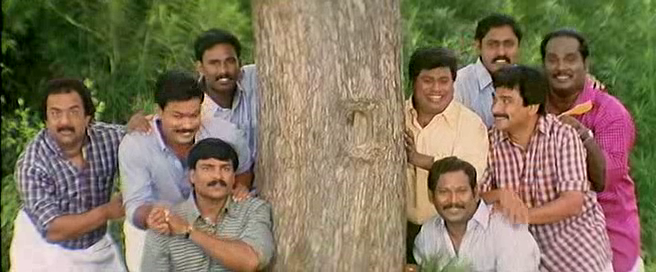
Padayappa’s friends are largely there to provide comic interruptions but they also do an excellent line in relationship advice and support (and hiding behind trees).

Padayappa-Sivaji Ganesan and Lakshmi

The legendary Sivaji Ganesan had a small but pivotal role as Padayappa’s father and was still quite magnetic. Lakshmi made the most of her big scenes as the surprisingly fierce mother. The always excellent Manivannan made his character despicable and yet pitiful while Nasser was just despicable.

Padayappa-Prakash Raj

And a quite svelte Prakash Raj was a nice bonus as a police officer. The casting budget for this film must have been enormous.

At almost 3 hours Padayappa does drag occasionally but just as I was thinking that surely things must settle down, K.S. Ravikumar would ramp up the action. See it for a classic village family revenge masala style story with a first class cast and loads of colour and movement. 4 stars!