China Town (1962)

Chinatown

Shakti Samanta is responsible for many of my favourite Hindi films, and China Town is another one to add to the list. Not only does it have Shammi Kapoor in a double role, but as an added bonus Helen appears as one of the two heroines, and she dances in two songs – awesome! Shakti Samanta heads to Calcutta and the seedy opium dens of Chinatown to deliver a crime drama with plenty of masala seasoning. It’s the story of a gangster whose buffoonish lookalike becomes involved in a police plot to uncover the shadowy figure behind the Chinatown drug trade. If that sounds familiar, Salim-Javed were supposedly inspired by China Town when they came up with the plot for Don and the set-up is certainly very similar. However there are fewer twists and a lower body count in China Town, and the end is quite different. This has fewer noir elements than Samanta’s earlier Howrah Bridge but it does edge into the genre, and even though the outcome is fairly predictable, the journey to get there is well worth taking.

The film opens with the title track and features Helen in a wonderful dress covered with dragons. Chinatown gangster Mike (Shammi Kapoor) is introduced in the bath (!) and has a wonderful laconic style as he explains that the world will order itself to accommodate Mike, not the other way around. With such ishtyle, it’s not really surprising then that dancer Suzi (Helen) is in love with Mike, despite the callous treatment she receives at his hands.

Mike works for Mr Wong (Madan Puri), the owner of a hotel in Chinatown that acts as the front for a number of criminal activities, but chiefly the gang run an opium den and deal in drugs. Mike is spotted making his dodgy deals by the indomitable Inspector Dutta (Kanu Roy) and in the course of the ensuing car chase Mike is hurt and brought back to the police station by Inspector Dutta. However Mike proves to be a tough nut to crack and none of Inspector Dutta’s interrogation techniques manage to force him to reveal the other members of the gang, or who is controlling their activities. Fortuitously for Inspector Dutta, Rai Bahadur Digamberprasad Rai (S.N. Bannerjee) comes to the police station to make a complaint about bar singer Shekhar (Shammi Kapoor) who has followed his daughter Rita (Shakila) to Calcutta. Shekhar just happens to be the spitting image of Mike, and Inspector Dutta sees a way to infiltrate the gang, if he can get Shekhar to impersonate Mike.

Shekhar is the antitheses of Mike. He lives with his mother (Jeevan Kala) in Calcutta and spends his time singing, chasing after Rita and avoiding her father who is less than impressed with Shekhar. Shekhar is carefree and careless, and Shammi is excellent as the crazy and impulsive singer who will do anything for love.  Here he is serenading Rita, who doesn’t seem too impressed by his moves here at all!

Rai Bahadur on the other hand will do almost anything to keep Shekar away from his daughter, and when you consider Shekar’s antics as he dresses up as a Sadhu to follow Rita on the journey to Calcutta it’s hard to disagree when Rai Bahadur calls him a cartoon.

Despite his somewhat frivolous nature, Shekhar allows himself to be persuaded to work for the police, and undergoes extensive training to impersonate Mike. He successfully infiltrates the gang and starts to pass information back to Inspector Dutta, but before he can find out who’s the boss behind the scenes, Shekhar’s mother arrives in town. She soon reveals that it’s not a coincidence that Shekhar looks like Mike, and soon my favourite Bollywood plot device of separated twins gets thrown into the mix. So now all Shekhar has to do is stop Rita from marrying Mr Chaudhary, convince Rai Bahadur that he is a suitable person to marry his daughter, find the head of the drug smuggling gang and save his long lost brother – no worries!

Although Shekhar fools the gang, he can’t hide his musical soul and when out delivering drugs he dances and sings along to this wonderful mujra. I love the way Shammi can’t sit still and gyrates away in the background before finally joining in with Roshan Ara.

Along with the action, as Shekhar fools Mr Wong and one by one delivers the gang members up to the police, naturally there is time for some romance. Rai Bahadur seems a very liberal father, except where Shekhar is concerned and Rita manages to meet up with Shekhar and hit the tourist spots of Calcutta. They make a lovely couple, and Shakila looks beautiful here in a couple of sweet duets. The romance is rather cute too – as in one scene where Shekhar and Rita take refuge in a hotel and pretend to be married. The owner’s wife Mahakali (a brief appearance by Tun Tun) adds a vermillion tikka which Rita then doesn’t want Shekhar to rub off later despite all her protests about the deception. Very sweet! Rita is also feisty and quite prepared to fight back when she is kidnapped by the gang, which makes her a likeable heroine and more of a partner to Shekhar.

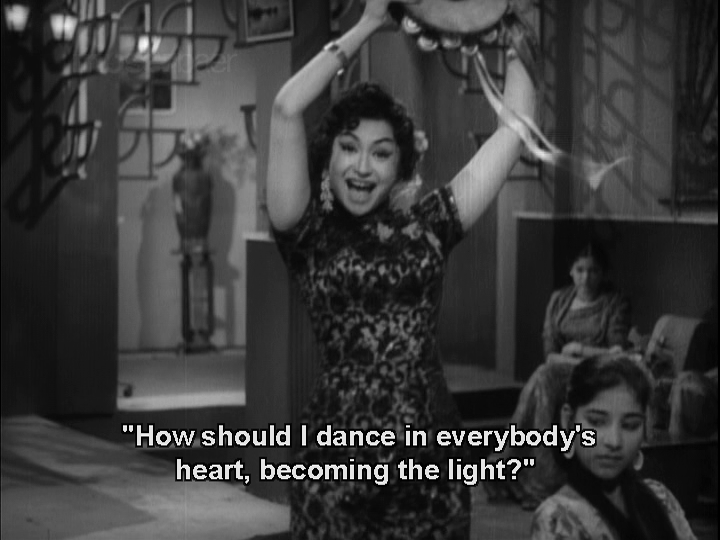
Suzi is quite prepared to fight for her man too, and Helen is fantastic in a role that gives her the opportunity to do more than dance. However she also looks stunningly gorgeous in this song where she dances with an intoxicated Shekhar.

The location allows Samanta to use the Calcutta backdrop and Howrah Bridge to good effect, particularly in the last fight scene. Dwarka Divecha does an excellent job with the cinematography and as in previous Samanta films there is good use of light and shade to heighten the drama. The Blue Dragon hotel has plenty of hidden doorways behind fake walls and bookcases, and there is even an escape route through the sewers to add to the ambiance.

The support cast all fit their roles well; Madan Puri reprises the role of a Chinese hotel owner while M.B. Shetty is expressive as Ching Lee, one of the gang who suspects Shekhar is not really Mike. But despite good performances from all the cast, China Town is all about Shammi Kapoor, and his performance here is the reason to watch the film.

I just adore Shammi in this film. He looks fabulous and seems to relish the contrast between his two roles, keeping the two personalities quite separate throughout. Shammi even looks very different as Mike and he plays the part of a brutish and rough gangster easily without hamming it up for the camera. As Shekhar he is buffoonish but good-natured, and although he does become more sensible when working for the police, he manages to make this seem like an act and every so often reverts back to true form with some classic Shammi craziness. When there are two Shammi’s onscreen it’s just wonderful, even if the technology isn’t quite able to make the effect completely seamless. Shammi is wonderful to watch, so even if the story does become a little predictable and the ending is annoyingly contrived, it really doesn’t matter when Shammi is this good – twice over! Recommended for Helen, Shakila, good songs and shady ambiance, but overall watch this for Shammi – he’s amazing! 4 stars from me – and I’ll give the last word to Helen, because I think this is exactly what she does.
Helen!

Bhoot Bungla (1965)

Bhoot_Bungla_poster

Adhering to the Scooby Doo school of horror, Bhoot Bungla is fun from go to whoa with great music, dodgy disguises, lukewarm romance, dancing skeletons and a dash of suspense. This was Mehmood’s debut as a director and he pulled out every trick in the book, and I suspect a few favours from the filmi fraternity, to make it a hugely entertaining romp.

Bhoot-Bungla-Moni Chatterjee

50 years ago Kundanlal was murdered and his wife and son disappeared from the family home. In the present day his three nephews live in the mansion. Ramlal (Moni Chatterjee) gets a telegram that his daughter Rekha (Tanuja) is coming home from Abroad. He prepares to collect her from the airport but brother Shyamlal (Nazir Husain) makes an excuse that he has to go to the office. Ramlal’s car explodes, leaving Rekha an orphan and heiress. Not long after, poor unhinged Ramu (Nana Palsikar) is found dead in a murder staged to look like suicide.

Shyamlal and Rekha move into a stylish apartment in town but can they escape the curse? Or is it a more corporeal threat? Worried that she is sad and afraid, Uncle calls Rekha’s friends to come and get her out of the house. They enter her in a singing competition at The Beach Club, where her rival is none other than Mohan Kumar (Mehmood) and his Youth Club, dedicated to Doing Good. The hi-tech Applause Meter gives Mohan the cup, but the audience is the real winner! Oh yes, hijinks ensue.

Tanuja is excellent as Rekha, sassy and sweet by turns. I really liked that the first thing Rekha did in the new flat was unpack her books while the servants dealt with the clothes and other belongings. She is smart but also raised to be obedient and good so when suspicion falls close to home, she tends to go with the dutiful response rather than a rational one. Tanuja matches Mehmood’s energy, throwing herself into the silliness with gusto. She also delivers a convincing portrayal of Rekha as someone weighed down by fear and losing confidence in their own judgement. I can think of no other explanation for her fleeing the apartment in a frothy nighty and huge fur coat (in Mumbai? Really?). The romance is a minor part of the story, and there are no sparks between Tanuja and Mehmood, but they do have nice rapport. Since the relationship is partly due to Mohan’s Youth Club commitment to helping people, it doesn’t matter that they seem more like friends than being crazy in love. There’s enough crazy to make up for it!

Mehmood’s grand entrance is riding a motorbike up Marine Drive and howling like a police siren. At first I actually thought it was just exceptionally dodgy sound effects and had grave fears for the rest of the film! There can be too much Mehmood, but in this case he gets it just about right and Mohan is wacky but always likeable and genuine. Maybe he was too busy worrying about tricky camera angles (of which there are many) to be The Star and settled for a happy camaraderie with the ensemble. Of course, restrained by Mehmood standards still includes doing drag, slapstick, encouraging children to gogo dance their fears away, and instigating a dance off with gyrating skeletons. But I knew Mohan truly loved Rekha when he shaved his moustache off to frock up, committing himself to having to draw it back on with pencil for at least one subsequent scene. That is commitment,

The music is fabulous and the songs are a real highlight. Mohan sees a blind beggar whose violin has been broken by drunk boys – so he does a West Side Story style dance number exhorting society to wake up and care. Pyar Karta Ja moves the hearts of all youth club boys and girls who were otherwise occupied in construction work. It’s not quite the barn raising scene in Witness but pleasing nonetheless, and Witness didn’t have Manna Dey. Everyone, including the special effects team, saved their best for the Bhoot Bungla song. Watch it now, and enjoy all manner of silliness with Mehmood and RD Burman dancing with skeletons and showing the ghosts who’s boss.

The support cast has lots of excellent performers although I am struggling to put names to all the faces despite the detailed opening credits. I will take a punt that Jerry played Jerry who was an imitation Jerry Lewis. I was particularly fond of Rekha’s exuberant girlfriends (including Lata Sinha). RD Burman is a hoot as Stocky, the cowardly foodie who accompanies Mohan on his ghost busting mission. It’s always good to know that someone has afternoon tea requirements under control. The creepy family retainers – Lakiya and the mysterious and toothy gardener – are perfectly cast with their spooky appearances adding to the sense of unease. Just the thought of Lakiya’s ruffles is enough to terrify me.

Bhoot-Bungla-Dedication

Apart from the fluffy entertainment value, the story is reasonably strong. Mehmood balances the various elements well and kept the suspense and laughs coming. There are some twists and red herrings, and things move along at a fair pace. I found the dedication to Guru Dutt quite touching – Mehmood seems to have been a thinker when it came to his own films.

See this for the excellent songs, the generally well balanced suspense and comedy, and the skeleton dance-off. Sure there are some things that go bump in the plot, and a couple of loopholes big enough to drive a Youth Club bus through, but nothing that detracted from the good natured fun. 4 stars!

Did someone say Twist?

Cannot. Resist. Urge. To. Dance!

Bhoot-Bungla-the end

Haider

Haider

Watching Vishal Bhardwaj’s latest film Haider is a visceral and haunting experience, as the gorgeous detail of the film allows every emotion and each drop of blood to be shown in crystal clarity. The story of treachery in Denmark is transplanted to Kashmir at the height of increased militancy in the area in 1995, but still remains tragedy on a grand scale. Bhardwaj and his co-writer Basharat Peer have successfully adapted the bard’s play into more modern-day India, although the pacing is a little inconsistent in places and at times the Kashmiri issue threatens to overshadow the personal drama. The heart of the film is in the performances, and although Shahid Kapoor is excellent in probably one of the best performances of his career, the real stand-out is Tabu who is completely mesmerising in her role as a conflicted mother to Haider and disloyal wife to Dr Hilal Meer. It is compelling cinema and definitely well worth watching in the theatre to fully appreciate the stunning cinematography and spectacular beauty of Kashmir.

Haider (Shahid Kapoor) is a student, safely studying poetry in Anantnag when he learns that his father has disappeared after providing medical aid to a militant leader. Dr Hilal Meer (Narendra Jha) is taken by the army in a truly frightening scene that manages to grasp the sense of hopelessness and terror of a military raid in just a few moments. The grim method of selecting who may go and who is arrested by a balaclava-wearing man in a Jeep is chilling, as is the resignation that makes everyone line up for inspection without any word of complaint. The detail in each frame is incredible, and the performances are very natural, making the film seem almost like a news report direct from the action, rather than a fictional story.

Dr Meer’s family home is also bombed, along with the militant leader still inside, and in a few seconds his wife Ghazala (Tabu) has become a ‘half-widow’ without anywhere to live. As a result, when Haider returns he finds his mother living with his uncle Khurram (Kay Kay Menon), and he is instantly suspicious about their relationship. While rejecting his mother, Haider relies heavily on his girlfriend journalist Arshia (Ahraddha Kapoor) and two friends Salman (Sumit Kaul) and Salman (Rajat Bhagat) as he searches for his father. Since up until this point the film is unrelentingly bleak, it’s a real relief when the comedy appears, and Salman and Salman are an excellent counterpoint to the violence and despair elsewhere.

Haider’s search for his father is heart wrenchingly sad, as he is just another one of many who are searching for their own disappeared relatives. However, interspersed with his search are confrontations with his mother and uncle which fuel Haider’s anger and mistrust. The relationship between Haider and Ghazala is wonderfully nuanced and both actors capture the essence of Shakespeare’s characters and their conflicted emotions well. There is a frisson of sexual tension, heightened since Tabu looks way too young to be Shahid’s mother, but mainly the film focuses on Haider’s sense of betrayal when his mother takes up with his father’s killer. Kay Kay Menon is also effortlessly perfect, juggling Khurram’s political ambitions with his desire for Ghazala and bringing more depth to the Shakespearean character of Claudius than I seem to remember from studying the original play at school.

The romance between Haider and Arshia is also nicely developed, and Arshia has a believable character as a journalist and relatively realistic relationships with her brother Liyaqat (Aamir Bashir) and father (Lalit Parimoo). Shraddha Kapoor is good in her role, particularly in her scenes with Shahid and she’s also credible in her despair when she loses the plot after her father dies. Most of the other characters from Shakespeare’s play appear, although the role of the ghost is changed into a fellow prisoner of Dr Meer who is expertly played by Irrfan Khan.  Most impressive is the ‘play within a play’ which in is depicted as a song. The puppets are wonderful, but even just a glimpse of Tabu and Kay Kay Menon in this clip illustrates just how good they both are in conveying their characters.

Haider’s eventual descent into madness is dealt with better than the earlier scenes where Shahid sometimes appears a little too distant. But as the film progresses his emotional shifts and internal struggles are mostly well represented and he does genuinely appear to be a conflicted personality by the end. Many of the famous lines from the original Hamlet appear in Haider’s soliloquies, although they are also inserted into various conversations (and the subtitles don’t really do them justice), and there is even a brief appearance of the skull before the final, and very bloody showdown. This is passion, vengeance, despair and madness writ large and the scope of the film truly feels epic.

Haider impresses with fine attention to detail and excellent performances from the entire cast. However the shift to Kashmir means the military conflict looms large in the story and as a result the original tale of betrayal and treachery occasionally gets a little lost. The pacing is uneven, particularly in the first half, but this allows time for the complexity of the characters to fully develop so isn’t necessarily a flaw with the film. It is a bleak story and be warned that some scenes are definitely not for the squeamish as the body count piles up and cinematographer Pankaj Kumar illustrates just how well snow contrasts with blood. Overall Haider is a well crafted and novel interpretation of Shakespeare’s Hamlet and one I definitely recommend watching for excellent performances and a rather different view of Kashmir.