Badlapur & Theevram

As I was watching Sriram Raghavan’s Badlapur I was struck by a number of similarities to Theevram, a Malayalam film I’d watched just a few weeks before, so it seemed appropriate to write about them together. Both are films based on a story of revenge where the hero is forced into action by his perceived lack of justice, and both star an up-and-coming young actor surrounded by an experienced and proficient support cast. While Badlapur focuses on the obsession of revenge and the destructive consequence to Raghu (Varun Dhawan), Theevram is a more straight forward drama with Harsha (Dulquher Salmaan) playing a game of cat and mouse with Police Inspector Alexander (Sreenivasan) as he exacts his revenge. Both are good films in their own right but while I prefer Badlapur’s more ambiguous storyline, Dulquher Salmaan just pips Varun Dhawan in his portrayal of a man driven to the absolute extreme for revenge.

The story of Theevram is told in a non-linear fashion, and is actually based on a couple of real life murder cases. Sreenivasan plays a respected police officer who has an unfortunate dislike of autopsy although there is nothing lacking in his detective skills. He’s paired with a younger officer, the more impetuous Ramachandran (Vinay Forrt) and the two make a good team. The film begins with Harsha’s revenge and it’s not until later that we discover why he has been driven to this extreme. At the start we don’t know if he is a good guy or a serial killer, as without any explanation he systematically tortures and kills a man in his plastic coated cellar. His actions seem to be at odds with his day-to-day life as a piano teacher, however once Inspector Alexander comes to call it becomes clear Harsha was the victim of a crime. Most of the film is shot with dull and muted colours, but once a flashback sequence starts, explaining what has happened to Harsha to turn him into this cold and methodical man, suddenly the colours are full and rich. A rather obvious metaphor but one which is very effective.

Harsha’s wife Maya (Shikha Nair) was murdered by a company driver Raghavan (Anu Mohan) for her complaints about his speeding with her in the car. Her murder is pre-meditated and brutal, with Raghavan severing her head from the body to attempt to delay identification. He’s quickly arrested and sentenced to life imprisonment for his crime while Harsha struggles to cope with life without Maya. However, just as Harsha is starting to get on with his life, the circumstances of Raghavan’s family life allow the murderer to obtain an early release from jail. Very early. In fact he only spends 4 years behind bars before being allowed his freedom. Harsha and his friends Dr Roy (Vishnu Raghav) and Nimmy (Riya Saira) decide that Raghavan must die for his crime and set about planning the perfect murder.

Theevram rather controversially takes the view that murder for revenge is perfectly justified if the legal system has failed to properly punish the offender for his crime. Writer and director Roopesh Peethambaran delivers a story of vigilantism where the cold-blooded murder of a criminal is depicted as a good solution, and even acknowledged as such by the police. I can’t say that I agree with this view or with portraying Harsha as a hero for what he does, but the story is gripping and the plot cleverly developed. The contentious treatment of Raghavan is perhaps a way to start a discussion about such issues, and it’s interesting that he isn’t a completely black character. Raghavan does appear to try to look after his disabled wife and seems to be trying to turn over a new leaf after his release from jail. However his behaviour towards Nimmy suggests that the change may only be surface deep and he still has a poor attitude towards women.

Badlapur is a darker film where the lines between right and wrong are blurred and revenge is shown to be a weight dragging Raghu down. The first few minutes are brilliantly filmed, with a shot of a street, with people going their everyday business and the only sounds heard the traffic going past and snatches of conversations as vegetables are bought and gossip exchanged. However in the background there is a robbery, and as the two criminals leave the bank they force their way into a car parked outside where Misha (Yami Gautam) is just loading in her young son and her groceries. During the subsequent chase Robin falls out of the car, while Misha is shot and killed. While one of the robbers manages to escape, Liak (Nawazuddin Siddiqui) is left to face the music. After his wife’s murder, Raghu becomes a haunted and driven man, obsessed with finding Liak’s partner whom he believes fired the fatal bullet. However in reality the opposite is true. Liak was the man who, in the heat of the moment shot and killed Misha, although he never confesses, insisting that he was just the driver.

15 years later when Liak is diagnosed with terminal cancer Raghu is persuaded to plead for Liak’s early release in the hope that he will run to his old partner in crime. Raghu’s bereavement turns him into a cold, hard man who rapes and abuses Liak’s girlfriend Jhimli (Huma Qureshi) as part of his revenge. He’s so obsessed with the idea of finding the man behind his wife’s death that he lives a miserable life, alone and in fairly dismal circumstances. The tragedy has become what has defined the man and it seems as if only his plans for revenge keep him going.

Here, revenge is shown as something that corrupts. Raghu becomes more despicable than his enemy, killing Liak’s partner Harman (Vinay Pathak) and wife Kanchan (Radhika Apte) in cold blood. Liak himself is shown as a rather grey character, who seems to have more of a life than Raghu, despite spending most of it behind bars.

Dulquher Salmaan and Varun Dhawan both do an excellent job as young men devastated by their loss. The problem I have with Varun’s character is that it takes 15 years before he manages to achieve his revenge, and it seems unlikely that he could have maintained his rage so long. Varun tries hard but doesn’t quite manage to pull off playing a man in his forties although he does convey his preoccupation with finding Liak’s partner and his disconnection from normal life very well. Dulquher has an easier time of it, as his character only has to wait 4 years to exact revenge, and his protagonist is easier to dislike. Dulquher is also a man who has managed to move on with his life and although his world is duller without Maya, he would have been content to let Raghavan rot in jail if he’d just stayed there. His revenge is coldly plotted with great attention to detail but there seems to be little rage left – in fact little emotion at all.

Both films are made even better by their excellent support cast. Badlapur would have been less substantial and the revenge less ambiguous without the excellent Nawazuddin Siddiqui and his nuanced performance as the main antagonist. Sreenivasan doesn’t have such a consequential role, but his support and that of Vinay Forrt rounds out the story and ensures a satisfying plot. The films are brutal, both in the violence they depict and in the exposure of such deep despair but there are lighter hearted moments in both and it’s not all doom and gloom. There is just enough light to allow the shade space to deepen and both directors have paced their films well. The strength of both Badlapur and Theevram is in the portrayal of emotions and it’s heartening to see two young actors bring so much depth to their roles. I enjoyed both these films and recommend them for a combination of fine performances, strongly written characters and good storytelling. 4 for both.


ABCD 2

ABCD 2

For me to enjoy a dance movie it just needs to have a lot of dancing. Sure a story is good, some character development would be nice but as long as there is plenty of dancing then I’ll be happy. And that’s just as well, since ABCD 2 has no coherent storyline and little character development, but does have excellent dancers, inspiring choreography and plenty of hip hop. It does at times feel a little like watching an extended episode of SYTYCD, except that there is probably more drama and definitely fewer inane dialogues in the TV show. But in fairness ABCD 2 does deliver just as much dancing. Not a film for everyone, but if you don’t mind a wafer-thin plot and are happy to watch the entire cast start dancing at every possible opportunity then ABCD 2 is the film for you.

The film starts with dance group the Mumbai Stunners being disqualified from a dance competition for plagiarising their entire routine from a Filipino group. This is particularly heart-breaking for Suresh (Varun Dhawan) whose mother was a celebrated Kathak dancer who died with her ghungroos on (naturally!) and who would no doubt have been appalled at her son’s behavior if she’d been around to see it. The group is subsequently ostracised for cheating, which even includes being ridiculed and abused at their respective workplaces however unlikely that may seem. Despite these setbacks, Suresh is determined to dance and starts up a new group with an alcoholic choreographer he meets in the bar where he works. The plan is to take the new group to Las Vegas, compete in the hip-hop world championships and thereby regain their honour.

That would be fine except that the group really did plagiarise someone else’s choreography. And they never actually admit to it, or apologise for doing so. Not even when they meet the group they copied later on in the film do they ever acknowledge that they were at fault. It seems an odd omission for a film that is otherwise concerned with redemption – how can the group deserve a second chance when they never admit they made a mistake?

Suresh’s childhood friend Vinnie (Shraddha Kapoor) and fellow dancer Sushant Pujari help Suresh recruit new dancers who include Dharmesh Yelande and Punit Pathak (from ABCD), and they start their quest to compete in Las Vegas. Their chosen choreographer Vishnu (Prabhu Deva), who may or may not be the same Vishnu from the first film, sobers up exceptionally quickly and helps the group gain their second chance to show they really can dance.

Varun Dhawan is an excellent dancer and impressively keeps up with the professional dancers most of the time. Shraddha Kapoor is also much better than I expected, although she does get a break (not quite literally) when the group get to Las Vegas and she injures her ankle. That allows Olive (Lauren Gottlieb) to be a last-minute substitute, which means the group can really go for it and pull out some serious dance moves. There’s a sub-plot that involves Vishnu behaving somewhat shadily in the USA but of course it all gets resolved in time for the big dance finale.

The film does follow a similar ‘underdogs fighting for success’ path as ABCD and even includes a reworking of Bezubaan, presumably because it worked so well in the first film. However Bezubaan Phir Se is very similar to the original, reprising both the music and the dancing in water choreography but lacks the spark that made the original such a standout track despite some very impressive dancing.

Sadly ABCD 2 doesn’t develop any of the characters apart from a brief glimpse of Suresh’s mother and a short interlude with Vishnu, making it difficult to develop any empathy for the dancers or get behind their search for success. Even the few who are more than just faceless performers have little impact on the story and the film probably didn’t need an actor of Varun Dhawan’s calibre given how little he gets to ‘act’. Still, there is amazing dancing at every possible opportunity and that’s where ABCD 2 wins me over. There may not be much in the way of a storyline, but the dancers are superb, the choreography different from most Bollywood films and it’s packaged with plenty of glitz and dazzle. One more for dance fans, but that includes me and I’m already eagerly awaiting ABCD 3.

Shamitabh

Shamitabh

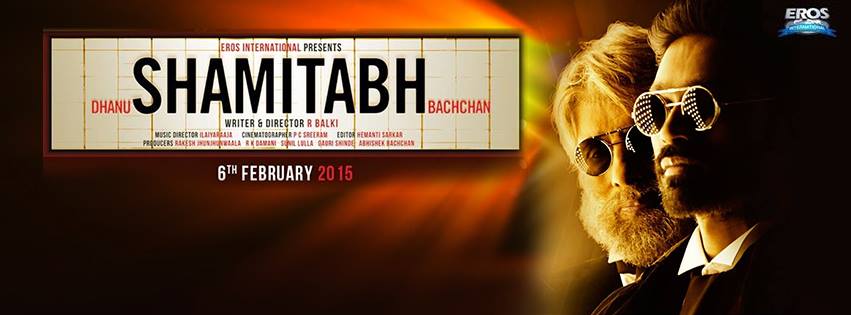
Shamitabh is the third film featuring Amitabh Bachchan from writer/director R. Balki and it’s definitely my pick of the three. I may however be somewhat biased, given that this film also stars my favourite Tamil actor Dhanush, who never fails to impress with his performance and delivers yet again in Shamitabh. I’ve found that while Balki’s previous two films Cheeni Kum and Paa have clever and overall engaging ideas, the execution doesn’t always live up to expectations. And to a lesser extent it’s the same with Shamitabh, although here there is more hit than miss and the film succeeds in humorously poking fun at a number of different aspects of the film industry. There are a few too many contrivances to make the plot really gel and the dodgy medical science is a drawback, but the central theme of two warring egos against the backdrop of the superficial and glamorous world of Bollywood is compelling enough to ensure an entertaining watch.

The film opens with a success event for début actor Shamitabh (Dhanush), and the impact on the room of invited guests is much the same as for the film audience when Dhanush opens his mouth and the voice of Amitabh Bachchan rolls out. The contrast could not be greater and it’s this combination of actor and voice that has made Shamitabh such a success in his first film. But before the phenomenon that is Shamitabh there was Daanish, a mute boy so obsessed with films that he dreamt of running away to Mumbai to be a hero. I don’t know who the young actor is who plays the young Daanish but he is absolutely brilliant, particularly when his exasperated teacher makes him act in front of the class. The anguish in his portrayal of despair at the supposed death of his mother is incredible and from that point it does seem possible that perhaps Daanish could be a hero despite his lack of a voice. However once he grows up and does make it to Mumbai, it’s evident that no matter how good an actor Daanish is, he will never be able to make it into the film industry without a voice.

Enter a young and ambitious AD Akshara (Akshara Haasan) who is impressed by the aspiring actor and decides to try and help him gain his dream. There is a wonderful irony in the rejection of an actor because he cannot speak in an industry that relies heavily on dubbing, which is of course the whole point. In one of those plot contrivances, Akshara’s father is a doctor whose laryngologist friend just happens to have heard about revolutionary new surgery in Finland. Somehow Akshara convinces her father to send Daanish for the surgery, which involves implanting a device in his throat which can store and then play back someone else’s speaking voice. As Bollywood medicine goes it isn’t the most ridiculous I’ve seen, but it’s certainly close and it’s probably best not to dwell on the lack of logic or the major holes with the technology and just go with it for the sake of the plot.

Naturally then, given the choice of absolutely anyone who could become his ‘voice’, Daanish decides to go with an older alcoholic who doesn’t look as if he will make it to the interval before succumbing to liver failure, let alone the entire career span of a young and upcoming actor. Amitabh Sinha (Amitabh Bachchan) came to Mumbai years before with a similar dream of being a hero, but was rejected because of his deep and powerful voice, ending up in the gutter where Daanish and Akshara find him. Despite his shabby and homeless appearance Amitabh lives in a graveyard, symbolism definitely intended, and doesn’t take too much persuading to sign up as the voice of Daanish. The idea is that he will in some way get his own back on the industry that denied him a chance at success, although he settles for a small proportion of Daanish’s earnings and the position of valet to hide his real occupation.

The composite of Daanish and Amitabh as ‘Shamitabh’ (a necessary change to deal with numerology issues) is instantly successful and Balki throws in plenty more digs at Bollywood clichés including product placement (the film is called Lifebuoy) and the inevitable romantic song. These, along with camero appearances by the likes of Rekha and Karan Johar keep the audience smiling despite the underlying tension and hostility between the ‘actor’ and his ‘voice’.

The relationship between Daanish and Amitabh is not a happy one, as Daanish struggles to deal with his unpredictable partner and Amitabh becomes ever more resentful of the fame and recognition heaped on Daanish. Daanish for his part is determined to prove that his charisma and acting skill is enough and the voice irrelevant, while Amitabh strives to prove that without his voice Daanish would be nothing. Akshara is forced to be the mediator in the middle, a role she neither wants nor fully accepts which leads to further tension and discord.

Amitabh has a tendency to ham it up as the gruff and grumpy alcoholic, particularly when he is the main focus of a scene, but he is excellent in his interactions with Dhanush and their mutual enmity boils off the screen when they face off against each other. Dhanush is as amazing as ever in a role where he never speaks but still conveys frustration at his predicament or excitement with his success with consummate ease.  The two actors work well together and their relationship is perfectly nuanced as they battle it out despite the occasionally forced and laboured storyline.

Akshara Haasan is also good and holds her own beside two such good performances from Dhanush and Amitabh. She has her own obsession and I like the way her character holds true to this dream, refusing to be merely the bridge to success for Shamitabh or even worse just a passing love interest. Her character is more interesting than that and Akshara is impressively successful in bringing her ambitious assistant director to life.

Although the relationship between the two men is well captured some of the story veers into ridiculous a little too often. I don’t understand the Bollywood obsession with toilet humour, and here Balki adds so much bathroom based comedy that I can’t be sure if he’s being satirical or whether he does actually think this is funny. Some of it works, but like Amitabh’s continual references to whiskey and water as similes for himself and Daanish, it does wear thin after a while.

Although the first half is excellent, the film falters towards the end, with the climax in particular being drawn out and almost clumsy in execution. By the end, neither Amitabh nor Daanish are particularly likeable as the success of their composite Shamitabh brings out their worst qualities, so it’s difficult to feel any sympathy for their plight, although the relationship itself is fascinating as it self destructs. However the rest of the film more than makes up for the clunky end, and the excellent performances from the three main leads ensure that the good idea of the story isn’t lost somewhere behind the dodgy medicine. Worth watching for a satirical look at the Bollywood film industry and an unusual relationship that is cleverly drawn and intelligently developed despite the manipulations required to start it in the first place. 3 ½ stars.