Kapoor & Sons

kapoor-sons-poster

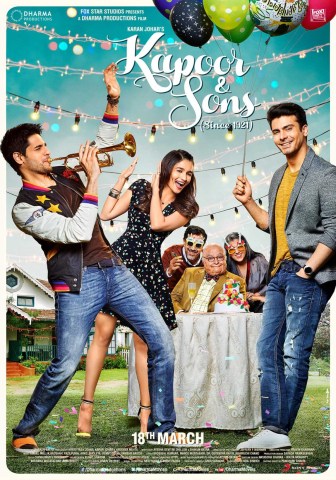
Kapoor & Sons is a refreshingly ‘un-Bollywood’ look at family and family relationships from director Shakun Batra. In conjunction with co-writer Ayesha Devitre Dhillon, Batra has produced a film that delves past the superficial public face of the Kapoor family to reveal the insecurities and arguments that lie beneath. It seems that there is something for everyone to relate to in this story – whether it’s the marriage between Harsh and Sunita that is falling apart, or the sibling rivalry between brothers Rahul and Arjun, most of the film relates to family episodes that are easily recognisable and understandable. While not everything in the story works, the relationships and characterisations do, making Kapoor and Sons a film that stays with you after the end credits have rolled.

I do love Rishi Kapoor and one of the drawcards of this film for me was watching him play the ageing patriarch of the Kapoor family. The prosthetics used to age him appropriately are fairly obvious and his character’s fixation on pornography quickly wears thin, but as the story progresses and Amarjeet Kapoor insists that all he wants as he approaches his ninetieth birthday is a happy family photograph, the character gains depth and intensity. The film starts with Amarjeet ‘practicing’ his death, obviously a common occurrence since his son Harsh (Rajat Kapoor) and daughter-in-law Sunita (Ratna Pathak Shah) pay no attention to his histrionics. The couple have their own problems and ignoring Amarjeet, or Daddu as the family call him, just seems to be part of their usual day. Harsh and Sunita have grown apart over the years of their marriage and there is a definite chill as they barely manage to speak civilly to each other. Sunita suspects that Harsh is having an affair with a previous work colleague Anu (Anuradha Chandan) and the two bicker and argue constantly. It’s a well written portrayal of a marriage gone sour where even the smallest comment can start a major argument and there no longer seems to be any common ground between husband and wife.

Their two grown up sons live overseas. Based in London, Rahul (Fawad Khan) has one successful book behind him but is falling behind his publisher’s deadline for the second. Arjun (Siddharth Malhotra) on the other hand is an aspiring writer, but is working as a bar-tender in New Jersey as he tries to find a publisher for his work. Both return to the family home in Coonoor when Amarjeet is hospitalised with a heart attack and the film follows the various relationships within the family as they are reunited under the one roof once more.

For me the most successful character is Sunita whose bitterness at her life flavours every word she says in the first few scenes. Her relationship with Harsh is perfectly portrayed and the hurt and resentment come through in each conversation. She has issues with her two sons too.  Arjun accuses her of always favouring her eldest son and although she denies it vociferously it’s obvious that she does have a definite preference for Rahul.  When she finally discovers the secret Rahul has been keeping from her she is devastated and Ratna Pathak Shah is superb in portraying her feelings of betrayal and loss mixed in with remorse and just a little guilt for some of the things she has said and done. She’s not just defined by the relationships with her husband and sons either, as her dreams of starting her own catering business allow her character to be more than just reactive. Rajat Kapoor too is excellent as the distant husband who wants to save his marriage but can’t seem to take the first step to making the necessary changes in his relationship. Although at times the bickering does seem to go on too long, to the point where I became uncomfortable watching Sunita and Harsh argue, it is true to life with every irrational and tit-for-tat response feeling genuine and realistic. There are moments of tenderness too and despite all the hostility there is a pervading hope that perhaps the two will manage to resolve their differences. The writing emphasizes the emotions of each character clearly and ensures the dialogue feels realistic and genuine.

The two sons have their problems with each other as well as with their parents. Arjun has always felt that he is the outcast in the family, particularly in comparison with Rahul, who always seems to be the perfect son. Returning home to find that his room has been taken over by his mother while Rahul’s has been left untouched immediately reinforces his feelings of alienation, further fuelled by his belief that Rahul stole the story of his first novel. Although Rahul can see the issues bedeviling the family and does his best to smooth things over, he has his own problems to work through.

During his visit home, Rahul wants to work on his latest book and also find a suitable place for an artists’ retreat. His search brings him into contact with Tia (Alia Bhatt) who is attracted to Rahul, but Arjun has already met Tia at a party and decided to make her the object of his attentions. This sets the two brothers up as potential rivals – an added friction that escalates the conflict between them. What makes it more believable though is that even with the issues between the two brothers, they still have typical sibling conversations. It’s not all arguments and fighting and the two share a good rapport that seems very natural. It’s typical family behaviour that adds to the authentic feel of the film and makes the characters more relatable. Both Fawad Khan and Siddharth Malhotra are at their best when dealing with each other, although otherwise Fawad Khan comes out the better of the two in terms of performance.

While Alia Bhatt is fine as Tia, her manic pixie-girl act is occasionally too OTT when added in to all the general angst of the Kapoor family. However, I like that Batra gives her character more depth using her friendship with Bunkoo (Aakriti Dobhal) and her dealings with cook/general handyman Kishore (Pradeep Pradhan) to bring out different aspects of her character. The romance between Arjun and Tia is also fairly standard stuff but does provide some welcome relief from all the squabbling between family members. Sukant Goel as Wasim and Fahim Shaikh as his brother Boobly also ensure there is some lightness amid all the doom and gloom as the rest of the ‘comedy’ is rather more hit and miss. Tia’s ‘jokes’ are not funny at all (although that I presume is the whole point!) while Daddu’s antics at the hospital appear too forced and falling just on the wrong side of offensive to raise anything more than the occasional smile.

Another plus for the film is the soundtrack which maybe works so well due to the number of different composers and lyricists involved. The background score by Sameer Uddin is lovely and the various songs include music from Amaal Mallik, Badshah, Arko and Tanishk Bagchi that give a good mix of different styles that each suit the flavour of the film. My favourite is Kar Gaya Chul above, but each is well placed in the narrative and complements the action. The scenery and beautiful house also give an authentic home-like atmosphere that adds to the overall realism of the film.

Although the film pacing is occasionally uneven and at times the arguments threaten to veer a little too close to farce, for the most part this is a realistic look at middle class family life. The arguments, petty disagreements and relationship flaws within the family are all explored, firstly among the family and then further secrets revealed when private disagreements are suddenly open to public view. The writing is excellent, the characters beautifully  developed and the story flows well from one excruciating argument to the next, with all the angst and self-recrimination that goes along with family fights. I thoroughly enjoyed Kapoor and Sons and recommend it for the wonderful performances, realistic dialogue, plausible situations and overall thoughtfulness that make this one of the better films from last year. 4 ½ stars.

Befikre (2016)

befikre

Easily the best thing about Aditya Chopra’s Befikre is Paris, and thankfully the characters spend plenty of time wandering past significant landmarks and meandering through lane ways full of beautiful buildings giving the city ample opportunity to shine. It’s not that the rest of the film is that bad – it’s just not that good. At its best, Befikre is funny and both Ranveer and Vaani are full of life and energy, but the plot is nonsensical, the dares that are used to further the love story ridiculous and there are so many WTF moments that the farcical ending is no surprise. And to cap it all off, it’s such a shame that a film set in the ‘city of love’ contains so little actual romance.

The opening sequence shows numerous couples kissing over the credits but what starts as possibly sweet and romantic moves to voyeuristic and just a little bit creepy as it goes on for that little too long. Any thought of love is also quickly dashed when we first meet Dharam (Ranveer Singh) and Shyra (Vaani Kapoor) as they’re in the process of breaking up. Neither one appears as an attractive character during the ensuing slanging match, while Dharam in particular seems to be typical of the chauvinistic man-child so often portrayed in Hindi cinema. Despite all the drama, the break-up is actually quite funny, at least until Dharam does the unforgivable and calls Shyra a slut (more of that later) before she finally leaves.

The film quickly moves back a year to when Dharam and Shyra first meet and their ’love’ story starts.  Dharam is a stand-up comedian who has moved to Paris to appear at a club run by his friend Mehra (Aru Krishansh Verma). Sadly Dharam isn’t funny at all as a comedian but he is quite amusing when he’s hanging out with Shyra. Initially Shyra doesn’t want a bar of him and is quite happy with a one-night stand, but a silly game of dare results in the two heading out together on a date and the relationship develops from there.  Both Shyra and Dharam resolve never to say “I love you’ and to keep things light and carefree with no commitment, but despite this agreement, Shyra ends up moving in with Dharam. The relationship moves forward through a series of ever more ridiculous dares, all of which would have resulted in arrest and possible jail time if, for example, anyone really did hit a policeman or perform a striptease in a library. Of course Dharam and Shyra are never seen to have to deal with any repercussions from their actions, some of which are a little too risqué to be easy viewing and despite all their antics there is never any sense that the two are anything other than friends-with-benefits. It’s Paris for goodness sake – where’s the wining and dining, the romantic walks through parks and along the Seine? Sadly for Dharam and Shyra it’s all night clubs and bedrooms with little else between – no wonder their relationship eventually breaks down so spectacularly.

The film moves back to the present day where Dharam and Shyra meet up again by chance and renew their friendship. And this time they are strictly friends as Dharam is happily working his way through a number of French women and Shyra is content with her single life. But then she meets Anay (Armaan Ralhan) and everything changes. Shyra embarks on a mature and adult relationship which seems to be happily heading towards commitment, but even here there are cracks in the screenplay. Who leaves their possible fiancé at the top of the Eiffel tower and runs off to ask their friend for advice? Would anyone seriously still be waiting for an answer after that? And while the easy camaraderie and friendship between Dharam and Shyra suits them much better than any romance, how can two people who parted on such bad terms ever develop the easy relationship shown here? At least Dharma apologises for his slut comment, accepting that it was inexcusable and less about Shyra and her previous lovers and more about him and his immaturity. Finally a small step (OK, maybe less of a step and more of a toe-dip) in the right direction, and rightly applauded by the audience too.

What keeps the film going are the performances from Ranveer Singh and Vaani Kapoor. No matter that there is zero sparkage between the two of them, they are both so energetic that it’s just possible to overlook the idiotic dares and juvenile behaviour and enjoy the craziness of two OTT people rampaging their way through Paris. This works better when they are friends rather than lovers, but for the most part their scenes together are funny and full of joie de vivre once they move past the bedroom antics. I love Ranveer Singh when he hams it up and exaggerates every possible expression and gesture as he does here. Similar to his roles in Kill Dil and Gunday, here he’s loud, brash and looks to be totally enjoying every minute as his enthusiasm colours every frame. He has great comic timing throughout and his one-liners had the entire cinema in stitches, while once again he sparkles through the songs.

Not to be outdone, Vaani Kapoor is equally buoyant during the flashback sequences while the evolution of her character allows her to be more reserved and restrained in the second half of the film. Vaani expresses a range of emotions well and her wavering and indecision about commitment is very well done in the latter half of the film. She also fits well into the European-Indian styling she is given and at least in the second half of the film does deliver some French-style sophistication during her romance with Anay.

Despite the ridiculous storyline I did enjoy most of Befikre – although nothing could make me enjoy the ending, not even Ranveer. It was a real pleasure to see Paris as the backdrop for the film even if more could have been made of its reputation as a city for lovers. While both Dharam and Shyra are irritating during the flashback sequences, for the most part their friendship is more accessible and I did find a lot of the humour very funny. Most of the audience were laughing too and the general atmosphere was pretty upbeat in the cinema. The songs from Vishal-Shekhar are great and suit the overall mood of the film and of course the whole film looks stylish, but Befikre really needed a much better story-line and more depth to the characters. The end result is a romantic comedy that basically has no romance despite the best efforts of Ranveer and Vaani. Worth watching for the beautiful views of Paris and the exuberant Ranveer Singh who really can make anything engaging!

Khoon Pasina (1977)

khoon-pasina-poster

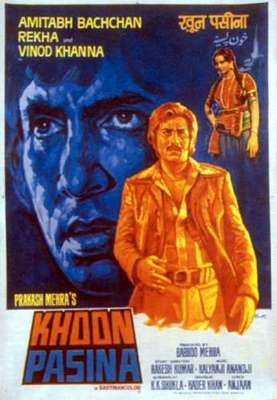
Sometimes when the world has gone mad, you just need the reassuring presence of The Big B dishing out dishoom and justice.

Shiva and Aslam grow up besties in one of those happily diverse communities. Their dads are also friends, teasing each other about being rubbish at being a Muslim or a Hindu because they can’t even remember their own religious celebrations. Both dads make a powerful enemy when they stop a flamboyantly bewigged and fringed Kader Khan killing a bloke. He decides to foment communal strife in order to kill them without the police suspecting him, and somehow this is linked via a montage to Partition. The family is torn apart by a house fire that kills Ram and Rahim, leaves Aslam lost, and places young Shiva with Aslam’s ma (Nirupa Roy) as his only family.

The kids are indifferent actors, probably chosen for their evolutionary potential to end up looking like neighbourhood thug Shiva, aka Tiger (Amitabh Bachchan), and principled dacoit Shera (Vinod Khanna). Tiger hasn’t forgotten his past despite being raised by Nirupa Roy while Shera is trying to find death, but even death is worried by his body count.

Amitabh gets the best and worst of the film. Shiva/Tiger is an impulsive thug who is motivated by the right reasons but doesn’t stop to think about collateral damage or even just stop to think, a dictator in his own manner. He also gets stuck with a wardrobe that I wish I could say was part of the comedy track. It annoys me so much that he is called Tiger yet wears leopard print. Really! But Amitabh has such charm that the glib one-liners work a treat and he can switch effortlessly to show Shiva’s darker side. And some of the comedy track is funny despite itself. I particularly enjoyed the wedding party being entertained and fed by the crooks who had come to steal the bride. I suppose in a different film, Tiger could always have picked up work as an event planner.

Tiger sees the curvaceous and feisty Chanda (Rekha) at the market and is smitten. She challenges him to back up his bragging by wrestling a tiger for her. So he does. But Chanda has been engaged to gangster Raghu (Ranjeet) since childhood, and he is not inclined to give up his claim. Raghu tries to get Shera to kill Tiger but Shera says it would be better if Raghu died. Raghu has other ideas and starts messing with Zaleem Singh who is still alive and scheming.

Shera still mourns his lost family, and believes himself alone in the world. Like Shiva, he has a strong commitment to justice as he sees it, and like Shiva he doesn’t pay attention to the law. Vinod Khanna was saddled with some dodgy hair and a lot of pleather, but Shera is certainly the cooler of the grown up boys. Probably because he doesn’t have his mummy choosing his outfits. But he is also afflicted with the faux leopard trim. Vinod delivers his cheesy lines with a detached and weary cynicism threaded with sentimentality about families and honour. It’s the kind of role that I usually expect to see Danny Denzongpa in and I think he might have added a little more spark to the pathos. The long lost friends spend almost all the film apart and their few scenes together are good. I wish they had interacted a bit more to ramp up the tension a bit.

Chanda faces Raghu down with the full support of her father who says she cannot be married off against her will. Hurrah for that dad! Naturally Raghu decides to eliminate Tiger, but being a weasel he takes many indirect routes rather than simple confrontation. Rekha’s body language is quite masculine and often aggressive in Chanda’s pre-marriage scenes. She owns her space and doesn’t let unwanted contact go past without payback. She falls for Tiger but then he plays hard to get. They have a push and pull in their dynamic that is amusing but not emotionally healthy. And when it comes to Tiger choosing between his wife or his ma, you’d better believe he is a mummy’s boy who will slap his wife into the middle of next week if she disagrees with Ma. Rekha and Amitabh have that chemistry of course, but I enjoyed Chanda’s scenes where she was going about her daily routine alone and her interactions with other people in the village. Rekha can be funny as well as dramatic, and despite a few airhead moments Chanda is quick-witted and interesting.

Shanno or Shantidevi (Aruna Irani) is another defiant woman. She loves her husband Mohan (a very restrained Asrani) who is a gentle, law abiding man and they talk about their conflicting beliefs and all seems really respectful and solid. Except when Mohan is threatening Shanno to prevent her from telling her brothers or when Shanno is telling Mohan to pop on some bangles and let her be the man of the family. Shanno also happens to be Zaleem Singh’s daughter and bears her Monobrow of Fury with elan. Her immediate reaction to any insult is to grab a gun and try and kill the offender, saying her brothers will clean up the legal issues. When Raghu burns down their farm and pretends he is Tiger, it sets up yet another conflict. After a tense family visit, and a huge random edit, Mohan decides to go kill Tiger so Shanti also runs off after him with a gun.

Shiva relocates to the jungle and ends up working on a plantation owned by Zaleem Singh. He gets a nice Kalyanji-Anandji number that looks like a rehearsal for Mr Natwarlal, and Helen makes an appearance to dance for the landlords. He builds new relationships and becomes the voice of workers’ rights and social justice. There’s even an “I’m Spartacus” scene. Chanda is gradually sidelined but she remains a strong force in the film and in Shiva’s life. Nirupa continues to give him pointless and conflicting instructions. The lack of emotional blackmail opportunities drives her to almost commit a crime so she can stop herself and “Nahiiiiin!” about it.

There are so many bad guys! Ranjeet gets his shirt off for no reason, Kader Khan is slimy and arrogant as Zaleem Singh, Mac Mohan is natty in pleather as Singh’s flunkey, Vinod Khanna is a cut above this material, and there are so many beefy shirtless dudes running around beating people up that I suspect that was the main industry for the village. There are also abundant good guys, many of whom speak with sense, logic, and empathy. It’s quite pleasing to have some good life advice doled out to the hero.

And all the while Shera is on Tiger’s trail, paid to hand Tiger over to Zaleem Singh but not really believing that he is a miscreant.

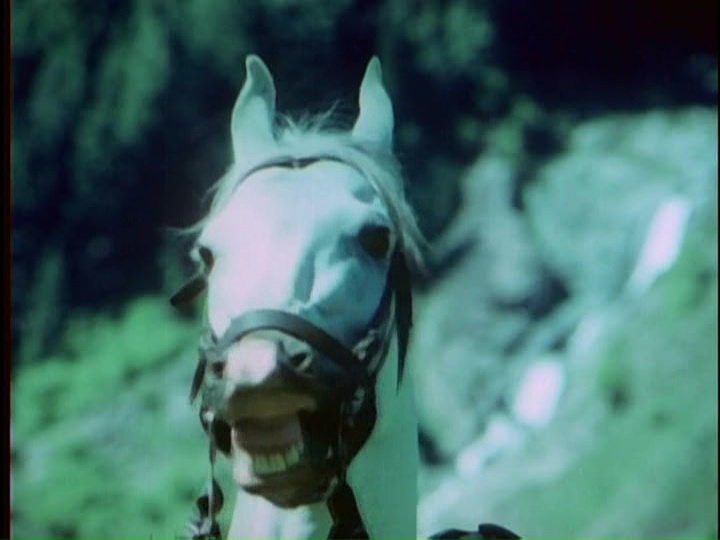
What happens next? Please, you already know. And yet there is always that bit extra that makes you go “Huh?” The action scenes are woeful as I don’t think Rakesh Kumar had the faintest idea of how to shoot or stage a fight so there is minimal choreography of the stunts and lots of bizarre angles and edits to skip over the lack of detail. There is a very long and quite unnecessary horse chase, although it did prove Moti knew what was what. It’s the kind of film where wallowing in quicksand is not enough, you have to simultaneously wrestle a snake. It’s the kind of film where if you want to kill someone you have to first build an enormous wooden edifice and tie them to a stake at the top. It’s the kind of film where Moti the horse should have been making key decisions.

Despite being quite slapdash, the story contains some interesting little bits and pieces. See it for Amitabh and Vinod emoting fiercely with Rekha and Aruna Irani being fierce. 3 ½ stars!

khoon-pasina-moti