Mirchi

Mirchi-Movie-PosterMirchi is a mass action romance revenge saga, offering few surprises in the story but with great casting and some solid performances. Writer/director Koratala Siva gets bogged down in a long flashback and loses the momentum a bit towards the second half, but generally moves along at a reasonable clip from fight to song to romance to fight and back again. Like many mass films, it starts light and fluffy but then the body count starts to rise so you do need to be a bit gore tolerant to fully enjoy Mirchi.

Jai (Prabhas) is an architect in Milan. He meets Manasa (Richa Gangopadhyay) and saves her from some thugs. They become friendly and he learns of her family – dominated by a violent assortment of men living in a big old house – and Jai decides to fix her life. Of course, Jai has an ulterior motive for wanting to reform her family, and that is revealed through a very long and detailed flashback. Jai is the son of Manasa’s family’s enemy, Deva (Sathyaraj). How can Jai reform her family, reclaim his place with his own estranged family, eliminate any enemies who refuse to comply and oh yes – what will happen to Manasa when he is reunited with his first love, Vennela (Anushka Shetty)?
mirchi_movie_prabhas dancersprabhas-mirchi

Prabhas is made for this kind of role. Jai is a nice guy, although of course he can kill evil doers with a single blow. Prabhas has such a likeable screen persona and the action scenes are well within his capability. He has nice chemistry with both leading ladies although as the story unfurls there is little ambiguity about who he would choose.  There is not a lot of complexity or nuance, but the role contains enough variety to give Prabhas a bit to work with. Jai does have to find a way that doesn’t totally rely on revenge and violence so there is a clear before and after in his character. One of the highlights is the slightly more prominent roles given to some supporting actors, and those scenes give Prabhas more scope for lighter moments. Jai’s relationship with his father is played out nicely too, showing the slightly more sympathetic side of the feud.

Favourite That Guy Subbaraju is Manasa’s brother. He is first seen pursuing some unfortunate bloke through college and delivering a serious beating. But Jai can see that apparently all he needed to give up his bullying ways was … discovering girls. Yes, Subbaraju got in touch with his sensitive side after dancing to Moves Like Jagger with the girl who fancied him. Who knew Maroon 5 was good for anything? But if that’s what it takes to get a good looking bloke to eschew dismemberment and take up flirting, well then I suppose that is not a bad thing. This dance outbreak also had the effect of making him dress better, pay his rent on time and generally improve his manners.  From then on he spends the rest of the film on the phone to the girl, very coy and giggly as he mouths what I can only assume are dialogues along the line of ‘no you hang up…no you…no you hang up first’ and the like. Silly but amusing, and nice to see him in a slightly different role.

Mirchi-Jai and Manasa

Richa has a one note character so there isn’t much she can do with Manasa, although she and Prabhas have nice rapport and that helps make the growing friendship between the characters more credible. Once the terribly long flashback starts, she is sidelined and pretty much disappears until the last couple of minutes. Anushka gets more investment from the screenplay as the feisty village belle Vennela. She sets her cap at Jai and he happily succumbs, colourful dance numbers and all. Until disaster strikes on their wedding day.

Sampath Raj has a prominent role as Manasa’s uncle, a nasty piece of work who bullies the entire household and believes he can heal his paralysed father by despatching selected enemies in front of him. Another That Guy, Adithya, plays Jai’s uncle, an old school type who believes in sorting out issues with a machete. Adithya doesn’t get the same opportunity to show off his acting range but he does get ample chance to flash a bit of leg. Supreet and Ajay make an appearance in the second half as muscle for Manasa’s family and the violence escalates towards a fairly brutal ending.

Sathyaraj and Nadhiya are good as Jai’s estranged parents and there are lots of other familiar faces. Brahmanandam does his usual thing and luckily has minimal screen time in the latter section of the film where comedy would have been misplaced. His scenes had the audience howling with laughter, but as this was another Adventure Without Subtitles that all went over my head. Satyam Rajesh, Raghu Babu and others do what they do in a film that relies on ‘types’ more than on characters.

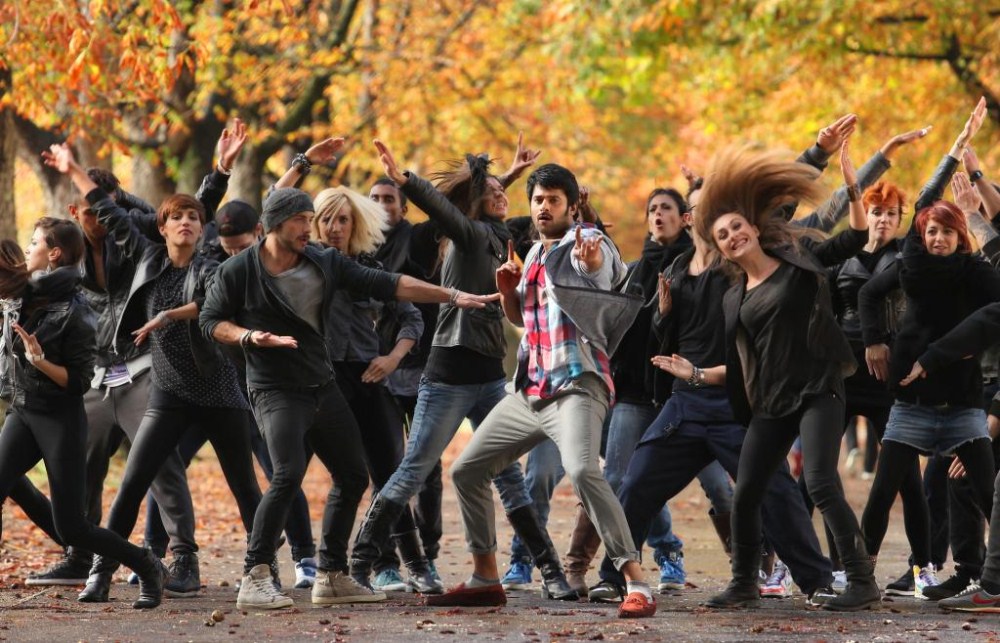
The soundtrack is fun and the picturisations are sometimes spectacular (Darlingey and Mirchi in particular). Devi Sri Prasad seems to know his audience, and the crowd response to the songs was great. The choreographers generally concentrate on the possibilities afforded by Prabhas’ lanky frame and enormous wingspan.

Despite what you may think based on that selection of images, Prabhas largely escaped the worst efforts of the blind costume designer, apart from one inexplicable t-shirt with braces attached. And there is an unwavering commitment to ugly acid wash denim throughout. But I do have to ask – the Keytar? Really design team? What were you thinking.

Mirchi is a good formulaic timepass. It has a good cast delivering the minimal requirements of the script, along with well structured action and song sequences. If you’re a fan of Prabhas or the mass action genre, it’s well worth a watch.  Plus  if you like medical moments only possible in Indian films, then this is for you.

Julayi

Trivikram films tend to focus as much on the dialogue as on the action, so it was inevitable that I missed the comedy that had the rest of the audience laughing and cheering through most of Julayi. Not that it really mattered. There was still plenty of great dancing, excellent action scenes, ample screen time for my favourite actor Allu Arjun, and a relatively easy to follow (if somewhat unbelievable) plot giving another enjoyable ‘adventure without subtitles’.

Ravi (Allu Arjun) starts as many a Telugu hero seems to do, by having an argument with his father (Tanikella Bharani in his customary role). Taking a cue from Chiru’s ‘money is easy to make’ speech from Challenge on a TV in the background, the argument seems to be based around Ravi’s lack of commitment to the conventional way to earn a living and ends with Ravi heading out to a gambling club. Since it’s raining heavily he cadges a lift, which just happens to be with a gang on their way to rob a bank. Because stopping to give someone a lift on the way to commit a major crime doesn’t seem like a risky thing to do at all – right?

Luckily for Ravi they seem happy to drop him off on a corner but that is their first big mistake. Ravi has awesome intuition, amazing powers of observation and a seemingly photographic memory and is able to lead the police to the site of the bank theft in time to partially foil the robbers’ escape. Head gangster Bittu (Sonu Sood) has already decimated his own gang, presumably to ensure a larger slice of the money, and Ravi helps lower the number still further by taking out one of Bittu’s trusted gang members (Shafi in a very brief appearance). This seems to spell war between the two, although the apparent destruction of the money and ensuring that Bittu is arrested and his plan foiled are also key contenders for the ensuing rivalry between Bittu and Ravi.

The bank heist is an odd mixture of some excellent ideas, such as the smooth way the robbers disable the cameras as they move through the building, and some gaping plot holes which just don’t make sense. This lack of logic reoccurs throughout the film where there is never any explanation for Ravi’s astounding ability to apparently read Bittu’s mind and predict how, where and when he will strike next. The police are also very ready to fall in with Ravi’s plans and have no objections any time he kills one of the gang. I was almost expecting that Ravi would be revealed as some sort of super-agent which might have explained the nonchalance towards his ever increasing body count and the willingness of everyone to follow his lead. But no, nothing quite so logical is allowed to intrude into the plot, or at least not that I could understand.

Sonu Sood is his usual impressive self as the villain Bittu, although he has a tendency to start cold and menacing but then over-do it just a tad and become almost comic. He too has amazing powers since he is able to interpret the sign language of his deaf henchwoman without even looking at what she is signing. It’s a talent she seems to share since she rarely looks at his replies either but at least she has better survival skills than the rest of the gang. To add some further complications, Bittu is collaborating with local MLA Kota Srinivasa Rao, who’s done some dodgy deal to cheat his investors and seems to be in it for the money. It’s the same crooked statesman role that Kota plays so well that now I don’t ever expect to see him without there being some dodgy deal involved.

The action moves to Hyderabad when Ravi is sent to ACP Sitaram (Rajendra Prasad) as part of a witness protection scheme. Ravi falls in love with a girl he sees at the bus-stop which results in a succession of songs, in fact almost the entire soundtrack one after the other, as Ravi attempts to win Madhu’s heart. Ileana started off well as Madhu and I liked her glasses and general look, but after Ravi takes her shopping and persuades her into contact lenses and Western clothes she just looks too thin and out of proportion. Although none of her outfits are terrible, the majority aren’t very flattering either and the curse of the Telugu film shoe designer strikes once again with a terrible pair of black boots.

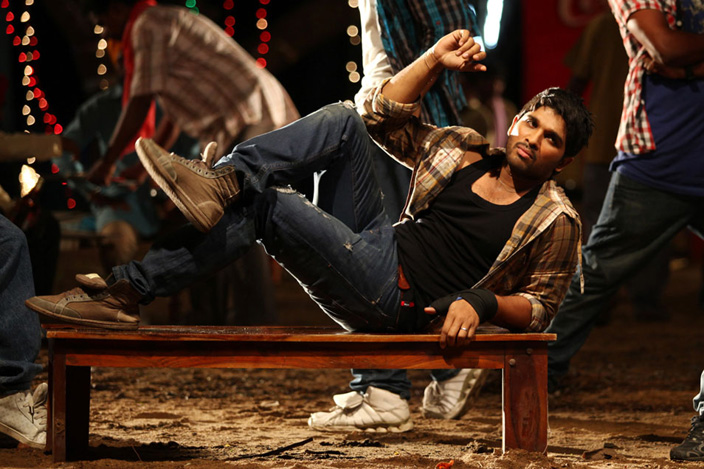
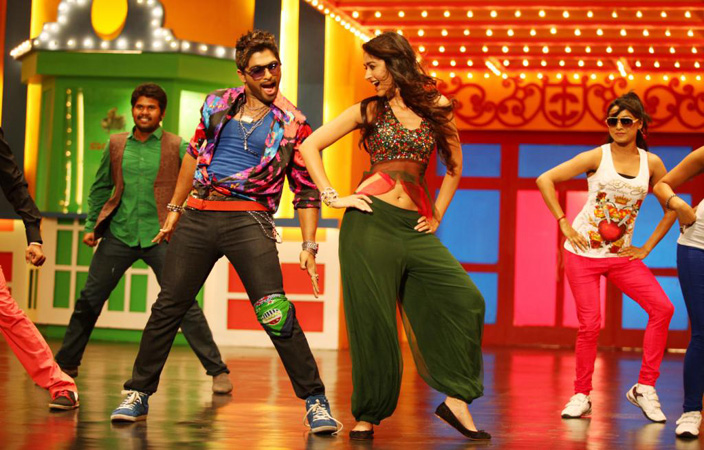
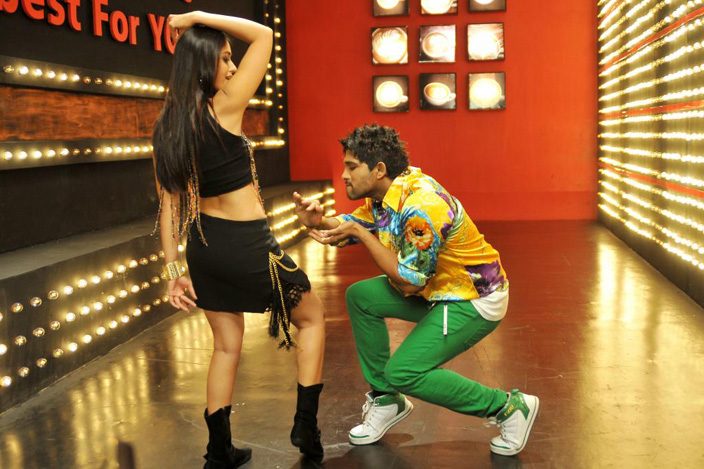
Bunny and Ileana have very little chemistry together and although there are some better moments in the songs, the romance never really takes off. The songs by Devi Sri Prasad are mainly pictured on Bunny who is energetic and wonderful to watch in better than usual choreography. For a change there are no special ‘feature moves’ – no sign of ‘the worm’ – and Bunny is given free rein to do what he does so well and just dance.  He also shows commitment to shiny multicoloured shirts which I did appreciate.

Every single possible comedy uncle turns up but thankfully their comedy is well integrated into the main plot and kept to a minimum. Trivikram seems to use most of the humour in snappy dialogues between  Bunny and Rajendra Prasad which were well appreciated by the audience. There is plenty of ‘action’ Bunny but a lot more ‘funny’ Bunny and both Allu Arjun and Rajendra Prasad work well together in these scenes. In fact the only major fail is Bunny’s hair which varies from OK in the frequent rain scenes (because it is flat and plastered to his head!) to really quite terrible with spikes at the back and flattened matting at the front. There is no hair continuity either and it becomes quite a distraction in a number of scenes as the number and position of the spikes varies – or perhaps I’m just becoming a little too obsessed. There is also the matter of his coloured contact lenses, but I’ll leave that rant for another time!

The film does look great, with some good use of locations in Dubai and reasonable special effects. The sets are also well dressed although Temple and I did have a discussion about the large assortment of really ugly ornaments that appeared on every desk. But there was commitment to family photographs and I did like the large picture of Michael Jackson in Ravi’s room. I liked the soundtrack before I saw the film and although it doesn’t sound too different from previous DSP soundtracks the music fits in with the general feel of the film. The songs could have been better paced though as there did seem to be a lot in the first half – not that I’m really complaining as watching Bunny dance is always worthwhile.

Julayi has plenty of action and strong performances from most of the cast which helps keep attention away from all the plot holes. Its slick and well filmed to make the most of Peter Hein’s excellently choreographed fight scenes. Definitely worth catching on the big screen if you can although I think this is a film that I will appreciate more with subtitles. Hopefully this doesn’t disappear into the same DVD black hole as Khaaleja and we do see a DVD release soon.

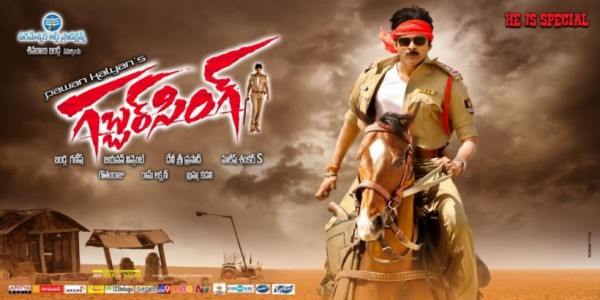
Gabbar Singh (2012)

Pawan Kalyan fans in Melbourne seem to be the loudest, the most enthusiastic and to prefer shredding rather than recycling their newspapers. The air was full of strips of paper right from the opening moments of Gabbar Singh and the paper storm continued well into the second half. A packed cinema, cheerleaders up the front to lead us in our favourite Pawan Kalyan chants as everyone pushed and shoved their way in and plenty of whistles and cheers meant a great start to another adventure without subtitles.

It’s a novelty to watch a Southern remake of a Hindi film since so often the shoe is on the other foot and after Osthe in Tamil, Gabbar Singh is the Telugu version of Dabangg. The film follows the same basic plot, but many of the other roles have been limited to allow more focus on Pawan Kalyan’s character. It’s his film the whole way through and while he has the charisma and capability to carry it off, the story loses much of its focus by dropping the back stories of Gabbar Singh’s wastrel brother and the conflicts within their family.

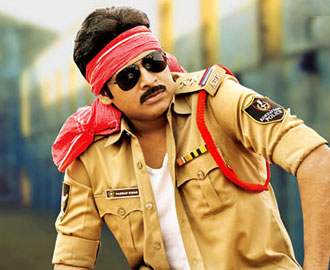
We start with young Venkat Ratnam Naidu and his stormy relationship with his adopted father Naidu (Nagineedu) who had married Venkat’s mother Suhasini after she was widowed. Naidu prefers his own son and makes no secret of the fact which gives Venkat a huge chip on his shoulder and a somewhat argumentative personality. Venkat ends up running away from his family, but returns years later as a police officer with the assumed name of his childhood hero, Sholay’s Gabbar Singh. He returns in style, renaming the police station after himself and single-handedly annihilating a gang of bank robbers after chasing after them on horseback so it seems safe to say that he’s not mellowed in the intervening years.

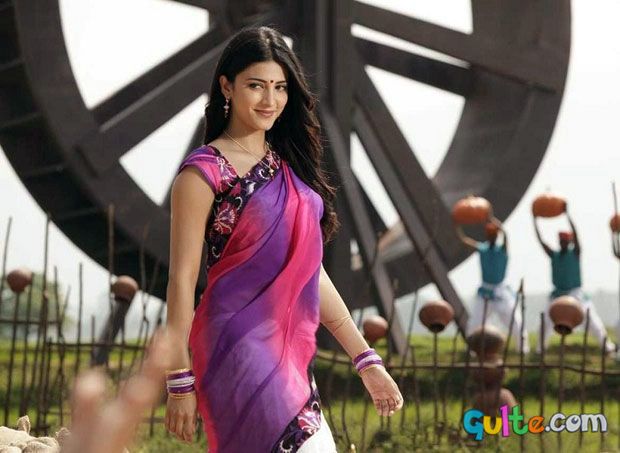
It’s not long before Gabbar Singh clashes heads with local rowdy Sidappa Naidu (Abimanyu Singh) and the feud between the two forms the plot for the rest of the film. In between all the gunfights and general mayhem, Gabbar Singh falls in love with Bhagya Lakshmi (Shruti Hassan) but her role is even more reduced than that of Rajo in Dabangg and Bhagya only appears briefly in a few scenes and a couple of dance numbers. Her friend, ably played by Gayatri, has almost as much screen time and judging by the audience reaction, seems to get the better lines too. Kota Srinivasa Rao pops up as Bhagya’s father but again the role has very little scope and he barely has any input.

Sidappa has political aspirations and Gabbar Singh disrupts his attempts to fund his career through various robberies and corrupt deals. Sidappa’s response is to have his henchmen beat him with clubs which is rather extreme but doesn’t really have too much of an effect on his arch nemesis. Abhimanyu Singh’s Sidappa is a typical Telugu goon and doesn’t have any of the flamboyance or appeal of Sonu Sood’s Chhedi Singh so the villain of the story is rather disappointing. As too is the item song. Although Malaika and the backing dancers did their best, Kevvu Keka just isn’t as catchy as Munni Badnam. I was also very disappointed that Ajay as Gabbar Singh’s brother only made a very brief appearance since he’s one of my favourite actors and I was hoping for more from him.

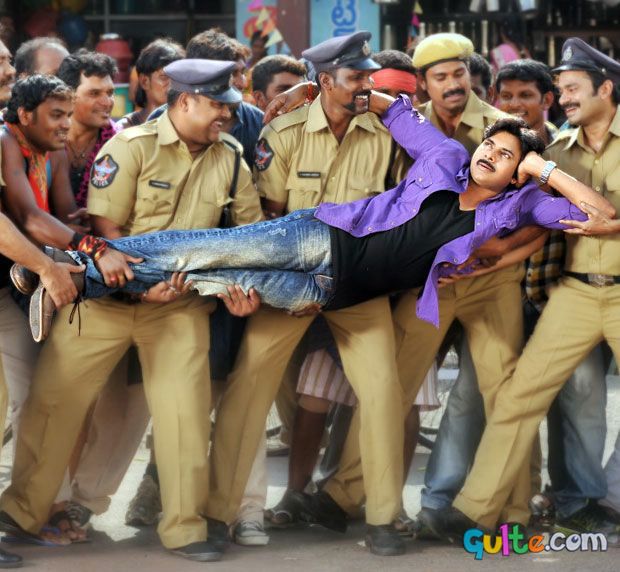
However the film was made totally worthwhile by a scene where Gabbar Singh forces the usual crowd of rent-a-goons to participate in a session of antakshari. This has to be the funniest piece of cinema I have seen this year and it had the crowd on their feet cheering for more! Generally the dialogue seemed to be of high quality since many of the lines had the audience applauding and both Ali and Brahmi’s comedic roles got plenty of appreciative cheers. Since I didn’t understand the dialogue I focused on the myriad of excellent details instead, such as the gun hood ornaments on Gabbar Singh’s 4WD and the incredibly happy and enthusiastic backing dancers. There is a reason why men in flak jackets are not often seen dancing and it’s a point well illustrated in the first song. Generally though the songs are good and Devi Sri Prasad’s music suits the feel of the film.

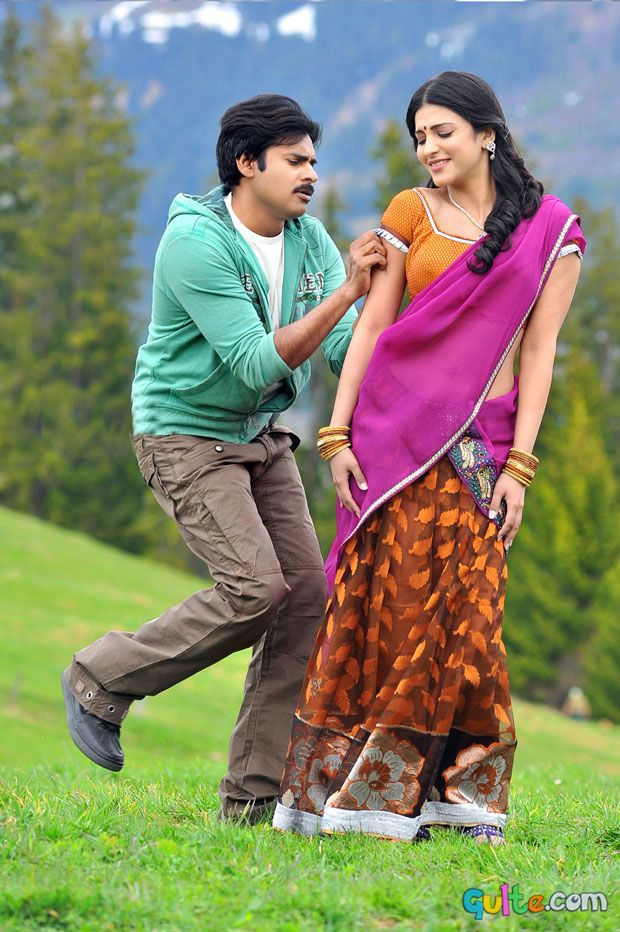
There is very little of Chubul Pandey in Pawan Kalyan’s Gabbar Singh. None of the mannerisms are there, although Gabbar Singh has plenty of the same chutzpah. The sunglass tricks are reserved for Brahmi apart from an opening scene where Gabbar Singh tosses his sunnies onto a colleagues face with impressive accuracy.  There are a few moments in one song in Switzerland where the normally smooth and co-ordinated Pawan Kalyan does seem to be channelling Salman Khan’s dance style, but thankfully not for long. I did feel sorry for Shruti Hassan dancing in the snow in sandals though.

The reason that Dabangg was such a hit was that it was a Southern style film incorporating plenty of the masala elements which have sadly been missing in Bollywood for some time with a hero who suited the part. Once that novelty element is removed and the film changed to a Southern locale and hero, the story is similar to most other Telugu films. The impact is further lessened by the South’s familiarity with the use of machetes, 4WD’s that roam in packs and acrobatic fight scenes and so Gabbar Singh doesn’t stand out in the same way as Dabangg, although it is more successful than Osthe. Harish Shankar has changed the screenplay to make the film suit his leading man and Pawan Kalyan is excellent as the unorthodox police officer in a rather more orthodox story. Gabbar Singh is still well worth a watch for his performance and I’ll definitely be looking out for the DVD to finally understand the dialogues and for that brilliant antakshari scene!