Narthanasala

This 1963 classic has an exceptional cast, featuring NTR, Savitri and SV Ranga Rao, under the lively direction of Kamalakara Kameshwara Rao. Narthanasala renders a chapter of the Mahabharata in an accessible and highly entertaining style. The story as shown concentrates on the Pandavas efforts to serve out the 13th year of their exile, and how they deal with their tribulations. I’m sure there are many versions of this tale and this screenplay no doubt varies from those in some ways. My knowledge of the Mahabharata is basic, but all the information you need to know to enjoy Narthanasala is contained within the film, so don’t let that be an obstacle.

Arjuna is honoured by Indra, but manages to tick off Urvashi (Padmini Priyadarshini) when he rejects her advances.  She curses him to become a eunuch. I cannot blame her for being mislead after watching him watching her in this dance:

And she looks furious!

The curse is mitigated somewhat by a time limitation granted in recognition of Arjuna’s essential manly goodness. This coincides with the 13th year of exile when the Pandavas must take refuge in a kingdom and remain anonymous for that final year. The set up of the characters and how they would conceal their identities was simply done in a conversation that pretty much spells out who’s who. There are spies and lures set to draw the Pandavas into the open, and the cat and mouse game with Duryodhana adds an edge of tension to the waiting game.

Dharmaraju (Mikkilineni Radhakrishna Murthy) is occupied as an advisor to King Viraat, and has little free time to spend with his brothers and wife.  The twins Nakula and Sahadeva work with the livestock and are absent most of the time. This leaves Draupadi (Savitri), Arjuna (NTR) and Bhima (Olympic wrestler Dandamudi Rajagopal) on centre stage.

Draupadi is beautiful and deceptively delicate looking. Her husbands make a big deal of her having to undertake manual labour, but she is more resilient than they are in some respects. Although usually deferential to her husbands, when she needs to stand up for herself she leaves no doubt as to the consequences of drawing her anger.  Calling herself Malini she goes to work as a ladies maid and beautician for Queen Sudheshna (Sandhya). She pleads with the queen that she be protected from tasks such as being sent off to entertain strange men and serve in other households, and Sudheshna agrees. Draupadi’s awareness of her vulnerability is clear, and despite her efforts she does attract unwanted attention.
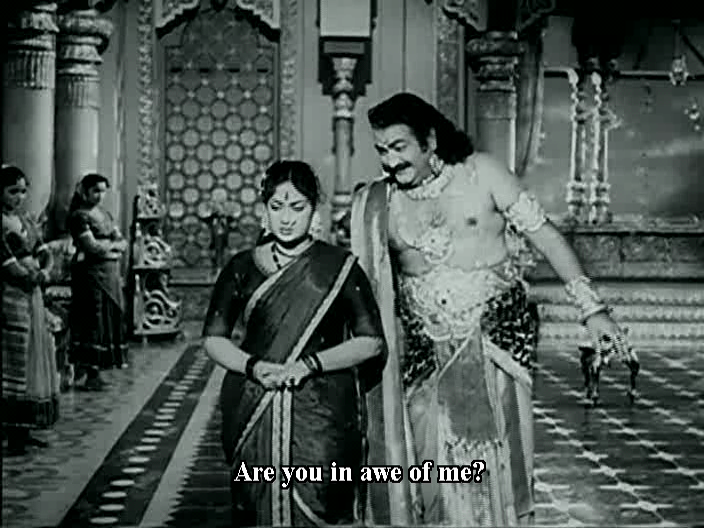
How she attempts to deflect and ultimately stop this harassment is the main focus of the drama, and she tries many approaches before demanding her husbands step in. Krishna intervenes when called upon, but the solution lies with the human characters. Draupadi’s affection for Arjuna gives their complex life a strong emotional core, and their scenes had an element of romance that her interactions with the other husbands didn’t. She has a rare laugh when talking to him about their son. Savitri is, as I have come to expect, excellent in a role that demands both high emotion and restraint.

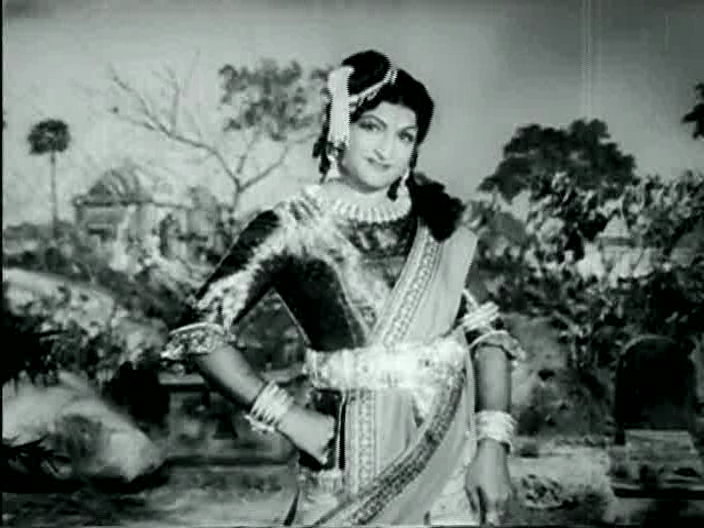
Arjuna is transformed into Bruhannala. He takes up the position as dance teacher to Uttara (L Vijayalakshmi) and embraces accessorising. He should have had those dance lessons as while Bruhannala’s expressions are flawless, his dance steps are not quite as graceful.

NTR looked knowing and effeminate as the eunuch, always slyly amused at fooling everyone around him. It falls to him to come up with the scheme to keep Draupadi from harm and to keep the Pandavas safe until the end of their exile.
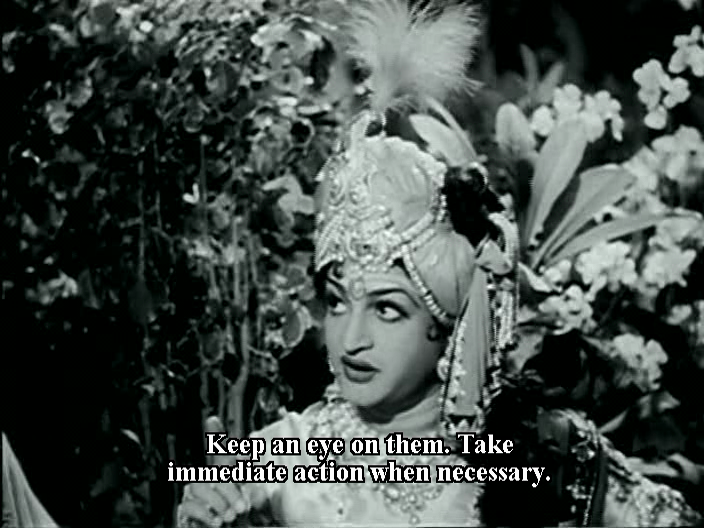
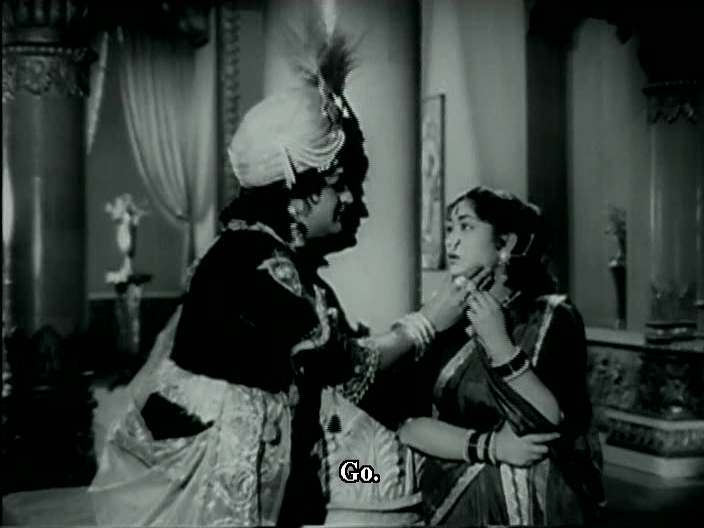
The stolen conversations between him and Draupadi have an undertone of longing. When they touch there is chemistry; Arjuna, the husband missing his wife, is suddenly visible despite the fripperies of Bruhannala. When NTR re-appears as Arjuna he is quite regal although maintains the air of amusement. His scenes with Uttarakumar in the chariot are fun and he enjoys the consternation caused by his transition from Bruhannala back to Arjuna. It’s a warm, appealing performance, and the knowing looks to camera drew me into the asides and secrets.

Arjuna is more philosophical about Draupadi’s situation and is prepared to manage each crisis as it happens. Bhima cannot contain his fury; he just wants to tear Keechaka apart.
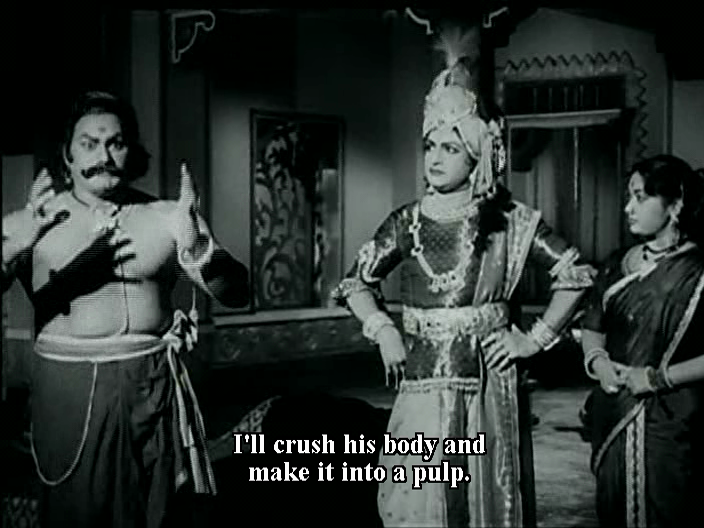
He knows his own flaws and is guided by the more calculating Arjuna and Dharmaraju’s sense of justice. His powerful physique is an asset to the family but may also be the thing that gives them away. There wasn’t a lot of subtlety needed for this performance, but it wasn’t just posturing and roaring.
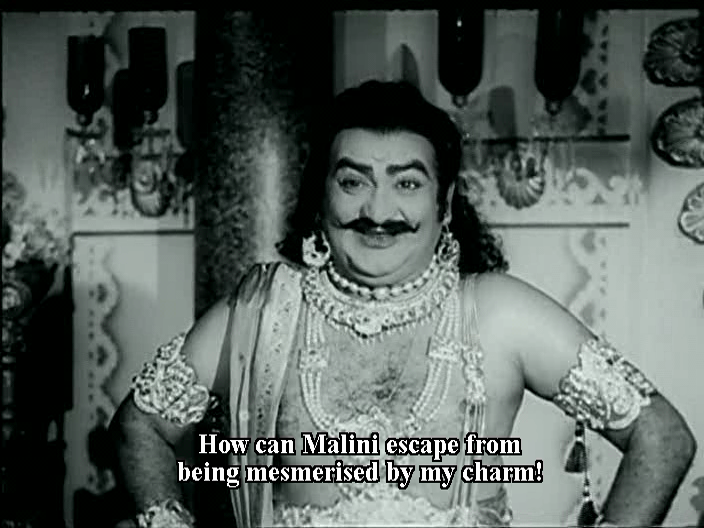
SV Ranga Rao is Keechaka, the queen’s larger than life brother, a jovial bully. His inability to control his lust does more than threaten Draupadi. It also jeopardises the safety of all the Pandavas who may not maintain their disguises under such insult, and threatens the kingdom as he forces the queen to give Malini over to him. He is literally blinded by desire.

How else could he mistake Bhima for Draupadi? His performance is excellent as he manages to be likeable and hateful. I was cheering when he got his just deserts.
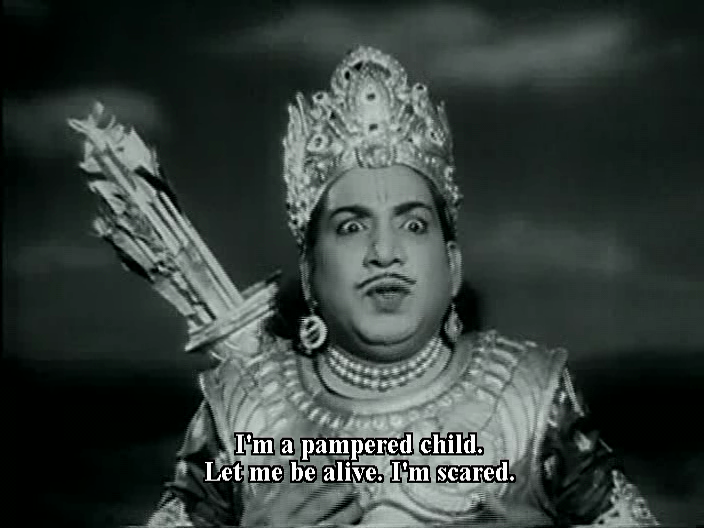
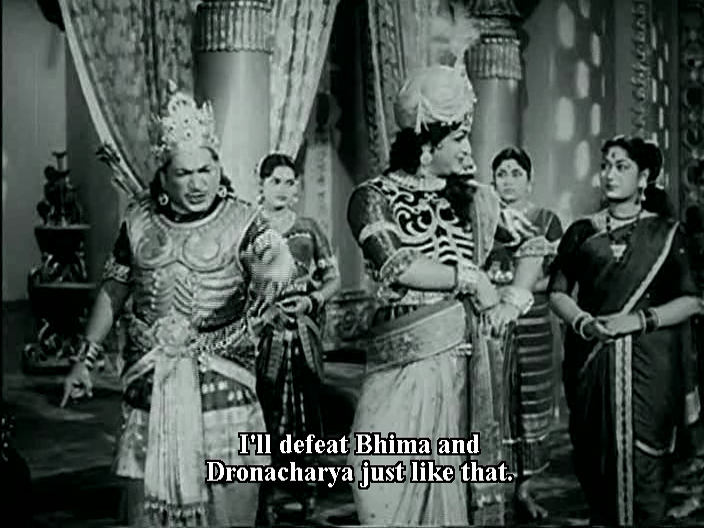
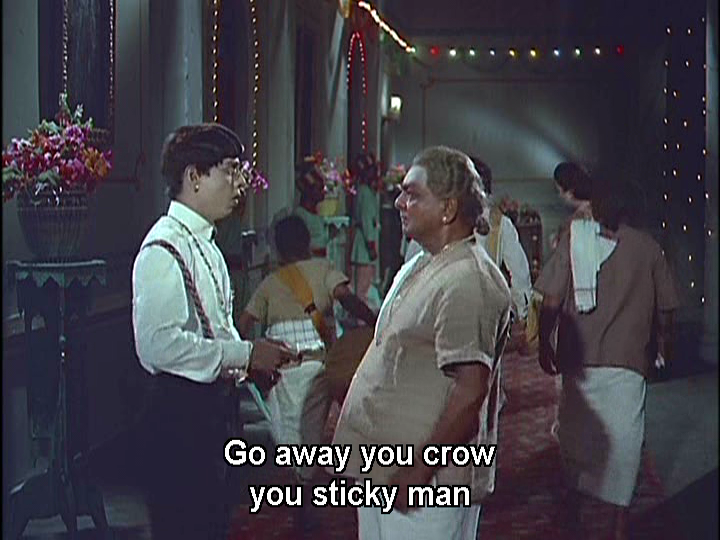
Relangi Venkata Ramaiah (a.k.a the ‘Clap Your Hands Behind Your Back guy’ from Mayabazar) is lots of fun as the pompous, cowardly but endearing Uttarakumar. He has delusions of being a great warrior and leader, and his preening and posturing amuses me as much as it does the Pandavas. He is followed around by his attendants, one of whom is Allu Ramalingaiah with perfect but unobtrusive comic timing. Uttarakumar is nice to his sister, and never gets angry or mean with the cooks despite their unfortunate comedic tendencies, so I like him.

L Vijayalakshmi is perfect as his sister Uttara. I really enjoy watching her dance and she has a sprightly, flirty, quality that enhances the role. She and Abhimanyu have a romantic subplot but really her purpose seems to be dancing and being decorative. This is only the third film I have seen her in, and I hope to find a few more.

The songs (original music by Susarla Dakshinamurthi) blend into the story and I wish they had been subtitled, as often they are used for exposition or introductions. The dancing is lovely, and the sets and costumes are opulent.  The decorations are extravagant and yet allow the performers to be the focal point. It’s also a ripping good story, and the pace of the direction matches the tempo of the drama to perfection. It’s just gorgeous.

4 ½ stars! (a small deduction for too many squeaky comedy cooks in the kitchen)
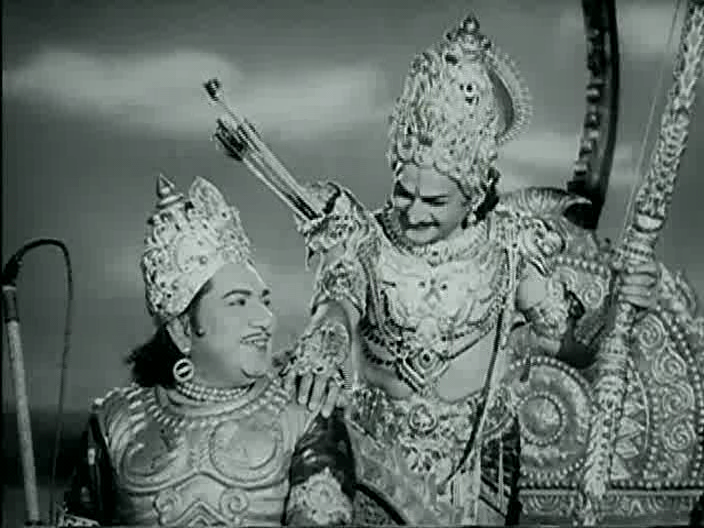
Heather says: Narthanasala is just delightful to watch. The film’s all star cast are excellent and the sets and costumes are fabulous. Since I’m not very sure about all the characters in this part of the Mahabharata, I really appreciate the opening scenes where everyone introduces themselves and explains who they are, the alias they are going to assume and what they are going to do for their time in exile. Very helpful.

The stand out performance for me is by NTR. He is excellent as Arjuna in the film’s opening scenes and his transformation into the eunuch dancing teacher Bruhannala is brilliant. It’s not just the delivery of his lines or his posture, but his whole demeanour which changes, and he is wonderfully feminine. He also has the best costumes and totally awesome eyelashes! This looked like such a fun role to play and NTR had the right amount of playfulness and hauteur to make it work.

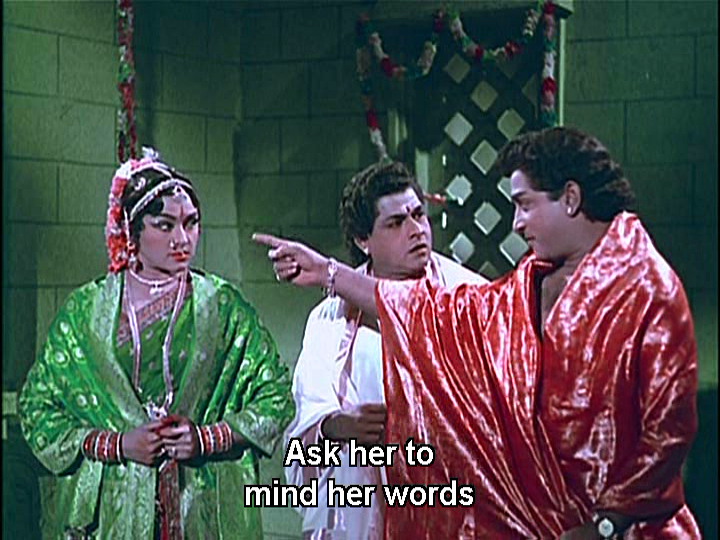
Savitri is as beautiful as ever although I was a little confused about her character as Malini. Since they were supposed to be in hiding it seemed rather odd that she would say that she had 5 husbands and needed shelter for a year. Surely that gave the game away as to who she really was? It didn’t seem to be a requirement of their exile since none of the other characters seemed to reveal quite as much about their identity. However, I only have a very limited knowledge of the Mahabharata, so this could just be an essential part of the original. The film drags a little in the middle while waiting for Draupadi’s rescue from the funeral pyre, but the previous scene with Bhima in drag pretending to be Malini was excellent. Dandamudi Rajagopal is very good in his portrayal of Bhima/Valala and as a professional wrestler he certainly looks the part. Unlike Temple, I love the minions in his kitchen who I think are really very funny, always fighting and squabbling and behaving more like troublesome children. The comedy with Uttarakumar is very well done as well, in particular the scenes with Arjuna when he goes out to fight the Kauravas

The dancing is lovely and although the fight scenes were quite stylised they are enjoyable to watch. I loved this line from the battle between the Kauravas and Arjuna towards the end “He greets the elders with his arrows. That is what makes him so adorable!” And NTR was! I really enjoyed this film – 4 ½ stars.
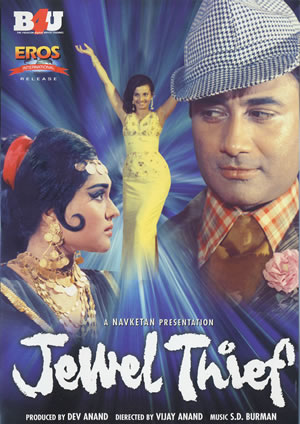
Jewel Thief

I always enjoy Vijay Anand’s Jewel Thief, mostly for the glorious presence of Tanuja, Vyjayanthimala, Helen and Faryal. The style is groovy Sixties cool, the music is fab and funky and the story is packed with incidents and coincidences.

SD Burman’s soundtrack is brilliant, and the dream playback ensemble of Lata, Asha, Mohd Rafi and Kishore Kumar does the material justice. The title sequence sets the tone; a swinging big band with Krupa-esque drums over an old school cut and paste montage of newspaper headlines that are stuck over real news stories.

Is it just me, or do these display mannequins look just a little like Nargis?

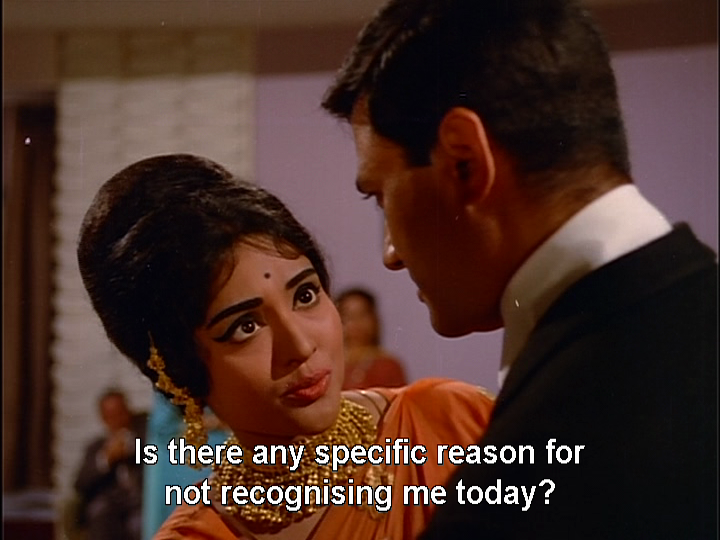
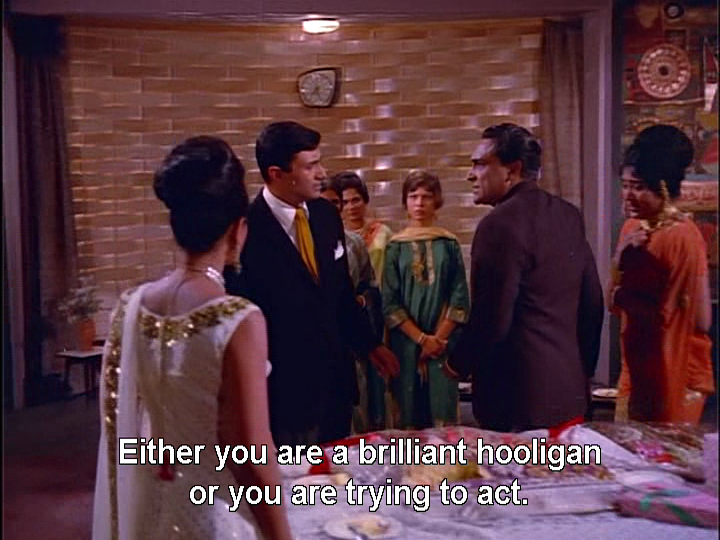
Vinay (Dev Anand) arrives at a jewellers looking for work. His skills dazzle Mr Visambhar Das and his flirting impresses daughter Anju (Tanuja) so he gets the job.  Soon after, he is mistaken for a man called Amar by a number of strangers. At Anju’s birthday party he is confronted by Shalu (Vyjayanthimala) who claims the mysterious Amar is her fiancée and that Vinay is indeed Amar.

This leads to the least suspenseful proof of identity scene ever as Vinay takes over one full minute to remove a shoe and prove he doesn’t have six toes. Did I mention the subtitles on this original DVD are quite peculiar?

Shalu’s brother Arjun Singh is played by the wonderful Ashok Kumar. Arjun seems to want to throw Vinay and Shalu together despite her apparent engagement to another man. He has hidden motives, and gradually more is revealed about his character. It’s a fun performance, and I do have a soft spot for all of the Kumar boys.

Anju and Shalu vie for Vinay’s affections, which results in some awesome outfits and extreme eyeliner. Tanuja is fun and bubbly, and plays her headstrong character with great gusto. Anju seems to have very few restrictions on her activities but isn’t spoiled by being indulged.

Shalu is the weeping wronged woman, and wants to recreate Vinay in Amar’s image which he initially rejects.  However Shalu is flirtatious and yet reserved, a combination Vinay cannot seem to resist.

Vinay plays both women and seems to have no qualms about his situation. He takes for granted that the girls find him irresistible and will tolerate his peccadilloes. Dev Anand has so many idiosyncrasies that I can never forget it is Dev Anand I am watching. However I do like his seemingly genuine enjoyment of Tanuja’s antics in Raat Akeli Hai, Bujh Gaye Diye. And hurrah for the interior design excellence at Anju’s house which we get to tour in that song. I love the fridge, but the bar steals the show.

Things become more tangled as it appears Amar and Vinay are impersonating each other, sometimes inadvertently. Amar aka the Prince is the Jewel Thief. He is a ladies’ man and a ruthless criminal by all accounts, although one with appalling fashion sense. No one seems sure of which side anyone is one. The plot becomes more and more convoluted, even as nothing really happens.

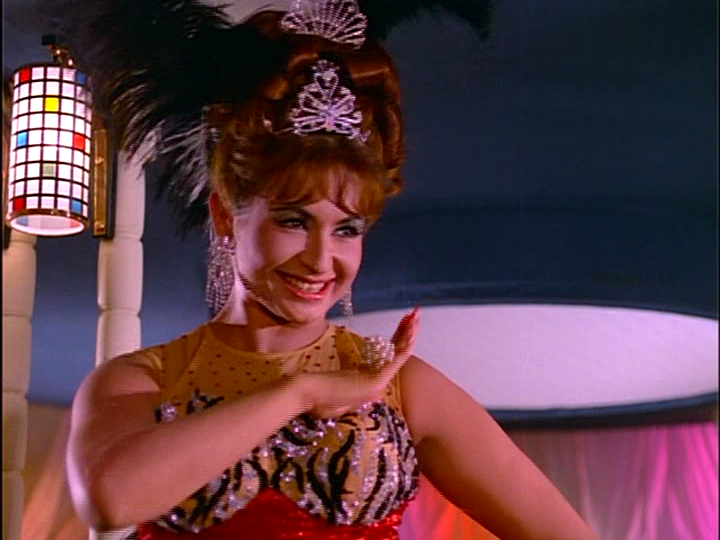
Amar has better taste in women than expected given his shocking taste in clothes. What’s not to love about Helen (playing a character called Helen) making her entrance in a sparkly zebra chicken ensemble complete with crystal beaded tights?

This was one of my first Helen films and whenever I describe vintage Bollywood, I draw on that image. Helen also loves her fridge, to the point of not locating it behind the nifty concealed revolving bar. It reminded me of my grandmother’s kitchen which was built before whitegoods were common so our fridge was plonked against a wall. It took me back to the exciting day when Nan got her first ever washing machine. Sadly I grew up without the groovy bar, but we did have a fair collection of 70s kitsch.

Julie (Faryal) doesn’t seem to have a fridge, but she did have a drinks trolley in one scene.  She is part of the gang and draws Vinay further into their murky designs. With Faryal wearing the entire budget for a key jewel heist scene, I can totally understand why the art team recycled the Nargis busts in the background.

It is a treat to have multiple vamps and heroines of this calibre in a film that lets them all shine. The ladies drive much of the action, providing the clues, motivation and manipulation that ensure Vinay continues to swagger limply in pursuit of Amar. Anju Mahendru also has a small but crucial role as Neena, yet another babe who runs rings around our hero. They are strong, individual women and I love seeing Helen and Faryal do more than an item number. For a fun and informative discussion of vamps, please listen to this excellent podcast by netvixens Beth, Amrita and Memsaab at Masala Zindabad.

The action moves to Gangtok as Vinay pursues Amar. Dev Anand is slick and superficial; Vinay looks the smooth man of the world but is never really convincing as a man of action. Luckily his dad (Hussain) is a police commissioner so he has resources to call on. Even more complexity in the plot is revealed as Vinay is taken hostage. (It was very thoughtful to provide the lads and ladies of the gang with table tennis. Such a wholesome recreation for evil doers!) The gang is working on one big heist that doesn’t seem to be worth it given that they are making ample money from the smaller crimes that attract less attention. The targeted crown is a bit more Miss Universe than I expected for a prince in Sikkim.

Amar continues to elude Vinay and his dad, but there is plenty else of interest going on. Vyjayanthimala wears a sari covered in furry bobbles for a start, but she has the consolation of a lovely song to emote to.


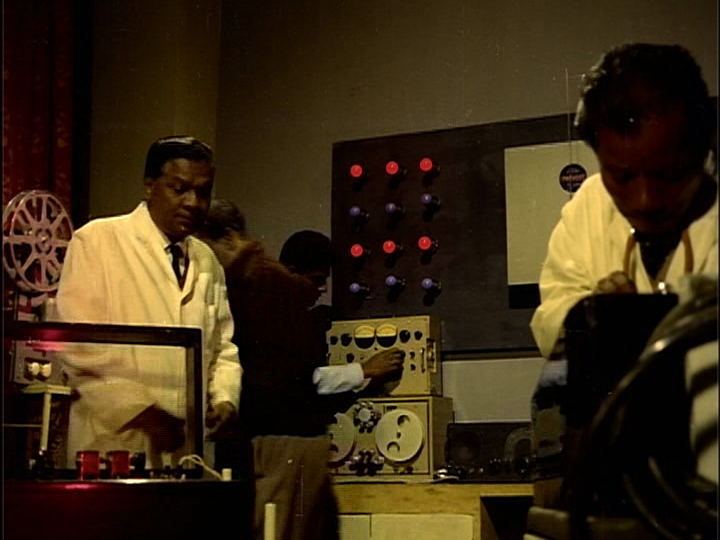
Helen and Julie create confusion as Vinay does a lot of overacting, sometimes intentionally. In a fantastic filmi architectural coincidence the old palace tunnel system was handily located under the captives’ quarters. All it took was Shalu, a rope made from a sari, her handy chisel and mallet plus the good scissors and they were off and running for freedom. The film is full of great secret rooms, sliding panels and amazing design features. But it wouldn’t be truly masala  if the hero escaped right away, and the director had invested in some hi-tech memory modification equipment, so the action returns for more mind altering shenanigans.

And then the deservedly famous Hoton Me Aisi Baat in which Dev Anand has the very good sense to restrict his dancing to posing and scuttling out of Vyjayanthimala’s way.

I don’t want to give the ending away completely but the Jewel Thief’s complex plan comes unstuck remarkably easily. Anju takes her turn at helping Vinay fight the good fight, and all loose ends are tied up in a delightful final scene.

Vijay Anand has created one of my favourite retro masala films. There is so much to enjoy visually, so many fun performances, and great music and dance numbers. What more could I ask for? 4 and ½ stars! (extra points for Helen, small deduction for Dev Anand’s hats).

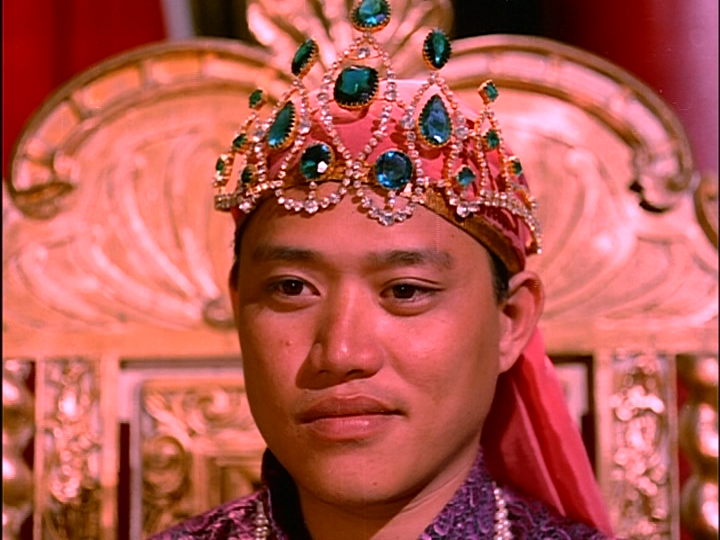
Heather says:  Jewel Thief was one of my early ‘oldies’ film purchases and I’m pretty sure I bought it because of Helen. Of course not only does Jewel Thief have the incomparable Helen but also the amazing Vyjayanthimala, Tanuja and Ashok Kumar along with Dev Anand. I’m not usually a great Dev Anand fan as I find him much too affected, but he seems to suit the James Bond-esque role he plays here fairly well. He does look to be too old to be a wayward son of the police commissioner though and his mannerisms make it hard to forget that he is Dev Anand rather than the character, but I still think this is still one of his best films.

The best part of this film for me is the music – the soundtrack is fantastic and as Temple has mentioned it has the dream team of playback singers. This is a film where I’d heard and loved the songs before I saw the movie, and they only got better with watching. The sets are fantastic too with plenty of hidden rooms and tunnels as well as some very inspired décor in Helen and Anjali’s apartments – so much to appreciate.

I also love the totally fab costumes. The red dupatta with white fluffy spots all over it that Vyjayanthimala is wearing in the song above is a particular fave, and Tanuja has a great selection of outfits.  Naturally Helen shines (and sparkles!) in that department as well, and one of the gang has a rather eye catching black jacket with large white pockets. Where do they find this stuff – actually I do know the answer to that as I went shopping in Chennai earlier this year! Dev Anand is a little too ‘corduroy’ in some scenes for me (clothes and attitude), but his collection of hats helps to make up for that. I particularly like that the jewellery was by Parikh Novelty house, which sounds exactly where I need to go shopping, and that there was just so much of it!

The story aims to be a mystery/thriller and I think in general it works fine for the mystery but not quite so well in the thriller part. There just isn’t very much suspense – at least not once we get past the sock removal. (Just as an aside, I seem to have a different copy toTempleas I have rather more boring subtitles which sadly refer only to toes.) But perhaps I’m just too distracted by the costumes, the jewellery, the interiors and the dancing! The story moves along well though and there are plenty of twists which generally make sense, even if the final scheme does turn out to be more complicated than it really needed to be. Adding in electro-shock treatment was particularly inspired, and I did enjoy Dev Anand’s grimacing throughout the procedure. Brilliant!

All the actors are excellent throughout and it is a real treat to see so many great performers together in a better than usual story. The end is just a little disappointing, but there is still plenty to enjoy in this very stylish film . 4 stars from me.

Thillana Mohanambal

Padmini is Mohanambal, a beautiful and exceptionally talented bharatanatyam dancer. Sivaji Ganesan is the less beautiful but equally talented musician, nadaswaram player Sikkal Shanmughan. Crossing paths at a temple festival sparks fly between them but within minutes they go from this:

To this:

They challenge each other to a contest of dance versus music at some later date. So the stage is set for a fiery romance, riddled with misunderstanding, thwarted by pride and a meddling mother (Vadivambal, played by C.K. Saraswathi).

Mohana believes that dance is for everyone and for all occasions, inspired by the world around the dancer as well as a gift of god. Sikkal is more of a princess, demanding that his audience give him full attention and due reverence as he displays his gift. He believes art exists for god and for the artist. He refuses Mohana’s invitation to stay and watch her dance, but sneaks back later to see this.

There are some interesting observations on women in the performing arts and Mohana is certainly subject to some assumptions by men who desire her beauty and talent. Her mother seeks to ensure a wealthy man as her daughter’s protector or husband, but Mohana rejects all offers even before her feelings for Shanmughan are an issue. Nagalingam (K Balaji) is one thwarted suitor and a kidnapping attempt results in a comedy fight scene that I could have done without. I don’t quite get the undersized guy with stupid hair as instant hilarity, and there are two of them (double the fun?). This diversion means Mohana and her group catch the same train as Sikkal who has been waiting in the hopes they might turn up.

Padmini is gorgeous and her dance training is evident in her deportment and expressions as she uses all of her skill in conveying Mohana’s emotions. She also does an exceptionally good eyelash flutter. Sivaji is more old school theatrical, and lays it on almost as thick as his makeup. But his somewhat rubbery face is wonderfully expressive, especially his eyes, and he does have palpable chemistry with Padmini. There is a delightful scene of wordless communication and voiceover on the train journey that is funny, romantic and beautiful.

There is lots of sparring between the two and she is not the heroine to fall in love and lose her sense of self. I liked seeing a young lady who was a bit of a brat, very self-confident, and who felt no need to be apologetic. I don’t think I would enjoy her half as much in real life, but she did keep my attention in the film. And there was no suggestion that she should give up dancing to be a servant of Sikkal’s muse. She was a dancer and was valued for her gift.

There are abundant comedy elements. Manorama is Jil Jil Ramamani, a folk dancer and girl of suspect virtue. Her ‘comic’ dances are strange, and perhaps the subtitle team decided to make sure we knew this was a modern film:

In addition to being the butt of many jokes, she does play a significant role at several points in the story. Manorama made her character both a caricature and quite sympathetic. I was left thinking Jil Jil understood herself and how others saw her, and she retained some dignity despite the silliness. Nagesh as Vaithy had a role that just irritated me. He is a Jerry Lewis kind of character, so if you like the style, you may have warmer feelings towards him than I do.

His presence extends the story with pranks and frauds, and a longwinded and obtuse approach to being a go-between. The supporting characters are pretty broadly drawn and usually played for comedic effect or buffoonery. There is some excellent face throughout.

There are pointed references to the issues of art versus money, the dedication of great artists and who owns art.  Sikkal storms out of a private party rather than be ‘owned’ by the landlord and plays an impromptu concert to the locals gathered outside. I particularly enjoy this face off where the classical versus modern question is settled judging by the smug expression on Sivaji’s face (wait for the white couple to turn up at about 4 min):

Mohana is pursued with increasing vigour by the landlord and the ensuing scenes are quite farcical. I was quite annoyed that Sikkal immediately assumed Mohana was playing him, without speaking to her or investigating. He just did the heroic leap to the conclusion that she was duplicitous and decided to feel sorry for himself. I might have been more tolerant of manly brooding in a more attractive character, but really I just wanted to slap him. He then departs to sulk with Jil Jil, now calling herself Rosarani, who owns a drama company. Word of this gets back to Mohana who knows about his misunderstanding but had hoped he might still be interested. Rather than giving up, judging or moping, she decides to confront him.

Jil Jil and Mohana show themselves to be more decisive and action oriented than many a filmi heroine. I have doubts over the subtitle translation of some of the relationships as people refer to the landlord wanting Mohana to live with him, but he is also referred to as a groom, there is mention of dowry and so on and he has a wife already. In one scene, Padmini begs him not to spoil both their lives and mentions women being enslaved by money. So I am guessing she would have been his mistress but perhaps the subtitle team decided to sanitise the arrangements. Regardless, her modesty and chastity helps to persuade the landlord to be a brother rather than a suitor.

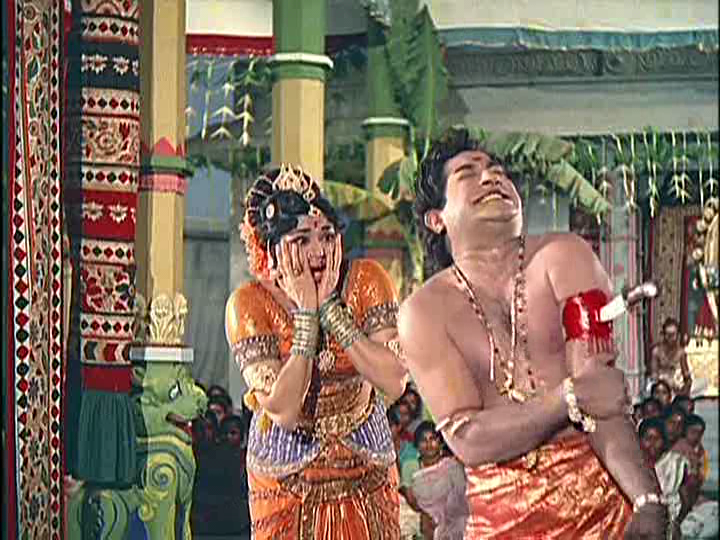
Mohana knew that the only way to keep Sikkal from leaving India with Jil Jil was to appeal to his artistic pride. The Thillana contest goes ahead. Nagalingam returns for skulduggery resulting in Sikkal taking a knife to the arm. Sivaji really milks the scene, thrashing around like a fish out of water for what seems like minutes. This injury prompts a further outbreak of overacting, and Sikkal gets another opportunity to feel sorry for himself again. Thanks to yet another smart competent woman (his nurse Mary) he begins to see that perhaps he has been a little narrow minded.

The finale is predictable but unravels over yet another complex scheme to sell Mohana, this time to a King. She defends herself, verbally and physically, and finds an ally in the very peculiarly accented Queen. Her chastity proves transformative once again, and the King decides to be a good husband.

Sikkal jumps to conclusions (yes, again!) and flings himself around chewing the scenery. This time Mohana has had enough and decides to resolve things. The climax is very filmi and over the top but the duelling diva personalities of the leads made it less unbelievable than it might have been.

This is such a pretty film. The ladies wear beautiful jewellery and costumes, there are lots of sparkly things, the temple locations and houses are lovely. It also has quite a timeless feel, with only a couple of scenes overtly placing the story in the late 1960s. The story is an overblown romantic melodrama but the theme of art and excellence gives the characters much more substance than I expected.  The female characters stand on their own feet, and have their own plans and desires. Padmini and Sivaji are exceptional and really made me care about their relationship even as their characters annoyed me sometimes. And of course, Padmini’s dancing alone makes this worth a look. Who won the contest you ask?  Art was the winner! 4 stars.