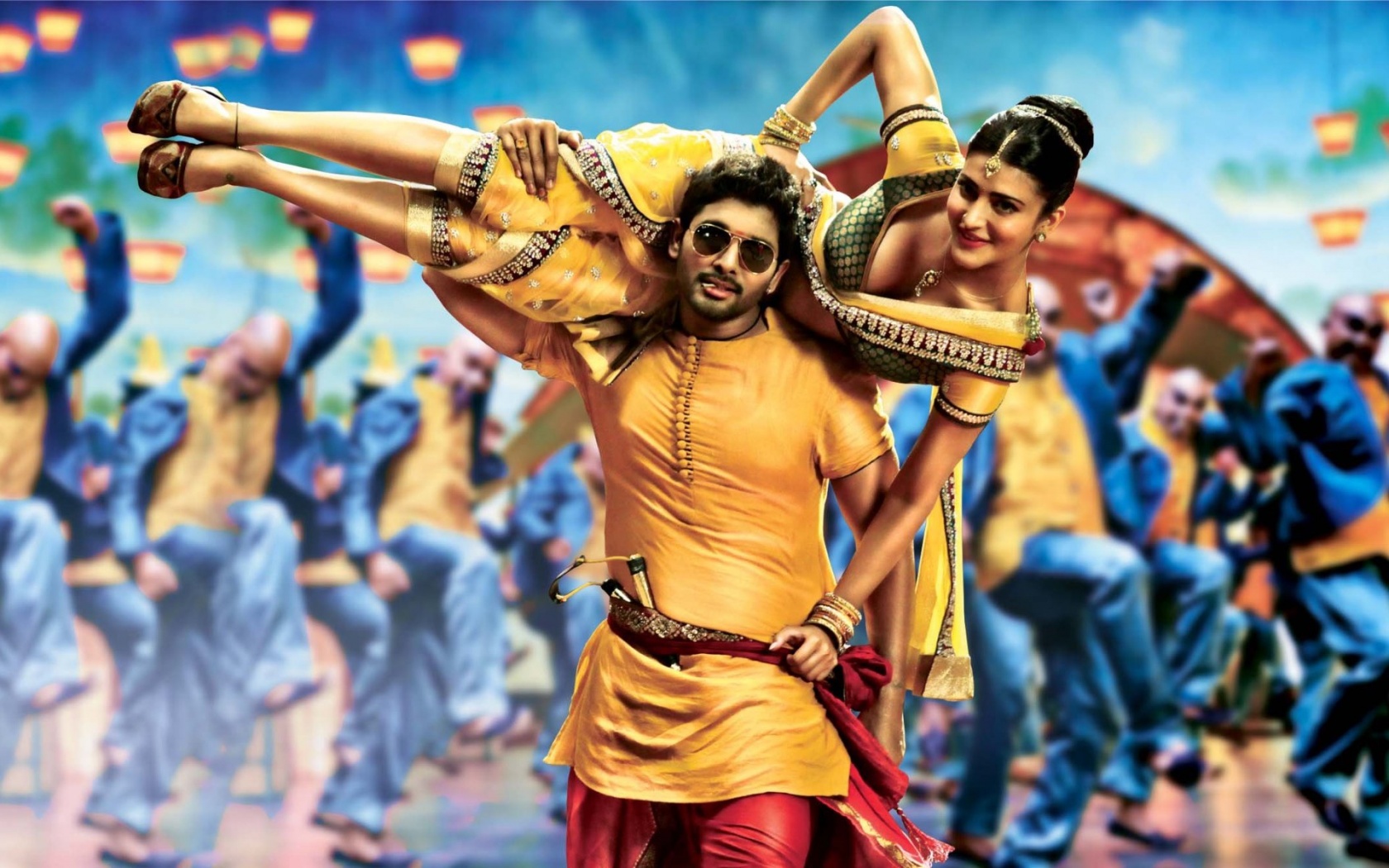
Sarrainodu

Sarrainodu

If all you want in a movie is plenty of gory fight scenes and a couple of good tunes then Sarrainodu is probably the film for you. But on the other hand, if you prefer a cohesive story with an actual plotline, semi-plausible romance and an attempt at more than one-dimensional stock characters, then best to steer clear. The one saving grace in Sarrainodu is Allu Arjun, who manages to entertain even while playing a violent, psychopathic stalker who nonetheless is actually the hero.

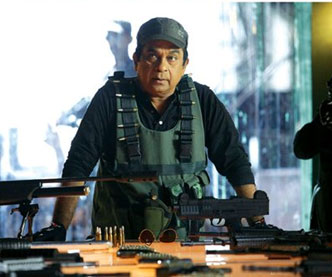
Bunny is Gana, ex-military, although ‘ex-‘ exactly what is never specified in a general vagueness that afflicts every character.  Gana spends his days bashing up offenders his lawyer uncle Sripathi (Srikanth) has failed to bring to justice in court, much to the frustration of his father (Jayaprakash) who feels he should be doing something more worthwhile with his life. The rest of the family dramatics follow Telugu Mass Movie Formula No 1, with the addition of a comedy track featuring Gana’s sister-in-law (Vidyullekha Raman), a Tamilian obsessed to the point of mania with sambar and Brahmi as a philandering brother-in-law. Neither of the two comedy tracks is funny and Brahmi’s sleazy character is particularly off with little relevance to the rest of the film but then that’s nothing unusual for this type of film.

With some nice symmetry, while Gana is belting the living daylights out of gangsters to reclaim land they appropriated, uber-villain Vairam Dhanush (Aadhi) is cheerfully slaughtering villagers to grab their land for his pipeline project. Vairam likes the sound of his own voice and witters on about ‘background’ as if the concept may have some significance to the plot later on. Perhaps it was meant to, but since the background of neither Gana nor Vairam (or anyone else for that matter) is given anything more than a brief mention, Vairam’s insistence on the concept makes little sense.

As a villain, Aadhi has a good sneer and appears appropriately nasty, but his character is so one-dimensional that Vairam himself has very little impact. He’s evil purely for the sake of being evil and naturally (adhering to TMMFNo1) he’s rich and privileged with the Chief Minister as his father and a large criminal network at his beck and call. Aadhi tries hard to give Vairam some personality but he has little to work with and his villain pales beside the spectacle of Gana’s righteous fury.

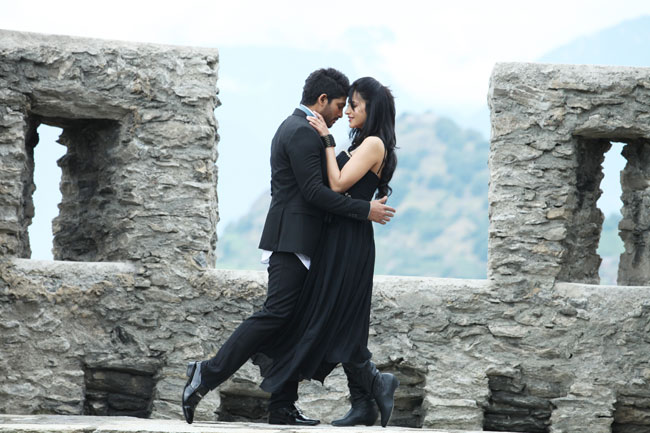
Gana falls in love with Hansitha Reddy (Catherine Tresa), oddly cast as a very unlikely MLA, and decides to follow the usual path to true love (TMMFNo1 again) by stalking the girl until she falls for his charms. This is even less viable than usual given that as an MLA Hansitha has the wherewithal to send Gana about his business, but bizarrely she declares her love for him instead. The path to true love is not smooth however and there is a complication in the form of Maha Lakshmi (Rakul Preet Singh), who falls heavily for Gana when he rescues her from Vairam’s thugs. Sadly neither of the romances works well at any point in the film and there is zero chemistry between Bunny and his two leading ladies, probably due to a lack of screen time together and therefore little opportunity for any relationships to develop.

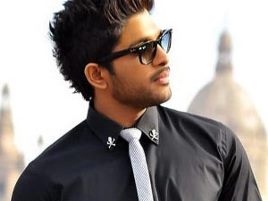
Bunny is on top form here and single-handedly manages to hold the film together despite the many flaws and gaping holes in the barely-there plot. Whether he’s fighting or dancing he looks amazingly fit, and effortlessly switches between his devotion to Hansitha and his uncontrollable fury when he sees injustice against the helpless. As always he looks awesome in the song sequences where every dance routine features excellent footwork, amazing energy and that trademark Bunny grin. S.S. Thaman’s songs are catchy and memorable too, and the choreography is well suited to showcase the stylish star. He gets to wear some incredibly bright and colourful costumes and fares rather better in the wardrobe department than Catherine Tresca and Rakul Preet Singh, who both suffer from the curse of inappropriately skimpy Western style costumes in the songs, although both look stunning for the rest of the film. Anjali has a better time of it with her guest appearance in the item song blockbuster – which I love for many reasons, not the least of which being that one of the backing dancers is totally rocking a cool pair of specs – you go girl!

The other aspect of Sarrainodu that works well is the action, with fight sequences that are well imagined and expertly staged despite being incredibly violent and completely over the top. Where else would you have a fight scene on roller blades for example, or a wonderful stand-off by the hero beating numerous thugs while the participants in Puli Kali leap energetically around the fight? Most of the action contains a lot of slow-motion, but this highlights the choreography and showcases the small vignettes in the background – the bystanders, a horse bucking as it runs past and the portentously displaced gravel with every one of Gana’s footsteps. And it’s just as well that the action sequences are good as there are a lot of them – Gana spends most of the film fighting in increasingly violent and bloody encounters, throwing thugs around like confetti at a wedding and inflicting maximum damage on Vairam’s crime empire.

Boyapati Srinu adds almost every possible masala ingredient in this mish-mash of a film, but fails to provide a coherent plot or any rationale to his characters. I love a good mass entertainer – I don’t expect great character development or logic and realism in the plot, but there does need to be an actual plot and some sort of reason for the antagonism between the hero and the villain.Sarrainodu does not succeed by any of those criteria and yet I still enjoyed the film. The fight scenes are excellent, the dance sequences well worth watching and Allu Arjun puts in a magnificent performance that just about manages to overcome all the flaws in the film. One for the fans sure, but if you’re a fan this is Bunny at his best and that’s all that’s needed.
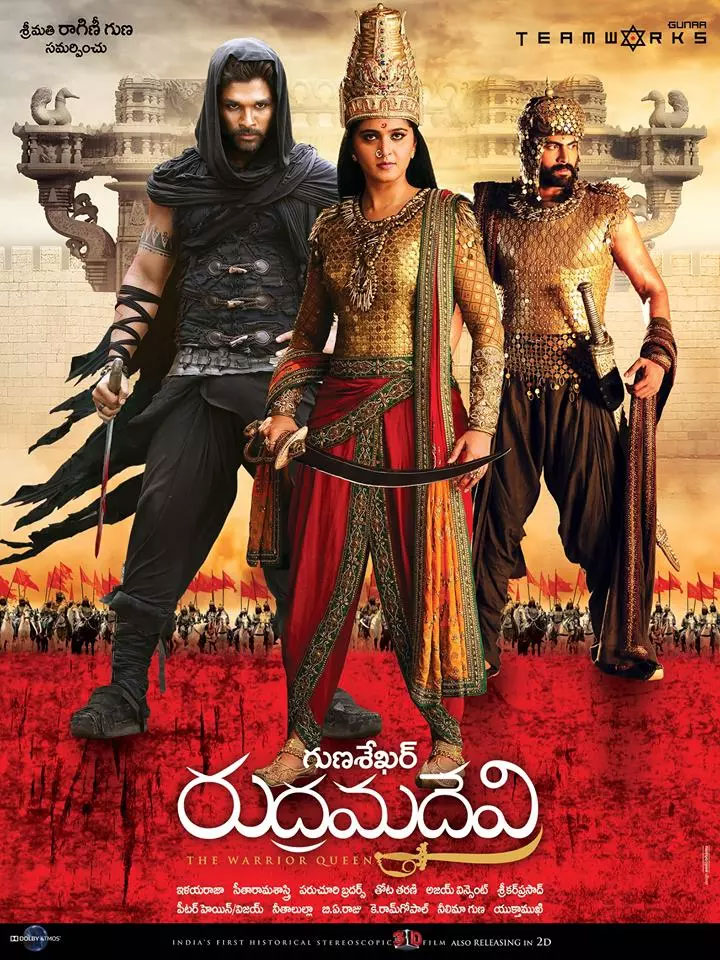
Rudhramadevi (2015)

Rudramadevi-Posters-2

If Rudhramadevi had been made in 1956 I’d have loved it, no question. But Gunasekhar struggles to realise his grand vision and the ripping story drags at times. The main cast give their all, but they can’t compensate for some poor directorial decisions and sloppy execution.

The first thing that hit me was the VFX. I thought it was maybe a deliberate stylistic choice as there are animated montages that look like a childs picture book. But it is just shonky quality, used too liberally, and with poor judgement. At least it distracted me from wondering what Marco Polo’s stuck on beard was made of. And why Marco Polo was in the film.

The story is so interesting this should have almost written itself. A girl is raised as a boy and keeps up the pretence to protect her kingdom for as long as she can. But Gunasekhar spends far too much time with the various enemies and uses loads of clunky “As you know Bob” exposition. I felt that there were some holes in the film and Gunasekhar was trying to paper over those gaps with other techniques including a Mega voiceover and a peasant who announced every new character with bio as well as voicing the people’s dissatisfaction with their rulers.

Anushka owns every frame she is in. She adjusts her posture and facial muscles so there is a clear distinction between Rudradeva and Rudhramadevi and is convincingly commanding. She has some weird darkening makeup on as a boy, but it does allow her to look stunningly radiant when she girls up.

Her closest female friends are Nithya Menen as her wife Muktamba and Catherine Tresa as The Other One Who doesn’t Wear Much, and there is a lightness and ease in the way Anushka moves as she drops the pretence and heavy armour undershirt to dance in the “Yay! I’m a girl” numbers. She did her damnedest in the tandav but while her expressions told a powerful story, her dancing was not as compelling. Rudhramadevi used Veerabhadra’s feelings for her to get him back on task, but she evinced far more concern about Muktamba’s reaction and wellbeing. That ruthlessness and emotional intelligence wasn’t really explored and I felt the film needed to reveal how she ruled, not just show a sequence of events.


I put that clip in just for some shirtless Rana. He looks so chuffed when he is prancing almost in time.

Rudramadevi-Rana Anushka

I knew a “Zorro” moment was nigh when Rudradeva wore a blue tunic done up with pink princess ribbons, and the gender reveal is a bit ho-hum. Veerabhadra took the whole “Dude, you’re not a dude” revelation quite well, all things considered. There is little sexual chemistry between Rudhramadevi and Veerabhadra, but the actors have a nice rapport, like childhood friends. I enjoyed moments like when Rana playfully tweaked Anushka’s nose as he said goodbye. While the writing skimmed the surface of characters emotional lives, the actors added their own flavour.

Gona Ganna Reddy (Bunny) and his horse seem to have ridden in from a different film; something more gothic perhaps or even a KPop music video (Jaejoong’s stylist may be moonlighting as a Telugu horse costume designer).  Bunny plays his character as unrelentingly dour and with one facial expression, but his one liners got the audience cheering. And he rarely blinks. It’s intense and unsettling after a while.

Rudrama Devi Posters

The support cast is huge. Hari Hara Devudu (Suman) and Murari Devudu (Aditya) are the Statler and Waldorf of villains. They sit back and critique everyone else but rarely do anything themselves, unless you count letting their allies die horrible deaths. Their brother Naga Devudu (Baba Sehgal) shows commendable willingness to really go for the snake theme. Nithya Menen is underutilized as Muktamba. I enjoyed her scenes with Anushka and thought her decision to respect the sacrifice and say nothing was interesting. This contrasted with the shouty peasants who just flat out refused to accept a woman, despite a rousing Prakash Raj girl power speech. Prakash Raj is in good form as Shiva Devaiah, the mastermind of the scheme that sees Rudhramadevi raised as the boy Rudradeva. Villain Mahadeva (Vikramjeet Virk) spends most of the film prancing atop a phallic tower made of polystyrene. Amusing, but you know a great hero or heroine deserves a genuinely scary bad guy and he is not the real deal no matter how many people he kills out of spite. Hamsa Nandini is slinky and duplicitous, the Bond girl of courtly spies.

Gunasekhar’s massed set pieces lack richness. If you arrange a formation of extras with one or two carefully out of position people for randomness, but then use that same formation scores of times over it ends up looking ridiculous with the pattern repetition of those supposedly random bodies. A critical battle scene started with a cool idea – one army emerging in a serpent formation as their opponents attacked in an eagle formation. But it went on forever and looked far too fake. I was reminded of the similar but excellent lotus and arrow scene in Magadheera.

One of the few actors I could imagine would happily rappel down a structure (possibly without even checking there was a rope), Bunny was plagued with dodgy wire work. Anushka was also caught so that her feet didn’t quite hit the ground or was frozen in awkward and unconvincing poses in midair. Maybe it was supposed to look good in 3D but I can’t imagine it would. And too many fight scenes and chases were sped up to slapstick comedy pace.

There is abundant weird CGI, possibly a workaround for the 3D version, although I should have remembered the effects in Okkadu. For example, when a drawbridge is being lowered they faked the cogs and ropes too which you’d think would be doable and cheaper for real. The climax scene as Rudhramadevi and elephant bring doom upon her enemies should be thrilling but it is just opportunity to crank up the bad CGI. The use of CGI elephants seemed unnecessarily frequent especially when in many scenes there was no obvious risk of physical harm to an animal – why not use a real one? And there seemed to be a bit of tusk whitening done in post production that was distractingly odd.

A big shoutout to the helmet and armour department. No design was too silly or impractical for them to try. I really wish I could find a picture of Bunny’s Glomesh helmet from the final battle, but you will just have to make do with Rana’s special dressing up armour.

Despite the negatives I really appreciate seeing Anushka as the lead with so much screen time in an awesome story. Bunny and Rana bring more interest to their characters than the screenplay demands. I would have liked to see more relationship development generally, and especially between the ladies given the story is of a woman pretending to be a man. I really wish the film had been better executed as I can see what it might have been, and the gap between what was delivered and that potential is frustrating.


Race Gurram (2014)

Race Gurram

Race Gurram was very nearly a non-starter in Melbourne, but at the 11th hour the distributors managed to find a venue and the race was on!  Better still, there were English subtitles – even for the songs – a first for Telugu cinema here in Melbourne, but hopefully not the last.  So, with a small but luxurious cinema, subtitles and the promise of Allu Arjun for just over 2 ½ hours, was the experience worth all the effort to get the film onscreen? Definitely!  Race Gurram is a mass entertainer that doesn’t break away from standard masala fare, but still manages to leave you laughing at the end.  That’s thanks mainly to strong performances from Bunny and Brahmi, while the usual suspects who make up the rest of the cast are a bit more hit and miss.

Apart from Allu Arjun’s introduction with a herd of horses and a few brief dialogues between our hero and the main villain, I’m not entirely sure why the film is called Race Gurram.  It has nothing whatsoever to do with the race track, and instead is a tale of acrimony between two brothers, Ram (Shaam) and Lakshman (Allu Arjun).

Race GurramRace Gurram


Ram is the elder and more sensible brother. He’s an ACP and is the standard morally upright policeman that Telugu films like to use as a sacrificial lamb.  Lakshman prefers to be called Lucky, because apparently it sounds ‘cooler’, which is probably enough of a clue to his feckless and irresponsible character.  The interactions between the two brothers are one of the strengths of the film and Shaam and Bunny make their exchanges seem natural and realistic.  Their arguments are just petty and immature enough to ring true, and when the situation escalates after a few more personal jibes, Lucky’s response is also in keeping with his personality. The way their relationship develops later in the film is also well handled, even if Lucky’s revelations before the interval do seem a little forced.   The tables are turned when Lucky finds out that someone else is targeting his brother and while it’s OK for Lucky to humiliate and fight with his brother, it’s not on if someone else tries to do the same.  It’s typical boy logic, but at least it gets Lucky on to the right side in the war against goon turned politician Shiva Reddy (Ravi Kishan).

Race Gurram

Shruti Haasan appears as Spandana, Lucky’s love interest, and at first seems to have an interesting role as a devotee of yoga who only shows her emotions on the inside.  But once she hooks up with Lucky, her usefulness to the plot seems to evaporate as her ability to emote increases, and she’s relegated to mainly appearing in the songs.  At least Shruti gets to actually dance rather than just pose and gyrate like Debi Dutta in the unimpressive opening number, and she does look great even if she doesn’t get to say much in the second half.

Another disappointment is Shiva Reddy and the whole plot against Ram and Lucky.  Although there are some good moments, overall Shiva Reddy is too much of a caricature villain to be properly offensive, and his machinations to become a minister are laughably inept. Ravi Krishnan never seems to get his teeth into the role, and mostly plays it for laughs with plenty of grimacing and sneering rather than any real maliciousness.  The knock-on effect is that the fight sequences don’t work as well as they should against such an ineffectual hoodlum and even throwing Mukesh Rishi in as Shiva Reddy’s somewhat nastier father doesn’t improve the situation. However, the usual suspects including Kota Srinivasa Rao, Posani Krishna Murali, Sayaji Shinde and even Prakash Raj as Spandana’s father all add enough to the mix to keep the action moving along well.

The second half introduces Brahmi as Kill-Bill Pandey, a name which does infer the usual dire slap-stick that Brahmi often relies on for comedy.  But such is not the case – Kill-Bill Pandey has great lines and an actual proper role in the story. And he’s really funny!  Seriously! Bunny and Brahmi work well together too, as Lucky comes to realise just what he has done by releasing Kill-Bill Pandey as head of a special police force on the unsuspecting Hyderabad public.  It makes for a much better ending than expected and has to be one of the best performances I’ve seen from Brahmi in recent times.

Race Gurram

I was expecting great things from the songs despite the fact that the soundtrack didn’t sound too special on first listen, and overall I wasn’t disappointed.  Apart from the first number which appeared out of nowhere without any particular point and had very little actual dancing by Bunny, the choreography was excellent.  Placement was generally odd and mostly there was no effort to place the songs within the storyline, but who really cares when it’s Bunny dancing? The stylish star looked, well, stylish, and as always his dancing was superb, particularly with Shruti Hassan in the larger group routines. Bunny always looks to be having such a good time when he’s dancing and his energy is incredibly infectious, so no matter how ridiculous the sudden appearance of Spandana and Lucky in the snow-covered fjords of Norway seemed, it was impossible not to enjoy the show.

Race GurramRace Gurram

Race Gurram does suffer from a rather rambling screenplay, and at times the film gets bogged down with irrelevant odds and ends that taper off into nothing.  Apart from the feuding brothers, the family moments are a tad cloying and overdone, and a heavier hand with the editing wouldn’t have gone amiss.  However, Bunny and Brahmi together make for a surprisingly entertaining finale that was certainly well appreciated by the Melbourne crowd.   Well worth a watch for their combined antics

Race Gurram