Pistolwali (1972)

pistolwali

I often wonder how gangs of ne’er-do-wells get along before they reach the critical mass that attracts a hero to sort them out, and what it is that they do all day. Pistolwali doesn’t answer the first of those questions, but it does provide plenty to look at as you ponder whether what they do all day is make their own outfits and fight over the dress-up box.

K.S.R Doss’ Pilla? Piduga? was either dubbed or partially reshot in Hindi as Pistolwali. Both (unsubtitled) films are on YouTube so choose your poison. I have chosen to use the Hindi version as some actors and both Helen and Jayshree T appeared to be speaking Hindi and this film is all about the authenticity…Plus I understood more of the dialogue even if I couldn’t read the significant clue written in blood.

Like so many other Telugu cowboy themed revenge films, this one is set in a time and place that exists only in Telugu cowboy themed revenge films.The movie opens with Raaka (Satyanarayana Kaikala) and his gang attempting a train heist. A brightly clad cowboy (Ramakrishna as Amar) puts them out of business from his perch in a convenient tree. It’s cowboys vs cowboys and hat colour is not a reliable indicator of anything.

Maybe if we saw the floral sunhats being stolen from helpless old aunties it might be suitably Bad, but instead it just looked like a job lot guaranteed to brighten up every occasion. And there was that one guy who just painted his scalp silver. Reeka (Prabhakar Reddy) seems to have fewer marbles and fewer outfits than Raaka. He throws childish tantrums that quickly escalate into homicidal rampages. And that is the nicest thing I could say about him.

“South Bombshell” (according to the poster) Jyothilaxmi is Neelu. She is first seen cavorting in a daring swimsuit but later changes into equally fashion forward pantsuits. The villains go too far when they steal from the temple, and Neelu sets off in pursuit. She swaggers, shoots and curses like a hero rather than a heroine relying on womanly wiles, and generally she rescues herself. Jyotilaxmi wears some abbreviated costumes and gets a big dance number, but Neelu isn’t a girly girl. Neelu gets roughed up by her adversaries but how to say this… they don’t get rapey and creepy with her despite the allure of her midriff. She is a foe and they deal with her as a threat, not as a plaything. She is tough cookie and I suspect it would take a bit to outrage her modesty in any case. When Helen gives it her all in Hoga Sa Hoga, Neelu fills the time honoured role of hero looking like they’d rather be elsewhere. Although that may also be professional item girl rivalry.  Neelu has her own ideas and just goes and does her thing. Even if that includes falling through a trapdoor and wrestling a (sight impaired) tiger.  And she has a straightforward approach to relationships.

Pistolwali-Graceful

I am not sure it was desire for authenticity or just directorial cruelty that had her struggling to get on and off horses, but it looked like Jyotilaxmi did a lot of her own action scenes.

The viewer learns that Raaka is Neelu’s biological father long before she does.  Raaka raped Lakshmi and left her for dead before also maiming his friend and rival for Lakshmi’s love. She fell pregnant as a result and she and the baby were taken in by her now one-legged true love who seemed to think it was the right thing to do. He may have been grooming Neelu for vengeance as well, but he seemed like an affectionate and over indulgent filmi Daddy. Neelu was none the wiser about her parentage until quite late in the film. That might all sound a bit progressive so let me assure you that the way it was revealed to her made me deduct a lot of the good parenting brownie points.

Ramakrishna is technically the hero but Neelu overshadows Amar in all respects. He does an OK job and he doesn’t get in her way, but apart from some excellent outfits he achieves little of note. Although I did giggle at his inept dealings with the ladies. On the subject of costumes, it looks as though each main character was issued with one distinctive pair of boots and they pretty much wear them throughout. Raaka’s boots were particularly special and Satyanarayana Kaikala was suitably over the top to match. And the outfits did help a little with identifying characters in the many and varied fights and action scenes. K.S.Madhavan threw everything and the kitchen sink into the stunts. However I have to say that the plot is quite cohesive and to an extent, I would almost say logical.

The background music is a brilliant mish-mash of fuzzy surf rock and funky Hammond organ with classic cowboy guitar strumming and the odd slide whistle. The song set pieces are unashamedly random and the film has an embarrassment of item girls that all get a guernsey in featured numbers.

Jayshree T is always so perky, I love watching her dance. She always seems to wear more hair than clothes but I never see her as really skanky.


Helen and her creepy blue contact lenses appeared in a nightclub song and Jyotilaxmi got a dance in a fabulous Fauxgyptian inspired village set with what may be happy go lucky tribal cannibals. The camera is often at crotch level which is a bit confronting. But to be fair, the camera wasn’t just upskirting the ladies. Once seen, never unseen.

This is one of my favourite heroine-centric B movies from 1972 and Jyothilaxmi is perfect as the righteous gunslinger. See it if you have ever harboured thoughts of wearing a fur trimmed vest with fringed pants but weren’t sure how to accessorise, or if you want a primer on tiger wrestling for the modern lady. 3 stars!
Malliswari (1951)

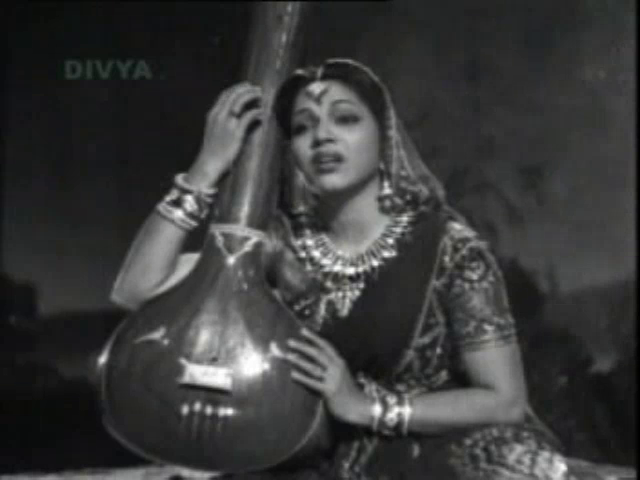
Malliswari-MalliswariB.N Reddi’s Malliswari is a film that almost every Telugu film fan praises as a masterpiece and a must see. It is so disappointing to see (and hear) the appalling state of the available copies, and also vexing that it is nigh impossible to buy on DVD. I would have loved subtitles. From the little I could pick out with my miniscule vocabulary, the dialogues seemed sensible and not overly filmi and the songs all seemed to fit in beautifully as an extension of the narrative.

Malliswari and Nagaraju grow up together in their peaceful rustic village. She calls him a monkey and he calls her a cat, but all the casual insults don’t mask their deep affection for each other. As Malliswari matures, her materialistic mother decides to nip the relationship with poorer Nagaraju in the bud. A chance encounter brings Malli to the Maharaja’s notice. In return for considerable payment, her mother hands Malliswari over to the palace as a Rani Vasam.Rani Vasam are forbidden to see or speak to men, and there was a lot of rigmarole for Malli even to see her mother and uncle. Nagaraju loses the plot, Malli mopes, but true love will not be torn asunder. When the king discovers Nagaraju and Malli have broken his rules, the penalty is death.

The female cast is superb and they all play off each other so well. Apart from Bhanumathi in the lead role, there is Kumari as the Maharani, the actress who plays Nagaraju’s mother, Rushyendramani as Malli’s mother and T.G Kamala Devi as Malliswari’s attendant Jalaja.

Based on the (rather thin) plot summary I found, I was expecting the men in the film to drive more of the action. I’m happy to be wrong about that. I wouldn’t describe this as feminist or ahead of its time, but the women are interesting and pursue their own goals and dreams. Malli is recruited into the palace against her will, but she is there because of her art as well as her beauty and is shown respect. Malli’s mother isn’t an evil shrew – just a materialistic woman who may even be motivated by wanting her girl to have an easier life. Jalaja isn’t a brainless servant, and while she and Malli become close she still cautions her against following her heart. And the enigmatic Maharani with a passion for art seems to be the real power inside the palace.

This is Bhanumathi’s film from the moment she steps into view. She gives Malliswari warmth and vivacity and is equally convincing when Malli feels sad and isolated. Her rapport with NTR is evident and I liked that Malli and Nagaraju seemed like friends as well as childhood sweethearts. In addition to her fine acting Bhanumathi also sang for herself (as did T.G Kamala Devi).

Her voice is beautifully expressive, and having the same voice for both dialogue and songs was wonderful as the songs are an integral part of the story and needed that same strong characterisation. When Malli is separated from her loved ones she yearns for happier times and for her bava, and her grief is as immediate and heartfelt as her joy had been. What I really liked was that even when Malliswari felt at her lowest ebb, she never completely gave up. There was always a spark of the vibrant and feisty girl we first met.

While NTR’s Nagaraju is important to Malli, he is often peripheral to the action so doesn’t dominate the screen as he has in other more hero-centric fare. His scenes with Bhanumathi are quite lovely and NTR’s doe-eyed charm is dialled up to the max. During a storm they take shelter in an old building, enjoying the adventure and singing to while away the time. It’s not a doom and gloom first love. When Nagaraju leaves home to make his fortune only to return and find Malli gone, he falls in a heap. Nagaraju ends up in a cave, sculpting Malliswari’s likeness and letting his hair get out of control as his clothes degrade to shreds. I found NTR’s portrayal of grief more theatrical than Bhanumathi’s and while I felt her pain I wanted to give him a bit of a slap and tell him to do something sensible instead of wallowing. I did a bit of eye-rolling in the final scenes where Nagaraju declared to the king that Malliswari was his life and he couldn’t give her up – I reckon the result had already been decided by the queen, and was based on her regard for Malli, not all the manly posturing. But this is a romance and since the chemistry and relationship building is so good, everything else diminishes.

The support cast is hard to identify due to the paucity of detail available but I did manage to put some names to faces. I thought I had identified the actress in a small but challenging role as Nagaraju’s mother, but I was wrong – so if you know her name, please share! She is a servant to Malliswari’s family and so is often a silent observer of goings on and has little dialogue to express her feelings. When she fears Nagaraju is dead or lost to her she cracks up (so that seemed to be a family trait) and goes a bit over the top, but is set to rights when her boy comes home and they can have a good cry. I recognised T.G Kamala Devi from Patala Bhairavi. I looked up her filmography and was amazed and quite delighted to see she was a billiards player, and won the Indian Womens title twice – when she was in her 60s! Doraiswamy (another familiar face, this from Devadasu) is the inarticulate father who regrets sending Malliswari away but doesn’t stand up to his wife. Kumari looks the part as Maharani Tirumala Devi, exuding confidence and a subdued energy in her scenes. Plus she gets to wear some stunning bling. I should mention Baby Mallika and Master Venkata Ramana who played the young Malliswari and Nagaraju. Both were lively and playful, and matched the adult stars well in terms of looks and mannerisms. I also liked the gossipy village ladies who always seemed to be at the well, passing comment on everyone else.

The set design is very pretty but is quite generic. I felt the actors were the real focus and the sets provided an appropriate backdrop. I really liked the episode at the fair as it was attractively shot and showed more of Malli and Nagaraju’s personalities, especially in a scene with a fortune teller. There was even a man in a bear suit. The music is outstanding, as it should be in a film about a singer. There are over a dozen songs in the film and composer Saluri Rajeswara Rao employs a range of styles to fit the scene and emotional tone. The songs are placed well and are a logical extension of the drama so they reinforce the actors characterisations. Music is always present, whether as a childhood favourite, a soulful plea to the heavens, a performance given for royalty or a simple work song to speed the day along.

There are several uploads of the full movie on YouTube and other sites. The official running time is 194 minutes but I haven’t managed to find the full version – most are missing around 20 minutes but not always the same 20 minutes. The sound and picture quality on every copy I have found is subpar. But if you can persevere with the technical issues, this is a beautiful film and a firm favourite of mine. Bhanumathi is superb, NTR is a perfect foil for her, and B.N Reddi blends everything into a very charming story with love and music at its heart. 5 stars!

Ugramm (2014)

Ugramm

A new discovery this weekend – Kannada films are being shown in Melbourne!  I found out about the weekend screening of Ugramm thanks to a message from my Hindi group and Roopesh at Kannada Movies Melbourne.  What’s even better is the news that there are more Kannada releases planned for later on in the year, and if the crop of recent films from Bangalore are anything to go by, they will definitely be worth catching on the big screen.

Ugramm is an action thriller that released in India back in February and has since become a major hit for director Prashanth Neel and its stars Srimurali and Haripriya.  Interestingly for me, the film starts with the story of the reincarnation of Vishnu as the half-man, half-lion Narasimha and provides an explanation of the title, which the film website tells me means ‘momentous anger induced by a great period of tolerance’.  I appreciate that Kannada has one word that says all of that so simply and it does sum up the storyline quite handily too.

Ugramm

After the initial animated explanation there is more background as a young Agastya witnesses his father’s death at the hands of a gangster, and begins his friendship with another young boy, Bala.  At the same time Jai Jagadish (as the heroine’s father) is forced to leave India after exposing the smuggling and criminal activities of gang-leader turned politician Shivarudra Lingaiya (Avinash).  So having set the scene, it’s time for action!  And there is plenty of that.  The modern-day story starts when Nitya ((Haripriya) leaves her father in Sydney to visit her mother’s grave in India.  No sooner does she get off the plane, than gangsters intent on settling the old score with her father kidnap her.  Luckily for Nitya, Agastya (Srimurali) arrives just in the nick of time to rescue her, and ends up taking her home to stay with his mother – what else could he possibly do?

Ugramm

Naturally our hero Agastya is a one-man fighting machine, who knows how to hit his victims so that they go down hard and stay down.  The fight scenes against a succession of different gangsters are completely over the top, but they are well choreographed and Srimurali is suitably grim as the reluctant hero.  That’s the whole ‘momentous anger induced by a great period of tolerance’ bit. The body count is high as many faceless gangsters are repeatedly smashed to the ground to the accompaniment of loud and intrusive background music.  However, like similar scenes in most Telugu movies, the violence is a little too cartoonish to take seriously.  Best of all are the moments where the last few villains standing turn tail and run rather than face Agasta and his momentous anger.

Ugramm

Meanwhile, in between the fight scenes, Nitya has to learn how to cook while dealing with a way of life completely different to how she grew up.  Romance blossoms as Nitya gets instruction in the names of different vegetables from Agastya, and even persuades him to help her cook.  Although Haripriya’s role is relatively small, her character is better developed than most heroines, and she does get the chance to be more than just a pretty face.  Since her character was a girl raised in Sydney I was expecting some totally inappropriate wardrobe choices, but for a change the costume department got it just right.  Haripriya is also a lovely dancer, and I was particularly impressed by her ability to dance convincingly in flip-flops.  There are a few brief glimpse in this song.

There is a brief comedy track based on two other guys living in the house, but I didn’t quite understand exactly what their relationship was to Agastya and his mother, and no subtitles meant that most of it passed me by.  It must have been funny though, as the rest of the audience were laughing at their antics.

The second half moves away from the developing romance between Agastya and Nitya to explain Agastya’s past and how he ended up working as a mechanic and resisting fighting unless there is no other choice.  The fights here are more menacing and there are some genuinely disturbing scenes as gangsters wreak havoc on the locals in the town of Mughor.  There are a plethora of different gangs and they are all equably interchangeable, particularly since a pre-requisite for gang membership seems to be a bad eighties style perm, and an inability to see that attacking Agastya is bound to turn out badly.  Agastya’s youthful friend is another gangster Bala (Tilak Shekar) and the second half focuses on their relationship and the reasons why Agastya finally moved away and got out of the gangster business.

Ugramm

While the tale of a gangster redeemed is not particularly novel, Ugramm delivers a few new twists and overall the story is well told with excellent characterisations and good performances from the main leads.  The added complication of Nitya and her back story helps keep the story from being overcome by the action sequences and actually helps keep everything moving long.  The support actors are also impressive with Atul Kulkarni appearing briefly as  Shivarudra Lingaiya’s son Dheeraj (although I couldn’t quite understand the importance of his character), while Padmaja Rao is good as Agastya’s mother.

Ugramm

Although the background music is at times overwhelming, mainly because it is just too loud, the songs by Ravi Basrur are good and well-placed in the narrative to provide a breathing space from the high energy action scenes.  The film also looks amazing, perhaps not surprising since cinematography is by the well-known Ravi Varman, although the addition of black screens in between the action is distracting and does disrupt the flow at times.

Ugramm is a well made gangster film that does perhaps overdo the violence, but makes up for it with a good storyline, sharp editing and excellent performances.  Definitely well worth a watch for fans of the genre, although if you didn’t manage to catch it at the weekend here in Australia that will mean waiting for the DVD.  Unless of course the recently reported remakes in Telugu and Tamil release here first!