Aayutha Ezhuthu

A little bit of research informs us that Aayutha Ezhuthu was supposed to be a call to the youth of the nation to take up politics and generally to encourage political awareness. We really don’t know if this was true, since this film seems to show that life in politics is apt to be short, violent and fraught with danger. In addition, the wily politician who sets up the main characters seems to be thriving through his various corrupt dealings, so perhaps the film serves more to show what the problems are within the system. Aayutha Ezhuthu uses the converging storylines of three characters to set the scene and their subsequent interactions form the rest of the story. As the story unfolds the film becomes more of a straight ‘good guys’ vs. ‘bad guys’ although it’s not totally clear who exactly are the ‘good guys’ here.

The film opens with three main characters following their own storylines in traffic on a bridge. The same scene is shown from the viewpoint of each of these three and, after each vignette, we are shown that same character’s life in the few months prior.

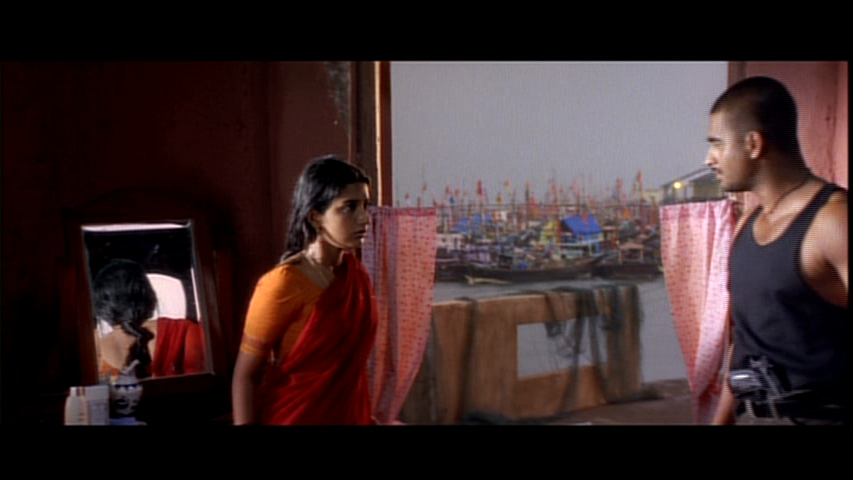
First we meet Inba, played by Madhavan in an uncharacteristically brutal role for him.  He is a thug, who works for his brother mainly ensuring a local politicians campaign runs smoothly. Inba beats his wife and almost casually chooses violence over any other form of social interaction. Inba’s current employer, Selvanayagam the local politician played by Bharathiraja, is the spider in the centre of the web.  He employs Inba to police his rallies, and is in direct conflict with the second character in the drama, Michael.  Through their involvement with each other, the third, Arjun is drawn into the fray.
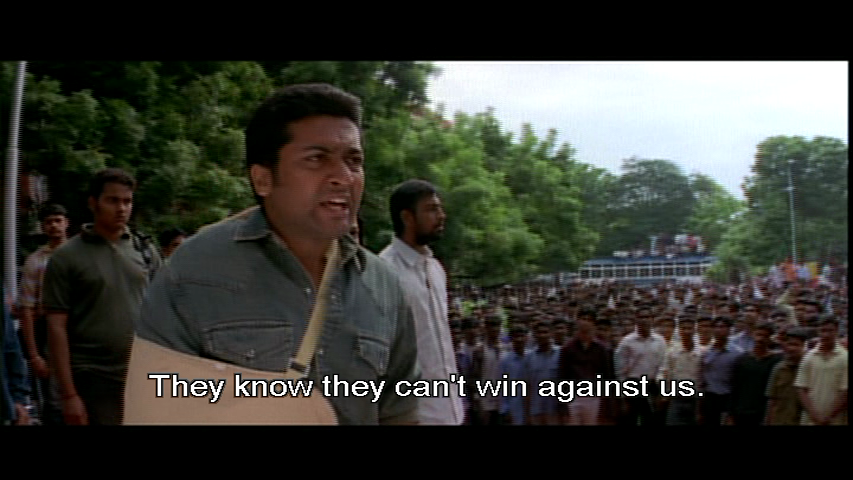
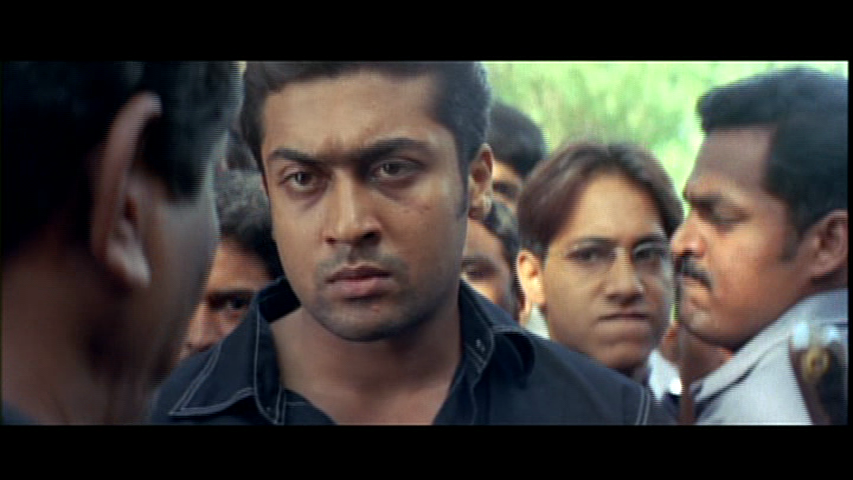
Suriya plays Michael Vasanth, a student, apparently a mathematical genius and also a political activist.  Not for him the more normal student methods of agitation such as demonstrations or debates, he prefers to be more direct in his approach and encourages retaliatory action.  This brings him into direct conflict with Selvanayagam and thus ultimately with Inba.  Suriya also seems out of place in his role.  He is muscular and obviously powerful, which doesn’t fit the image of a serious scholarship winning student.  His solution to problems faced by local villagers seems to be almost as confrontational as Inba’s violent tactics.  He appears belligerent and selfish as we see him brush off his mother’s concerns and treat his girlfriend badly. Although it is quite conceivable that students will use such extreme tactics, as has frequently been seen in many countries of the world, this approach just felt wrong with these characters. Perhaps this was partly an issue with the subtitles which may not have conveyed the dialogues accurately, but Michael came across as a very unpleasant character and his political aspirations felt more self-serving and less for the public good than perhaps was intended.
The final character in the drama is Arjun, played by Siddharth.  A playboy who has just finished his studies and plans to head to the US, Sid at least seems to fit the role he has been given.  His approach to life seems much more in keeping with his character and his pursuit of Meera, while typically filmi does feel much more genuine than Michael’s relationship.  By a series of coincidences all three are on the same bridge at the same time.  Inba uses this opportunity to get rid of Michael by shooting him, which sends him falling into the river past Arjun’s shocked gaze.

The storylines all converge at this point, and the aftermath of the confrontation is played out to its bloody and somewhat inevitable conclusion given the arrogance and brutality of the main characters.

What are much more interesting about this film are the female characters.  Although she is regularly abused by Inba, his wife Sasi is a very strong personality who is determined to wean him away from his brother’s influence and stop his forays into crime. Their relationship is very realistically portrayed by Meera Jasmine who is fantastic as the battered wife. Despite her family’s objections to her husband, Sasi enlists them to help get Inba a job, so she obviously has great powers of persuasion.  Madhavan’s scenes with her are the best in the film and she was very compelling in her performance. Trisha in her role as Meera is less of a driving character, but she is part of the reason why Arjun changes his playboy ways as he slowly falls in love with her.  She is convincing and effective in the initial scenes, but towards the end of the film she appears to be sidelined. Esha Deol plays Geetha, who is involved with Michael.  There is a lot of potential in their relationship as he doesn’t want to get married and asks Geetha to move in with him instead.  This opportunity to look at the issues surrounding marriage and commitment is squandered as the theme is never really developed further.  Geetha lies to her parents and to Michael’s mother and never really becomes anything other than the woman in Michael’s life.

However these three women, as well as the various female characters that stand for election in the story, seem to be at least an attempt to show women as other than just the pretty wife, girlfriend or daughter.  There is more meat to their roles here, although it’s not sustained and ultimately only Sasi makes a lasting impact.

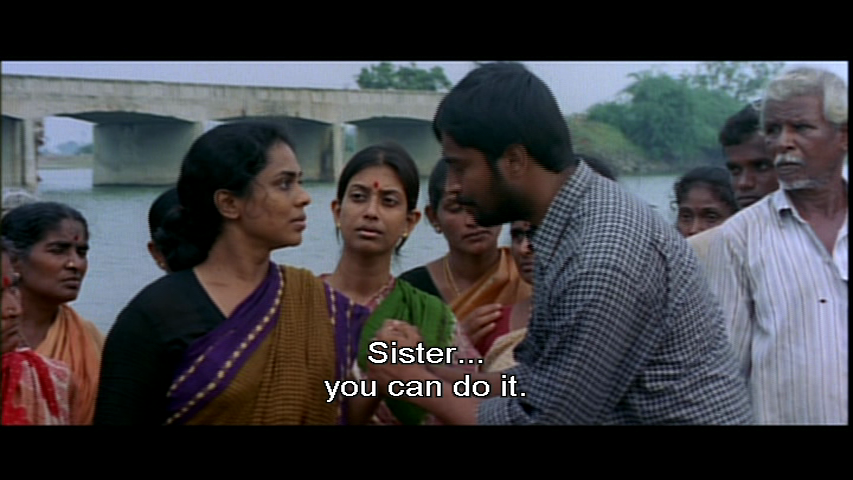
Because of the belligerence behind Michael’s actions it’s hard to see him as one of the good guys.  The virtual worship of him by the other students contributes to the impression of arrogance and he imposes his will on everyone around him without any seeming thought to the consequence.  Despite his thuggish ways, Inba appears as the more sympathetic character as he is genuinely trying to change his ways, but cannot get out of the cycle of violence he has lived with all his life.  The supporting characters all seem to have their own agendas as well, keeping the whole feel of the film as one of corruption and deceit.  The only genuine people seem to be the villagers caught up in the struggle for their village. While the film tries to be a statement on youth and politics, the end result seems to disregard Michael’s supposed motivation and political ambition and highlight the futility of anything other than corruption and violence as a means to achieve and hold on to power.  The secondary plot line of Inba’s attempts to escape his violent lifestyle is much better handled. While Meera Jasmine is the standout performance, both Trisha and Esha Deol ultimately aren’t given enough screen time to be effective.  A special mention for Sriman who played the character of Dilli, and was excellent in his role as Inba’s conscience.

Heather says: I really didn’t like this film.  For me it may have worked better if the casting of Madhavan and Suriya had been the other way round.  I found that Suriya didn’t fit the image of a student at all. He is too old and not convincing, while Madhavan in his role switches between mayhem and maniacally happy.  This didn’t seem to fit either the characters lifestyle or generally bleak prospects.  As a man recently released from prison, with a pregnant wife and no real job aspirations other than working for his brother, the ‘crazy happy’ was difficult to swallow.  Some of this was to show the reason why his wife stayed with him, and indeed some of these scenes were much less overdone.  This may have been a directorial decision as Abhishek Bachchan appears very similar in his characterisation of Beera in Raavan. I stuck with the film mainly because of the relationship between Inba and Sasi which was very well portrayed. Siddarth’s character was also quite watchable, and overall the story was interesting, but I was very tempted to fast forward every time Suriya was on screen. I have liked him in the other films I have seen him in and was horrified by him in this.  I really wanted his character to die as quickly as possible, just so that I did have to suffer through his flexing and belligerence.  I wish I had liked this film more but thought it was a potentially good story that for me was ruined by bad choices in the cast and poor directorial decisions. 2 1/2 stars from me.

Temple says:  This is another film that, like Leader, is well made but not likeable. I have issues with the character of Michael and his immunity from consequences. Everyone around him is made to pay for his activism but he escapes with a few flesh wounds. Surya was unappealing as he seemed to show only the arrogance of Michael and gave me nothing to respect in that character. Unlike Heather, I really liked Madhavan’s performance in this. I thought he really made sense of Inba and Sasi’s relationship, and showed the complexity of his character. He was boyishly impulsive, and casually brutal in turns. He showed the pressure Inba felt to be a man’s man and ignore his wife unless they were behind closed doors. Their relationship was compelling as Meera Jasmine showed the gamut of attraction and repulsion depending on which side of her husband’s nature was dominating.  I didn’t get the impression he was ‘crazy happy’, he was just a thoughtless guy who wanted what he wanted, and was happy so long as things ran his way. I thought the whole cast, with the exception of Surya, did a good job and made the most of their roles. I did have to laugh (a lot) at the idea of Esha Deol teaching French though! So, while I don’t like the inherent message that corruption is OK as long as you say you mean well, I do think this film was compelling and well made. The only disappointment was the lack of follow through on what seemed to be interesting roles for women. 4 stars from me.

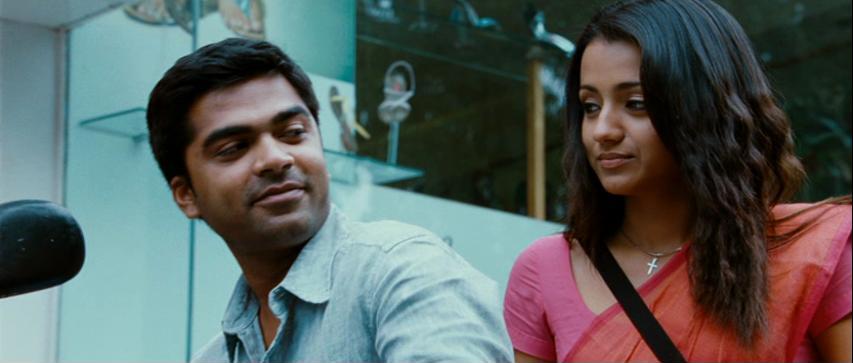
Vinnaithaandi Varuvaayaa

A number of people recommended this film to me, and I really should have listened to them and watched it sooner!  VTV (to save on space!) released earlier this year and was an instant hit.  Much of its success must lie with the performances from the two leads – Silambarasan (Simbhu) and Trisha as much as from the excellent direction, beautiful music by A R Rahman and a very realistic story.  The title, which is translated to ‘Will you reach for me across the sky’ is actually a lyric from Minsara Kanavu, a film by Rajiv Menon, and this is credited in the opening titles – a very nice touch.

The film is the story of a relationship between Karthik and Jessie.  Karthik sees Jessie walking along his street shortly after his family has moved in, and falls instantly in love with her.  One of the few typical filmi devices used in the film.


Jessie is his neighbour, and as Karthik sees her every day he tries various ways to get her attention.  After exchanging meaningful glances and brief conversations he eventually blurts out that he loves her, and she instantly tries to dissuade him.  She is Malayali Christian while Karthik is Tamil Hindu and Jessie knows that her family will never consent to the match. Despite this and her initial reluctance Karthik pursues Jessie, but we never feel that this is creepy filmi stalker love.

He is very open in his admiration and Jessie appears to reciprocate – she obviously has feelings for Karthik, but her upbringing and the fact that she is trying very hard to stay true to her family’s values means that she holds him at arm’s length.

This indecision is wonderfully depicted in a scene in the train back to Chennai.  Karthik has followed Jessie to her family’s home in Kerala and after managing to meet her, he catches the same train home.  We can see Jessie’s developing feeling for Karthik warring with her loyalty to her family.  She is attracted to Karthik, perhaps even excited by his obvious adoration of her, and while she wants to kiss him, and take things further, she is reluctant to take those steps.

This realism is what makes the story so compelling.  Karthik’s frustration is very evident – both with Jessie when she blows hot and cold, and with the whole situation.  He clearly just wants her to be with him, and has no real thought to her family and the consequences to her if she marries him since his family does not seem to have the same reservations.

Whereas Jessie has seen the problems caused when her sister fell for a man her father did not approve of, and doesn’t want the same pain for herself.  Almost in spite of herself we see her fall in love with Karthik and then struggle with how to reconcile her family and her love.

The couple is often pictured with the gate, or some other barrier between them very poignantly illustrating their troubled relationship.  In fact, they are often not shot together, and the camera switches between them.

But when they are together they look fantastic and the chemistry between them zings!  Karthik is an aspiring film director, and this is cleverly worked into the film.  However it’s another source of their separation as Jessie doesn’t watch films, and Karthik ends up going to Goa for a shoot.  Yet another divide is the age difference – Karthik is a year younger than Jessie.  Despite all of this, and in spite of Jessie’s family’s opposition, their romance flourishes.

The end comes as somewhat of a surprise for such a romantic story, but is absolutely brilliant and just works!  The Telugu version, shot simultaneously with Naga Chaitanya and Samantha, has a different ending which for me diluted the film’s impact, making it less powerful and memorable.

Both leads in this film are fantastic in their roles, and have great chemistry together.  They convey their growing attraction to each other in such subtle but very natural ways adding to the realism of the film.  Since the whole story revolves around them, their performance has to be perfect to capture the audience’s attention, and they succeed admirably.  I haven’t seen Simbhu before, and while I’ve read that this isn’t his typical type of role, I will definitely keep an eye out for more of his films.  Gautham deserves much praise for the restrained way in which he handles the screenplay.  The soundtrack is beautiful and the songs by Rahman add to the whole romantic feel of the film.  Even the more upbeat numbers contribute to the overall feel of the film.  As always for his music, I was left singing the songs, (or rather humming along since I don’t speak Tamil), for weeks afterwards.

The supporting actors are really just there to provide reactions to the main couple, but all do a good job in their much less realised roles.  Ganesh is very good as Karthik’s friend, while Kitty as Karthik’s father and Babu Anthony as Jessie’s make the most of their small roles.   The conflict between Jessie’s father and brother and Karthik is very well played, and their interactions with Jessie are also well depicted.  A clever touch is that the Telugu leads play the roles of Jessie and Karthik in his film within the film, and vice versa in the Telugu version.

The other standout of the film is the scenery, captured so well on camera by Manoj Paramahamsa.  The locations, particularly in Malta for the songs and in Kerala, are stunningly beautiful.  And what a way to arrive for your wedding!Perhaps the only flaw to this film is that it is paced quite slowly.  There is only 1 fight scene and not a machete in sight!  However this approach worked for me considering the subject matter, and I was never bored.  In fact I absolutely loved this film!  The story is simply and well told and the actors are amazing.  5 stars. Heather

Endhiran

After all the hype, hysteria and build-up we finally made it to a packed showing of Endhiran.  There was a definite buzz in the air as we queued in disorderly fashion totally blocking both the main street and the exit to various shops and restaurants in the area.  As the opening credits rolled, the crowd went wild, and we were off into our first Tamil film with subtitles in the cinema.

The film starts well with an interestingly wigged and bearded Rajni working on his robot creation.  His lab is wonderfully futuristic and his lab assistants appropriately comedic.  We then had the introduction of his love interest in the form of  Sana (played by Aish), and this was where the film began to lose its way.  There was no chemistry between them as a couple, and the age difference was notable. Aish actually looked far too old to be playing a medical student, especially one who was too flaky to study for her exams.

Scenes between Rajni as Vasi (the scientist) and Chitti (the robot) were generally done well and conveyed the growing tension in the relationship between the man and his creation. Rajni’s performance in both roles was very polished and often compelling. Again though, the lack of chemistry between the leads undermined this as the plot hinged on Chitti falling in love with Sana and that failed to be really convincing. Once love drives the man and robot apart , the film turns into a revenge action drama and the pace picks up.

Danny Denzongpa makes a welcome return as Dr Vaseegaran’s old teacher, and current rival in robotics. He makes some fine points regarding ethics and behaviour, and seems to have more of a grasp on what it means to create sentient life than any of the good guys.  Unfortunately he seems to be much less well funded than the lone scientist Vasi, and this leads to some bad choices in his associates.

The film tosses up some really interesting ideas and questions, but fails to expand on or answer them which was frustrating.   The scene where Chitti rescues people from burning buildings had so much potential to expand on the theme of the value of life, but instead just served to point out how far removed from the realities of life the scientists had become.

The effects in general were really well done, but even for a sci-fi film like this there just seemed to be too much reliance on clever CGI and not enough on actual story.  For example, in the fire scene the robot could fly with no obvious means of propulsion and despite being hot enough for his silicone skin and clothes to burn away, his metallic frame wasn’t so hot that it burned any of the people he helped. It was obvious that the artistic vision didn’t extend to any basic logic or science.

Once we got to Chitti 2.0 the pace did pick up and the story did consolidate into a straight good guys versus bad guys. Rajni has a great line in evil laughs and his evil strut was a crowd favourite. The production design was excellent and the appearance of the various lairs, labs and other locations suited the theme of the film.

The basic question of why Chitti didn’t have the same rights as the men around him was never addressed, despite that being the reason for him turning to the dark side. Instead, we got more CGI and more Rajnis – not necessarily a bad thing but it did go on for longer than it needed to. We did love the snake! Once all the whizz bang technological effects were done with, the film failed to really reach a conclusion. It seemed that all the surviving characters would just go on with their lives as though this little episode had never happened. It was quite disappointing and not satisfying at all after so much build up and excitement to leave the film with no clear conclusion.

The songs were generally well placed in the film and were beautifully shot.  The outdoor locations were stunning with some excellent use of local fauna.  Aish’s outfits were beautiful and the costumes in Kilimanjaro do deserve special mention for the total exuberance of feathers.

Heather says: While I did enjoy this film I thought it could have benefited from longer in the editing room. The film seemed to be a collection of good scenes which were drawn out a little too long and too many ideas which were never fully developed.  The story had a tendency to lose its way when the focus was on the romance between the two lead characters and this tended to lose my attention.  Rajni however was fantastic and his scenes both as the scientist and as the robot worked very well. He was always the main focus of attention in any scene and made the most of his double role.  His assistants provided most of the comedy and I found them to be very funny and also quite well utilised in the story.  I’d been playing the music for weeks, and liked most of the songs.  Watching the film, even the two songs I hadn’t really liked on the CD worked well and although the dancing was perhaps a little lacking the locales and costumes were elaborate enough to make up for that.  I really didn’t like the bad medicine in one scene – always a pet hate for me, and even some of the physics was just a little too hard to swallow.  But then again it was a sci-fi film and not meant to be taken literally!  On that sci-fi note, the special effects really were special.  Overall the CGI was impressive, and the robot scenes in particular were very well done.  They did seem to get a little carried away towards the end, but the film did have enough of a futuristic feel and justifies at least some of its apparently massive budget.   Perhaps I just expected too much from a Rajni film, and it failed to be as good as anticipated.  But I did enjoy the film and with a little more thought on the editing felt that it could have been excellent.  In this current version, I give it 3 and 1/2 stars.

Temple says: There was a lot I enjoyed about Endhiran but also a lot that left me cold.  Rajni is the superstar, and he certainly dominated the screen whenever he appeared. He had to carry the whole film, and managed to make the biggest scenes and the smallest moments compelling and memorable. He was ably assisted by his wig designer! The first half of the film just dragged, and spent far too long on the unconvincing Rajni/Aish relationship. Aish’s acting was poor throughout, but having seen her give excellent performances in other films (Ravanan, Raincoat, Kandukondain Kandukondain, Devdas) I place a lot of the responsibility for that on a weak character/script and on the director. The second half of the film was much more successful and more enjoyable. It was clear that Shankar has been “inspired” by many other blockbuster films, and seemed determined to use scenes from many of them in Endhiran. This collage effect was spoiled by the lack of linking episodes and dialogues so it became a bit disjointed and messy. I can’t even begin to explain the mosquito skit. The supporting actors are good, and it was great to see Danny Denzongpa back as a villain of sorts.  I didn’t like the music before I saw the film, and thought that might change seeing the songs in situ. It didn’t. I still don’t like the soundtrack much at all, and found it boring despite the excellent production design for the song picturisations. With a good edit, and a bit more thought for the story, this could have been brilliant. I give it 3 stars.