Nagara Haavu (1972)

Nagarahaavu

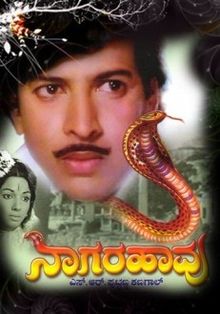
Nagara Haavu is a classic film from Kannada cinema featuring Vishnuvardhan in his first lead role. Director Puttanna Kanagal based his 1972 screenplay on three novels by T.R. Subba Rao, telling the story of an angry young man, his love affairs and his relationship with his old primary school teacher, who seems to be the only one who has any patience with his outbursts. The film is set in the 1950’s and although many of the social conventions are now outdated, there are some that still apply to-day; while Ramachari’s struggle against conformity continues to be a popular theme in modern cinema. At almost 3 hours Nagara Haavu is a bit of an epic, but it’s an interesting film to watch and essential viewing to anyone interested in the evolution of cinema in Bangalore.

The film begins and ends with the same images of rocks and the sun viewed through a red filter, presumably an indication that despite the tumultuous events portrayed, by the end nothing has actually changed. The young Ramachari of the opening scene is a rude and angry child with terrible hair, who grows into a rude and angry young man, still with a terrible haircut. This time perhaps he has reason for his anger since his teacher instructs him to remove his trousers when he is caught cheating at college. It seems rather extreme, but Ramachari (Vishnuvardhan) has a reputation as being a bad student and his reaction is even more over the top. He decides that if he is considered to be villainous, then he will become villainous, going to his professor’s house and smashing the windows. Not content with this wilful destruction of property, Ramachari then ties Shyamrao (Lokanath) to a lamppost and leaves him there overnight to the horror of Tungamma (Leelavathi), Ramachari’s old schoolteacher’s wife. And me! How he avoids being arrested is baffling!

Ramachari seems to be angry with everyone and everything, but the reason for his apparently all-consuming rage is never fully explained. It may be partly due to frustration with his religious parents who revere God above all else, and seem to have little time for their son. Possibly his anger is a reaction to being forced to study when he clearly has no interest or aptitude, but whatever the reason, Ramachari has a well-deserved reputation for belligerence in his home town.

The only person who seems to have any time for Ramachari is his old schoolteacher Chamiah (K.S. Ashwath) who has practically adopted Ramachari and considers him to be his son. His wife Tungamma also has a soft spot for the troubled youth and between them they act as mentors and advisors whenever Ramachari finds himself (yet again) in trouble. The relationship between Ramachari and Chamiah is well written and excellently portrayed by Vishnuvardhan and K.S. Ashwath through both the good and the bad times. There is real warmth between them, and Vishnuvardhan does an excellent job of capturing the respect and love that Ramachari feels for his mentor. For his part, K.S. Ashwath is compassionate and stern as required while making it clear that he can see beneath the surface anger to the possibility that Ramachari represents. The dialogues between the two are the best parts of the film, as Chamiah tries to instruct Ramachari how he should behave in society, while Ramachari does his best to point out the double standards and hypocrisy that make him rebel against convention.

Ramachari’s best mate is Varadha (Shivaram), a man who knows the value of product, and who happens to have a beautiful sister Alamelu (Aarathi). When Alamelu is harassed by local sleaze Jaleel (Ambareesh) her brother is too much of a wimp to do anything, so he recruits Ramachari to deal with the problem. Ramachari has seen Alamelu, so his price for helping her dissuade her unwelcome suitor is to marry her himself. Neither Varadha nor Alamelu have any problem with this plan but it’s a different story for Alamelu’s parents who have no desire to marry their daughter to the local rowdy.

There is much drama when Alamelu steals away to tell Ramachari of her impending marriage to someone else and it’s up to Chamaiah to persuade Ramachari that Alamelu’s parents should decide her fate. After much emoting, Ramachari is eventually persuaded that sacrificing his love is the noble thing to do although it’s clear that Chamaiah doesn’t believe this at all and is simply bowing to conventional wisdom and the presumed dictates of society.

This has serious consequences for Ramachari’s relationship with Chamaiah when he later discovers that instead of living in luxury, Alamelu has been forced into a life of prostitution. This could have been one of those terribly over-dramatic scenes so common in seventies Bollywood, with Alamelu dying rather than continue to live in shame, but instead Puttanna Kanagal gives her a beautiful song and impassioned speech where she says that she wants to live! OK, she’s not happy, but it’s better than the usual attempt at suicide at least. There is also a lovely moment of symmetry too when this time it’s Alamelu who walks away from Ramachari and sacrifices her love for his sake. It’s all wonderfully melodramatic as Alamelu recites her story to Ramachari beside a red-lit fountain.

After Alamelu is married, Ramachari is pursued by Margaret (Shubha), a girl from his class in college who is determined that he should fall in love with her. She is portrayed as being more modern, chasing after Ramachari shamelessly, wearing Western clothes and declaring her love quite openly. Margaret seems to get away with all this because she is Christian and the daughter of a single mother – which is apparently all we need to know to realise that she is no better than she should be. Once again Chamaiah is recruited to break up the relationship as Margaret’s mother Mary (M.N. Lakshmi Devi) has much bigger plans for her daughter while Ramachari’s parents are mortally offended at the idea that their son would marry a Christian. The question is, will Ramachari listen to his long-time mentor or has he lost faith after what happened to Alamelu?

There is plenty of over-the-top drama in Nagara Haavu and some of the best ‘death stares’ I’ve seen for a long time. Everyone overacts like crazy, Ramachari throws chickens at Margaret after she teases him in class, her mother accuses him of rape, while Chamaiah clambers over rocks trying to find Ramachari to drag him off to apologise to the latest person he has offended. All apparently part of a normal day in downtown Chitradurga!

As well as showing the relationship between a troubled youth and his kindly teacher, the film paints a picture of a dysfunctional society where appearances and prestige matter more than love and happiness. Chamaiah believes that Ramachari just needs time to mature and indeed he becomes a more responsible person when he is allowed to leave college and work for a wage. The rest of the town however brand him a troublemaker and don’t allow him the opportunity to ever become anything else. No matter how much Chamaiah tries to fit Ramachari into the role that society demands, he is never going to conform, particularly when Chamaiah realises just how shallow and self-centred society has become.

Nagara Haavu is deservedly classed as a classic film with good performances, a well-written story and engaging music from Vijaya Bhaskar. Despite the length, the film doesn’t drag and is a fascinating look at times past, society attitudes (and fashions!) and family dynamics of the time. Some thing have changed, but many of these issues are still a concern even now, making the film relevant and not as outdated as it first appears. The dialogues might seem stilted, but the ideas behind them are valid and used to good effect. I enjoyed Nagara Haavu and recommended watching it for Visnuvardhan, Aarathi and K.S. Ashwath, the excellent screenplay plus beautiful shots of Chitradurga and countryside. 4 stars.
Kavan (2017)

Kavan

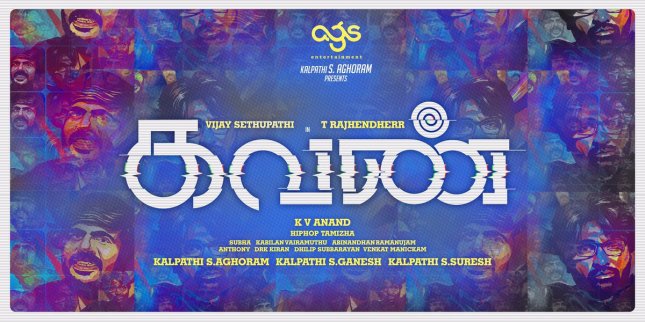
K.V.Anand doesn’t tread any new ground with his latest film Kavan, revisiting a theme of land and water contamination by big business that’s been seen many times before. But rather than making another ‘message’ or pure action film, here we are firmly in masala territory, and that’s what helps make Kavan such a watchable film. It’s set in the world of television and journalism where breaking news is the key to big ratings and in this new post-truth world of alternative facts, the machinations of one TV station to keep ahead of the competition don’t appear quite as far-fetched as they may have done a few months ago. Writers K.V. Anand, Subha and Kabilan Vairamuthu have come up with an entertaining screenplay and some excellent dialogue that drive the story along despite numerous diversions. With great performances from Vijay Sethupathi and Madonna Sebastian, Kavan is more engaging and enjoyable than expected, even with the 160 minute run-time.

Vijay Sethupathi is Thilak, the only student in his class who wants to make documentaries rather than work in films or TV which immediately identifies him as someone more interested in facts and the truth than entertainment. However, he ends up working at Zen TV, alongside his former girlfriend Malar (Madonna Sebastian) who doesn’t want a bar of him after their acrimonious break-up. Initially Thilak does well, impressing channel owner Kalyan (Akashdeep Saighal) with his novel approach, but it doesn’t take long until Thilak’s moral stance gets him into trouble. Kalyan is prepared to put anything on-screen as long as it will lift ratings and he isn’t above manufacturing news either. Alongside corrupt politician Dheeran Maniarasu (Bose Venkat) he spins facts out of all semblance of the truth to promote Dheeran Maniarasu’s political career and his own TV channel. The inevitable clash comes about due to Dheeran Maniarasu’s involvement with a chemical company which is polluting the local area.

Activists Mira and Abdul (Vikranth Santhosh) are friends of Malar who fall foul of the politician and his rowdies and their subsequent search for justice sees Thilak and his friends leaving Zen TV for good. They team up with Mayilvaganan (T. Rajendar) who has a small struggling TV channel and start their campaign to broadcast the truth.

Now, initially I found Rajendar’s comedy jarring and out of sync with the slick styling of the rest of the film, but as the story moves on, and Malar and Thilak start to work with Mayilvaganan, his eccentricities become more relevant and I found his scenes to be really funny. His routine may not change, but Rajendar is good at what he does and that can be very effective, especially as here when administered in small measured doses.

The move to Mayilvaganan TV has the added bonus of demonstrating how to renovate on a budget, if you should ever feel the need to know, and of course the new revamped channel starts to become popular as it spreads the true story of Dheeran Maniarasu’s various corrupt practices.

The story plans out exactly as expected but there is a good mix of drama, comedy, action, and just the smallest amount of romance as Malar and Thilak put aside their differences. Despite the total lack of surprises, the film keeps us interested by keeping the story topical – there are mentions of recent events such as demonetisation and the Chennai floods – and adding plenty of good snappy dialogue. Vijay Sethupathi is always very watchable and he excels yet again, ensuring that his character’s belief in truth and honesty in reporting never come across as preachy or too sanitised. No matter how ridiculous the plot (running through woodland carrying a camera chasing a car and still managing to arrive in time to catch the action for instance), it somehow always seems possible in the face of Vijay’s absolute confidence and sincere belief in the role he is playing. He looks the part of a journalist, and I loved the brief glimpse of laser eye-correction surgery to ditch his glasses before he went on-air as a talk show host. Shame though as he looks good in specs!

Madonna Sebastian too is charming and plays the role of a modern career woman well. Her early scenes with Vijay are brilliant and I liked Malar’s gradual realisation that actually Thilak wasn’t such a bad guy after all. For a commercial entertainer this is a better than usual female role where Malar isn’t just the love interest, but has a reasonably substantial part to play in the story too. The romance too is very low-key and more an acknowledgement that the two are in a relationship rather than the more usual excuse for a flurry of songs. This is pretty much all of the romance in the film – nicely condensed into one song from Hiphop Tamizha.

The friends, including a rather subdued Jagan, are all good too, although they don’t have much to do for most of the film. Vikranth Santhosh stands out as the activist and his impassioned appeals for justice come across as more heartfelt and sincere than expected for a masala film.

As in Ayan, Akashdeep Saighal as the villain is the weak link for me, although this is likely due to the sketchiness of his character. All the hair tossing and posing suit the character of a TV mogul better at any rate and his acting has improved slightly, but I didn’t buy into the character of Kalyan at all. Bose Venkat is much better as the corrupt politician and does appear appropriately duplicitous throughout the film. It’s often the villain that lets these films down, but since it’s the policies of Kalyan rather than the character that Thilak and Malar are fighting, it’s not as important that Kalyan fails to make much of an impression.

Basically Kavan is a masala entertainer that doesn’t pretend to be anything ese. There is never any sense that the film is trying to be a serious exposé of the TV industry, or that the various feminist, Hindu-Muslim brotherhood or land right speeches are meant to generate a response; it’s simply a story to enjoy in the theatre with a box of popcorn. It is overlong and there are a number of diversions that aren’t at all necessary but the dialogue is good, the performances generally excellent and the masala mix is just about right. Worth watching for Vijay Sethupathi, Madonna Sebastian and a vision of alternative facts that’s perhaps a tad more realistic than may have been planned.

Phillauri

Anshai Lal’s Phillauri is set in two different timelines, and is a movie of two very different halves. Usually things take a turn for the worse after Intermission, but in the case of Phillauri it is the first half that I found a chore.

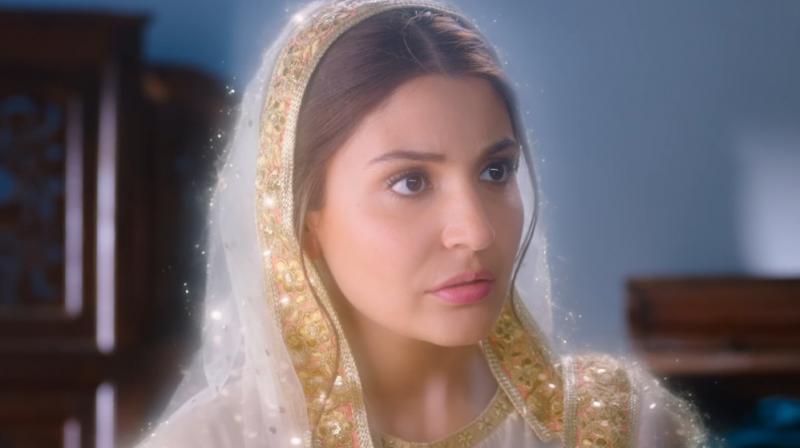
Kanan (Suraj Sharma) goes home to India to get married to his longtime girlfriend Anu (Mehreen Pirzada). Just before his engagement he is told he has a problem in his horoscope, and the only way to avoid future calamity is to marry a tree. He is sceptical but does what the families want. Soon after the tree wedding, he is woken by a sparkly spirit hovering above his bed. Shashi (Anushka Sharma) found herself transported to the house, but had no idea how or why. Only Kanan can see or hear Shashi, just adding to his already troubling behaviour. He is ambivalent about marrying Anu, Shashi is unhappy at her lot, and Anu is miserable that the guy she loves is turning out to be a wuss. So it was a huge relief to skip back in time and learn more about Shashi and the love of her life, Roop Lal Phillauri (Diljit Dosanjh). Shashi and Anu between them force Kanan to examine his decisions and motivations. Will Kanan and Anu get married? And what happened that Shashi spent 98 years alone, her spirit connected to the tree?

The modern story line is the least interesting by far. It feels glib, done by numbers, and is not helped by some weak performances. Suraj Sharma is particularly flat as Kanan, and terribly unconvincing in scenes where he is supposed to be overcome by fear. Speaking in a weedy falsetto is not enough. Mehreen Pirzada gets almost nothing to work with. Anu has been in love with Kanan since school, she has never had any other plan than to marry him, and I have no idea if she has a job or finished college or anything else. Anu is a weepy, sullen girl which is a bit tiresome although understandable. I did like that she confronted him and demanded he articulate his feelings and make a decision, not just try and passively weasel out as she deserved better than that. There is the usual array of parents and relatives, and a pickled grandmother who starts drinking at breakfast. And there’s a rather nasty “joke” about Kanan being gay and maybe a paedophile. It’s mostly a jumble of clichés, and where the dialogue is a bit more realistic the acting falls over.

The earlier timeline seems to be given so much more love, the writing is more solid, and the performances are stronger. Shashi helps her brother the village doctor, who has raised her since she was young. She is educated but conservative, knowing how a girl from a good family is expected to behave.  Shashi’s one weakness is poetry, and she waits every week to see the poems of Phillauri in the journal. Roop Lal Phillauri (Diljit Dosanjh) uses the same name but his songs are bawdy drinking fare, not the more heartfelt and literary work that Shashi loves. He is a flirt, and she shuts him down when he pretends to have written lines that she knows the real Phillauri wrote. But their mutual love of poetry and music, and of love, brings them together. Anushka and Diljit have a beautiful low key chemistry that makes their scenes together shine. She is expressive even without speaking and he inhabits the role of country layabout turned honest man so comfortably. It was a pleasure to get back into their timeline, and not just for the nostalgic beauty. Shashi’s story served to show how the status of women hasn’t improved significantly in almost 100 years, and was also a sterling example of a relationship built on equality, consent, and honesty.

One of the most understated but surprising scenes was a conversation after Shashi’s affair had been discovered. Her brother (played beautifully by Manav Vij) was furious, and laid into both Shashi and Roop Lal. All typical filmi villain thwarting True Love stuff. But later he took her a drink and spoke to her about how he had raised her like his own child and always wanted her to have everything she deserved, and that he loved her. Not what I was expecting at all, although I may have muttered something about the patriarchy. When Shashi and her best friend Amrit (Nidhi Bisht) were talking discreetly about her virginity situation, the scene was nicely gossipy but also quite sweet and not salacious. I liked seeing Shashi being herself, and having people love her for it, without Anushka taking so much as a step towards the Manic Pixie Dreamgirl line. And I don’t want to spoil the story but there are scenes where Anushka and Diljit show a whole arc of story just through the emotions playing across their faces.

The film’s mythology is a bit patchy. Is technicolour glitter cannon heaven a thing for Sikhs? Does every ghost have tinkerbell sound effects and shed a trail of sparkles? Why did Shashi usually float on an awkward horizontal rather than gliding vertically? Why could she wear Anu’s dupatta but not be seen or felt by anyone other than Kanan? Who knows.

But for all the cheesy effects, there are songs like Dum Dum and Sahiba that take us into the story and reveal more of the rich inner lives of Shashi and her bloke. Anvita Dutt wrote the screenplay and some lyrics, and her dialogues were a highlight in the olden days timeline.

Phillauri is not a masterpiece but it does show flashes of excellence. If Lal had been more disciplined in that draggy first half, and maybe pushed Suraj Sharma to try more nuance in his squeaking, it would have helped. But I liked seeing a full blown romance centred on two people who were genuine, honest, and respected each other. Tolerate the first half and enjoy the second half!