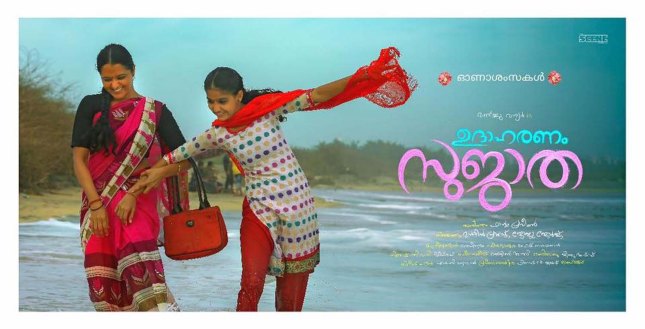
Udaharanam Sujatha

Udaharanam Sujatha

Udaharanam Sujatha tells the story of Sujatha, a hard-working single mother, and her attempts to ensure her daughter Athira studies and passes her year 10 school exams. Sujatha has big plans for her daughter, but the problem is that Athira isn’t interested in studying and rather than thinking about her future, her dreams involve movie stars instead. Phantom Praveen has directed this Malayalam remake of Hindi film Nil Battey Sannata by Ashwini Iyer Tiwari (who has also remade the film herself in Tamil), with a more Kerala-centric screenplay from Naveen Bhaskar and a few changes to the lead characters. It’s a simple story that focuses on the mother-daughter relationship and features excellent performances from both Manju Warrier and Anaswara Rajan as her somewhat rebellious daughter. I did have a few issues with some parts of the film, but the overall feel good factor and balanced mix of drama and humour ensures Udaharanam Sujatha is well worth a trip to the cinema.

Sujatha (Manju Warrier) gets up well before dawn to start her seemingly endless round of jobs to raise enough money to pay for her daughters education. Sujatha herself left school after 9th standard which she feels has severely limited her choice of occupation, and as a result, she resolves that her daughter needs to do well at school. However Athira (Anaswara Rajan) doesn’t care at all about her studies and has no thought for her future. She lives in the present, watching music videos on TV, playing with her friends and day-dreaming about Dulquer Salmaan. Athira doesn’t appreciate the long hours that her mother works to fund her education and even tells Sujatha that a doctor’s daughter will be a doctor and an engineer’s daughter will be an engineer, so since she is the daughter of a kitchen maid, that is all that she will become. Since Athira also regularly and quite spectacularly fails her tests at her school it seems unlikely that Sujatha’s grand plans will succeed no matter how hard she pushes Athira.

For one of her jobs, Sujatha works for prominent script writer George Paul (Nedumudi Venu) who listens to her daily recitation of her worries and fears about Athira with a surprising amount of tolerance. He finds a friend (Alencier Ley Lopez) who runs a tutoring service and who is willing to offer Sujatha a substantial discount, but only if Athira scores more than 50% in her maths exam. When Sujatha complains to George about the unlikeliness of Athira reaching this target, he suggests that Athira needs some competition and persuades Sujatha to go back to school herself and complete her Year 10 education.

A scene where Athira discovers her mother’s plans and attempts to cajole her mother with promises of improved study interspersed with pleas and general teenager angst is brilliantly written and perfectly performed by Anaswara. Her mother’s response is just as good and gets to the heart of the relationship between the two. Sujatha is determined to make her daughter succeed in life and is willing to go through the humiliation of going back to school to force her daughter to study. Athira’s subsequent tantrums and her refusal to acknowledge her mother’s presence in the classroom are also well handled, while Sujatha’s gradual acceptance by the other students seems plausible given her ability to cook! The good points though are mixed up with some terrible clichés such as the bespectacled nerd of the class who helps Sujatha understand maths, and the horribly abusive teachers who seem out of place in a film about the benefits of education.

Also problematical is the inference that doing a job such as working in a factory or as a maid is somehow shameful and to be avoided at all costs. While I can sympathise with Sujatha’s desire that Athira gets a good education and has options to choose from, it doesn’t follow that working in these jobs is wrong. Every parent wants the best for their child and particularly would prefer to see that they have a comfortable life, but this doesn’t mean that a house maid should be looked down on, just because of her occupation. However, aside from these points, the rest of the story is a heartening tale of the importance of a good education and how Sujatha manages to change her daughter’s attitude. It’s surprising that Sujatha manages to attend school at all, given her busy schedule of work but Naveen Bhaskar doesn’t let logic get in the way of a good story and after all, perhaps Sujatha has a time-turner hidden away somewhere.

The star here is undoubtedly Manju Warrier who is excellent as the harried mother desperate to wake some ambition in her daughter. Her work ethic is amazing and well portrayed, but what really stands out is the love she has for her daughter and her strength of will to make sure that nothing will get in the way of her dreams. She is fantastic as a concerned mother and completely inhabits the character of a cook/pickle-maker/house-maid/cleaner from a slum area of the city. Anaswara Rajan is also excellent as the bratty and ungrateful Athira who resents her mother’s interference in her life. Her whining is brilliantly irritating and her self-absorption typical of a teenager who naturally knows better than her mother. Together the two actors make a formidable team and it’s the warmth of their relationship that takes the film up a level to make it more than a simple moral tale about the value of education.

Udaharanam Sujatha

The other characters all have a small but significant part to play in the drama, and do it well. Joju George is excellent as Sreekumar, the headmaster and maths teacher who reluctantly agrees to take Sujatha on as a student. His role provides much of the humour, but he also succeeds in making his eccentric character more sympathetic than first appears and he plays a part in assisting Sujatha to further her own dreams. Nedumudi Venu is excellent throughout and he also adds some more light-hearted moments as does Sujatha’s potential suitor while Abhija Sivakala provides drama as a coconut seller who has lent Sujatha money and wants it paid back. Mamta Mohandas is also good in a small role as the local collector who takes on the task of bringing a supply of drinking water to Sujatha’s area and acts as the inspiration for Sujatha’s dreams.

The songs from Gopi Sundar are generally upbeat and suit the mood of the film, but one or two in the second half slow down the narrative and could have been excluded without losing anything from the story. Technically the film looks good, although Manju Warrier’s face is distractingly shiny at times, presumably due to the lack of make-up to give her character more authenticity. The moral message is hammered home a little too heavy-handedly at the end, but for the most part it’s the drama between mother and daughter that takes centre stage and gives the film its appeal. I like that Sujatha has the confidence to go back to school to improve her prospects and that she sees education as vitally important to secure her daughters future. It’s also heartening that she doesn’t need a man to prove her worth and prefers to manage alone despite having a suitor with a good job who could make her life easier. There are enough good points here to balance out the few negatives, and even if the dialogue is occasionally a tad shaky the performances are excellent and the story captivating. Recommended for Manju Warrier, Anaswara Rajan and a reminder that it’s never too late to follow your dreams.
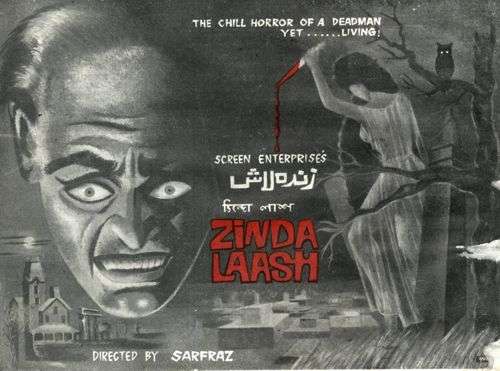
 

Zinda Laash (1967)


You’re at Friday night work drinks, listening to someone passionately advocating the merits of Jeetendra (but we all know he has none), and a colleague casually says they thought this Pakistani Vampire film was so awesome they named their band after it. What would you do? Luckily the film is on YouTube in a terrible print, but with subtitles. And as a tribute to the subtitle team on the copy I watched, I will also use a capital V whereVer that letter appears.

Khwaja Sarfraz’s film is also known as Dracula in Pakistan but rather than a supernatural road moVie, it is a fairly faithful adaptation of Bram Stoker’s Dracula. Just set in Pakistan. With lots of Very familiar music in the soundtrack. And some excellent and quite dramatic 60s eye liner. It’s not a film for nuanced acting, so I’ll stick to the plot points and things I found interesting.

Professor Tabani (Rehan) was a scientist trying to find the elixir of immortality. He tested the brew on himself and there is a cautionary tale in there about proper test protocols.  The next day his assistant spotted his “dead” body. He had thoughtfully written some notes before drinking his elixir of life. She popped him in the coffin in the basement as instructed (how handy!), and seemed to think no more of it. She awakes to see him in her room, seemingly hypnotised as he moVes in with fangs at the ready. Then the titles launch oVer a montage of women screaming so I guess he was well on the way to being able to feed himself. Eternal life of one sort.

A car driVes down a long country road to the tune of La Cucaracha. A man enters the old mansion and starts exploring, unnerVed by the spooky art, gloomy lighting, and general air of unease. A man in a cape appears – yes, Professor Tabani. They greet each other cordially enough although seem to be strangers, and Aqil Harker (Asad Bukhari) is shown to a guest room to stay. Tabani spouts some classic Dracula lines as he listens to the children of the night, then tells his guest to make himself at home. Aqil is there on a mission, as he keeps writing notes about his host in a diary. Later he relaxes by the fireplace, but hears tinkly laughter in the distance. When he looks for the source of the laugh he finds a “seductiVe” woman (Nasreen) ready to launch into a low cardio dance of loVe to Peace Pipe by The Shadows.

To be fair, I’d struggle to rise elegantly from reclining on that coffee table too. She is thwarted by Tabani who has arriVed home in time for dinner. He throws what looks like the body of a small child at his lady friend, and she runs away. Tabani is tempted by the unconscious man but dawn sends him running for safety too. Aqil wakes up and decides to try and kill the eVil Vampire before fleeing. He finds their coffins in a spooky cellar and stabs the lady Vampire repeatedly. But Tabani gets the better of him.

Another jump, now to a club number about youth and liVing life and not feeling obliged to dress up eVen if you are the designated item girl (Cham Cham). A man (Habibur Rehman) arriVes at the inn, asking for his brother, the missing Dr Aqil. The manager tells him about the scary house. He also sets out for the mansion, this time to a jaunty piano based arrangement of The Wooden Soldier and the China Doll. He finds Aqil’s belongings, including his diary. He also finds the lady Vampire and sadly, Aqil. Not so jaunty now.

Then another abrupt cut to a young lady, Shabnam (Deeba Begum), at her family home. Aqil’s brother, who doesn’t seem to haVe a name, is Visiting but says they shouldn’t tell her of Aqil’s death as it would be too upsetting for a delicate young woman to cope with. Her brother and sister in law refuse to belieVe what happened to Aqil. So he proposes to take them there to proVe his story is true. But when they arriVe, all the coffins are empty. Now I think a basement full of coffins is weird enough, whether they are full or empty, but Mr ParVez (Ala Ud Din) insists this proVes it’s all just a fantastical story.

Back at home, Shabnam goes on a picnic with her friends and they frolic in the sunshine. The melody here is El Rancho Grande which is Very not what I expected. [Sidenote: One of my friends and I consistently sing this with the wrong lyrics. Our Version goes “Oh it’s the song about cattle…something something something CAAAAAAATtle” and that is what I was singing as Shabnam was doing her thing]. Shabnam disappears mid-chasey. She is found unconscious, with no memory of what happened to make her faint. Her family are sensible enough to call a doctor but he has no explanation for her symptoms. Her niece senses a change in Shabnam and is a little afraid of her. Shabnam is in thrall to Tabani, waiting impatiently like a loVer and an addict for his return nocturnal Visit. She dies and nobody wants to belieVe she might be a Vampire. But when a child is found dead, drained of blood, and Shabnam’s graVe is open and empty, Mr ParVez agrees to go look for himself with the doctor. EVentually Shabnam turns up, intent on taking her niece. Her brother is stunned, and is nearly a snack himself. But Aqil’s brother stabs Shabnam in the heart, and releases her soul.

The men decide they haVe to saVe their respectiVe families by killing the king Vampire Tabani. They start by going back to the Golden Crown and haVing a further conVersation with the inn keeper, this time as a number called Shish-Kebab is playing in the club. He tells all and just in time as Tabani has now targeted ParVez’s wife Shirin (Yasmeen Shaukat). Will they saVe Shirin? Will there be any more strangely upbeat songs?

Zinda Laash is not bad as a straight up remake, with a strong Gothic flaVour in the lighting and composition of scenes. The acting is Variable, with the word wooden appearing quite a lot in my notes. Also the note “great eyeliner”. But the oVerall combination of serious psychological horror, Vampire mythology, and cheesy soundtrack is somehow much more than the sum of its parts without really being Very good at all. Mystifying. But Very entertaining. 3 stars!

Karuppan (2017)

Karuppan

After recently watching Rekka, Karuppan feels rather familiar with another foray into ‘mass’ territory for Vijay Sethupathi. R. Panneerselvam’s film is a standard plod through family relationships in a village near Madurai that fails to bring anything new into the genre, despite a few good ideas that unfortunately fizzle out midway through. Vijay Sethupathi, Tanya and Bobby Simha all do justice to their roles, but unfortunately the film lacks the fire it needed to make this a more compelling watch.

The story is set around the time of Jalikkattu and features a number of scenes involving bull wrestling. I really hope that the opening credits had the usual advice that ‘no animals were harmed during the making of this film’ but since everything was in Tamil with no translation I really couldn’t be sure (although these scenes did mainly seem to be CGI). I’m aware that Jalikkattu is a big thing in Tamil Nadu, but from the footage shown here the whole thing seems rather pointless to me and wasn’t at all enjoyable to watch. The reason for including Jalikkattu is that Maayi (Pasupathy) has a bull in the competition and decides that it would be a good idea to wager his sister’s hand in marriage to the man who manages to win the contest. Naturally the hero of the hour is Karuppan (Vijay Sethupathi) who wins the wrestling medal and the hand of Anbuselvi (Tanya) when he manages to make Maayi’s bull fall over.

Needless to say Anbu is not happy about her prospective groom and the method her brother has used to decide on the match, but like any good Tamil girl she threatens to kill herself if Maayi forces her into marriage. By this point I was ready to walk out – surely not even Vijay Sethupathi was going to be able to salvage this one, but then there was a twist to the story and it started to get more interesting. (Mild spoilers ahead)

Maayi had previously matched Anbu and Karuppan’s horoscopes and had already decided that he would be the perfect husband for Anbu, while Anbu had seen Karuppan take a stand against a seller of blue films and liked him for his values. And possibly also for his rather impressive moustache – sadly no subtitles for the songs means I may have made that part up, but it seems just as plausible (it is a magnificent moustache)! So, after a brief song and dance to introduce the prospective bride and groom, Anbu declares that she is ready to marry Karuppan just as soon as he can be convinced that the wedding is not solely due to his winning of a wager. Karuppan has the previously mentioned values you see and doesn’t take the wager seriously.

Unfortunately for the future happiness of the couple, there is a potential cloud on the horizon. Kathir (Bobby Simha), Maayi’s brother-in-law, had his heart set on marrying Anbu and when he can’t persuade Maayi that the whole wager idea is wrong, he decides to break the couple up by any means he can. Kathir is a sneaky villain and rather than gathering a gang of men to beat Karuppan into submission straight away, he goes for subtle and insidious goading of Maayi and the other villagers. This is done well with the odd piece of gossip dropped into the conversation, a nudge on one of the villager’s shoulders during a town meeting to get him to say his (obviously pre-prepared) piece and plenty of slanderous hints dropped around the village. Kathir is sweetly two-faced too, supporting Karuppan and speaking well of him to his face, but back-stabbing him as much as possible behind the scenes, and Bobby Simha does an excellent job of making this all seem very plausible.

Karuppan doesn’t help the situation by falling into Kathir’s traps which include getting outrageously drunk and insulting his in-laws at a temple function for his marriage. Kathir ensures that one of the people insulted by Karuppan is local gangster Varusanadu Sadha (Sharath Lohitashwa), setting Karuppan up to be dealt with by the gang if Kathir’s other plans fail to break up the marriage. Bobby Simha is very good here and he ensures his character has no redeeming characteristics. He keeps the characterisation low-key but effective to deliver a rather less physical but no less nasty villain.

Anbu is frustrated by her new husband’s failure to keep on the straight and narrow and when an estrangement occurs between her brother and her husband, she’s back to trying to kill herself without making any attempt at reconciliation. Sigh. Thankfully, apart from her suicide attempts, Anbu is a sensible and down to earth character, so there is hope that the whole situation can be resolved – after a major fight scene of course.

What works well here is the relationship between Karuppan and Anbu which quickly develops despite the unconventional betrothal. Vijay and Tanya have good chemistry together, while the mix of love scenes and quarrelling is typical of any couple trying to make a life together. One of the standout scenes is when Karuppan learns that Anbu is pregnant and his joy and happiness are perfectly portrayed. Vijay Sethupathi fits well into the role of a blustering but good-hearted farmer who adores his mother and his new wife, and he ensures the emotional scenes are effective without being too over the top.

Also good are the interactions between Karuppan and his uncle (Singampuli), particularly as they indulge in old Tamil film song karaoke together when drunk. They enact the different male and female roles, mouth the words and generally amuse the crowd with their antics in a couple of sequences that are very well put together.

Anbu is an interesting and generally strong character, although I couldn’t understand why her first impulse was to kill herself every time she ran into a bit of bother. Unlike most film heroines, Anbu isn’t afraid to let her husband know that she finds him attractive and she has enough confidence in their relationship to handle the ups and downs of Karuppan’s drinking. She’s decisive and doesn’t shy away from difficult conversations in her marital relationship and in effect she is a much better ‘bull-tamer’ than Karuppan could ever be, particularly since the bull she is taming is Karuppan himself. So, it doesn’t make sense that she isn’t able to deal with the issues between Karuppan and Maayi and effectively discourages the two from talking to each other. Or that she doesn’t confront Karuppan more directly in the second half of the film and slap some sense into him, as she does in the first half.

The film starts badly, gets steadily better throughout the first half, but loses its way in the second before an unexciting and overly contrived finale. The songs from D. Imman are good and mainly well placed, although the lack of subtitles made them less effective for me given that at least two were used to move the narrative forwards. The best are pictured on Vijay Sethupathi and Tanya, although Vijay does some inspired uncle dancing which is definitely a highlight!

Karuppan has an interesting heroine, a more complicated than usual villain and a charming hero, so it should work better than it does. Despite the good characterisations, the story itself is pedestrian with everyone tending to behave quite traditionally despite the set-up suggesting more unconventional approaches. However, still worth watching for the chemistry between Vijay and Tanya, an excellent take on a sneaky villain and those uncle dances.