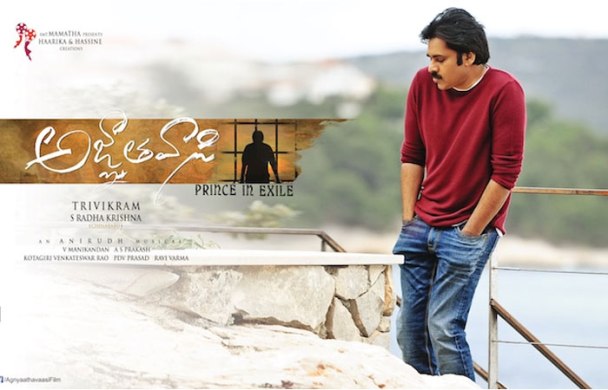
Agnyaathavaasi

PosterDespite a stellar cast and a rocking soundtrack, Agynyaathavaasi turns out to be a rather disappointing watch. Trivikram takes an interesting plot and fills it chock full of masala, to the extent that the story of a son’s mission to exact vengeance on his father’s killers becomes lost in the morass of comedy, romance and OTT fight scenes. Nothing too much out of the ordinary for a Telugu film then you might think, but there is simply too much of everything here, making Agynyaathavaasi a clutter of confusion instead of the thrilling action film it could have been.

The story (when you can catch a glimpse of it) follows the exploits of Balasubramanyam (aka Abhishikth Bhargav aka Bala aka Abhi!) as he attempts to discover who murdered his father and brother, and then follow through to exact revenge. Abhi (Pawan Kalyan) has been raised in secrecy, allowing his younger half-brother to assume the role of heir to his father Vinda’s pharmaceutical empire. Vinda (Boman Irani) is notorious for always having a Plan B, hence the existence of Abhi who is rather oddly is his step-mother’s favourite, despite his exiled status. Indrani (Khushboo) suspects that her son and husband did not die accidental deaths, and calls Abhi back to discover which of the two aspirants to Vinda’s AB Company were responsible for the deed. Varma (Rao Ramesh) and Sharma (Murali Sharma) have been part of the company since its formation, but neither seem up to the challenge of running a multi-national organisation. Both actors do their best, but with poorly etched characters played mainly for comedic value it’s hard to see why they could ever be in the running as suspects for the murders.

Adding more unnecessary slapstick is Raghu Babu as a particularly sleazy office manager whose antics aren’t even remotely funny and who is completely superfluous to the plot. As too are Abhi’s side-kicks, who start off by offering technical support for his scheme to infiltrate the company but end up as a kind of enthusiastic group of cheer-leaders on the sidelines instead. These include Tanikella Bharani as Abhi’s uncle, Srinivasa Reddy and Abhishek Maharshi who all gasp, cringe and applaud at appropriate moments but otherwise have little to do as Abhi smoothly goes about his investigation without encountering too many problems.

Naturally there has to be a romance – so why not two? Anu Emmanuel and Keerthy Suresh are the two women Abhi uses as part of his schemes to discover the truth, which goes some way to explaining the mainly superficial nature of the relationships. Still it does mean a couple of songs and a quick jaunt to Bulgaria in between Abhi’s many fight scenes. Outside of this though, the two actors only appear as light relief in between beautifully staged but surprisingly dull fight scenes.

Normally the saving grace in these films is the performances of the actors, but almost everyone here, including Pawan Kalyan overact like crazy. The Powerstar doesn’t seem engaged with the screenplay at all for most of the film – not surprisingly perhaps, since I found it difficult to engage with too! There’s a bizarre scene where an insightful police officer (Sampath Raj) starts to postulate on who Abhi could possibly be, and manages to reconstruct the entire sequence of events without any clues, witnesses or evidence to back up his theory! It’s another example of needless frills that hinder the story. A flashback sequence would have worked much better and there was no need to add such speculation, particularly when the police officer involved reported that both Vinda and his son died by accident despite Vinda being shot in the head before he plunged to his death from a high-rise.

On the plus side, the music from Anirudh Ravichandler is excellent and suits both the action and romantic sections of the screenplay. The songs are also catchy, but for the most part don’t sit well within the screenplay and most seem to be added rather randomly. Despite this, the choreography is excellent and the locations beautifully filmed. Indeed, overall the cinematography is excellent with some stunning shots of Varanasi near the start of the film. I also liked the attempt to link Abhi’s story to parts of the Mahabharata and the story of Krishna, which helped to fill in some of the back-story that was glossed over rather quickly.

There are some terrific performances too in the midst of all the general scenery chewing. Boman Irani is good and Khushboo is notable in her return to the big screen as Abhi’s step-mother and Vinda’s widow. She’s compelling in her scenes and her understated performance stands out in the midst of all the other melodrama. Also very good is Aadhi Pinisetty as the main protagonist, Seetharam. He gets the balance between arrogant brat and murdering megalomaniac just right while looking dapper and well-groomed at every occasion. Despite only a short amount of screentime Aadhi is impressive and makes an excellent villain once again.

Agynyaathavaasi is simply too uneven to be anything other than a one-time watch. Although there is a good basic storyline, the added fluff and masala buries it too deep and not even the excellent production values can keep it from sinking under all that weight. Although Khushboo and Aadhi along with Anirudh’s music and V. Manikandan’s cinematography are worth seeing, this is really a film best for fans only.
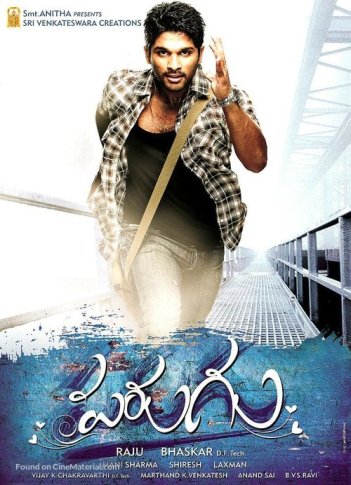
Parugu

Parugu

Parugu is Bhaskar’s 2008 follow-up to his hit film Bommarillu and despite a rather hit and miss screenplay the movie ended up being a hit, was remade in various other languages and scored a number of awards. While the story might be nothing new and labours under every single film cliché imaginable (love at first sight, stalking = love etc), both Prakash Raj and Allu Arjun are excellent and work well together to make Parugu more watchable than the synopsis suggests. Plus the film starts with Bunny on roller skates – how can you not appreciate that!

I particularly love this song since when I can tear my eyes away from Bunny dancing, I recognise many of the locations. Plus, as always Bunny’s energy and enthusiasm is incredibly infectious, making for a great start to the film.

Sadly, the film doesn’t manage to keep the energy for long as the story moves to a village where local big-wig Neelakanta (Prakash Raj) is presiding over the marriage of his daughter Subbalakshmi (Poonam Bajwa). However, not all goes to plan as Subbalakshmi elopes with local villager Erra Babu which sets her father and his army of goons off on a rampage to find her. As part of their investigations, they pick up all of Erra Babu’s friends from the village and soon widen their search to include Sharma (Saptagiri) from Kakinada, Seenu (Chitram Srinu) in Nellore and Krishna (Allu Arjun) in Hyderabad.

Neelakanta and his brother Chinnabbayi (Subbaraju) keep the men in a shed while they continue the search for Subbalakshmi and Erra Babu, although this seems likely to backfire when Krishna engineers an escape. However, just before making it to the train and freedom, Krishna is brought up short by a girl he sees in the morning mist. He falls instantly in love and resolves not to leave the area until he discovers her identity. Naturally, the girl Krishna has fallen for is the youngest daughter of Neelakanta and she’s already having a number of issues due to the fall-out from her sister’s elopement. Through a window in the shed she pleads with Krishna and the rest of the detainees to reveal her sister’s whereabouts but instead she gets caught in a blackmail trap and agrees to help Krishna find the girl of his dreams. While the audience know that Meena (Sheela Kaur) is the girl he has fallen in love with, neither Krishna nor Meena realise until well into the film that she is the one Krishna is trying to find.

There is some comedy in the first half as Krishna hatches up various schemes to search for the girl in the woods, while Sunil and Srinavasa Reddy add some slapstick to further lighten the mood. Prakash Raj does his usual ranting as an enraged father but Bhaskar aims to show him as a more sympathetic figure and changes tack with the character in the second half.

As Krishna discovers that the girl he loves is Neelakanta’s daughter, Neelakanta finds out that it is Krishna who has helped Subbalakshmi vanish and he tortures him to find out where his daughter is hiding. This results in everyone – Neelakanta, Chinabbayi, all the various thugs, Krishna and Erra Babu’s other friends and Meena, haring off to Hyderabad on the trail of the missing couple. Krishna takes advantage of every opportunity to speak to Meera and starts to manipulate her feelings for her father to his advantage.

Meena doesn’t instantly fall for Krishna, but rather tries to keep her distance and is generally upset and confused by his attentions. Sheela plays Meena as nervous and afraid, although also somewhat gullible and impressionable. Bhaskar has given Meena and her father the same nervous mannerisms which does help link the two as a family, but Neelakanta’s decision to bring Meena with him still stands out as odd. There is some attempt to have meaningful conversations between the two, but these don’t work as well as they could, and the relationship between Meena and her father seems cold and impersonal as a result.

Meena genuinely seems scared and anxious for most of the film – afraid of her father and his goons, afraid of the men in the shed, particularly Krishna and afraid of falling in love. There is a rather bizarre song where Krishna is dressed as a mad priest and chases Meena though the canyons of Petra before she wakes up to realise it’s a dream. Bhaskar isn’t as clear here as he could have been that stalking is not the best way to a girl’s heart and for all his cheer and mostly sunny personality at times Krishna’s behaviour is quite predatory, making Meena’s fear seem quite rational. There really isn’t any good reason for Krishna to continue his pursuit of such a reluctant object of his affections, and very little basis for Meena to change her opinion. So Meena’s gradual acceptance of Krishna doesn’t seem realistic and even when she does start to warm to him, the romance generally has little sparkage. It’s left to Arjun and Prakash Raj to provide the chemistry that keeps the film going, and they both do that magnificently!

As Neelakanta gets more and more desperate, Krishna starts to realise that it’s his love for Subbalakshmi and his concern for her welfare that is driving her father to such desperate lengths. Although the change from concern about reputation and prestige to concern about his daughter is uneven and not always convincing, the change in Neelakanta does make the point that families suffer in a myriad of ways after a runaway marriage and provides the families point of view rather than the usual romantic picture of an elopement. Strangely, neither Krishna nor Meena use this opportunity to approach Neelakanta about their own love affair, which draws out the already overly long screenplay even further without adding any more substance to the plot. However it’s the interactions between Krishna and Neelakanta that make the film interesting, and both actors work well together to make their conversations and gradual acceptance of each other the best part of the film.

This is a Bunny movie and so there are plenty of opportunities for him to shake a leg and demonstrate his dancing skills. This is one of the best although the location and costumes could have been better.

Prakash Raj is in his element here. He has plenty of material to work with – all the rage and fury when his daughter runs away, slow burning anger at the men who are hiding her whereabouts and plenty of angst and remorse as he starts to fear that he as lost her forever. However, Bunny matches him step for step and together the two bring credibility to their roles that the romance and hunt for Subbalakshmi fail to deliver. It may be predictable with a total lack of empathy for any of the female roles (for which I’ve deducted a star), but Parugu does have strong performances from Bunny and Prakash Raj and the idea that elopement isn’t the solution to every problem is at least a little different from the norm. Parugu is worth watching for Bunny (of course!), Prakash Raj and the excellent dance sequences, but best to consider as an action/drama rather than as a romance to avoid disappointment. 3 ½ stars.

Nana – A Tale of Us

poster.jpg

A few weeks ago I was in Edinburgh for my brother’s Graduation, which he had very thoughtfully timed to coincide with the Edinburgh Festival of Indian Films and Documentaries. I was able to catch the closing night film, Nana – A Tale of Us, an excellent Nagamese film from director Tiakumzuk Aier, who deservedly won the Best Director Award at the festival. Despite having just got married a few weeks earlier, Tia was in Edinburgh and took part in a Q and A session which revealed just how difficult it is to make a film in Nagaland. It made the film even more impressive when he described filming conditions (only 2 cameras!) and revealed that for many of the actors and crew it was their first time working in the industry. Nana is also the first ever film from Nagaland to make it to an International Film Festival and hopefully its success in Edinburgh will ensure it travels to more Film Festivals and gets a larger audience. Do see it if you get the chance, it really is well worth watching for a completely different view of India and glimpses of a region that few ever get to visit.

The film is set in a village located in the mountainous area of Mokokchung in Nagaland where work is scarce and resources are limited. Malay (Zhokhoi Chuzho) struggles to find work to support his wife Ano (Mengu Suokhrie) and their young daughter Nana (Watipongla Kichu) since their small farm doesn’t provide enough food to keep them going. For Malay, as for many of the men in the area, the only option seems to be to work for the local Minister as a thug-for-hire during election time, where wide-spread corruption means there is plenty of opportunity for those who don’t mind getting their hands dirty. Malay works with his friend Thiru (Ariensa Longchar) as an enforcer for the Minister and threatens everyone with violence unless they vote for the party he works for.

Malay’s home life provides a stark contrast to the violence of the corrupt political process. The film opens with a violent confrontation at night that’s immediately followed by a domestic scene as Ano grinds spices in the kitchen where two cats sit close to her cooking fire. At home there is peace and quiet, light and laughter, and above all an abiding sense of love and happiness despite the family struggling to make ends meet. Nana is the light of Ano and Malay’s life and a source of both joy and hope as they struggle with the harsh realities of life in their small village. But away from the family, Malay is a very different man indeed and he represents of the conflict within Nagamese society. On one hand there is the old political structure, corrupt, violent and desperate to hold on to power, while on the other there is the new drive for equitable, clean and fair elections which appears to be gathering pace, even in the rural areas where Malay and his family live.

Although the film tells the story of Nana and her family, it is set against the backdrop of the political elections and shows a different perspective to the thugs and rowdies who usually get short shrift in Indian cinema. However, the corruption and abuse of power is just one facet of the film. The domestic scenes are also very well written and evolve slowly, contrasting perfectly with the more intense and fast action sequences when Malay is acting as an enforcer. Nana is a real charmer too, and she makes a wonderful centre to the film as well as stealing the limelight every time she is on screen. Watipongla Kichu is a real find, and she is incredibly natural and honest in her portrayal of Nana. The other actors are all very good too, and it’s hard to believe that many of them are novices to the screen, but the beauty of the film lies in how well Tia brings the different threads together and makes such a complete whole that is completely satisfying. It’s a stunning film visually too. The scenery is spectacular, and many of the aerial shots are beautifully done to showcase the mountainous terrain and precarious farmland of Nagaland. MT Akum Aier’s cinematography is excellent thoughout while the music from Akok Imsong, Atsa Lang Roths and Along Longchar also complements the action well.

Nana is a message film, but it doesn’t feel preachy, and the point that everyone deserves to have their voice heard as part of the political process is well made without overpowering the rest of the film. I found this a fascinating look at the Indian political process and also appreciated the chance to see day-to-day life in a tribal village in rural Nagaland. With such a winning combination, Nana- A Tale of Us is a very impressive film and has definitely whetted my appetite for watching more from this fairly unknown region of Northern India. I highly recommend watching this film if you do see it playing at a festival near you and hopefully this is the start of a wider exposure for Nagamese films outside of India. 5 stars.